
Collaborative Efforts Enable Auto Business to Stay Afloat
Driving Forces
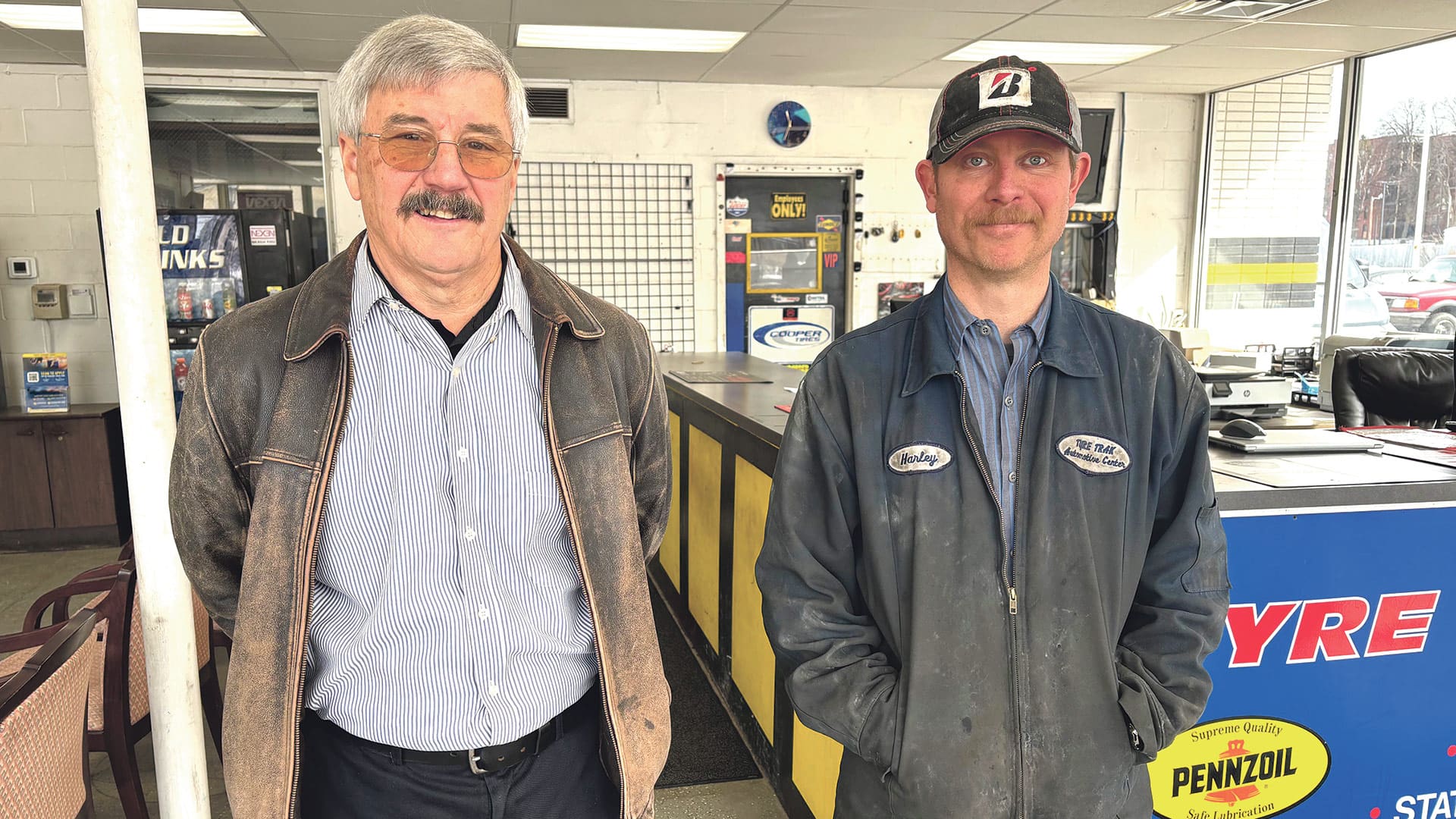
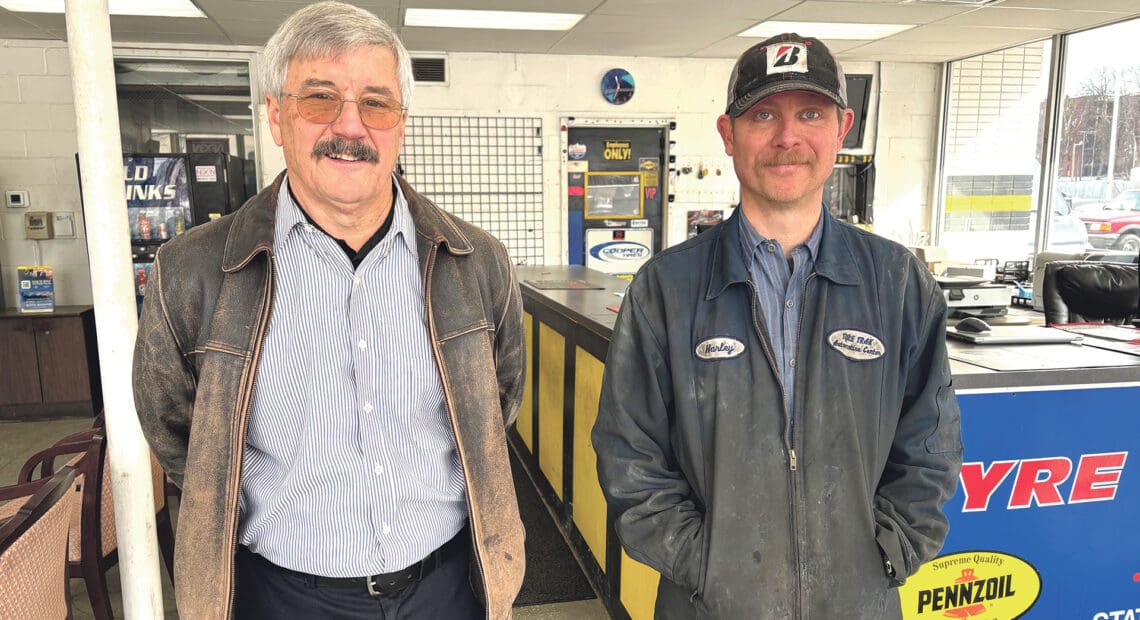
Peter Kearing, left, and Harley Andrew in the new home of Springfield Tyre Track and Auto Service.
Harley Andrew remembers feeling down, emotionally, and then up, as in way up.
He remembers packing up some things one day and then, seemingly just a few days later, unpacking them and returning them to their place in a Springfield auto shop where he had worked for decades.
“We went from being dead to being in business again,” he said. “There was a huge swing of emotions.”
This swing is perhaps the best way to sum up a unique … let’s call it real estate transaction, one that has allowed a thriving business to remain in an area of the city that has long been neglected.
That business, Springfield Tire and Auto Service Inc., was located on a parcel that was acquired by a team looking to build a new Springfield courthouse in the area just south of the North End, a parcel dominated by the former, long-vacant W.F. Young factory. And with that acquisition, Peter Kearing, owner of the auto service center — and several others across the region — was told to vacate.
“We went from being dead to being in business again. There was a huge swing of emotions.”
He was doing just that when Jeb Balise, leader of the development team that acquired the property, presented Kearing with an opportunity to move one block north, into the Tyre Track Automotive Center, a staple in the region that was started by Andrew’s father, Tim, and that was closing amid the land grab accompanying the state’s pursuit of a new site for a courthouse.
Kearing seized on that opportunity, and Andrew seized on an opportunity to join Kearing in a business that brings the names of both ventures together — Springfield Tyre Track and Auto Service.
In that way, two businesses have been melded into one, where there might not have been any, and Balise has demonstrated his commitment to that area, north and east of downtown, whether his group’s plan is ultimately chosen for the courthouse or not.
“Pete was prepared to close down his business, but then, it was like, ‘why?’ And we said, ‘OK, let’s do it,’” said Balise, comparing, on some levels, his work in this section of downtown with initiatives in the South End, where Balise has a huge presence that includes several dealerships, a collision center, a laundromat, and, most recently, the purchase and gifting of a building near Square One’s new facility on William Street for agency operations.
“We don’t know what the plans are long-term for that property,” he said of 175 State St., noting that the courthouse project may change the trajectory of that site. “But the bottom line is, whatever it is, my outlook is no different from what we did in the South End. Pete will not be deserted by me; we’ll figure this out, and that’s what’s so fulfilling to me — figuring out the win-wins.”
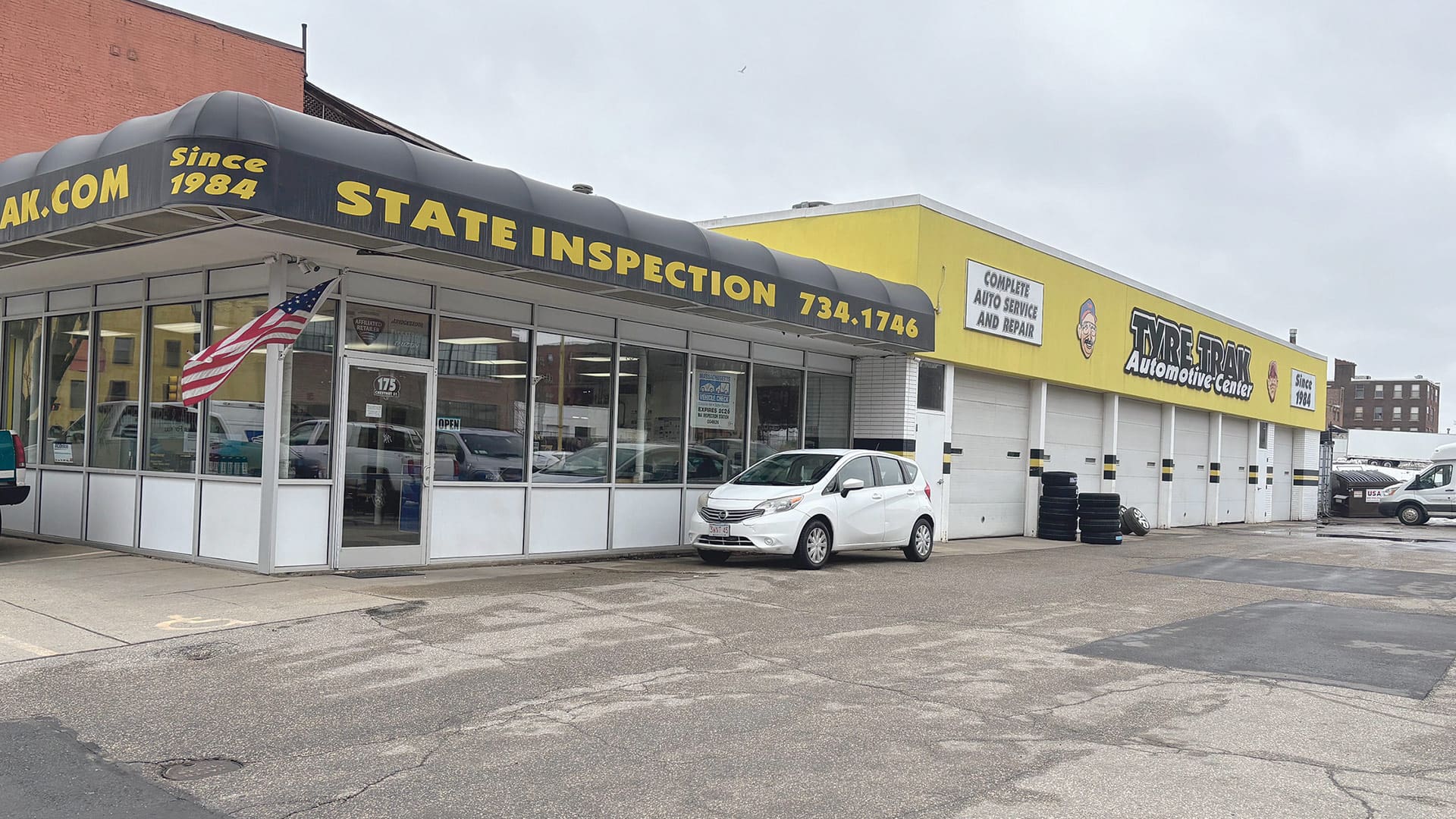
The two ventures have essentially merged and are now doing business at 175 Dwight St.
As for Kearing, he’s thinking short-term and also potentially long-term, noting that, in the larger scheme of things, the 175 Chestnut St. location isn’t an ideal site for an auto services business given recent changes in the business community — there are fewer people working downtown — and the higher cost of doing business in an urban setting, “but being in the footprint of where Jeb Balise wants to build a courthouse is ideal.”
For this issue and its focus on commercial real estate, BusinessWest looks at how this deal came together, and what it means for that section of downtown moving forward.
Court of Opinion
Our story begins with Kearing, a serial entrepreneur who, as noted earlier, would eventually own several auto service centers across the region.
He started as an employee of the business at 435 Dwight St. in 1980, and would eventually run it as a company-owned Gooodyear store, thus beginning a 45-year relationship with that neighborhood and the eclectic clientele of the store, which included area residents, but also large numbers of downtown employees taking advantage of its location for tuneups, tire rotations, inspections, and more.
“The neighborhood was pretty rough back then, and there were a lot more people working downtown,” he recalled. “And in 1980, on a hot day, all you could smell was W.F. Young; Absorbine Jr. permeated the senses of the city in 90 degrees.”
Eventually, he would go on to acquire the property from his landlord and continue that relationship with the neighborhood.
And it was a desire to continue serving that area that led him to discussions with Balise about strategies for keeping that business in operation — not at 435 Dwight St., but at 175 Chestnut St., home to Tyre Track, which, like the Goodyear facility, had become an institution of sorts in that region, serving generations of area residents and downtown workers.
Balise acquired that property last fall for $1 million amid widespread speculation — and property acquisition — regarding sites for a new courthouse.
“Having the number of people who would work in a courthouse right next door to you would be awesome. Jeb’s vision is to build a whole neighborhood there, but he doesn’t want to get too far ahead of himself.”
His original intention was to convert 175 Chestnut St. into a central service center for advanced driver assistance systems, said Kearing, adding that such a facility was planned to centralize the service on such equipment for the Balise company’s many dealerships across the 413.
But his discussions with Kearing concerning that section of downtown, and his desire to continue serving a customer base he had built up over nearly a half-century, prompted Balise to change those plans.
“I went to him and said, ‘you’re taking 10 bays away here [Goodyear] and six bays away there [Tyre Track] … that’s a big hit on the neighborhood,” Kearing recalled. “He thought about it and said, ‘you’re right,’ and he gave me a very sweet deal to operate out of this place.
“People still shop for automotive service in a tighter radius than they do for tires or shop for cars; they want to operate within a few miles of where they live or work,” he went on, adding that, while there are fewer people working five days a week, or at all, downtown, there is still a solid customer base for the ‘new’ business.
Meanwhile, auto service centers are, by and large, being priced out of urban centers like downtown Springfield, he continued, adding that the taxes and rents are both high, and, often, the numbers don’t pencil out.
They do in this case, Kearing said, adding that the picture will be exponentially brighter if the Balise site is chosen for the new courthouse.
“Having the number of people who would work in a courthouse right next door to you would be awesome. Jeb’s vision is to build a whole neighborhood there, but he doesn’t want to get too far ahead of himself.”
Bottom Line
Balise concurred with that assessment, noting that, while Kearing may not be looking past his 18-month lease on the property, he is.
“I think there is a great opportunity long-term — we just have to figure it out,” Balise said, adding that that this section of the city wants and needs this business to continue operating in that neighborhood.
The parties involved have figured out how to transform two ventures into one and keep it in business, so they’re confident they can figure on the next chapter in this intriguing story as well.