
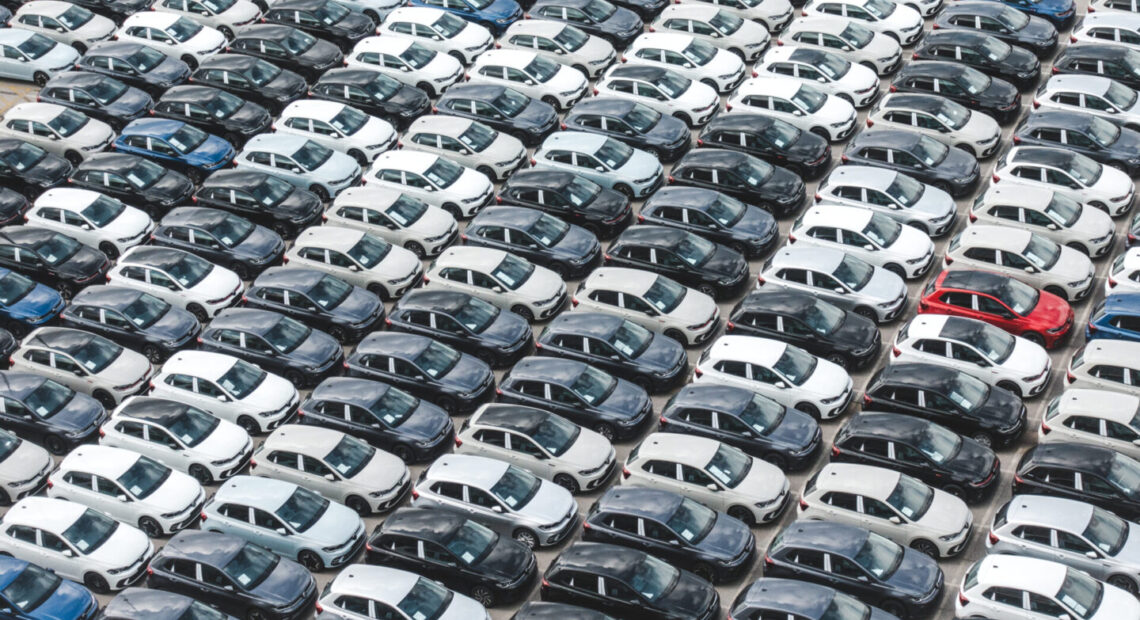
Car Makers, Dealers Motivated to Shake Off Slow Start to 2026
Gearing Up
It’s called a ‘20 Group.’
It’s a collection of 20 non-competing auto dealers with similar business models who gather several times a year to exchange ideas and share best practices.
Carla Cozenzi, president of the Hadley-based TommyCar Auto Group, attended a session recently in Cedar Rapids, Idaho. And before that, she was at another conference, ASOTU CON (Automotive State of the Union) in Baltimore. There were packed agendas in both cases, she said, with discussions on everything from AI and how the industry is using it and can use it (see related story on page 15) to the somewhat sluggish start to the year for the auto industry — and the reasons behind it.
And those reasons are many, including everything from a brutal winter in many regions, including New England, to global tensions and economic uncertainty; from the high cost of new cars, trucks, and SUVs — the average sticker price is now close to $50,000 — to soaring gas prices.
Collectively, these factors contributed to a flat start, a few percentage points off last year’s pace and what was projected for this year, and some minor shifts within the market — from a slight uptick in car sales (although SUVs still reign supreme), in a nod to those soaring gas prices, to continued high demand for used cars, a response to those high prices for new models.

Carla Cosenzi says that, unlike the industry as a whole, TommyCar Auto Group is off to a solid start in 2026.
“Overall, automotive is down slightly from last year,” said Cosenzi, adding quickly that her group is bucking that trend, up a few points. “And there are many reasons why … the overall state of the economy, what’s happening in the world, all the talk on tariffs, the cost of vehicles, and the rising cost of living.”
As the calendar turns to June and the sales season heads into high gear, pun intended, dealers are optimistic that this year will get back on track, especially as manufacturers respond with attractive incentives designed to move hesitant consumers to action.
Ford is leading the way with the return of employee pricing for May and June, a strategy deployed by various manufacturers during other slow times. It’s an attractive incentive that is already moving the needle, said Mike Marcotte, president of Marcotte Ford in Holyoke.
“It’s a substantial saving for the customer,” he said, adding that the program covers almost the full lineup, including trucks and transits, and was designed as a way to mark the nation’s 250th birthday. “The message has been out there, and it’s created more online traffic and more traffic in the dealership, especially with the nicer weather.”
Meanwhile, other makers are introducing less splashy, but still effective incentives, including attractive lease deals and lower financing rates, designed to make monthly payments more palatable.
“Overall, automotive is down slightly from last year. And there are many reasons why … the overall state of the economy, what’s happening in the world, all the talk on tariffs, the cost of vehicles, and the rising cost of living.”
“Employee pricing is basically the best you can get,” said Alex Balise, director of Corporate Strategy for the Balise Auto Group, which includes a few Ford dealerships. “Most of the manufacturers, though, are taking a targeted approach, offering different incentives based on supply and demand. They’re not just tossing incentives out there … they’re being strategic and going model by model, which makes sense.
“Depending on the model, it might be a low APR or a special rebate,” she went on. “They’re doing what they can do address the needs of each model — which makes it a good time for customers.”
Overall, summer is generally a good time for the industry, between the better weather, longer sales days, people with time on their hands, and sometimes the need to ramp up and get into something new for the family road trip vacation. And with initiatives in place to drive sales and leases, those we spoke with are projecting that the industry’s overall performance should move into a higher gear over the coming months.
“We’re optimistic, based on the last few months, that things will stay steady through the summer,” said Balise, adding that, after a solid May, the company is on roughly the same pace it was last year.
Driving Forces
As he talked about the start to the year and the outlook for the second half of 2026, Marcotte said it seems that dealers are always

Mike Marcotte says Ford’s employee pricing offer during the months
of May and June has already had an impact on sales.
coping with different challenges, many of which are unforeseen.
In his case, it’s slightly lower inventories for the popular Ford F-150 pickup due to supply issues impacting manufacturing. But the dealership is plowing through, he said, moving that model at a faster pace than last year. Meanwhile, SUV sales have remained strong, despite the higher gas prices, and commercial sales have followed up a strong end to 2025 with continued solid performance.
Still, affordability is an issue with many consumers, he said, adding, as others did, that employee pricing and other incentives are designed to make the lift somewhat lighter for consumers.
And in the meantime, cost-conscious consumers are looking at more affordable options, including everything from longer financing terms — up to 84 months, in some cases, to keep the monthly payment affordable — to traditional cars, which have certainly taken a back seat in recent years to the SUV.
“They’re selling now because of the cost and gas prices,” Balise said. “There aren’t many [models] left, but the ones that are there are selling. If you’re looking for a lower price point for a new vehicle, that’s where to find them.”
This explains improved sales of Camrys and Corollas at the group’s Toyota stores, she said, adding that it’s the same with other makers still offering cars.
But SUV sales remain solid, especially those vehicles at the smaller end of the spectrum, those that get better gas mileage, those with hybrid options, and those that offer a lower price point, said Cosenzi, adding that, across the board, car makers are motivated to help consumers get into new vehicles.
“They’re not just tossing incentives out there … they’re being strategic and going model by model, which makes sense.”
“Manufacturers are stepping up in a really big way to make vehicles more affordable for customers again,” she told BusinessWest. “We’re seeing some of the most aggressive incentives and APR offers that we’ve seen in a very long time.
“That’s helped us bridge that gap,” she added, noting that the incentives have helped push consumers over the top when it comes to a decision on buying or leasing something new. “We’ve reached out to customers and put them in better positions and educated them on how we can help them.”
Elaborating, she said these incentives, many of which have been in place for months, have helped TommyCar move ahead of the sales pace set last year at most of its dealerships.
“Our Hyundai store is up more than 8%, our Nissan store is flat, Genesis is up 16%, and our Volkswagen store is up just slightly,” she noted. “So, overall, as a group, we’re up.”
She attributes this to several factors, but especially close customer connections — letting them know about new incentives, vehicles they might be interested in, programs to purchase their used vehicle, and more — that create opportunities.
And there remains strong interest in used cars, especially with the high prices of new vehicles, Cosenzi said, adding that dealerships are looking for cars in what would be called the ‘affordable’ category — quality used cars in the $25,000 to $30,000 range that provide an attractive option to new — and target people with them, to both secure more inventory in that column and put their previous owners into something new.
“That’s a customer life cycle that has made us so successful in the first half of 2026,” she said, adding that such strategies address consumers in both categories.
Fueling Speculation
Meanwhile, the higher gas prices are prompting some movement, or at least some looking, in directions other than the mid-size and large SUVs that have captured the attention of the buying public.
“Gas prices are impacting some of what people are looking for,” Balise said, adding that the surge at the pump has prompted immediate discussion about changes in buying habits, if not immediate action.
“It’s on their mind,” she went on. “People are thinking, ‘am I going to get a truck or an SUV? What’s the gas mileage on it? Is there a hybrid option?’”
Cosenzi agreed. “Our customers have become accustomed to and feel safe having an SUV,” she told BusinessWest. “However, as soon as we see that gas threshold increase to what we’re seeing now, we do see interest in EVs and compact and subcompact SUVs, and we see demand for those vehicles increase.”
Balise said there is a still a strong market for electric vehicles, despite an end to federal incentives, with manufacturers offering their own rebates to move inventory off the lots.
“The people who want EVs are still coming in for EVs,” she noted. “The people who were on the fence … with rebates not being as strong, they’re more likely to consider hybrids. People are still buying EVs, and it helps that the OEMs are offering their own rebates to offset the loss of federal incentives.”
Overall, inventories of vehicles in nearly every category are much improved over just a few years ago, although they’re still not back to pre-COVID levels in many cases, area dealers report.
“It’s a healthier supply-to-demand ratio,” Balise said, adding that, for the most part, there aren’t too many cars on the lot, just a good number that mostly eliminates the need for customers to wait for what they want or settle for less.
“There are multiple options available — it’s not getting on the list for the next one that comes in, necessarily,” she noted, adding that this is yet another reason why it’s a good time to be buying or leasing.
Looking ahead, those we spoke with said the second half of the year — and especially Q4 — is typically better than the first half, and they are expecting that trend to continue in 2026, as various driving forces collaborate to prompt consumers to act.
It should make for some interesting talking points at the next 20 Group meeting.