
Learning Process

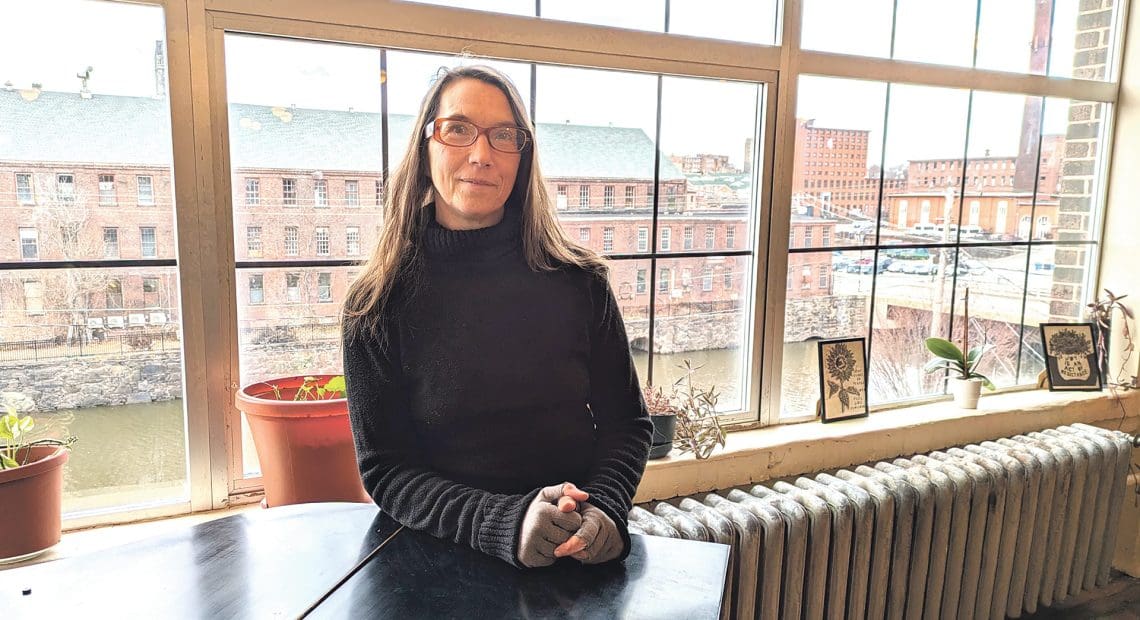
Executive Director Catherine Gobron
July 18 to Sept. 3. That’s 47 days. Not quite seven weeks.
That’s how much time LightHouse Holyoke, a non-traditional middle and high school celebrating its 10th year in operation, had between its purchase of the Gateway City Arts property on Race Street and the start of classes for the 2024-25 year.
Executive Director Catherine Gobron called that whirlwind of activity “amazing” as she gave BusinessWest a tour of the facility during the recent holiday break and reflected on the past few months; the school’s impact on students, many of whom thrive there more than they would a traditional public school; and how the new location opens up more educational programs — and potential career paths — for these teens.
Take, for example, a production academy integrated into two existing performance spaces, a small theater and a larger concert venue that has hosted national touring acts through the years; together, they will allow for training and internship opportunities for young people to learn the many skills associated with the entertainment and event-production industry, from lighting and sound to artist management and beyond. Isaac Eddy, a 12-year veteran of the Blue Man Group, is developing the theater program.
“Our expenses have gone up quite a bit, and we’re still really figuring out how that’s all going to work. But we’ve got a vision to grow it, and I can see it.”
“Different aspects of the work appeal to different students — some kids are really lit up by how to use the lighting board, and other kids are interested in learning sound. Some of these young people, we predict, will go on to careers in the music industry or in the production industry,” Gobron explained, adding that LightHouse is also developing partnerships with the Fine Arts Center at UMass Amherst and a local theatrical stage union, “so hopefully we can feed young people into the union. which would be a win-win.”
Similarly, the complex’s café will reopen to the public, with integrated courses and internships in all aspects of running a café, leading to paid work and future career opportunities. The complex also hosts an 8,000-square-foot community maker space, complete with a woodshop and ceramic studio, hosting classes and workspaces both for LightHouse students and accessible to the wider community.
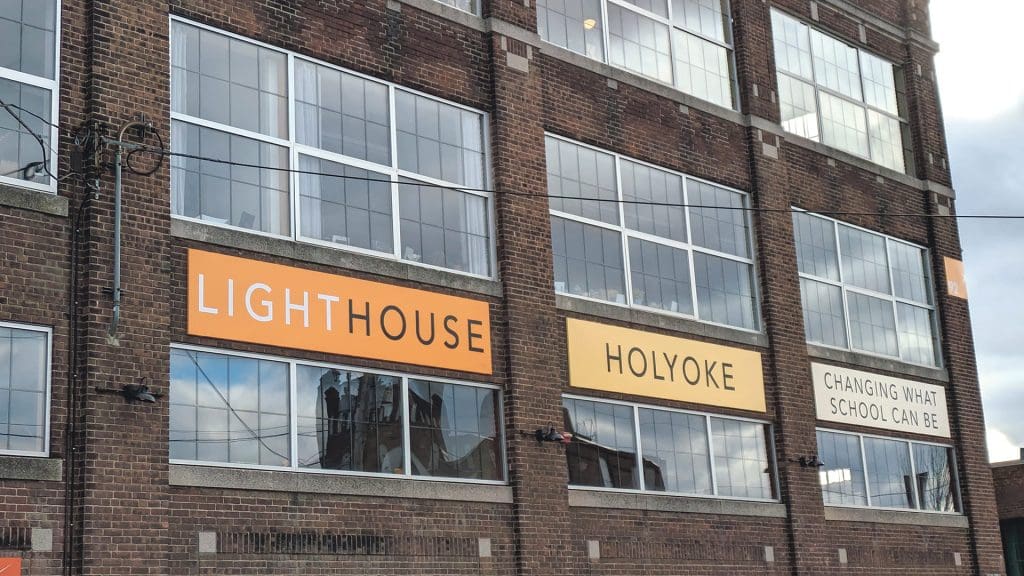
LightHouse bought the Gateway City Arts complex on July 18 and started classes on Sept. 3 — a whirlwind of activity Catherine Gobron calls “amazing.”
Gobron is also excited that the just-opened kitchen space will serve both the café and student lunches, meaning the school no longer has to rely on one of the large, national lunch suppliers.
“It’s really exciting that we’re going to have a real lunch program, and we’re going to eat together in the dining room every day,” she said. “Many of our young people are not arriving with strong skills or awareness or resources around healthy food choices, and that can have dire consequences.”
So there’s plenty of excitement at LightHouse — which currently enrolls about 75 students and could double that with more buildout — but also a sense of challenge.
Through what Gobron has called “a steady stream of community-supported miracles,” the school raised $1.5 million toward purchasing and renovating the 40,000-square-foot property, and borrowed another $2.5 million in partnership with Greenfield Northampton Cooperative Bank and MassDevelopment. Collaborators on the project included HAI Architects, Houle Builders, and Sarah Reid at Small Victories Interior Design. A second capital campaign aims to raise another $1.5 million; that’s on top of an annual budget that relies partly on tuition, but with philanthropy covering about one-third of the total.
“A lot of times, if a young person isn’t thriving in school, we think that’s the young person’s fault: they have ADHD, they have whatever. We often don’t talk about it as a systemic problem. Here, we don’t try to blame the kid.”
But the school’s mission is important, Gobron said, which is why these efforts are not just challenging, but gratifying. “Our expenses have gone up quite a bit, and we’re still really figuring out how that’s all going to work. But we’ve got a vision to grow it, and I can see it.”
Impactful Journey
Gobron’s life experiences led her to a non-traditional path in the world of education, and eventually to the launch of LightHouse in 2015 along with then-business partner Josiah Litant.
“High school was terrible for me, and I ended up leaving during my senior year. I was a strong student academically, but it was a really negative space for me in other ways,” she recalled. She started her career in alternative education at a Montessori school and eventually made her way to North Star Self-Directed Learning for Teens in Sunderland, where she stayed for 12 years.
While program director there, she dreamed of opening a school in Holyoke focused on self-directed learning that would serve a more urban, diverse population. She and Litant, an education consultant who had worked at Hampshire College, found a home in the Sustainability Technology Entrepreneurship Art Media (STEAM) building on Race Street, which, like Gateway City Arts, was owned by Vitek Kruta and Lori Divine.
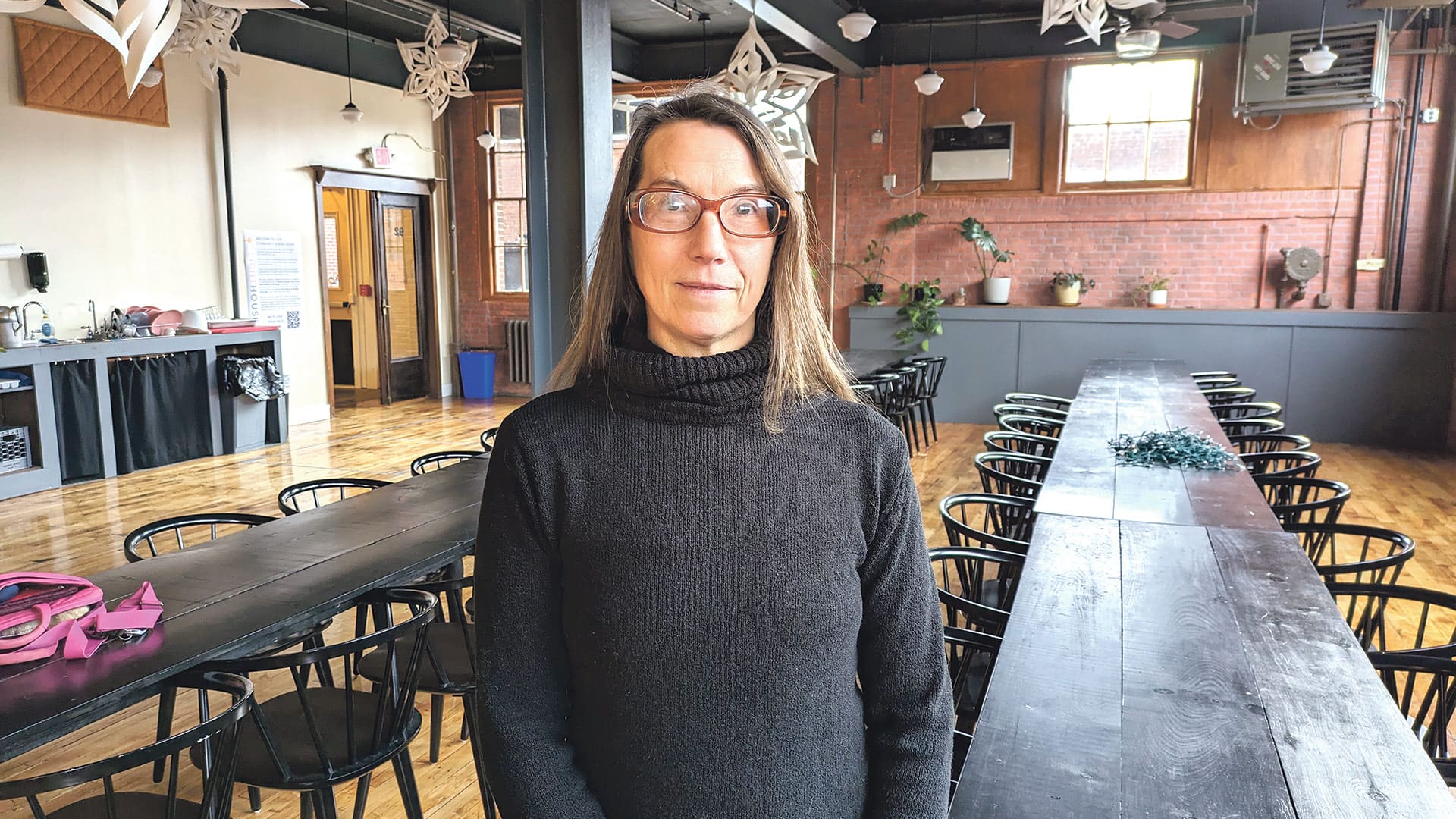
Catherine Gobron stands in the school’s dining area, where students will benefit from a just-launched in-house kitchen.
Gobron said the model isn’t as radical as it sounds, as college students typically craft their own degree track within certain parameters. “But we typically don’t recognize the value in that when it’s teenagers.”
Especially those, like herself, who don’t feel they fit into a traditional high-school structure.
“A lot of times, if a young person isn’t thriving in school, we think that’s the young person’s fault: they have ADHD, they have whatever. We often don’t talk about it as a systemic problem. Here, we don’t try to blame the kid,” she said, noting that LightHouse’s opening coincided with Holyoke Public Schools entering state receivership (which was lifted in 2024). “There were so many kids struggling, we couldn’t blame them anymore. The system had to ask, ‘OK, what are we doing?’ And there was a window of openness to other possibilities that might have otherwise seemed kind of crazy.”
LightHouse actually has partnerships with the public school systems in Holyoke and other communities, taking in a handful of students who are technically enrolled with the city, but do their learning at LightHouse.
“The students they’re sending us are typically disengaged,” Gobron said. “A lot of times, we hear from parents, ‘I used to have a curious and excited kid, and somewhere, that went away.’ And now we have this child who’s kind of shut down and disengaged, thinks that they hate learning, or have any number of challenges.”
“A lot of times, we hear from parents, ‘I used to have a curious and excited kid, and somewhere, that went away.’ And now we have this child who’s kind of shut down and disengaged, thinks that they hate learning, or have any number of challenges.”
Each student has an advisor that becomes their point person, she explained, both for the student and their family — with ‘family’ being an adaptable term. “Some students have two parents; some students have four parents; some students have a grandmother, a social worker, and a probation officer. And the advisor creates a team of support around the student.”
Students are encouraged to pursue their own interests — sometimes with immediate, real-world applications, as with the burgeoning event-production and culinary programs — but still need to achieve the same graduation requirements, in terms of credits and testing, as public-school students in Massachusetts.
“We believe that young people can and should be supported to be the leaders of their own lives,” the school’s website states. “We know that learning is most successful when it is actively chosen and personally meaningful. For us, the purpose of education is to collaborate with young people to cultivate the skills, confidence, and vision to co-create the future.”
Success Stories
Incoming students tend to fall into one of several categories, Gobron noted: young people with passions and interests who seek more time, support, and flexibility to pursue them; those who come from negative schooling experiences, may learn differently, or be anxious, depressed, bullied, ostracized, struggling academically, or managing other challenges; and teens somewhere in the middle, who are open to the possibility of being inspired, but aren’t there yet.
One senior student recently wrote an essay on her experiences, and how she always liked learning, but faced a combination of bullying in middle school and struggles at home.
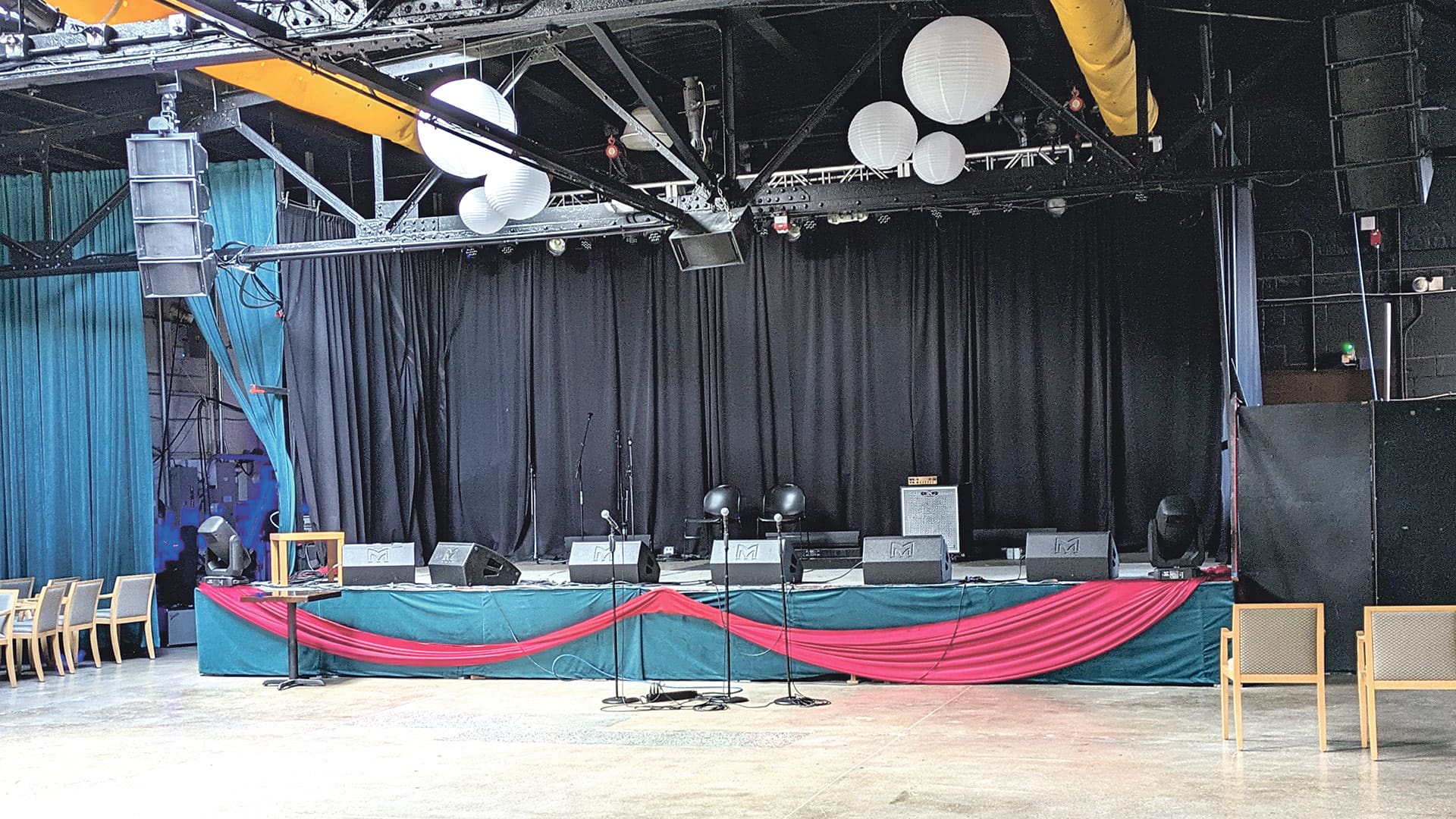
The stage where many locals have enjoyed concerts over the years will now showcase a blend of student training and community events.
“I went from being an honor-roll student to skipping classes and not learning a single thing,” she wrote. “I was so consumed by depression and anxiety that I felt suffocated. I understand that it was a tough time for everyone when COVID hit, and school became completely different, but I’d never done worse in my life in terms of grades. COVID was my excuse. I hid all the parts of me that I deemed weak behind my face mask. I was at an all-time low, and I accepted it.”
Until she found LightHouse — very near her home, actually — and began to reclaim her passion for learning.
“LightHouse was very supportive of me. I’d been used to being treated in a lot of ways. I knew when I was being brushed off, neglected, or taken advantage of, so this feeling was very odd.”
“LightHouse was very supportive of me. I’d been used to being treated in a lot of ways. I knew when I was being brushed off, neglected, or taken advantage of, so this feeling was very odd,” she wrote, later adding, “I’ve been doing all kinds of things, and I’ve honestly never been more motivated in my life. I went from declaring that I was going to drop out to applying for college. That’s what LightHouse has done for me. I couldn’t be more grateful.”
Kruta and Divine are also grateful they were able to sell the Gateway City Arts complex — long a hive of arts, learning, performance, and community connection — to an equally mission-driven entity, and one with which they were already familiar.
“We couldn’t be happier to have LightHouse move into the space that we spent 12 years creating,” Divine said last year. “Our mission was always to create a space for education, community, creativity, and inspiration. This was carried out in our classes, meetings, theater, food, music, and gatherings. LightHouse Holyoke shares so many of our values. When it was clear that Gateway City Arts had to close, our hope was to find a buyer that would continue our vision merged with their own. We applaud what LightHouse brings to the lives of its students and their families and friends. We created a space for learning and sharing — LightHouse will continue that.”