
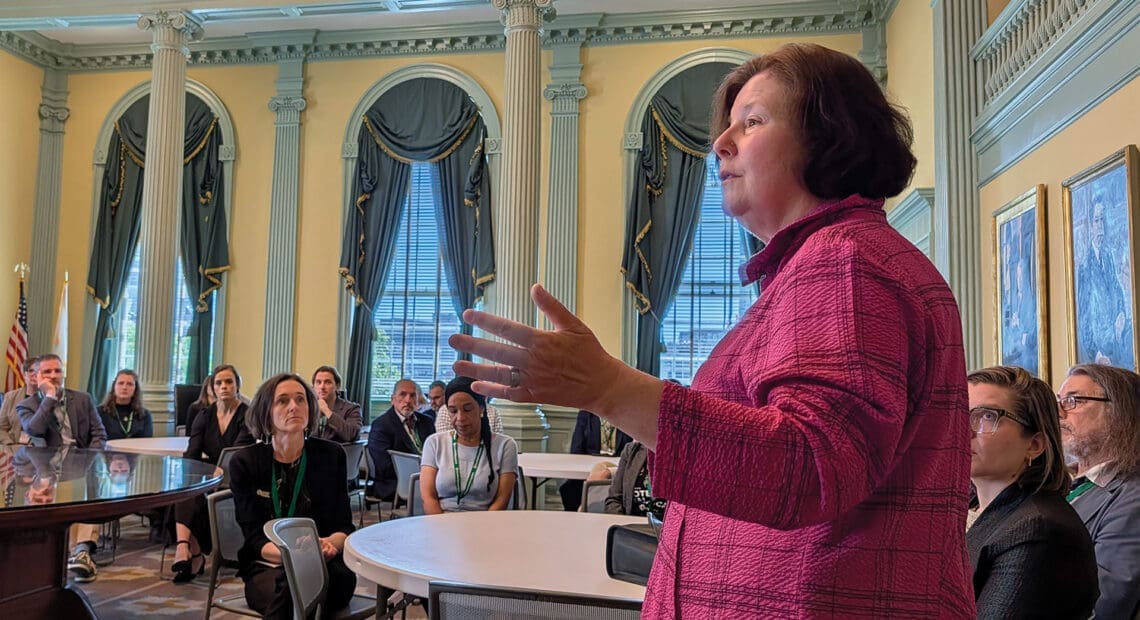
Back on the Bus
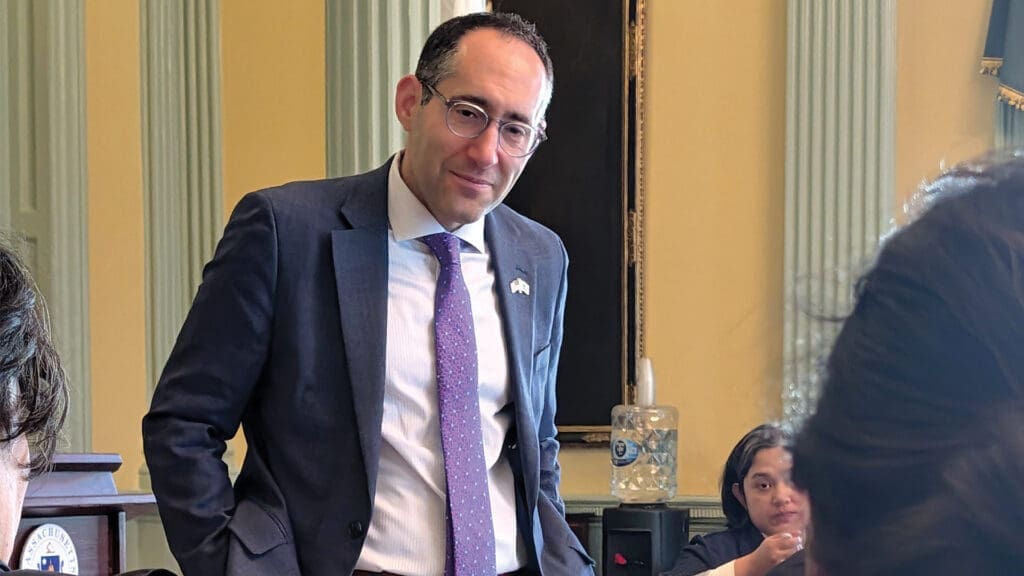
Secretary Eric Paley says Massachusetts will not thrive as it should unless all regions of the Commonwealth, from the 413 to the 617, are doing well.
Eric Paley calls it “one of my biggest concerns — maybe my biggest concern that keeps me up at night.”
Specifically, “we have a very robust economy, but there’s tremendous economic dispersion. So how do we handle the fact that we have this K-shaped economy throughout Massachusetts?” said Paley, Massachusetts’ secretary of Economic Development, using a term for an uneven growth environment where different segments of the economy or population experience different outcomes.
And in grappling with that question, he knows he’s accountable to not only dozens of sectors, but 351 municipalities.
“The people on the ground, they’re the ones who know what matters in their community,” he went on. “So we can’t sit here thinking we know all the answers to solving the problems in those communities.”
In the spirit of mutual education, communication, and collaboration, Greenfield Savings Bank hosted its third annual bus tour to the State House on June 3, bringing about 50 regional business and nonprofit leaders to Boston to speak with legislators and department and committee chairs about economic development, discuss issues ranging from housing to clean energy to transportation, and hear about the legislative process that moves the needle on all of it.
The importance of those “people on the ground” is why Paley conducts roundtables in local communities, he said, in addition to the one that came to him on this occasion, as he gave the main address over lunch in a Senate meeting room.
“It’s why I want to talk to the bankers — because the bankers tend to invest in and support businesses that, on paper, make no sense whatsoever. It’s because they know the people, and they’re willing to commit and support those people,” he said. “Sometimes people have misconceptions about bankers, but community banks step up in ways that are extraordinary, and I see it all the time.”
Tara Brewster, Greenfield Savings Bank’s vice president of Business Development and director of Philanthropy, said the annual trip keeps building on previous successes.
“We have new people on the bus each year, making meaningful connections with each other in the 413 as we travel to the 617, to the State House, to make meaningful connections with the elected officials there,” she told BusinessWest on the ride home. “We heard from so many amazing elected officials, senators, representatives, chairs, all listening about how they want to help all of Massachusetts strengthen each other.
“We have amazing elected officials, and we know they do the hard work every day, every week, every month, to really champion us in Western Massachusetts, and it was time for us to start doing some of our own heavy lifting for them,” Brewster added, describing how the annual trip came together two years ago. “So this has been such an incredible trip, so meaningful, toward collaboration, friendship making, bridge building, and convening of Western Mass. constituents, both nonprofit and for-profit.”
“The people on the ground, they’re the ones who know what matters in their community. So we can’t sit here thinking we know all the answers to solving the problems in those communities.”
Paley pointed to a February report by JPMorgan Chase & Co. that surveyed business owners nationwide. Among Massachusetts employers, positivity about their own business was well above the national average, but when asked about the overall economy, they were much less positive than the national average.
“When I go to groups of business owners, a lot of people start shaking their heads and tell me, ‘I worry about it.’ But why are we so negative?” he went on. “I think some of it is, we are disproportionately affected by a lot of the federal policies today. The whole country’s felt a lot of volatility around this. You think of something like tariffs — we are a very heavy exporter of money. That doesn’t explain it alone, but that is key.
“Then there’s immigration — we are a top five immigration state. I didn’t know that we have more immigration per capita in Massachusetts than Texas does; that kind of blew me away. But as we’ve seen ICE crackdowns and all this anti-immigration stuff, the sense that people can’t get visas, borders are closed … I think that’s created a lot of anxiety. Some people are not coming to work because they’re so worried about raids.
“And then the biggest one that I think is unique to us is our research economy, which is a huge engine of our overall economy,” Paley explained. “We get more federal research dollars than any state in the country, and there’s been a huge cutback in federal research. So a lot of the universities are really struggling. UMass is a really great example of that, but every major research institution has massive uncertainty.”
Developing Matters
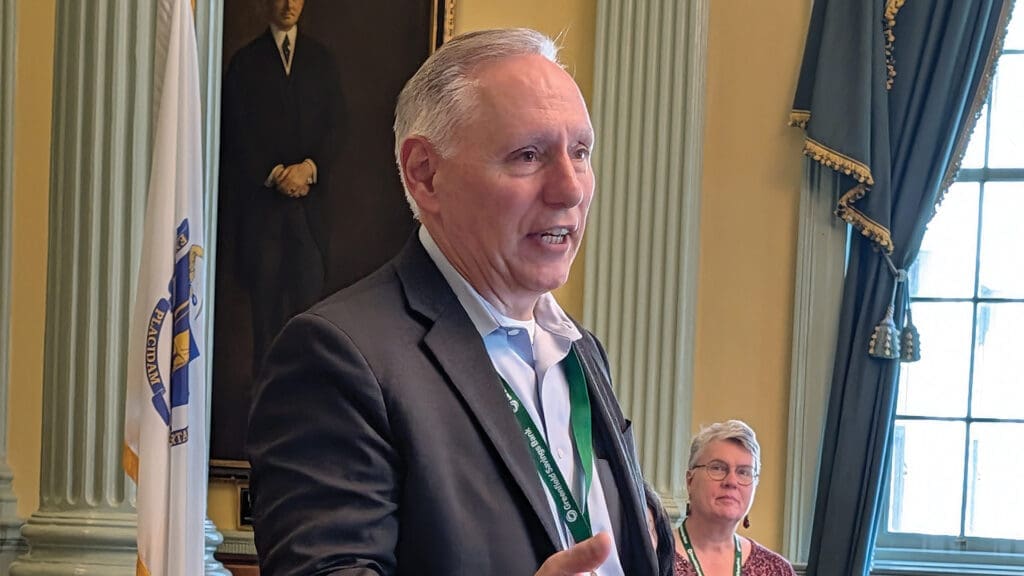
Peter Albero says legislators have responded positively to Greenfield Savings Bank’s annual bus trip.
In another session on June 3, Carole Fiola, House chair of the Joint Committee on Economic Development and Emerging Technologies, addressed a number of topics, including the importance of both collaboration and persistence when it comes to getting things done — because no projects move as quickly as their proponents would like.
As one example, she cited South Coast Rail, a $1 billion project connecting Boston and Southeastern Mass. that was 30 years in the planning and development before coming to fruition last year.
“With 351 cities and towns, everyone wants the attention of the administration; everybody wants that infrastructure grant, right?” Fiola said. “So you’ve got to be focused, you’ve got to have a good message, you’ve got to have an idea of how the funding streams can work, and the private-public partnerships that would be needed.”
Especially over a 30-year timeline, she added, “administrations change. Some of the community leaders change. And as elected officials move and change, priorities can change — but if your priority hasn’t changed, you’ve got to stay with it. I can’t repeat that enough because, finally, after 30 years, it happened.”
Later, Secretary of Housing and Livable Communities Juana Mattias said constituents need to bring similar energy and persistence to matters like housing stock, which has become a serious concern for communities of all sizes across Western Mass.
“Showing up to those town meetings, showing up to those discussions and saying, ‘this is where the business community stands,’ ‘this is where the nonprofit community stands,’ writing op-eds in your local newspaper, all makes a huge difference,” Mattias noted. “We have to organize and understand, who are the partners at the state level, at the regional level? What are the stories we’re bringing to the forefront?
“It’s reminding [state and local leaders], ‘you had an opportunity to raise your family. Your kids had an opportunity to leverage the public school system. What we want to do is make sure that other people have the same opportunity.’ It has huge implications on our ability to remain the state that we are. So organizing and leveraging your voices is critically important.”
Others who spoke to the bus trip participants included state Sens. Jo Comerford and Barry Finegold and state Rep. Lindsay Sabadosa, and the day concluded with a tour of the State House. But the liveliest conversation emerged from Paley’s talk, which touched on everything from Community One Stop for Growth, a streamlined application portal and collaborative review process of grant programs, to a recent effort to lower LLC filing fees for small businesses.
“We are a global competitor. People don’t even realize, if Massachusetts were a country, we would be the fourth most productive economy in the world by GDP per capita,” he said. “So we want to attract global investment. We get a lot of it anyway, but we need to really build business development programs and activities around this.”
He also touted a ‘one Massachusetts’ model, noting that “people in Greater Boston need to understand Boston ultimately will not thrive if the whole state is not thriving. The rest of the state also needs to appreciate it; if the region inside 128 or 495 is not thriving, the rest of the state won’t. We are one state.”
“We have amazing elected officials, and we know they do the hard work every day, every week, every month, to really champion us in Western Massachusetts, and it was time for us to start doing some of our own heavy lifting for them.”
Paley also discussed continuing conversations around affordability in Massachusetts and how that affects outmigration, and, as a related matter, the importance of talent capture amid all that movement. “We think we have the best talent engine in the world,” he noted, “but a disproportionate percentage of it leaves.”
Keeping the Conversation Alive
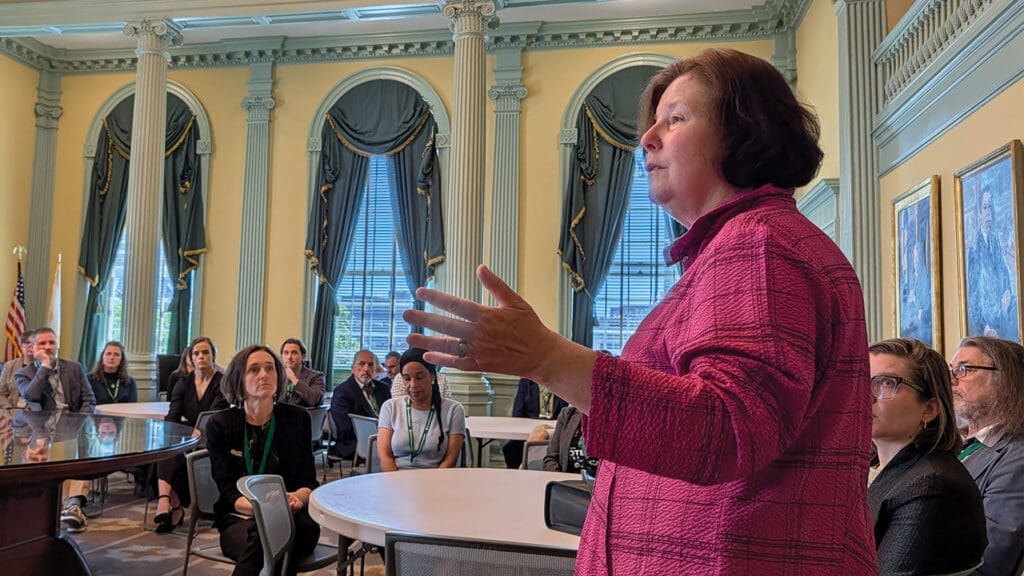
State Sen. Jo Comerford addresses a gathering of about 50 Western Mass. business and nonprofit leaders at the State House.
A former venture capitalist who shifted to a career in public service, Paley said he’s constantly learning new things every day, and those emphases on learning, communication, and listening framed a busy day in Boston for the Western Mass. contingent.
“I’m learning stuff I’ve never seen before, being challenged in ways I’ve never been before,” he said. “I literally feel like the limit might be my capacity to learn as fast as I want to learn. I remember feeling like that in college, wishing there was a way to inject the knowledge. I feel that way again. It’s been incredibly exciting and challenging.”
Peter Albero, president and CEO of Greenfield Savings Bank, said he hoped all the guests on the bus trip embraced the same spirit of learning and collaboration.
“We think it’s important for Greenfield Savings Bank to bring all these organizations in Western Massachusetts to Boston to voice their concerns and hear directly from the legislators about what they’re doing to address those concerns,” he told BusinessWest.
“We think, as a community bank, one of our main missions is to bring the community together, and we think this is one of the best ways we can do it,” he added. “This is our third year in a row doing this, and when we talk to legislators, they think it’s important for us to continue to do this year in and year out. So we’ll be back next year and in the years to come.”