
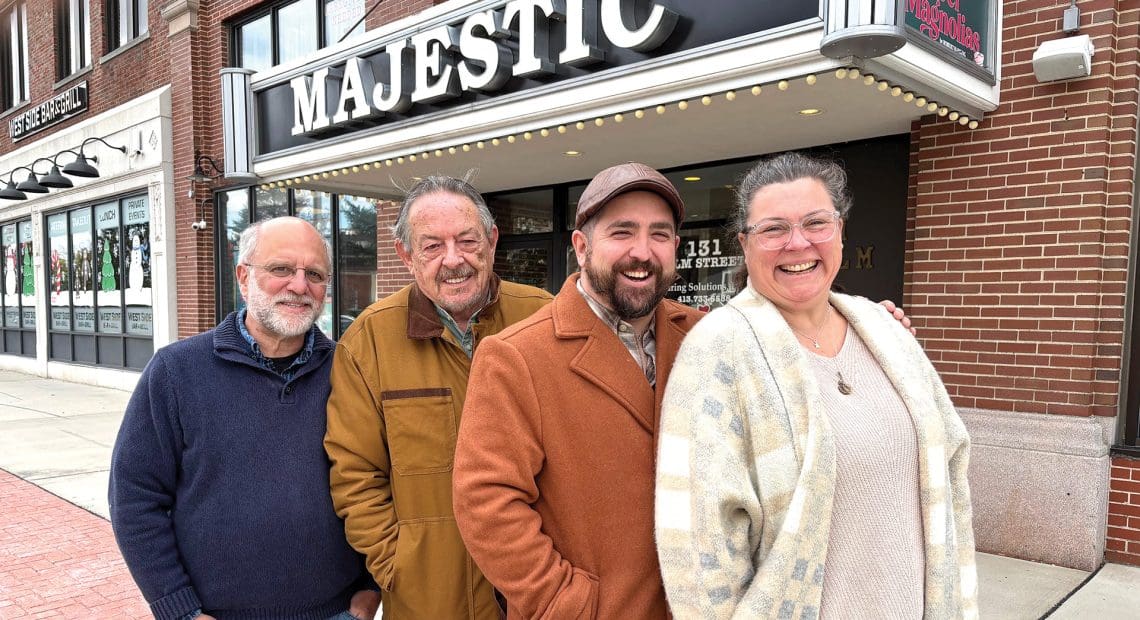
A Long-running Success Story

From left, Todd Kadis, Danny Eaton, Sue Dziura, and Terry LaCasse.
It’s been more than 30 years now, but Danny Eaton can still vividly remember the first time he saw what was left of the historic Majestic Theater on Elm Street in West Springfield.
There wasn’t much to look at, he recalled, adding that the back area of the old moviehouse, where Mickey Rooney once played Puck in A Midsummer Night’s Dream and the Three Stooges had performed, had become a crumbling dumping ground of sorts.
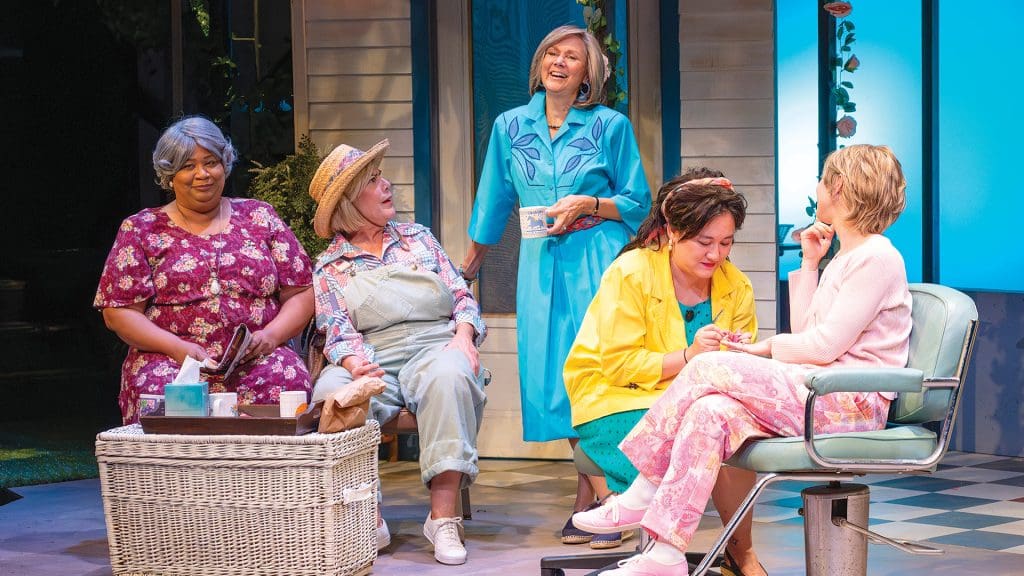
A scene from Steel Magnolias, currently playing at the Majestic.
“There were carpet remnants, some broken office furniture, and all kinds of junk like that,” said Eaton, the actor, director, playwright, and entrepreneur who had been leading a group of like-minded individuals in the creation of a nonprofit professional theater company called the Theater Project, which was, at that time, looking for a permanent home.
A board member who taught business at Westfield State University arranged for two interns to work with the fledging troupe, and their primary assignment was to find a venue. They were steered to the old theater, built in 1928, by the town’s assessor. And after being let in by the owner of a delicatessen that occupied the front part of the theater, they could see what they had to work with.
That same board member thought he was crazy to do anything but look at the Majestic, but Eaton said simply, “I loved it … it spoke to me.”
Nearly three decades after the theater opened with a showing of The Buddy Holly Story, it’s still talking — to Eaton and to the tens of thousands of people who visit it every year.
“We’ve always seen new people, first-timers, coming to the theater, based upon the offerings.”
And the Majestic — not the building, necessarily, but the institution — has become part of the fabric of the region, said Eaton and others we spoke with.
“People have grown up with us,” he noted, referring to both the audiences for the shows, which span generations now, and some of the performers as well.
Like Ben Ashley, who played Buddy Holly in the The Buddy Holly Story and has reprised that role a few times, while performing in several other shows at the theater as well, including its upcoming Home for the Holidays. And Robbie Simpson, who grew up attending shows at the theater, then started performing in some, and has gone on to star on ABC’s General Hospital and Hulu’s The Path. He returns to West Springfield for shows at the Majestic, such as 2023’s The Glass Menagerie.
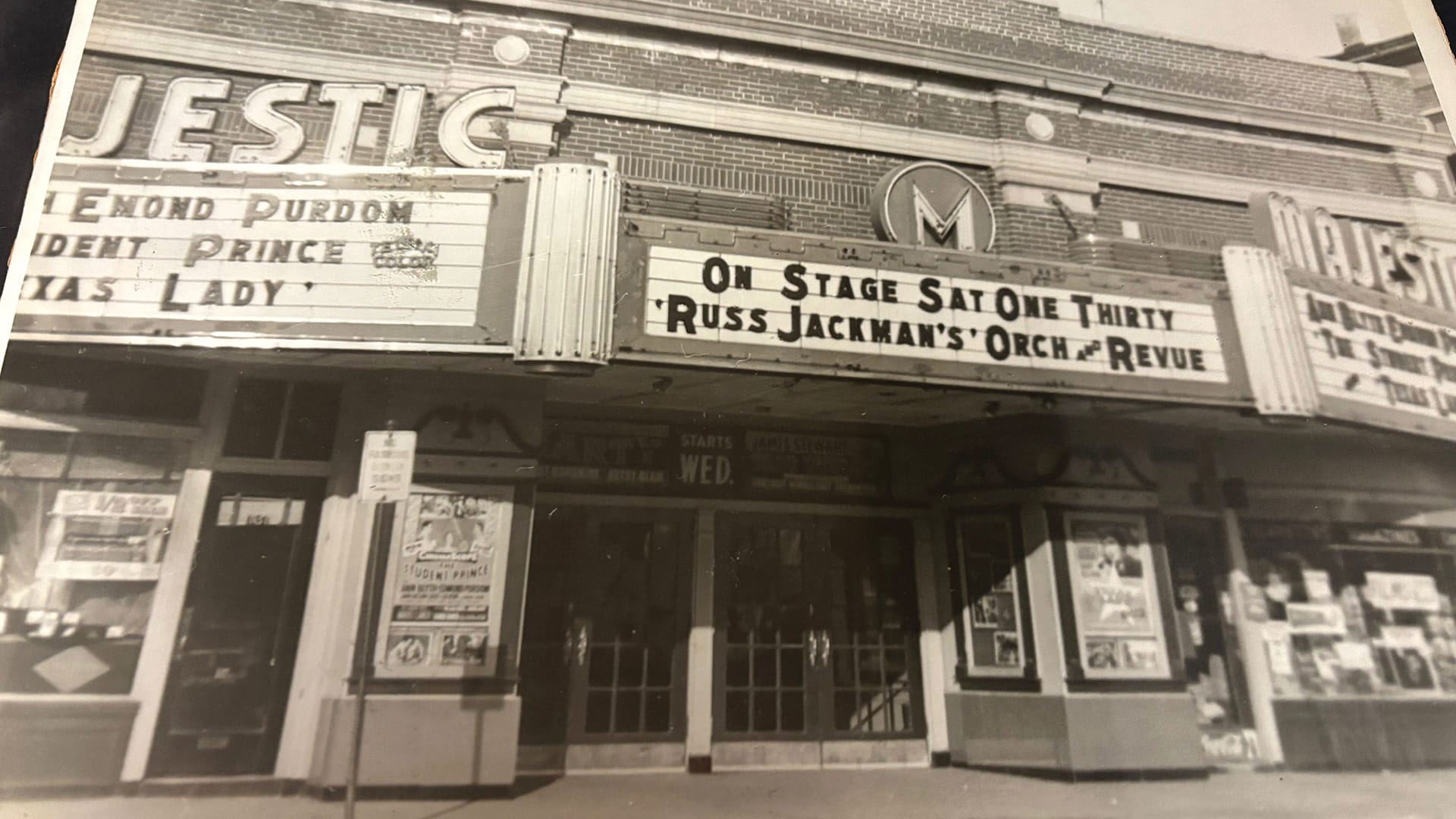
The historic Majestic Theater opened in 1928.
Like the plays shown at the theater, the Majestic has several plotlines and props, from the framed showbills that line the café area celebrating shows that include the well-known (Death of a Salesman, Hamlet, Miss Saigon, and Judgment at Nuremburg, for example), and the not-so-well-known (Golf: The Musical) to the annual fundraising car raffle, another institution — first prize this year is a 1962 Corvette convertible; the drawing is Dec. 31.
And then, there are the coffee mugs. Given each year to subscribers — who now total more than 4,000 — they’re printed with the names of the shows from each season.
Subscribers passionately collect them, said Sue Dziura, producing director for the Majestic, and look for them every year.
“They’ll tell us when they come in — ‘I have all my mugs,’” she said, adding that, in many ways, the mugs have become symbols of the Majestic’s two enduring traits — creativity and perseverance.
Indeed, between the shows, the mugs, the cars, a playbill supported by more than 100 local businesses, and more shows, the Majestic has become a long-running success story, one complete with its magic moments and stern challenges, like the pandemic, but also the rising expenses associated with professional theater, from paying the actors to insuring the property.
“Danny has programmed it so that there’s something for everyone, whether that’s genre-related — a comedy and a drama and sometimes a whodunit.”
For this issue, we look behind the curtain, if you will, at nearly 30 years of a class act — literally and figuratively.
Setting the Stage
When he spoke with BusinessWest as the 10th anniversary of the theater’s opening approached in 2006, Eaton recalled how, at that opening, a local journalist remarked that his dream had come true.
Eaton said he had to correct him to a degree and note that getting the doors open wasn’t the dream, or the hard part, or the end of the story. Keeping them open was, and is, the dream. And the hard part as well.
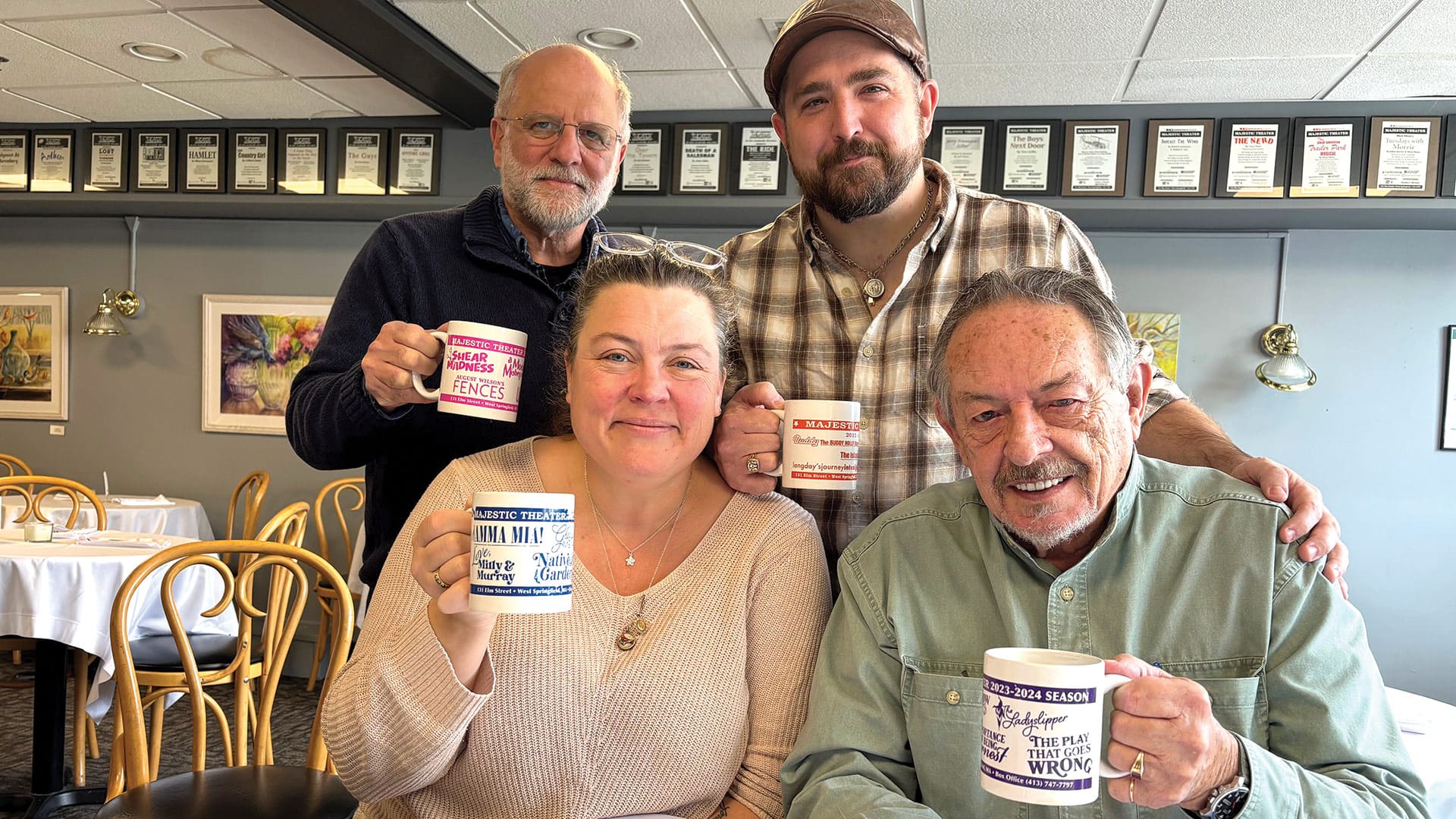
From left: Todd Kadis, Sue Dziura, Tery LaCasse, and Danny Eaton in a ‘mug’ shot.
And nothing has really changed in that regard over the past three decades, he said, adding that the overriding mission can be boiled down to those four words: keeping the doors open.
Actually, there’s much more to it than that, said Todd Kadis, the Majestic’s treasurer, who has also been here from the beginning.
Indeed, the overriding goals are to make theater accessible and affordable (tickets are under $40), he said, and also to draw people who might not otherwise attend theater.
“We’ve always seen new people, first-timers, coming to the theater, based upon the offerings,” he explained, adding that most of these first-timers will return, and many of them will become subscribers.
It all started, as noted, with The Buddy Holly Story, which returns every five years at the Majestic. Actually, our story really begins in 1992 with the creation of the Theater Project, which performed shows at the Church of the Good Shepherd, just down the street from its current home, to raise money to open the Majestic’s doors.
Or new doors, to be precise, because the current front entrance still led to the deli, so a new entrance had to be built in the back of the structure.
“We spent summers hammering nails and lugging concrete blocks,” Eaton recalled, adding that the team put in two and half years of sweat equity to get the theater ready for prime time. And that hard work essentially set the tone for all that has happened since.
“One of things we found with The Buddy Holly Story is that we could get people to come to the theater who had never been to the theater before and maybe had a notion that it was a highbrow thing that couldn’t be part of their lives.”
Over the years, the Majestic has added more framed playbills to the walls — to the point where there’s no remaining room; raffled off 29 vintage cars; transformed its café into a gathering spot, with patrons showing up an hour or more before a show starts for a quick meal and a beverage; maintained its core audience while attracting new patrons; and become one of the cornerstones for growth and new businesses in the Elm Street area.
Very little, if anything, has been easy, said those we spoke with, but the Majestic has persevered through hard work, imagination (in all its forms), and the ability to stay engaged with its audience.
All these traits were on display during the pandemic, when the lights went down, literally, on March 21, 2020, and didn’t go back on again until August 2021, when the Majestic picked up right where it left off.
Kadis said the institution was kept afloat by PPP and also a much-needed Shuttered Venues Operating Grant, a federal program that, as its name suggests, provided grants to shuttered venues ranging from theaters to aquariums to museums.
And while the theater was dark, those at the Majestic found ways to stay engaged with subscribers and the community at large through online programs such as “Behind the Curtain,” a series of interviews with actors and directors who had done shows at the Majestic, providing a backstage perspective.
Shows of Force
The Majestic now hosts between 250 and 300 shows each season, which begin in September, said Dziura, noting that the simple strategy is to “create as much art as possible.” Each season features five subscription shows as well as Home for the Holidays and a packed summer schedule that includes more than 100 performances, including a children’s theater.
In putting together that five-show slate, organizers strive for diversity and a solid mix of plays and at least one musical, a lineup crafted to appeal to both subscribers — who provide a rock-solid base for the theater company — and single-ticket sales.
“Danny has programmed it so that there’s something for everyone — a comedy and a drama and sometimes a whodunit,” she explained, adding that this year’s slate is no exception.
The season started with Once – The Musical, which tells the story of an Irish street musician and a Czech immigrant who form an unlikely bond over their shared love of music. Currently running is Steel Magnolias, a comedy set in a small Southern beauty salon. In January, The Hound of the Baskervilles, a parody of the Sir Arthur Conan Doyle classic, will begin its six-week run, followed by a ‘two-hander,’ an two-person performance called Dear Jack, Dear Louise, described as heartfelt and comical play that unfolds through the letters exchanged between a young Army doctor and a nurse during World War II. The season concludes with Come From Away, an uplifting musical that tells the true story of 7,000 passengers who were stranded in the small town of Gander, Newfoundland after the events of 9/11.
Each year’s schedule is crafted to provide variety, but also more opportunities to bring new people to the theater and bring back those who have already found it.
“Being a nonprofit theater in a small community in an area that is not particularly known as a cultural hub is a challenge,” Eaton said. “One of things we found with The Buddy Holly Story is that we could get people to come to the theater who had never been to the theater before and maybe had a notion that it was a highbrow thing that couldn’t be part of their lives.
“We changed their minds,” he went on, adding that this might be the unofficial mission statement for the Majestic. “I’ve always maintained that, if I can get 10 new people to come to theater for the first time in their lives, I’ll get seven of them to come back, and I’ll get five of them to become subscribers — and that’s held true in many respects.”
Looking ahead, the simple goal is to keep changing minds about theater, said Kadis, while also maintaining and growing the subscriber base and attracting audiences of all ages. He noted that the average age of attendees is roughly 65, and it has been this way for some time, meaning the theater group has managed to retain subscribers who joined years ago and add new, younger ones as the original subscribers move into their 70s and 80s.
Terry LaCasse, the Majestic’s managing director, agreed. “There’s a multi-generational appeal here,” he noted. “I remember my first week here … I was introduced to a parent, a grandparent, and a child at one of the shows. They were sitting in the back, and they said, ‘we’ve had these seats for years, and we’ve passed then down from generation to generation.’”
That story, and others like it, speak volumes about what the Majestic has become over the years in terms of a cultural institution and tradition.
“The Majestic is a true-to-form community anchor,” said LaCasse, speaking for all those at the table, adding that it promotes the arts, supports local businesses, and makes this region more of a destination.
And that’s why the show has gone on for nearly 30 years — and counting.