
Produce and Promise
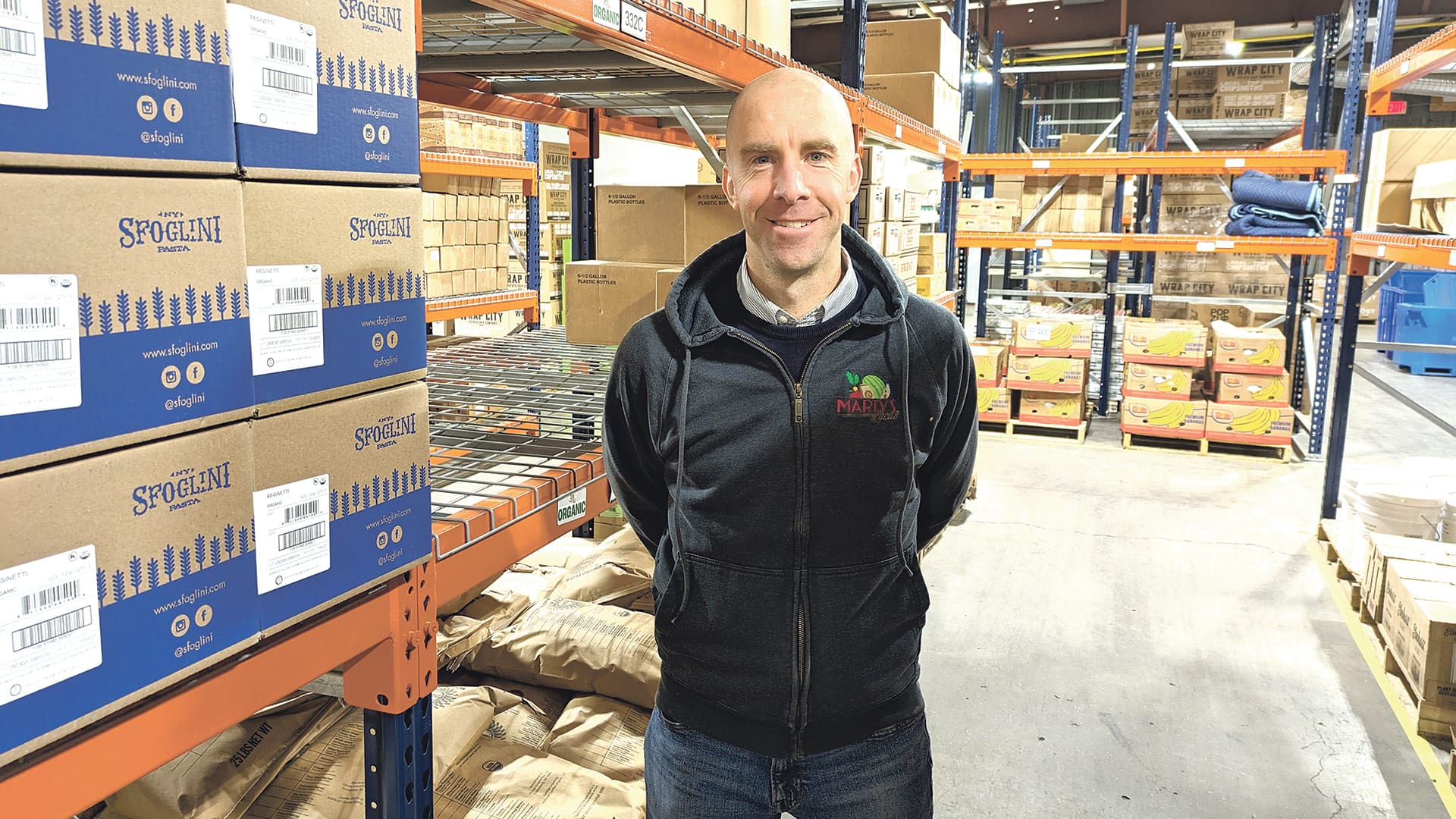
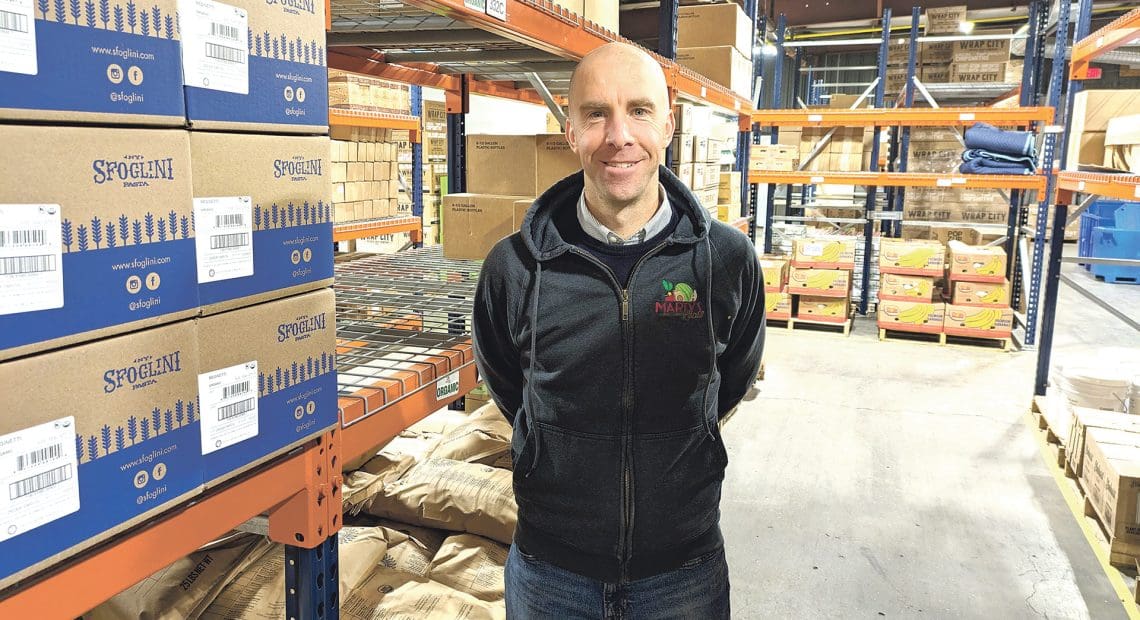
CEO Nick Martinelli
As he gave BusinessWest a tour of his 12,500-square-foot warehouse in Deerfield, winding past long, high racks of boxes and bags of fresh produce and other food and beverages, as well as a brightly lit cold-storage area, Nick Martinelli eventually came to a three-bay loading dock which he called perhaps the most important part of the decade-old operation known as Marty’s Local.
“We have eight trucks, and they’re going six days a week. They’re going out to the farms in the area, and then to the restaurants and colleges and grocers,” he explained. “Everything comes in and out of here.”
Indeed, food that arrives at the facility from farms doesn’t stay long; it heads right back out to its final destination, wherever that may be. The operation has about 115 different partners, counting both the farms and food producers on one end and those purchasing food on the other.
“They’re primarily in Western Mass., but also elsewhere in New England and New York,” Martinelli said. “There are instances where food will be picked up and delivered the same day. But the great majority of our business is having trucks on the road, making deliveries, and then ideally picking up from our farm partners on the way back to the facility, to be packed that night and go out the next day. That’s the ideal.”
Martinelli, founder and CEO of Marty’s Local, began this career in 2015, completing a farming program in Orange called the Farm School, knowing he wanted to work in agriculture, but not sure exactly how.
“I was looking to figure out a place in the local agriculture economy,” he recalled. “I was going to work on a farm, but then I started to talk to a bunch of farmers and realized that there was a real need for distribution. I was seeing some of the growers that I knew driving their own product around, and I knew the demand was strong for these these foods that are really good. So maybe there’s a business opportunity to play that role and just focus on distribution, marketing, trucking.”
So Martinelli started doing just that, first in his car and then with a rented truck. “Then folks would say, ‘what else can you bring us?’ So it started to grow organically that way.”
That was the birth of Marty’s Local, whose network of partners are based not only in Western Mass., but also Vermont, Connecticut, Maine, and New York’s Hudson Valley.
Produce and grains were the first focus of the operation, but it soon expanded to dairy, including butter and cheese, as well as eggs, honey, maple syrup, and even products like sriracha and salsa.
“Almost every week, another farm or maker would reach out and say, ‘we heard you have this distribution service; could we work with you?’ So that’s how we built our roster of partners.”
In 2019, Marty’s Local acquired Squash Inc., a similarly minded local food distributor that had been around since 1973.
“We’d started to do some work with them, and then their owners were looking to retire, so we acquired that business. They had a lot of relationships with growers in the area, and a great customer base, and that was a nice merging of the two businesses that’s worked well,” Martinelli said. “With Squash, we added non-locals. They were sending a truck to the New England Produce Center in Chelsea, outside of Boston, three times a week to get non-local produce — avocados, limes, things you can’t get around here. We continued that, and it’s been a helpful component of the business.”
About 50% of the operation’s food purchasers are retailers, meaning everything from farm stores to independent grocers to chain stores. On the food-service side, which is most of the other half, are colleges, K-12 schools, caterers, restaurants, and wellness and retreat centers.
“There are a ton of farms, and we’re just scratching the surface with the ones that we’re working with.”
Martinelli said one plus for this business is that schools and colleges — not all, but many — have become more diligent about serving healthy options, while restaurants, everywhere but especially in Western Mass., have increasingly seen the farm-to-table concept as a selling point.
To supply those end users, farms have several options, he explained. “Farms are still doing self-distribution. They’ll either have a refrigerated truck that they use, or they’ll have a pickup truck or their personal vehicle, depending on the scale they’re operating at. Some of the farms we work with have multiple trucks, depending on how many customers they have. Some of them are working with distributors that are much larger than us, or some of them work with regional distributors like us. It really depends on the scale of the grower and maker.”
What’s in a Local Name?
Grateful for the farms that choose to partner with him, Martinelli takes a broad view of the operation’s impact on the region.
“On a personal level, all of us are motivated and compelled by the trust we have in food when we know where it came from. And when I say all of us, I mean on our team, although I think, in the market, too, there’s some truth to that for sure.”
That idea has driven growth in the local food economy over the past couple decades, he added.
“The sector has grown so much. And I think the reason is that trust, in terms of what food you’re putting in your body, but also who you’re supporting. Are you supporting somebody that’s down the road that you might run into, a business that you’re familiar with, whether you know those people personally or just drive by their business regularly? That’s meaningful to me personally, and I think that’s meaningful to a lot of people, and it’s an opportunity to put your money where your values are.
“So that’s certainly a driver for us — facilitating that, making it easier for people to see more products they recognize on the shelves,” he went on. “On a lot of shelves, it will say, ‘product from X country.’ OK, that’s not really that helpful, right? But if it says it’s from such-and-such farm in Northampton, Massachusetts, well, that’s different.
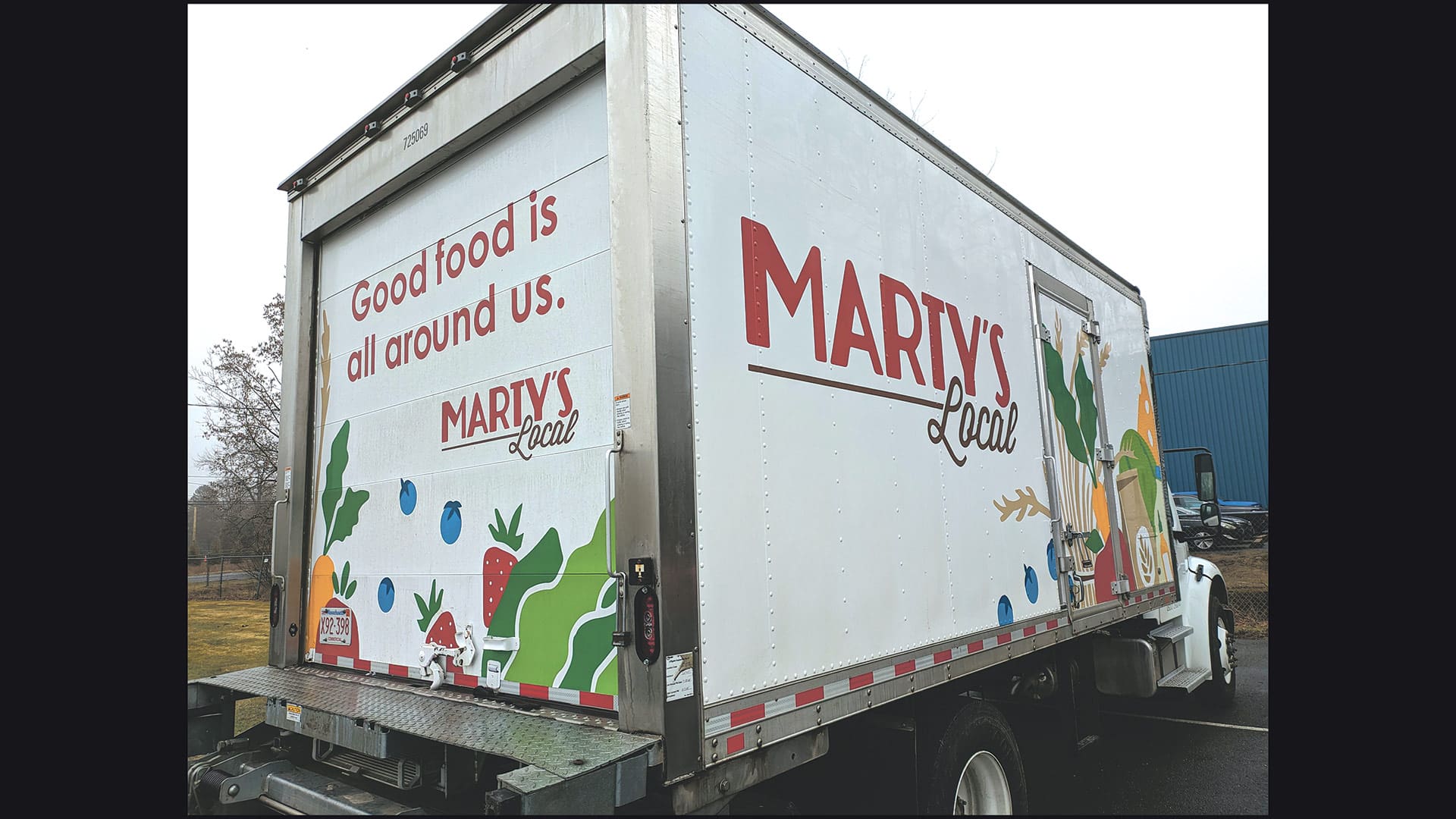
Eight trucks, both box trucks like this one and larger trailers, move food six days a week for Marty’s Local.
“Then you know what you’re getting,” he went on. “And you’re not only supporting the person or the business that’s down the road and putting food in your body that you can trust, you’re also supporting your regional economy, and maybe you’re preserving farmland. There are all sorts of ancillary benefits that come with it.”
Then there’s the matter of healthier eating.
“It’s more nutritious if it’s local,” Martinelli said. “I mean, there are studies showing that the nutrients are stronger after fewer days. So, if it’s coming in a truck five days across the country, it starts to leach out flavor — not in every single product, but there can be meaningful differences in the flavor and nutrition.”
Fortunately, he sees potential to grow this operation and continue to influence food freshness and nutrition while stimulating the local food economy.
“Are you supporting somebody that’s down the road that you might run into, a business that you’re familiar with, whether you know those people personally or just drive by their business regularly? That’s meaningful to me personally, and I think that’s meaningful to a lot of people, and it’s an opportunity to put your money where your values are.”
“There are a ton of farms, and we’re just scratching the surface with the ones that we’re working with,” he noted. “And not only farmers, but entrepreneurs who are one- or two-person businesses saying, ‘I have this great new product’ or ‘I make this great jerky.’ We’re talking about sauerkraut, yogurt, any number of different things where someone is eager to take their craft and get it out to the world, and that’s the role that we want to play.”
Recognizing that impact, Community Involved in Sustaining Agriculture (CISA) named Marty’s Local one of its Local Hero honorees in 2024.
“Marty’s functions in a part of our local food system that is absolutely essential but largely invisible to the general public (except inasmuch as we might see a truck making deliveries),” CISA noted. “We’re lucky to have thriving farmers’ markets, farmstands, and CSAs in our region, but the reality is that direct sales from farm to consumer make up only about 10% of Massachusetts farm sales. That means that 90% of the food grown by Massachusetts farms is winding its way through more complex channels from farm to table — and Marty’s Local smooths that complexity out, bridging the gaps and getting more local food onto more local peoples’ plates.”
Special Delivery
Martinelli said his operation’s continued growth is a testament to untapped demand in what is, after all, an agriculture-heavy region.
“That’s also a testament to the number of people growing great food or making great food. So you have people who want it and people who are providing it, and we get to do it really well in the middle,” he told BusinessWest. “We take pride in doing that and paying real attention to good relationships with our vendor partners and with our customers, and all three parties valuing one another.”
And he enjoys making the connections that drive that growth.
“It’s exciting to be able to say to another customer, ‘you know, I just talked to a guy recently who didn’t know there was a service like this, saw our catalog, and said, ‘these are exactly the kinds of foods that I want to have in my store.’ And we make it easy for them to get those foods in there, and do it in a way that’s just as professional as any very large distributor, but with a special focus on local and regional high-quality foods.”
Again, Martinelli added, “we feel like we’re scratching the surface, 10 years in, with the amount of suppliers that have food to go out into the world and the amount of people out there who want that good food.”