

Is the Commonwealth Losing Its Competitive Edge?
State of the Bay State

“The success of Massachusetts’ economy has historically been driven by a number of key strengths: a strong quality of life, an educated and engaged workforce, and economic sectors that adapt to changing conditions and are at the vanguard of innovation. However, these strengths are no longer as unique to Massachusetts, nor are they guaranteed to continue in perpetuity, and in recent years, national demographic shifts and increased mobility for people and employers have threatened to degrade Massachusetts’ competitive edge when attracting residents, businesses, and investment.”
That’s the introductory, summary paragraph in a note from the Massachusetts Taxpayers Assoc. (MTF) as it introduced something it calls its Competitive Index, which was first released last fall and will now be conducted annually. And it effectively sets the tone for the document, which compiled 26 different metrics — from grade-8 math test scores to energy costs; from international migration to commute time — that clearly and concisely measure how the Bay State is stacking up. (The full report can be found at masstaxpayers.org.)
The bottom line is that is that, while the state still has several strong attributes, it is not as competitive as it has been historically. Or, put another way, other states, such as California, Florida, North Carolina, and Texas, have become more competitive. And now, thanks to the pandemic and the advent of remote work, it has more competitors, including other New England states.
“Massachusetts has a number of real strengths; the fact that we are the most highly educated state in the nation and have been for a long time, the fact that we have the best K-12 school system, at least on average, and higher education is such a strength, bodes well for us,” MTF President Doug Howgate told BusinessWest. “But at the same time, there are lot of things that we can and do need to do better — we’re either lagging behind the standards we’ve set for ourselves, or we’re lagging behind other states.”
“One of the reasons why we wanted to look into some of these issues within the competitive index is that, during the pandemic, we started to see that location choices became a little more flexible — not for everyone, but for some people,” he went on. “And that has real impacts for the long-standing proposition that Massachusetts has for its residents in terms of what you gain from living here and what the costs are.
“There are lot of things that we can and do need to do better — we’re either lagging behind the standards we’ve set for ourselves, or we’re lagging behind other states.”
“If people became a little less sticky and had a little more ability to move around — the same with employers — was that going to be a competitive advantage or disadvantage for Massachusetts?” he continued. “And at least in the very short term, it appeared to be a net competitive disadvantage as we saw these big surges in domestic outmigration — not everywhere, but certainly in higher-cost areas.”
Since the release of the report, compiled with researchers at the UMass Donohue Institute and with the support of the Massachusetts Competitive Partnership, it has been the subject of discussion and debate — about what the state has lost when it comes to its historic competitive edge, to whom it has lost that edge, and, perhaps most importantly, how it might get that edge back.
Howgate has spoken at several forums about the Competitive Index and the issues related to it, including the Outlook lunch staged by the Springfield Regional Chamber earlier this month.
Doug Howgate
“If people became a little less sticky and had a little more ability to move around — the same with employers — was that going to be a competitive advantage or disadvantage for Massachusetts?”

At those forums, and in a wide-ranging interview with BusinessWest, he stressed that the Commonwealth can no longer take its historic advantages — and, again, there are several, from educational attainment to its ability to attract international immigrants — for granted, because other states are gaining ground in those realms.
In the meantime, several factors, such as the rising cost of everything from housing to energy to childcare, as well as the so-called ‘millionaire’s tax’ and the rise of remote work, have contributed to the state losing population — and talent — to other states, although some, if not most, of these losses have been made up through international immigration.
As he talked about the index and what the numbers mean, Howgate said it suggests at least five key areas for policy focus: creating a competitive roadmap, stemming outmigration, growing the labor force, incorporating cost considerations into policy conversations, and fostering and supporting the relationship between the state’s education system and the economy.
We’ll get into each in more detail as we examine the Competitive Index and how it serves as a call to action as the state, which is still very competitive when it comes to businesses, jobs, and talent, faces the hard reality that it must take steps to remain that way.
Moving Targets
As he sliced through the numbers in the index, Howgate reiterated that the Commonwealth still has several competitive strengths.
Indeed, it is ranked at or near the top in such areas as population age 25 and over with a bachelor’s degree or higher, average weekly wage, research and development funding as a share of gross state product, and even life expectancy at birth.
But these strengths are counter-balanced by many weaknesses, with the state ranked at or near the bottom nationally in income inequality, energy costs, overall cost of living, commute time, childcare costs, housing cost burden, and even average unemployment insurance tax amount per covered employee.
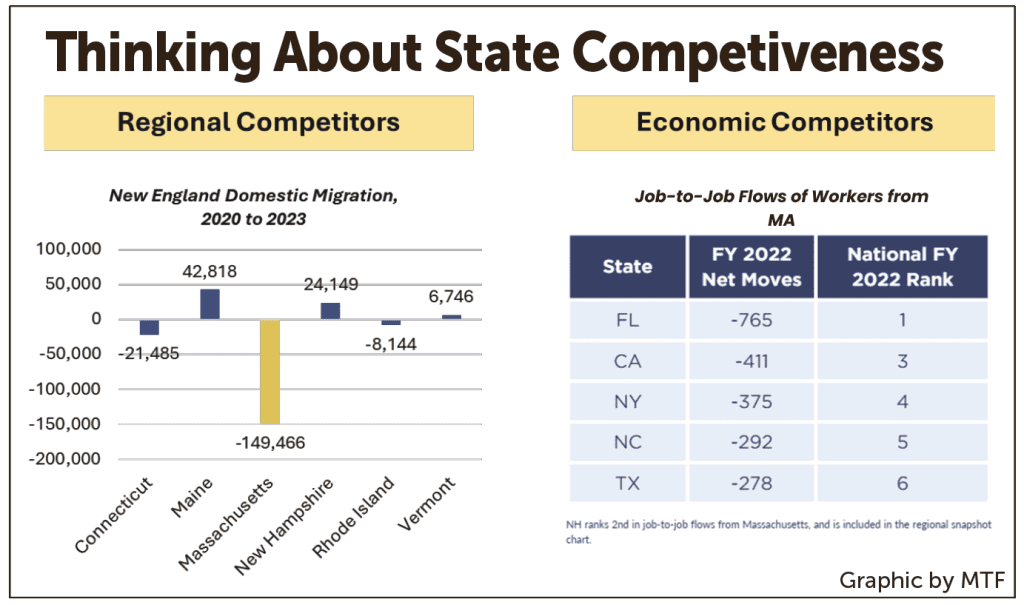
In many ways, these weaknesses are now taking their toll, and this is showing up in domestic migration, with the state losing workers to regional competitors such as Maine and New Hampshire, and especially Florida, California, and New York.
This disconcerting trend is what prompted MTF to “look under the hood,” as Howgate put it, and determine if and where the state was losing some of its edge.
“We started looking at questions related to where are we a leader or a laggard, and a lot of the places where we’re a laggard are places where the costs are borne by wealthy folks,” he said, referring to the millionaire’s tax but also other factors. “But also, a lot of the costs make it a challenging place to live for working families, which is another huge challenge for the Commonwealth moving forward.
“What we talk about in the report is that people are more sensitive to cost than they used to be,” he went on. “So that heightens some of our long-standing competitive disadvantages. The fact that childcare costs are higher, housing costs are higher, unemployment insurance taxes … we continue to fare very poorly in those areas, and they’re at the core of where people can afford to live.”
Statistics show that, while outmigration is occurring most in the higher income brackets, especially $250,000 in annual income and above, it is also happening with other groups, such as those in the $75,000-$100,000 range, said Howgate, adding that this speaks to, respectively, people who can afford to relocate and those who can’t afford to stay. And in both cases, the trends started before the pandemic.

“And the factor that’s kind of marbled throughout that is that we’re seeing increasing evidence that it’s our younger professionals who are leaving,” he said, adding that this reality has deep ramifications for the Commonwealth and its businesses, large and small.
Meanwhile, he acknowledged that this challenge does in some ways present opportunities for this part of the state, where some of these costs, especially housing and childcare, are not as burdensome.
Indeed, opportunities exist to convince people, and even businesses, to move to different parts of the Commonwealth rather than to another state, he said, adding that, due in large part to remote work possibilities, some areas, such as the Cape and the Berkshires, are gaining population.
Behind the Numbers
Howgate noted that one of the many lessons from the pandemic, a once-in-a-lifetime happening that altered many aspects of life, is that things can change quickly.
“Just like you don’t want to assume that things are going to go right back to the way they were before the pandemic in a couple of months or a couple of years, you also don’t want to assume that the way things looked in June of 2023 is what they’re going to look like forever,” he told BusinessWest. “One of the points with the competitiveness index is to say that, as we find a new normal — and what ‘normal’ is is always changing — how do we start to create these baselines for ourselves about what we’re doing well and not doing well?”
And with this baseline, Massachusetts can continue to track how it’s faring, he said, adding that overall competitiveness is something that the state and its leaders should continually gauge — and work to improve.
It hasn’t been this way historically, he went on, and this is perhaps one of the reasons why some of its edge has been lost.
“You don’t want to overreact as a policy maker, but at the same time, we have some compelling data that something has altered how people are making location decisions,” he said. “So we need to be more mindful of the fact that people aren’t going to just stay because this is where they’ve always been; there has to be more to our argument than that.”
This brings him back to some of those suggested key areas of policy focus and the overall need to emphasize competitiveness as an economic-development priority for the state.
Action, and change, is needed on several fronts, Howgate said, especially housing and what he called the “nexus between transportation and housing.”
“If people can’t afford to live in a place that gets them to where they want to go conveniently, you have a big problem on your hands,” he told BusinessWest. “And that is something Massachusetts has a real crunch on — both accessible and efficient transportation options and affordable housing.
“While there are other things that absolutely matter as well, such as childcare costs,” he went on, “I think that we started to focus more and more, as others have as well, on what are some of the smart things we can do on transportation and housing to get people more quickly to places with inexpensive housing, like Central Mass. and Western Mass., and then also, what can we do on the production side to boost housing so people are able to afford where they want to live?”
The Commonwealth is certainly not alone with these challenges — many other states and urban areas are dealing with sky-high housing costs and transportation issues, he said, adding that some are being more proactive, and effective, in dealing with them and issues such as zoning and land use.
When asked to project ahead five or 10 years to where the Commonwealth might be from a competitiveness standpoint, Howgate said this is difficult because of the profound pace of change. But he did say the state cannot afford to leave anything to chance.
“We know what our demography is, that we’re an aging population, like other Northeast states, and we know that we’re a high-cost area,” he said. “At the end of the day, irrespective of where you are ideologically, it’s in all of our best interests to incentivize people to stay in Massachusetts, and move to Massachusetts, because we’re not going to have that level of growth if we just sit here and do nothing.”