
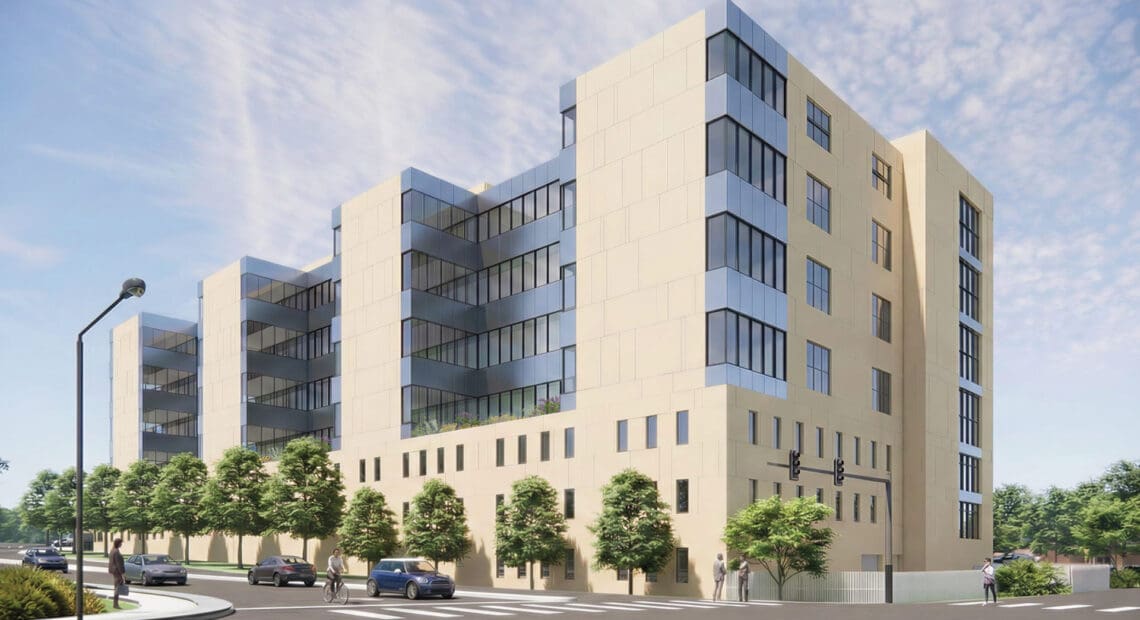

An architect’s rendering of the courthouse that is the centerpiece of the Liberty Junction Team’s proposal.
Rendering Opinions
The region’s long wait for a decision on the site and development team for a new regional justice center (RJC) is over, with the state Division of Capital Asset Management and Maintenance (DCAMM) accepting the recommendation of the Massachusetts Trial Court to select the Liberty Junction Team, led by Virginia-based FD Stonewater and Boston-based CoJo Partners.
What is just beginning, however, is fierce debate — and even a lawsuit filed by two of the rejected developers (more on that later) — about the state’s choice of a site and team to replace the troubled Roderick L. Ireland Courthouse, and speculation concerning what this $600 million initiative means for Springfield and its business landscape, the region, and even the legal community.
“This is a once-in-a-generation opportunity to get it right, and they didn’t get it right.”
Springfield Mayor Domenic Sarno and others — from Hampden County Clerk of Courts Laura Gentile to Hampden County Sheriff Nick Cocchi — have been vocal in their criticism of the chosen team and site, noting that the former is not local and the latter is too far from downtown to have a positive impact on Springfield’s central business district. They’ve also focused on the fact that the chosen proposal comes with the lowest price tag for the state, and that this is not necessarily a positive.
“This is a once-in-a-generation opportunity to get it right, and they didn’t get it right,” Cocchi told BusinessWest. “Sometimes, the least expensive proposal isn’t the one that creates the most long-term value for our community.”
But DCAMM Commissioner Adam Baacke and Claiborne Williams, a principal with FD Stonewater, have much different takes.
Baacke told BusinessWest that the proposal submitted by the Liberty Junction Team wasn’t merely the cheapest, but the cheapest by a considerable amount — an estimated $600,000 per month less than the next-lowest price — and “one of the strongest, regardless of cost,” boasting everything from a 42-month delivery schedule to proximity to Union Station, 21 bus lines, and regional highways, to a partnering architecture firm, Boston-based Leers Weinzapfel Associates, that specializes in courthouse construction.
“While this was not a low-bid procurement — it was more of a best-value procurement — when you have multiple proposers offering comparable quality, and one of them is at a considerably lower price, that one inherently is the better value,” he said. “That was ultimately the differentiating factor for why the Trial Court ultimately recommended the Liberty Junction project as the preferred proposal, and DCAMM accepted that recommendation.”
Meanwhile, Williams, while noting his firm’s experience building and managing large government buildings, also stressed that this is a courthouse that will serve 23 cities and towns, not simply Springfield, prompting a hard focus on access, which this site provides. But it also offers additional development opportunities at adjoining parcels, including 280 Chestnut St., home to Baystate Health’s corporate offices, and its adjoining, 550-space parking garage.
Adam Baacke
“While this was not a low-bid procurement — it was more of a best-value procurement — when you have multiple proposers offering comparable quality, and one of them is at a considerably lower price, that one inherently is the better value.”

“Part of the RFP involves economic development in and around the courthouse, and we knew we needed additional parcels to make that happen,” he said, adding that the development team put 280 Chestnut St. under contract, as well as 616 Dwight St., properties likely to be used for some combination of housing, office, retail, and parking.
“We’ve heard everyone loud and clear, and we want to work with the community organizations, politicians, the city, even our competition, if they’re willing, to come up with the best mixed-use development plan for our three parcels,” he told BusinessWest, adding that, contrary to what some critics of this selection have said, this development will be more than a courthouse.
But the courthouse will be the centerpiece, and its location has bearing on several constituencies, including the legal community.
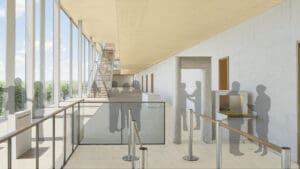
Another architect’s rendering, this one an interior perspective.
In the decades after the Roderick L. Ireland Courthouse opened in the late ’70s, most law firms were clustered into the blocks surrounding that facility, with many leasing space in buildings along State Street. They started spreading out a little when MGM acquired several properties along State Street for its casino complex, forcing them to move.
But, overall, they stayed downtown, joining dozens of other firms located in or near the central district’s four main office buildings. With the new courthouse representing a longer walk for some, there is speculation about whether there will be more shifting.
John Gannon, an employment law specialist with the firm Skoler, Abbott & Presser, located in Monarch Place, doesn’t think that will happen, noting that the planned new regional justice center is roughly the same distance from the downtown office towers as the current courthouse.
But for some firms, adjustments will be needed. That’s certainly the case for Bacon Wilson, located across State Street from the current courthouse, and a dozen blocks from the planned new site.
“All the courthouse constituents — court officers, probation, clerks, judicial staff, as well as all the attorneys and all the clients, are going to have to acclimate to a new geography and a new way of doing business,” said Managing Partner Jeff Fialky, noting that the firm’s current home, leased from owners that include several retired partners of the firm, includes a large parking lot that sees heavy use from visitors to the courthouse, revenue that will be lost when the new facility opens. “I’m sure that’s how it was 50 years ago when this was courthouse was built.”

The Verdict Is In
When asked about general criticisms leveled at DCAMM for not selecting a local developer, Baacke responded simply by saying, “the name and address of any of the proposers was not a decisive factor in whether they could deliver the product that the Trial Court needed.”
Factors that were considered include access, parking, design, a site’s ability to stimulate economic development, delivery date, and, obviously, cost, and these essentially decided the four finalists, if you will, among the 10 proposals:
• The Liberty Junction proposal for 125 Liberty St. and adjoining parcels;
• A proposal for 413 Dwight St. submitted by USPB JV LLC, led by Jeb Balise, president of Balise Motor Sales;
• Park View South LLC, a proposal led by Peter Pan Chairman Peter Picknelly that involves several parcels off Avocado Street on the riverfront; and
• A proposal submitted by Greatland Realty Partners for 1860 Main St., the Springfield Republican building.
The nod went to the Liberty Junction Team and FD Stonewater, which, Williams noted, has extensive experience with large construction projects, many of them involving government agencies at the federal, state, and local levels as well as government contractors. And many of these are what he called “secure spaces” — a courthouse falls into that category — which is a specific niche for the firm.
Claiborne Williams
“We’ve heard everyone loud and clear, and we want to work with the community organizations, politicians, the city, even our competition, if they’re willing, to come up with the best mixed-use development plan for our three parcels.”

The portfolio for the 20-year-old company includes the 500,000-square-foot U.S. Drug Enforcement Administration Headquarters in Arlington, Va., a facility that includes courtrooms; the new Hanover County (North Carolina) Government Center; the U.S. Army Corps of Engineers’ Mobile, Ala. District Headquarters; a U.S. Coast Guard Sector Air Station in Corpus Christi, Texas; the U.S. Department of Homeland Security Customs and Border Protection Southwest Science Center in Houston; student housing at North Carolina State University, the University of Tennessee, and the University of North Carolina at Chapel Hill; and many others.
“Our ability to finance these high-dollar-per-square-foot spaces is our niche, and we’re successful at it,” Williams said. “This is what we do day in, day out — government real estate — and we’ve been successful numerous times on analogous projects of size and scale, and we’ve delivered on time and on budget.”
He noted that the Hampden County courthouse project came on the company’s radar via the state’s RFP for proposals.
“We were excited about it, and therefore, we pursued it,” he said, noting that this interest preceded any specific site in Springfield or elsewhere. The company eventually focused on the 125 Liberty St. site after it scored high (second among 13 sites scattered across Springfield and surrounding communities, behind only the existing courthouse) in a state assessment of proposed locations for a new courthouse in 2023.
“We wanted to focus in on the North Blocks area, or the northern end of the city,” he said, adding that this section of the city offered perhaps the best blend of access — with Union Station and nearby highways — and opportunities for economic development.
Williams said the Liberty Junction Team, put together in response to DCAMM’s preference for diversity, includes several local players, including O’Reilly, Talbot & Okun, a woman-owned environmental consulting firm based in Springfield, and VHB (Vanasse Hangen Brustlin), a national planning and engineering company with a local office in Springfield. Meanwhile, Andrea Leers, a principal with Leers Weinzapfel Associates, has Springfield roots.
“We have a well-qualified team, and an experienced team,” Williams said, noting that Leers Weinzapfel Associates has designed several courthouses, including the Franklin County Justice Center in Greenfield, and been involved in several DCAMM projects.
“The architect for this team has a really good understanding of what the Trial Court needs in terms of a modern court facility, particularly around security and the character of the courtrooms themselves,” Baacke added. “The primary driver of designing a court is figuring out to manage three very complicated security pathways that cannot intersect, so that the public, the detainees, and the judges and jury members don’t pass one another in the hallway as they move through the building both vertically and horizontally. It’s actually a very complex exercise, and this design firm has mastered how to do that, not only for DCAMM, but for courts across the country.”
As noted earlier, however, DCAMM’s decision was met within days by a lawsuit filed by two of the rejected bidders: Balise’s USPB JV LLC and Springfield Tower Square LLC, owned by Dinesh Patel. They seek to prevent the Commonwealth from finalizing the 40-year lease, citing a conflict of interest — CoJo Partners’ John Barros was named interim executive director of the Massachusetts Convention Center Authority while DCAMM was actively evaluating proposals — as well as questions about whether the Liberty Junction Team demonstrated sufficient site control for the project location and alleged failures by DCAMM to apply procurement requirements consistently across bidders.
“I got into this for one reason: the good of Springfield. My family has lived and worked in the Springfield area for four generations, and a new courthouse done the right way could be a generational boost for our downtown. That’s the goal, no matter who ultimately wins,” Balise said. “This is not an effort to stop Springfield from getting a new courthouse. It is an effort to prevent the Commonwealth from locking taxpayers into a 40-year lease before serious questions about the award are reviewed.”
Courting Opinions

Jeff Fialky stands outside Bacon Wilson’s headquarters across State Street from the current courthouse.
As for speculation about the site for the new courthouse and its overall impact, it comes in many flavors.
Evan Plotkin, owner of NAI Plotkin, a commercial real estate brokerage and management firm, as well as the office tower known as 1350 Main St., told BusinessWest that he favored the existing courthouse site as the location for the new one, basing that opinion on convenience for visitors and the broad impact on downtown and individual businesses and properties.
The Liberty Street site, a property his firm had managed for more than 50 years, and he co-owned for some time, won’t have that same impact, he said.
“There just aren’t enough amenities around there — it’s somewhat landlocked,” he explained. “And it doesn’t have proximity to the core of downtown. I think the priority should have been placing this as close to the epicenter, the core of downtown, as possible to try and revitalize Main Street.”
Williams, meanwhile, chose to focus on the North Blocks area and the potential impact of the new courthouse there.
“I think it will be transformative — that neighborhood is prime for redevelopment,” he said, noting that there hasn’t been much growth in that area, created through a massive urban renewal effort in the ’60s, in years, if not decades, and the courthouse will likely stimulate some activity.
Noting the more than $100 million in federal and state investments to revitalize Union Station, he said the courthouse could build on those efforts and bring vibrancy to the area, possibly creating something it isn’t considered now — a neighborhood.
Other speculation concerns the sites not chosen for the courthouse and what happen with them. Sarno and Tim Sheehan, Springfield’s chief Development officer, said redevelopment of the existing courthouse will be a linchpin project for Springfield given its location off the highway and also to 31 Elm St. and other nearby housing projects, as well as Old First Church.
Meanwhile, Balise has said that he is committed to developing the Dwight Street site, which has been cleared of existing buildings, even if he loses the contest to build the new courthouse.
He declined comment for this article, instead issuing a statement shortly after DCAMM announced its decision (and before announcing the lawsuit), noting that “our commitment to this city is bigger than any single project. We invested in these downtown parcels because we believe in this neighborhood’s future, and we remain fully committed to seeing this site become what Springfield deserves.”
Plotkin noted that, while some of the non-chosen sites are more challenging than others when it comes to redevelopment options — he put the riverfront location in that category, for example — many have potential, especially as sites for new housing, which has long been considered a key to bring more vibrancy to the downtown.
And while office use is possible at some of the sites, especially with some law firms possibly looking to move closer to the new courthouse, he doesn’t believe there’s much appetite for new office construction given the amount of space already available. Also, new office construction will likely result in businesses such as law firms moving out of downtown, hurting buildings like his, which houses several firms, including a few displaced by MGM.
Fialky, meanwhile, said the legal community will be making some adjustments, and that will likely include some firms migrating to the North Blocks area, creating opportunities for new development.
“If you build it, they will come,” he said. “As we get closer to 2030 and nearer to completion, and we start to work through what some of those logistics look like, maybe we’ll see some other developments in that area, and that was the hope for any new courthouse location — that it would spur some type of development.”