Leading the Way

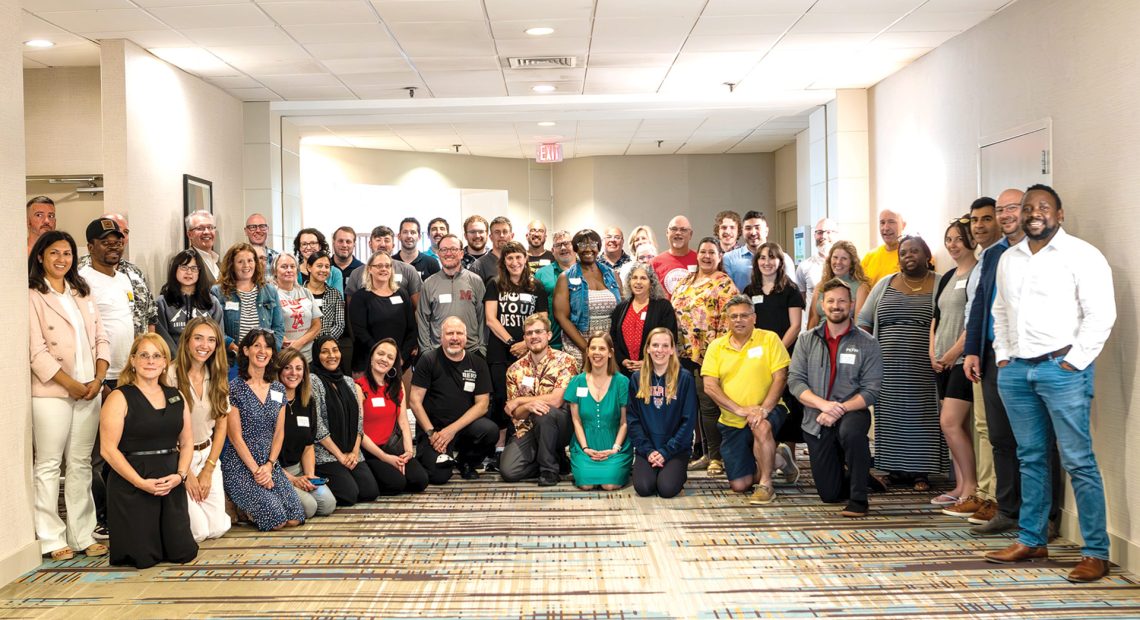
Educators gather at the professional development kickoff at the Massachusetts Technology Collaborative campus in Westborough.
The Healey-Driscoll administration recently partnered with Project Lead The Way (PLTW) to launch Future Ready: AI in the Classroom. Through a $135,000 investment, this professional development pilot will support teachers in 45 classrooms, estimating to reach more than 1,600 students, and is designed to provide high school educators with the tools, knowledge, network to bring artificial intelligence (AI) into their classrooms.
This experience is jointly funded through the administration’s STEM Advisory Council and the Massachusetts AI Hub and will be administered by PLTW. Organizers say this pilot marks an important step in expanding access to AI learning opportunities for students and educators across the state.
“Massachusetts has long been a global leader in both technological innovation and education,” Gov. Maura Healey said. “With this pilot, we are building on that success, providing our teachers with the skills and tools so they can support the next generation and ensure Massachusetts remains a global leader in applied AI.”
Lt. Gov. Kim Driscoll added that “our administration knows AI is a transformative technology that is already reshaping how we live and learn. Through this pilot, we’re giving educators the foundation they need to navigate this new era with confidence, fueling workforce readiness and expanding opportunity for students.”
This year-long, 50-hour professional development experience kicked off at the Massachusetts Technology Collaborative campus in Westborough, where participants engaged in curriculum design workshops, peer collaboration sessions, and targeted mini-trainings. This first experience aimed to create a professional learning community that fosters innovation and shared best practices. The program introduced educators to the fundamentals of AI, explored ethical and responsible classroom applications, and facilitated ongoing collaboration with industry experts and peers throughout the academic year.
“As a former teacher, I know how important professional development is, especially in an ever-changing world. This pilot helps turn possibility into practice,” Education Secretary Patrick Tutwiler said. “By investing in our educators and grounding their work in ethical, real-world AI applications, we’re making sure our students are not just consumers of technology, but future leaders in it.”
Interim Secretary of Economic Development Ashley Stolba added that “Massachusetts is uniquely positioned to lead in the responsible and innovative use of artificial intelligence. This pilot reflects our forward-looking approach, aligned with the vision of the Massachusetts AI Hub. By investing in educators today, we ensure our students are prepared to shape the innovations of tomorrow. Supporting this kind of early, hands-on learning helps build the talent pipeline that will drive our future economy.”
Technology Services and Security Secretary Jason Snyder related how, as a young student interested in computer science, having passionate and experienced teachers as mentors was transformational. “This pilot helps ensure that our next generation of students in Massachusetts learn the fundamentals of data and AI literacy, and that our educators are empowered to lead with confidence and instill emerging technology proactively, in classrooms all over the state.”
“Through this pilot, we’re giving educators the foundation they need to navigate this new era with confidence, fueling workforce readiness and expanding opportunity for students.”
The pilot is a cornerstone of the Massachusetts AI Hub’s mission to position the state as a global leader in applied and ethical AI. Future Ready: AI in the Classroom is the first in a series of educator-focused initiatives aligned with the Hub’s education and workforce development strategy, ensuring that students across Massachusetts are not only prepared for the future of innovation, but are actively shaping it. The pilot program also advances the goals of the Massachusetts STEM Advisory Council by strengthening STEM education and supporting educators with a network of STEM resources.
“Artificial intelligence has the potential to expand access to information and unlock new learning opportunities for students across Massachusetts,” Massachusetts AI Hub Executive Director Sabrina Mansur said. “With this pilot program, our state will be able to empower teachers to incorporate the benefits of AI in student education. Ultimately, our goal is to create a strong pipeline of talent who understand how to use AI to build a stronger economy.”
David Dimmett, president and CEO of PLTW, noted that “we believe in empowering students to become the innovators and problem solvers of tomorrow. This partnership with Massachusetts represents exactly the kind of forward-thinking approach we need to prepare educators and students for an AI-driven future. By providing teachers with hands-on, project-based AI learning experiences, we’re ensuring that students don’t just understand artificial intelligence — they learn to harness it as a tool for creativity and innovation. This pilot will serve as a model for how we can scale AI literacy across the U.S.”
The launch of the pilot reflects a broader, coordinated effort across Massachusetts state government to harness AI’s potential in a way that is forward-thinking, inclusive, and impactful. It follows the work of the Massachusetts AI Strategic Task Force, established by Healey in 2024 to chart a path for AI adoption, talent development, and economic growth. The task force’s recommendations directly informed the creation of the AI Hub and highlighted the need for strong partnerships between government, industry, and academia. The administration also invested $100 million through the Mass Leads Act to support AI innovation at scale and strengthen Massachusetts’ global leadership in AI.
In K-12 education specifically, the Department of Elementary and Secondary Education (DESE) is also leading efforts to support educators as access to AI increases. Through a partnership with the International Society for Technology in Education and the Assoc. for Supervision and Curriculum Development, DESE convened a K-12 AI task force focused on developing recommendations to support school communities in their use of AI. This task force produced a multi-year AI roadmap focused on AI literacy, student data privacy, and educator preparation.