Getting a Bounce
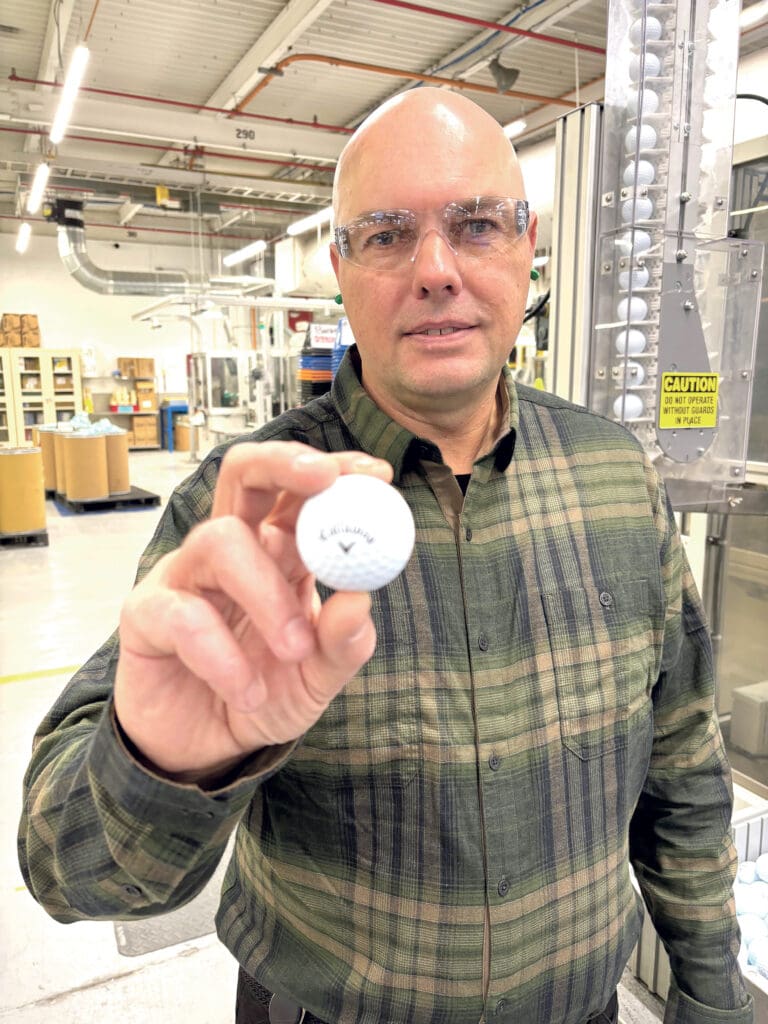
Algis Norkevicius says Callaway is the world’s second-largest golf ball manufacturer
Algis Norkevicius says it’s difficult to effectively quantify and qualify the overall impact from all those close-up shots of Callaway golf balls during television broadcasts as the professional golf tournaments wind to their climax on Sunday afternoons.
But he knows it certainly helps when ‘Callaway players’ such Akshay Bhatia storm from behind and win the Arnold Palmer Invitational, as he did earlier this month, or when Xander Schauffle is in contention at the Players Championship — and also at the Arnold Palmer Invitational. Or when Sam Burns is near the top of the leaderboard at the AT&T Pebble Beach Pro-Am.
“It’s great exposure for our products, and it’s fun to watch and follow these players,” said Norkevicius, senior director of Global Golf Ball Manufacturing for Callaway, which has facilities in different corners of the globe, but makes most of its balls in a sprawling facility on Meadow Street in Chicopee that was once home to Spalding.
He said these strong performances from those Callaway players comprise just one of many factors contributing to the company’s rise to number two among golf ball manufacturers, behind Acushnet, maker of Titleist, and on a path to steady growth — in sales, and in the number of balls produced at the Chicopee facility.
Another factor is the continued strong health of the game, which enjoyed a surge during COVID and has, by and large, been able to maintain that momentum since.
“Rounds of play and golf ball sales are directly correlated; statistics show that the average person uses around three golf balls a round,” Norkevicius said. “As rounds of play increase, so do golf ball sales. Last year, the National Golf Foundation released its annual report — golf grew again by 1% over the previous year, which was a record year.”
Then there are new products, such as the company’s recently introduced second generation of the Chrome Tour line, balls that tout greater speed, more consistency, and tighter dispersion, and are expected to be popular with players at all levels.
“We’ve grown our workforce, and we’ve increased our technical staff — all in pursuit of making a better golf ball.”
Norkevicius calls what’s going on at Callaway a “transformation,” one marked by everything from new products and the growing popularity of those products to new efficiencies in the manufacturing processes and, overall, more than $130 million in capital investments inside the facility.
“We took a look at each process and upgraded the equipment,” he said. “It started with our mixing line, and then core molding and injection molding; our printing equipment has been upgraded; and the last thing we’re upgrading is our packaging line, and we’re in the middle of that now.
“We’ve grown our workforce, and we’ve increased our technical staff — all in pursuit of making a better golf ball,” he noted, adding that recent results have shown that these substantial investments are certainly paying off.
Looking forward, he said the company is looking to continually grow its market share — the new Chrome Tour products are certainly expected to help improve those numbers — and eventually become the number-one golf ball maker in the world.
To get there, the company will look to make ever-greater use of technology, including artificial intelligence (AI) to not only produce a better golf gall, but achieve the most important quality in the manufacturing of these products: consistency.
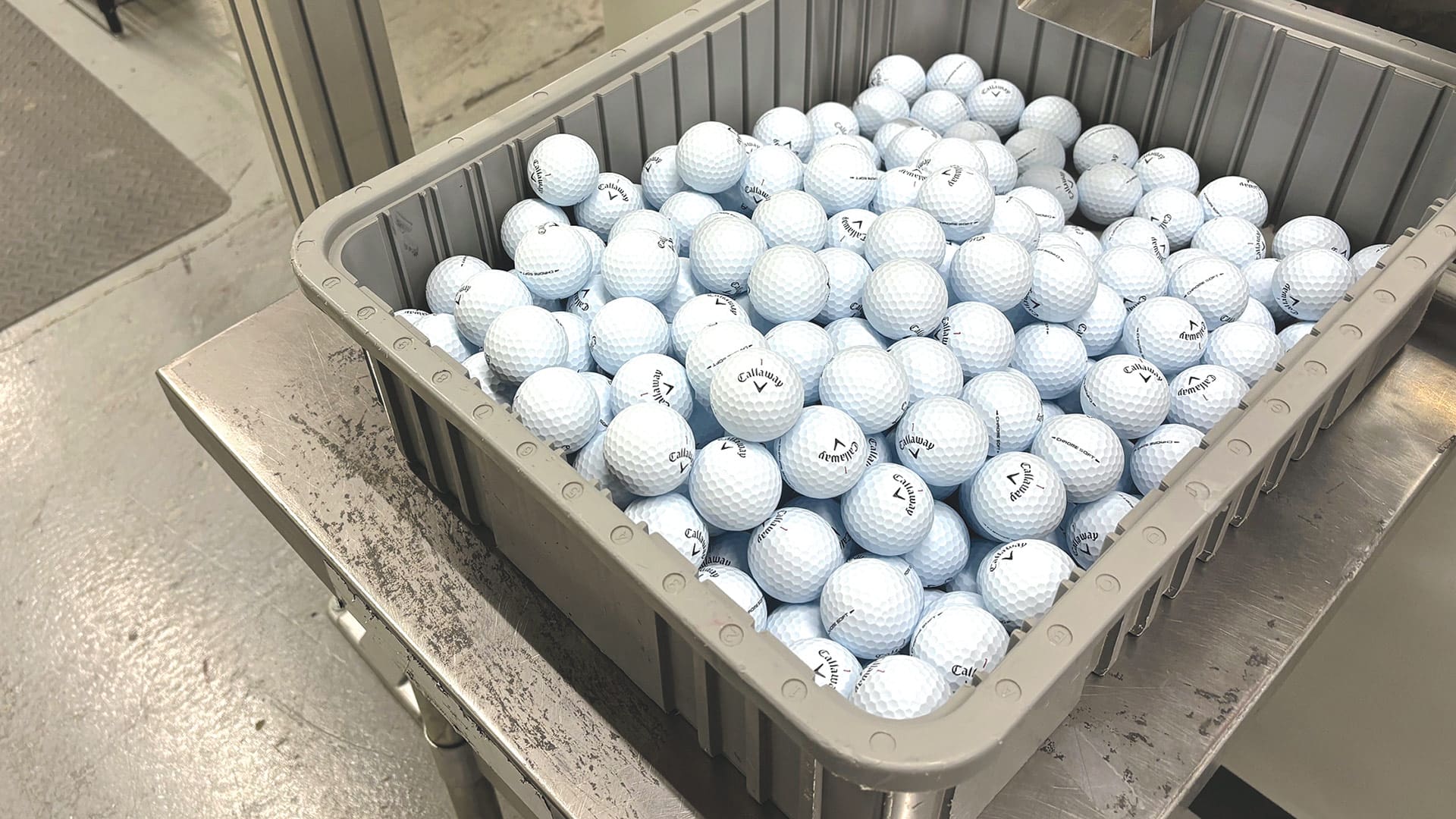
The growing popularity of golf is a boon to manufacturers, as the average player uses about three balls per round.
For this issue, BusinessWest talked at length with Norkevicius about the golf ball business, the manufacturing of those products, and how Callaway continues on a strong growth trajectory.
Positive Spin
Norkevicius has been involved with golf ball manufacturing for nearly 30 years now. He started at Acushnet, which is both a company and a town in Bristol County where the golf balls are made.
He came to Callaway in 2019 to lead worldwide golf ball manufacturing operations, meaning the facility in Chicopee, but also other plants in Thailand, Taiwan, and Vietnam that produce mostly value and range products. He’ll visit those facilities once a quarter, on average, spending the bulk of his time in Chicopee.
“That knowledge base in how to make a golf ball is one of the key assets we have here.”
Over his time at Callaway, the company’s share of the overall golf ball market has risen from roughly 14% to 22% (Achusnet remains on top, with nearly 50% of the market). He attributes this to products that have captured the attention of players at all levels, such as those within what’s now known as the ‘Chrome family’ — the Chrome Tour, Chrome Tour X, Chrome Tour Triple Diamond, and Chrome Soft — but also other offerings, such as the popular Supersoft, Superfast, and Warbird.
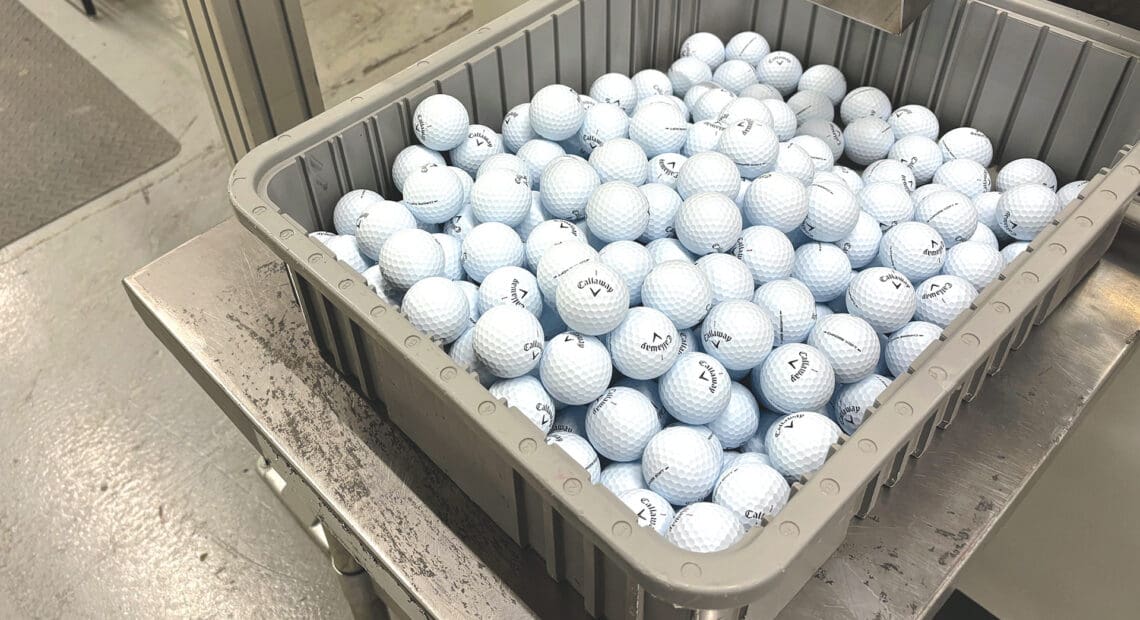
Many of these balls are made in Chicopee, including the Chrome Tour products, as well as the Supersoft and the ERC Soft, he said, adding that the facility will churn out 5 million dozen golf balls a year, or 25,000 dozen a day, with three shifts operating five days a week (there are roughly 450 employees), with overtime on weekends during busy seasons — like this one.
Indeed, the months leading up the start of the golf season in the Sun Belt (March) and then the rest of the country (early- to mid-April) are among the busiest times for the Chicopee facility.
“There’s a seasonality to the business,” Norkevicius explained. “Typically, the summer months are one of the slowest times, and then it will ramp up in September and October in advance of the holidays, and then plateau — and then, around Memorial Day, it starts to get a little lighter.”
Overall, 2025 was another sold year for both the company and the Chicopee plant, he told BusinessWest, adding that the game continues to grow a percentage point or two a year in terms of the number of rounds played; as noted, this translates directly into more balls being used.
“We’ve created what I’d call a quantum data universe; on any given day, we’ll take 150 million data points from our processes, equipment, and our testing, and we load this data into the cloud. And from there, our engineers will use AI to help predict outcomes or potentially get ahead of failures before they occur.”
And this growth pattern is expected to continue in 2026, especially as the company releases the next generation of its Chrome Tour products, first introduced in 2024.
“We changed the ball so significantly that we separated Chrome Tour from Chrome Soft,” he explained. “That marked a leap in technology and performance. And over the past two years, we’ve continually refined the golf ball, working with R&D on some material changes as construction changes to optimize it even more, adding more speed and more distance, and then we were able to decrease our dispersion along the fairway; the ball lands in a tighter spot compared with previous models.”
The Chicopee plant started producing the new Chrome Soft balls last summer, he went on, adding that production has ramped up as the new season draws closer.
Drive to Improve
As he gave BusinessWest a tour of the Chicopee plant, Norkevicius said its best asset is its workforce, which boasts many team members who have been making golf balls for decades — some for a half-century.
“That knowledge base in how to make a golf ball is one of the key assets we have here,” he said, adding that the company has been working to blend this experience with new technology and improved processes to take golf ball manufacturing to the proverbial next level.
This includes the use of AI, which Norkevicius called one of the plant’s more significant advancements over the past several years.
“We’ve created what I’d call a quantum data universe; on any given day, we’ll take 150 million data points from our processes, equipment, and our testing, and we load this data into the cloud,” he explained. “And from there, our engineers will use AI to help predict outcomes or potentially get ahead of failures before they occur.
“They can monitor our processes, and as soon as there’s an indication that a process may be going out of control, they will alert a technician or engineer, and they can address that before we make a bad product,” he went on, adding that, with golf balls, the most important quality — even above distance, which is still important — is consistency.
“With every golf ball you use, you want it to perform the same … and we want to ensure that each ball goes the same distance, has the same dispersion, same flight, same spin,” he said. “And to do that, it’s difficult. Making golf balls is hard, and if we can understand and control all these parameters, we can make it a little easier.”
Elaborating, he said there is much that goes into the making of a golf ball, from its core to its cover; from rubber chemistry to injection molding, and maintaining quality through the many stages of the complex process is as difficult as it is essential.
“It’s not an easy process — it’s very challenging, especially to make things consistent,” Norkevicius told BusinessWest. “We need to have those controls in place, we need to have the knowledge of our processes, and we need to have those tools to help us identify when those processes go out of control — or start to go out of control.”
AI also helps the R&D teams create better products, he added.
“They can create virtual models based on what’s going on here, and then come up with an even better model for the next generation,” he explained. “They can basically do this analysis and future trials, utilizing AI to do that — they can then predict outcomes. Things that would take weeks to do, to test and compile … we can do that in minutes today.”
With this focus on quality and the use of technology to not only make better products but produce them more efficiently and more consistently, Norkevicius believes Callaway is well-positioned to not only continue on its strong growth trajectory, but achieve that ambitious goal of rising to the top among golf ball manufacturers.
“With the investments we’ve made here and the continued improvements to our products and processes, we know we have the foundation in place to increase our market share,” he said, adding that Callaway shares a goal common with golfers of all handicap levels — continuous improvement.