Home Posts tagged Deerfield MA
Features Special Coverage

Tapping into Tradition

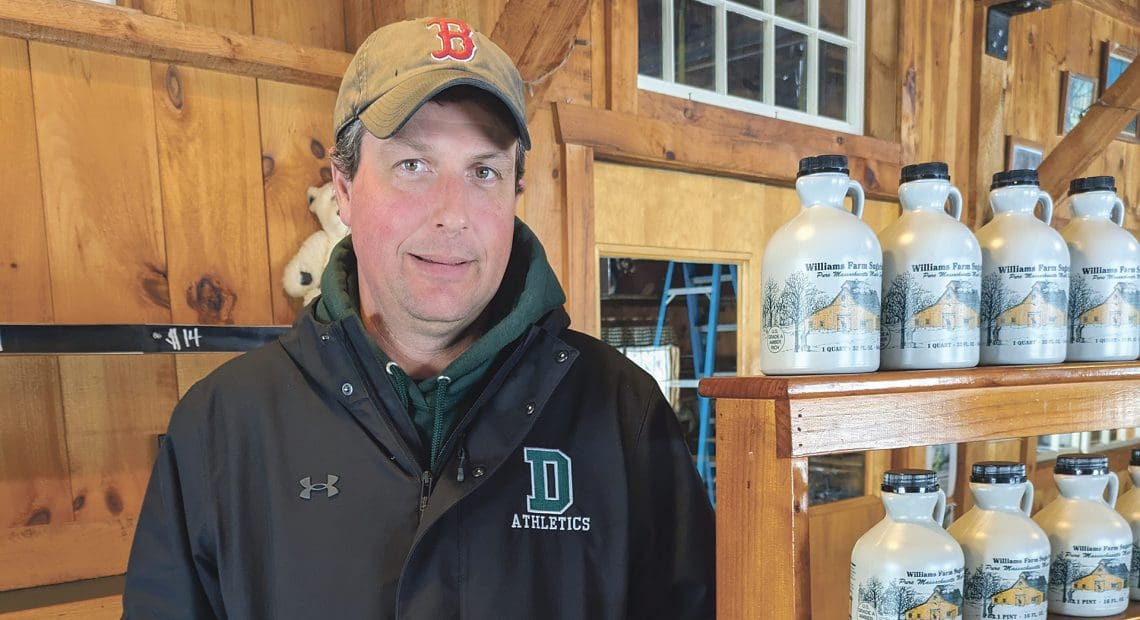
Chip Williams (pictured) and his sisters represent the fifth generation making maple syrup at the family’s sugarhouse.

Chip Williams (pictured) and his sisters represent the fifth generation making maple syrup at the family’s sugarhouse.


Chip Williams has his eye on the weather reports around Deerfield. He’s not looking for long stretches of mild weather, or cold, for that matter. He wants both. Every day.

That’s because sugar maple trees in this region are tapped beginning in late February, and temperatures are critical for sap production — specifically fluctuating temps, with the ideal conditions being nights in the low 20s followed by days in the 40- to 45-degree range. This freeze-thaw cycle is necessary because, as the temperature warms, the ice inside the trunk melts, and the ice-compressed gases expand, forcing the sap out of the trunk.

“It’s all temperature-dependent. We need the right weather, and when I say right weather, it’s the freezing and thawing cycles. If we have that for an extended period of time, we’ll have a decent season,” said Williams, who is part of the fifth generation operating Williams Farm Sugarhouse, which starts selling maple syrup — and breakfast — to the public on Feb. 21.

“What often happens is a week of warm and then a week of cold, longer cycles of ups and downs,” he noted, “but we really want a freeze at night, warm during the day, freeze at night, warm during the day, and not so much warm for a week and then cold for a week.”

The reason, he said, is that the sap flows only on a warm-up. “So, after a freeze, that next day, when it warms up, it’ll flow, but it’ll only flow for a certain amount of time before you need it to freeze again. If it warms up and stays warm, it’ll run for a little while, and then you won’t get anything.”

That thermometer watching is just one of many challenges he and his sisters, Kelly Scofield and Casey Williams, take on when they work at the sugarhouse every spring. They all have regular jobs — Chip is the athletic grounds supervisor at Deerfield Academy, while Kelly and Casey work in hotel management in Eastern Mass. — but the maple-syrup season is a labor of love for the siblings, who are also joined by their father, Sandy, who comes up from Florida during tapping and boiling season.

“After a freeze, that next day, when it warms up, it’ll flow, but it’ll only flow for a certain amount of time before you need it to freeze again. If it warms up and stays warm, it’ll run for a little while, and then you won’t get anything.”

It’s also a tradition for plenty of local families as well, in a region that boasts a number of sugarhouses, few with as long a history as this one. The facility is open Friday through Sunday for pancakes, french toast, waffles, and more, all topped with that fresh maple syrup. And if they like what they taste, they can bring home syrup, maple cream, maple candy, and more from the store.

“We see a lot of the same families every year,” Chip said. “And when we’re boiling, we invite people to come back and ask questions, and we’ll explain the process. It’s really interesting to get people’s feedback — a lot of people have no idea how you even start making maple syrup, and people are amazed you take this product that looks like water and make it into this all-natural sweetener.”

It’s a product that has brought some sweet times for the Williams family since Milton Hubbard Williams began the syrup tradition in the mid-1800s, followed by his son, Kenneth Sanderson Williams. The original Williams sugarhouse was one of 13 located on Mount Toby in Sunderland.
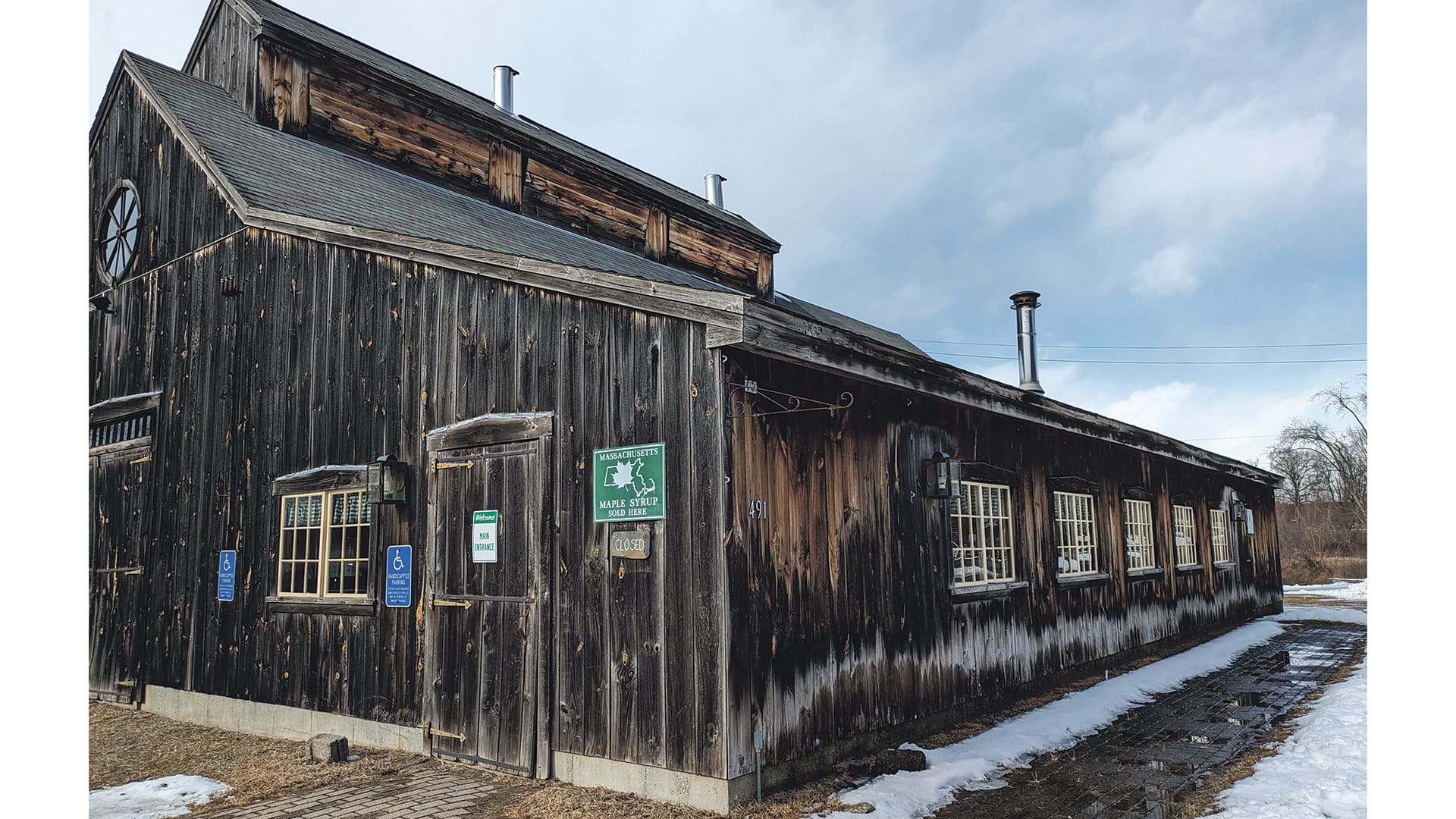
The Williams Farm Sugarhouse

The Williams Farm Sugarhouse has been at its current location along Route 5 since 1994.
Staff Photo

In his diary, Hubbard Williams wrote, “March 6, 1853, commenced sugaring. March 25, 1853, traded sugar for coat and pants in Amherst.” Thirty-six years later, he was still sugaring, and on April 1, 1889, he wrote, “Gathered 20 bls [barrels] sap for four successive days. Had the best week I ever knew … syrup sells readily.”

In the mid-1960s, amid growing success and realizing the need for a better retail location, Kenneth Williams Jr. and his brother, Milton, moved the third-generation sugarhouse off the mountain to Route 47 in North Sunderland. The final move came in 1994, when the family, led by fourth-generation operator Sandy Williams, built a sugarhouse on Route 5 in Deerfield, near its sweet-corn farm.

“The reason we moved here is our farm was just right up the road in Old Deerfield,” Chip said. “We would drive over to Sunderland every day to operate the sugarhouse during the sugaring season, so when this property here came up for sale, my family bought it, and we were able to move everything closer to our operation.”

“When we’re boiling, we invite people to come back and ask questions, and we’ll explain the process. It’s really interesting to get people’s feedback — a lot of people have no idea how you even start making maple syrup.”

In Sunderland, they served coffee, donuts, ‘sugar on snow,’ and the like, but the move to Deerfield saw the food-service operation expand to serving meals — first on weekends, then seven days a week for a while, and currently three days a week. They stopped growing corn up the road 2012, but the sugarhouse — and its almost two centuries of tradition — lives on.


From Tree to Plate

Some years are weaker than others because of the uncertainty of the weather, Williams said. Last year wasn’t particularly strong for sap production, but 2010 was much worse, with only about 20% of the normal crop.

“It just warmed up around the middle of March, and it never froze again. It just stayed warm. So we didn’t get any more sap,” he explained, adding that an early start to those cold-warm cycles are important. “Here at our sugarhouse, if we don’t make any syrup in February, a lot of years it’s hard for us to have a really good year; we find that whatever we miss early, we never make up on the other end.”

When tapping a sugar maple, it’s best to drill a taphole that can provide an ample amount of sap while maintaining the long-term health and sap production of the tree. In a good year, one tap can yield around 10 gallons of sap, or almost one quart of syrup. Sap is, on average, about 2% sugar, and it takes about 45 gallons of sap to make one gallon of syrup.
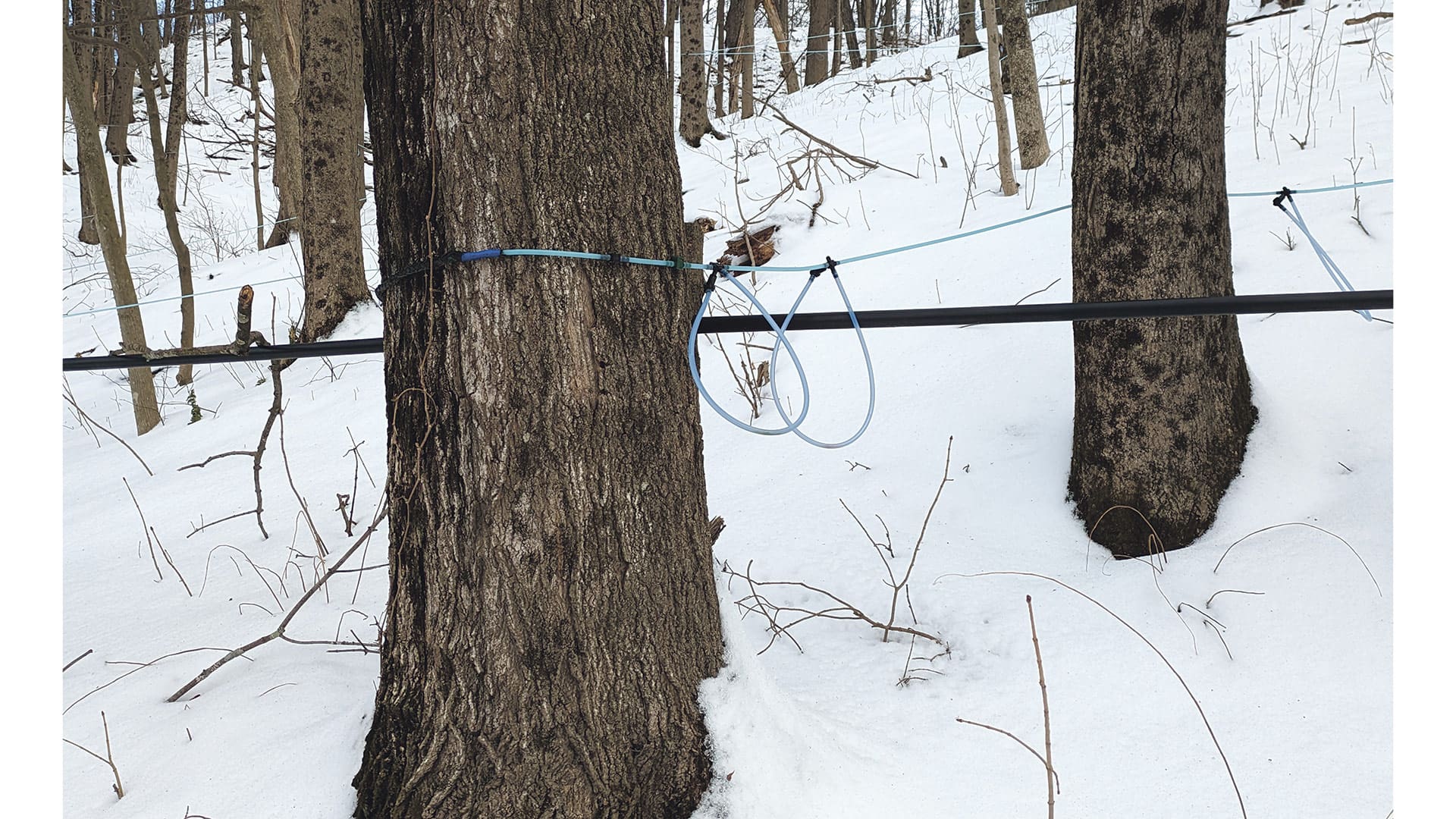
Sap flows best from the trees when freezing nights are followed by warm days.

Sap flows best from the trees when freezing nights are followed by warm days.
Staff Photo

The traditional method of gathering sap is to hang four-gallon buckets below the tap to catch the drip. The process is very labor-intensive, and buckets must be gathered and emptied up to once a day. The Williams Farm enterprise hangs about 3,000 buckets each season, tapping more than 1,000 trees in Deerfield and Sunderland.

A less labor-intensive way of collecting sap is through a tubing pipeline, which utilizes gravity to gather sap into holding tanks that are positioned lower than the trees or at a slope. While the initial cost of setting up lines is greater than that of buckets, once lines are established, they can hold for 15 to 20 years. The farm has about 1,000 taps on pipelines, but is looking to expand that number in the future.

As noted earlier, the sap gathered from a sugar maple tree is not the same as what’s poured on pancakes. Sap has a large concentration of water and a small concentration of sugar, and the additional water must be boiled off in an evaporator.

In the sugarhouse, sap is continuously fed into the evaporator, where it flows through a series of troughs. The sap is boiling the entire time, and when it reaches the proper density at 219 degrees, it can then be called syrup. The more water that is boiled away from the syrup, the thicker it gets. Products like maple cream, candy, hard blocks, and granulated sugar are all made by further reducing the syrup at higher temperatures.

Williams noted that the team starts boiling as soon as they begin to get sap into the sugarhouse, and the sap is processed at its freshest in order to ensure the highest-quality syrup.

They always try to boil on weekends so the visiting public can witness the process, although, because sap flow is so dependent on the weather, they can’t guarantee they will be boiling on any given day, so for customers who want to see the process, it’s best to call ahead or check the website for projected boiling times.

“We like to get started in February, but it doesn’t always pan out. We’re just at the mercy of Mother Nature,” Williams told BusinessWest. “That’s some of what makes it interesting too — you don’t know. People will ask, ‘how’s this year going to be?’ And it’s like, ‘well, we don’t know until April, once it’s all over.’ We almost always make enough syrup for our customers, and it’s always good syrup. So, any year we can do this is a good year.”


Sweet Moments

Williams said he looks forward to this season for a number of reasons, including being close to nature.

“As the days get longer and it starts to warm up a little bit, it’s nice just getting out in the woods and working on the lines. I don’t get to be out as much as I did when we were farming full-time. I’d be out all the time, if not for my full-time job, so we have some people that help us.”

The sugarhouse is open to the public from late February into early April, and those dates aren’t set in stone so much as dependent, as noted earlier, on the weather and the frequency of that freeze-thaw cycle.

“Traditionally, we would always start right around the week of school vacation. Growing up, I remember having that February break, going out with the guys tapping,” he recalled, adding that sugaring season has long been a community tradition as well. “Because this craft is native to this region, it seems like people really have a tradition of visiting these houses and looking forward to it.

“And it’s important to my sisters and me to keep the tradition going,” he added, noting that he has three sons of his own. “Obviously, I don’t want to put any pressure on them doing this, but they love it here, and they help out. My 11-year-old likes to run the register up front.”

Williams Farm Sugarhouse does some wholesaling as well, selling syrup to local farmstands and maple candy to Richardson’s Candy Kitchen, right across the street. There are online sales as well, “but that’s tricky; you’re just a small fish in a big ocean. But once you make a few sales and people like your product, they’ll keep buying.”

And the family will keep tapping, boiling, and serving breakfast.

“There are times, like on a busy Sunday toward the end of the year, when we’re just dragging, but it’s fun,” he said. “We have three generations of family helping us out, too, so that’s great. Everyone kind of chips in to get it done.”
Community Spotlight Special Coverage

Community Spotlight

In the last 12 months, Deerfield has attracted more than 1.1 million visits

In the last 12 months, Deerfield has attracted more than 1.1 million visits, with 48.5% of all visitors classified as tourists, with their home residence more than 50 miles away.
Staff Photo

While Deerfield is home to Yankee Candle Village, Historic Deerfield, the Magic Wings Butterfly Conservatory, and other tourist attractions, its economy is broad, covering sectors ranging from agriculture and manufacturing to retail, restaurants, and the arts.

That diversity is an asset, said Jessye Deane, executive director of the Franklin County Chamber of Commerce, which is based in Deerfield. And the community continues to add assets, thanks to a series of developments over the past few months.

Like the Golf Club, a new, 24/7, membership-based indoor golf simulator.

“I’m an avid golfer,” owner Frank Messana explains on his website. “When COVID forced-retired me from Comcast due to downsizing, I realized I wasn’t ready to sit around all day. So I decided to chase a dream I’ve had for many years of opening a state-of-the-art driving range when I retired.

“Then, I thought, what golf in this area really needs is a great place to go when the courses (and us golf nuts) are freezing cold for too many months. You know how it goes … spend all the warm months playing, practicing, and improving only to have to start at square one after the long, cold layoff from the game we love. I want to help golfers of all skill levels stay sharp over the winter season, when those bitter nor’easters keep us off the course.”

On the municipal front, development plans continue around the town campus, a collection of buildings including the current Town Hall, two churches, and a former elementary school.

Last month, the Zoning Board of Appeals granted the what’s known as the 1888 Building — that’s the former school, at 67 North Main St. — a variance to allow the structure to exceed the town’s 35-foot height limit. That clears the way for the 136-year-old building to be converted into a modern town hall, with a full renovation and a 2,600-square-foot addition. The $8 million project, funded by $3.8 million in Community Preservation Act money and a $4 million federal earmark, is expected to begin construction this summer.

Meanwhile, Deane said, “Tilton Library is being renovated and is a very involved, very impressive project.”

The project at 71 North Main St. will nearly triple the building’s space to 12,784 square feet and include expanded teen and children’s rooms, meeting and co-working spaces on the second floor, and what’s being called a ‘nighttime suite,’ which will be accessible after library hours and feature meeting spaces, a small kitchen, and bathrooms.

“Tree House Brewing is expanding their outdoor music concert series, and it has generated foot traffic.”

Nearby, Rivermoor Energy recently completed a new electric-vehicle (EV) fast-charging hub in downtown South Deerfield, in partnership with the town and the Federal Highway Administration. The project was funded by a $2.46 million federal Charging and Infrastructure grant, made possible by the Bipartisan Infrastructure Law. The EV-charging hub, located at 59 North Main St., is open to the public.

“This project is not only an impactful one for the environment and the advancement of clean energy, but it’s also a boost for the economic backbone of our town,” Town Administrator Christopher Dunne said at the opening. “With the added accessibility, climate-change mitigation, and new pedestrian walkways leading to downtown businesses, Deerfield can continue to thrive and serve its local business owners and attract new customers to our business community.”

Speaking of downtown development, a just-announced, $500,000 Complete Streets grant will fund the construction of a 10-foot-wide, shared-use path with plantings on the north side of Elm Street and a crosswalk on the south side. Other improvements will include curb ramps, flashing beacons, and bicycle racks.


Music in the Air

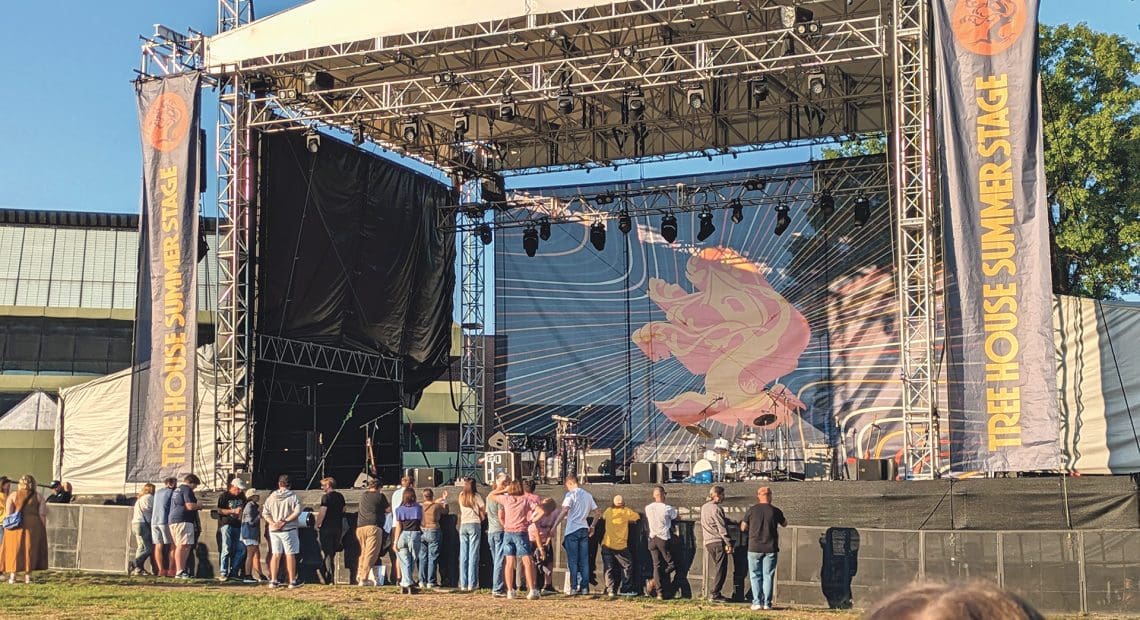
Just up Route 5, Tree House Brewing Co. has become a destination unlike any other in town — not only as a thriving brewery, but as host to a summer outdoor concert series that’s drawing big crowds to see some big names.

While the venue did generate some neighborhood noise complaints toward the end of its 2024 season, Tree House Compliance and Business Development Manager Allison Masley assured residents at a hearing last month that the venue has been trying to readjust the way its stage faces in an effort to mitigate the issue.

Attendees gather early for one of Tree House Brewing’s summer concerts last year.

Attendees gather early for one of Tree House Brewing’s summer concerts last year.

But, at the same time, Tree House Director of Finance Mark VanAtta noted that, with 62% of concertgoers living at least 50 miles away, the business generated about $8 million in revenue to the community, while Tree House itself contributed $137,000 in taxes and another $35,000 in meal taxes, as reported in the Greenfield Recorder.

“Not only are people coming and spending money at Tree House, but these are people that are coming from different communities to this community to spend money to have a good time,” VanAtta said.

Deerfield at a Glance

Year Incorporated: 1677
Population: 5,090
Area: 33.4 square miles
County: Franklin
Residential Tax Rate: $13.25
Commercial Tax Rate: $13.25
Median Household Income: $74,853
Median Family Income: $83,859
Type of Government: Open Town Meeting
Largest Employers: Yankee Candle Co., Pelican Products Inc.
* Latest information available

The chamber sees the concert series as a definite plus, Deane noted. “Tree House Brewing is expanding their outdoor music concert series, and it has generated foot traffic.”

Indeed, over the last 12 months, Deerfield has attracted more than 1.1 million visits. By the state’s definition, 48.5% of all visitors can be classified as tourists, meaning their home residence is more than 50 miles away.

During that time, Tree House’s South Deerfield location attracted 240,500 visits from 145,500 visitors. Of those visitors, 23.3% had a household income of $200,000 or more, 37.9% of all Tree House tourists stopped at least one local business before going to Tree House, and 42.9% visited a local business after their visit.

Meanwhile, back at the chamber, Deane said many Deerfield businesses are participating in a redesigned, relaunched Franklin County gift card, another reason for visitors to head to this town of just over 5,000 residents.

“Through our work as both Franklin County’s Chamber of Commerce and Regional Tourism Council, we are especially attuned to the critical role Deerfield plays in Franklin County’s economy, thriving on a diverse economic base and hosting businesses ranging from retail to advanced manufacturing,” Deane said. “With attractions like Historic Deerfield, Sugarloaf Mountain, Yankee Candle, Clarkdale Fruit Farms, Berkshire Brewing Company, Tree House Brewing Company, and more, Franklin County is fortunate to benefit from Deerfield’s vibrant mix of industries and a steady stream of visitors who contribute to our regional economy.”


Community Spotlight

Community Spotlight

Diana Szynal

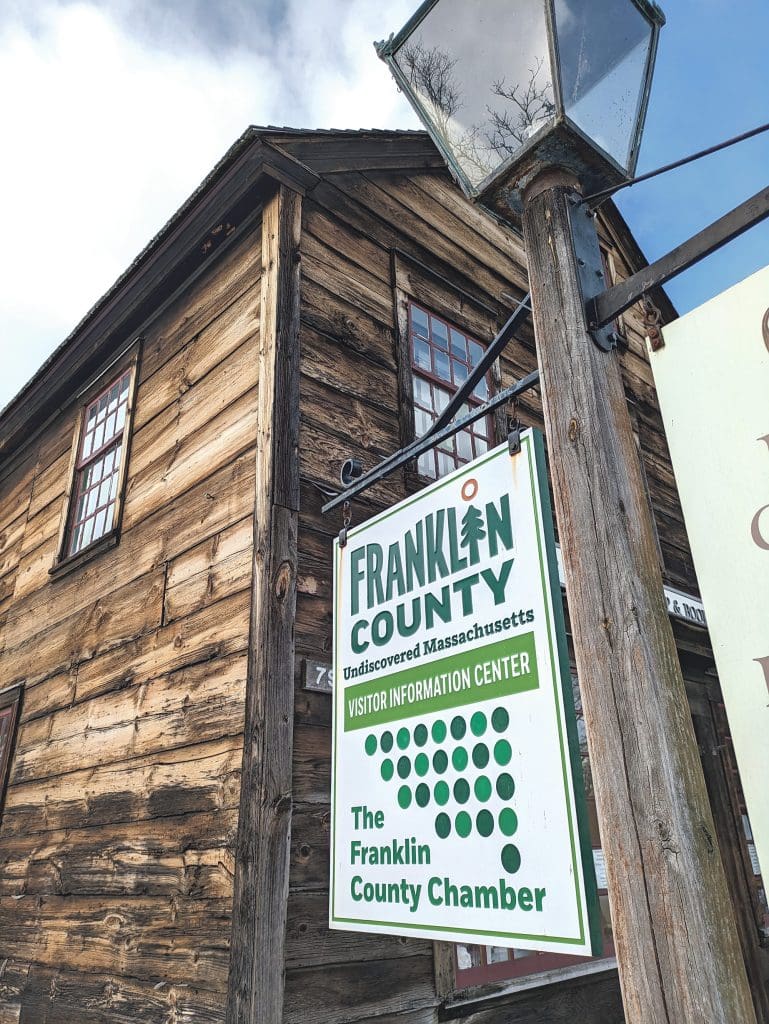
Diana Szynal says the Franklin County Chamber of Commerce’s move to Deerfield will include a visitor center.


By Mark Morris


Deerfield is one busy town these days.

Residents there are engaged in 22 different boards and committees planning several ambitious projects to better the town. Still, while all that activity is admirable, it also invites confusion if anyone feels out of the loop.

A group of 15 residents who serve on several boards and committees in Deerfield were aware of the potential pitfalls and formed the Connecting Community Initiative (CCI) to improve communication among the various committees and with municipal officials. Denise Mason, chair of the CCI, said the initiative came about after increasing frustration among members of several boards and committees.

“Because we are all volunteers, people often don’t have the time to stay on top of activities that fall outside of their committee work,” Mason said. “We created the CCI to eliminate the silos in town so we can keep all our projects moving forward.”

The initiative started in November, with the group meeting eight times since then. Mason said they’ve been successful so far with keeping people informed and projects on track.

One big project involves renovating and repurposing the former Deerfield Grammar School to house the municipal offices. Part of the plan also calls for building an addition on the back of the building, where the town’s senior center would be located.

“These projects are part of a bigger objective, which is to create a walkable town campus in Deerfield,” Mason said, explaining that 45% of residents are over age 45.

Kayce Warren, Deerfield town administrator, strongly supports these plans and intends to use American Rescue Plan Act (ARPA) funds to develop a municipal parking lot centrally located in town.

“This is an opportunity for us to make Deerfield a more walkable community. With an aging population, a community’s walkability is a big part of helping people age better.”

“If there’s parking, people will come,” she said. “We’re looking to create a campus that provides walking access to the municipal offices, the senior center, and other resources, such as a small market and a bank.”

The walkable community idea doesn’t stop at the center of town. Work has begun on a municipal park on North Main Street, located past Frontier Regional School. Warren would like to see sidewalks extend from the center of town to the park, nearly two miles up the road.

“This is an opportunity for us to make Deerfield a more walkable community,” she said. “With an aging population, a community’s walkability is a big part of helping people age better.”


Location, Location, Location

Deerfield’s location along the Interstate 91 corridor makes it easily accessible from all directions. Many in town are hopeful the new Treehouse Brewery that opened in the former Channing Bete building will be a catalyst for drawing people to town. In her meetings with the brewery, Mason said Treehouse is cautiously developing its Deerfield location in three phases.

“Right now, they are working on the second phase, which calls for construction of a pavilion to stage outdoor concerts,” Mason said. “Once that’s up and running, hopefully this year, there is a big potential for other businesses to benefit as well.”

Among those businesses, Yankee Candle will likely benefit, as it has always been a big tourism draw for Deerfield. As Yankee and Treehouse are located close to each other on Route 10, Warren is hopeful they will create a working relationship to bring even more people to Deerfield.

It would surprise no one if the two entities were brought together by Diana Szynal. The executive director of the Franklin County Chamber of Commerce recently moved the organization from downtown Greenfield to Historic Deerfield. She said the move makes perfect sense because, prior to COVID-19, Historic Deerfield traditionally drew nearly 20,000 visitors a year.

“The rivers and mountains have always been here, but suddenly there has been a renewed interest in these resources.”

“We will be opening a visitor center, which will allow us to promote all the attractions in Deerfield and surrounding towns,” Szynal said. The chamber’s former visitor center was located in a corner of the Registry of Motor Vehicles in Greenfield, a location she said was never worthy of Franklin County. “With the visitor center in Historic Deerfield, thousands more people will be able to learn about all the fun things to do in Franklin County.”

While Szynal and her staff are still settling in from the move, which occurred in mid-January, their focus is on having the visitor center ready to go when Historic Deerfield begins its season on April 16.

Jesse Vanek, vice president of Development and Communications for Historic Deerfield, said 2022 is a tremendous opportunity to welcome back large crowds to the outdoor museum that depicts life in 18th-century New England. “Historic Deerfield is such a special place, and we’re hoping to see our in-person visits get back to pre-COVID levels.”

Deerfield at a Glance

Year Incorporated: 1677
Population: 5,090
Area: 33.4 square miles
County: Franklin
Residential Tax Rate: $15.17
Commercial Tax Rate: $15.17
Median Household Income: $74,853
Median Family Income: $83,859
Type of Government: Open Town Meeting
Largest Employers: Yankee Candle Co., Pelican Products Inc.
* Latest information available

Every year, the museum runs a full schedule of programs for visitors. Beginning in the spring, programs will range from Sheep on the Street, which explores heritage breed sheep and the role of wool processing in New England’s history, to a Summer Evening Stroll held on July 3 and themed on Deerfield during the American Revolution.


COVID and the winter season inspired Historic Deerfield to expand its program offerings online through virtual sessions. As a result, the museum now reaches audiences around the world. The winter lecture series included relevant topics such as understanding climate change from a historical perspective.

“We are fascinated with the response to our virtual programming,” Vanek said. “I believe it helps entice people to come visit us, which is good for our organization, the town, and the region.”


Out in the Open

Szynal has learned that people will travel long distances to take part many of the outdoor activities in Deerfield and Franklin County.

“We were shocked to learn how robust fly fishing is here,” she said. Indeed, whether casting a line into the Deerfield River or rafting in Charlemont, outdoor activities are a true resource for the area and bring in people who often stay for several days.

“The rivers and mountains have always been here, but suddenly there has been a renewed interest in these resources,” she said.

Warren is thrilled that Szynal and the chamber are now part of Deerfield.

“Diana has great ideas, and I think she can help us keep Historic Deerfield connected to the rest of the community,” Warren said, adding that, in a perfect world, Deerfield would provide more incentives for tourism, but ongoing infrastructure projects have stretched budgets to their limits.

Located between the Connecticut and Deerfield rivers, the town faces constant challenges with stormwater runoff and flooding issues. Bloody Brook, which also runs through town, maintains a higher-than-normal water table.

“We have a group of passionate volunteers who want to work together help the tow. They are engaged and willing to put in the time to keep these projects moving forward, and that’s so important.”

Deerfield was one of the first communities to qualify for the state’s Municipal Vulnerability Preparedness (MVP) program. MVP grants are awarded to cities and towns that build climate-change resilience into all their infrastructure plans. Warren explained that type of thinking applies to every project in town, from simple tree boxes designed for better stormwater management to larger projects like the school repurposing and sidewalk additions.

“We are linking everything together in terms of managing water issues, and we’ve set our sights on staying on top of this for the next 50 to 100 years,” Mason said.

As Deerfield’s many projects move forward with Mason and the CCI keeping them on track, Warren took a minute to appreciate the situation.

“We have a group of passionate volunteers who want to work together help the town,” she said. “They are engaged and willing to put in the time to keep these projects moving forward, and that’s so important.”