
Rolling with the Changes

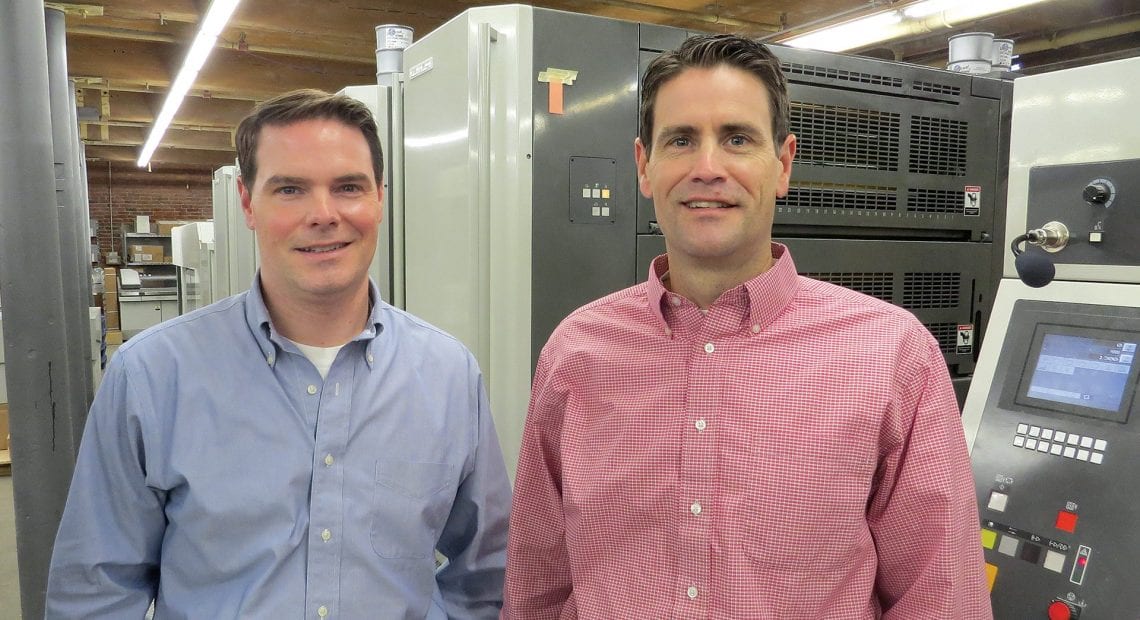
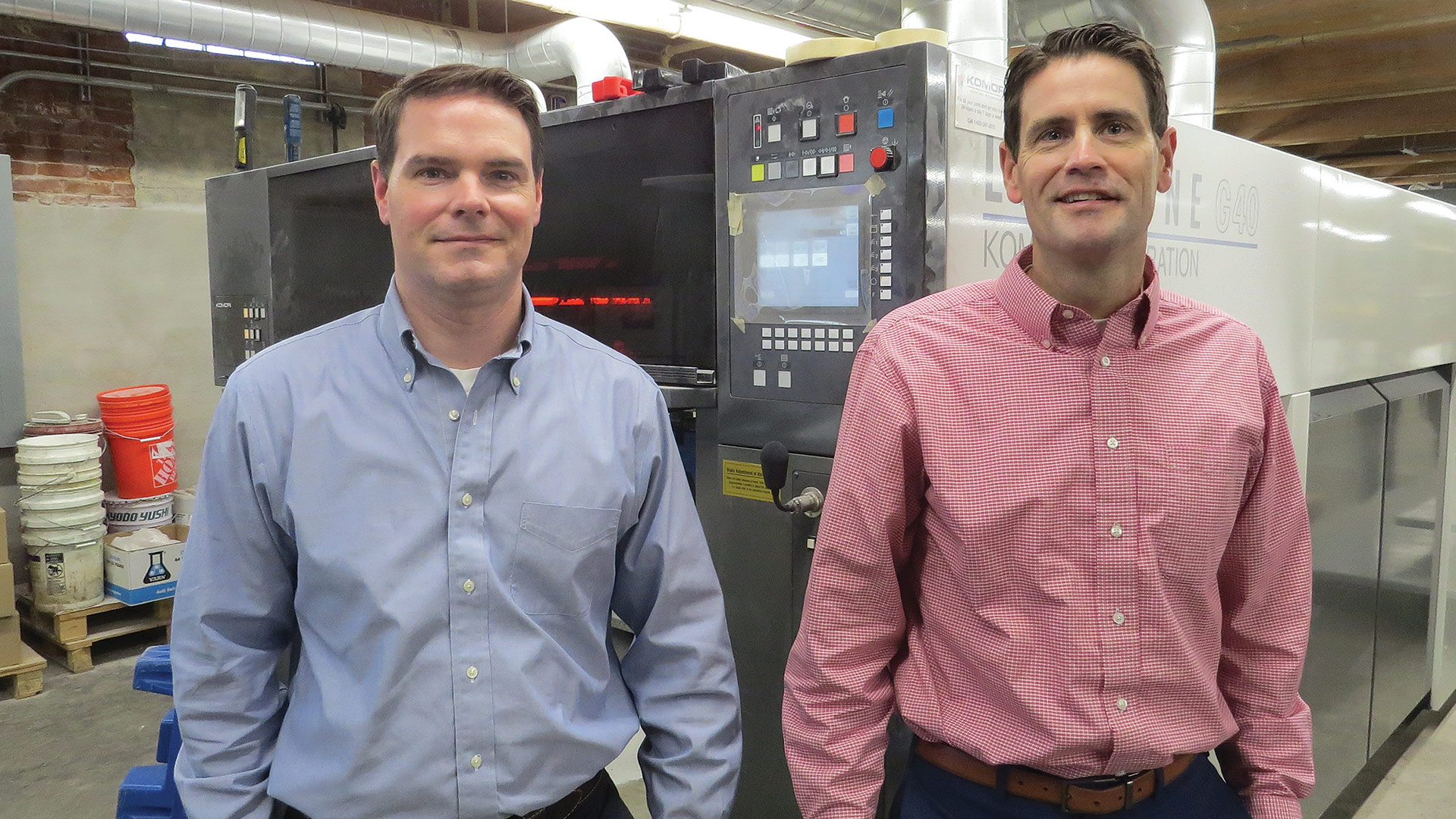
Co-owners Greg Desrosiers (left) and Chris Desrosiers
Looking back on 2020 and 2021 — when business ground to a halt for many industries, then began to ramp back up way too slowly — Chris Derosiers is grateful that Hadley Printing Co. was able to weather the storm after clients of all kinds halted jobs and dramatically scaled back on the volume of orders.
And he’s equally grateful for 2022, a historically strong year for this more-than-125-year-old Holyoke mainstay, when much of that business returned.
But the lingering effects of the pandemic years — namely inflation that has impacted Hadley Printing’s own costs as well as the marketing budgets for many of its clients — has lent an unusual inconsistency to a flow of business that had normally been very predictable.
“You hear that whole cliche term in business, ‘pent-up demand,’ and that’s what 2022 was; it was a strong bounce-back year,” he said. “But from COVID, we launched right into inflation, and prices just started to escalate, and supply chains were not quite there. And that really forced pricing up everywhere. It was a challenge, not just in our industry, but every industry.”
Hadley’s business is split fairly evenly among the educational market, direct business, and ad agencies and designers, and all three client buckets have altered spending habits in this current inflationary era, he explained; both 2023 and 2024 started slow, but eventually picked up.
“We have months where it’s all hands on deck, and then we have months where we’re looking for work or we’re catching up on maintenance because there’s not enough work in the building.”
“Inflation has caught up with everyone, and I think people are just kind of waiting to see what develops in the year ahead,” Desrosiers said, adding that even the peak Great Recession years of 2008-09 had a lesser impact on business than the past few years because that crisis ended more quickly.
“We’ve still got great things happening here. The work that we do, 98% of it is repeat customers. We really have a great staff and a great group of customers that support us,” he told BusinessWest. “But inconsistent is the right word. We have months where it’s all hands on deck, and then we have months where we’re looking for work or we’re catching up on maintenance because there’s not enough work in the building. That’s the takeaway for me; that COVID time has created inconsistency in the market.”
It has also created an environment for shops to expand their reach. Vice President Greg Desrosiers, who co-owns the third-generation family business with his brother, noted that the company is competing with printers from as far away as Maine these days, which makes sense because Hadley has also broadened its reach.
“We’ve found ourselves having to branch out and go a little bit farther when it comes to acquiring new customers,” Chris noted. “We’re going a little bit more east on the pike, and we’re going a little bit more west, trying to supplement some of that inconsistency in our business model.

Hadley Printing has been in its current location on one of Holyoke’s historic canals for the past 48 years.
“That market in Worcester has been a good one for us because there are printers in Boston, but that Central Mass. area has fewer commercial printers,” he went on. “So we tend to do well in that market because we’re priced a little bit more economically than that Boston printer who’s also coming in.”
One-source Solution
Hadley Printing offers a range of services, including digital printing, offset printing, and mail services, to a wide variety of customers in New England. Chris Desrosiers noted that it’s been critical to keep investing in new technology, but also to never neglect the human touch and the value of strong service.
“We have constantly reinvested back into our business every year with new equipment to better serve our customers,” he said. “But the biggest thing that I’ve seen is that people are looking to get it done at a fair price, on time, and make sure they’ve got a good product.
“We have a lot of repeat customers here because we take a lot of pride in what we do and make sure that, when we deliver, we’re delivering on time, we’re delivering a superior product, and it’s at a fair price,” he went on. “There’s always going to be that customer that’s looking for a cheaper price, but usually you get what you pay for. Sometimes, if we have a customer who goes somewhere else for a lower price, they’ll do that once or twice, and then they end up back here. That’s not to say that we’re superior to everyone else, but we do put a high focus on quality and delivering for our customers.”
Another selling point, he said, is to be a one-stop shop for all types of jobs.
“Whether it’s something as simple as a business card or anything from small quantities to large quantities, we like to be that one-source solution so that we don’t have to say ‘no’ to a customer. So we have a lot of different equipment on the floor to be able to support all of our customer demands and requests, and it allows us to service the customer from top to bottom.”
Desrosiers noted that Hadley has two 40-inch Komori offset presses that service the higher-end, large-volume offset market, but the shop can also focus on the quick-turn, smaller-volume digital market. The business has also added mailing capabilities over the last five years.
“There’s always going to be that customer that’s looking for a cheaper price, but usually you get what you pay for. Sometimes, if we have a customer who goes somewhere else for a lower price, they’ll do that once or twice, and then they end up back here.”
“We found that, usually five times out of 10, the customer is looking to have a piece mailed as well. So that’s part of that whole one-source solution — a customer can come to us and have it printed and dropped in the mail stream; we can handle the whole process,” he explained. “We’ve also brought a lot of finishing techniques in-house. We do in-house foil stamping, embossing, and die cutting. That’s something that we’ve really expanded into in the past five years.”
As a result, he said, “for any account, no matter what they throw at us, nine times out of 10, we can say ‘yes, we do that.’ We do use outside vendors, but, decreasingly so in the last five to 10 years. We’ve really set up our company to be a one-source solution.”
Seeking Sustainability
Hadley Printing originated in South Hadley, but in 1976, it moved to its current location on Canal Street in Holyoke, a 32,000-square-foot former silk mill alongside one of the city’s historic canals.
“It’s been a good spot,” Desrosiers said. “Up until 2006, we were renting part of our space out, but we’ve now taken over the entire building, and we’re using every inch of it.”
Because of its location, at least 50% of its power comes from hydroelectric energy. “That’s obviously a selling point. A lot of customers are looking for that environmental factor, the green manufacturing. And we have two things going in our favor there: hydroelectric power, and we’re also an FSC-certified printer.”
Certification by the Forest Stewardship Council ensures that the products in a print job come from responsibly managed forests, and Hadley Printing, which has been certified since 2011, must undergo an audit each year to retain that mark.
“It’s about chain of custody, and it assures the end user that the product was manufactured in a sustainable, green way,” Desrosiers added. “For example, we just did the UMass commencement. We printed 20,000 programs, and on the back of that program, they’ve got the FSC logo that states that it was printed on FSC paper in a sustainable way. And then it’s got a message that encourages people to either recycle that program, archive it, or share it with others.
“That’s usually driven by the customer; what it takes is a customer that wants to print an FSC order. We do about 50 FSC orders a year; it’s just an added level of service that we provide. Most businesses out there are environmentally aware, and they want to print in a sustainable way.”
While the focus on sustainability has increased over the years, the number of commercial printers in the market has consolidated somewhat — though, as noted earlier, they’re competing for a shrinking, or at least more unpredictable, pool of jobs.
“It’s a very capital-intensive business as well,” Desrosiers said. “You constantly have to reinvest in equipment to be able to produce work in an economical way and be competitive. Some of the businesses that didn’t reinvest in new equipment on their floor have had challenges being able to meet customers’ demands.
“Putting a 40-inch commercial press on the floor is a big financial commitment, sure. And you’ve got to make sure you’ve got the volume of work to support it,” he added. “But once you do have that equipment, it allows you to produce work in a more efficient way. So it’s a double-edged sword. But not reinvesting in the business is where I think a lot of companies have fallen out of being competitive in this market.”
A more predictable market, as in the pre-pandemic days, would help all players in this field, but Desrosiers knows his industry not alone there.
“Whether it’s printing, whether it’s construction, whether it’s banking, everyone is just trying to ride the roller coaster,” he said. “But overall, we’re doing well. We’re adapting to those changes. And I think we’re well-positioned in this market going forward.”