Home Posts tagged Parents
Education

Balancing School and Life


Amy Woody

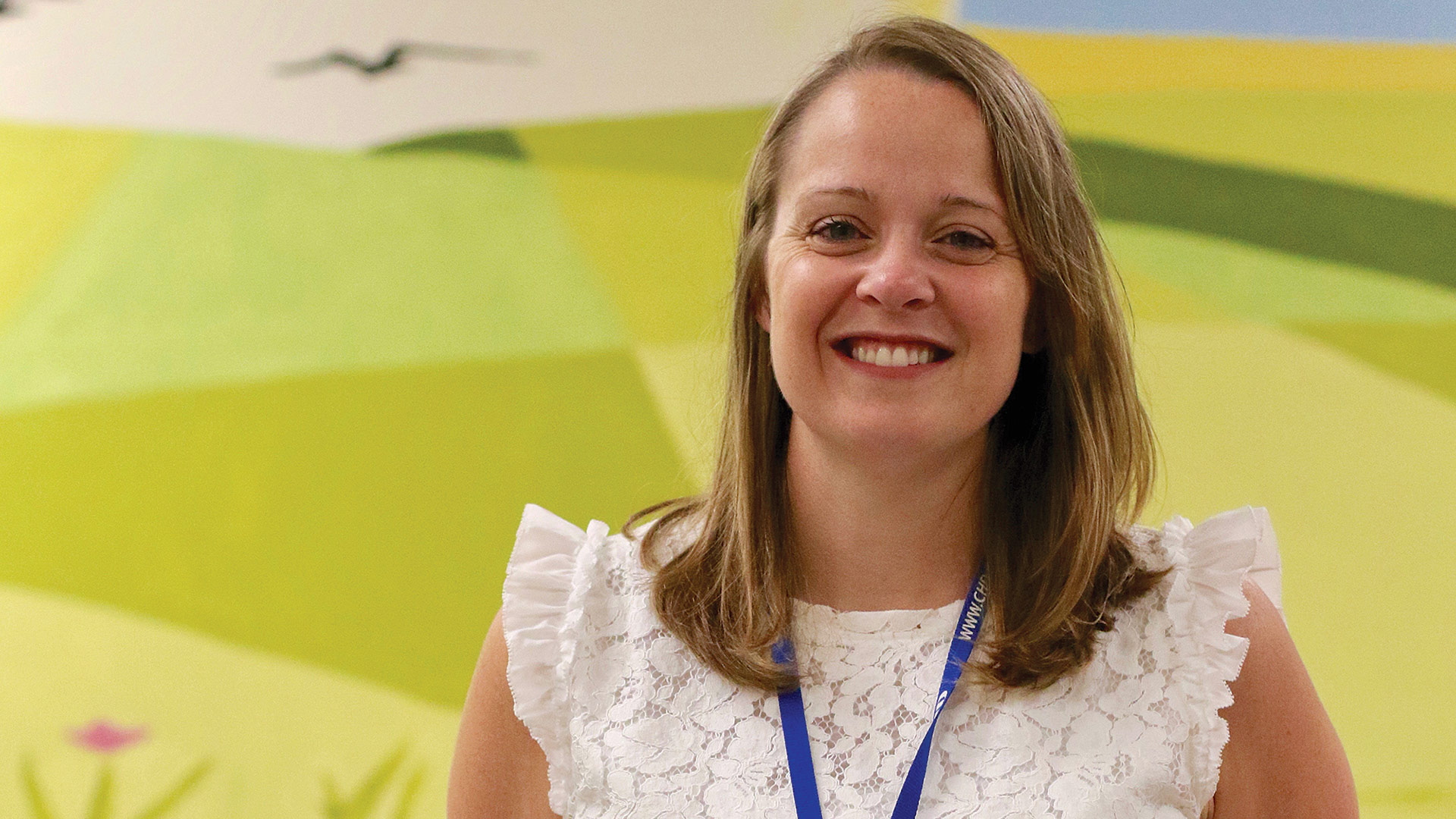
Amy Woody stands in the new Marieb Adult Learner Success Center.


Amy Woody knows something about adult learners — students who enroll in college later in life than the typical 18-year-old high-school graduate — because she was one.

When she started at Holyoke Community College in her 20s, she had a 1-year-old son, so she also knows what it’s like to be a student and parent at the same time. So it’s been personally gratifying for her to see the development of a new support program for adult learners and student parents at HCC, which opened last month.

The Marieb Adult Learner Success Center and the Parent Learning Center are funded through a $1 million gift from the Elaine Nicpon Marieb Foundation, established by the late Elaine Marieb, an HCC alum and long-time member of its biology faculty who went on to become a bestselling author of anatomy and physiology textbooks.

“In her generosity and love of lifelong learning, she earmarked this money for the adult-learner and student-parent community,” said Anne Medina, HCC’s associate director of Enrollment and Recruitment. “She herself was an adult learner and understood the unique challenges adult learners face as older students. She firmly believed that they needed dedicated programs and spaces on campus to be successful in their studies.”

Woody agrees. As coordinator of the Marieb Adult Learner Success Center, she told BusinessWest that, as the college began to see an influx of adult learners coming in from MassReconnect — a state program launched in 2023 offering free community-college tuition to students over age 25 — one of the things it was missing was a space where students could be on campus with their children. The Parent Learning Center fills that need.

“She herself was an adult learner and understood the unique challenges adult learners face as older students. She firmly believed that they needed dedicated programs and spaces on campus to be successful in their studies.”

“We were finding they had gaps in their schedules, and they just wanted some place where they could go be with their kids and study,” Woody said. “So we realized this could be a valuable place for students to be on campus, include their children in a family-oriented space, and not feel as though they’re distracting others, or that their kids don’t have a place here. We really believe that education is a family affair, so we’re trying to create spaces and programming that bring the whole family in and not just the student.”

Meanwhile, the Marieb Adult Learner Success Center is for older students in general, not just parents, she added. It’s a more quiet space where students can study, have coffee and snacks in the kitchen, but also access academic advising and workshops to support both academic and life skills.

“It’s not just about turning your work in on time, but how do you manage that with your entire life, your kids and your family and your cooking and your cleaning and all of that fun stuff?” Woody said. “So we try to do programming that honors the adult learner as an entire person and not just a student.”

The Marieb Adult Learner Success Center is a small lounge and study area with adjoining staff offices, while the Parent Learning Center, just across the hall, is a much larger space that contains a desk with a secure play or napping area for small children, as well as a pack and play, changing station, large-screen TV, conference table, art easel, and learning corner with children’s books and toys.
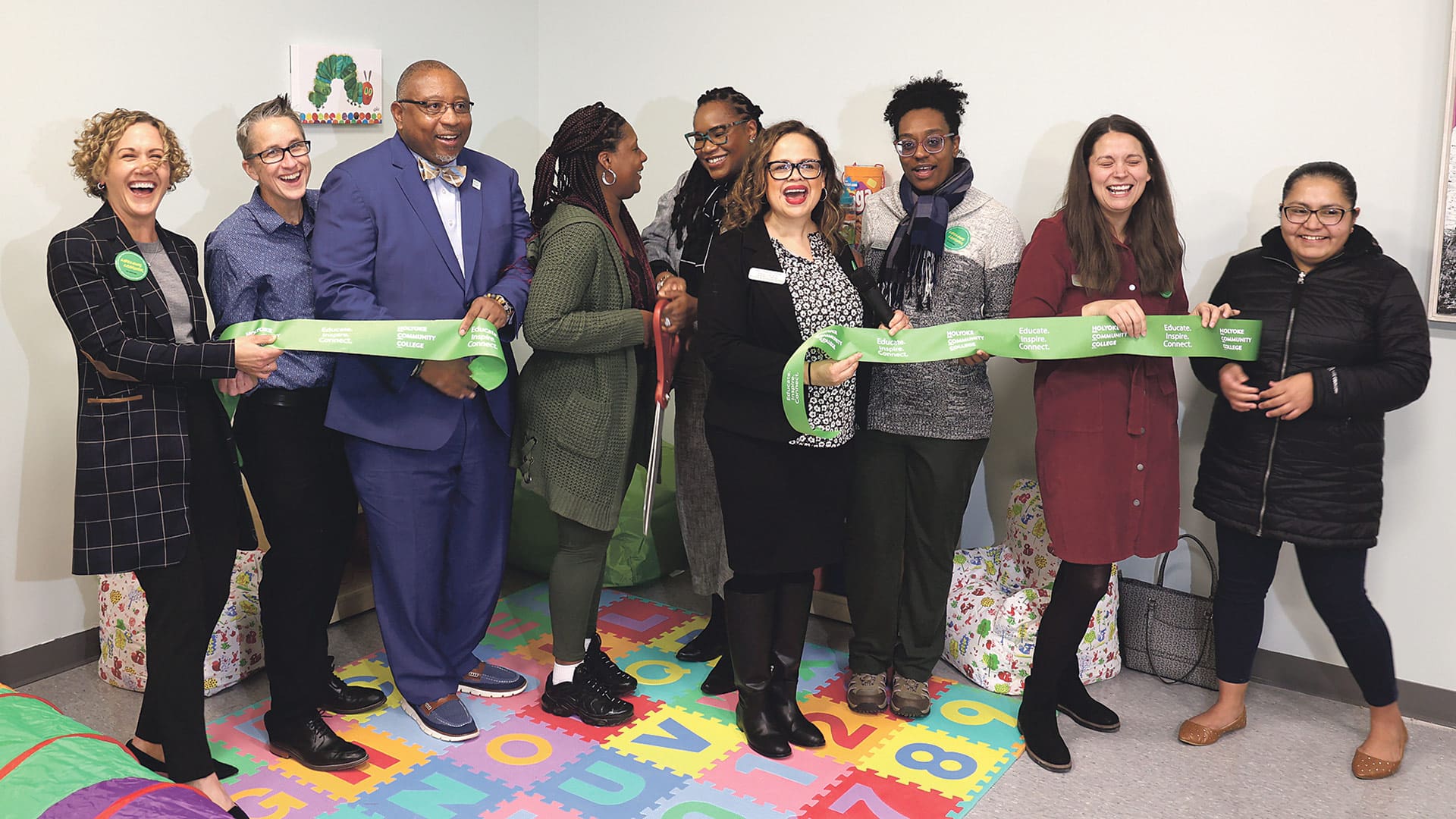
grand opening with a ribbon-cutting ceremony on Dec. 11.

HCC President George Timmons (third from left) helps celebrate the grand opening with a ribbon-cutting ceremony on Dec. 11.

“The Parent Learning Center is a workspace where students can bring their laptops, sit and work on group projects, or just kick back and relax for a while, where they can have their kids with them and feel safe and welcome,” Medina said.


Evolving Effort

Before the Marieb Adult Learning Success Center, HCC housed a program in that space called New Directions for Adult Learners, as well as its Pathways program, which is a transfer program mostly focused on adult women learners.

“The New Directions program was relatively small — it was just one academic advisor who was really running that whole program,” Woody said. “Now we have three full-time staff members, and we’ve been able to scale up the program significantly. When the New Directions program ended, there were between 60 and 80 students, and now, in our first year, we have about 200 enrolled in this program.”

More students have expressed interest as well, she added. “so we were able to take a model that was working — offering this extra, holistic support to adult learners — but scale that up to a much bigger level so that we can serve more students.”

Woody feels that having such a resource could encourage adult students to enroll while helping them stay successful on their academic journey.

“That’s one of the big things — can we make it any easier for them? We recognize that they’re sacrificing a lot of time away from their families, so that’s one of the reasons why we wanted to give back with these spaces where the whole family can be involved.

“A big part of our program is recognizing that being an adult learner is just one aspect of their identity, and there are so many other things going on in their lives,” she added. “So offering programming in the evenings, or by Zoom, or just doing little things that make us more accessible to them in their busy lives, is really helpful. So is that holistic advising piece, having a person you can call up with whatever issue you’re having, and they can help you troubleshoot and walk you through it and just remind you that you belong here at HCC, no matter what’s going on.”


Generational Impact

The ceremonial check from Elaine Marieb still hangs in the center named after her, for two reasons, Woody said.

“First of all, her generosity is what made all of this possible, and I think that’s amazing. But also, she’s a wonderful example of an adult learner, somebody who came to HCC as an adult, pursuing a nursing career.”

She noted that about 70% of students in HCC’s nursing program would be classified as adult learners, so that demographic is helping to fill persistent shortages of talent in the field, which lends another layer of importance to efforts to support them on their academic journey.

“And I was an adult learner here at HCC,” said Woody, who used her associate degree there as a springboard to a bachelor’s degree at Westfield State University. Meanwhile, her son is now 18; he’ll graduate from high school this spring and just completed his first psychology class at HCC.

“So, when I say it’s a family thing, I really believe that,” she went on. “I think seeing me here was a big push for him to say, ‘I can do this.’ It’s made a big impact on how he approaches his education.”
 

Health Care

Baby Steps

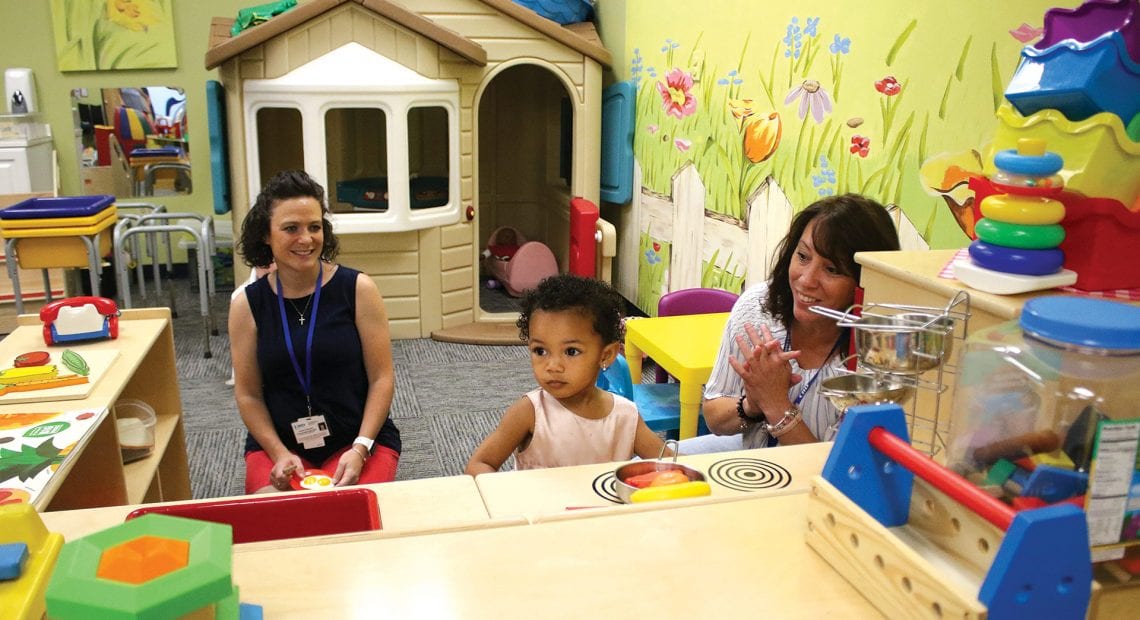
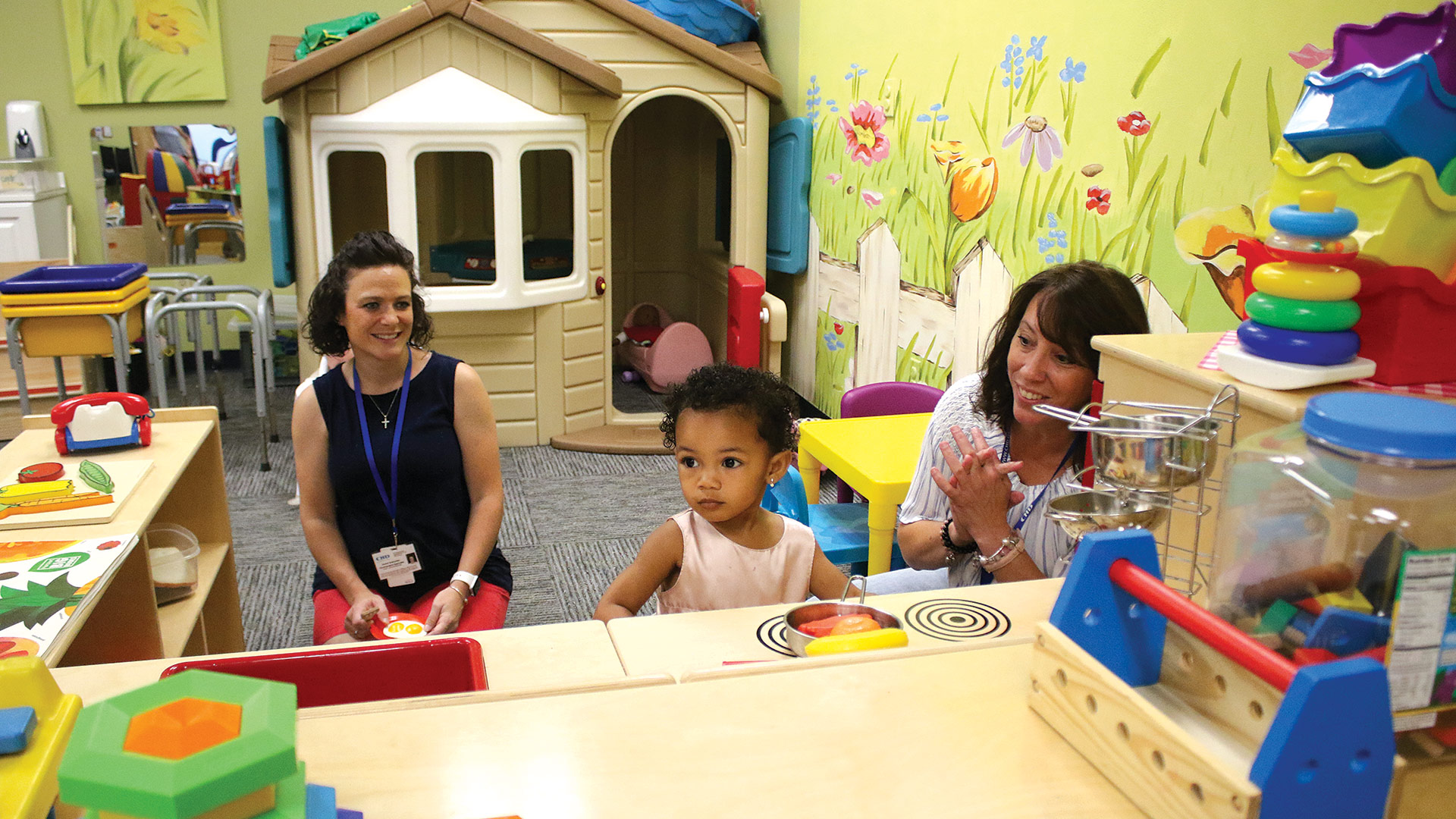
Rachel Szlachetka, Jazz, and Cindy Napoli play in the kids’ room at the Center for Human Development facility on Birnie Ave in Springfield.

When looking at 2-year-old Jazeilis “Jazz” Jones, she seems like any normal toddler who loves to eat and play. But what you can’t tell from looking at her is that Jazz, born a month prematurely, has overcome several developmental hurdles to get to where she is today.

When Diany Dejesus gave birth to Jazz, she was already fighting her own battle with anxiety and depression. A newborn baby who wouldn’t latch to her breast or drink from a bottle only added to her stress and made it nearly impossible for Dejesus to sleep at night. After talking with her therapist, she was referred to the Early Intervention program at the Center for Human Development.

Today, Jazz could seemingly eat all day if you let her, and Dejesus is exponentially more confident as a mother.

This success story, like others similar to it but unique in some ways, wasn’t written overnight, but rather over time and through perseverance — as well a partnership, if you will, between the parent and the 22 staff members of the Early Intervention program.

Erinne Gorneault, a licensed clinical social worker and program director, explained how it works. She told BusinessWest that each child is unique and grows at his or her own pace. But sometimes a child needs help.

“It’s the best feeling in the world to feed your kid. Everybody should be able to have that joy in feeding, and it can be so stressful for our kids who are developmentally delayed or on the autism spectrum.”

With a caseload of 230 families, CHD’s Early Intervention program works with infants and children from birth to age 3 who have, or are at risk for, developmental delays. A CHD team can assess a child’s abilities and, if indicated, will develop an individualized plan to promote development of play, movement, social behavior, communication, and self-care skills. Staff members work with children and their families in their own environment.

The work is extremely rewarding, said Cindy Napoli, an occupational therapist and program supervisor of Early Intervention, who cited, as just one example, how the program can help give parents the gift of being able to feed their child.

“It’s the best feeling in the world to feed your kid,” she said. “Everybody should be able to have that joy in feeding, and it can be so stressful for our kids who are developmentally delayed or on the autism spectrum.”

For Jazz, her biggest challenge was with feeding. At one point, she was labeled as “failure to thrive,” meaning she was unable to grow or gain weight. Even when Napoli and other CHD staff found a solution by having her drink through a straw, she was still struggling. Now, Jazz is thriving, eating more than enough food to keep her healthy, and speaking in full sentences.

“She’s doing so great, I’m so amazed. At the beginning, it started off so slow, I was really afraid for her. I didn’t know what I was going to have to deal with, but she’s way ahead of herself now.”

Erinne Gorneault says that being receptive to parents’ wants and needs is a critical part of the early-intervention process.

For this issue, BusinessWest takes an in-depth look at CHD’s Early Intervention program and that aforementioned partnership between team members and parents to achieve life-changing results for both the child and the parents.

Food for Thought

Gorneault said parents often contact CHD’s Early Intervention program because they are concerned about their baby or toddler’s development in the areas of speech delays, or delays in walking or crawling.

The experienced team can assess the possibility of a delay and work with parents and their children to help them attain their milestones — essentially, to catch up — if that’s what’s needed.

Program staff members also work with children diagnosed on the autism spectrum, infants and toddlers with feeding concerns, toddlers with sensory issues, and infants and toddlers with medical needs. They support the family by providing education and improving developmental milestones through teaching parents to interact with their infant or child while building strong emotional relationship. In all cases, staffers work with families to connect them with other community services that might be helpful and provide several playgroups for both community members and CHD Early Intervention families to participate in without interactive team members.

Although the 22 staff members in the program may be the experts, Napoli said the most important part of their work is going at the parents’ pace and empowering them to be advocates for their child.

“It’s about enabling and empowering the parents to be the lead person and the specialist,” she said. “We believe the parents are the specialists. It’s about empowering them and teaching them how to be advocates.”

Gorneault agreed, adding that the trans-disciplinary approach used at Early Intervention allows them to guide parents effectively while also keeping them in the driver’s seat.

Diany Dejesus says that one of the most beneficial things that has come out of her participation in the Early Intervention program with daughter Jazz is that it has built up her confidence as a mother.

“We just help; the parents are the ones doing all the work,” she told BusinessWest. “They’re the ones working on the outcomes; they are making the difference.”

With occupational therapists, physical therapists, and speech therapists in the program, staff members use a trans-disciplinary approach to work with families and find the best way to help achieve milestones.

“You don’t go in there with blinders on, thinking, ‘I’m only here for feeding,’ or ‘I’m only here for walking,’” said Napoli. “It’s about where the child is at, where do we want them to go, what are the priorities of the family, and how can we all do it together?”

One of the most important aspects of this program, said those we spoke with, is that the specialists work with the families in their most natural environment, usually the home or a day-care facility, in order to get the most successful outcomes.

“Being in the home, you’re able to adapt the environment,” said Napoli. “You’re able to see what they’re cooking. I can’t say enough about the natural environment.”

One of the priorities during the hour-long sessions staged over several weeks is working on what is most difficult for the parents, said Napoli. Once staffers have made their suggestions, their goal — and their hope — is that parents continue to practice the suggested strategies on their own.

“You’re modeling in hopes to encourage the parent to do the same thing,” she explained.

This is important, she said, because while CHD staff see the child for only one hour a week and specialists may visit a family at different times, parents are with the baby daily, almost 24/7.

Gorneault agreed, adding that being receptive to the parents’ wants and needs is a critical part of the process.

“They run the show,” she explained. “We make recommendations, but if they’re not ready for that, we slow down and just stay at their pace and support them and build their confidence as parents.”

A Matter of Confidence

And a confidence boost was exactly what Dejesus needed.

“I started off doubting everything, due to the fact that I have anxiety and depression; it just made it so much harder for me,” she said. “Little by little, with a lot of help from here and from my therapist, I just got reassured more, and it made me that much more confident.”

Dejesus said the people she interacts with at CHD are like another family, and have helped her achieve the confidence she needs to be a great mother.

“Having more people that can help you and guide you, that really did help me a lot,” she said. “Now, I trust myself and my instincts as a mom when it comes to Jazz.”

Kayla Ebner can be reached at [email protected]