
Moving On Up
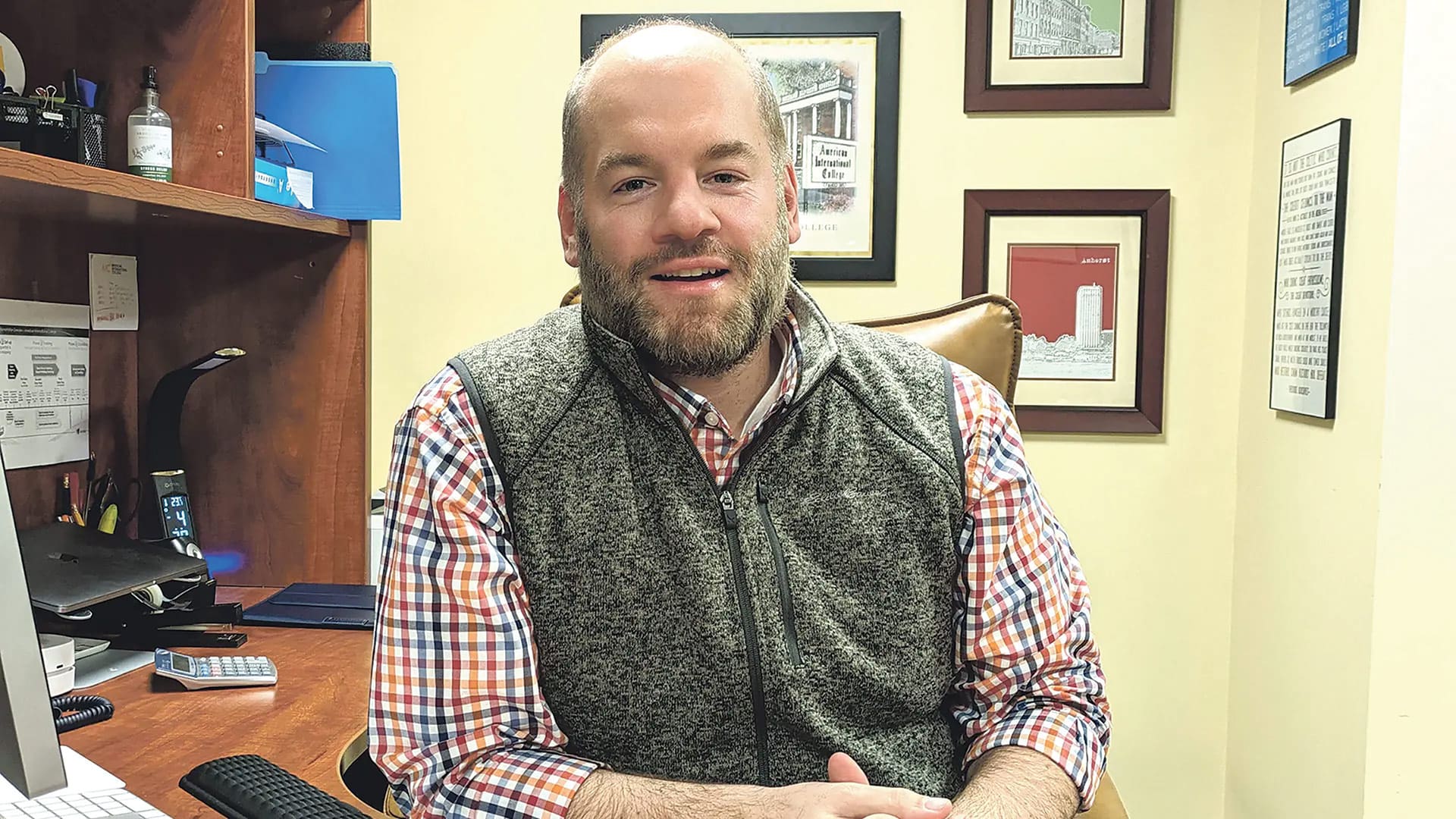
American International College Provost Michael Dodge
When Michael Dodge thinks about the 227 students from Duggan Academy in Springfield currently taking classes at American International College (AIC), he understands who benefits the most — and it’s not necessarily the academic high achievers who already have their eyes on college.
“We’re reaching the ones saying, ‘college isn’t for me,’ or ‘I’m not smart enough,’ or ‘no one in my family has gone to college.’ And we’re saying, ‘this program is for you.’ We’re helping students that might not have thought of college as an option — helping it become an option for them.”
Dodge, AIC’s provost, was describing the college’s relationship with Duggan, which began three years ago with high-schoolers taking classes for college credit, and has now become much more robust with AIC being designated as a Massachusetts Early College Program by the state’s joint Early College Committee.
AIC, in partnership with the Springfield Empowerment Zone Partnership (SEZP), is one of 18 new Early College programs announced this year by the Healey-Driscoll administration, and the only private college west of Worcester to receive this designation.
“Those students are taking a total of 900 credits,” Dodge said. “Given our successful pass rates with Duggan, that’s bringing in a significant number of students who are picking up a lot of college coursework that they now have under their belts as they think about where they want to go after high school.”
Notably, the program is a ‘wall-to-wall’ model in which every Duggan student participates. Students have the opportunity to earn up to 60 college credits — at no cost — before graduating from high school. Courses focus on high-growth, high-wage fields including allied health, education, and criminal justice.
“We’re reaching the ones saying, ‘college isn’t for me,’ or ‘I’m not smart enough,’ or ‘no one in my family has gone to college.’ And we’re saying, ‘this program is for you.’”
“We wanted to focus on fields that are in demand and lead to well-paying jobs,” Dodge said. “This puts them on a path to pursue an associate degree either at AIC or a community college or another four-year institution.”
The model ramps up the college coursework as they advance, he explained. Freshman year orients them to the expectations of a college class, and what follows is coursework in general education classes that are easily transferable, regardless of institution.
“Those include things like English composition, analytical writing — things that can help them be better writers and critical thinkers, which sets them up for success when they get to their junior year and senior year,” Dodge noted.
In those final two years of high school, students are blending college-credit courses at Duggan with classes they actually take on the AIC campus, he explained. “We want you to come to AIC, but regardless of where you go, you’re setting up a strong foundation to help you be able to keep pace with the academic rigor that exists at a college.”
While Duggan students have already been earning AIC college credits, the new designation is designed to build on that success and help even more students access college by removing common barriers.
Key program features include personalized support, including small cohorts, academic coaching, and dedicated advisors for multilingual and exceptional learners; advising to promote college readiness; culturally responsive teaching and staffing to reflect and support the student population; and universal access, with 100% of Duggan students participating regardless of prior academic performance.
Tricia Canavan
“Tech Foundry’s senior team has been collaborating with various members of UMass leadership in a variety of ways over the last couple of years. Our partnership has evolved to include working with the IT staff on workforce priorities and employment opportunities.”

“All students deserve opportunities to succeed,” Dodge said. “Early College is about more than earning credits — it’s about building the skills, confidence, and support networks students need for college and life.”
Priming the Pump
Early College is just one way the state has been trying to draw more students into the college pipeline. The most notable ones, of course, have been MassReconnect, which made community college free for Massachusetts residents age 25 or older, and, more recently, MassEducate, which extended that tuition- and fee-free model to any resident, regardless of age, who has not yet earned a bachelor’s degree.
Beyond that, many of the state’s community colleges have forged articulation agreements with four-year institutions, under which students who satisfactorily complete an associate degree program are guaranteed admission into a bachelor’s degree program at the four-year school.
One of these partnerships, between Elms College and both Holyoke Community College (HCC) and Springfield Technical Community College (STCC), deepened recently by allowing students of those two community colleges to reside in residence halls at Elms.
STCC and HCC are commuter colleges and do not provide on-campus housing, so the agreement benefits STCC and HCC students who have housing needs, while creating the kind of familiarity with the Elms campus and culture that makes it more likely they’ll pursue a baccalaureate degree there.
“Elms College, for nearly 100 years, has prided itself on promoting educational opportunities to those who would otherwise not have access, and being a collaborative partner with our neighboring colleges. This agreement accomplishes these goals and expands our strong partnerships with HCC and STCC,” Elms President Harry Dumay said. “Our campus has always been a welcoming, inclusive community, where we work hard to ensure that everyone feels like they belong in the spirit of our founding mission. HCC and STCC students now get to discover that aspect of the Elms experience.”
Other regional partnerships target an older demographic — people who either never attended college or started but didn’t finish.

Elms College President Harry Dumay recently announced that the college expanded its articulation agreement with HCC and STCC to allow students at those colleges to live on the Elms campus.
One recently announced collaboration between UMass Amherst and the Tech Foundry — the Springfield-based workforce development nonprofit that trains local residents for IT careers — enables Tech Foundry staff and community members to complete their undergraduate degrees through the university’s flexible, customizable online program.
Specifically, Tech Foundry members can take classes, receive academic counseling, and map their educational pathway through UMass Amherst’s University Without Walls Department of Interdisciplinary Studies (UWW-IS).
Current UWW-IS admission requires 12 transferrable college credits and a 2.0 GPA for adults who did not previously attend UMass Amherst. As part of its program, however, UWW-IS offers credit for prior learning or life experience. Under the new agreement, students who are accepted into UWW-IS and have completed Tech Foundry’s 18-week immersive hybrid training program will receive 15 credits via special transcript, which is equivalent to a full semester courseload. The collaboration builds on earlier programs in which UMass Amherst IT provided internships for Tech Foundry trainees.
“Tech Foundry’s senior team has been collaborating with various members of UMass leadership in a variety of ways over the last couple of years. Our partnership has evolved to include working with the IT staff on workforce priorities and employment opportunities,” said Tricia Canavan, CEO of Tech Foundry, who called the new collaboration an important expansion of opportunity for Tech Foundry students.
“We’re really centering equity efforts. We don’t always want to polish just the shiniest of apples, but we’re making sure we’re reaching out to that student who may not have thought of college as an option — but help them do it in ways that make sense.”
UWW-IS Department Administrator Siobhan Henderson said the collaboration also enhances University Without Walls’ longtime relationship with Springfield residents. “We are committed to meeting learners where they are — professionally, academically, and geographically. This collaboration aligns with our UWW-IS mission that was founded more than 50 years ago: to open doors to adults who thought achieving a bachelor’s degree was unattainable.”
Opportunity Knocks
Gov. Maura Healey has called Early College programs a central element of her administration’s Reimagining High School initiative to prepare students for college or careers and expand access for those historically underrepresented in higher education — at a time when higher education is already facing demographic headwinds in the form of fewer high school graduates.
“Early college is an important and effective tool for making higher education more accessible and affordable for every Massachusetts student,” she said earlier this year. “These new partnerships give more young people the opportunity to earn college credit at no cost while still in high school, setting them on a path to success and helping to close opportunity gaps.”
Dodge sees such efforts as steps in the right direction, and considers the college campus immersion element an important part of the process.
“The intent, in senior year, is to have students be on our campus taking college-level courses, similar to the models for dual enrollment in the past,” he explained. “Students can take 12 to 15 credits over the course of senior year — typically four to five classes — develop some affiliation with the institution, and be able to take some independent coursework and things very specific to their planned major, so it’s not just, ‘oh, I come to campus for one class and then leave. Instead, they’re thinking about being on campus most of the day for Tuesday and Thursday, or Monday, Wednesday, and Friday.”
He also appreciates the Healey administration’s focus on equity and helping close performance gaps.
“That’s one of the reasons why we applied for this designation with SEZP and the Department of Higher Education. We’re really centering equity efforts. We don’t always want to polish just the shiniest of apples, but we’re making sure we’re reaching out to that student who may not have thought of college as an option — but help them do it in ways that make sense. That’s why we start small, one or two courses freshman year, then building up intentionally and bringing them into the fold in college.
“We’re really thankful for the support from SEZP and the Department of Higher Education, and we value the partnership we have with Duggan and the Springfield Public Schools,” Dodge went on. “We think it’s a partnership that makes sense in this current environment, this academic cliff where fewer 18-year-olds are going to college. It seems like what the future of higher education needs to be.”