Collaboration in Health and Wellness
Director of Healthcare Workforce Initiatives, MassHire Hampden County Workforce Board
She Helps Put Future Healthcare Heroes into the Pipeline
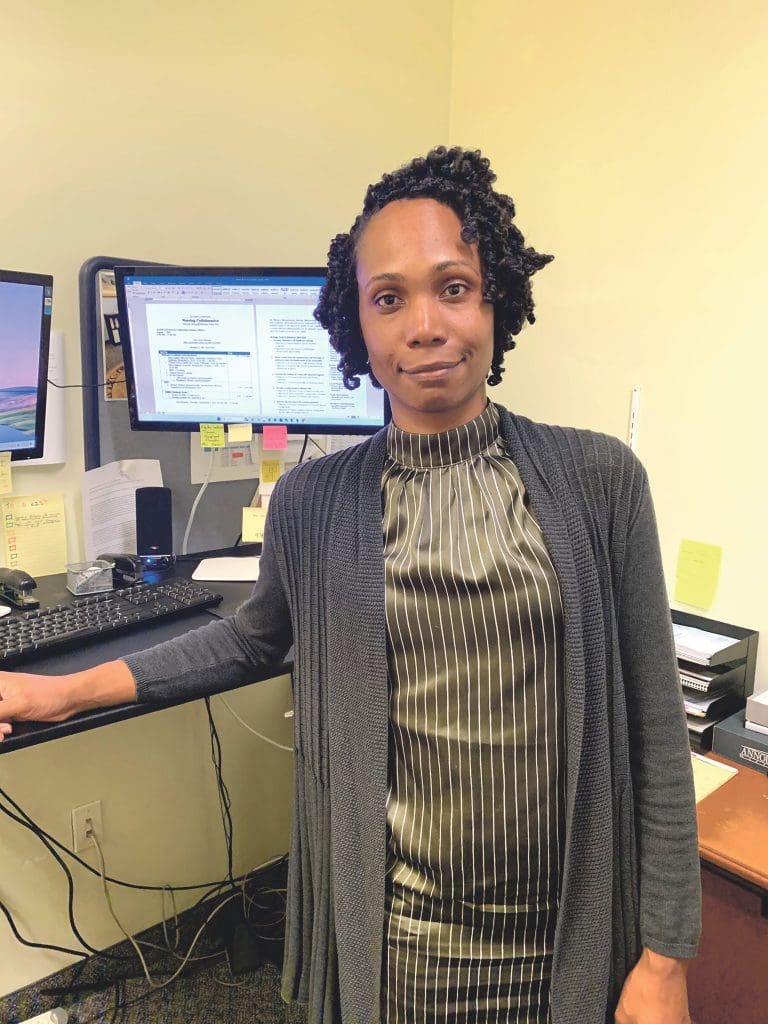
Peta-Gaye Johnson
Peta-Gaye Johnson is not your typical Healthcare Hero.
Indeed, in the eight-year history of this recognition program, there hasn’t been an honoree quite like her.
She’s not a provider of care, like a doctor, nurse, or occupational therapist, and she’s not an administrator in a healthcare facility; in fact, she’s never worked in the healthcare sector. Nor does she teach those who want to enter this profession, as several honorees, including two in the class of 2024, do.
But as the director of Healthcare Workforce Initiatives for the Hampden County Workforce Board, she works with administrators, educators, and others to help ensure that there is a reliable pipeline of workers — and, yes, potential Healthcare Heroes — for this sector.
Thus, “she has been the cornerstone for driving successful workforce-development programming to strengthen the region’s workforce and enhance the quality of patient care,” said Peter Farkas, who became president and CEO of the MassHire Hampden County Workforce Board earlier this year and nominated Johnson for this award.
Johnson is the winner in the Collaboration category, specifically for her efforts to foster collaboration — between the region’s larger healthcare providers, its colleges and universities, community-based organizations, and philanthropic agencies — and, in many respects, to lead these collaborative efforts.
They include:
• The Healthcare Workforce Partnership of Western Massachusetts, a MassHire inititive that, through Johnson’s leadership, responds to the workforce needs of employers and ensures that workers have access to the education and training needed to prepare them for lifelong careers in a changing industry;
• The Western Massachusetts Nursing Collaborative (WMNC), one of three working groups within the partnership — the others are the Allied Health Working Group and the Pioneer Valley Interprofessional Practice and Education Collaborative — and one that has made great strides to ensure that the region has an adequate supply of nurses;
• A website called westernmasshealthcareers.org, which Johnson developed to provide area residents with relevant information on occupations and career pathways in the healthcare industry;
• The Pioneer Valley Healthcare Center Pathway Forum, an annual event that brings together high-school guidance counselors from across the region to provide them with information to assist and direct students to enroll in and successfully complete health science programs; and
• Her work to oversee and drive a three-year grant to train 174 unemployed and underemployed individuals in the Pioneer Valley for careers as medical assistants, EMTs, recovery coaches, and behavioral resource technicians.
Summing up all these initiatives and Johnson’s involvement with them, Farkas said it’s not necessarily what she does for this sector — the largest employer in the Pioneer Valley, with roughly 73,000 jobs — that makes her a Healthcare Hero, although that’s certainly part of it. It’s how she goes about this work.
“She’s very passionate about the industry, and she’s a leader when it comes to driving the agenda,” he said, adding that it is her job to not just convene the partners working with the workforce board, but to help them set goals and objectives and then create strategies to meet and, hopefully, exceed them. “She’s a good listener and helps build consensus.”
Using these skills, she’s helped area providers address recognized shortages when it comes to many occupations within this broad sector, including nurses, CNAs (certified nurse aides), home health aides, medical assistants, emergency medical technicians (EMTs), and others.
“Before, it was mostly about numbers. Now, it’s beyond numbers — it’s about how people feel about their work, the appreciation they feel for the work they’re providing for the community.”
Beyond that, the collaboratives she leads address myriad other workforce-related issues, from retention of valued workers, to the different generations working together in healthcare and how the wants and needs of each one is different, to the seismic changes that came about during, and because of, the pandemic.
She said the region, and its healthcare sector are still experiencing a workforce crisis, but one where the parameters — and priorities — are shifting.
“Before, it was mostly about numbers,” she said. “Now, it’s beyond numbers — it’s about how people feel about their work, the appreciation they feel for the work they’re providing for the community.”
Johnson said her work is rewarding on many levels, and when asked what she likes most about, she said simply “the collaboration piece.”
“That’s the one thing I’m really excited about,” she told BusinessWest. “The people who are part of our collaboratives are leaders of our collaboratives, so when anything comes up I can reach out to these people, and I always get a ‘yes’ — no matter what it, no matter what I ask them to do, I always get a ‘yes.’

Peta-Gaye Johnson (first row, center) with the other members of the Western Massachusetts Nursing Collaborative.
Elaborating, she said the stern workforce challenges facing this sector require collaborative efforts — individuals sharing information and experiences and working together to meet agreed upon goals — and she is inspired by the way these groups go about their work.
Meanwhile, others are inspired by her efforts to lead these collaboratives and address challenges old and new. And this is why she is a different kind of Healthcare Hero.
Hire Education
1. Increase retention in all healthcare settings;
2. Ensure nurses have comptetencies and full scope of practice to meet the healthcare needs of the community;
3. Increase the number of nurses with advanced degrees;
4. Increase nursing faculty in Western Mass.;
5. Increase the diversity of the nursing workforce; and
6. Sustain the partnership.
These are the stated strategic goals and objectives of the WMNC, and they, and the progress made toward achieving them, are reviewed at each monthly meeting, said Johnson, adding that this is just one of many meetings, most of them now by Zoom, that she attends on a regular basis.
Meetings are just a small but important part of her job description, she said, adding that such sessions help keep the many agencies and institutions partnering with the workforce board focused on goals like those stated above.
And these goals provide some real insight into how Johnson and all those she works with keep one eye on the present when it comes to the workforce needs of the region and the healthcare providers that call it home, and the other eye on the future.
“We try to project what our future needs will be and address those needs before they come,” she said, adding that this proactive approach helps ensure an adequate pipeline of workers across the broad spectrum of healthcare and social services.

Peta-Gaye Johnson and members of the Western Massachusetts Nursing Collaborative celebrate the WMNC’s 16th-year celebration lunch.
Filling this proverbial pipeline is just part of the job description for Johnson, who came to the workforce board 13 years ago. She started as an intern while working toward a master’s degree in social work at UConn, and took part in the Hasbro Summer Learning Initiative. She was hired by then-President and CEO Bill Ward, working part-time on the summer learning initiative and part-time with Kelly Aiken, then-director of Healthcare Workforce Initiatives.
When Aiken left for another opportunity in 2016, Johnson was encouraged to apply for her position. She did, won the job, and has flourished in it ever since.
Over the past nine years, she has certainly learned a lot about the healthcare sector and its challenges, but she’s learned much more, she said, about workforce development and all that goes into it, especially partnerships and efforts to work collaboratively.
The WMNC is a good example. It’s a large board — 17 people — representing the nine colleges and universities in the region with nursing programs, as well as five service partners (Baystate Health, Caring Health Center, Cooley Dickinson Hospital, Holyoke Medical Center, and Trinity Health Of New England/Mercy Medical Center) and the Western Massachusetts Black Nurses Assoc., the Massachusetts Senior Care Assoc., and MassHire.
It met three or four times a month during COVID to address the myriad challenges it created and exacerbated, but has settled back to once a month.
By convening these partners, Johnson is able to help gauge their needs, understand their challenges, and lead the group to finding solutions together, said Farkas, using the WMNC as an example.
“Bringing together that group monthly … I would say that’s helpful just for them to hear from each other in terms of their struggles and successes,” he noted. “It’s not different than most people’s jobs — you can get in silos. Just to talk as a group helps; people say, ‘this is what’s working for us.’ Hearing from your peers is invaluable. Peta-Gaye’s ability to drive collaboration and consensus amongst diverse stakeholders has positively impacted the region’s healthcare workforce.”
Work in Progress
As noted earlier, Johnson’s work, and that of the partnership, involves meeting the healthcare sector’s needs today — and tomorrow.
When it comes to today, as she mentioned earlier, the challenges of the workforce crisis extend beyond sheer numbers. There are also issues with retention and adjusting to changing dynamics in the workplace, and especially in healthcare settings.
“For every person, COVID helped them to reassess the work they were doing,” she explained. “And one of the things we talk about in our groups now is the fact that the people coming into the workplace today are much different from those who entered previously; the generational shift is real, and it’s happening.
“Before, people committed a lot more of their time to work — that’s not the case anymore,” Johnson went on. “Conversations that we’re having most recently in our groups center on the fact that people want work to match their lifestyle, and hospitals have to deal with that; they have to deal with people who want to work as little as possible and receive as many benefits as possible. And on the other end, they have to deal with that increase in violence toward healthcare workers.”
As for the future, efforts include everything from introducing young people to the many career opportunities in healthcare early — as in middle school — to the website westernmasshealthcareers.org, which helps visitors gain an understanding of the many careers in this sector, how to pursue them, and the degree offerings at area colleges and universities.
“One of the things that our leaders have identified is the fact that recruitment doesn’t start with people entering high school — we go all the way back to middle school,” she explained. “We run programs with middle-school-aged students to talk with them about to expect and what the journey is like so they’re prepared academically.”
Elaborating, Johnson said young people have, historically, heard about the benefits and rewards of a career in healthcare; what they need is the full picture.
“One of the biggest obstacles that we identified years ago is that students are not necessarily prepared academically, whether it’s math or science,” she noted. “But on the other side of it, what many people do not consider is what healthcare looks like, the fact that it is very demanding. It doesn’t just mean providing care to people who are ill or wounded; it means making them feel comfortable.”
As she talks about these issues and challenges and how they are being addressed, Johnson will always use the collective ‘we’ or ‘our groups.’
She does so to stress that these are complicated issues that must be addressed collectively. For that to happen, the region needs a leader and a convener, someone to bring people together and, as Farkas noted, “drive the agenda.”
That someone is Johnson, whose tireless work to forge partnerships and address matters through collaboration makes her a Healthcare Hero.