Peter Farkas Takes Reins at MassHire Hampden County Workforce Board
Hire Purpose

Peter Farkas
Peter Farkas can give you the textbook definition of workforce development, at least as he understands it.
“Workforce development is economic development,” said Farkas, who was named president and CEO of the MassHire Hampden County Workforce Board in March, succeeding long-time president David Cruise. “Workforce development is addressing the needs of employers by reskilling and upskilling the labor force to meet industry needs. It’s ongoing, and it’s very fluid.”
To him, though, workforce development is defined by, made possible by, and is a function of … partnerships.
In fact, forging and strengthening partnerships is the unofficial job description for his position with the workforce board, the latest stop in a career that, as we’ll see, has been entirely in the broad realm of workforce development in different regions of the Bay State, from the Berkshires to Middlesex County to Boston, and in different capacities, including executive director of the MassHire Greater Lowell Workforce Board.
His latest assignment brings him to Hampden County, a region that includes several gateway cities — Chicopee, Holyoke, Westfield, and, of course, Springfield. These former manufacturing hubs have been reinventing themselves over the past several decades, and, like other Gateway Cities across the state, have their challenges when it comes to workforce.
Specifically, companies across virtually every sector are struggling to find enough qualified help. At the same time, there are significant numbers of unemployed and underemployed individuals who need the skills — often, basic skills — to succeed in the workplace.
With these challenges in mind, MassHire focuses on current needs, while anticipating future needs and taking steps to create a solid pipeline of workers.
“From the workforce-board perspective, we’re demand-driven and industry-led,” Farkas explained. “What are the needs from our industries? What are our employers’ needs? Currently, what jobs are they having trouble filling, but also short- and long-term, where are the areas they need to be invested in?”
Farkas comes to MassHire at an intriguing time. The workplace is changing, thanks largely to COVID and the seismic shifts it brought about in how people work and where. There is still a workforce crisis, if you will, with many sectors struggling mightily to find enough qualified talent. Baby Boomers continue to retire in huge numbers, impacting all sectors, but some, including healthcare and manufacturing, more than others.
“From the workforce-board perspective, we’re demand-driven and industry-led.”
In this environment, the workforce board is working on several fronts involving recruitment, retention, and enabling employees to advance within a business or sector, he said, adding that one of these initiatives involves internships, which not only introduce people to jobs and individual businesses, but start them down the path toward a potential career.
He said the Hampden County Workforce Board is one of the leading participants in the state’s Registered Apprenticeship program, an employer-driven model that combines on-the-job mentoring with job-related instruction.
“This an area I would like to see us continuing growing in,” he told BusinessWest. “We’re doing a lot of registered apprenticeships, which are helping employers address a few areas of need — filling their current job openings, but also investing in current employees and upskilling them for retention purposes.”
Internships are just one piece of a much larger puzzle, he went on, adding that he made this work his career because of the many kinds of rewards it brings. “A lot of what we do can be life-changing. Taking someone who’s unemployed and putting them in a career where they have room to grow and they can support their families … that’s rewarding.”

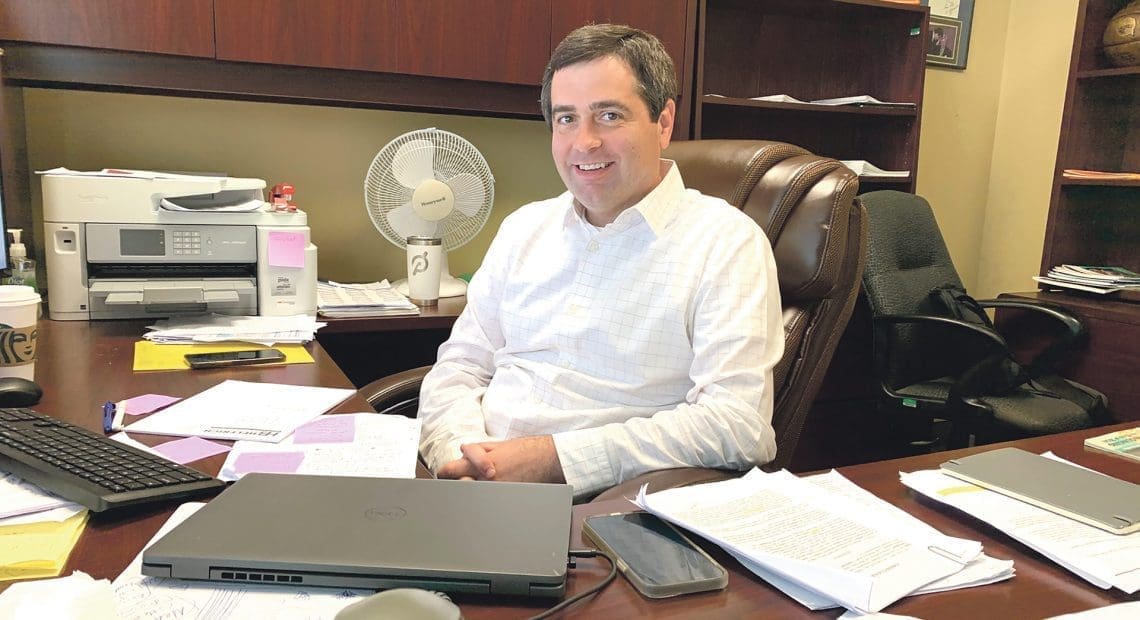
Peter Farkas says workforce development essentially comes down to one word: partnerships.
For this issue, we talked at length with Farkas about his latest career challenge, workforce development and what defines it, and his goals and objectives for fulfilling this agency’s important mission.
Forging a Career
As noted earlier, Farkas has spent pretty much his entire career in workforce development.
A graduate of UMass Amherst who later earned an MBA at Suffolk University’s Sawyer Business School, he started his career at Middlesex Community College, serving as Youth Services director, as well as overseeing programs at one-stop career centers serving 20 communities and also managing and coordinating several state- and federally funded grants and initiatives.
In 2014, he became associate director of the Metro North Regional Employment Board. During his tenure there, he chaired the youth committee of the Massachusetts Workforce Professional Assoc. and also secured a three-year, $500,000 grant with the U.S. Department of Commerce by partnering with the city of Somerville and Greentown Labs to connect hardware startups and advanced manufacturers in Northeast Mass.
In 2017, he took the helm at the MassHire Greater Lowell Workforce Board. Lowell is another of those gateway cities, and during his tenure there, punctuated by the pandemic, he secured a three-year, $2.4 million National Health Dislocated Worker grant from the U.S. Department of Labor to address workforce-development issues impacted by the opioid crisis. He also developed strategic relationships with several community stakeholders, including adult basic education providers, Middlesex Community College, UMass Lowell, and various state agencies.
In 2022, Farkas returned to higher education (and where he grew up), but remained focused on workforce development, serving as associate director of Workforce Development & Community Education at Berkshire Community College. There, among things, he oversaw a $735,000 grant to train a diverse talent population for in-demand occupations in the Berkshires.
When Cruise announced his plans to retire late last year, Farkas, who said he “missed the workforce-board/MassHire world,” saw an opportunity to take his career in a different direction, and in a different corner of the state.
“We’re disappointed we didn’t get the grant, but I think — correct that, I know — the region is better-situated now to proceed with applications for larger grants.”
“I wasn’t really looking for a change, but I knew here in Hampden County that the board itself was very strong in terms of the team staff-wise, but also the board of directors,” he explained. “And there were a lot of solid partnerships in place. I was looking forward to joining a great board that is well-regarded across the Commonwealth.”
At MassHire, he manages a budget of between $12 million and $15 million; oversees the region’s two one-stop career centers, in Holyoke and Springfield; and administers publicly funded worker-training and job-placement programs in the county’s 23 cities and towns.
But mostly, this job comes down to developing and nurturing strategic alliances and partnerships with internal and external stakeholders, he said, noting that these include educational institutions; community-based organizations; and federal, state, and municipal government agencies — everything from the U.S. Department of Labor to the state Department of Higher Education.
The career centers are the public-facing entities within the state’s 16 MassHire workforce boards, most of them covering regions rather than counties, Farkas noted, adding that they stage job fairs, stage résumé-writing workshops, and conduct training programs. His work, and that of most team members, is more behind-the-scenes in nature, involving everything from writing grant applications to meeting with other stakeholders to forge strategies for dealing with the region’s workforce issues.
Work in Progress
Since arriving in March, Farkas has been spending some of his time meeting with stakeholders, such as employers and the region’s colleges and universities, and coming to understand the wants, needs, challenges, and opportunities that exist.
He said the unemployment rate in the county remains comparatively low, and employers are still struggling to fill positions. Those remaining on the sidelines when it comes to the workforce are those who lack necessary skills and/or face other challenges, such as transportation, he went on, adding that many employers are just looking to get people in the door and then provide them with the skills they need.
“They’re saying, ‘give me someone who will show up on time, knows how to talk to their co-workers, is a team player, and dresses appropriately, and we’ll help build up their technical skills,’” he said, adding that some struggle simply to find people who can clear this low bar.
Overall, as he surveys the scene in Hampden County, Farkas sees several sectors being impacted by the changes and trends dominating the workplace.
Manufacturing, specifically precision manufacturing, is one of them, he said, noting that this sector is being especially impacted by the so-called silver tsunami, the retirement of the Baby Boom generation, and is thus one of the areas of focus when it comes to educating people, especially young people, about this industry and then putting them on a course to enter it.
“How do we get more people interested in manufacturing, whether it’s young people, current job seekers, or career changers?” he asked, adding that one of the assignments for his team is to create answers to that question.
Meanwhile, healthcare, the region’s largest employer, is another sector facing challenges, and one where the focus must be on both today and tomorrow.
“We have to build awareness of the various career paths in healthcare and let young people know that there are a lot of occupations within this industry,” he said, adding that such work is ongoing and being undertaken by the Healthcare Workforce Partnership of Western Massachusetts, led by one of BusinessWest’s Healthcare Heroes for 2024, Peta-Gaye Johnson (see story on page H20).
Internships are an important part of the equation, but so are efforts to introduce people to careers in these sectors at a young age — middle school and even earlier.
Funding is the key to these and other programs, he said, adding that the workforce board collaborates with its many types of partners in applications for both state and federal grants, many of them focused on young people, unemployed and underemployed individuals, but also incumbent workers needing more skills to advance within a company.
The workforce board was the lead applicant for a $20 million grant from the U.S. Economic Development Administration, Farkas noted, adding that there were several partners in the bid — from Baystate Health to Way Finders — known as the Springfield-Holyoke Recompete Plan.
The alliance became a finalist but did not ultimately receive the grant, which would have gone to “connect historically marginalized communities in Springfield and Holyoke to good jobs,” Farkas said, but the experience gained through that process, which brought several different parties together behind the initiative, will benefit the region moving forward.
“That process of bringing together all those various stakeholders has been beneficial to continue growing partnerships and relationships, which is very important for my role,” he added. “We’re disappointed we didn’t get the grant, but I think — correct that, I know — the region is better-situated now to proceed with applications for larger grants.”
As he said earlier, workforce development is all about partnerships — and workforce development is economic development, and that’s why it’s so important, and so rewarding.