Home Posts tagged MassHire
Features Special Coverage Workforce Development

Numerous Factors Are Complicating the Region’s Job Market
Whatever else can be said for the job market — both nationally and in Western Mass. — job seekers have lost some leverage. Specifically, job openings aren’t as plentiful (in most sectors, anyway) than they were a year or two ago, meaning it’s tougher to hold out for a better offer, and not as easy to move around.

“What we’re seeing is a retraction of people moving jobs right now. Employees are staying put,” said Allison Ebner, president of the Employers Assoc. of the NorthEast. “We’re seeing that for a variety of reasons today; the economy is certainly one reason why employees are staying with the devil they know instead of jumping ship for a different job.”

Specifically, she noted, the Bureau of Labor Statistics (BLS) reported earlier this month that, for the first time since 2023, the cost of living has outpaced wage growth in the U.S.

“Basically, the inflation rate has outpaced the cost-of-living adjustment, that 3.5% average that many people probably got at the beginning of the year. It’s not even covering the cost-of-living increase today, between the rising gas prices and the rising food prices.”

At the same time, Ebner said, wages are leveling off after jumping up for a while post-COVID. “The only outlier we’re seeing is some variable pay for AI skills in general.”

Kevin Lynn, executive director of the MassHire Springfield Career Center, said the local labor market has seen a broad contraction in job opportunities, and cited a number of factors that have been problematic.

“What we’re seeing is a retraction of people moving jobs right now. Employees are staying put. We’re seeing that for a variety of reasons today; the economy is certainly one reason why employees are staying with the devil they know instead of jumping ship for a different job.”

“We have a benefits cliff here affecting both hiring and retention,” he told BusinessWest. “We have a federal immigration policy that is contracting our labor market. We have population decline locally and outmigration. We have a childcare crisis that is tamping down the available labor market. We certainly have developing AI/automation anxiety out there. We have federal funding uncertainty. We have a local criminal justice issue, getting ex-offenders re-employed. And we have this totally egregious Iran war which is causing our economy to slow.

“Judging from the most recent [BLS] Producer Price Index, we’re running into a really fun June, if not July, with a rise in prices,” Lynn added. “We’ve got all that around us, which gives us a picture of what I would term a struggling regional economy.”

In fact, he said, Hampden County has one of the weakest labor markets in the state, with a relatively high unemployment rate continuing to climb, and average weekly wage rates below the national average.

All this has contributed to a slowdown in employee movement, where both workers and companies are loath to make moves.

“Companies are making slower hiring decisions, when they have hiring decisions to make, and they’re seeing less turnover,” Ebner said. “And from what we’re hearing, the employers that have employee turnover, it’s not because workers are leaving to go to different jobs; the turnover is because of employees’ poor performance, attendance issues, or not meeting the employer’s standards.”

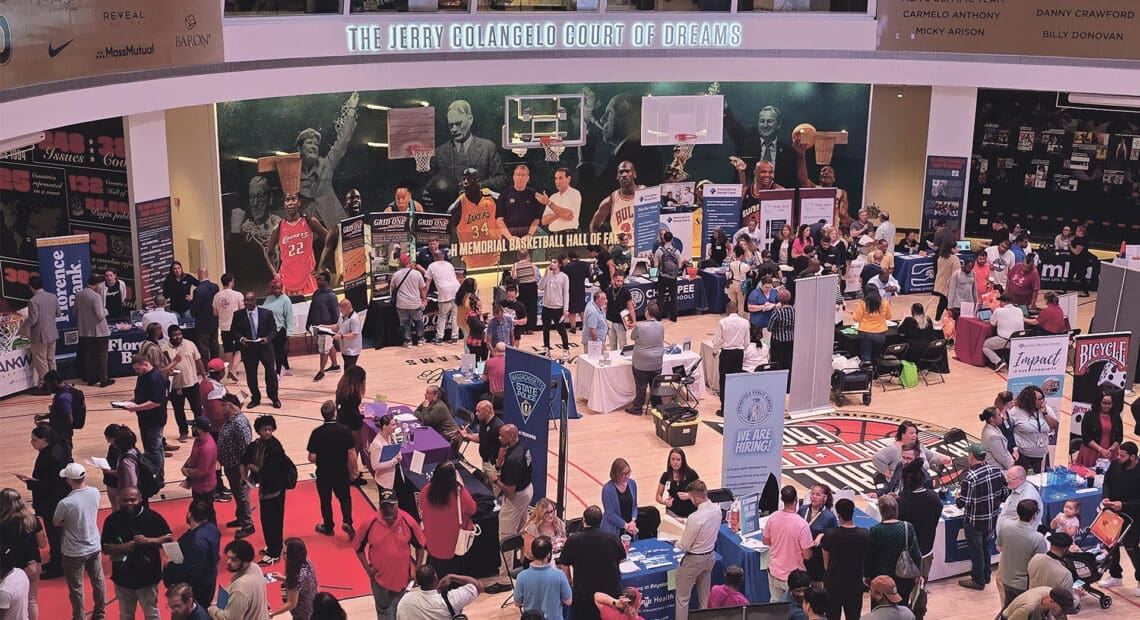
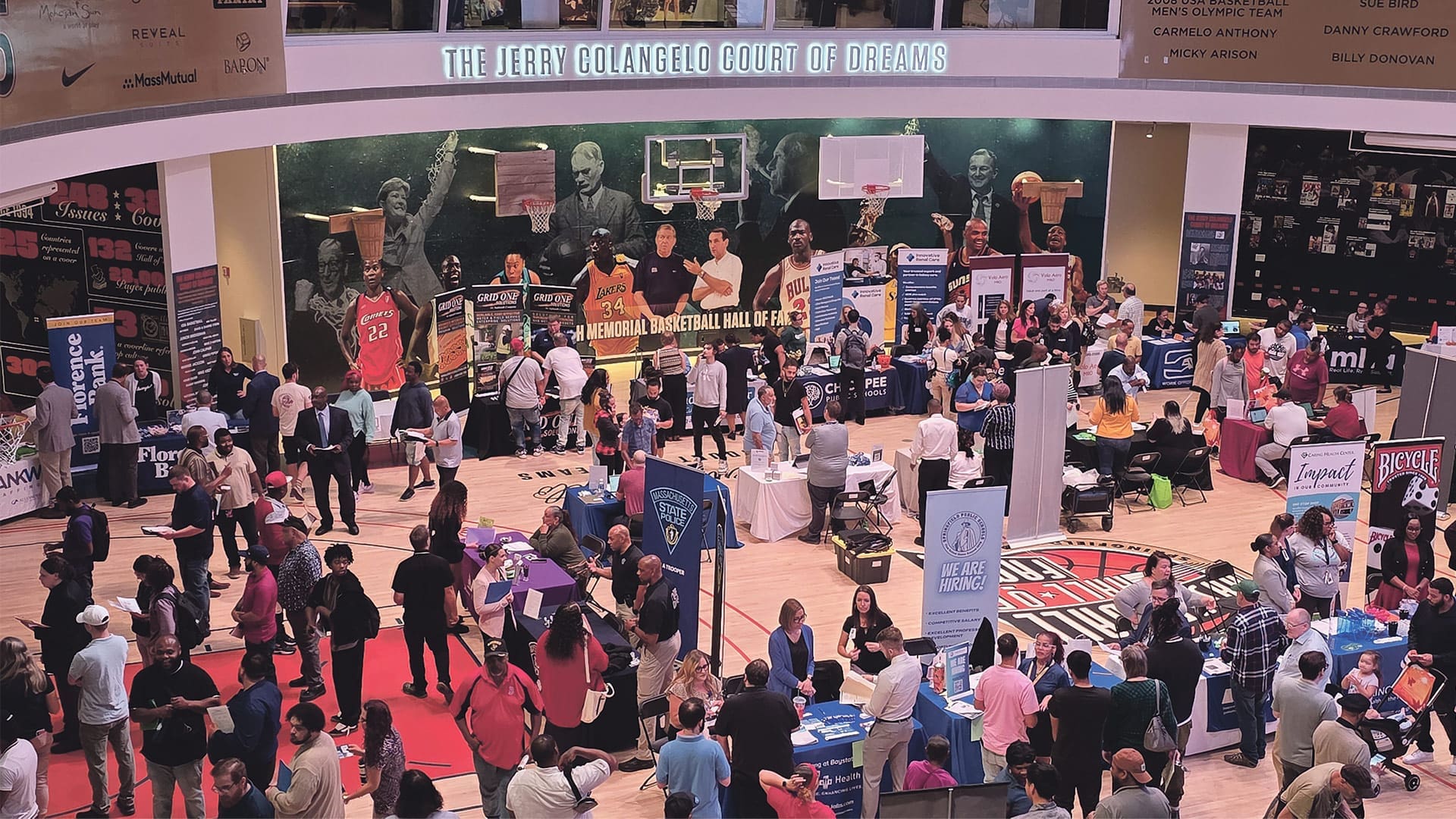
The slowdown in hiring is even manifesting itself in the most recent MassHire job fair at the Basketball Hall of Fame on May 18. When she spoke with BusinessWest the week before the fair, Ebner — who is also president of the MassHire Springfield board of directors — said vendor registration was running at about 60% the usual pace.

“They may pick up a few more, but that’s certainly a telltale sign locally that employees aren’t hiring,” she added. “There are still close to 30 coming, but usually it’s in the 45 to 50 range of employers coming to market their companies.”

Unhealthy Outlook

Lynn noted that the region is struggling with a bifurcation of wages — and a lot of posting activity in positions that are high-churn, low-wage, and not necessarily a living wage. And it’s happening most in healthcare.
Allison Ebner says employee engagement — even at the managerial level — is a rising problem for employers.

“Locally, healthcare is our dominant sector in terms of employment, and it’s contracting,” he said, pointing to struggles at local hospitals to employ frontline staffers, even before the recent announcement of Mercy Medical Center merging into Baystate Health later this year.

“What is that going to look like? What does that mean for employment?” he asked. “Crucially, a lot of healthcare workers — home health aides, CNAs, those lower kinds of lower-paying positions within the healthcare system, have an issue with a living wage. Can people survive on those wages?

“It’s really kind of an existential question for healthcare, where so much of what they do depends on Medicare and Medicaid funding to pay the bills, and they’re not doing a great job paying as it is,” he went on. “So, are they in a position to increase wages? I’m guessing not, so there’s a tension going on: people tend to think of where the jobs are, who’s hiring, what the jobs are — but increasingly, people are taking the next step and asking, ‘does this job pay a living wage?’”

It’s a question the healthcare industry must deal with sooner than later, said Ebner, who pointed to data from Lightcast, a global leader in labor market intelligence and workforce analytics, that notes that healthcare openings nationally currently outnumber unemployed job seekers by a five to one margin, and two-thirds of all job growth over the past year is in healthcare and social assistance.

“There was a predicted gain of 60,000 jobs in April, and it came in closer to 105,000, but it’s being skewed by a couple of industries; it’s not a true picture of all industries,” she said, and at the top of the list is healthcare. In fact, in 49 of 50 U.S. states, nursing is currently the top open job category. And that trend of healthcare demand outpacing staffing bodes poorly not just for the economy, but in broader ways.

“Healthcare is going to be a problem for us as people are living longer and Baby Boomers are retiring. They’ve done the math, and there’s simply not enough people to fill those healthcare jobs,” Ebner noted. “There’s a huge opportunity in home health and PCAs; they don’t have enough people to fill those positions. But it’s not a high-paying job.

“There’s a lot of talk right now about how about how the trades are working to draw students from high schools and colleges into electrical, HVAC, plumbing,” she added. “Those are considered AI-proof, and they’re high-income-earning. You could start as an apprentice and make a great wage very quickly. You can’t say that about PCAs.”

Data researcher Hannah Grieser, writing for Lightcast, cited a 2026 survey finding that 73% of healthcare executives say staffing shortages negatively affect their ability to provide high-quality care, pointing to several specific roles as acutely difficult to fill: among clinical roles, 98% of healthcare executives named physician specialists, and 86% primary care physicians. And among allied health roles, a majority of executives said radiology techs and ultrasound techs are tough to find.

“But across the healthcare workforce,” Grieser noted, “labor shortages are an ongoing challenge that’s expected to intensify.”

Meanwhile, Ebner continued, “COVID burnt out a lot of the healthcare workers. A lot of people opted out of that profession. They don’t have the same appeal post-COVID. So, healthcare is going to be in trouble and, with the level of urgency we’re at, needs immediate attention at the state and federal levels for sure.”

“Crucially, a lot of healthcare workers — home health aides, CNAs, those lower kinds of lower-paying positions within the healthcare system, have an issue with a living wage. Can people survive on those wages?”
Kevin Lynn says the main problem for companies isn’t finding people to hire, but finding the right people.

MassHire’s mission is to connect employers with skilled, motivated employees, Lynn said, but, increasingly, those workers aren’t finding the wage levels they need.

“Employers are in a push-and-pull position right now, and it’s been heightened with inflation and rising rents and mortgages,” he explained. “The cost of living in general has been escalating. People are saying, ‘I can’t take a job if I can’t find a home,’ or ‘I can’t take a job if I don’t make enough money to stay in my home.’ There’s more of that going on than ever now.”

That said, he noted, certain positions in healthcare — RNs, LPNs, and allied professionals come to mind — can find decent wages, and other sectors are similarly tiered when it comes to who’s making what.

“Also, the nonprofit sector continues to hire — again, it depends on the position, but they often do pay decent wages and have outstanding benefit packages to make up the difference. So that’s good. But on the flip side, human services, nonprofits, and healthcare are being hit by reductions in federal spending.”

Other sectors are relatively stable as well, including retail, logistics, and warehousing, but Lynn is concerned that the overall regional wage picture is outpacing what’s being seen locally.

“Read the national economic news, and you see economic numbers that are not great, but don’t look too bad, either. You get the sense locally we’re in a different ballgame.”

The Right Stuff

Lynn reiterated that matching employers with job seekers is much easier than finding the right workers, in terms of both skills and engagement. “We talk to different companies who are hiring, but struggling to hire at the same time because they don’t just want a body, but the right person.”

Ebner agreed. “Employers are definitely discouraged about the quality of the candidates they have. They’re not seeing the caliber of candidates that they’ve seen in the past from a customer service standpoint, from an innovation standpoint; they’re still struggling with employee engagement.”

Gallup’s State of the Global Workplace study recently reported a 21% employee engagement rate, she noted. “That means 21% of employees are fully engaged with their jobs. That’s a problem. An even bigger issue was manager engagement, which dropped from 31% to 22% over the last two years.

“These are the people that teach and educate and coach your employees,” Ebner went on. “This is something we talk to our members about regularly — manager development, and to be very careful about who gets to be a leader in your organization. Just because somebody did a great job working on the line as a project manager, or in an individual capacity, doesn’t mean they’re going to be a great leader. You’ve got to have someone with qualifications who shares your mindset, and then take those high-performing individuals and try them out in those roles to see if they’ll be a good leader.”

Meanwhile, among all the negative factors impacting the regional job market, Lynn pointed to immigration enforcement as a thorny one, though fewer people are talking about it right now.

“It’s definitely impacting healthcare, especially looking at long-term care; a lot of immigrants work in that field, and now that pool has started to dry up. When you see these ICE pickups, the optics don’t make people feel comfortable going out to find work.

“It’s almost like we put everything into a blender, and we’re not coming out with a great drink,” he added, referring specifically to decisions being made in Washington, D.C. “I’m worried about a potential recession. I lived through that in 2008; I don’t want that to happen. It’s tough to hire right now because there’s so much craziness going on.”

Special Coverage Workforce Development

‘Weird’ and ‘Confusing’


“Confusing.”

That’s the one word that Kevin Lynn, executive director of MassHire Springfield Career Center, chose when asked to describe the current jobs market and put into perspective what he’s seeing and hearing.

Elaborating, he referenced the center’s job fair at the Basketball Hall of Fame on Oct. 6, the latest of dozens of such events in recent years. In the weeks leading up the fair, organizers were worried about having a critical mass of companies seeking applicants — a nod to a slowing in overall hiring across the 413. But then, over the final few days of registration, there was a rush to sign up.

“We had 64 businesses — we literally did not have room for another company — and that was very surprising to us,” Lynn said.

Meanwhile, on the job seekers side of the equation, organizers were expecting what they’d seen in recent fairs — anywhere between 200 and 350 people — or maybe a few more. Instead, 617 turned out.

“That’s both good and concerning — that’s the busiest job expo we’ve had since before COVID,” he noted, adding that, while the numbers generate confusion on some levels, on another level, they make sense, because some sectors are hiring, but also still struggling to find talent with the requisite skills. Meanwhile, a variety of factors, from tariffs to turmoil in Washington, are leaving many people with jobs feeling less certain about the security of those jobs, and this helps explain the fair’s large turnout.

Allison Ebner

Allison Ebner

“They’re feeling like there’s enough uncertainty around … they’re hearing about layoffs with the larger companies and AI taking jobs — and there’s so much buzz about all that, the job market seems unstable.”

“I’ve talked to people who say they’re in businesses that are seeing a slowdown, and people are getting a little concerned,” said Lynn, listing manufacturing in that category, and adding that, overall, the pendulum has swung, and what was a buyers’ (job seekers’) market maybe as late as nine months ago has now shifted to employers, with an abundance of candidates for many positions and, overall, fewer job opportunities.

Allison Ebner, president of the Employers Assoc. of the NorthEast, agreed, but noted that the higher levels of uncertainty and anxiety — in Washington, the job market, and everywhere else — are key contributors to the latest trend (and buzz term) in employment circles: ‘job hugging.’

“Folks are staying put; they’re giving their job a hug,” she explained. “They’re feeling like there’s enough uncertainty around … they’re hearing about layoffs with the larger companies and AI taking jobs — and there’s so much buzz about all that, the job market seems unstable.

“People are feeling a sense of volatility and continuous change, and when you feel like that, you look for some personal anchors, and for a lot of people, their job is their personal anchor,” she went on, adding that this is a fairly recent phenomenon dating back to last spring or early summer. “Everything in the world is changing, and they want to keep something consistent, and maybe it’s their job.”

But just because people are staying put in many cases that doesn’t mean they’re necessarily happy or that they aren’t looking, Ebner went on, adding that wages are stagnant after a period of upward movement in the years after COVID, and, in some cases, companies — especially smaller ones — are making do with fewer or the same number of employees, which often adds up to more work.

Overall, she had her own word for the current job market — ‘weird’ — meaning that there are many forces pushing and pulling at people and businesses (from tariffs to general uncertainty to AI) that are creating a confusing landscape.

nicole Polite

Nicole Polite

“Companies are running a little bit leaner, so they may not have the capacity to train like they used to, so they need someone who already has the skill base to come in and hit the ground running a little faster than before.”

As for AI, it is impacting everything from job availability in some sectors — everything from hospitality to computer technology — to candidates being overlooked because they don’t have those skills.

“It’s definitely a skill set that they want to stay ahead of,” said Nicole Polite, CEO and founder of the East Longmeadow-based MH Group, adding that this is part of a larger trend she’s seeing toward skill-based hiring rather than focusing on whether someone has a requisite degree.

“The degree requirement isn’t as strong as it once was, and employers are really focusing on the skill base,” she told BusinessWest. “And the reasoning for that, in many cases, is the ability to train. Companies are running a little bit leaner, so they may not have the capacity to train like they used to, so they need someone who already has the skill base to come in and hit the ground running a little faster than before.”


Hire Powers

Lynn told BusinessWest that the job fair, as it played out, presented an accurate snapshot of what’s happening in the employment market — at least when it comes to the companies turning out to recruit and the makeup of that crowd of 617 people.

With the former, there were businesses across the spectrum, he said, but certain sectors were better-represented, including healthcare (although much of it is on the lower end, with CNAs and home health aides), area schools, and the broad realm of government, where there are jobs — with water and sewer operations and public works departments, among other realms — but fewer takers, especially among the younger generations.

“They don’t see any future in it,” he said, adding that many area cities and towns are struggling to fill such jobs.

As for the job seekers, or those simply exploring options, there was a good cross-section, said Lynn, noting that there were professionals, “people in suits — which we haven’t seen a lot of lately,” as well as a mix of young people, some mid-career types, and “significant amounts of gray hair.”

Kevin Lynn

Kevin Lynn

“Part of the problem is that the people doing the hiring are much younger than the people looking for work, and they don’t have a clear understanding of the skill sets that the older worker brings.”

This diversity points to the across-the-board nature of a softening job market and the restlessness of those with jobs, but also the plight of older workers.

“There’s a lot of ageism that people have to deal with,” he explained. “And part of the problem is that the people doing the hiring are much younger than the people looking for work, and they don’t have a clear understanding of the skill sets that the older worker brings.

“One of the best things about older workers is they show up every day, and they’re very task-oriented — you can plug them in, and they’ll just go,” he went on, adding that this attribute is often overlooked amid perceptions that older workers struggle with technology. “There are all these assumptions being made that often don’t let the older worker get past the first cut, the résumé screening.”

As for those at the other end of the spectrum — recent college graduates and those wrapping up degrees — the overall job market remains solid, but some areas have slowed, said Cheryl Brooks, associate provost, Career and Professional Development at UMass Amherst, who put jobs in technology, life sciences, and, understandably, the federal government at the top of that list.

Tiffany Appleton, associate director of Employer Relations for the university’s Office of Career Development & Professional Connections, agreed, noting that jobs with the federal government are fewer in number than many other sectors, but they cross many degree programs at the school.

“It’s a bigger number that many people would think,” she told BusinessWest. “I know there were a number of people from the class of 2025 who had offers they had accepted for government jobs early in the spring of 2025, and by the time they graduated, those offers had been rescinded. They had to restart their job search, and many of them have been successful with finding jobs elsewhere.”

Brooks said it will be early next year before she has hard data on how the class of 2025 has fared, but anecdotally, she believes it has fared well, with those notable exceptions, and also with lingering questions about whether some international students will be able to obtain OPT (optional practical training, a temporary work authorization for F-1 student visa holders in the U.S. directly related to their field of study) or work visas.

As for this fall and the class of 2026 and beyond, she said turnout among employers at job fairs staged at the school, such as those for engineering, life sciences, and building and construction technology, is down slightly (8% to 10%, by her estimate) from previous years, but companies are turning out in good numbers, looking for both employees and interns.

Appleton concurred. “The vast majority of employers I’m talking to are still moving forward with their recruitment plans,” she noted. “They’re actively coming to campus, posting jobs, interviewing and extending offers to start after graduation.

“There’s only been a little bit of a decline, and if there’s a decline, it’s more like, instead of hiring 20 students into this entry-level job, they’ll hire 15 — and I haven’t seen much of that.”


The AI Factor

Overall, job seekers across the board are seeing fewer opportunities, at least in some sectors, as companies cope with uncertainty, tariffs and threats of tariffs, and other forces by being “more careful” in their hiring, Ebner said.

This phrase applies to both the numbers of people being hired and the skills they bring to the table, noted Polite, adding that, overall, companies are taking their time — because they have it, whereas they were far more under the gun a few years ago — and sharply focused on getting it right.

“They’re fine-tuning what they’re looking for,” she went on. “And since demand has changed in terms of the job seeker pool, they’re able to have more leverage and recruit in a different manner than they did post-pandemic.

“We saw post-pandemic that employers had positions they needed to fill immediately,” Polite continued. “This didn’t allow them the capacity to do some of the more intensive skill-set requirements that they’re doing now. So it’s definitely a different market in terms of what they’re looking for — and holding the line for.”

This is one of many forces contributing to job hugging, said Ebner, adding that this trend is both good and bad for employers.

“Even though people may not be jumping ship as quickly as they had been over the past few years, people are still unhappy where they are,” she noted. “They are looking, they’re out there, they’re seeing what’s out there, so it doesn’t necessarily mean that people are staying put and they’re more productive.

“It means they’re staying put, their job search is probably quieter, but they might be looking,” she went on. “Depending on their industry and whether they feel they might have more exposure to a layoff or job reduction — depending on whether they’re being impacted by tariffs or AI — they might be a little more motivated to search.”

As for AI, it is one of the more powerful forces impacting the job market and the plight of job seekers. In the broad realm of computer technology, for example, some jobs are being lost to AI, but others are being, created, Brooks said.

“It’s like a net-zero in terms of overall jobs, because it’s changing a bit,” she explained. “Some of the jobs are going away, but others are being created. It’s hard to parse out exactly what the numbers are, but we’re definitely seeing a decline this year, and who knows if that will level off this year.”

Ebner agreed. “Software development … that was the hottest gig in town 10 years ago, 15 years ago,” she said. “And now, AI is doing a lot of that work.”

Meanwhile, AI is having a growing impact on other sectors, including hospitality.

“Go visit the McDonald’s at Bradley Airport — there are no people,” Ebner said. “There are people making your food, but there are no people at the counter; it’s all kiosks. These are the pockets where we’re seeing technology replace people.

“But most industries are looking at how they can bring AI in, not to replace the people, but to use it to enhance the work that humans are doing,” she went on, adding that AI skills are increasingly becoming a determining factor is whether a candidate can land a specific job.

“The phrase you hear now is, ‘AI won’t replace all the people, but it will replace people who don’t have AI skills,’” Ebner explained, adding that this new reality crosses the broad employment spectrum.

Both Lynn and Ebner said their agencies offer training in AI and that, overall, there are an abundance of opportunities to gain these skills, and job seekers need to take full advantage of them.

Polite agreed. “I often talk to people during the interview process and ask them what training they’ve had in terms of AI and make sure they stay in front of it,” she noted, “because AI is here for the long haul, so we have to adjust to it.”

Features Special Coverage

Making It Work

Executive Directors Sarah Wilson (left) and Maura Geary

Executive Directors Sarah Wilson (left) and Maura Geary


To explain why the MassHire Franklin Hampshire Career Center and the MassHire Franklin Hampshire Workforce Board merged their operations in July, Maura Geary first explained how the MassHire network is set up.

“There are 16 workforce areas in the state of Massachusetts, and every area has one workforce board and at least one career center,” she noted. “And the career center has two customer bases. One is job seekers; one is employers. We work with employers to find out what jobs they have, how we can help them find the talent they need, and we work with job seekers to find out what barriers they may have to employment in the jobs that exist in our region, and how can we help them overcome the barriers so that they’re prepared with the skills they need to enter the workforce.”

Meanwhile, the Workforce Board is more of a “30,000-foot view,” Sarah Wilson said. “We’re looking at regional trends, labor market information for the region. We’re convening employers. We’re bringing all this information to the Career Center, which does more on-the-ground work.”

Until July 1, Geary headed up the Career Center, while Wilson helmed the Workforce Board. But today, they’re co-executive directors of the first MassHire operation in the state to merge their operations into one, simply called MassHire Franklin Hampshire.

“Having the labor market information and understanding what trends are happening, we ask, ‘what are the challenges that exist in our region? Where are there opportunities? How can we bring in more resources to support the workforce that we have or the economy that we have?’” Geary told BusinessWest. “This merger really helps us align even more closely with the big picture of the region and the strategies that exist.”

When the MassHire Franklin Hampshire Career Center and the MassHire Franklin Hampshire Workforce Board announced the merger, they characterized it as a strategic unification and a significant milestone in the region’s efforts to deliver more coordinated, efficient, and impactful workforce development services across Franklin County, Hampshire County, and the North Quabbin region.

“They basically have paid internships at local businesses, where the grant pays for the wages of the participants. Employers get that labor, and they also have the opportunity to expose their businesses and their career pathways to the next generation of the workforce.”

The newly merged organization aims to streamline operations and enhance services for job seekers, employers, training providers, and community partners by combining the strategic oversight and policy leadership of the Workforce Board with the direct services and employer engagement expertise of the Career Center.

The merged organization will continue to operate offices in Greenfield and Northampton; its headquarters are still in the Greenfield Corporate Center, where the two halves formerly had separate space on the same hallway but now operate out of shared space.

“We were sort of set up for this in some ways because we were already co-located; the Workforce Board used to be just across the hall,” Wilson said. “And we shared resources — besides the space, we also shared HR and IT. And we’d been working hand in hand for many years.

“But this really solidifies it, and it brings together disparate teams and disparate strategies,” she went on. “I had my own thing on the Workforce Board, and Maura had her own thing in the Career Center. We would collaborate, but it wasn’t as structured as it is now. The communication between teams is now streamlined, so we can really streamline the work. This makes it much more efficient.”

The two MassHire Franklin Hampshire divisions were both located in separate offices at Greenfield Corporate Center, and now share space — and operations — as a single entity there.

The two MassHire Franklin Hampshire divisions were both located in separate offices at Greenfield Corporate Center, and now share space — and operations — as a single entity there.

Allison van der Velden, chair of the MassHire Franklin Hampshire board of directors, agreed.

“The merger is a natural next step in the evolution of our work,” she said when the merger was announced in June. “It strengthens our ability to deliver results and ensures that public workforce dollars are used efficiently, effectively, and equitably.”


Early Exposure

Another example of how the merger makes sense has to do with its young adult programs, Geary said.

“There’s separate funding for three different young adult programs, major funding that we oversee. Some of that funding was directed to the Workforce Board, and some of it was available to the Career Center. But now that we’re under one roof, we have completely merged all three of those programs into one unified program.

“When they existed between the Workforce Board and other providers and the Career Center, we were not maximizing those funds,” she went on. “So there’s a lot of opportunity to integrate programs on the ground, and we weren’t able to do that before because of the artificial silos that were in place.”

Mass Hire Franklin Hampshire’s state-funded YouthWorks programs are, in fact, among its most robust offerings; the organization receives about $530,000 in funding over both a summer cycle and a year-round cycle, and serves youth from ages 14 to 25.

“For the youngest participants, we’re going into the schools during the year and setting up after-school programs or different ways to engage them so they are learning about what career pathways are available. So the earliest contact is really about career awareness,” Geary explained. Meanwhile, the second tier serves 16- to 18-year-olds with paid work experiences.

“It’s the future of workforce development — it makes us more streamlined, more efficient. I think it’s better for the customer as well, whether that’s an employer or a job seeker.”

“They basically have paid internships at local businesses, where the grant pays for the wages of the participants. Employers get that labor, and they also have the opportunity to expose their businesses and their career pathways to the next generation of the workforce.”

Young people can also access a curriculum that delivers work readiness skills, financial literacy, and other competencies needed to enter the workforce.

“And with our oldest participants in YouthWorks, we actually are paying for them to enter into training programs and get their first job,” Geary went on, giving as one example a partnership with Greenfield Community College (GCC) to help young people earn clean energy HVAC certifications.

Meanwhile, from a Workforce Board perspective, MassHire convenes employers to learn about the different needs of the region, Wilson said. “But we can also think of training opportunities, grant opportunities, how we can bring funding into the region to help support some of those needs. It’s not just connecting to the workforce, but determining how we can go about that.”

One strategy is through on-the-job (OTJ) training and registered apprenticeships.

“Both of those get money to the employer, and they are also paid training opportunities. With OJTs, we can reimburse the employer up to 50%. And we’ve been doing that for manufacturing over the past year.

“We’re starting to get into registered apprenticeships, but there’s a tax credit that could be applied to that,” Wilson added. “It really helps with retention for the employer because they’re investing in that employee. There’s a structured training program and wage boosts that are built into that. There’s mentorship. So we see a lot of positives other than just the tax incentive.”

Much of MassHire Franklin Hampshire’s funding targets workforce training in its priority industries of education, healthcare, and manufacturing, Geary explained, while helping job and career seekers find a path that works for them.

“One of the models that we’re moving toward is recognizing that most people, when they’re looking for a job, can’t afford to go to training. It’s a paid training, and that’s amazing, but most people can’t take 12 or 16 or more weeks in a free training without having an income. So we’ve been promoting, with our employers, models where people are getting paid while they’re in the training. That’s something we’re excited about.”


Ready to Learn

Geary noted that, when MassHire surveys employers about what they’re looking for, they often say they can give people the technical training needed to do this job, but too often, prospective employees are coming in without professional skills or soft skills — what she and her team more commonly call ‘work readiness skills.’

“So we have a workshop team here developing content that is specific to different trainings. We’ll go into a training program and deliver the work readiness workshops and make sure that we’re preparing people across multiple industries to just be ready to be good employees.”

Speaking of training, MassHire Franklin Hampshire also has a strong relationship with GCC.

“We’re really lucky that GCC is a community college that is really interested in being innovative and responsive to the employers in our region,” Geary said, adding that the college has expanded and invested in its workforce training programs on campus over the past few years.

“If you look at their website, you’ll see they have really comprehensive career pathway programs that match our priority industries and engage employers and students. So we partner with them all the time. When they have a new grant-funded training program, we help them recruit students. We help provide the work readiness.”

MassHire is also expanding its business services team that works directly with employers, she added. “We want to make sure that, when GCC has any training program ending, we have employers who are in that industry lined up to receive them. So we’re doing more events early on, helping people prepare for the employers that are going to come to a job fair that are specific to that training cohort.”

Besides key sectors like education, healthcare, and manufacturing, MassHire Franklin Hampshire also keys in on industries that are particularly relevant to its region, including clean energy, outdoor recreation, and agriculture.

“We are seeing, nationwide, a decrease in the agricultural industry. But in Massachusetts, we’re seeing a slight increase. And Franklin Hampshire holds about 20% of the state’s agricultural industry right here,” Geary said. “So we’re really looking at what we can be doing with small and mid-sized farms. It’s a lot of small businesses, so we want to have an industry sector partnership where we do some of the legwork and say, ‘what do you need? Let us help you design some strategies that will meet your workforce needs.’

In the realm of clean industry, she noted that GCC has partnered with the Massachusetts Clean Energy Center, which funds clean energy grants and workforce training, among other things.

“They’re really developing a comprehensive career pathway and training program, and we’re working on engaging young adults, but also the adult population, to get trained in that industry as we’re seeing more and more employers start to pop up in our region.”

It’s a region that has unique challenges in that it has the largest geography of any of the 16 workforce areas, but with relatively few residents.

“We’re serving 50 cities and towns in Franklin, Hampshire, and the North Quabbin, and a lot of it is rural. So we have fewer funds than other workforce areas that have larger populations. And some of the challenges of the rural communities that impact the workforce are the same challenges as everywhere else, like transportation and childcare, but they have a little different flavor up here,” Geary explained.

“So those are really difficult barriers to overcome when we have people trying to get to jobs over this 1,400-square-mile region, and there’s not really any transportation infrastructure to speak of.”


One-stop Shop

The majority of MassHire’s funding comes through the federal Workforce Innovation and Opportunity Act, which brings up another current challenge: the general uncertainty organizations of all kinds are feeling about federal funding.

“That’s very much up in the air. We don’t really know what’s going to happen,” Wilson said. “So coming together gives us a little more stability to be able to weather that. But it’s also setting us up for the future, no matter what. It’s the future of workforce development — it makes us more streamlined, more efficient. I think it’s better for the customer as well, whether that’s an employer or a job seeker.”

Geary said that speaks to something she hears all the time from clients on both sides.

“Once they’re engaged with our services, they all inevitably say, ‘oh my gosh, I had no idea I could get so much help by working with you. I didn’t know you existed.’ We hear that all the time, so streamlining our messaging helps with that, too. We don’t have to get into that confusing conversation — ‘you’re going to work with them over here for that, and then you’re going to come to us for this over here.’”

Instead, she said, “we can eliminate that point of confusion and just say, ‘come to MassHire Franklin Hampshire, and we’re going to help you solve your workforce needs.’”

Features Special Coverage

Hire Purpose

Peter Farkas

Peter Farkas

Peter Farkas can give you the textbook definition of workforce development, at least as he understands it.

“Workforce development is economic development,” said Farkas, who was named president and CEO of the MassHire Hampden County Workforce Board in March, succeeding long-time president David Cruise. “Workforce development is addressing the needs of employers by reskilling and upskilling the labor force to meet industry needs. It’s ongoing, and it’s very fluid.”

To him, though, workforce development is defined by, made possible by, and is a function of … partnerships.

In fact, forging and strengthening partnerships is the unofficial job description for his position with the workforce board, the latest stop in a career that, as we’ll see, has been entirely in the broad realm of workforce development in different regions of the Bay State, from the Berkshires to Middlesex County to Boston, and in different capacities, including executive director of the MassHire Greater Lowell Workforce Board.

His latest assignment brings him to Hampden County, a region that includes several gateway cities — Chicopee, Holyoke, Westfield, and, of course, Springfield. These former manufacturing hubs have been reinventing themselves over the past several decades, and, like other Gateway Cities across the state, have their challenges when it comes to workforce.

Specifically, companies across virtually every sector are struggling to find enough qualified help. At the same time, there are significant numbers of unemployed and underemployed individuals who need the skills — often, basic skills — to succeed in the workplace.

With these challenges in mind, MassHire focuses on current needs, while anticipating future needs and taking steps to create a solid pipeline of workers.

“From the workforce-board perspective, we’re demand-driven and industry-led,” Farkas explained. “What are the needs from our industries? What are our employers’ needs? Currently, what jobs are they having trouble filling, but also short- and long-term, where are the areas they need to be invested in?”

Farkas comes to MassHire at an intriguing time. The workplace is changing, thanks largely to COVID and the seismic shifts it brought about in how people work and where. There is still a workforce crisis, if you will, with many sectors struggling mightily to find enough qualified talent. Baby Boomers continue to retire in huge numbers, impacting all sectors, but some, including healthcare and manufacturing, more than others.

“From the workforce-board perspective, we’re demand-driven and industry-led.”

In this environment, the workforce board is working on several fronts involving recruitment, retention, and enabling employees to advance within a business or sector, he said, adding that one of these initiatives involves internships, which not only introduce people to jobs and individual businesses, but start them down the path toward a potential career.

He said the Hampden County Workforce Board is one of the leading participants in the state’s Registered Apprenticeship program, an employer-driven model that combines on-the-job mentoring with job-related instruction.

“This an area I would like to see us continuing growing in,” he told BusinessWest. “We’re doing a lot of registered apprenticeships, which are helping employers address a few areas of need — filling their current job openings, but also investing in current employees and upskilling them for retention purposes.”

Internships are just one piece of a much larger puzzle, he went on, adding that he made this work his career because of the many kinds of rewards it brings. “A lot of what we do can be life-changing. Taking someone who’s unemployed and putting them in a career where they have room to grow and they can support their families … that’s rewarding.”

Peter Farkas says workforce development essentially comes down to one word: partnerships.

Peter Farkas says workforce development essentially comes down to one word: partnerships.

For this issue, we talked at length with Farkas about his latest career challenge, workforce development and what defines it, and his goals and objectives for fulfilling this agency’s important mission.


Forging a Career

As noted earlier, Farkas has spent pretty much his entire career in workforce development.

A graduate of UMass Amherst who later earned an MBA at Suffolk University’s Sawyer Business School, he started his career at Middlesex Community College, serving as Youth Services director, as well as overseeing programs at one-stop career centers serving 20 communities and also managing and coordinating several state- and federally funded grants and initiatives.

In 2014, he became associate director of the Metro North Regional Employment Board. During his tenure there, he chaired the youth committee of the Massachusetts Workforce Professional Assoc. and also secured a three-year, $500,000 grant with the U.S. Department of Commerce by partnering with the city of Somerville and Greentown Labs to connect hardware startups and advanced manufacturers in Northeast Mass.

In 2017, he took the helm at the MassHire Greater Lowell Workforce Board. Lowell is another of those gateway cities, and during his tenure there, punctuated by the pandemic, he secured a three-year, $2.4 million National Health Dislocated Worker grant from the U.S. Department of Labor to address workforce-development issues impacted by the opioid crisis. He also developed strategic relationships with several community stakeholders, including adult basic education providers, Middlesex Community College, UMass Lowell, and various state agencies.

In 2022, Farkas returned to higher education (and where he grew up), but remained focused on workforce development, serving as associate director of Workforce Development & Community Education at Berkshire Community College. There, among things, he oversaw a $735,000 grant to train a diverse talent population for in-demand occupations in the Berkshires.

When Cruise announced his plans to retire late last year, Farkas, who said he “missed the workforce-board/MassHire world,” saw an opportunity to take his career in a different direction, and in a different corner of the state.

“We’re disappointed we didn’t get the grant, but I think — correct that, I know — the region is better-situated now to proceed with applications for larger grants.”

“I wasn’t really looking for a change, but I knew here in Hampden County that the board itself was very strong in terms of the team staff-wise, but also the board of directors,” he explained. “And there were a lot of solid partnerships in place. I was looking forward to joining a great board that is well-regarded across the Commonwealth.”

At MassHire, he manages a budget of between $12 million and $15 million; oversees the region’s two one-stop career centers, in Holyoke and Springfield; and administers publicly funded worker-training and job-placement programs in the county’s 23 cities and towns.

But mostly, this job comes down to developing and nurturing strategic alliances and partnerships with internal and external stakeholders, he said, noting that these include educational institutions; community-based organizations; and federal, state, and municipal government agencies — everything from the U.S. Department of Labor to the state Department of Higher Education.

The career centers are the public-facing entities within the state’s 16 MassHire workforce boards, most of them covering regions rather than counties, Farkas noted, adding that they stage job fairs, stage résumé-writing workshops, and conduct training programs. His work, and that of most team members, is more behind-the-scenes in nature, involving everything from writing grant applications to meeting with other stakeholders to forge strategies for dealing with the region’s workforce issues.


Work in Progress

Since arriving in March, Farkas has been spending some of his time meeting with stakeholders, such as employers and the region’s colleges and universities, and coming to understand the wants, needs, challenges, and opportunities that exist.

He said the unemployment rate in the county remains comparatively low, and employers are still struggling to fill positions. Those remaining on the sidelines when it comes to the workforce are those who lack necessary skills and/or face other challenges, such as transportation, he went on, adding that many employers are just looking to get people in the door and then provide them with the skills they need.

“They’re saying, ‘give me someone who will show up on time, knows how to talk to their co-workers, is a team player, and dresses appropriately, and we’ll help build up their technical skills,’” he said, adding that some struggle simply to find people who can clear this low bar.

Overall, as he surveys the scene in Hampden County, Farkas sees several sectors being impacted by the changes and trends dominating the workplace.

Manufacturing, specifically precision manufacturing, is one of them, he said, noting that this sector is being especially impacted by the so-called silver tsunami, the retirement of the Baby Boom generation, and is thus one of the areas of focus when it comes to educating people, especially young people, about this industry and then putting them on a course to enter it.

“How do we get more people interested in manufacturing, whether it’s young people, current job seekers, or career changers?” he asked, adding that one of the assignments for his team is to create answers to that question.

Meanwhile, healthcare, the region’s largest employer, is another sector facing challenges, and one where the focus must be on both today and tomorrow.

“We have to build awareness of the various career paths in healthcare and let young people know that there are a lot of occupations within this industry,” he said, adding that such work is ongoing and being undertaken by the Healthcare Workforce Partnership of Western Massachusetts, led by one of BusinessWest’s Healthcare Heroes for 2024, Peta-Gaye Johnson (see story on page H20).

Internships are an important part of the equation, but so are efforts to introduce people to careers in these sectors at a young age — middle school and even earlier.

Funding is the key to these and other programs, he said, adding that the workforce board collaborates with its many types of partners in applications for both state and federal grants, many of them focused on young people, unemployed and underemployed individuals, but also incumbent workers needing more skills to advance within a company.

The workforce board was the lead applicant for a $20 million grant from the U.S. Economic Development Administration, Farkas noted, adding that there were several partners in the bid — from Baystate Health to Way Finders — known as the Springfield-Holyoke Recompete Plan.

The alliance became a finalist but did not ultimately receive the grant, which would have gone to “connect historically marginalized communities in Springfield and Holyoke to good jobs,” Farkas said, but the experience gained through that process, which brought several different parties together behind the initiative, will benefit the region moving forward.

“That process of bringing together all those various stakeholders has been beneficial to continue growing partnerships and relationships, which is very important for my role,” he added. “We’re disappointed we didn’t get the grant, but I think — correct that, I know — the region is better-situated now to proceed with applications for larger grants.”

As he said earlier, workforce development is all about partnerships — and workforce development is economic development, and that’s why it’s so important, and so rewarding.


Healthcare Heroes

Collaboration in Health and Wellness

Director of Healthcare Workforce Initiatives, MassHire Hampden County Workforce Board

She Helps Put Future Healthcare Heroes into the Pipeline

Peta-Gaye Johnson

Peta-Gaye Johnson

Peta-Gaye Johnson is not your typical Healthcare Hero.

Indeed, in the eight-year history of this recognition program, there hasn’t been an honoree quite like her.

She’s not a provider of care, like a doctor, nurse, or occupational therapist, and she’s not an administrator in a healthcare facility; in fact, she’s never worked in the healthcare sector. Nor does she teach those who want to enter this profession, as several honorees, including two in the class of 2024, do.

But as the director of Healthcare Workforce Initiatives for the Hampden County Workforce Board, she works with administrators, educators, and others to help ensure that there is a reliable pipeline of workers — and, yes, potential Healthcare Heroes — for this sector.

Thus, “she has been the cornerstone for driving successful workforce-development programming to strengthen the region’s workforce and enhance the quality of patient care,” said Peter Farkas, who became president and CEO of the MassHire Hampden County Workforce Board earlier this year and nominated Johnson for this award.

Johnson is the winner in the Collaboration category, specifically for her efforts to foster collaboration — between the region’s larger healthcare providers, its colleges and universities, community-based organizations, and philanthropic agencies — and, in many respects, to lead these collaborative efforts.

They include:

• The Healthcare Workforce Partnership of Western Massachusetts, a MassHire inititive that, through Johnson’s leadership, responds to the workforce needs of employers and ensures that workers have access to the education and training needed to prepare them for lifelong careers in a changing industry;

• The Western Massachusetts Nursing Collaborative (WMNC), one of three working groups within the partnership — the others are the Allied Health Working Group and the Pioneer Valley Interprofessional Practice and Education Collaborative — and one that has made great strides to ensure that the region has an adequate supply of nurses;

• A website called westernmasshealthcareers.org, which Johnson developed to provide area residents with relevant information on occupations and career pathways in the healthcare industry;

• The Pioneer Valley Healthcare Center Pathway Forum, an annual event that brings together high-school guidance counselors from across the region to provide them with information to assist and direct students to enroll in and successfully complete health science programs; and

• Her work to oversee and drive a three-year grant to train 174 unemployed and underemployed individuals in the Pioneer Valley for careers as medical assistants, EMTs, recovery coaches, and behavioral resource technicians.

Summing up all these initiatives and Johnson’s involvement with them, Farkas said it’s not necessarily what she does for this sector — the largest employer in the Pioneer Valley, with roughly 73,000 jobs — that makes her a Healthcare Hero, although that’s certainly part of it. It’s how she goes about this work.

“She’s very passionate about the industry, and she’s a leader when it comes to driving the agenda,” he said, adding that it is her job to not just convene the partners working with the workforce board, but to help them set goals and objectives and then create strategies to meet and, hopefully, exceed them. “She’s a good listener and helps build consensus.”

Using these skills, she’s helped area providers address recognized shortages when it comes to many occupations within this broad sector, including nurses, CNAs (certified nurse aides), home health aides, medical assistants, emergency medical technicians (EMTs), and others.

“Before, it was mostly about numbers. Now, it’s beyond numbers — it’s about how people feel about their work, the appreciation they feel for the work they’re providing for the community.”

Beyond that, the collaboratives she leads address myriad other workforce-related issues, from retention of valued workers, to the different generations working together in healthcare and how the wants and needs of each one is different, to the seismic changes that came about during, and because of, the pandemic.

She said the region, and its healthcare sector are still experiencing a workforce crisis, but one where the parameters — and priorities — are shifting.

“Before, it was mostly about numbers,” she said. “Now, it’s beyond numbers — it’s about how people feel about their work, the appreciation they feel for the work they’re providing for the community.”

Johnson said her work is rewarding on many levels, and when asked what she likes most about, she said simply “the collaboration piece.”

“That’s the one thing I’m really excited about,” she told BusinessWest. “The people who are part of our collaboratives are leaders of our collaboratives, so when anything comes up I can reach out to these people, and I always get a ‘yes’ — no matter what it, no matter what I ask them to do, I always get a ‘yes.’

Peta-Gaye Johnson (first row, center) with the other members of the Western Massachusetts Nursing Collaborative.

Peta-Gaye Johnson (first row, center) with the other members of the Western Massachusetts Nursing Collaborative.

Elaborating, she said the stern workforce challenges facing this sector require collaborative efforts — individuals sharing information and experiences and working together to meet agreed upon goals — and she is inspired by the way these groups go about their work.

Meanwhile, others are inspired by her efforts to lead these collaboratives and address challenges old and new. And this is why she is a different kind of Healthcare Hero.


Hire Education

1. Increase retention in all healthcare settings;

2. Ensure nurses have comptetencies and full scope of practice to meet the healthcare needs of the community;

3. Increase the number of nurses with advanced degrees;

4. Increase nursing faculty in Western Mass.;

5. Increase the diversity of the nursing workforce; and

6. Sustain the partnership.

These are the stated strategic goals and objectives of the WMNC, and they, and the progress made toward achieving them, are reviewed at each monthly meeting, said Johnson, adding that this is just one of many meetings, most of them now by Zoom, that she attends on a regular basis.

Meetings are just a small but important part of her job description, she said, adding that such sessions help keep the many agencies and institutions partnering with the workforce board focused on goals like those stated above.

And these goals provide some real insight into how Johnson and all those she works with keep one eye on the present when it comes to the workforce needs of the region and the healthcare providers that call it home, and the other eye on the future.

“We try to project what our future needs will be and address those needs before they come,” she said, adding that this proactive approach helps ensure an adequate pipeline of workers across the broad spectrum of healthcare and social services.

Peta-Gaye Johnson and members of the Western Massachusetts Nursing Collaborative

Peta-Gaye Johnson and members of the Western Massachusetts Nursing Collaborative celebrate the WMNC’s 16th-year celebration lunch.

Filling this proverbial pipeline is just part of the job description for Johnson, who came to the workforce board 13 years ago. She started as an intern while working toward a master’s degree in social work at UConn, and took part in the Hasbro Summer Learning Initiative. She was hired by then-President and CEO Bill Ward, working part-time on the summer learning initiative and part-time with Kelly Aiken, then-director of Healthcare Workforce Initiatives.

When Aiken left for another opportunity in 2016, Johnson was encouraged to apply for her position. She did, won the job, and has flourished in it ever since.

Over the past nine years, she has certainly learned a lot about the healthcare sector and its challenges, but she’s learned much more, she said, about workforce development and all that goes into it, especially partnerships and efforts to work collaboratively.

The WMNC is a good example. It’s a large board — 17 people — representing the nine colleges and universities in the region with nursing programs, as well as five service partners (Baystate Health, Caring Health Center, Cooley Dickinson Hospital, Holyoke Medical Center, and Trinity Health Of New England/Mercy Medical Center) and the Western Massachusetts Black Nurses Assoc., the Massachusetts Senior Care Assoc., and MassHire.

It met three or four times a month during COVID to address the myriad challenges it created and exacerbated, but has settled back to once a month.

By convening these partners, Johnson is able to help gauge their needs, understand their challenges, and lead the group to finding solutions together, said Farkas, using the WMNC as an example.

“Bringing together that group monthly … I would say that’s helpful just for them to hear from each other in terms of their struggles and successes,” he noted. “It’s not different than most people’s jobs — you can get in silos. Just to talk as a group helps; people say, ‘this is what’s working for us.’ Hearing from your peers is invaluable. Peta-Gaye’s ability to drive collaboration and consensus amongst diverse stakeholders has positively impacted the region’s healthcare workforce.”


Work in Progress

As noted earlier, Johnson’s work, and that of the partnership, involves meeting the healthcare sector’s needs today — and tomorrow.

When it comes to today, as she mentioned earlier, the challenges of the workforce crisis extend beyond sheer numbers. There are also issues with retention and adjusting to changing dynamics in the workplace, and especially in healthcare settings.

“For every person, COVID helped them to reassess the work they were doing,” she explained. “And one of the things we talk about in our groups now is the fact that the people coming into the workplace today are much different from those who entered previously; the generational shift is real, and it’s happening.

“Before, people committed a lot more of their time to work — that’s not the case anymore,” Johnson went on. “Conversations that we’re having most recently in our groups center on the fact that people want work to match their lifestyle, and hospitals have to deal with that; they have to deal with people who want to work as little as possible and receive as many benefits as possible. And on the other end, they have to deal with that increase in violence toward healthcare workers.”

As for the future, efforts include everything from introducing young people to the many career opportunities in healthcare early — as in middle school — to the website westernmasshealthcareers.org, which helps visitors gain an understanding of the many careers in this sector, how to pursue them, and the degree offerings at area colleges and universities.

“One of the things that our leaders have identified is the fact that recruitment doesn’t start with people entering high school — we go all the way back to middle school,” she explained. “We run programs with middle-school-aged students to talk with them about to expect and what the journey is like so they’re prepared academically.”

Elaborating, Johnson said young people have, historically, heard about the benefits and rewards of a career in healthcare; what they need is the full picture.

“One of the biggest obstacles that we identified years ago is that students are not necessarily prepared academically, whether it’s math or science,” she noted. “But on the other side of it, what many people do not consider is what healthcare looks like, the fact that it is very demanding. It doesn’t just mean providing care to people who are ill or wounded; it means making them feel comfortable.”

As she talks about these issues and challenges and how they are being addressed, Johnson will always use the collective ‘we’ or ‘our groups.’

She does so to stress that these are complicated issues that must be addressed collectively. For that to happen, the region needs a leader and a convener, someone to bring people together and, as Farkas noted, “drive the agenda.”

That someone is Johnson, whose tireless work to forge partnerships and address matters through collaboration makes her a Healthcare Hero.

Employment Special Coverage

Hire Expectations

Kevin Lynn

Kevin Lynn, executive director of the MassHire Springfield Career Center.


It was the spring of 2022, and Kevin Lynn was starting to think the job fairs conducted three times a year at the Basketball Hall of Fame by MassHire Springfield Career Center — which he serves as executive director — had run their course.

Attendance among job seekers, which had been running at roughly 300 pre-pandemic, had dropped to maybe 100, even though employers across the region and in virtually all sectors of the economy were seeking help — many of them desperately.

As for the job seekers themselves … the very generous unemployment benefits awarded at the height of the pandemic, when millions of jobs disappeared almost overnight, were all but gone. Yet, many people were still sitting on the sidelines, not at all anxious to enter the workforce.
“I didn’t know what was going on — nothing made any sense, really,” said Lynn, who has spent more than 20 years with the entity now known as MassHire Springfield Career Center, 10 as its director. People were still hunkered down, and people like me were asking, ‘how can these individuals not afford to work?’”

While waiting for an answer to that question — one that never really came — two things happened. The first is that the picture started righting itself with regard to people getting back to work. The second is that MassHire Springfield, in Lynn’s words, “started acting more like a business.”

By that, he meant the agency started to more aggressively market itself and its services, especially through digital platforms.

“We had to get our name in front of people and remind them of exactly what we do and how we do it,” he recalled. “Also, we had to pull in what I’ll call a new generation because we’d been on pause for the better part of four years. That natural flow that we had established since 1997 had been disrupted, so we needed to prime that pump again with our core constituency.”

Those efforts have succeeded in bringing the customer base back to pre-pandemic levels, as we’ll see. And roughly two years after he was thinking about retiring the job fairs, attendance is pretty much back to where it was pre-pandemic, said Lynn, adding that the program will actually be expanded this year from three fairs to four, with the fourth likely to take place at the agency’s facility on Liberty Street in Springfield.

“We had to pull in what I’ll call a new generation because we’d been on pause for the better part of four years. That natural flow that we had established since 1997 had been disrupted, so we needed to prime that pump again with our core constituency.”

“We think we need a fourth because of the demand,” he said. “We’ll see how it goes.”

As for the job market itself … Lynn said things have not exactly returned to normal — whatever that is — although he is seeing an overall softening of the job market, with many challenges remaining for those needing skills, older workers (over age 55), and other constituencies.

Most employers are still struggling to find good help, he said, adding quickly that, while some are willing to train and shape candidates who may not have the full package, others are holding out for the “fully formed” applicant, and sometimes losing out in the process.

Meanwhile, on the wage front, many employers are still not fully embracing the need to move the needle higher. Instead, they’re focusing on what they think they can afford, and not the proverbial big picture — meaning what they spend to hire, and then to hire again when someone brought in at a comparatively lower wage leaves after a few months, or a few weeks, because he or she can secure a dollar or two more an hour elsewhere (more on this later).

These are just some of the observations made by Lynn as he talked about his agency, the job market, and what could, and likely will, come next.


The Job at Hand

“Blocking and tackling.”

That’s what Lynn said MassHire Springfield is back to focusing on these days after what can only be called a turbulent period that includes the pandemic and its aftermath.

By blocking and tackling, he means work with both employers and job seekers to put people in jobs. Such work with job seekers includes training available through the agency’s upskilling program, workshops on everything from handling tough interview questions to helping mature workers prepare for today’s job-search process, job fairs, connecting individuals with resources, and much more.

job fairs

Kevin Lynn says the job fairs conducted in partnership with Audacy Springfield and the Basketball Hall of Fame are back to pre-pandemic numbers.

As for the pandemic and its aftermath, this was a difficult, stressful time, when the agency’s mission — connecting job seekers with employers and helping those job seekers garner the skills needed to not only land jobs, but secure careers — didn’t really change. But the overall need for it did — sort of.

“COVID killed our customer base,” he said matter-of-factly. “Customers weren’t coming in, and they weren’t even using us virtually.”

Quantifying the matter, he noted that, in fiscal 2019, prior to COVID, the agency served roughly 11,500 people over the course of the year. For fiscal 2020, which included the first several months of the pandemic, the number fell to 8,500. And for fiscal 2021, a full and very traumatic year of COVID, the number of customers tumbled to 4,300, roughly a third of the pre-pandemic total.

Why? There were several reasons, Lynn recalled. First, many were content to collect those generous unemployment benefits and not enter, or re-enter, the workforce, he said, adding that, during those times, people not actively seeking employment could receive unemployment benefits, something that wouldn’t happen in more ‘normal’ times. Meanwhile, many of those who had jobs were content to stay put given the large amounts of uncertainty that accompanied that environment — and a desire to work remotely.

“It was the devil you knew versus the one that you didn’t know,” he recalled. “Also, people were desperate to get working-at-home arrangements set up; everyone wanted to be remote. And if you were in a remote situation, and it was solid, you weren’t going to risk that by going to a new employer.”

Meanwhile, with the pandemic came the loss of day-care services for many, he went on, adding that some people had no choice but to quit their jobs — or not seek a job or a better job — so they could be home with their children. It was the same for many of those caring for elderly parents.

“A large section of the labor market just literally pulled back and chose not to work,” he said. “And that impacted us greatly.”

Indeed, the phone started ringing at a much slower pace, and there was a considerably quieter atmosphere at the career center, Lynn recalled, adding that, by the end of 2022, as the number of customers served rose slightly to more than 5,000 (still less than half the pre-pandemic totals), the agency responded by being proactive.

It launched a six-month advertising campaign, much of it digitally with Audacy Springfield (the agency’s partner on the job fairs), designed to raise awareness of the agency, its services, and those fairs.

“A large section of the labor market just literally pulled back and chose not to work. And that impacted us greatly.”

And for fiscal year 2023, the customer base jumped to more than 9,300, a 56% increase, he went on, adding that this was a byproduct of both those aggressive efforts to prime the pump and what he considers a softening of what had been a very attractive market for job seekers, with employers struggling to replace retiring Baby Boomers and simply handle the turnover that was impacting almost every sector.


Searching … for Answers

As Lynn explained, “if you have skills, you’re in a good spot in terms of being able to find job opportunities and get offers. But the job market has softened over the past few months; it’s not as strong as it was prior to this.”

Elaborating, he said the market remains challenging for many subgroups within the workforce and those looking to join it, including older workers, many of whom have skills but struggle to find employers willing to recognize and pay for them.

“They continue to have problems breaking through and getting jobs simply because of their age,” he told BusinessWest. “We see it all the time; you look at people, and they have a solid résumé, and you think, ‘this person is at least worth a conversation.’”

But often, they aren’t part of the conversation.

“Maybe the person isn’t right for the organization; I get all that,” Lynn went on. “But when you have people who have come to us, and they’re working very diligently and a lot of times working with our job developers even, and they’re trying to find work … it can be a tremendous struggle to come out on the other end.”

For those older workers who do come out on the other end with a job, their search will have been much longer than for those who are younger, as many employers are hesitant to look past someone’s date of birth and instead focus on what they might be able to bring to an organization.

Overall, and as noted earlier, Lynn said many employers are still looking for the full package, the “fully formed” applicant, as he called it, when hiring.

“They’ll vocalize that they’re not,” he said, noting that many will say or hint that they are willing to train. “But that’s not the case. They’re holding out for the fully formed applicant, and that’s a problem for the job seekers.”

Another problem is what he referred to as “ghost postings,” which are, well … what that phrase indicates they are: postings that aren’t exactly real.

“They may not have the opening, but they’re posting the job on the anticipation that they may have an opening,” he explained, adding that such phantom postings are prompting him to question the actual level of demand in certain fields and for certain jobs. Meanwhile, they are bringing new forms of stress to job seekers, who are investing time, energy, and emotion in pursuit of a job that may or may not exist.

Meanwhile, for those pursuing work, or a better job, the bigger challenge may not be finding a job, but finding one they can live on.

“It takes more diligence to find the right job,” he said. “Anyone can find a job; the issue is finding a job with a living wage — pay and benefits that you can live on. We see companies that post jobs that do not pay a living wage.

“My staff has conversations with employers on this topic; they’ll say, ‘we can post this job for you, but at the wage you are offering, you are not going to get any applicants,’” he noted. “If you’re at $17 or below, you’re going to have a tough time — a very tough time.”

He said most employers fully understand that a lower wage number shrinks the applicant pool. What they may not fully appreciate is that, even if they do hire someone, that lower wage serves to further increase turnover, bringing costs that will likely exceed a higher wage.

As for those job fairs, they certainly provide a window into what’s happening with the job market, he said, noting that the one in May drew more than 300 job seekers and 54 companies, a growing number of which were represented not by recruiters, but by decision makers — even the CEO.

Such was the case with Conval Inc., a Connecticut-based valve manufacturer. The president of the company was behind the table at the job fair and managed to not only talk with an applicant for a machinist’s position, but hire him on the spot.

“That made his night because he can’t find machinists anywhere,” said Lynn, adding that, while such on-the-spot hirings are quite rare, the goal of these fairs is for employers and job seekers alike to make connections, and these are, indeed, happening.

In short, the clock hasn’t been turned all the way back to 2019, but it’s looking and feeling more like those times.

Employment Special Coverage

Work in Progress


Since its inception, the SummerWorks program administered by the Commonwealth Corp. has opened doors for young people and introduced them to the world of work. This year, as the program expands to include individuals ages 22-25, it is primed to open more doors — and potentially create more opportunities, for employees and employers alike.

By Kaily Houle


David Cruise is more than familiar with the vast potential of Hampden County’s young people and their importance to the region’s business community.

As the president and CEO of MassHire Hampden County Workforce Board, he administers a program called YouthWorks, a state-funded summer-employment program that helps teens and young adults gain the skills and experience needed to not only find and keep jobs, but to begin to design a path toward success.

He’s watched over the years as the program has helped introduce young people to the world of work while also assisting area cities, towns, non-profits, and for-profit businesses with finding needed help and, sometimes, long-term employees.

And this year, he’s anticipating that he’ll see more of all of the above.

Indeed, program administrators are expanding the age parameters of YouthWorks in order to reach a broader range of young adults in the region. Initially, the program was offered to people ages 14 to 21, but now young adults from 22 to 25 are able to participate as well. The mindset behind this expansion of the program is to help more people enter or return into the workforce by providing them with jobs, leadership development and career-exploration opportunities, and various skills training.

“The intent is to take young people, primarily those that live in high-risk, urban areas like Springfield, Holyoke, and Chicopee, Westfield, and provide them with the opportunity of a structured work experience that usually lasts five to six weeks.”

“The intent is to take young people, primarily those that live in high-risk, urban areas like Springfield, Holyoke, and Chicopee, Westfield, and provide them with the opportunity of a structured work experience that usually lasts five to six weeks,” Cruise told BusinessWest, adding that the young people participating are not the only ones who stand to benefit.

Those hiring these individuals benefit as well, he said, adding that this is true at any time, but especially when businesses in every sector of the economy are struggling to find enough help to function at full capacity.

The YouthWorks program will see a boost in funding this year, from $2.5 to $3.17 million — enough to fund more than 700 summer jobs and another 130 evening and weekend jobs during the school year. These initiatives are aimed at getting young adults back into the workforce. Because some of these youth, especially those between the ages of 18 and 25, were displaced from the workforce — either by being disconnected from school or working — YouthWorks gives them the opportunity to find not only a job, but a career they can grow into.

“They may be working part time or under the table, but they’re not in a job that is going to lead them to success,” Cruise explained. “They’re not in a job where they’re in a career that will eventually allow them to make a family-sustaining wage and live at a level they feel comfortable; we have a lot of people beyond the age of 21 that are in the marginal labor market.”

YouthWorks was able to receive its funding a year earlier to aid in planning and serve young people more efficiently. In the past, the agency has received separate funds for the summer program and the year-round program. This year, they’ve combined the funds into one lump sum.

“This is the first time we’ve done that; it’s significant because now we can tie together the summer programming and the work we do during the school year,” said Cruise. “Several of the youths involved in our summer program can continue on into our year-long program.

“So it has a nice continuity to it,” he went on. “We’re not offering full-time positions, but we do think our older youth have an opportunity to not only have a successful summer program, but to also get into a company that can offer a full-time position if that is what they want to do.”


The Job at Hand

Cruise has long been an advocate of summer jobs — not only as a way to introduce young people to the workforce, specific lines of work, and the soft skills needed to succeed long-term, but also as a way to help at-risk young people find alternatives to the streets and the trouble often found there.

But the YouthWorks initiative has always been a win-win-win, he went on, adding that the initiative has benefitted several sectors of the economy — manufacturing and the broad hospitality sector, to name a few — as well as individual businesses and nonprofits, and area cities and towns as well.

Dave Cruise says summer jobs bring benefits to both employees and employers.

Dave Cruise says summer jobs bring benefits to both employees and employers.

And at a time when many sectors are still contending with an ongoing workforce crisis, there are more opportunities for young people and businesses to benefit, with young adults participating in Youthworks now having a better opportunity to find a job that will last longer than the five-to six-week program.

“I believe there are some opportunities in the private sector, because many companies are having a difficult time finding the sufficient staff to do their work,” said Cruise. “It’s hard in the summer to bring someone on for five to six weeks, but if we do a good job matching the young people to the particular site, that five-to six-week summer program can potentially turn into something full time. We’re pretty confident that some of that is going to happen with our older groups.”

Meanwhile, a main focus for YouthWorks is to teach young adults the importance of work and the employability skills they will need to not only find a job, but to keep that job moving forward. Young adults will learn the importance of communicating with your work colleagues, showing up on time, being open to constructive criticism, working in a team concept, developing critical thinking and judgment skills.

“The technical skills they learn on the job are really important also, and we don’t consider them to be secondary,” Cruise went on. “We want to be sure the young folks are getting a real sense of the value and the importance of work — that work is good, work is healthy. It’s very exploratory with our 14-and 15-year-olds but those soft skills are just as important as they are for the 21-to 25-year-olds.”

Focusing on urban areas allows young adults to provide for not only themselves, but also for their families, said Cruise. Participants between the ages of 16 and 25 will be working 100 to 220 hours over the five-to six-week program, making $14.25, Massachusetts minimum wage.

“It’s a job where … they won’t get rich, but they’ll earn money to help continue to support their families and themselves,” he noted. “They’re not taking their check and running to the Apple store — they have other priorities.”

Young adults will be placed in one of the three organizations working with YouthWorks. They have placement opportunities at New England Farm Workers Council, MassHire Holyoke One Stop Career Center, and Valley Opportunity Center. The goal this summer, as noted, is to provide 740 jobs for the summer program and about 130 jobs during the fall.

Due to the COVID-19 pandemic, many of the jobs secured by young people through the YouthWorks program were remote in nature, said Cruise, adding that as workplaces return to something approaching normal this year, participates should see a mix of working conditions, which will only add to the learning experiences.

“We want young people to not only experience hybrid and remote work and how that happens, but see it as something they have to adapt to and deal with as they deal with their career path,” he noted.

Meanwhile, Cruise emphasized that, despite the name of the program, those within the extended age range will not be treated like children. The purpose of the program is to help people — whether they be adolescents or adults — realize their potential and become successful members of the workforce.

“It’s hard to take a 25-year-old or an 18-year-old and call them a youth,” he said. “I don’t make that mistake calling them youth; they’re young adults … they’re adults, period. We treat them like adults. We respect them as adults.”

The summer program is going to begin the weekend after the Fourth of July. Applications are still available at the three organizations partnered with YouthWorks, online, and in most high schools in Hampden County.


Beyond a Paycheck

Since it was launched decades ago, the summer-employment program has been all about opening doors for young people, said Cruise.

These open doors lead to learning experiences on many different levels — from acquiring a specific skill, to understanding the importance of showing up for work on time, to discovering well … how to make a living.

Sometimes, these open doors lead to much more — not just a summer job, but a career. And with the expansion of the SummerWorks program to a broader age group this year, the hope, and the expectation, that more doors will be opened and many more young people will march through them.

Daily News

NORTH ADAMS — As part of the Berkshire Compact for Education, Massachusetts College of Liberal Arts, MassHire and other community partners will help showcase careers in the Berkshires the week of April 26-30 through Berkshire Virtual Career Week. The event aims to engage high school students, mainly in grades 10-12, in career awareness and exploration through a blend of live Zoom sessions with local professionals and scheduled broadcasts on Pittsfield Community Television.

Career Week programming is also open to Berkshire residents of all ages who are interested in learning more about the current labor market landscape in the Berkshires. Via PCTV, portions of the live sessions will be broadcast, and career-related content will air when there is not a live Zoom meeting. All videos will be available after the week-long event in PCTV’s online educational library. A full schedule with all programming will be available prior to April 26 at www.masshireberkshire.com

The MassHire Berkshire Career Center will also host a virtual job fair from noon to 4 p.m. on April 27. This event is for those ages 14-21 seeking jobs in the Berkshires. To register for the job fair, visit www.MasshireBerkshireCC.com and then “Calendar of Events.”

Career Week will also feature daily, live Zoom sessions focused on different careers in the Berkshires including a STEM session organized by MCLA and the Berkshire STEM Network, plus sessions on Health Care and Human Services, Hospitality and Tourism, Communications, Building Trades, and Advanced Manufacturing.

“It’s great to see these opportunities for students to learn more about what they want to pursue in their future,” said Berkshire Workforce Board high school intern Nick Lopenzina. “Workshops like this really give kids a chance to start finding their direction.”

Said MCLA Director of Corporate and Strategic Partnerships Dr. Joshua Mendel, “MCLA is proud to partner on this program with MassHire. Through MCLA representation on the Berkshire Compact’s Aspiration Committee and the Berkshire STEM Network, the College is able to contribute to these kinds of opportunities for students throughout the Berkshires, another part of our mission of public education, and another aspect of the work we do toward maintaining a thriving economy in Berkshire County.”

Opinion

Editorial

What’s in a name — or a brand?

Sometimes, very little, especially when it comes to government agencies, state or federal offices, or administrative programs. Changes in names and titles undertaken to eliminate confusion and generate progress rarely succeed in those missions.

We don’t believe that will the case with the state’s decision to rebrand, if you will, its many workforce-oriented agencies under the umbrella name MassHire. For example, the Regional Employment Board of Hampden County is now the MassHire Hampden County Workforce Board; CareerPoint in Holyoke is now the MassHire Holyoke Career Center. Springfield-based FutureWorks is now the MassHire Springfield Career Center; you get the idea.

There are 29 career centers and 16 workforce boards across the state, and they are now all unified under the MassHire brand, replacing what were 45 different names.

It sounds like a simple bureaucratic initiative perhaps designed to save money. But it’s much more than that; it’s an effort to simplify matters for job seekers and employers alike and bring more focus and energy to what is easily this state’s biggest and most vexing ongoing issue when it comes to business and economic development — creating and sustaining a large and effective workforce.

Rebranding to MassHire won’t solve all the problems, but it will make the system that’s been created — and it is a very good system, to be sure — far more user-friendly and reduce a great deal of confusion about where employers, employees, and job seekers should turn for help.

And a good deal of help is needed when it comes to each of those constituencies.

For employers, these are very intriguing times, as we’ve noted on many occasions and in several different ways. The economy is chugging along and doing very well in most respects. Many companies across a number of sectors are in a growth mode, but they are challenged — as in severely challenged — to find talented help that will enable them to achieve that growth.

Rebranding to MassHire won’t solve all the problems, but it will make the system that’s been created — and it is a very good system, to be sure — far more user-friendly and reduce a great deal of confusion about where employers, employees, and job seekers should turn for help.

It’s a numbers game, and it’s reaching a critical stage as unemployment rates continues to fall, even in urban markets such as Springfield and Holyoke, where they have been consistently higher than the state and national averages. In fact, in many states, and in this one, according to most accounts, we’re at what’s known as full employment.

That’s a technical term to describe a situation where, by and large, everyone who needs a job, and is qualified to hold one, has one. Full employment is a good thing, in most respects, but it’s also a dangerous state, because employers are under more duress as they look to fill their ranks.

Meanwhile, this situation is made much worse by the huge numbers of Baby Boomers that are retiring each year.

The phrase you hear most often these days, whether it’s the manufacturing sector (that’s probably where it’s heard most) or healthcare, or even financial services, is that candidates ‘lack the skills’ companies require. The career centers and workforce boards were created to help people acquire those skills and make them workforce-ready.

But because each one had a different name, there was often confusion about just where employers and employees should turn to get the help they needed.

As we said, rebranding to MassHire is not, by itself, going to solve the many workforce challenges facing this state. But it is a big step forward in many respects.

What’s in a name? In this case, plenty.