
Fifth Generation of Williams Farm Sugarhouse Continues Sweet Story
Tapping into Tradition

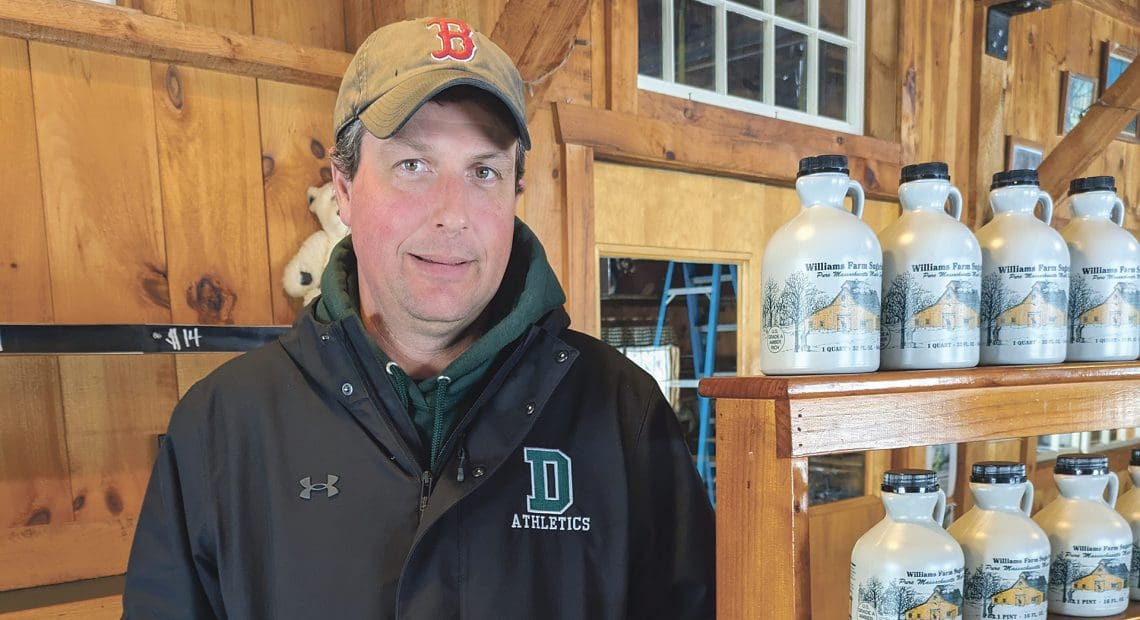
Chip Williams (pictured) and his sisters represent the fifth generation making maple syrup at the family’s sugarhouse.
Chip Williams has his eye on the weather reports around Deerfield. He’s not looking for long stretches of mild weather, or cold, for that matter. He wants both. Every day.
That’s because sugar maple trees in this region are tapped beginning in late February, and temperatures are critical for sap production — specifically fluctuating temps, with the ideal conditions being nights in the low 20s followed by days in the 40- to 45-degree range. This freeze-thaw cycle is necessary because, as the temperature warms, the ice inside the trunk melts, and the ice-compressed gases expand, forcing the sap out of the trunk.
“It’s all temperature-dependent. We need the right weather, and when I say right weather, it’s the freezing and thawing cycles. If we have that for an extended period of time, we’ll have a decent season,” said Williams, who is part of the fifth generation operating Williams Farm Sugarhouse, which starts selling maple syrup — and breakfast — to the public on Feb. 21.
“What often happens is a week of warm and then a week of cold, longer cycles of ups and downs,” he noted, “but we really want a freeze at night, warm during the day, freeze at night, warm during the day, and not so much warm for a week and then cold for a week.”
The reason, he said, is that the sap flows only on a warm-up. “So, after a freeze, that next day, when it warms up, it’ll flow, but it’ll only flow for a certain amount of time before you need it to freeze again. If it warms up and stays warm, it’ll run for a little while, and then you won’t get anything.”
That thermometer watching is just one of many challenges he and his sisters, Kelly Scofield and Casey Williams, take on when they work at the sugarhouse every spring. They all have regular jobs — Chip is the athletic grounds supervisor at Deerfield Academy, while Kelly and Casey work in hotel management in Eastern Mass. — but the maple-syrup season is a labor of love for the siblings, who are also joined by their father, Sandy, who comes up from Florida during tapping and boiling season.
“After a freeze, that next day, when it warms up, it’ll flow, but it’ll only flow for a certain amount of time before you need it to freeze again. If it warms up and stays warm, it’ll run for a little while, and then you won’t get anything.”
It’s also a tradition for plenty of local families as well, in a region that boasts a number of sugarhouses, few with as long a history as this one. The facility is open Friday through Sunday for pancakes, french toast, waffles, and more, all topped with that fresh maple syrup. And if they like what they taste, they can bring home syrup, maple cream, maple candy, and more from the store.
“We see a lot of the same families every year,” Chip said. “And when we’re boiling, we invite people to come back and ask questions, and we’ll explain the process. It’s really interesting to get people’s feedback — a lot of people have no idea how you even start making maple syrup, and people are amazed you take this product that looks like water and make it into this all-natural sweetener.”
It’s a product that has brought some sweet times for the Williams family since Milton Hubbard Williams began the syrup tradition in the mid-1800s, followed by his son, Kenneth Sanderson Williams. The original Williams sugarhouse was one of 13 located on Mount Toby in Sunderland.
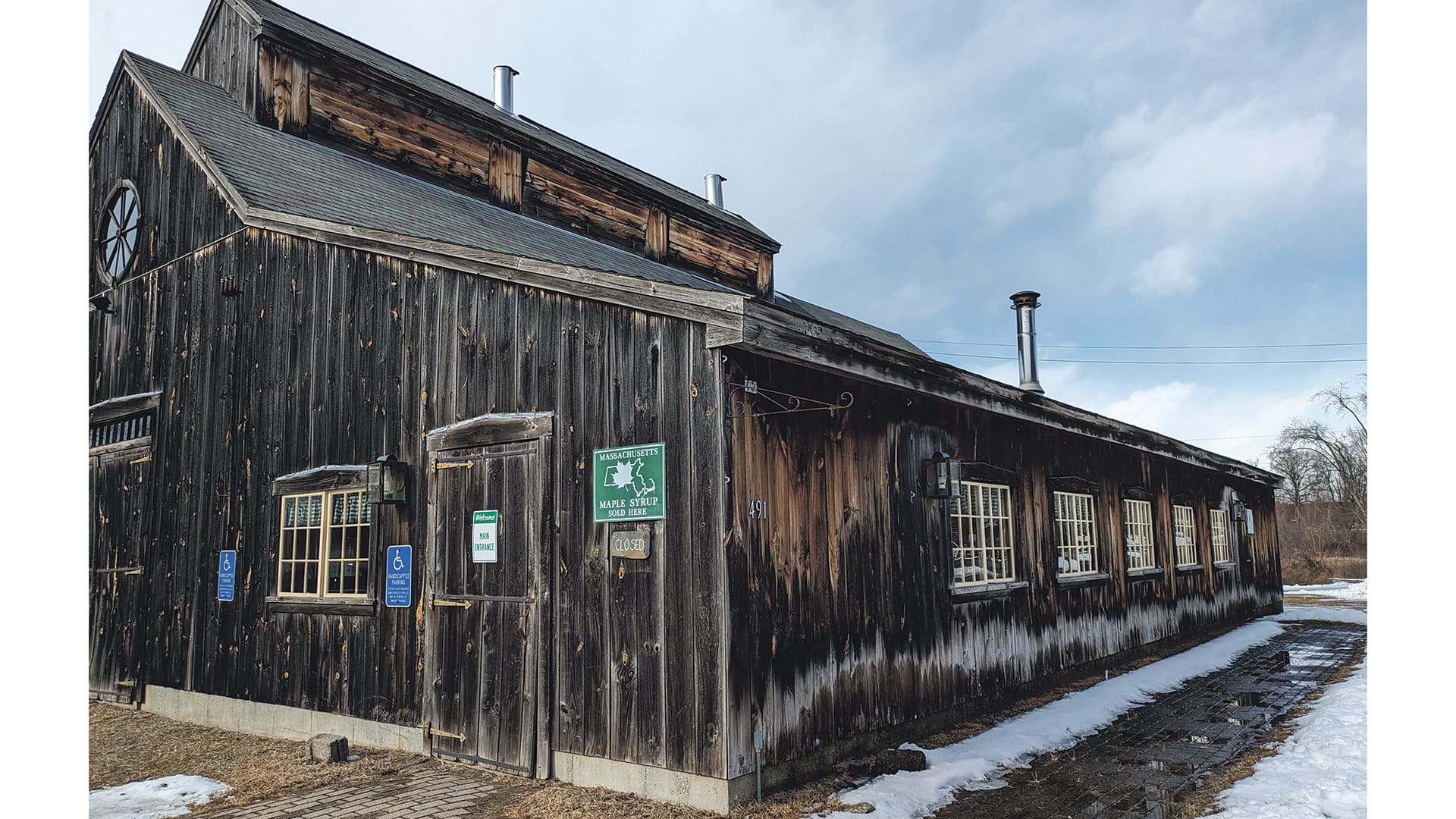
The Williams Farm Sugarhouse has been at its current location along Route 5 since 1994.
Staff Photo
In his diary, Hubbard Williams wrote, “March 6, 1853, commenced sugaring. March 25, 1853, traded sugar for coat and pants in Amherst.” Thirty-six years later, he was still sugaring, and on April 1, 1889, he wrote, “Gathered 20 bls [barrels] sap for four successive days. Had the best week I ever knew … syrup sells readily.”
In the mid-1960s, amid growing success and realizing the need for a better retail location, Kenneth Williams Jr. and his brother, Milton, moved the third-generation sugarhouse off the mountain to Route 47 in North Sunderland. The final move came in 1994, when the family, led by fourth-generation operator Sandy Williams, built a sugarhouse on Route 5 in Deerfield, near its sweet-corn farm.
“The reason we moved here is our farm was just right up the road in Old Deerfield,” Chip said. “We would drive over to Sunderland every day to operate the sugarhouse during the sugaring season, so when this property here came up for sale, my family bought it, and we were able to move everything closer to our operation.”
“When we’re boiling, we invite people to come back and ask questions, and we’ll explain the process. It’s really interesting to get people’s feedback — a lot of people have no idea how you even start making maple syrup.”
In Sunderland, they served coffee, donuts, ‘sugar on snow,’ and the like, but the move to Deerfield saw the food-service operation expand to serving meals — first on weekends, then seven days a week for a while, and currently three days a week. They stopped growing corn up the road 2012, but the sugarhouse — and its almost two centuries of tradition — lives on.
From Tree to Plate
Some years are weaker than others because of the uncertainty of the weather, Williams said. Last year wasn’t particularly strong for sap production, but 2010 was much worse, with only about 20% of the normal crop.
“It just warmed up around the middle of March, and it never froze again. It just stayed warm. So we didn’t get any more sap,” he explained, adding that an early start to those cold-warm cycles are important. “Here at our sugarhouse, if we don’t make any syrup in February, a lot of years it’s hard for us to have a really good year; we find that whatever we miss early, we never make up on the other end.”
When tapping a sugar maple, it’s best to drill a taphole that can provide an ample amount of sap while maintaining the long-term health and sap production of the tree. In a good year, one tap can yield around 10 gallons of sap, or almost one quart of syrup. Sap is, on average, about 2% sugar, and it takes about 45 gallons of sap to make one gallon of syrup.
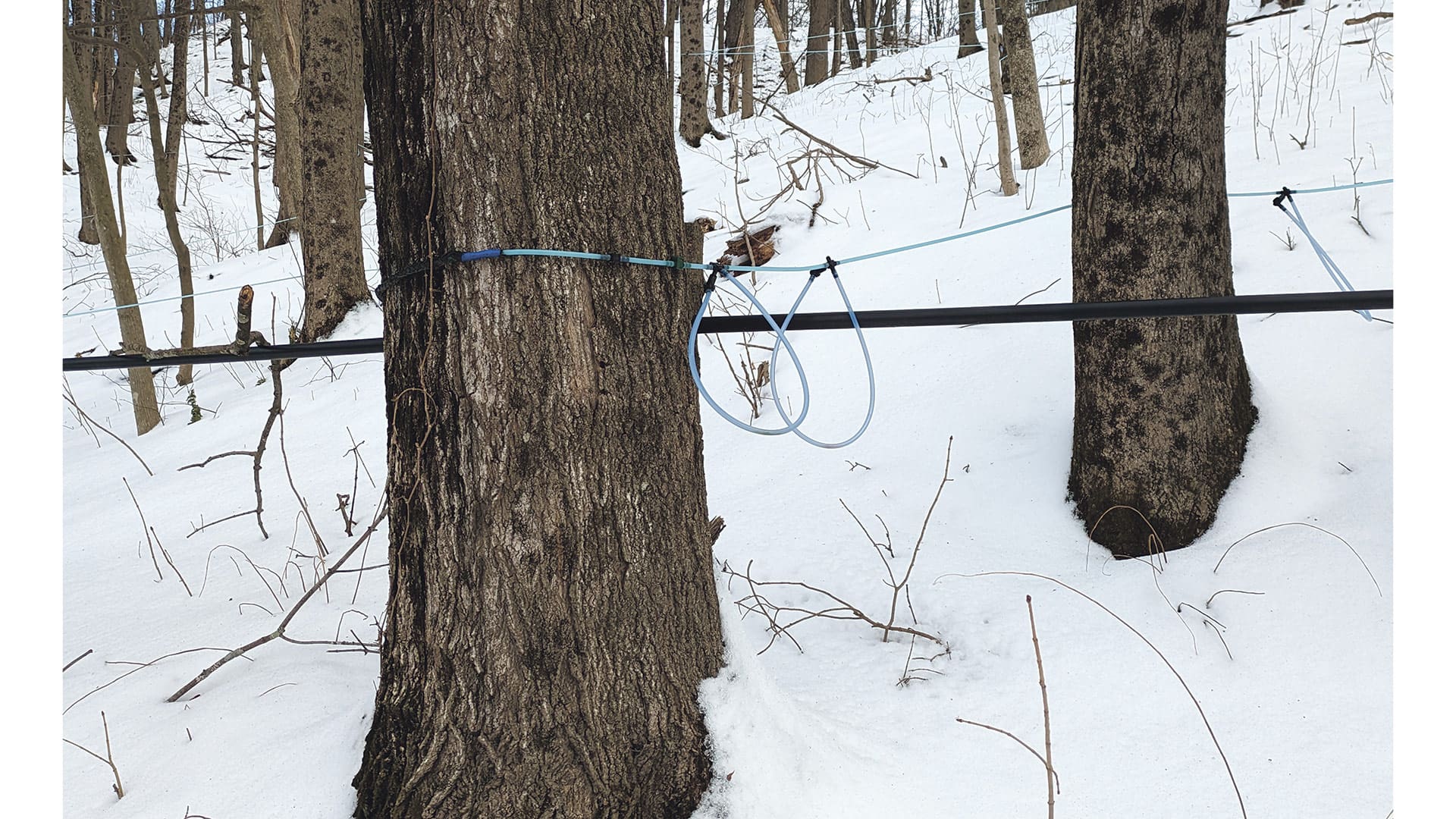
Sap flows best from the trees when freezing nights are followed by warm days.
Staff Photo
The traditional method of gathering sap is to hang four-gallon buckets below the tap to catch the drip. The process is very labor-intensive, and buckets must be gathered and emptied up to once a day. The Williams Farm enterprise hangs about 3,000 buckets each season, tapping more than 1,000 trees in Deerfield and Sunderland.
A less labor-intensive way of collecting sap is through a tubing pipeline, which utilizes gravity to gather sap into holding tanks that are positioned lower than the trees or at a slope. While the initial cost of setting up lines is greater than that of buckets, once lines are established, they can hold for 15 to 20 years. The farm has about 1,000 taps on pipelines, but is looking to expand that number in the future.
As noted earlier, the sap gathered from a sugar maple tree is not the same as what’s poured on pancakes. Sap has a large concentration of water and a small concentration of sugar, and the additional water must be boiled off in an evaporator.
In the sugarhouse, sap is continuously fed into the evaporator, where it flows through a series of troughs. The sap is boiling the entire time, and when it reaches the proper density at 219 degrees, it can then be called syrup. The more water that is boiled away from the syrup, the thicker it gets. Products like maple cream, candy, hard blocks, and granulated sugar are all made by further reducing the syrup at higher temperatures.
Williams noted that the team starts boiling as soon as they begin to get sap into the sugarhouse, and the sap is processed at its freshest in order to ensure the highest-quality syrup.
They always try to boil on weekends so the visiting public can witness the process, although, because sap flow is so dependent on the weather, they can’t guarantee they will be boiling on any given day, so for customers who want to see the process, it’s best to call ahead or check the website for projected boiling times.
“We like to get started in February, but it doesn’t always pan out. We’re just at the mercy of Mother Nature,” Williams told BusinessWest. “That’s some of what makes it interesting too — you don’t know. People will ask, ‘how’s this year going to be?’ And it’s like, ‘well, we don’t know until April, once it’s all over.’ We almost always make enough syrup for our customers, and it’s always good syrup. So, any year we can do this is a good year.”
Sweet Moments
Williams said he looks forward to this season for a number of reasons, including being close to nature.
“As the days get longer and it starts to warm up a little bit, it’s nice just getting out in the woods and working on the lines. I don’t get to be out as much as I did when we were farming full-time. I’d be out all the time, if not for my full-time job, so we have some people that help us.”
The sugarhouse is open to the public from late February into early April, and those dates aren’t set in stone so much as dependent, as noted earlier, on the weather and the frequency of that freeze-thaw cycle.
“Traditionally, we would always start right around the week of school vacation. Growing up, I remember having that February break, going out with the guys tapping,” he recalled, adding that sugaring season has long been a community tradition as well. “Because this craft is native to this region, it seems like people really have a tradition of visiting these houses and looking forward to it.
“And it’s important to my sisters and me to keep the tradition going,” he added, noting that he has three sons of his own. “Obviously, I don’t want to put any pressure on them doing this, but they love it here, and they help out. My 11-year-old likes to run the register up front.”
Williams Farm Sugarhouse does some wholesaling as well, selling syrup to local farmstands and maple candy to Richardson’s Candy Kitchen, right across the street. There are online sales as well, “but that’s tricky; you’re just a small fish in a big ocean. But once you make a few sales and people like your product, they’ll keep buying.”
And the family will keep tapping, boiling, and serving breakfast.
“There are times, like on a busy Sunday toward the end of the year, when we’re just dragging, but it’s fun,” he said. “We have three generations of family helping us out, too, so that’s great. Everyone kind of chips in to get it done.”