
A Fuzzy Picture on Tariffs Becomes Sharper, But Questions Linger
Coming into Focus

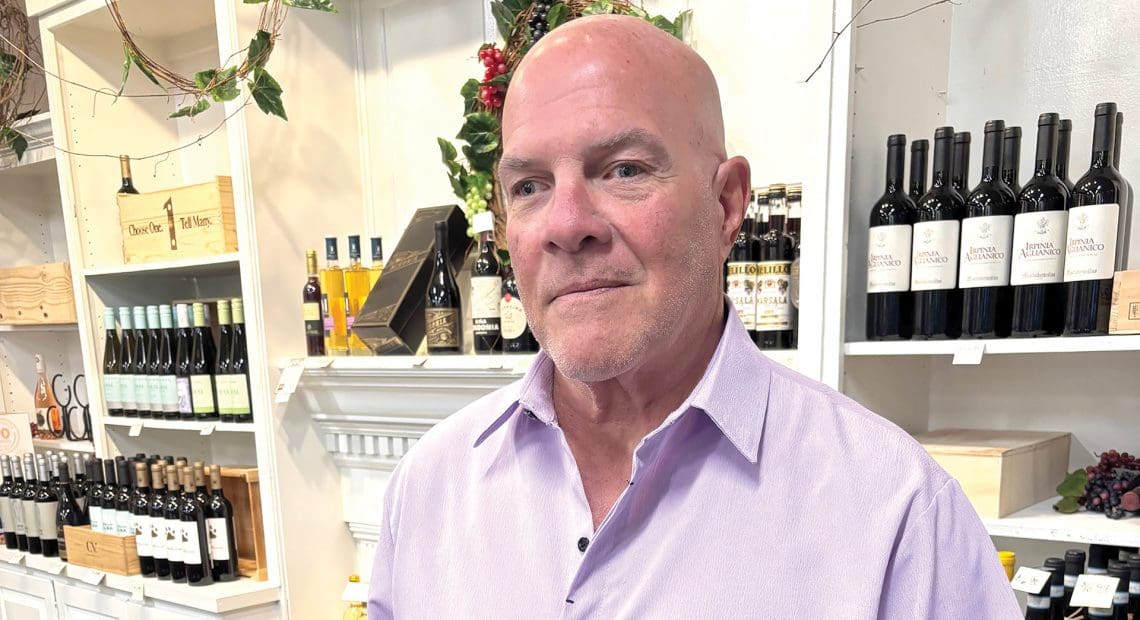
Carlo Bonavita says tariffs will likely prompt some wine drinkers to switch to domestic products.
Clarity.
Ever since tariffs became a main thrust of the Trump administration’s economic policy — that would be day 1 — that’s what business owners and managers have been calling, if not begging, for.
They still don’t have as much as they want, but they now have a lot more than they did 60 or even 30 days ago.
That’s especially true in the auto industry, where trade deals inked with Japan, South Korea, and the EU lock in 15% tariffs on a large list of foreign imports. That translates into a roughly $2,000 increase on an average-priced vehicle, which is now in the mid-40s, said Ben Sullivan, chief operating officer for the Balise Auto Group.
And that number must be put into perspective, he went on, noting that, with the return of incentives such as 0% financing and attractive lease rates, the consumer’s monthly payment — which is what most focus on — may not rise much higher than it is now.
“At the same time as those price increases are coming, most manufacturers have increased production, and when they increase production, they want to sell a bunch of cars, and when they want to sell a bunch of cars, they put incentives on them.”
“At the same time as those price increases are coming, most manufacturers have increased production, and when they increase production, they want to sell a bunch of cars, and when they want to sell a bunch of cars, they put incentives on them,” said Sullivan, who cited the case of a co-worker with a truck coming off lease. She’s getting into a new one and shaving $100 off the monthly payment at the same time.
That’s an indication of how unattractive the incentives were in the years after COVID, and how much better they are now, said Sullivan, adding quickly that, while there’s still a good amount of dust to settle, especially with regard to tariffs imposed on Canada and Mexico and the cars and parts made in those countries, there is a sense of normalcy returning to this sector (more on that later).

Ben Sullivan says that, while car prices are rising by $2,000 on average due to tariffs, with incentives, consumers may not see a rise in their monthly payment.
The same can generally be said for Carlo Bonavita’s business, Springfield Wine Exchange, where clarity is also a technical term.
Bonavita’s shelves are loaded with imported wines, many of which will now be subjected to at least 15% tariffs. This will add a few dollars to the average-priced bottle, which might be enough to sway some consumers to switch to domestic labels, something he’s been promoting for some time now, especially with the prices from some European wines rising even before tariffs were imposed, for reasons he can’t pinpoint.
“The reality is, I’d prefer to find domestic wine alternatives for our customers. It’s our job to go out there and find wines for our customers that are affordable, quality — and that’s easy to do,” he said, adding that he expects that some will shift more to domestic products. “Most people are loyal to the grape, and not necessarily the label,” he said, adding that consumers are likely to trade an Italian Pinot Grigio for one made in California.
There is less clarity in some other sectors, however, and with many different products, especially since a new, wide round of tariffs on individual countries went into effect earlier this month. The countries included Brazil (50%), Switzerland (39%), Vietnam (20%), and Taiwan (20%), and the tariffs are expected to generate price increases on everything from watches to shoes; computers to furniture; coffee to toys.
Construction is another sector where there are still some unknowns.
Dave Fontaine, CEO of Fontaine Bros. Inc., said tariffs will certainly impact the cost of projects large and small because tariffs on products, such as steel or copper, are applied not when they are ordered, but when they enter the country.
“I would equate it to walking into a store … the sales tax is 6.25%, and then, while you’re purchasing the item, the sales tax gets doubled or tripled,” he explained. “That’s going to impact at the register.”
To date, increases in prices from tariffs have been offset by decreases in the cost of some materials due to a general slowdown in the industry, allowing projects to stay on budget, he went on, but it remains to be seen if things will stay that way.
“I don’t know for sure, but I think that what our distributors did, as these tariff talks were going on, was bulk up their warehouses just to get people along for six or seven months in anticipation that the tariff talks would blow over and things would get settled.”
For this issue, BusinessWest talked with business owners and managers across several sectors to get some perspective on tariffs and what they mean for their businesses and their customers.
Grape Expectations
The announcement of Trump’s ‘Liberation Day’ tariffs on April 2 has been followed by four and half months of trade talks, new deals, deadlines made, deadlines extended, and seemingly never-ending speculation about the impact of tariffs on prices, individual businesses, and entire sectors.
In many respects, the speculation is giving way to increased clarity, though there are still plenty of question marks on everything from how much of the price increases will be passed on to consumers to how those same consumers will respond to the higher prices.
More will be known in the weeks and months to come, said those we spoke with, adding that much, but not all, of what’s for sale now — be it cars in showrooms or wines on shelves — were delivered before tariffs went into effect.
That’s true of the popular beers from Germany, Belgium, and other European countries sold at the Student Prince, said Nate Yee, director of Hospitality for the Bean Restaurant Group, which counts the downtown Springfield landmark among the many area eateries in its portfolio.
“I don’t know for sure, but I think that what our distributors did, as these tariff talks were going on, was bulk up their warehouses just to get people along for six or seven months in anticipation that the tariff talks would blow over and things would get settled,” he said, adding that prices have remained remarkably, and unexpectedly, stable. “That’s the only explanation I can think of for why our costs haven’t gone nuclear.”
The company has enough in its own warehouses to get through the Big E, where it will have several locations, said Yee, adding that what happens when the current warehouse stock is replaced with post-tariff products remains to be seen.
“Who knows what will happen?” he said, adding that, if costs rise, the Bean Group will have to think about adjusting its own prices. “But we want to be as price-sensitive as we can; we want to be affordable, and we want our guests to come back multiple times a week, and a big part of that is the value aspect of it.”
Bonavita said almost everything at his storefront in Tower Square, and everything shipped to customers elsewhere, including the eastern part of the state (a growing part of this business), arrived pre-tariffs. It will be September or October, he projects, before the nature of the inventory shifts and prices are adjusted.
And while he will continue to order wines from dozens of other countries (together, they make up roughly 35% of what he sells), he fully expects movement toward domestics as the inevitable price increases come. Meanwhile, like Yee, he said he will likely absorb some of the hit to minimize the impact on the consumer.
“We wouldn’t be here without our customers, so I’ll do whatever it takes to keep our customers,” he explained. “If that means we work on a lesser margin, we’ll work on a lesser margin.”
Driving Forces
Sullivan said many — but certainly not all — the cars on area lots were delivered pre-tariffs. That means consumers might find two almost identical cars at a dealership with different price tags.
And, as he mentioned earlier, while the price tag on the post-tariffs model might be higher, the monthly payment might — that’s might — not be. And that’s just one of the many intriguing dynamics within the auto industry as a once-fuzzy picture sharpens a bit.
“The tariff landscape is coming into clearer focus,” he told BusinessWest. “Now, it’s about what the scale and the impact of the tariffs will be and when it will all settle into something that’s predictable. We’re not home yet, knowing exactly where this whole thing shakes out, but we’re getting closer.”
Elaborating, Sullivan said there will be more clarity in the months and years to come on issues ranging from used car sales to how long consumers hang on to their cars as the cost of maintaining them rises because of tariffs on parts, many of which are made in China.
Meanwhile, with new car sales, as well as the proverbial big picture, there is more normalcy than a few months ago, when panicked consumers were running to dealerships to beat the tariffs.
“Now, things have calmed down,” he said. “People are aware that it’s not as bad as they feared; it’s still going to cost them more to buy a car, but not as much as they feared. So right now, we’re seeing a more normalized market than we’ve seen in a while.”
‘Normalized’ wouldn’t be a word to describe what’s happening in the construction sector, said Fontaine, noting that tariffs are impacting not only projects in progress — such as the new high schools his company is building in East Longmeadow and Agawam — but some initiatives on the drawing board.
“When the cost of materials is going up, that makes construction projects more difficult to to get financed — and more difficult to make sense,” he explained, adding that this is more prevalent on the private side of ledger than on the public side. “And a lot of people are in the wait-and-see phase because of the uncertainty with the economy.”
For construction firms, the challenge is to find ways to minimize the impact through use of more domestically produced materials and other strategies to keep projects on budget.
“We’re spending a lot of time trying to protect ourselves and our clients from the impact of them, and I think we’ve been generally successful with that,” Fontaine said. “We’ve pushed a lot of things to be imported from places that are not impacted by tariffs or made in America. We’re doing everything we can to mitigate costs, but it’s a hot issue in construction right now.”
And in many other sectors as well.