The New Courthouse Will Change the Landscape — Somehow
Where Will It Go?
Chuck Irving says he’s surprised that none of the other groups that responded to the state’s request for proposals to build a new Springfield Regional Justice Center submitted plans that focused on the current courthouse site.
“We see an opportunity to not abandon the current courthouse location, but embrace it and make it even better,” said Irving, a principal with the Davenport Companies, who is partnering with Thomas O’Brien, CEO of HYM Investment Group, on two proposals for a new courthouse, one involving redevelopment of the current site off State Street. “We want that site to be the tentpole that it is in terms of holding up the economy of downtown.”
That’s his opinion.
And everyone, it seems, has their own opinion on this project, which has captured the attention of the development community, the business community, the legal community, and the city as a whole — to an extent that has impressed Adam Baacke, commissioner of the State Department of Capital Asset Management and Maintenance (DCAMM), which issued the RFP and will decide — probably in Q1 of next year — which of the 11 proposals received will be the winner.
“We do a lot of projects, both construction and leasing, and the vast majority of them don’t garner the level of interest and, dare I say, excitement that this is generating in Springfield.”
“We do a lot of projects, both construction and leasing, and the vast majority of them don’t garner the level of interest and, dare I say, excitement that this is generating in Springfield,” he said. “We’re happy to be involved with something that the community sees as such a significant project for its city.”
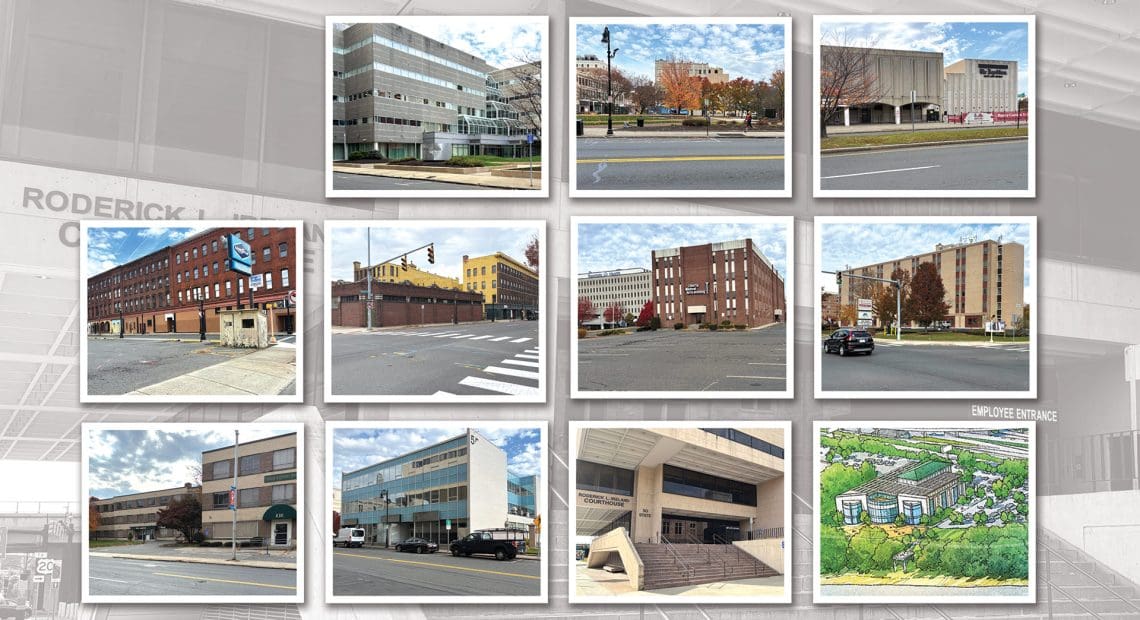
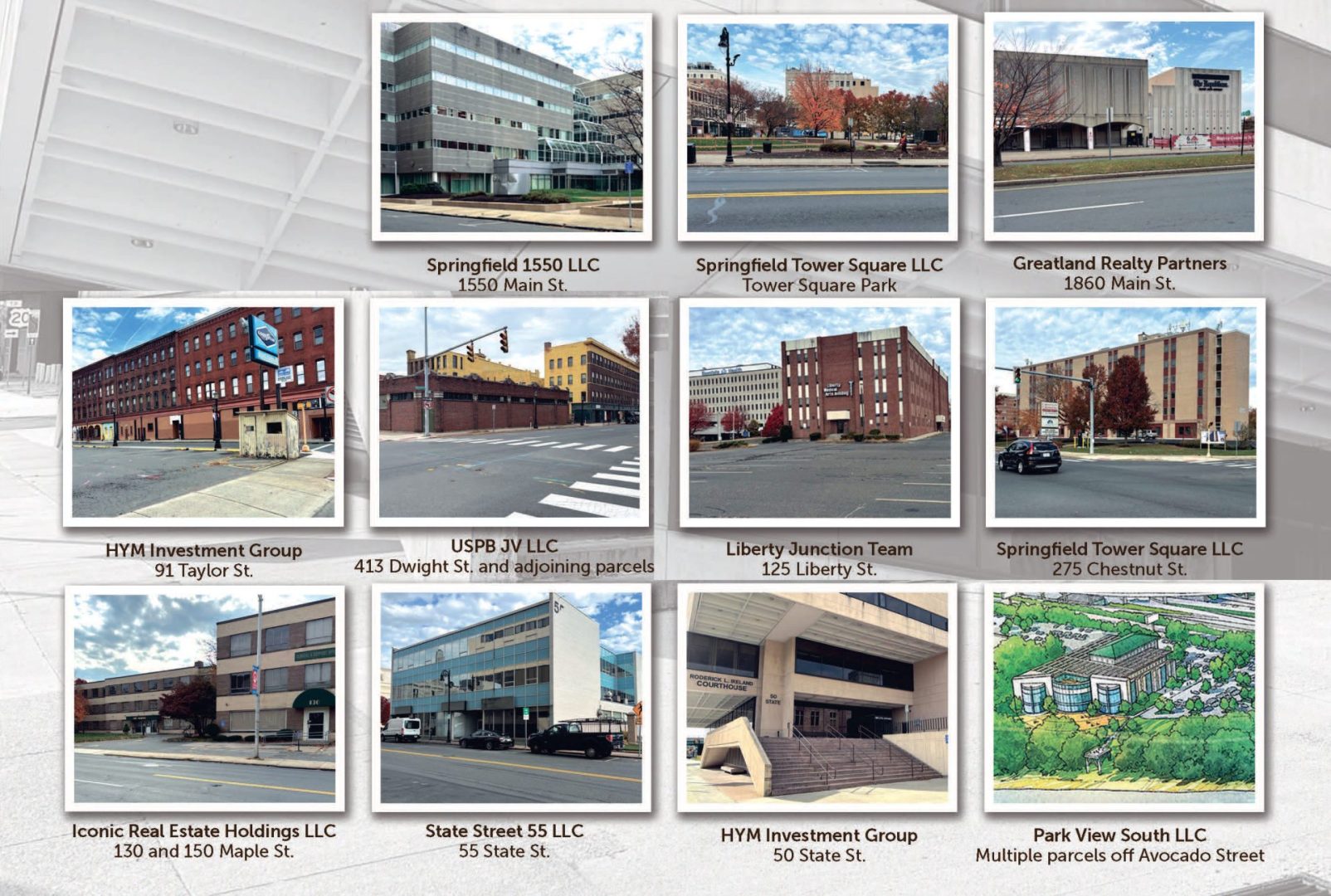
Efforts to build a replacement for the troubled Roderick L. Ireland Courthouse reached an intriguing phase last month, when DCAMM released the list of 11 proposals submitted by a wide range of local and regional developers (see box).
The submissions cover an eclectic mix of properties, ranging from the park created when the Steiger’s department store on Main Street was razed nearly 30 years ago to the building that houses the Republican and its giant printing presses; from the site of a factory where Absorbine Jr. was made to a now-vacant property that was home to a strip club.

An architect’s rendering of the proposal submitted for the property at 55 State St.
Meanwhile, the list of developers includes a notable who’s who when it comes to major projects in Springfield and the Commonwealth, from Davenport and HYM to the brothers Picknelly (Paul and Peter, each heading their own proposal); from Greatland Realty Partners, which recently prevailed in a similar competition to build the state’s new crime lab in Marlborough, to the team of Jeb Balise, president of Balise Motor Sales, and Tom Dennis, president of the Dennis Group, which both have downtown Springfield development projects in their portfolios.
These groups were drawn in by a unique opportunity whereby DCAMM has decided to use a private developer to identify a site, permit, and build the new justice center and then lease it back to the Commonwealth. The terms are quite attractive — a 40-year lease, a rarity in commercial real estate — with an obviously high-credit tenant, and these conditions certainly contributed to what Baacke considers a robust response.
“We’re very happy with the quantity of responses, and I think it’s a clear reflection of how attractive this opportunity is in the development community,” he noted, adding that the RFP has attracted a solid mix of local and regional developers. “This is a very substantial requirement from the largest commercial tenant in Massachusetts that also happens to be one of the strongest credit tenants available in the marketplace, and this is a time when the commercial real estate market is not as strong as it has been at other times.”
Adam Baacke
“This is a very substantial requirement from the largest commercial tenant in Massachusetts that also happens to be one of the strongest credit tenants available in the marketplace, and this is a time when the commercial real estate market is not as strong as it has been at other times.”

Overall, this method creates opportunities for the city (in tax revenue from what will be a privately owned facility, as opposed to state owned) and both the state and the chosen developer, said Baacke, adding that it enables the justice center to be built more quickly and perhaps more cheaply, although cost is not the overriding reason for going this route, which was also chosen for the crime lab.
“The biggest benefit for the state, especially in this instance, is the speed with which we can deliver the project,” he explained. “The process that the private sector undertakes for construction procurement is more efficient — time-efficient and probably cost-efficient as well — than the process the Commonwealth is required to undertake for a public building.
“That results in some benefit in how quickly we can deliver the project,” he went on. “But the really big factor in this case is that this is a pretty sizable project, and fitting it into an already-oversubscribed capital plan would push the project further out than would otherwise be necessary.”

The current courthouse at 50 State St. is considered obsolete in many respects.
As for what will go into the decision-making process, Baacke said several factors will be considered, from cost to accessibility to “having a positive economic impact on the city.” And given all that, there was a requirement within the RFP that the courthouse be built in the center of the city, a broad area that covers all 11 proposals, from Maple Street to the south to a parcel on the riverfront to the north.
For this issue’s focus on commercial real estate, BusinessWest examines the many aspects of the courthouse project, from the process to the players to the factors that will go into the decision.
Court of Opinion
Baacke noted that, while the ‘sick’ nature of the current courthouse has added a degree of urgency to the matter, the 46-year-old facility is in many ways obsolete, from operating efficiency to design.
“That building reflects old thinking around everything from security to how the building welcomes the public and celebrates the importance of justice,” he said, adding that, with recently constructed courthouses, such as the one in Lowell and those under design in Quincy, Framingham, and Lynn (all to be built by the state), there is a “different feel to the buildings and a very different organization, particularly around circulation and security, and it’s just not possible to retrofit that building, which was designed for a very different philosophy around judicial architecture.”
“We believe we’re ready to move as fast or faster than anyone. We’ve got a fully formed team that has built basically the last several courthouses to the state’s specifications and satisfactions, so there will be no learning curve for anyone involved. And we have a site that is basically shovel-ready.”
As noted, the state’s quest to replace the structure has attracted a broad range of development teams, many of which have helped reshape the landscape in Springfield in recent years.
In addition to Davenport, which has been involved in several projects in Springfield, including the recent conversion of the Willys-Overland building on Chestnut Street into market-rate housing, redevelopment of the former RMV building in Springfield, and the new Square One facility, teams submitting proposals include the owners of Tower Square, Vid Mitta and Dinesh Patel, who successfully retenanted the downtown landmark, bringing in the Greater Springfield YMCA, White Lion Brewing, and others.

The new courthouse in Lowell is one of several opened recently or in the design/construction phase.
The two partners have submitted three different proposals, one involving 1550 Main St., the office building adjacent to Tower Square that they acquired in 2023; another involving the park across the street, created when Steiger’s closed and was torn down; and a third entailing the site of the former YMCA building on Chestnut Street, most of which has been demolished, with the remaining portion used for affordable housing.
As for Greatland, company President Kevin Sheehan said the company’s portfolio is dominated by projects in the eastern part of the state, including the crime lab, and the Springfield courthouse represents a growth opportunity in a different market.
Sheehan didn’t want to discuss the Springfield project in any detail other than to say the company looked at several sites and ultimately concluded that the Republican building represented the best option for the city and the trial court.
Other developers also chose to refrain from comment on their projects, opting, as one put it, to “let the DCAMM process play out.”
The Balise/Dennis partnership, for example, issued a simple statement on their proposal, which involves a city block between Dwight, Taylor, and Chestnut streets that includes the former home of W.F. Young, maker of Absorbine Jr.
“We see this project as an opportunity to transform downtown Springfield in a way that connects the metro center’s various neighborhoods and increases community pride,” it reads. “By tying Union Station more closely to the rest of downtown, we can bring new energy and life to the area while revitalizing the surrounding neighborhood. Just as important, our proposal prioritizes the health, safety, and well-being of everyone who works and visits the new courthouse, giving Springfield the modern facility it deserves.”
Building Momentum
But other developers were more open about their proposals and willing to tout their attributes.
Irving said both Davenport/HYM proposals have merits. The second, for the building that once housed the Mardi Gras strip club, is just a block from Union Station, he noted, adding that a courthouse on that location could provide a substantial boost to that section of the downtown.
But the group’s other school of thought was that moving the courthouse from its current location would be devastating for the city’s downtown, so it submitted two plans.
Kevin Sheehan
“I definitely wouldn’t say there’s no risk, but I think that, with a high-credit, long-term lease, you’ve solved a lot of the risk in real estate development. It’s a smart strategy for the state to get what it wants, a nice new facility, and not take the risk on construction overruns and instead push that to the developer.”

“We said, let’s give the state its choice,” he noted. “But the best thing we’re offering to DCAMM is the depth of our development experience. Between a massive company like HYM, which has done work for DCAMM around the state, and Davenport, which has vast experience in Springfield, I think we bring a team that can deliver, and I think that’s the biggest issue for this project — who can deliver. The state needs this to be done on budget and on time, and we can do that.”
Meanwhile, Paul Picknelly gushed about the proposal submitted by Monarch Enterprises for the property he owns at 55 State St. — and the team behind it.
That team includes Finegold Alexander, a women-owned architecture firm that has designed several courthouses, including the one in Lowell, as well as the one under design in Framingham; Springfield-based Fontaine Construction, which has a deep portfolio of projects in the city, including the MassMutual Center and the Court Square apartment complex, a block from the current courthouse; Dimeo Construction, which built the courthouse in Lowell and is currently building the one in Framingham (Fontaine and Dimeo recently collaborated to build the new Doherty Memorial High School in Worcester); and Westmass Area Development Corp., chosen to see oversee redevelopment of the existing courthouse site.
Picknelly and David Fontaine Jr., president of Fontaine Construction, talked about what they consider to be a strong case for their proposal, including everything from design (it bears a strong likeness to the Lowell courthouse, also built vertically) to how quickly their concept could move from demolition to construction, to its location across the street from the current courthouse — proximity, they say, that brings everything from familiarity to better odds for successful redevelopment of the existing courthouse when it is demolished.
“We believe we’re ready to move as fast or faster than anyone,” Fontaine said. “We’ve got a fully formed team that has built basically the last several courthouses to the state’s specifications and satisfactions, so there will be no learning curve for anyone involved. And we have a site that is basically shovel-ready.”
Even parking, a consideration for all proposals and a problem for some, won’t be an issue for the 55 State St. site, said Picknelly, who referred to his recent call for jury duty at the Springfield courthouse to get his point across.
“It instructs me to park in the I-91 South lot,” he said, referring to the facility under the highway, adding that these instructions won’t change if the courthouse is built at 55 State St.
New Lease on Life
The Springfield Regional Justice Center will be the largest undertaking by the state when it comes to using a private developer to build a facility and then leasing it. But this method has been used with many facilities, including smaller courthouses, such as the one in Westfield.
“The state has about 7.5 million square feet under lease across the Commonwealth, including dozens of properties on behalf of the Trial Court,” Baacke explained, adding that what makes the Springfield project unique is its scope and the length of the lease.
Approved by the state’s Asset Management Board, which authorizes leases longer than 10 years, the 40-year commitment was considered necessary for this project to work.
“During the process of working with the Asset Management Board for the authorization for this project, we really tapped into expertise of the development community members of that board for their recommendations about what length of term would enable developers to not only be interested, but obtain financing on terms that could be most favorable, ultimately, to the Commonwealth in what they would pass through in terms of the lease cost.”
In those respects, this project is most similar to the new State Police crime lab in Marlborough, a 200,000-square-foot, $300 million project that comes with a 20-year lease; construction is due to start in early 2026.
Sheehan said there are many similarities between the crime lab project and the courthouse initiative. He described the former as an effective process, one with advantages for both the state and the chosen developer — and even for the host community.
“In terms of working together with a private developer and the state and the local community … that has resulted in a pretty successful outcome,” he told BusinessWest, referring to the crime lab. “It can be a great partnership; it allows us to do what we do, and by publishing a long-term lease, the state can use its credit to support the construction of this facility without putting all the cost up front and without committing its resources to the design and construction and procurement process, which I think we can a little more efficiently than the state government.”
Irving agreed. “The state provided an opportunity to have a 40-year lease, and in my lifetime, I’ve never seen Massachusetts offer a 40-year lease, which is pretty much the equivalent of a bond,” he explained. “So, this is really well done because it makes this easily financeable, and it makes that financial modeling much easier, and that’s why you have 11 proposals on the table; it’s an amazing opportunity.”
And while there are certainly fewer risks for developers with a project of this nature rather than building a spec office building or renovating a tenanted office facility (where leases typically run five to 10 years) given recent trends with remote work, there are still risks, even with the state as a tenant and a 40-year lease.
“In the development world, there are three basic risks — the leasing risk, the financing risk, and the construction risk,” Sheehan noted. “If it’s a pre-leased facility, you’ve solved the first one, and if you’re using the state’s credit, you’ve somewhat solved the second one, but there’s still fluctuations in interest rates that certainly impact cost, so that’s a risk. And then, there are the construction risks — cost escalation, trade tariffs, labor rates, and general execution risk from construction of the building.
“So I definitely wouldn’t say there’s no risk, but I think that, with a high-credit, long-term lease, you’ve solved a lot of the risk in real estate development,” he went on. “It’s a smart strategy for the state to get what it wants, a nice new facility, and not take the risk on construction overruns and instead push that to the developer.”
Heavy Wait
Getting back to the factors that will ultimately decide which proposal is chosen, Baacke said there will be several, from the proposed lease terms to accessibility; from meeting the state’s decarbonization and climate goals to a project’s ability to positively impact the city economically.
“We do want this project to be a benefit to the city of Springfield,” he told BusinessWest. “As a former gateway city planner myself, I know this is the kind of facility that can be influential in attracting people to an area. It can have a positive impact, and it can also have, if it’s placed in the wrong location, a negative impact on areas that benefit from the location of the current facility.
“The biggest factors in selecting the best proposal are going to be about how the proposal aligns with the needs of the Trial Court,” he explained. “And that’s a little bit about siting, but more about the design of the facility and how well it meets the program and is consistent with their expectations for a hall of justice.”
And then, there’s the cost.
“This is not going to be a decision that is made on which project is cheapest, but which project delivers the best value to the Commonwealth,” Baacke continued. “The project that has the strongest alignment with the needs of the Trial Court, at the best price available to the Commonwealth, is what we’re ultimately going to be looking for.”
Which proposal best does all that will be decided over the next several months.
Now comes what may the hardest part of this process — waiting for a decision.