CET Marks 50 Years of Making Sustainability Easier
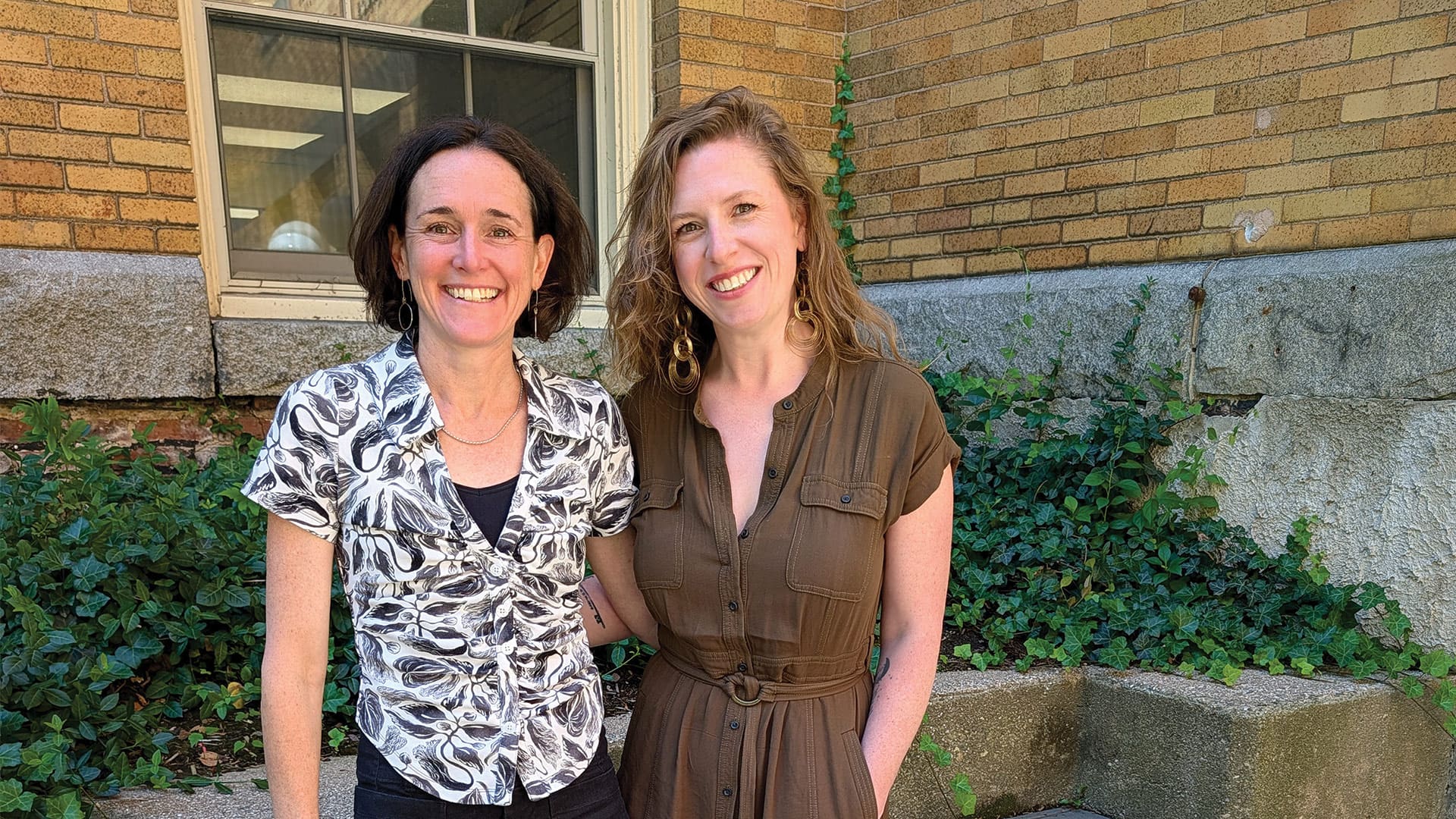
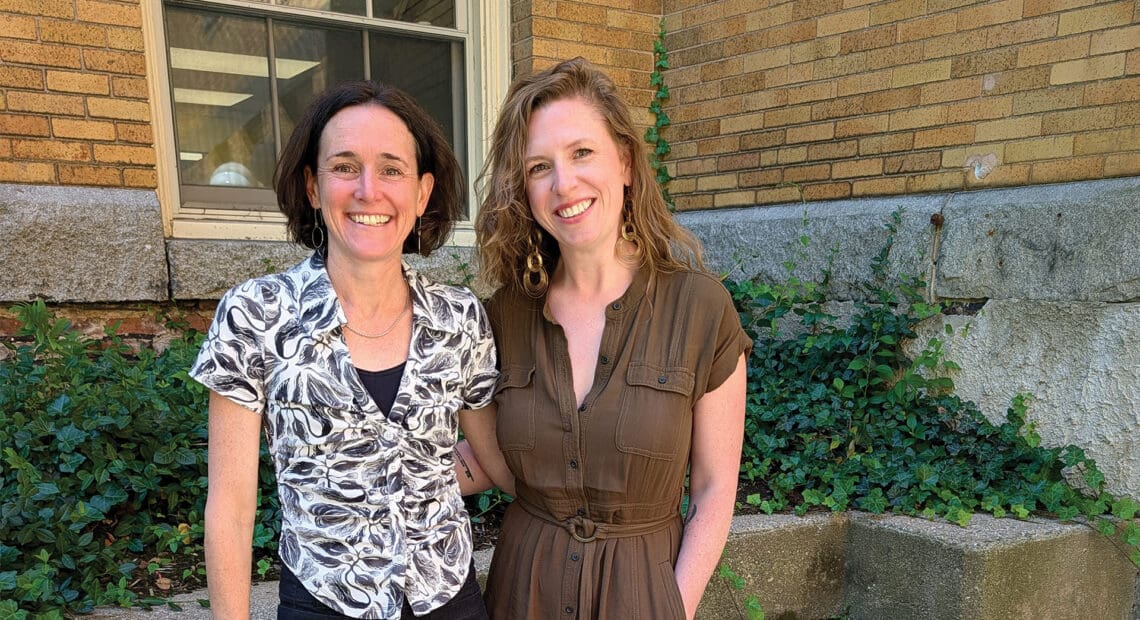
President and CEO Ashley Muspratt (left) and Director of Communications and Market Evolution Emily Gaylord
Renewed Energy
She calls it “radical ease.”
That’s the term CET President and CEO Ashley Muspratt used to describe how the nonprofit — originally called the Center for EcoTechnology, and celebrating its 50th anniversary this year — aims to make positive environmental impact easier for clients.
That starts with the initial assessment of a home or business.
“We send one of our waste reduction consultants or our energy consultants to the building to determine, ‘what’s the state of this building? What’s the state of their waste management practices?’ We need to understand their existing systems in order to help them prioritize the steps that they’re going to take, but also make sure, when it comes to behavior change, that we’re looking at ways to seamlessly integrate any new solutions into their existing practices because that’s the only way they’ll be sustained for the long term. That’s the radical ease piece,” said Muspratt, who has been at CET since 2017 and at the helm since 2020.
That assessment is typically followed by a discussion of budget, priorities (perhaps climate concern, staff comfort, or long-term energy savings), available state and federal incentives, and how to connect with contractors to achieve goals ranging from weatherization to composting.
“Coming back to this radical ease concept, we try to remove the friction, remove the barriers, and take the work out of climate action for people,” Muspratt said. “So we do all the research and the heavy lifting to get people to their goals.
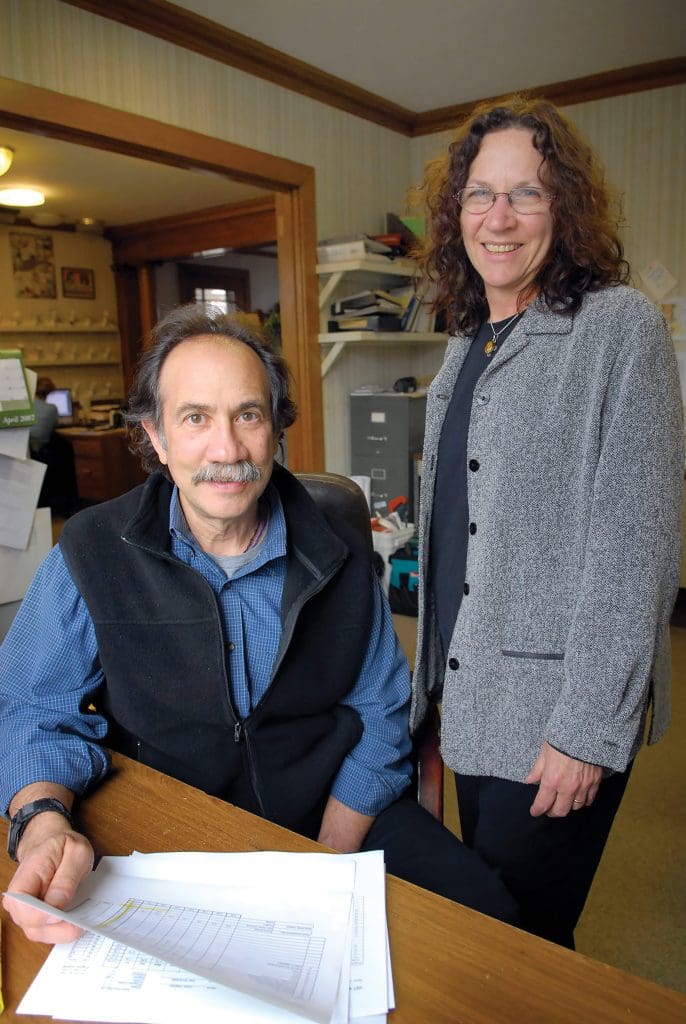
Alan Silverstein and Laura Dubester, former CET executive directors. The Alan Silverstein and Laura Dubester Award for Community Environmental Leadership was created in their honor.
Once we do the site assessment, it’s a very tailored service that we provide, based on what we find and what the customer is interested in. And we try to see them through all the way to implementation.”
That involves the administration of about 60 different programs for state agencies and utilities — quite the evolution from CET’s beginnings in 1976, when it focused mostly on energy audits, an innovative concept for the time.
“These climate solutions exist — we know what they are — but for most people, you have a life, you have a job, you have kids, you have to go to the baseball game, you have a dentist appointment,” added Emily Gaylord, director of Communications and Market Evolution. “So what CET offers is helping people and businesses find a way for climate solutions to make sense in their day-to-day life in a way that doesn’t feel like yet another thing to do.
“I always say with climate solutions, pick your co-benefit,” she added. “Like, weatherization reduces emissions, but it also makes you more comfortable and can save you money. If you reduce your food waste, not only are you reducing methane, but you might be feeding people who really need it. There are so many opportunities where we can take climate action from daunting to doable.”
Amid all the change and evolution at CET, Gaylord is impressed with what has stayed the same — namely, the mission. “The heartbeat of what we do — making it possible for people to participate in these programs, making it feel easy, like a no-brainer, and finding all of those co-benefits — has been consistent. From the beginning, we’ve been working with small businesses and low-income homeowners and farms and folks that are often left out of climate conversations.”
Innovative Start
In many ways, the 1970s was the birth of the modern environmental movement. The decade saw the first Earth Day, the creation of the Environmental Protection Agency, and legislation in the form of the Clean Air Act, the Clean Water Act, and the National Energy Act. It was also the decade of the oil crisis, when many Americans wondered if they would run out of gas.
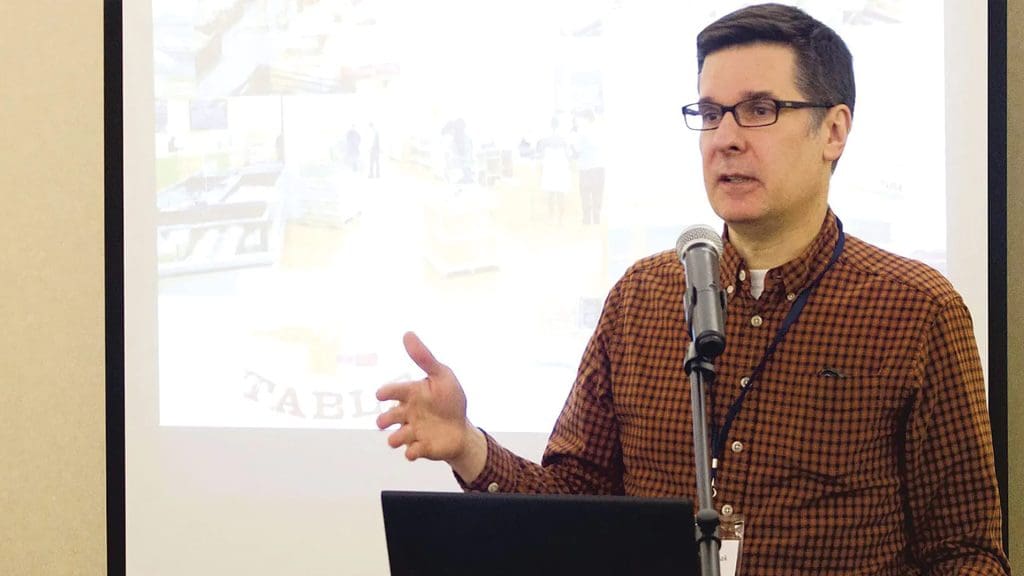
Former CET Executive Director John Majercak, seen here leading a staff meeting during his tenure.
CET’s founders had an idea: to examine technologies and practices that could improve energy efficiency for businesses and reduce their environmental impact, all while increasing profits and raising quality of life. At first, they focused on energy conservation, in particular partnering with utility companies on the relatively new concept of energy audits, whereby a consultant visits a home or business to talk about ways in which their building or operation could be revamped to save on energy costs.
Other early initiatives included the development of a passive solar greenhouse at Berkshire Botanical Garden and a program that taught solar energy, energy conservation theory, and carpentry to unemployed people, who then installed 31 solar space-heating systems in low-income households.
CET still conducts energy audits, helping homeowners and businesses understand the value of sustainable systems and educating them on the incentives available to make changes. But the organization, which now employs about 85 people, has become much more, expanding its mission into 18 states and a host of new opportunities, from composting and food waste reduction to a national train-the-trainer program and a partnership between utilities and customers called inclusive utility investments (more on those later).
“Our official mission is to innovate, implement, and scale the environmental solutions that communities need to thrive,” Muspratt told BusinessWest. “Our work as an organization is to mitigate CO2 emissions and other greenhouse gas emissions to prevent the worst, most catastrophic impacts of climate change, slow that down.
“The work that we do to weatherize buildings and transition them off of fossil fuels, these are all technology solutions that are also very good for a changing climate,” she added. “Another big component of our work is waste reduction, as waste, particularly food waste, is another major driver of greenhouse gas emissions, specifically methane.”
Gaylord said clients welcome the opportunity to achieve win-wins that benefit both the planet and their own business.
“No one understands the value of food more than somebody in food service who interacts with it every day. A contractor understands building materials more than anybody else. A facilities manager knows exactly how much they’re spending on their energy costs. So this idea that people are doing nothing, or they’re not doing enough, is not a helpful place for people to start,” she said. “It’s better to acknowledge how much is already happening and then build on that momentum and allow the customer to feel really proud of the work they’ve already been doing and the ways they’ve been participating in climate action without even realizing it — and then help foster these other ways to work on it.”
Muspratt agreed, again reiterating the ancillary benefits of CET’s work.
“These days, it’s become more normalized to talk about climate as one of the many reasons you might take action. But certainly, for businesses and households, economics is the number-one thing — that tends to be a big driver. And then, for certain programs, it’s the public health piece, particularly when we’re working with lower-income customers in really challenging housing situations where there might be moisture and mold issues that we’re helping to mitigate before weatherizing the building — issues that contribute to chronic respiratory disease and all kinds of compounding health challenges like asthma.”
With CET’s train-the-trainer program, the nonprofit is helping to accelerate the conservation learning curve for organizations across the country, particularly with food waste, in settings like restaurants, hotels, hospitals, and colleges.
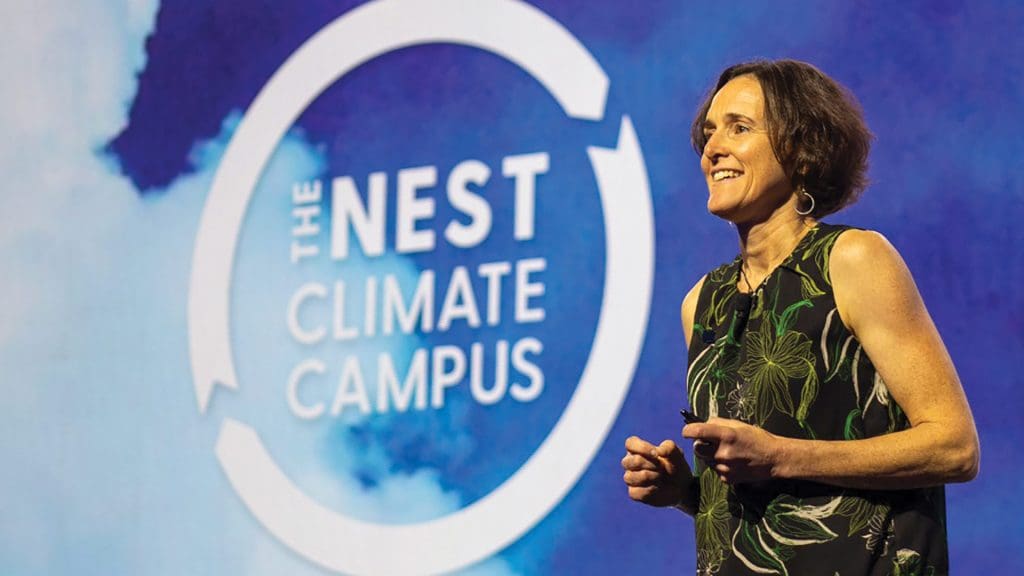
Ashley Muspratt delivers an address from the main stage at New York Climate Week.
“We deliver these trainings first remotely, and then we actually send our techs to their cities or towns to deliver technical assistance while they shadow us,” she explained. “And then we turn the tables, and they deliver the technical assistance while our techs shadow them and give them feedback and coaching. And then we set them free, and we’re already seeing some of them fly.”
As for those inclusive utility investments, that’s a mechanism CET promotes whereby utilities are making the investment in upgrades to people’s homes — weatherization, heat pumps, renewable energy, etc. — and recover that investment through a tariff tied to the building meter.
“That’s a really important distinction from on-bill financing, which is a loan, effectively, to the individual occupant of the house. You’re taking on personal debt, and before you do that, you need to go through a credit check, and you need to be in your home long enough to get a positive return on that investment,” Muspratt noted. “With inclusive utility investment, by tying the payback to the meter, you eliminate the consumer debt and the credit check, and there’s a guarantee to the occupants of the building that, as they start paying that tariff, their total energy costs are actually going down.”
CET has been working for several years to get this concept launched at scale in Massachusetts, including working with municipal utilities in Ipswich and Peabody. And now, the energy affordability bill being discussed in the Massachusetts Legislature will likely include an inclusive utility investment mandate.
“That would mean the rest of the utilities, the Eversources, the National Grids, would be required to offer this kind of financing mechanism to their customers,” Muspratt said. “So it could have a huge impact on the pace of deployment of climate solutions for the residential sector.”
Collaborative Effort
Muspratt explained that more than 95% of CET’s revenue comes from contracts to run its many programs, with philanthropy covering the rest.
“We have had the best partners and clients and customers,” Gaylord added. “There is just no way CET could have existed for 50 years — and will continue to exist — if we didn’t have such incredible partners throughout the state that equally believe in this work.”
Innovative ideas abound in these partnerships, she added, such as a Community Climate Fund that was seeded by Williams College, which tackles ‘barrier mitigation.’
“So if a customer is ready to go, but has a mold or moisture issue, we’re still able to pursue that project because of philanthropy,” Gaylord said. “There are times when philanthropy might make the like the difference in terms of it being something that’s solvable. So it’s a small percent of the budget, but it’s a really critical part of the budget in terms of what it can unlock for customers.”
And most people recognize the importance of this work and want to find ways to accomplish it, Muspratt said — even if the federal government has pulled away from such work.
“We had a huge increase in funding and attention on climate change under the Biden administration, and then that all kind of disappeared pretty quickly. So over the past year, we’ve had to do a lot of restructuring and pivoting because we had taken on a lot of federal funding that then disappeared,” she told BusinessWest. “So my hope is that, in the next 10 years, we start to get back to the place we were a few years ago in terms of focus and attention on climate change, taking it seriously.”
She cited a study by the Yale Program on Climate Change Communication showing that most Americans believe climate change is real and want to do something about it, Muspratt added. “The challenge is where to begin and how, and coming back to the role that CET is playing in that. I think there’s a disconnect right now between our government and what most Americans really want.”
Meanwhile, it’s important to help people see the value of individual decisions, Gaylord added.
“You may be wondering, ‘why would I start composting? Why would I get an energy audit? I have a million other things to do, and it’s not even going to make a dent.’ But even though it’s incremental, that whole body of action is making not just a dent, but a chasm — it’s really pushing forward CO2 reduction and methane reduction, while making the places we live and work healthier and more affordable and more pleasant to be in.
“I think that’s sometimes missed in the conversation right now — that, yes, it is going to take all of us, and that’s not necessarily convenient, but it’s really powerful.”
And that’s why it’s important to keep explaining — and demonstrating — radical ease.
“We’re just trying to just remove the barriers so people can take action,” Muspratt said. “There are a lot of competing interests these days, a lot of things that people are rightfully worried about. So, if we can help them, we’re here to help.”