
Getting Employees in the Game
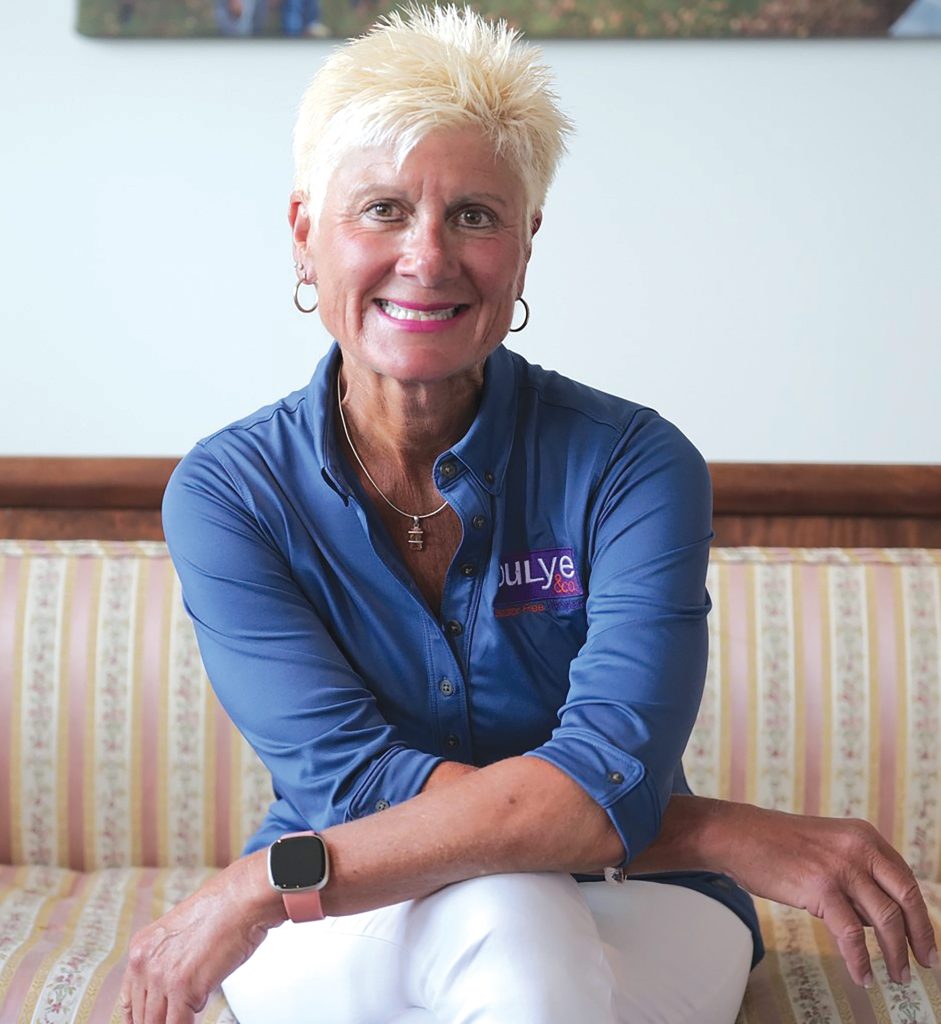
Linda Dulye
Linda Dulye calls them ‘spectators.’
That’s the term she uses to describe employees who, well, are not in the game, as they say in the sports universe. Instead, they’re watching it from the sidelines. They’re not engaged, and they are not part of the solution, said Dulye, the former journalist turned corporate communications specialist and change-management agent turned entrepreneur who started Dulye & Co. in 1998 to help leaders and their organizations cultivate magnetic cultures where people want to stay and grow.
The Pittsfield-based company, which counts Lockheed Martin, General Dynamics, Cigna, and other global companies on its client list, helps guide these firms to achieve a ‘spectator-free’ workplace through meaningful connections, open communications, and mutual respect.
“If you’re paying people to show up, put a badge on, and complain all day, all they are … are spectators,” she explained. “And spectators don’t add depth. If you’re going to just leave them on the benches watching, that’s a bad business strategy. Your goal is to be spectator-free, have them down on the field helping you move forward and score.”
Such sentiments have always been important to the success of any organization, large or small, she told BusinessWest, but they are even more critical in this time of profound change in the work environment brought on by the pandemic and related forces.
“This has been the most dramatic change I’ve ever experienced in my consulting career,” Dulye said, adding that, at this critical time, communication and engagement have never been more important, but they have also never been as challenging.
Overall, she said companies large and small have historically waited until a time of profound change, or crisis, before addressing issues such as culture, communication, and engagement. Her simple message is not to wait.
“Let’s not wait for a crisis,” she said. “Let’s be pre-emptive; let’s realize that everything in building a spectator-free workplace is a great business strategy, not just when something catastrophic has happened.”
While helping companies become more connected and engaged — two words she used very early and quite often as she talked about her work — Dulye has also committed herself to helping the next generation of leaders thrive in an ever-changing work environment.
“If you’re paying people to show up, put a badge on, and complain all day, all they are … are spectators. And spectators don’t add depth. If you’re going to just leave them on the benches watching, that’s a bad business strategy. Your goal is to be spectator-free, have them down on the field helping you move forward and score.”
Indeed, she created the Dulye Leadership Experience (DLE), which offers year-round developmental and networking programs (such as an upcoming program on cryptocurrency) and, especially, an intense two-day retreat that, after two years of being a virtual event, will again be in-person in early November.
Applications are currently being accepted for the conference, and 45 individuals from different business sectors will eventually be chosen to attend the retreat, which “is a not a conference,” she said with considerable emphasis in her voice. Instead, it is more of an immersion, where young people hear from experts, who stay for the entire weekend, on various subjects with the goal of improving vital skills and stimulating networks for career and life success. The accent, as it with Dulye’s business-consulting work, is on collaboration and connections.
The DLE is a nonprofit endeavor funded by Dulye, who said she created it because there has always been a strong need for such programming, and that need has also been magnified given the changing landscape in business.
“I invest quite a bit in this because I believe in philanthropy,” she said. “And I believe in helping others see — and seize — their best.”
For this issue and its focus on women in business, we talked at length with Dulye about entrepreneurship, the leadership experience she created, changing dynamics in the workplace, and, especially, about how she helps companies convert employees from spectators into engaged team players.
Dulye Ink.
Looking back on her life and career, Dulye said she had several important role models and mentors, starting with her parents, who were both entrepreneurs.
Her father ran a chain of small newspapers in New York’s Lower Hudson Valley, while her mother started a commercial printing business, a field that was totally dominated by men at the time.
“When you grow up in family business, or businesses, you learn every facet of a business,” she said. “You also learn that you get paid last, and you learn that employees are what enable you to go to college — my parents’ employees enabled me to go to college — and you learn that every single person is vital; it doesn’t matter what their title is.
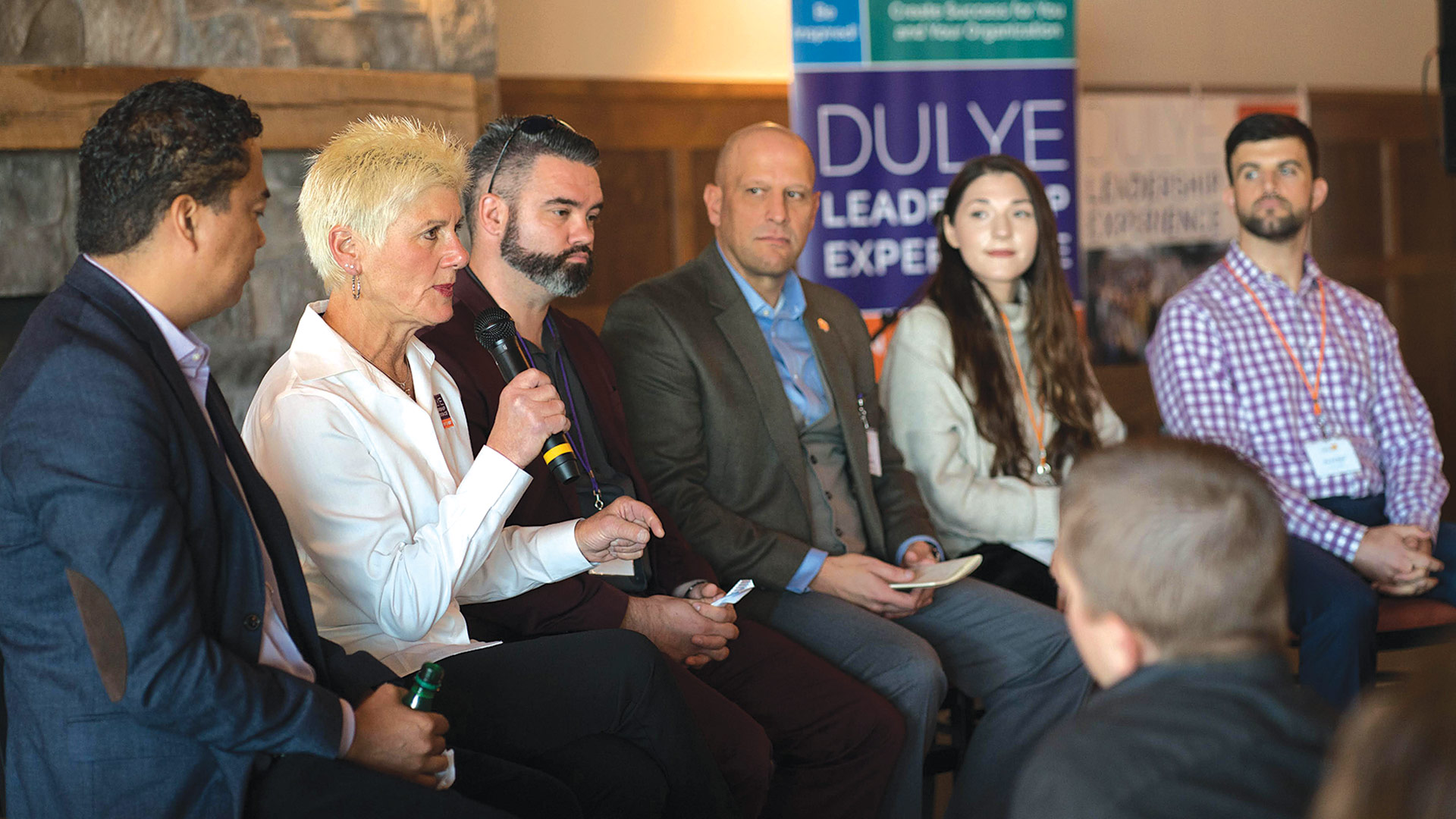
Linda Dulye says the Dulye Leadership Conference has evolved over the years, but its mission remains unchanged — to help young people gain the skills and confidence needed to thrive in an ever-changing workplace.
“I got my hands dirty, and I got humbled by both my parents,” she went on. “I never had cushy jobs, and I had to earn my promotions; I never wanted to be the kid that was the boss’s kid. I learned how to love work, and that’s important; I love what I do, and my parents loved what they did.”
Growing up, she worked in both businesses, starting with her mother’s shop when she was 8. By age 13, she was writing obituaries for her father’s papers “back when writers wrote the obituaries, not the funeral homes,” before moving on to the police beat and other assignments.
Meanwhile, her mother’s entrepreneurial spirit and willingness to go where women traditionally didn’t go, job-wise, certainly inspired her throughout her career.
“My mother was a novelty — there weren’t a lot of women business owners at that time, and I learned a lot from her,” she recalled. “Most of the industries I was in were male-dominated, and I learned how to express my views in a confident way and how to form relationships with people who were going to be very judgmental of me, because I’m the token female out there, so I have to prove myself a little bit more.”
But there was something else she took from her mother that stayed with her through all her various career stops and especially when she went into business for herself.
“She could look at a cloudy sky and always find that patch of blue,” Dulye said. “And it was finding that patch of blue every day — in your work, in your life — that stuck with me. Sitting in rooms where people would ask me when I was going to be serving the coffee, even though I was part of the leadership team at the table, was pretty typical — but I always looked for that patch of blue.”
Dulye didn’t want to go back to either of her parents’ businesses after graduating from Syracuse University, so she went to work for a daily newspaper in suburban Philadelphia called the Bulletin. Her real ambition, she told BusinessWest, was to be a sports journalist, but at the time, the field was mostly closed to women, so she stayed on the news side, while maintaining a love of sports that can be seen in the terminology she uses and references to getting employees into the game and off the bench.
Fast-forwarding a little, Dulye, seeking a better-paying profession, eventually segued into corporate communications, starting at Drew University while earning her master’s degree. With a desire to work for large corporations, she went to work for GE in Pittsfield and later New Jersey and Pennsylvania.
She joined the company in the late ’80s, at a time of dramatic downsizing, a period that provided several critical learning experiences she would apply later in her career.
“There’s was lots of learning about culture, about people, about effective leadership, about communication — you were communicating some of the toughest messages ever,” she recalled, adding that she worked for tough bosses, including Jack Welch, who were “ahead of their time in many respects.”
As GE was in the process of selling its aerospace division, she moved onto Duracell, then Allied Signal and Public Service Electric and Gas.
She made a number of job changes at a time unlike today, when such movement is expected and even appreciated by many of those doing the hiring, because she wanted to be in different environments, experience different organizations, and learn from different leaders.
“I wanted to experience different cultures and leadership styles and get smart in different industries,” she said. “Even though I knew family business, I wanted to learn global business.”
Eventually, after growing tired of lengthy daily commutes to work, she decided to go into business for herself, essentially to pass on to business leaders what she had learned while working for her parents, but also while working in corporate America.
“I knew what companies needed most,” she explained. “They needed people to help their leaders connect with the front-line folks, to help explain change, to help get people motivated, to move forward with goals. With all the work I had done, I wanted to focus on leadership communication and employee engagement.”
Connecting the Dots
As she talked about her business and the value it provides to clients, Dulye focused on that word ‘engagement,’ its importance in the workplace, getting people to be part of the team in question, and having them help leadership run the business.
Which brings her back to the importance of having a spectator-free work environment, which businesses appreciate, even if they know they need help to achieve such an environment.
The key, she said, is to give employees the opportunity to get on the playing field.
“My mother was a novelty — there weren’t a lot of women business owners at that time, and I learned a lot from her. Most of the industries I was in were male-dominated, and I learned how to express my views in a confident way and how to form relationships with people who were going to be very judgmental of me, because I’m the token female out there, so I have to prove myself a little bit more.”
“Which means you have to share information, you have to be open to their ideas, and you have to involve them in making decisions on how the business needs to move forward,” she explained. “Otherwise, you’re going to have spectators; that means really stopping, listening, and having conversations, not presentations.
“Presentations do not build relationships; conversations build relationships,” she went on. “That’s what leaders, more than ever, need to do. “Leaders say, ‘I don’t have time’ — and I understand, time management is a massive challenge. However, if you don’t have time to help your people understand what’s going on and why and you think it can be done better, then you’re losing out on the greatest resource you have to help you improve as a business — and as a leader.”
Finding time and becoming spectator-free is obviously challenging, said Dulye, adding that it almost always requires adjustments in culture and leadership dynamics, with a hard focus on upgrading people skills, processes, and practices that ultimately create what she calls a “connected organization.”
Providing critical help with this complex assignment through tools such as its Engagement through Action Planning Process has enabled Dulye & Co. to grow and consistently add new clients over the years, she went on, adding that there have been times — the Great Recession of 2008 was one of them, and the early months of the pandemic was another — when even the largest corporations cut back on consultants.
And it was during what became a very slow period for the company in the fall of 2008, when the company lost 80% of its work, when Dulye found a patch of blue and conceived of what would become the Dulye Leadership Experience.
“In my consulting work, I was noticing that the new grads coming into the businesses really weren’t prepared to integrate well,” she recalled. “They were very smart in their technical majors, but they’d gone from a bubble of being able to pick their friends, being able to hang around a lot of people their own age, and being able to know when there was a test because they would get a syllabus and knew what to read, to showing up and not knowing anyone, and being in a hodgepodge, diverse team that they didn’t pick, with people having all kinds of issues going on that are very different generationally. They need to form relationships and strong communication bonds, and they need to know how to sell themselves and their ideas.”
The DLE, originally established in partnership with Syracuse University, was created as a philanthropic, nonprofit organization to help undergraduates cope with all that and successfully transition to the workplace.
But like any successful business, it has responded to change and evolved over the years.
Indeed, when Dulye moved to Western Mass. in 2017 to re-establish her home and business, programming shifted to attract, develop, and retain young professionals in the Berkshires. And with the pandemic and the dramatic changes it has brought to the workplace, the DLE shifted again, to virtual programming that escalated in frequency and variety and succeeded in attracting a more diverse professional network that now stretches from coast to coast and beyond, she told BusinessWest.
“We started moving and creating new programming every single week to connect people, which means connecting people from all over,” she explained, adding that an alumni group was established, and programs like a ‘breakfast club’ and chat initiatives were created to involve more individuals at a time when technology allowed that to happen.
The DLE soon added workshops on a variety of topics, from public speaking to time management, to provide more and different learning experiences, most of them inspired by polling and questions like ‘what are you struggling with?’
This shift can be seen in the latest offering, an ownership workshop titled “Demystifying Cryptocurrency,” slated for Sept. 20. The one-hour, virtual conversation will feature nationally recognized experts Paul Farella and Alexandra Renders of Berkshire-based Willow Investments, who will discuss, among other things, what blockchains are and how they work, the impact this technology can have on business and society, and the risks and opportunity that exist in this realm.
This workshop is an example of how the DLE works to educate and inform, while helping emerging leaders succeed in a business world where change is the only constant, Dulye said.
As for the upcoming annual retreat, it is, as she noted earlier, an immersion in every sense of the word.
“It’s three days in the Berkshires — you stay at this compound; you don’t come and go like at a conference where you go to a 9 o’clock session and then hit Starbucks at 10 and go back at 11,” she explained. “Once you come in on Friday night, you can’t leave until Sunday, at all, and you need to stay fully engaged with everyone there.”
There’s that word, engaged, again.
Summing up the retreat, Dulye said the goal, the mission, is to get participants to “learn like mad and get out of their comfort zones,” and it has been this way since she first launched the initiative in 2008.
Bottom Line
Flashing back a half-century or so, Dulye remembers when her mother took what was a huge risk at that time and invested heavily in a Goss Community press to take her commercial printing enterprise to the next level.
“People would come into her business from all over the world to look at this press,” she recalled. “I have no idea how much she probably put on the line from our family finances and going into debt — although my father had to sign for everything, because women couldn’t do that then. That, I remember, was groundbreaking.
“And I wanted to experience a lot of groundbreaking events in business,” she went on, adding that she certainly has. But, more than experience them, she’s been part of them, through her work as a consultant, but also through creation of the Dulye Leadership Experience.
In both realms, she’s focused on facilitating success in a changing workplace and, as she said repeatedly, helping business leaders create a place where there are no spectators.
George O’Brien can be reached at [email protected]