
Auto Dealers Reflect on a Solid Year, Project More of the Same in 2025
Drive Time

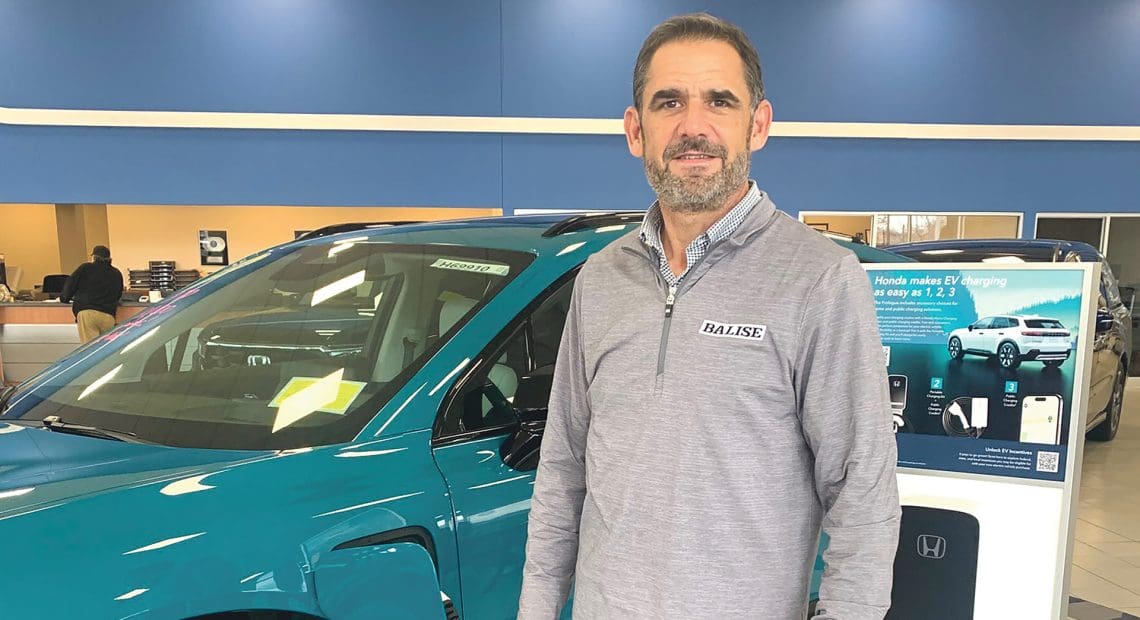
Ben Sullivan, seen here with a Honda Prologue, says sales of all-electric vehicles, as well as hybrids and plug-in hybrids, have been rising as consumers become more familiar with them.
‘Almost normal.’
Those are the two words that Ben Sullivan, chief operating officer for Balise Motor Sales, used to describe 2024 when it comes to just about every aspect of the auto-sales industry.
After four years of relative turmoil generated by COVID and its aftereffects, things were back to normal — almost, said Sullivan. To get his point across, he referenced the southernmost end of the huge parking lot for Balise’s Chevy/GMC dealership on West Columbus Avenue in Springfield.
Even 18 months ago, it was so barren, several people asked Sullivan if Balise had sold the lot. Now, it is heavily populated with cars — especially the commercial vehicles that were visible several years ago but were simply not available due to supply-chain issues in the wake of COVID.
That’s the case in every one of the many dealerships Balise has in Western Mass., the Cape, and Rhode Island, said Sullivan, noting that, when it comes to inventory levels, things are almost back to what was seen pre-pandemic.
“Until this year, there were cars coming in and cars going out, but there was zero stock to walk in and say, ‘I want to take something home today,’” he told BusinessWest. “We’re not back to totally normal levels now, but it’s getting a lot closer to what people would say is normal.”
Carla Cosenzi, president of TommyCar Auto Group, which boasts Nissan, Volkswagen, Hyundai, Volvo, and Genesis stores, agreed. In fact, she said that, in some cases, inventories even exceed pre-pandemic levels.
“Until this year, there were cars coming in and cars going out, but there was zero stock to walk in and say, ‘I want to take something home today. We’re not back to totally normal levels now, but it’s getting a lot closer to what people would say is normal.”
Which helps explain some of the aggressive incentives being offered by some of those brands, including 0% financing on a Nissan Rogue and a $79-a-month lease deal on a Hyundai IONIQ 5 EV. And they help explain why, on the Monday of Thanksgiving week, normally a traditionally slower time, the TommyCar dealerships were “swamped.”
“I think they’re trying to build demand for the increased production,” Cosenzi said of the manufacturers, adding that these incentives were one of the key contributors to a very solid year.
Sullivan agreed that 2024 was a good year saleswise — better than most in the industry, and he puts himself in that category, were projecting roughly a year ago.
At Balise, sales were up roughly 10% (most years, 3% to 5% is the average), a performance he attributes to lingering pent-up demand from the COVID years and availability of most models and most trims, including the lower-priced options on cars and SUVs that manufacturers pushed to the sidelines in favor of the higher-priced trims during COVID.
“This year was the first time that you started to get what people would consider to be real availability back,” he said.
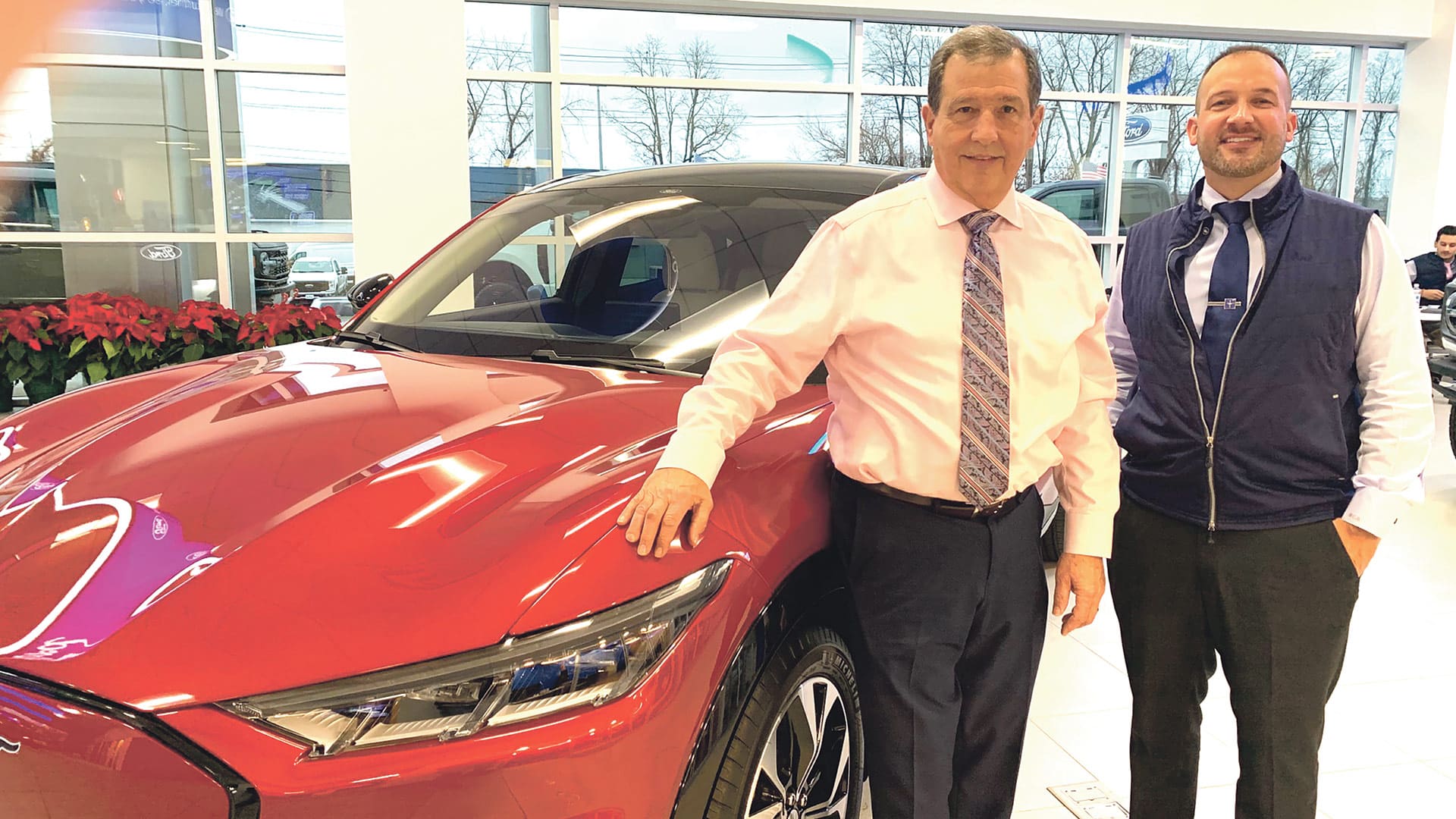
Mike Filomeno, left, and Mike Marcotte show off a Mustang Mach-E, one of the many EVs now sold by Ford.
Mike Marcotte, president of Marcotte Ford in Holyoke, said his dealership has also recorded a nearly 10% increase in overall revenue in 2024, which he attributed to those same factors, particularly availability — on both the consumer and commercial sides of the ledger — with December, traditionally a big month, especially on the commercial side, still to go.
“Ford has put some great incentives out there to end the year out,” he said, adding that these cover everything from pickups to EVs that come with free chargers. “It’s been a good year, and we’re expecting to end it in strong fashion.”
Cosenzi said final numbers are obviously not in yet, but she is projecting 8% growth for 2024, and something along those same lines for 2025.
While things are returning to normal on most fronts, on the electric vehicle and hybrid segment, there isn’t really a ‘normal,’ because this is an emerging market, one that is building some momentum, although there are now real question marks about the future of the EV consumer tax credit.
“You’re seeing a big increase in customer demand for hybrids and plug-in hybrids,” said Sullivan, adding that many see them as an alternative to — or a bridge to — EVs, which are enjoying gradual growth in sales amid more options and better incentives, for the moment, anyway. “People might be scared to get into an electric, but they’re saying, ‘what can I do?’
“This hybrid technology has been out there for some time, it’s performing very well quality- and reliability-wise, and people are a lot more comfortable getting into these vehicles,” he went on. “The percentage of sales of hybrids versus non-hybrids continues to grow.”
To a Higher Gear
To get his points across regarding availability, getting back to normal, and even the EV and hybrid markets, Sullivan referenced Balise’s Honda dealership on Riverdale Road in West Springfield.
“During COVID and the post-COVID era, it was not unusual for us to finish the month with maybe 16 vehicles for sale,” he told BusinessWest. “Now that they’re starting to build more Hondas, I think we’ll finish this month [November] — and we had a very good month — with 80 to 100 to choose from if someone wanted to walk in and take one today.
“You went through three years of expecting to have to put a deposit down on something that was inbound on a ship, a train, or a truck,” he went on. “And now, you’re getting to the point where there’s a good chance you can find what you’re looking for available — not the same levels as before COVID, but at a level where the customer probably wouldn’t notice the difference.”
Elaborating, Sullivan said normal stocking levels would be 30 to 45 days of inventory, or maybe 140 cars in the case of this Honda dealership. At present, as noted, there are maybe 100, and they cover all trim levels.
“You went through three years of expecting to have to put a deposit down on something that was inbound on a ship, a train, or a truc. And now, you’re getting to the point where there’s a good chance you can find what you’re looking for available.”
It’s pretty much the same across the spectrum, he said, adding that inventory levels vary with the dealership, but most are working their way back to ‘normal.’
Improved availability is one of the key reasons why 2024 was a better year than most were expecting, said those we spoke with, noting that there is still a large amount of pent-up demand — and, now, many options for meeting that demand.
Indeed, during COVID and its immediate aftermath, manufacturers, hit with massive supply-chain issues, focused mostly on higher-end vehicles, driving up the average cost of a new car to levels many consumers were not willing to pay, said Cosenzi, adding that lots are now close to full with models across all trim levels, which has certainly helped drive sales.
“It was very hard to find middle and lower trim levels during that time,” she explained. “Now that things are opening back up again, it’s a lot easier to find a selection of low, middle, and high-end options of the same model. Buyers have more options than they’ve had in years.”
Meanwhile, other contributing factors include comparatively low unemployment, relatively strong consumer confidence, and those incentives from the manufacturers, Cosenzi said. “We’ve seen the manufacturers get more and more aggressive. Right now, we have 0% for 60 months — Nissan has it on its Rogue, which is a prime model, Volkswagen has it … 0% is back. Meanwhile, the Hyundai Tucson has 1.9%; those are examples of how aggressive the incentives are.”
Marcotte agreed, noting that these incentives come in many forms, including the Ford Power Promise, whereby those buying or leasing an EV become eligible for a complimentary home charger and standard installation.
Picking up Speed
With improved availability and overall sales up 10%, the question then becomes, ‘what are people buying?’
Some of everything is the obvious answer, but especially SUVs and crossovers — in part because there are simply fewer cars to buy — as well as trucks, EVs, and hybrids, said those we spoke with.
And commercial vehicles as well, noted Sullivan, adding that year end is traditionally a busy time for such sales as contractors and others look to take advantage of Section 179 tax deductions. But until recently, they simply weren’t available.
“We’re finally at the point where we can take care of those customers, and that’s making them happy, and it makes us happy,” said Sullivan, noting that the southern end of the crowded parking lot at the Chevy/GMC store reflects this reality. “The past several years, in many cases, people just said, ‘we’ll wait until next year.’ It was a very difficult time getting commercial vehicles.”
Mike Filomeno, Sales manager at Marcotte Ford, agreed, noting that truck sales, on both the commercial and consumer sides, remain solid as inventories grow. He cited, as one example, Ford’s Maverick, a small pickup with prices starting at $27,000.
“It comes in a hybrid and all-wheel drive, so it’s pretty popular; that’s a great price point,” he said, adding that Ford’s lineup of larger trucks is also performing well.
And used-car sales are also solid, said Filomeno, noting that inventories have improved somewhat, prices have returned to something approaching normal, and, as a result of both factors, sales are up, contributing to the dealership’s growth this year.
As for SUVs, they continue to dominate the market, with most manufacturers cutting back to one or two car models. Ford, for example, has just one, the Mustang.
But Sullivan said those in the industry are starting to see some movement among the younger generations toward cars.
“It’s too early to see if it’s a trend or just data, but there is some indication that the young people, the Millennials, don’t want to be in SUVs like their parents were,” he noted. “And you’re starting to see a lot of young people migrate into the sedan market.”
If that movement accelerates, then manufacturers may need to rethink their lineups and add more sedans, he went on. For now, the focus remains on SUVs. And larger numbers of these are coming in the hybrid, plug-in hybrid, and EV varieties, said those we spoke with, adding that sales of those vehicles are up across the board.
EVs still comprise only around 6% of all sales, said Sullivan, adding that the numbers continue to gradually improve as the options increase and consumers become more familiar with them.
To that point, he said Balise recently brought each of the 23 EVs sold across its stable of dealerships to an event at the Palmer Motor Sports Park, where consumers could get acquainted with the various vehicles — and drive them on a racetrack. More than 100 consumers turned out, and most all of them came away impressed with what they saw and experienced.
“I did not speak to one of them who didn’t say, ‘now that I’ve driven one, I believe it’s the car for me,’” he recalled, adding that familiarity breeds comfort.
Marcotte agreed, noting that Ford’s lineup of EVs includes everything from the Mustang Mach-E to the F-150 Lightning pickup to an E-Transit cargo van, and that, increasingly, consumers are becoming more comfortable with such vehicles.
Cosenzi concurred, noting that the Hyundai store put more than 30 people in the IONIQ 5 this month, thanks to the $79-a-month, 13-month lease deal. She said the outlook for continued improvement is generally positive, but much depends on whether the incoming Trump administration makes good on plans to kill the $7,500 consumer tax credit for EV purchases as part of broader tax-reform legislation.
“There’s a lot of speculation about what might happen with those incentives,” she said, adding that, at more than $10,000 in many cases, they certainly help some consumers get over the hump and into an EV.