Home Posts tagged 2024
Features Special Coverage

From AI to the Courthouse Search, the Landscape Is Changing

By George O’Brien and Joseph Bednar
It is December, time to look ahead to what might happen in the new year, but also look back, at what has been an eventful year, to say the least.

For example, Springfield has become engrossed in the search for a site for a new courthouse, the Western Massachusetts Economic Development Council has named a new director, AI is changing the landscape in all kinds of ways, and remote work is becoming more entrenched in the workplace. Then there’s the constantly changing story of tariffs, federal budget cuts that are challenging nonprofits, and an ongoing housing crisis.

As we said, it’s been an eventful year. Here’s a look back at some of the biggest stories of 2025:


A Softening of the Job Market

“Job hugging.”

That was one of the workforce trends to unfold in 2025, a year that saw the pendulum swing from this being an employees’ market to one favoring employers. The phrase refers to people hanging onto their jobs longer amid concerns that the grass isn’t any greener elsewhere, amid forces ranging from AI to severe cutbacks within the federal government.

“People are feeling a sense of volatility and continuous change, and when you feel like that, you look for some personal anchors, and for a lot of people, their job is their personal anchor,” Allison Ebner, president of the Employers Assoc. of the NorthEast, told BusinessWest recently, adding that this is a fairly recent phenomenon dating back to last spring or early summer. “Everything in the world is changing, and they want to keep something consistent, and maybe it’s their job.”

But while people may be hugging their job, they’re still looking around, as evidenced by the strong turnout at the recent job fair staged by the MassHire Springfield Career Center. The turnout was strong on both the job seeker and employer sides of the coin, indicating that, while some sectors are seeing a slowdown, many others, especially healthcare, are still struggling to find qualified help.


Seeking New Sources of Funding

This issue of BusinessWest includes the annual Giving Guide, encouraging readers to support local nonprofits. And it couldn’t come at a better time, at the tail end of a year in which federal funding for nonprofits of all types was significantly slashed.

That has caused frustration, but also a new determination among nonprofit leaders to be more creative and collaborative in meeting the many needs of the community.

“People are reaching out, and not just with appeals for direct funding,” Denise Hurst, vice president of Community Impact and Partnerships with the Community Foundation of Western Massachusetts, told us in May. “They’re asking about opportunities to partner with one another, share ideas, and collaborate in real time to navigate these difficult times.”

Meanwhile, a coalition of local nonprofits working in farming, conservation, food security, health, and environmental justice has come together under the name Resilient Valley to respond to federal funding cuts that have slashed organizational budgets by 25% to 40% or more.

“We realized we were all telling the same story,” said Billy Spitzer, executive director of the Hitchcock Center for the Environment. “Our budgets had been gutted overnight, and the ripple effects were only beginning. We decided we couldn’t face this crisis in isolation. We needed to find strength in each other.”


The Impact of Tariffs

President Trump ran on the promise of new, sweeping tariffs, and he has certainly followed through, announcing ‘Liberation Day’ on April 2, followed by months of trade talks, new deals, deadlines made, deadlines extended, and seemingly never-ending speculation about the impact of tariffs on prices, individual businesses, and entire sectors.

Dave Fontaine, CEO of Fontaine Bros. Inc., told BusinessWest earlier this year that tariffs will certainly impact project costs because tariffs on products, such as steel or copper, are applied not when they are ordered, but when they enter the country.

“I think it’s vitally important to bring this area back — it raises the quality of living for those living downtown, and it provides places for people to go and eat.”

“I would equate it to walking into a store … the sales tax is 6.25%, and then, while you’re purchasing the item, the sales tax gets doubled or tripled,” he explained. “That’s going to impact at the register.”

Uncertainty around tariff decisions also triggered fluctuations in the stock market this past spring — and plenty of client phone calls to investment firms. But Jeffrey Liguori, executive vice president of Bradley Foster & Sargent Inc., was one of several experts who told us it’s wise to take a longer view.

“The data is 100% in your favor. Nothing ever goes straight up. We’ve lived through most of these crises — the housing crisis, the tech bubble, the Great Recession,” he said. “All of those, time and again, have been incredible buying opportunities. It’s almost like, if there’s no pain, there’s no gain.”


The Search for a New Courthouse

The search for a replacement for the troubled Roderick C. Ireland courthouse in Springield entered an intriguing new phase when the state’s Department of Capital Asset Management and Maintenance (DCAMM) decided to let a private developer build and manage the facility and have the state lease it.

An RFP was issued mid-year, and 11 proposals were received involving a wide range of properties, from the park created by the demolition of the former Steiger’s department store to the Republican building; from the current courthouse site itself to the home of the former Mardi Gras strip club.

DCAMM is now weighing those proposals and is expected to have a decision in the first or second quarter of next year, making for a long and agonizing wait to see how the city’s landscape will be changed.


Progress in the Entertainment District

Many of the windows in the storefronts are still boarded up or covered by brown paper, but behind all this, there is some progress in Springfield’s entertainment district.

Noted attorney and developer Raipher Pellegrino, with support from the city in the form of a $2 million grant, is filling in a canvas along a city block of buildings on Worthington Street.

He envisions five restaurants in all, most with doors opening out onto Worthington Street and outdoor dining, in addition to a club and other businesses that will support each other and bring people and energy back to that corridor.

“I think it’s vitally important to bring this area back — it raises the quality of living for those living downtown, and it provides places for people to go and eat,” he told BusinessWest in June, adding that the project is a work in progress. “That was my desire with this, and it’s a much more difficult project than I think anyone envisioned, but I think we’re starting to see it evolve, and we’re seeing a lot of momentum.”


A Work of Arts

Another intriguing story in 2025 was the opening of the Hope Center for the Arts in downtown Springfield. Created in the former CityStage space, the center is the culmination of a long-held dream of Bob Bolduc, former owner of Pride Stations and Stores and founder of the Hope for Youth and Families Foundation.

The center, which opened its doors during the summer, and created at a cost of more than $14 million, is designed as flexible learning, rehearsal, and performance space that will advance the mission of the foundation and several partner organizations focused on the arts and helping youth and families in Springfield thrive.

Bolduc said the facility is designed to educate young people, immerse them in the arts, and perhaps inspire careers in that realm.

“The arts are not just entertaining and cultural, which we need in this city; they’re also inspiring,” he told BusinessWest. “Imagine a kid who gets turned on to dance or vocals or an instrument and then goes to a good school on a scholarship … we’ve changed their life.”


AI Has Become a Force

Wherever artificial intelligence takes us, we’ll look back at 2025 as the year it firmly established itself as a force to be reckoned with. Businesses in sectors ranging from law to accounting to healthcare are finding new ways to utilize AI to create new efficiencies and, in some cases, trim their workforce expense.

Meanwhile, for those in the workforce, as well as those looking to enter it, the ability to use AI has rapidly become a skill they must have.

Indeed, Ebner told us, “the phrase you hear now is, ‘AI won’t replace all the people, but it will replace people who don’t have AI skills.’”

Nicole Polite, CEO and founder of the East Longmeadow-based MH Group, agreed, telling BusinessWest that employers are becoming more skills-focused in their hiring.

“I often talk to people during the interview process and ask them what training they’ve had in terms of AI and make sure they stay in front of it,” she noted, “because AI is here for the long haul, so we have to adjust to it.”


Remote Work Is Here to Stay

Also seemingly here for good is remote work, as 2025 saw remote and hybrid models becoming more entrenched, regionally and nationally, even as some major employers were scaling back on the practice, if not cutting it out.

Indeed, while business leaders such as J.P. Morgan CEO Jamie Dimon enforced return-to-office policies, requiring most employees to work in person five days a week — arguing “you can’t learn working from your basement” — most businesses locally have preferred to stay with hybrid schedules as a way to retain valued talent — and attract new talent.

And while the practice seems to work for most businesses and their employees, it is definitely having an impact on businesses in central business districts in cities regionally and across the country — as well as the commercial real estate owners who rely on them, not to mention the restaurants and retailers who count on people working nearby and stopping in.


The Housing Crisis Continues

An ongoing story in 2025 was the housing crisis that has enveloped the county and this region. As BusinessWest continued its Community Spotlight series, leaders in cities and towns across the 413 spoke of the need for more housing of all kinds, especially the affordable variety.

Housing is needed for many reasons, they said, from helping seniors stay in their hometowns as the cost of homes skyrockets to enabling those in the workforce to afford to live in or close to the communities where they work, a problem that is especially acute in the Berkshires, where home prices have soared.

And while new housing projects are underway or planned in several area communities, from Pittsfield and Lee to Springfield and Chicopee, in many cases, the new units will only scratch the surface when it comes to what is needed.


A New Effort to Spark Entrepreneurship

They’re calling it VVM 2.0, and that’s a poignant name.

VVM is an acronym for Valley Venture Mentors, the nonprofit started to inspire entrepreneurship and provide fledging businesses with the mentorship and technical support needed to get to the next stage. The agency thrived for several years, but essentially didn’t survive the pandemic and other challenges to its existence.

Paul Silva, one of VVM’s founders, with support from the Davis Foundation and the MassMutual Foundation, recently launched a new initiative called Innovate413 that is designed to spark new tech-based startups in the region.

When asked how it would work, Silva said the initiative will provide startups with what he called “an unfair advantage,” in the form of access to potential customers, meaning large, regional employers that will talk about problems facing them and all those in their industries, and access to the latest artificial intelligence and product development techniques.

“When you’re in Silicon Valley or in Boston, you have access to that stuff, but the vast majority of the country doesn’t,” he told BusinessWest.


Aaron Vega Chosen to Lead the EDC

Rick Sullivan, president of the Western Massachusetts Economic Development Council (EDC), announced his retirement early in the year, and soon thereafter, a nationwide search for a successor commenced.

It ended this fall with the announcement that Aaron Vega, director of the Office of Planning and Economic Development in Holyoke, would assume that high-profile position in January. Vega brings a diverse résumé to his new job. Indeed, he worked for many years as a freelance film editor and also owned his own yoga studio before becoming a city councilor in Holyoke and then a state representative.

Vega told BusinessWest that his first order of business is to conduct a lengthy listening tour. Longer-term, he wants to build on progress made with developing new business sectors, such as food science, clean energy, and cybersecurity, while also being more aggressive with efforts to promote the region and tell its story.


Hub of Progress

Speaking of the EDC, it recently celebrated a major milestone for the innovation economy, with Western Mass. being designated as both a Quantum Technology TechHub and a Food Science TechHub through the Massachusetts Technology Collaborative. In addition to the two designations, funding in the form of $1 million to advance a feasibility and design study of a quantum supply chain accelerator (QSCA) was awarded to Springfield Technical Community College.

“Western Massachusetts is the only region in the Commonwealth to receive two TechHub designations, which is a testament to the strength of our innovation ecosystem and the collaboration that defines it.”

The QSCA will build on the foundation established in Holyoke at the Massachusetts Green High Performance Computing Center and the state’s first quantum computing complex launched with QuEra Computing Inc. The accelerator, which will be the first regional facility of its kind to drive commercialization, support startups, and strengthen advanced manufacturing supply chains across the Pioneer Valley, will be located at the Springfield Technology Park.

“Western Massachusetts is the only region in the Commonwealth to receive two TechHub designations, which is a testament to the strength of our innovation ecosystem and the collaboration that defines it,” said Rick Sullivan, outgoing president and CEO of the EDC. “These designations, and the $1 million dollar investment in the quantum supply chain accelerator, represent years of hard work and vision from our regional partners.”


A New Chapter for the Monson Developmental Center

Housing is one of the many potential new uses for the Monson Developmental Center, which is an intriguing new addition to the large portfolio of Westmass Area Development Corp.

Indeed, in July, the Commonwealth officially transferred the sprawling campus to Westmass, touting the transaction as part of ongoing efforts to utilize existing properties to build more housing in the state.

And with that transfer, Westmass, in partnership with DCAMM, will commence work to create what will be known as the Village at Sawmill Brook, named for the brook that runs through the property, which closed in the ’90s. This village will take shape over the next 10 to 20 years, said Westmass President and CEO Jeff Daley, adding that this is a large and difficult undertaking for the agency, but one laden with potential.

“It’s an imposing site, and there’s a ton of work that has to be done,” he told BusinessWest. “And there’s a lot of money that has to be invested just to make the site developable again.”


Something to Sink Your Teeth Into

BusinessWest continued a 30-year tradition by honoring its Top Entrepreneur in 2025, with the award going to John and Chris DeVoie, founders of the Hot Table chain of panini restaurants.

Launched in 2007, the chain has grown to 13 locations and well beyond its roots at the Brightwood Plaza — to several communities in the 413 and also Central Mass. and into Connecticut.

The past few years have been extremely busy, with the opening of five new restaurants — in Westfield, Chicopee, West Springfield, and Franklin, as well as Manchester, Conn., a time that has been followed by a period of absorbing such rapid and profound growth. Further expansion is possible, but the high costs of building has prompted the partners to hit pause while they continue to search for new opportunities.

“We always want to be nimble — the market changes quickly; that’s one of the things COVID taught us,” Chris said. “We always have our eyes open and our ears to the ground, watch what’s happening in other cities and with trends, and not chase every shiny object, especially when it comes to the menu — do what you do, and do it well.”

Cover Story Top Entrepreneur

John and Chris DeVoie Build a Brand — and a Following

John (left) and Chris DeVoie

John (left) and Chris DeVoie
Photo by Bob Zemba, Simple Truth Imaging

It has established residency in one corner of the conference room at the Hot Table offices on the 23rd floor at Tower Square in downtown Springfield.

And the plaster statue of the character Captain Jack Sparrow from the Pirates of the Caribbean movies — salvaged from a closed seafood restaurant in the Plaza at Buckland Hills in Manchester, Conn., where it greeted visitors at the front door — speaks volumes about the Hot Table chain of panini restaurants and the entrepreneurs who have grown it to 13 locations. And counting.

It speaks to how far the chain, launched in the Breckwood Shoppes in Springfield in 2007, now reaches — south and east of Hartford — but also to how the chain has been able to capitalize on some real-estate opportunities, in this case that failed restaurant, to expand its reach. But mostly, it speaks to how founders and brothers John and Chris DeVoie like to collect memorabilia and, well … also have a good time.

“It was a seafood place with a kind of a pirate theme,” John explained. “The place was emptied out, we went in, demoed it, and that was left over, and we decided to take it and put it in our office. It makes a great conversation piece.

“It scared the cleaning people when we first brought it up here,” he went on, noting that the cigar-store-Indian-like artifact wears a nametag — Rich — for Rich Calcasola, a partner in the Hot Table venture based in North Carolina, so that he can have a physical presence in Springfield.

Other examples of memorabilia include a framed copy of the blueprint, if you can call it that, for the first Hot Table restaurant at the Breckwood Shoppes, now hanging in the sitting area of the Hot Table’s suite of offices at Tower Square, affectionately dubbed ‘Club 23.’ It’s just one sheet of paper, compared to the dozens of pages for some of the latest standalone locations in Chicopee and Westfield. And also the glowing red ‘Hot Table’ ordering kiosk, which sits in another corner of the conference room.

“We were doing great, and then the music just stopped. That was a scary time — we had an 80% drop in revenue from one week to the next. And that was before anyone was talking about PPP or a bailout. We were thinking … do we have a company.”

Other examples of fun include the vintage arcade game installed in Club 23, a nod to the games the DeVoies played in the ’80s — and how they still like playing them — as well as their increasingly famous billboard featuring a cheese-steak panini and the words ‘Bite Me.’

These various items speak to a business, a brand, and an entrepreneurial gambit that continues to grow, evolve, and become an ever-bigger part of the regional landscape, both literally and figuratively.

John (left) and Chris DeVoie with ‘Rich,’

John (left) and Chris DeVoie with ‘Rich,’ some memorabilia from a closed seafood restaurant in Manchester, Conn. that became the latest location for Hot Table.

And one that has earned its founders BusinessWest’s coveted Top Entrepreneur award for 2024.

First presented in 1996, the award pays homage to this region’s strong tradition of entrepreneurship and those that are continuing that legacy. Recipients have ranged from vodka-label founder Paul Kozub to former Springfield Technical Community College President Andrew Scibelli; from the Balise family of auto dealers to the D’Amour family still operating Big Y.

The story of the DeVoies and Hot Table echo some of the region’s better narratives of entrepreneurship, especially that of Curtis and Prestley Blake, founders of the Friendly’s chain of restaurants.

Not in size, certainly — Friendly’s grew to hundreds of locations in its heyday — but in how two brothers took a chance and created both a concept and a following, overcoming some growing pains and extreme adversity, especially during the pandemic, in the process.

“We were doing great, and then the music just stopped. That was a scary time — we had an 80% drop in revenue from one week to the next,” John said, recalling the early days of the pandemic. “And that was before anyone was talking about PPP or a bailout. We were thinking … do we have a company?”

As for size … well, with interest rates high and construction costs still soaring, continued expansion of Hot Table has become a difficult proposition. But the brothers DeVoie continue to look for opportunities and say there are likely to be some, especially with the attrition rate with restaurants in today’s changing, ultra-competitive market, and less sticker shock when it comes to real-estate prices in general.

Beyond expansion, the two like to focus on other aspects of this growing venture, from brand building to getting involved in the many communities where they now have a presence, to the opportunities, and mentoring, they provide to young people.

“We have a lot of success stories … people starting with pressing paninis and advancing to general manager and even regional manager,” Chris said. “Eight of our general managers are homegrown, and we’re very proud of that.”

There is much to be proud of with this growing business — especially the entrepreneurial spirit that launched it and has taken it to the next level.


Chain of Events

By now, most people in this region know at least some elements of the Hot Table story, such as its origins in the Breckwood Shoppes, just a few doors down from Sophia’s Pizza, where both John and Chris worked as delivery drivers while attending Western New England University just across the street.

“That’s how we got our start in the restaurant business,” said John with a laugh, noting that the experience did provide some valuable insight into the industry.

Many folks have also heard how the two, while both working in corporate sales for day jobs, blueprinted their venture in 2007 with an initial focus on coffee and an eventual shift to a design-your-own-panini format after John’s sister and brother-in-law saw such a setup on a cruise ship.

Or how they were turned down for financing by a slew of area lenders before finally securing a loan from Nuvo Bank, a startup in its own right.

Or how they made Tower Square their second location after essentially getting an offer they couldn’t refuse from then-owner MassMutual, and have been there ever since.

Chris (left) and John DeVoie at the company’s Chicopee location

Chris (left) and John DeVoie at the company’s Chicopee location, one of many new stores to open over the past several years.
Photo by Bob Zemba, Simple Truth Imaging

Or how they managed to survive the pandemic in large part because they were already developing an app that would enable people to order online and pick up at the store.

Or how they’ve expanded both within this region — with stores now in Chicopee, Westfield, Hadley, and West Springfield — and well beyond, going as far east as Route 495 in Massachusetts, and deep into Connecticut, with locations in Enfield, Manchester, Glastonbury, and West Hartford.

These are all elements to a compelling story, one that blends opportunity with vision, persistence, and creativity.

And, obviously, some entrepreneurial spirit, something the brothers say runs in the family — their mother, Lois, owned and operated the House of Flowers in East Longmeadow for nearly 40 years. With that background and degrees in business from Western New England in their portfolios, the two brothers developed “an itch to do something,” as John put it, while also working their day jobs.

This itch coincided with the return of John’s brother-in-law, veteran restaurateur Don Watroba, to this region. Watroba had owned and operated several eateries in the area, including Admiral DW’s, Captain DW’s, the Goldmine, and DT Smith’s, before selling them in the early ’90s, moving out west, and returning to this region when his father became ill.

“He was looking for an opportunity also, and we had this itch, so we teamed up with Don, who had some restaurant experience,” John explained, adding that they considered a seafood restaurant and other options before settling on sandwiches and coffee, and especially the latter.

“With John and I being on the road in sales — we were in a lot of different markets in the Northeast — we saw the rise of the café, the fast casuals,” Chris said. “And the coffee aspect was a big part of it.”

The other big part of it, the panini aspect of the venture, traces back to that cruise taken by John’s sister and brother-in-law, and with that concept, the Hot Table picture began to come into focus.


Entrepreneurial Flavor

Fast-forwarding a little, the two partners first made the significant leap from one location to two with the opening of the store in Tower Square, formerly home to Gus & Paul’s and, before that, coincidentally, a Friendly’s location.

“To do two locations,” Chris recalled, “that’s when you said, ‘whoa, we’re running a business, and it’s scalable — we can do this in two places, where we never thought that was possible. We’ve created something that people enjoy and desire. That’s great; it’s very fulfilling.’”

“To do two locations, that’s when you said, ‘whoa, we’re running a business, and it’s scalable — we can do this in two places, where we never thought that was possible. We’ve created something that people enjoy and desire. That’s great; it’s very fulfilling.’”

After that, they continued a pattern of expansion that took them across this region and then well beyond, to communities and locations that made sense: Enfield, Hadley, Marlborough, the Trolley Yard in Worcester, Corbin’s Corner in West Hartford, the jughandle off the turnpike exit in Westfield, Memorial Avenue in Chicopee, and space that was part of Table & Vine in West Springfield.

While adding new locations, the DeVoies and third partner Rich Calcasola have been building a brand, and using many vehicles, including social media and billboards, to do so.

While adding new locations, the DeVoies and third partner Rich Calcasola have been building a brand, and using many vehicles, including social media and billboards, to do so.

Several locations marked milestones, if you will. Enfield, which became a real confidence builder, marked the first time the Hot Table brand was taken to an area loaded with fast-casual competition, such as Panera Bread, Five Guys, and others. Chicopee was the first standalone, new-construction site. Marlborough marked the first venture to the eastern part of the state, and Worcester marked the next major population center.

Calcasola joined the business as a third partner in 2013, just as Watroba was essentially moving on to something else, and Chris gave up his day job and made Hot Table his sole focus in 2018. And over the years, the venture has become a true family affair, with Chris’s wife, Cara, now serving as HR director, and several members of the second generation taking jobs during school vacations and the summer.

The past few years have been extremely busy, with the opening of five new restaurants in 19 months — Westfield, Chicopee, West Springfield, and Franklin, as well as Manchester, Conn., a time that has been followed by a period of absorbing such rapid and profound growth.

“It’s like snake eating a rabbit — it takes time to digest all that,” said John, adding that the cost of each buildout grew higher as inflation climbed. And while those costs have stabilized somewhat, they remain high, making additional expansion a trickier proposition.

“We decided to pump the brakes and evaluate what we were doing because the return on investment was a different proposition,” he explained. “Something that cost $450,000 in 2022 is all of a sudden costing $800,000 in 2024.”

While hitting pause in many respects, the partners continue to search for opportunities for continued expansion, while also looking at the menu in an effort to identify ways to provide more value to consumers and create efficiencies.

“We always want to be nimble — the market changes quickly; that’s one of the things COVID taught us. We always have our eyes open and our ears to the ground, watch what’s happening in other cities and with trends, and not chase every shiny object, especially when it comes to the menu. Do what you do, and do it well.”

“We always want to be nimble — the market changes quickly; that’s one of the things COVID taught us,” Chris said. “We always have our eyes open and our ears to the ground, watch what’s happening in other cities and with trends, and not chase every shiny object, especially when it comes to the menu. Do what you do, and do it well.”

As for eventual expansion, John said the company will look to progress farther south in Connecticut, toward New Haven, along the Route 495 belt (going further east will likely be cost-prohibitive, and labor is in short supply, he noted), and perhaps into Rhode Island — the store in Franklin is near the border. As for the long term, Hot Table could eventually become more of a regional and then national chain, but the company would need to partner with an entity with expertise in capital to take that step.

“We’re going to continue to do what we do — look for good real estate,” said John, adding that franchising, which has been considered, is not in the cards at the moment.

“Getting into franchising is stepping out of the restaurant business — selling and supporting franchises is a completely different company,” he went on. “That’s not something we’re looking to do right now.”


Food for Thought

Beyond adding more restaurants — and collecting memorabilia — John and Chris say they’re hard at work building a brand and creating a culture, complementary assignments that have many aspects to them.

As for brand building, billboards — including ‘Bite Me,’ described by at least one friend as “slightly inappropriate” — are just a small part of the equation, as is a strong social-media presence.

Bigger parts include involvement in the community while also getting the Hot Table name out there. Examples include everything from a partnership with the Springfield Thunderbirds, which includes an animated panini race between periods, to providing meals to the Franklin High School football team; from support of the Hooplandia 3-on-3 basketball tournament at the Big E to setting aside a portion of sales on given days to support area food pantries.

An employee at the Chicopee location presses a panini

An employee at the Chicopee location presses a panini, a concept that has done well in several different markets where the chain now has a presence.
Photo by Bob Zemba, Simple Truth Imaging

Such efforts provide exposure and let people know this is a local, family-owned company, said John, adding quickly that many still believe this is a national chain and the brothers are merely franchisees.

As for culture, Hot Table is establishing itself as a good place to work, where young people (and that’s the bulk of the workforce) can find not only a first job — and many have — but also a real opportunity to grow and develop leadership skills. Indeed, Chris noted that several men and women have worked their way up from the panini line to management positions, progression that he’s proud of.

“They’ve grown with Hot Table — we’ve given them an opportunity to grow from making paninis to a supervisor to assistant manager to general manager,” he explained. “And we’ve had an opportunity to mold them in a way where they have an influence and help us create a culture of good service.

“Sometimes, you get people who have been in the restaurant business for a long, long time, they become hardened to the industry, and with that sometimes come mistakes,” he went on, adding that the ability to teach and mentor new talent is valuable. “And they bring a certain energy level — a newness.”

Jeff Sullivan, president of Springfield-based New Valley Bank — who, as a lender with the institution known then as United Bank, was among those who turned down the DeVoies as they sought financing for the Breckwood location — said the two have succeeded with their niche in large part because of their ability to listen to various constituencies, especially customers, and respond to what they hear.

“They’re very dedicated to continuously improving their business,” Sullivan said. “They are humble in the way they study their business processes and try to listen to the customer, adapting constantly based on the feedback they get from their customer base.

“I think of them as one of those companies that are setting a high bar for service and teaching very valuable lessons to young people, giving them the skills that they can use their whole lives,” he added.

That’s just one aspect of this intriguing success story, one that certainly builds on the region’s strong tradition of entrepreneurship.

Previous Top Entrepreneurs

• 2023: The Food Bank of Western Massachusetts
• 2022: Benson Hyde and Bruce McAmis, co-owners of Provisions
• 2021: Dinesh Patel and Vid Mitta, owners of Tower Square in Springfield
• 2020: Golden Years Homecare Services
• 2019: Cinda Jones, president of W.D. Cowls Inc.
• 2018: Antonacci Family, owners of USA Hauling, GreatHorse, and Sonny’s Place

• 2017: Owners and managers of the Springfield Thunderbirds
• 2016: Paul Kozub, founder and president of V-One Vodka
• 2015: The D’Amour Family, founders of Big Y
• 2014: Delcie Bean, president of Paragus Strategic IT
• 2013: Tim Van Epps, president and CEO of Sandri LLC
• 2012: Rick Crews and Jim Brennan, franchisees of Doctors Express

• 2011: Heriberto Flores, director of the New England Farm Workers’ Council and Partners for Community
• 2010: Bob Bolduc, founder and CEO of Pride
• 2009: Holyoke Gas & Electric
• 2008: Arlene Kelly and Kim Sanborn, founders of Human Resource Solutions and Convergent Solutions Inc.
• 2007: John Maybury, president of Maybury Material Handling

• 2006: Rocco, Jim, and Jayson Falcone, principals of Rocky’s Hardware Stores and Falcone Retail Properties
• 2005: James (Jeb) Balise, president of Balise Motor Sales
• 2004: Craig Melin, president and CEO of Cooley Dickinson Hospital
• 2003: Tony Dolphin, president of Springboard Technologies
• 2002: Timm Tobin, president of Tobin Systems Inc.
• 2001: Dan Kelley, president of Equal Access Partners
• 2000: Jim Ross, Doug Brown, and Richard DiGeronimo, principals of Concourse Communications
• 1999: Andrew Scibelli, president of Springfield Technical Community College
• 1998: Eric Suher, president of E.S. Sports
• 1997: Peter Rosskothen and Larry Perreault, co-owners of the Log Cabin Banquet and Meeting House
• 1996: David Epstein, president and co-founder of JavaNet and the JavaNet Café


Features Special Coverage

Reflecting on the Year That Was


George Timmons

George Timmons calls education “the great equalizer,” and MassEducate a very effective way to achieve that.

In many ways, 2024 didn’t provide much clarity regarding economic questions we posed a year ago in our annual year in review. Inflation and interest rates remain high (if not historically so), while remote work, a housing shortage, and some sector-specific challenges continue to make the news.

But there was some good news, too, and some encouraging progress on fronts ranging from rail development to educational access to some intriguing high-tech developments. As 2025 dawns, BusinessWest presents its year in review, noting some of the stories and issues that shaped our lives, and will, in many cases, continue to do so.


The High Cost of Everything…

The Federal Reserve has been on a mission over the past two years — to tame inflation without putting the country into recession. By and large, the latter part has been accomplished, but inflation remains a thorny challenge.

Consumer prices were up 2.7% for the 12 months that ended in November, but stubborn inflation in housing (up 0.3% for the month in November) and food (up 0.4%) continue to hit people where they notice it most, while the price of cars and energy also rose in November. Economists are also unsure how President-elect Trump’s promised tariffs will impact inflation.

Meanwhile, some economists expect some relief in interest rates, and a chance that the Fed may go as low as 4% in 2025.

Still, Bob Nakosteen, semi-retired professor of Economics at the Isenberg School of Management at UMass Amherst, recently told BusinessWest that “the economic numbers don’t look bad at all. The labor market has weakened a little bit, but it’s not weak; it’s just not as strong as it had been. And most of the other indicators are strong, including GNP. It’s about where it had been, and in some ways, it’s above trendline.

“This is not breaking news,” he added, “but the economy has held up really well in spite of a lot of pressure, especially from a rapidly rising interest-rate environment. The consumer has really rolled with the punches.”


…Except Community College

MassReconnect, a program the state launched in 2023 to fully fund tuition, books, and supplies at community colleges for students over age 25, has, to hear college presidents tell it, been a game changer, significantly boosting enrollment and getting more students into a pipeline that will hopefully bring more new blood to the region’s workforce.

“The economic numbers don’t look bad at all. The labor market has weakened a little bit, but it’s not weak; it’s just not as strong as it had been. And most of the other indicators are strong, including GNP.”

This past summer, state lawmakers went further by implementing MassEducate, a $117.5 million annual investment that covers tuition and fees for all students, plus books and supplies for some. The program aims to support both economic opportunity for students and workforce development across a Massachusetts economy that has struggled, sector by sector, to recruit and retain talent in recent years.

Importantly, the program is a ‘last dollar’ investment, meaning students will still access federal funds, like Pell Grants, as well as state aid and scholarships, and MassEducate will pay the costs that remain, so it’s not funding anywhere near the full cost of a student’s education.

“I’m so passionate about this work of education,” Holyoke Community College President George Timmons said. “It is the great equalizer. Once you have an education and all the rights and privileges of that degree, you can earn a livable, sustainable wage, you can take care of yourself and your family, and you can literally change the trajectory of a family.”


Productivity in Pajamas?

A report last year by McKinsey Global Institute suggested that remote work risks wiping $800 billion from the value of office buildings in major cities worldwide by 2030 as the post-pandemic trend pushes up office vacancy rates and drives down rents.

Large employers are fighting back. In September, Amazon President and CEO Andy Jassy informed tens of thousands of workers that they will be back in the office five days a week come January. That was good news for commercial real-estate owners and developers, who hope other employers follow suit.

But while remote-work critics claim improved collaboration and communication, as well as the learning opportunities that come when everyone is together, outweigh any benefits that might come from remote work and hybrid schedules, the fact is that the hybrid movement, at least, seems entrenched for now — and also puts employers who nix all remote work at a competitive disadvantage when recruiting in an already-tough talent market.

But Evan Plotkin, president of Springfield-based NAI Plotkin, told BusinessWest that he sees a partially offsetting force in east-west rail, which has the potential to drive development in areas near the rail stops, and even prompt some businesses to realize they don’t have to be in Boston anymore. “It could be transformative; in Springfield, for example, it could drive development in the Union Station area and make that area much more attractive.”


Working on the Railroad

So, is east-west rail finally becoming a reality, connecting Springfield and Boston? Well, the money being put behind what’s known as the Compass Rail project is certainly real.

At the end of October, U.S. Rep. Richard Neal announced the latest $36.8 Consolidated Rail Infrastructure and Safety Improvements (CRISI) grant by the Federal Railroad Administration, following a $108 million CRISI grant — the third-largest in the nation — late last year. Since Union Station reopened in 2017, more than $200 million has been allocated toward east-west rail, both from federal grants and MassDOT funding.

The latest funding will support the Springfield track-reconfiguration project, which is designed to increase capacity to accommodate both freight and increased passenger rail service. The project will include building new crossovers and layover tracks, upgrading platforms around Springfield Union Station, and modernizing track and signal systems.

“With the substantial progress that has been made with west-east rail, the Commonwealth is well-positioned to pursue additional funding for years to come.”

Since the station’s reopening, Neal said, “the investments that have been made in passenger rail have been extraordinary,” adding that, “with the substantial progress that has been made with west-east rail, the Commonwealth is well-positioned to pursue additional funding for years to come.”

Meanwhile, MassDOT is conducting a study focused on the restart of passenger rail along the Route 2 corridor, a project whose public advocates include dozens of municipalities, regional planning agencies, and state legislators.


SOC It to Springfield

Speaking of Union Station, in September, it officially became home to the Richard E. Neal Cybersecurity Center of Excellence, one component of a multi-million-dollar series of investments, announced in 2022, to bolster cybersecurity resilience — and the related workforce — across the state.

These awards included a $1,086,476 grant to support the launch of CyberTrust Massachusetts, a nonprofit that works with business and academia statewide to grow the cybersecurity talent pipeline while promoting local security operations.

U.S. Rep. Richard Neal joins a host of local dignitaries

U.S. Rep. Richard Neal joins a host of local dignitaries in September to cut the ribbon on his namesake cybersecurity center.

The state also awarded $1,462,995 award to Springfield Technical Community College (STCC) and $1,200,000 to Bridgewater State University to establish a security operations center (SOC) and cyber range in each city. The Neal Center at Union Station, managed by STCC, also benefited from $500,000 in ARPA funding from the city of Springfield.

Springfield’s 6,000-square-foot center — a collaboration between STCC, the Springfield Redevelopment Authority, and CyberTrust Massachusetts — aims to be a hub for advancing cybersecurity awareness, education, and innovation while battling global security threats. Its cyber range is a simulated, hands-on training environment, and its SOC is envisioned as a support service for Massachusetts municipalities, as well as regional businesses, to detect cybersecurity events in real time and respond quickly.


Tackling the Housing Crisis

One of the dominant stories of 2024 was a continuing housing shortage that touches virtually every community.

With that in mind, over the summer, Gov. Maura Healey signed into law the Affordable Homes Act, which aims to support the production, preservation, and rehabilitation of more than 65,000 homes statewide over the next five years. It is the largest housing bond bill ever filed in Massachusetts, at more than triple the spending authorizations of the last housing bill passed in 2018.

The legislation authorizes $5.16 billion in spending over the next five years along with 49 policy initiatives to counter rising housing costs caused by high demand and limited supply. Key spending authorizations and policy changes include allowing accessory dwelling units, an unprecedented investment in modernizing the state’s public housing system, boosts to programs that support first-time homebuyers and homeownership, incentives to build more housing for low- to moderate-income residents, support for the conversion of vacant commercial space to housing, and support for sustainable and green housing initiatives.

“The Affordable Homes Act creates homes for every kind of household, at every stage of life, and unlocks the potential in our neighborhoods,” Healey said. “We are taking an unprecedented step forward in building a stronger Massachusetts where everyone can afford to live.”


High Risks for Cannabis Operators

According to a new report in the Boston Business Journal, cannabis businesses are surrendering licenses at an alarming rate in Massachusetts. Since September 2023, four retail licenses have been either surrendered, not renewed, or revoked, and so have 26 non-retail licenses, which include growers and manufacturers. In the five years before that, just five retail and 11 non-retail licenses were surrendered.

The green rush is clearly over; more than 700 cannabis businesses have opened or received licensing approval, and prices have fallen sharply amid stiffer competition — which makes running a business much more challenging.

Springfield Mayor Sarno recently cut the ribbon opening EMBR Springfield, a cannabis dispensary at 461 Boston Road.

Springfield Mayor Sarno recently cut the ribbon opening EMBR Springfield, a cannabis dispensary at 461 Boston Road.

So does a still-unresolved disconnect between state and federal law that has thrown a number of wrenches into cannabis businesses, which, among other hurdles, grapple with an onerous tax burden since they can’t write off many of the costs other businesses can. Federal laws also impact elements from transportation to banking. And while federal rescheduling of cannabis has bipartisan appeal, it’s uncertain whether the next Congress will have the appetite for it.

There may be some potential good news for dispensary owners: a newly established regulatory framework for operating ‘social consumption sites’ in Massachusetts, potentially allowing public use of the drug. The Cannabis Control Commission is currently receiving public comment on the draft and will take the issue up in the new year.


Data Center Clears Tax Hurdle

Two years ago, Westmass Area Development Corp. helped Servistar Realties secure approval from the Westfield Planning Board, as well as a major tax break from the City Council, for a large, high-tech data center near Westfield-Barnes Regional Airport that could attract some of the largest tech companies in the world. Servistar even negotiated a power-purchase agreement with Westfield Gas & Electric allowing it to access below-market electric rates.

“The challenges in healthcare over the past five years have shifted, but they have not let up. And they ultimately result in financial challenges that are stressing the ways in which we collectively provide access to care in our communities.”

One hurdle remained to move the $3 billion project — which will feature 10 buildings going up over two decades — off the ground, and that was a state sales-tax exemption commonly offered to data centers in other states. Last month, that exemption became a reality as part of a larger economic-development bill on Beacon Hill, and because of it, the Westfield project could start progressing soon.

Analysis from McKinsey & Co. shows demand for data-center capacity in the U.S. more than tripling by 2030, according to the Boston Globe. Meanwhile, the sales-tax exemption could save the future Westfield park owners up to $30 million per year. Construction could start early in 2026, with the first building completed 18 months later.


Diagnosing the Problem

In a recent interview with BusinessWest, Mercy Medical Center president Dr. Robert Roose used the word ‘relentless’ to describe the current headwinds in medicine, which include everything from spiraling costs and inflation to persistently inadequate reimbursements from payers; from continuing workforce challenges to access and capacity issues — not to mention the overriding issue of caring for a population that is older and sicker than what has been seen historically.

“The challenges in healthcare over the past five years have shifted, but they have not let up,” Roose said. “And they ultimately result in financial challenges that are stressing the ways in which we collectively provide access to care in our communities.”

Baystate Health, in a remarkable show of transparency, recently went public to detail its struggles — including $300 million in operating losses over the past few years — and its response, which includes the sale of its lab, the pending sale of Health New England, and, most recently, the elimination of 130 administrative positions.

Those steps are part of what Baystate’s new president and CEO, Peter Banko, called a “transformation plan, one that calls for making hard decisions, relieving cost pressures, some cuts, but also investments in the years to come and greater financial stability.”

Expect more hard decisions across the healthcare spectrum in the year to come.


Music Lives Again at the Iron Horse

Finally, a positive note — many notes, in fact.

When music venues began to reopen in the wake of the pandemic, the Iron Horse Music Hall in Northampton was not among them, and owner Eric Suher didn’t have immediate plans to unshutter the venerable Center Street storefront.

Chris Freeman says he wanted to “bring back the glory days” of the Iron Horse.

Chris Freeman says he wanted to “bring back the glory days” of the Iron Horse.

In stepped the Parlor Room Collective, a nonprofit that operates the nearby Parlor Room music space, which purchased the Iron Horse and set about raising $750,000 to renovate it, maintaining its intimate feel but improving facets like its famously inadequate green room and restrooms, while expanding into adjoining space for a dedicated bar and community events. The venue reopened on May 15 and has hosted a robust lineup of concerts ever since.

“We have witnessed the magic of our local music scene and its ability to fuel the engine of our economy, enhance the overall well-being of our community, and contribute to our cultural vitality,” said Chris Freeman, executive director of the Parlor Room Collective.

“I live here, and part of the reason Northampton has become a great food scene and a great downtown culture is the arts,” he also told BusinessWest. “I’ve made it my life’s mission to make sure that never goes away, and we can bring back the glory days of such a legendary venue.”

Opinion

Editorial


BusinessWest celebrated its 40th anniversary this year, and that’s worth celebrating — so we did, with a special issue in May that looked back on how things have changed — and, in some ways, how they’ve stayed the same — in fields like banking, construction, education, technology, and more.

But as the calendar turns to 2025 — well into our 41st year of delivering key business news, trends, profiles, and much more to our readers — business leaders are far more focused on what’s ahead, not what’s behind, as they should be.

While they’re undoubtedly split on the results of the Nov. 5 election — some cheering the shift in power in Washington, some apprehensive of the policy changes ahead — any federal leadership change poses questions that won’t be answered immediately. Meanwhile, the economy continues to pose a mixed bag of good (still-healthy unemployment rates) and bad (still-pesky inflation, interest rates, and a housing shortage), all of which lend an unsettled element to the immediate future.

What is more certain is that BusinessWest will continue to reflect the current times, trends, and stories from a local perspective — that is, through the eyes, minds, and experiences of business owners and economic experts throughout the 413.

In the Jan. 6 issue, we’ll present our annual Economic Outlook, this year featuring the voices of dozens of regional business leaders from many different sectors. And on Jan. 20, we’ll reveal our 29th annual Top Entrepreneur, the owner of a local chain that’s pressing forward — and beyond this region — in some intriguing ways.

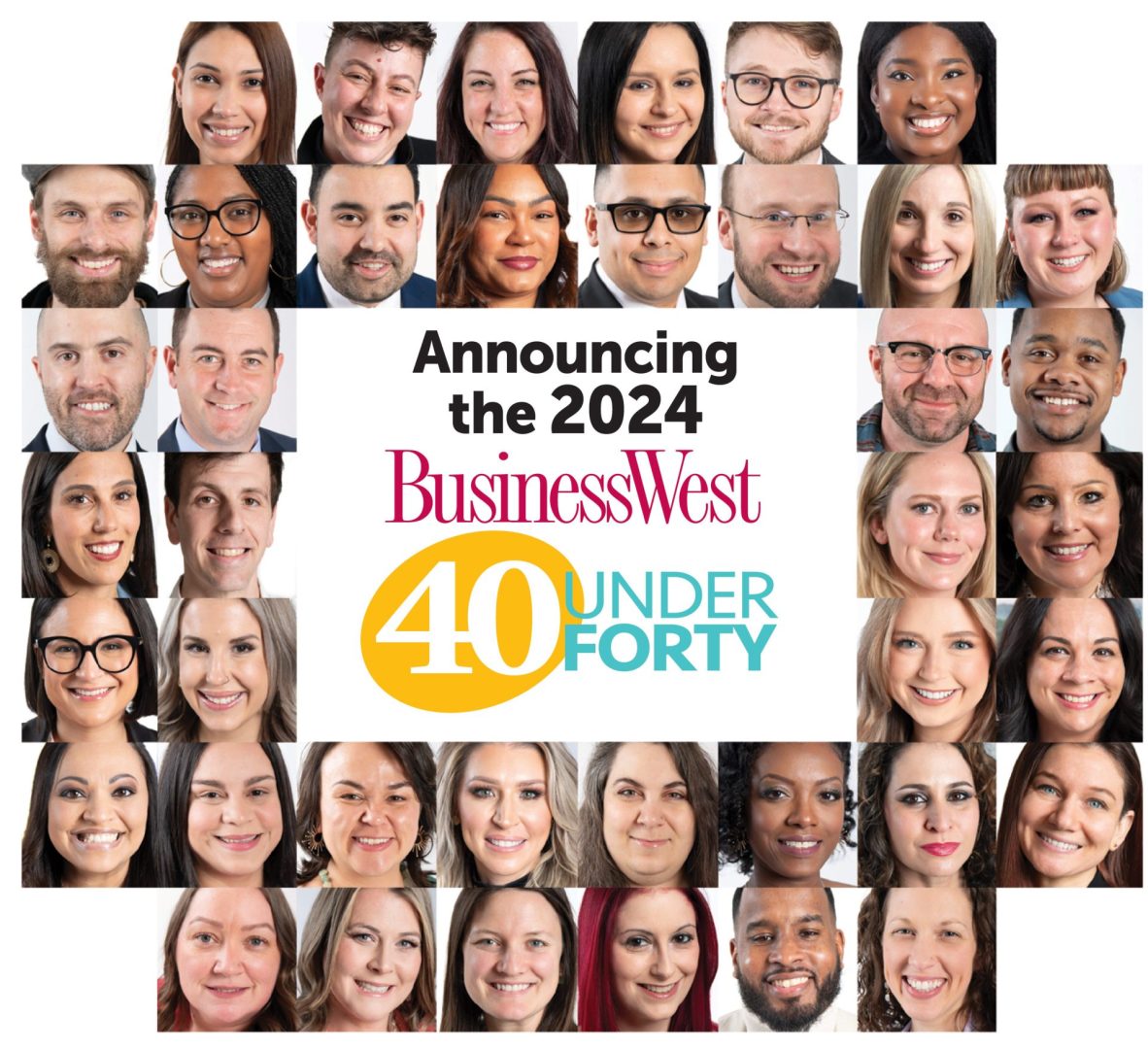
Two issues after that, we’ll unveil our 17th annual class of Difference Makers, the first of four very popular recognition programs throughout 2025, along with 40 Under Forty in April, Healthcare Heroes in September, and Women of Impact in October. BusinessWest accepts nominations for all four programs all year long.

This year will also bring a broader mix of feature stories, as well as returning favorites like each issue’s Community Spotlight, shedding light on economic development, municipal projects, tourism, and quality of life in individual cities and towns; and the quarterly Where Are They Now? — each installment visiting with a past winner of one of the four awards mentioned earlier, detailing how their life and career have evolved since. All that is, of course, on top of our regular coverage of dozens of industries.

And look for our annual Book of Lists early in the year as well, a comprehensive resource guide to the businesses and sectors that drive this region’s economic engine.

As 2025 takes shape, we’re excited to bring all that, and more, to you — on the page, at our recognition events, and at businesswest.com. Happy New Year.


Cover Story Giving Guide Special Coverage Special Publications

Regional Philanthropic Opportunities

Click on the image to view the PDF flipbook

The importance of giving to those in need — and to the organizations who help others secure their basic needs — doesn’t take a holiday, and there’s no season of the year when their work is not critical, especially at a time when an uncertain economy continues to pose challenges to so many individuals and nonprofits.

Still, there’s no doubt that people think about giving more around the year-end holidays, and that’s why BusinessWest and the Healthcare News publishes its annual Giving Guide around this time: to shine a spotlight on specific community needs and show you not only how to support them, but exactly what your money and time can accomplish.

These 25 profiles of area nonprofit organizations are just a sampling of the region’s thousands of nonprofits. These profiles are intended to educate readers about what these groups are doing to improve quality of life for the people living and working in the 413, but also to inspire them to provide the critical support (which comes in many different forms) that these organizations and so many others desperately need.

These profiles within the Giving Guide list not only giving opportunities — everything from online donations to corporate sponsorships — but also volunteer opportunities. And it is through volunteering, as much as with a cash donation, that individuals can help a nonprofit carry out its important mission within our community.

BusinessWest and HCN launched the Giving Guide to 2011 to harness this region’s incredibly strong track record of philanthropy and support of the organizations dedicated to helping those in need. This special section is designed to inform, but also to encourage individuals and organizations to find new and imaginative ways to give back. We are confident it will succeed with both of those assignments

Joseph Bednar, Editor
John Gormally, Publisher
Kate Campiti, Associate Publisher

Presented by:

Autos Special Coverage

Drive Time

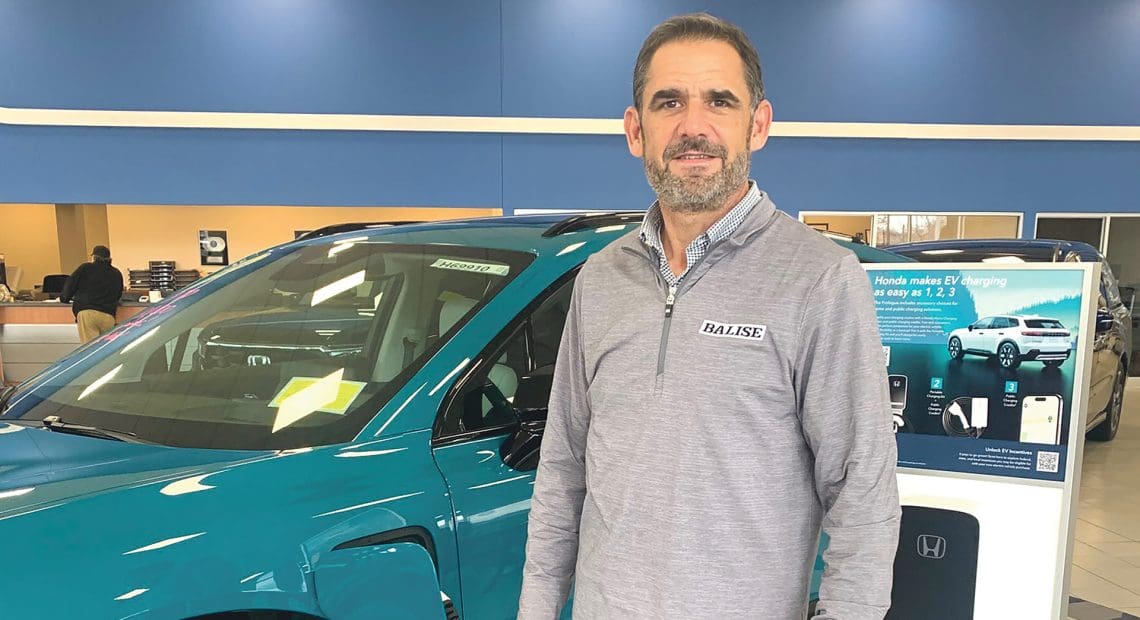
Ben Sullivan, seen here with a Honda Prologue

Ben Sullivan, seen here with a Honda Prologue, says sales of all-electric vehicles, as well as hybrids and plug-in hybrids, have been rising as consumers become more familiar with them.


‘Almost normal.’

Those are the two words that Ben Sullivan, chief operating officer for Balise Motor Sales, used to describe 2024 when it comes to just about every aspect of the auto-sales industry.

After four years of relative turmoil generated by COVID and its aftereffects, things were back to normal — almost, said Sullivan. To get his point across, he referenced the southernmost end of the huge parking lot for Balise’s Chevy/GMC dealership on West Columbus Avenue in Springfield.

Even 18 months ago, it was so barren, several people asked Sullivan if Balise had sold the lot. Now, it is heavily populated with cars — especially the commercial vehicles that were visible several years ago but were simply not available due to supply-chain issues in the wake of COVID.

That’s the case in every one of the many dealerships Balise has in Western Mass., the Cape, and Rhode Island, said Sullivan, noting that, when it comes to inventory levels, things are almost back to what was seen pre-pandemic.

“Until this year, there were cars coming in and cars going out, but there was zero stock to walk in and say, ‘I want to take something home today,’” he told BusinessWest. “We’re not back to totally normal levels now, but it’s getting a lot closer to what people would say is normal.”

Carla Cosenzi, president of TommyCar Auto Group, which boasts Nissan, Volkswagen, Hyundai, Volvo, and Genesis stores, agreed. In fact, she said that, in some cases, inventories even exceed pre-pandemic levels.

“Until this year, there were cars coming in and cars going out, but there was zero stock to walk in and say, ‘I want to take something home today. We’re not back to totally normal levels now, but it’s getting a lot closer to what people would say is normal.”

Which helps explain some of the aggressive incentives being offered by some of those brands, including 0% financing on a Nissan Rogue and a $79-a-month lease deal on a Hyundai IONIQ 5 EV. And they help explain why, on the Monday of Thanksgiving week, normally a traditionally slower time, the TommyCar dealerships were “swamped.”

“I think they’re trying to build demand for the increased production,” Cosenzi said of the manufacturers, adding that these incentives were one of the key contributors to a very solid year.

Sullivan agreed that 2024 was a good year saleswise — better than most in the industry, and he puts himself in that category, were projecting roughly a year ago.

At Balise, sales were up roughly 10% (most years, 3% to 5% is the average), a performance he attributes to lingering pent-up demand from the COVID years and availability of most models and most trims, including the lower-priced options on cars and SUVs that manufacturers pushed to the sidelines in favor of the higher-priced trims during COVID.

“This year was the first time that you started to get what people would consider to be real availability back,” he said.

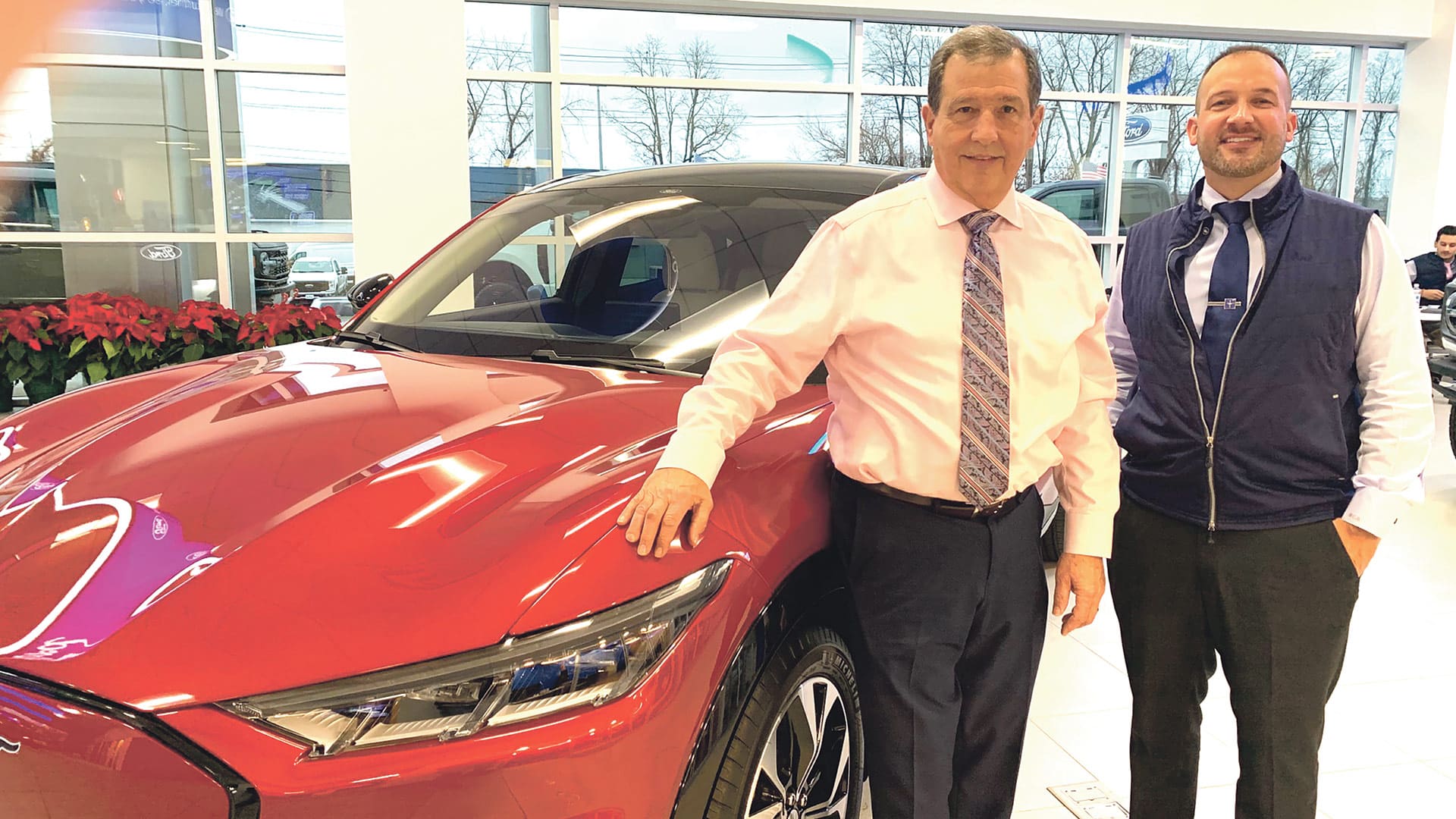
Mike Filomeno, left, and Mike Marcotte

Mike Filomeno, left, and Mike Marcotte show off a Mustang Mach-E, one of the many EVs now sold by Ford.

Mike Marcotte, president of Marcotte Ford in Holyoke, said his dealership has also recorded a nearly 10% increase in overall revenue in 2024, which he attributed to those same factors, particularly availability — on both the consumer and commercial sides of the ledger — with December, traditionally a big month, especially on the commercial side, still to go.

“Ford has put some great incentives out there to end the year out,” he said, adding that these cover everything from pickups to EVs that come with free chargers. “It’s been a good year, and we’re expecting to end it in strong fashion.”

Cosenzi said final numbers are obviously not in yet, but she is projecting 8% growth for 2024, and something along those same lines for 2025.

While things are returning to normal on most fronts, on the electric vehicle and hybrid segment, there isn’t really a ‘normal,’ because this is an emerging market, one that is building some momentum, although there are now real question marks about the future of the EV consumer tax credit.

“You’re seeing a big increase in customer demand for hybrids and plug-in hybrids,” said Sullivan, adding that many see them as an alternative to — or a bridge to — EVs, which are enjoying gradual growth in sales amid more options and better incentives, for the moment, anyway. “People might be scared to get into an electric, but they’re saying, ‘what can I do?’

“This hybrid technology has been out there for some time, it’s performing very well quality- and reliability-wise, and people are a lot more comfortable getting into these vehicles,” he went on. “The percentage of sales of hybrids versus non-hybrids continues to grow.”


To a Higher Gear

To get his points across regarding availability, getting back to normal, and even the EV and hybrid markets, Sullivan referenced Balise’s Honda dealership on Riverdale Road in West Springfield.

“During COVID and the post-COVID era, it was not unusual for us to finish the month with maybe 16 vehicles for sale,” he told BusinessWest. “Now that they’re starting to build more Hondas, I think we’ll finish this month [November] — and we had a very good month — with 80 to 100 to choose from if someone wanted to walk in and take one today.

“You went through three years of expecting to have to put a deposit down on something that was inbound on a ship, a train, or a truck,” he went on. “And now, you’re getting to the point where there’s a good chance you can find what you’re looking for available — not the same levels as before COVID, but at a level where the customer probably wouldn’t notice the difference.”

Elaborating, Sullivan said normal stocking levels would be 30 to 45 days of inventory, or maybe 140 cars in the case of this Honda dealership. At present, as noted, there are maybe 100, and they cover all trim levels.

“You went through three years of expecting to have to put a deposit down on something that was inbound on a ship, a train, or a truc. And now, you’re getting to the point where there’s a good chance you can find what you’re looking for available.”

It’s pretty much the same across the spectrum, he said, adding that inventory levels vary with the dealership, but most are working their way back to ‘normal.’

Improved availability is one of the key reasons why 2024 was a better year than most were expecting, said those we spoke with, noting that there is still a large amount of pent-up demand — and, now, many options for meeting that demand.

Indeed, during COVID and its immediate aftermath, manufacturers, hit with massive supply-chain issues, focused mostly on higher-end vehicles, driving up the average cost of a new car to levels many consumers were not willing to pay, said Cosenzi, adding that lots are now close to full with models across all trim levels, which has certainly helped drive sales.

“It was very hard to find middle and lower trim levels during that time,” she explained. “Now that things are opening back up again, it’s a lot easier to find a selection of low, middle, and high-end options of the same model. Buyers have more options than they’ve had in years.”

Meanwhile, other contributing factors include comparatively low unemployment, relatively strong consumer confidence, and those incentives from the manufacturers, Cosenzi said. “We’ve seen the manufacturers get more and more aggressive. Right now, we have 0% for 60 months — Nissan has it on its Rogue, which is a prime model, Volkswagen has it … 0% is back. Meanwhile, the Hyundai Tucson has 1.9%; those are examples of how aggressive the incentives are.”

Marcotte agreed, noting that these incentives come in many forms, including the Ford Power Promise, whereby those buying or leasing an EV become eligible for a complimentary home charger and standard installation.


Picking up Speed

With improved availability and overall sales up 10%, the question then becomes, ‘what are people buying?’

Some of everything is the obvious answer, but especially SUVs and crossovers — in part because there are simply fewer cars to buy — as well as trucks, EVs, and hybrids, said those we spoke with.

And commercial vehicles as well, noted Sullivan, adding that year end is traditionally a busy time for such sales as contractors and others look to take advantage of Section 179 tax deductions. But until recently, they simply weren’t available.

“We’re finally at the point where we can take care of those customers, and that’s making them happy, and it makes us happy,” said Sullivan, noting that the southern end of the crowded parking lot at the Chevy/GMC store reflects this reality. “The past several years, in many cases, people just said, ‘we’ll wait until next year.’ It was a very difficult time getting commercial vehicles.”

Mike Filomeno, Sales manager at Marcotte Ford, agreed, noting that truck sales, on both the commercial and consumer sides, remain solid as inventories grow. He cited, as one example, Ford’s Maverick, a small pickup with prices starting at $27,000.

“It comes in a hybrid and all-wheel drive, so it’s pretty popular; that’s a great price point,” he said, adding that Ford’s lineup of larger trucks is also performing well.

And used-car sales are also solid, said Filomeno, noting that inventories have improved somewhat, prices have returned to something approaching normal, and, as a result of both factors, sales are up, contributing to the dealership’s growth this year.

As for SUVs, they continue to dominate the market, with most manufacturers cutting back to one or two car models. Ford, for example, has just one, the Mustang.

But Sullivan said those in the industry are starting to see some movement among the younger generations toward cars.

“It’s too early to see if it’s a trend or just data, but there is some indication that the young people, the Millennials, don’t want to be in SUVs like their parents were,” he noted. “And you’re starting to see a lot of young people migrate into the sedan market.”

If that movement accelerates, then manufacturers may need to rethink their lineups and add more sedans, he went on. For now, the focus remains on SUVs. And larger numbers of these are coming in the hybrid, plug-in hybrid, and EV varieties, said those we spoke with, adding that sales of those vehicles are up across the board.

EVs still comprise only around 6% of all sales, said Sullivan, adding that the numbers continue to gradually improve as the options increase and consumers become more familiar with them.

To that point, he said Balise recently brought each of the 23 EVs sold across its stable of dealerships to an event at the Palmer Motor Sports Park, where consumers could get acquainted with the various vehicles — and drive them on a racetrack. More than 100 consumers turned out, and most all of them came away impressed with what they saw and experienced.

“I did not speak to one of them who didn’t say, ‘now that I’ve driven one, I believe it’s the car for me,’” he recalled, adding that familiarity breeds comfort.

Marcotte agreed, noting that Ford’s lineup of EVs includes everything from the Mustang Mach-E to the F-150 Lightning pickup to an E-Transit cargo van, and that, increasingly, consumers are becoming more comfortable with such vehicles.

Cosenzi concurred, noting that the Hyundai store put more than 30 people in the IONIQ 5 this month, thanks to the $79-a-month, 13-month lease deal. She said the outlook for continued improvement is generally positive, but much depends on whether the incoming Trump administration makes good on plans to kill the $7,500 consumer tax credit for EV purchases as part of broader tax-reform legislation.

“There’s a lot of speculation about what might happen with those incentives,” she said, adding that, at more than $10,000 in many cases, they certainly help some consumers get over the hump and into an EV.


Banking and Financial Services Special Coverage

Turning the Corner

Jeff Sullivan says the ‘drill’ is now part of doing business — an important part, and an expensive part.

He was referring to a recent exercise at Springfield-based New Valley Bank, in which a cyber attack was carried out and the staff’s response was chronicled, scored, and evaluated.

“You come in the morning and your screen is black — what do you do now?” said Sullivan, president and CEO of the institution. “Then someone gets an email, and it’s says, ‘pay X amount of ransom by the end of the day.’ What do you do? They test your preparedness for things that can happen.”

This simulated cyber attack is one of many aspects of disaster planning at the bank — there’s another drill where there’s a tripledemic and no employees can come to work — and at all banks, large and small. It represents aspects of a “brave new world,” as Sullivan called it, and one of many ongoing challenges and expenses for financial-services institutions.

And there are many others. They include:

• Continually growing competition, both from non-bank financial institutions (NBFIs) and players within the industry, including regional and national powers such as JPMorganChase, which has opened 75 branches in Massachusetts, including several in the 413 in an aggressive bid for market share;

Jeff Sullivan

Jeff Sullivan

“You come in the morning and your screen is black — what do you do now? Then someone gets an email, and it’s says, ‘pay X amount of ransom by the end of the day.’ What do you do? They test your preparedness for things that can happen.”

• The many aspects of technology, including the need to keep up with the larger players with deeper pockets while also correctly gauging what customers want and not investing for the sake of investing;

• Artificial intelligence, specifically the need to understand this emerging technology and then deploy it in ways that improve the customer experience and overall efficiency while maximizing the time of human talent;

• Margin compression, a function of rapidly rising interest rates and corresponding huge increases in the cost of deposits in 2023 and early 2024. Interest rates are coming down, and the situation is easing, but there will be a lag;

• A still-sluggish housing market marked by fewer sales because people don’t want to trade a lower-rate mortgage for a much higher one, and a virtually nonexistent refi market; and

• The ongoing need to grow, and the question of how to accomplish this given all of the above.

These issues and others were addressed by several area banking leaders as BusinessWest asked them to put 2024 in perspective and speculate on what they expect to happen over the next several quarters.

“The rate increases by the Fed really hammered bank margins and, therefore, bank profitability; it was a tough grind in 2024,” said Matt Sosik, president and CEO of bankESB, who described this year as one in which the price was paid for 500 basis points worth of interest-rate increases that started early in 2023. “Most banks are just now starting to turn the corner.”

Most area banks were fortunate to have their balance sheets structured in a way that allowed them to be resilient and absorb the blows, and even record decent, if less-profitable, years in 2024, but the rate hikes still took a toll, Sosik went on, adding that, as rates come down (the Fed approved another drop earlier this month), margins will start to improve. But there will be a lag, just as there was when rates started climbing.

Matt Sosik

Matt Sosik

“The rate increases by the Fed really hammered bank margins and, therefore, bank profitability; it was a tough grind in 2024. Most banks are just now starting to turn the corner.”

As for technology, it remains the quintessential combination of challenge and opportunity for banks. The opportunity comes in the form of improved service to customers and thus the ability to retain and perhaps grow market share. The challenge comes with keeping up, the cost of keeping up, not paying for something customers don’t want, and keeping customer information safe.

“You don’t want to be chasing shiny objects or next greatest thing,” said Matt Garrity, president and CEO of Florence Bank. “You really want to be rooted in understanding what it is your client wants from you and that you’re delivering the best possible product, the best possible service, to address what they’re after.”


By All Accounts

As he told BusinessWest that “banks have hit bottom,” Sosik acknowledged this might not be the best way to describe the current state of the industry.

But it works.

“We’ve seen the bottom, and we’re on the upswing,” he said, adding that, as interest rates come down and pressure on margins eases, banks should see some improvement on the bottom line. “There will be positive earnings impacts in the fourth quarter and into 2025, and slow movement back toward more normal margins.”

Matt Garrity

Matt Garrity

“You don’t want to be chasing shiny objects or next greatest thing. You really want to be rooted in understanding what it is your client wants from you and that you’re delivering the best possible product, the best possible service, to address what they’re after.”

Overall, while 2024 was, indeed, a grind, most area institutions fared comparatively well because they took a conservative approach, although performance, meaning profitability, was off from previous years due to the margin squeeze resulting from a slow, persistent, 550-basis-point increase in interest rates over roughly a year, which was largely unprecedented, by most accounts.

As a result, most institutions in this region were simply less profitable than usual, said Sosik, noting that 2025 should see the pendulum continue its swing back to where bottom lines were a few years ago.

Sullivan agreed, and projected improvement on everything from margins to the yield curve, although it may come at a slower pace than the industry would want.

“The bond market has sensed inflation being persistent, and it shows by the long-term rates running back up over the past two months,” he noted. “That is actually normalizing the yield curve; an investor should get paid more for locking her money up for a longer time period.

“The inverted yield curve that we’ve had the past two years [short-term rates higher than long-term] is really bad for community banks, so this change back to a normal yield curve is welcomed,” he added. “We’ll see about whether the Fed cuts interest rates a lot next year; there is now talk that the short-term rate reductions will be slower, but Trump will want them to be faster to juice the economy.”

But there are several caveats that make it difficult to project how pronounced a bounceback will be seen over the next few quarters. Indeed, while there is general agreement on perhaps another 100 basis points worth of rate cuts in the year to come, there is less consensus on the prospects for a recession or what will happen with inflation.

Dave Glidden

Dave Glidden

“As rates decline and the pressure relieves a little on margins, banks, if they’re smart, will stay laser-focused on the cost of funding and their deposit mix.”

Indeed, Glenn Welch, president and CEO of Freedom Credit Union, said the kinds of tariffs on foreign products trumpeted by President-elect Trump could cause inflation to spike — and have other repercussions.

“If those tariffs are put in place, we’re going to see higher inflation, and then the Fed won’t be able to drop interest rates as quickly as many are projecting,” he noted.

Meanwhile, although interest rates are expected to continue their downward trend, there will be a lag when it comes to the overall impact on deposit rates, especially with banks hard-focused on protecting their deposit bases.

“The competition for deposits will continue through the balance of this year and into 2025,” said Dave Glidden, president and CEO of Middletown, Conn.-based Liberty Bank, which has expanded its footprint into Western Mass. “Each bank will have to make their own decisions based on their deposit composition and cost of funding overall, but I expect that the rates on deposits won’t come down as fast as the Fed drops interest rates because deposits are the lifeblood of banks. As rates decline and the pressure relieves a little on margins, banks, if they’re smart, will stay laser-focused on the cost of funding and their deposit mix.”


Points of Interest

Glidden didn’t really want to speculate too much on Chase Bank’s strategy of adding new branches; like others, he preferred to talk about his own institution.

But he said the Jamie Dimon-led institution’s aggressive push is yet another indication that competition continues to increase — and come from seemingly everywhere.

That includes NBFIs, also known as NBFCs (non-bank financial companies), such as investment banks, hedge funds, private equity funds, private mortgage lenders, and other players. And it includes area banks and credit unions that are continually expanding their footprints — in this region, this state, and into neighboring Connecticut. It even includes the federal government. “People can get better rates on T-bills than they can get in the banks,” Sullivan said.

Dan Moriarty

Dan Moriarty

“Organic growth is becoming tougher and tougher. But as the bigger banks get bigger, we feel we can provide services and faster response times for small to mid-size companies. That’s our niche, and that’s what we’ll continue to focus on, but it’s getting tougher.”

As for Chase’s move, Glidden said there is lot of science and analytics behind it, and the bank, which he called the “900-pound gorilla,” is already making a dent when it comes to market share. “Branches are very expensive, and they’re always going to be a critical part of a bank’s distribution network, but you don’t build branches today haphazardly. Jamie Dimon hasn’t called me to let me know what he’s doing, but he puts a lot of science behind it.”

And this heightened competition from Chase and elsewhere comes as banks face the many challenges detailed above — at a time when they need to continuing growing in the wake of the many rising costs they’re facing and the need for economies of scale.

In this environment, the community banks that dominate this region need to focus on blocking and tackling, said those we spoke with, meaning an emphasis on what they do right, specifically a generally higher brand of personalized service.

“Organic growth is becoming tougher and tougher,” said Dan Moriarty, president and CEO of Monson Savings Bank. “But as the bigger banks get bigger, we feel we can provide services and faster response times for small to mid-size companies. That’s our niche, and that’s what we’ll continue to focus on, but it’s getting tougher.

“We’re trying to go against the super bigs and sell our services and our reputation,” he went on, adding that Monson Savings picked up some market share when a Citizens Bank branch closed.

Garrity concurred. He noted that, while mergers and acquisitions will continue — and perhaps pick up as the skies clear — the cleaner path is organic growth, and that comes through customer service, new branches when and where they are appropriate, and keeping pace with the larger institutions on technology.

Sullivan agreed, noting the sizable investments New Valley is making both in cybersecurity and new online banking products.

“We have to stay relevant with the big players, we’ve got to have the same sort of offerings that they have, and, in some cases, we have to be even better,” he said, adding that keeping up is a big part of doing business in this environment.


Technically Speaking

As he talked about technology, Sosik spoke for all those we interviewed when he said customer expectations are high — as in sky-high.

“When customers use technology, they want it to work. When you turned on your laptop this morning and the wheels spun a little bit or it took longer to load your email, you said, ‘what’s going on here?’” he told BusinessWest. “So the expectations are really high, and the margin for error is really thin; you have to have near-perfect execution.”

Couple high expectations with the equally high cost of technology, security, and compliance, and banks and credit unions are under enormous pressure to get it right.

“Twenty years ago, it was basically bad loans that could kill a bank,” Glidden said. They would kill a bank over time, and you could kind of see it coming. Today, with technology, a privacy breach, a cyberattack, ransomware … those things can change the fate or status of a bank in seconds.

“That’s why I call that side of technology ‘table stakes,’” he went on. “You have to invest, and invest heavily.”

By that he meant investments in new technology aimed at improving customer service, in training and drills like simulated cyberattacks, and in AI, which amounts to a new frontier for financial-services institutions, and another area where they need to get it right.

Welch said Freedom has recently deployed AI in its call center, a strategy with many goals.

“We’re rolling it out slowly, and we rolled out the first part over the past few weeks; it’s answering the phone and transferring people to where they want to go,” he explained. “Shortly, customers will be able to get balances and do transactions like transferring money between accounts.

“The whole idea is to free up the call-center people to deal with more complicated financial issues that customers have when they call in, rather than ‘what’s my balance?’ and ‘transfer $1,000 to this account,’” he went on, adding that maybe 25% to 40% of the calls to the center can be handled by AI.

Other area institutions are in similar early-stage rollout phases, but most are still doing research and deciding how to best implement the emerging technology.

Moriarty, like others we spoke with, said his bank is looking at AI not to replace face-to-face interactions and decision making, but instead to help make decisions faster.

And like other institutions we spoke with, Monson will measure twice and cut once when it comes to all aspects of AI, especially when it comes to security.

“Confidentiality is a critical component of a bank’s reputation,” he told BusinessWest. “If banks start using this too quickly, they could run into a situation where information might be out in the open or in the cloud somewhere. So we’re going to be very prudent about when and how we use AI to give information.”

Garrity agreed. “We want to integrate AI in our business, but it’s going to be a longer process overall to make sure that we understand what the risk components are,” he said. “We want to look at how we can use those tools to make our team members more efficient in serving our customer. It’s a tool to use, and a not a replacement of that team member.”

And it’s just one more challenge — and opportunity — banks face as they turn the corner from a tough 2024 into an uncertain 2025.

Cover Story Women of Impact 2024

BusinessWest has long recognized the contributions of women within the business community and created the Women of Impact awards in 2018 to further honor women who have the authority and power to move the needle in their business, are respected for accomplishments within their industries, give back to the community, and are sought out as respected advisors and mentors within their field of influence.

Go HERE to view the 2024 Women of Impact Digital Section

The eight stories below demonstrate that idea many times over. They detail not only what these women do for a living, but what they’ve done with their lives — specifically, how they’ve become innovators in their fields, leaders within the community, advocates for people in need, and, most importantly, inspirations to all those around them. The class of 2024 features:

Alison Berman

Council director of Girls on the Run Western Massachusetts

Dianne Fuller Doherty

Co-founder of the Women’s Fund of Western Massachusetts

JoAnne Finck

President of Friends of Cooley Dickinson

Kimberley Lee

Chief of Creative Strategy and Development at MiraVista Behavioral Health Center

Megan McDonough

Executive director of Pioneer Valley Habitat for Humanity

LaTonia Monroe Naylor

Chief business educator at Monroe Naylor Consulting, LLC and president and CEO of Parent Villages

Kristi Reale

Partner at Meyers Brothers Kalicka, P.C.

Dr. Shirley Jackson Whitaker

Nephrologist, artist, and filmmaker

WOMEN OF IMPACT GALA

Presenting Sponsors

Partner Sponsor

Women of Impact 2024

Nephrologist, Artist, and Filmmaker

In More Than One Way, She Draws on History to Help People Heal

Staff photo

Staff photo


“When a patient walks into my room, they expect to have a seat and for me to talk with them about their history, about their journey. I take that information, and I use it to help them heal. I need to look at history. And sometimes patients come in and tell you horror stories, but I can’t discard it because I need it all to help that patient to live.”

Dr. Shirley Jackson Whitaker, a nephrologist by trade — that’s a kidney specialist — shares those thoughts toward the beginning of Ashes to Ashes, a documentary she produced in 2019. And they are apt when juxtaposed against the story she goes on to tell.

The film is actually two intertwined stories, both incredibly powerful. One is related by Winfred Rembert, an avid Star Wars fan and master leatherwork artist.

Clear-eyed but haunted, he relates a life-changing experience in 1967, when he drew the ire of law enforcement in Cuthbert, Ga. because of his work advocating for civil rights. They tossed him in a car trunk, and he emerged to see a noose hanging from a tree. They stripped him, hung him upside down, stabbed him, and made it clear they intended to castrate him, hang him, then burn his body. When one of the men suggested they stop, they moved on, and Rembert, bleeding and deeply traumatized, lived.

“In this country, no one really, genuinely talks about the people who were lynched.”

The other story in Ashes to Ashes concerns the 4,000 people lynched in the U.S. during the Jim Crow era, which, as Rembert painfully reminds us, didn’t end all that long ago. In 2017, Whitaker, a friend of Rembert’s who also grew up in Georgia, organized a funeral in Springfield to honor the many lynching victims who were never buried. As Whitaker explains in the film:

“Sometimes they would lynch people, then put them in the water with weights, so the family would never see them again. Sometimes they would take the bodies and cut them up and sell the pieces. Sometimes they would take the body after they lynched it and burn it up, so the families would not have anything. A lot of these people never got a funeral. It was often too dangerous for the families to retrieve those bodies. And sometimes, there were no bodies to retrieve. It’s not just black history — this is American history.”

At the funeral ceremony, participants read names of many of these unburied individuals, and members of a local theater group read monologues drawn from Whitaker’s historical research. The account of a father forced to choose to die along with his young son or watch the boy drown is especially wrenching.

Ashes to Ashes gained acclaim on the festival circuit and was a finalist for Academy Award consideration.

Ashes to Ashes gained acclaim on the festival circuit and was a finalist for Academy Award consideration.

“In this country, no one really, genuinely talks about the people who were lynched,” Whitaker says in the film. Which is why she produced it — to give those people a voice, get people talking about some too-recent history, and, by grappling with that reality, just maybe start the process of healing.

“I decided to have a funeral for the over 4,000 African-Americans who were lynched in the United States to close that chapter and move forward. America has to do the same thing to help heal this country. You’ll get some pushback from people: ‘why do you want to stir that up?’ But it hasn’t been stirred enough. People were saying, ‘ah, that’s so depressing.’ I say, well, if you think this depressing, try hanging from a tree.”

She then asks, “what can I do? I can’t bring them back, but I can give them a prayer.” For doing so much more, Whitaker is an uncommonly powerful Woman of Impact.


Pain and Promise

As she spoke with BusinessWest in her Amherst home about her multi-faceted life and career, virtually every wall in every room was covered with her paintings — some traditional in medium, some incorporating mixed media, including fabrics and, in a few cases, unprocessed cotton.

“Cotton has this fluffy appearance to it, but just take your hand and squeeze right there,” she said. “Just squeeze. You feel the seeds? Once Eli Whitney got the seeds out, they had more uses for cotton.”

And the slaves who picked it, as the cotton gin essentially rejuvenated the plantation slavery industry.

“The thing is, when you go to pick this, you’ve got to be careful because this is like knives,” she continued, pointing out the sharp wall surrounding the fluffy cotton. “You learn early how to avoid that.”

Rembert, who passed away in 2021, knew that well; he grew up picking cotton on a plantation, and he understood the dark history of the crop in the South.

Whitaker’s path was somewhat different; the seventh child of Eddie and Charlie Mae Jackson from Waycross, Ga., she attended Clark Atlanta University, graduating with a bachelor’s degree with honors and then earning a public health degree at Yale University School of Medicine and undergoing advanced medical training in internal medicine and nephrology at Emory University School of Medicine, where she was the only Black woman in her class.

After some years on the West Coast, she moved to the Pioneer Valley when her husband was hired at UMass Amherst as a professor of Mathematics. For a decade, she worked at Springfield Southwest Community Health Center, where, in addition to bettering and saving lives, she designed a children’s coloring book advising against drugs, created a community-health newsletter, and produced an imaginative ‘puppet opera’ for young people titled “Monsters Among Us.” In 2006, she went into private practice.

But nephrology wasn’t her only interest; to address her concerns about the academic standing of African-American children in Amherst schools, she established the Academic Initiative for Maximum Success, which resulted in a dramatic increase of Black students in AP math programs.

“In addition to caring for her patients’ health, Shirley brings joy and hope. Her contributions to her community through educational programs have provided many with opportunities that would not have been afforded without her initiatives.”

Whitaker has also continued to paint, authored two children’s books, and produced her award-winning documentary. These days, she continues to practice medicine two days a week at the Northampton VA Medical Center.

“When I look back and I think of all these things, and the ripple effect of it all, I’m pleased with that,” she told BusinessWest, adding that her honest, often hard assessments of patients made a long-term difference. “People to this day come up to me and say, ‘I remember what you said, and it changed my life. I changed my diet; I lost 40 pounds.’”


Stories Worth Sharing

Taylor Rees, director of Ashes to Ashes, will certainly never forget her. “Dr. Shirley is a neighbor of mine who lived on the same street as my family in Massachusetts when I was growing up,” he wrote. “In 2015, she asked for help documenting her memorial, and throughout the year, we worked together to also visit with and listen to the personal and lived experiences of Winfred, her friend. The film evolved over time into an homage to both Shirley and Winfred and their work using art to address racial injustices in America.”

Whitaker has also made a powerful impression on Anika Lopes, who nominated her as a Woman of Impact a year after Lopes, president of the Ancestral Bridges Foundation, earned the same honor from BusinessWest.

“Dr. Whitaker is a woman of impact with every step she takes, a tireless giver, sharing all she has with others,” Lopes wrote. “As a medical doctor, Shirley has and continues to dedicate herself to the wellness of others; she goes far beyond expectation and keeps going. In addition to caring for her patients’ health, Shirley brings joy and hope. Her contributions to her community through educational programs have provided many with opportunities that would not have been afforded without her initiatives.”

Lopes added that Whitaker believes we all have a collective responsibility to create a better future, “and she sure is walking her talk.”

She’s doing so at a time when too many people don’t truly comprehend the horrors of slavery or the more recent legacy of Jim Crow, or are actively trying to erase that history. But she’s also hopeful about the future, currently working on a screenplay called Blanket, noting that “a blanket of hate can never cover the resilience, remembrance, and hope.”

As for Rembert, he spent more than 50 years struggling with sleep issues, stemming partly from the trauma he experienced in 1967, as he describes in Ashes to Ashes.

“Even today, now, it’s dragging me down. I can’t rest. I can’t rest. I lie in my bed, and I can’t rest. I’m running for my life every night. Somebody’s after me, and I don’t know what to do.”

And later in the film:

“I don’t think I can be healed. I think I’ll go to the grave with what I got, holding me down and holding me back. Even though those things were done to me years ago, they’re still holding me back. Can I send the message? Can I change this? I can’t change this world. I know I’m not a big enough man to do that, but I can put a dent in it. But you just keep going, and going, and going, and going.”

Whitaker has kept going as well, maybe not changing the world, but impacting her corner of it in profound ways as a doctor, educator, artist, and filmmaker. And she empathizes with the pain of friends like Rembert and thousands of people she never knew, but wanted to memorialize through a unique funeral service and a story that will live on as people continue to watch it.

“I talked to him like two days before he died,” she said of Rembert, “and he said, ‘I just want to know what it’s like to go to sleep.’”

“We’re looking back in history so this patient can live,” Whitaker said during that 2017 memorial service in Springfield, referring not to a nephrology patient, but to a nation with deep, unhealed wounds. “We’re looking back in history so this patient can thrive. We’re looking back in history so this patient can become very strong. But this patient could only live and get stronger if we’re willing to look back. So tonight, we start.”

Women of Impact 2024

Partner, Meyers Brothers Kalicka, P.C.

She Emphasizes the Need to ‘Work Hard, Play Hard’

Photo by Focus Ashely Photos

Kristi Reale says it’s an unofficial assignment. In other words, it’s not written or her business card. In addition to serving as a partner with the Holyoke-based accounting firm Meyers Brothers Kalicka (MBK), she’s also in charge of the ‘fun committee’ there.

She even has a ‘fun drawer’ in her credenza, filled with Easter eggs to be hidden around the office at that time of year, golden coins and shamrocks for St. Patrick’s Day, material for the ‘decorate your space for the holidays’ competition, and much more.

Fun is an important part of the equation at this firm, she said, adding that there is stress throughout the year, but especially around the many tax-filing deadlines, such as those in April, September, and October, and fun is needed to help take the edge off.

“It’s a hard job, and you want to make it fun,” she said, adding that she tries to do something fun — like a Belgian waffle bar or hot chocolate bar — every Saturday during spring tax season, when many employees are in and trying to dig out.

But fun is just a part of that equation, as evidenced by the sign on top of that credenza, the one that reads, “Work Hard, Play Hard.” Those are words her father, Bill Hurley, a small-business owner who passed away in February, lived by, and Reale does as well, she said, adding that she stresses both elements — to anyone who will listen, but especially to the young women (and men) she mentors.

“Hard work is important, but you also need to have some fun,” said Reale, who is the proud (sort of) repeat recipient of one of the awards given out at the firm annually, this one to the individual “most likely to have squatted” at MBK, meaning you could find her at her desk at almost any hour.

“It’s not an award you really want to get,” said Reale, who has also been awarded a blanket by her colleagues, in part because she’s always, as in always, cold, but also as a nod to the notion that she sleeps in her office.

Hard work — but not necessarily the kinds of hours needed to win the ‘squatter’ award — is what Reale preaches to young people — as well as the need to balance that hard work with fun, to give back to the community in many different ways, and to mentor others on their way up, just as they were mentored.

She does all this, and that’s why she’s being honored as a Woman of Impact in 2024.

Her office helps tell the story: there’s the fun drawer, that aforementioned sign, photos of family (a nod to work-life balance), her 40 Under Forty plaque from 2009, her diplomas and credentials hanging on the walls, and — on this day, parked in one corner in large bags — 60 pairs of kids’ pajamas she had already purchased for an organization called Jammie Jingles, started by a firm member, which contributes new pajamas to children in need.

But comments from those she works with tell it better.

“She’s devoted 100% to the firm, to her clients, and, more importantly, staff,” fellow Partner Rudy D’Agostino said. “What’s great about Kristi is that she’s a mentor to many of our younger staff; she takes the time out of her busy schedule to meet with them, work with them, mentor them, and help them put a plan together.”

“Hard work is important, but you also need to have some fun.”

Howard Cheney, another partner at the firm, concurred. “Kristi has made, and continues to make, a remarkable impact on individuals, businesses, and organizations in Western Mass. The position she holds is a unique one because her job directly enables others to thrive in their own endeavors. The weight of that responsibility is not lost on her, as she goes above and beyond for her clients.

Kristi Reale, right, with Springfield Thunderbirds mascot Boomer and fellow Meyers Brothers Kalicka Partners (from left) Rudy D’Agostino, Kristina Drzal Hougton, Howard Cheney, and Jim Krupienski on the occasion of the firm’s 75th anniversary in 2023.

“Additionally,” he said, “Kristi serves as a role model to a number of young professionals on our staff, and she works hard as a mentor, helping these young accountants to navigate the road to success, as she experienced it herself.”


Firm Resolve

Reale was a student at Assumption College in Worcester, working toward a degree in accounting, when she decided that real world-world experience would be a good complement to what she was learning in the classroom.

Her advisor agreed, suggesting that she pursue an internship. So she did, with a vigor that would reflect her career to come.

“I opened the phone book, and I called every single accounting firm within driving distance of Assumption,” she said, adding that she scored some interviews, including one at a large regional firm in Worcester.

“When I went to interview with this person, he said, ‘how did you find us?’” she recalled, adding that she told him about opening that phone book and calling every accounting firm in Worcester and asking if they had an internship program. “He called me up and said, ‘Kristi, I’m a Bentley guy, and I had a Bentley student pinned for this internship, but I’m going to give it to you.”

She completed that internship in the spring and started with the firm in the fall, she went on, noting that times were different in the broad world of public accounting then; jobs were much harder to come by, and the competition for them was fierce.

“You went to work, you did your job, you did the best you could every day because, if you didn’t, there was a line of people outside waiting to get your job. It was a tough market,” she said, adding that this environment was fine with her because, from a young age, good working habits were instilled in her by her parents and, later, several mentors.

And she is essentially trying to impress that same message on young people today.

“What’s great about Kristi is that she’s a mentor to many of our younger staff; she takes the time out of her busy schedule to meet with them, work with them, mentor them, and help them put a plan together.”

Tracing Reale’s career, she stayed with the firm in Worcester for a few years before tiring of the commute from and a perceived lack of opportunities to advance. So she went to work at a smaller firm but was again stymied by a lack of opportunities, feeling “disposable,” as she put it. Frustrated, she decided in early 2001 that she was done with public accounting.

But she still needed to work, so she called her sister-in-law, an employee at Meyers Brothers, and asked if the firm needed any tax-season help. It did, and she came on board with the intention of making this a very temporary assignment and finding something else to do for a career.

Instead, she saw women in management roles, became inspired, and stuck around, passed the CPA exam, and plowed ahead.

“I knew no one was going to outwork me, and I was just going to do it,” said Reale, who eventually became the second woman to become a partner at the firm (her colleague, Kris Houghton, was the first).

As a partner and CPA, she works hard on behalf of her clients, but also on behalf of those she works with, setting an example and also acting as a mentor — to young people in general, but especially women.

Kristi Reale, right, and Chelsea Russell, manager/CPA at Meyers Brothers Kalicka, display some of the many items collected during a supply drive to benefit the residents of Ruth’s House in Longmeadow.

“What I’m trying to encourage is for this next generation of women to be strong and financially independent, and to succeed. The glass ceiling’s already been broken; why not go for the moon?” she said, adding that most of her mentorship activity is informal, and she works hard to make herself accessible, with some colleagues calling her at 10 p.m. or later.


She Gives of Herself

There is no managing partner at MBK; the six partners essentially split up the workload. Reale’s areas of emphasis include IT and administration.

But, as noted earlier, she’s also in charge of bringing some fun to the firm’s 80 or so employees. That’s a broad assignment that includes everything from activities around various holidays to celebrations when those tax-filing deadlines have passed, to random pranks and other efforts to coax smiles and relieve all that stress.

It’s an assignment she takes … well, seriously.

But in addition to her work with clients and her ‘work’ to supply fun, she is also very involved in the community — and in many different capacities.

She has sat on different nonprofit boards in the past and remains involved with the board at the Advertising Club of Western Massachusetts. She has also been involved at various levels with Habitat for Humanity, Trees of Hope Supporting Ronald McDonald House, Unify Against Bullying, and Dress for Success.

Meanwhile, the firm supports several different nonprofits and individual programs, with initiatives revolving on a monthly basis, and Reale makes a point of stepping up for each one.

Such as with those kids’ pajamas she started buying, with an emphasis on starting.

“I’m at 60, but I could be at 100 soon. This is fun; I enjoy this,” she said, adding that she does most of this kind of giving — including the purchase of pairs of Air Jordans for two teen boys in a family the firm adopted last holiday season — on a low-profile basis. (Since the firm went ‘casual’ at the height of COVID, she often wears Jordans herself; she says it gives her some street cred with the younger employees in the office.)

Overall, Reale is a giving person with an incredibly strong work ethic … and a great sense of humor, a blend of traits exemplified by her donation of a kidney to her husband 18 years ago, and the ultimate timing of that donation.

“I was tested and passed all the testing in late 2005, during the beginning of tax season,” she recalled. “I was cleared to be a donor in March of 2006, and they had an opening, but I told him I had to wait until the end of tax season. I said, ‘you waited like eight years … what’s a few more weeks?’”

All this explains why Reale is a Woman of Impact and why D’Agostino, who knew her father well, says he would undoubtedly be very proud of all she has accomplished and the manner in which she has, indeed, become a role model to so many.

Women of Impact 2024

Chief Business Educator, Monroe Naylor Consulting, LLC; President and CEO, Parent Villages

She Has a Passion and Purpose for Helping Others Find Their Own

Photo by Focus Ashely Photos

Photo by Focus Ashely Photos


Mission-rich and Profit-powered.

That’s the title of the book LaTonia Monroe Naylor wrote, and its subtitle — A Guide to Transforming Your Passion Work into a Fully Funded Business — offers further clues to what’s inside.

And to how she helps businesses move purposefully to the next level, through her business, Monroe Naylor Consulting LLC, which seeks to help entrepreneurs build profitable, mission-driven businesses.

But that consultancy, and the book, are just two elements in what has become a life and career of helping others. It’s been a life of a Woman of Impact.

“When I came up with this, the idea was, how do you take your overwhelming passion and structure it in a way that you can be productive?” she explained.

“Most people don’t use the administrative part of their skillset, or they don’t have it, but that was a gift that I’ve always had,” Monroe Naylor told BusinessWest, noting that she was developing business acumen from a very early age, working at her uncle’s store.

While entrepreneurs typically bring the passion and purpose — that’s why they started the business, after all — they don’t necessarily know how to marry that with an understanding of how a successful business works. “Most people are not taught that because they don’t come from environments where people are teaching them that. So I want to teach people that; I want them to be successful.”

At the same time, “I want them to know that starting a business is not the only thing you should be focused on, so how do you sustain what you do and have harmony in your life?” she said, adding that people shouldn’t feel like they need to sacrifice time with their family for the sake of a job that keeps them separated 100 hours a week.

“That, to me, is mission-rich. How do you do the things that you love and embrace the things that you love, but still have enough stability that you can be comfortable and have a nice house?” she went on. “If you can’t have both, then you’re not going to be happy. And who wants to be miserable?”

Essentially, Monroe Naylor works with entrepreneurs, small-business owners, churches, and other organizations on culture, business sustainability, and other key elements of a thriving business. “I provide training on grants, management, strategy, funding, how to start your business, what you need, what kinds of people you need on your team. On the nonprofit side, how do you set up your board, who should be on your board, how do you ensure you stay compliant?

“Then, when I created the book, I literally thought about the last 20 years of my life. What were the biggest challenges and roadblocks that I ran into? And how do I simplify that for people in less than a three-hour read, so that they will actually read it?”

“How do you do the things that you love and embrace the things that you love, but still have enough stability that you can be comfortable and have a nice house? If you can’t have both, then you’re not going to be happy. And who wants to be miserable?”

Ayanna Crawford, president of AC Consulting and one of three individuals who nominated Monroe Naylor as a Woman of Impact, wrote that her story “serves as a testament to the power of resilience and unwavering dedication to making a difference. As a chief business educator, she inspires others to follow her lead and create lasting impact in their communities. She has reached the place she is today by focusing on others and making their needs a priority in light of her own.”


Back to School

Monroe Naylor has long had a heart for the community, which manifested in running for, and winning, a seat on the Springfield School Committee in 2017 — a decision also influenced by a desire to help her young son navigate the challenges of school and life.

“We ran a very grassroots, non-political campaign because we didn’t know any other way to do it,” she recalled. “We just wanted to help our kids. I feel like, if you do things for the right reason, the good will always come back to you. Even though a lot of bad may happen, I focus on the good.”

LaTonia Monroe Naylor says she wants people to be successful in business and happy in life.

LaTonia Monroe Naylor says she wants people to be successful in business and happy in life.

Her experience on the committee led indirectly to her establishment, in 2018, of Parent Villages, a multi-faced nonprofit that works to improve educational achievement while also offering assistance for victims of violence, resources for family engagement and parent advocacy, and more.

The educational focus came from a presentation she heard as a School Committee member, about how 7% of kids aren’t prepared for kindergarten.

“I said, ‘70 or 7?’ And she was like, ‘7.’ So I said, ‘so 93% of our kids aren’t prepared for kindergarten.’ She said, ‘yeah,’ and I was floored,” Monroe Naylor recalled. “How can they be successful if they’re not ready for kindergarten? They’re starting off on a bad foot.”

So Parent Villages was born, first through meetings in at places like community centers and libraries.

“At one meeting, about 85 people came, all kinds of stakeholders, to try to understand what it is that we need to focus on,” she said. “And we found there were these disconnects; people just didn’t know about resources or how to access those resources.

“We also learned very quickly that the people who showed up to the meetings were parents like us, who were already in the 7% — our kids were already prepared. So how do we reach the other 93%? That’s when we built the organization and started to get into the schools, started working with Baystate Health and other programs to develop a strategy.”

Now, Parent Villages focuses on youth in grades 6 to 12 and their parents and caregivers — what Monroe Naylor called a two-generation model, which offers educational programming and workshops, but also provides interim support services.

“So if somebody is going through a domestic situation and needs housing, we help them. Over 90% of our folks are dealing with trauma, dealing with some type of violence, and just need help and support. They don’t know how to wrap their minds around where they need to go. We help them to see the end and see the potential they already have and help them grasp hold of the fact that they have a village, and that’s going to help them through it.”

The topic of trauma is personal to Monroe Naylor due to an event during her teenage years that almost killed her.

“I was shot when I was 16, and that changed my whole life,” she told BusinessWest. “I already had trauma dealing with the fact that I grew up in the neighborhood that I did — that was trauma enough. But when I was 16, I found a way to escape my day-to-day through music. I loved music, I used to rap, I used to do poetry; that was my safe space.”

So she’d spent time at local studios, working on her music. One day, while walking out of one, she was struck by a stray bullet from a fight on the street. Recovering from that physically wasn’t as challenging as the emotional aspects.

“It wasn’t just [the shooting] that that haunted me; it was the fear and the trauma after — the fear of going into certain spaces, or the fear of somebody coming after you. Those are the things you live with for the rest of your life.”

Through therapy, self-care, and a commitment to her faith, among other factors, she’s navigated that trauma, but always understood she had a solid support system, while many people dealing with trauma don’t, and need a village to be successful. Hence, the ‘village’ aspect of Parent Villages.

“It was the fear and the trauma after — the fear of going into certain spaces, or the fear of somebody coming after you. Those are the things you live with for the rest of your life.”

“The last couple of years, we’ve helped well over 700 people, and we consistently have about 40 youth that we work with throughout the year, and we have about 80 families that we’re working with, doing case management, throughout the year,” she said. “We have a great staff and a diverse board, and we focus on the important things that matter. We make sure we get what they need.”

An earlier nonprofit Monroe Naylor established in 2006, called VITAL Center, advised several nonprofit startups, sole proprietorships, and small businesses. These days, she’s also an adjunct professor at Springfield College and Worcester State University and volunteers as a mentor to youth and young adults in her church and community, establishing initiatives such as computer learning centers, youth summer programs, and other projects.


Care Starts at Home

Monroe Naylor is no stranger to being recognized. A member of BusinessWest’s 40 Under Forty class of 2016, she was also named a Massachusetts Commonwealth Unsung Heroine in 2020, won the Commonwealth Black Excellence Award in 2021, and was named Community Builder by the Urban League of Springfield in 2022.

But Woman of Impact may be the broadest and most accurate way to sum up her life, which she says has been profoundly shaped by so many of the people in it, from her mother to her husband, Mah’dee Naylor Sr., a pastor who founded Dwelling Place Church in Springfield earlier this year, and their four kids — not to mention community giants like Dora Robinson, who was impactful in her life in her early years.

And make no mistake: Monroe Naylor aims to be impactful every day, whether on the business plans of a budding entrepreneur, the trauma of a victim of violence, or the well-being of anyone struggling to be all things to all people.

“A lot of women leaders are so heavily focused on everybody else that they forget to take care of themselves,” she said. “We talk about all the great things that happen, but we don’t talk about our own trauma that we have to deal with, our own internal struggles. How do you gather the inner courage and the inner fortitude that it takes to be a person of impact, and be able to do it on a continual basis? That’s something we don’t talk about enough.”

At the end of the day, she said, being there for other people requires self-care, so she can wake up the next day and continue to have that impact on the lives of others.

“The model that I live by is, whatever you do, make sure you can sleep at night. And if I can’t, I won’t do it. That’s how I hold fast to what I do and the decisions that I make.”

Women of Impact 2024

Chief of Creative Strategy and Development, MiraVista Behavioral Health Center

Her Career Is a ‘Narrative of Commitment, Innovation, and Compassion’

Photo by Focus Ashely Photos

Photo by Focus Ashely Photos

She called it the “Mom Squad.”

This was a group of mothers recruited by Kim Lee or community service at nonprofits and even a few Springfield city departments. Beyond the good work they were doing, these women were using that community service as a way to earn a voucher for childcare that would enable them to address that challenge and eventually go back to school or join the workforce.

Lee — then working as vice president of Advancement for the child- and family-services provider Square One, previously known as Springfield Day Nursery — read the fine print on the literature pertaining to childcare vouchers, noticed the section on community service, and then did what she’s done throughout her career: she went to work helping those were less fortunate and needed a leg up.

Whatever that might be.

“There are so many women who might not be working, might not be employed, or in school, but they want to be, but there is the major barrier, oftentimes, of childcare for their kids,” she said. “The idea was to use what was available to us in order to help these women get the childcare they needed. Meanwhile, through their volunteerism, they were able to gain skills they could put on a résumé.”

There are plenty of other examples of how, throughout Lee’s career, she has gone well above and beyond her official job description to help others while also advancing the mission of the nonprofit in question.

At the Basketball Hall of Fame, where she worked early in her career, she played a pivotal role in curating the “Freedom to Play” exhibit, a landmark project that not only celebrated the pivotal contributions of African-Americans to the sport of basketball, but also served as a platform for discussing the broader themes of racial equity and inclusion within sports and society at large.

Meanwhile, at the Mental Health Assoc. (MHA), she helped secure the donation of a patio set for a residential program for teens, an initiative that was about much more than outdoor furniture.

“It was not about the table and four chairs and the umbrella,” she said. “It was really about giving young people that place, that space, that medium to just enjoy their time together outside.”

At MHA and now at her current employer, MiraVista Behavioral Health Center, Lee has been an advocate for those with mental-health and substance issues, and a facilitator, if you will, for bringing many individuals into programs of care.

“Each professional opportunity I’ve had has afforded me the chance to reflect my personal values and what I deem to be extremely important, which is to make a difference in the community,” she said in summing up what could be called her life’s work. “I’ve always strived to reach individuals who need support and access to services, and harness the energy and resources of an organization to make an impact.”

“I’ve always strived to reach individuals who need support and access to services, and harness the energy and resources of an organization to make an impact.”

But to understand her commitment to empowering the most vulnerable in society, one needs to go back to when she was only in grade school.

Indeed, at age 10, she organized a carnival for the Jerry Lewis Muscular Dystrophy Assoc. Telethon, raising significant funds and awareness of muscular dystrophy.

“This early venture into community service was a precursor to a lifetime of advocacy and engagement, setting the stage for her lifelong commitment to harnessing collective energy for the greater good,” wrote Darby O’Brien, president of Darby O’Brien Advertising, in his nomination of Lee for the Woman of Impact Award. “Throughout her career, Kim has spearheaded numerous outreach programs aimed at extending healthcare and support services beyond traditional settings, directly reaching those in urgent need.”

Kim Lee with Springfield Thunderbirds President Nate Costa and some teddy bears donated to the Center for Human Development’s youth-serving programs by the team through its teddy-bear drive.

Kim Lee with Springfield Thunderbirds President Nate Costa and some teddy bears donated to the Center for Human Development’s youth-serving programs by the team through its teddy-bear drive.

O’Brien, who has worked with Lee on initiatives throughout her career, including the rebranding of Springfield Day Nursery to Square One, said her career is “a profound narrative of commitment, innovation, and compassion.

“From her early days organizing community events to her impactful work in healthcare and advocacy, she has consistently demonstrated what it means to be a leader who not only dreams of a better world, but takes tangible steps to create it,” he went on. “Kim’s enduring impact on individuals, families, and communities, coupled with her pioneering contributions to healthcare and social justice, make her an exemplary candidate for the Woman of Impact award.”


She’s a Shoe In

When Lee first applied for work at the United Way of Pioneer Valley after graduating from Westfield State University, she received a polite rejection in the mail.

Never one to give up easily on anything, she wrote back and included with the missive a man’s shoe.

“I told him I was just looking to get my foot in the door,” said Lee, referring to then-United Way Director Ty Joubert, who was so impressed with her creativity and determination that he put her on the payroll.

“This early venture into community service was a precursor to a lifetime of advocacy and engagement, setting the stage for her lifelong commitment to harnessing collective energy for the greater good.”

So began an impressive career in the broad realm of marketing, public relations, and development, one where creativity has been just one character trait she has brought to her work, in ways that have benefited not merely her employers, but the community at large.

After several years with the United Way, she was recruited (as she was with all subsequent positions) to the Basketball Hall of Fame, where she served as vice president of Marketing for three years before starting a lengthy stint with what was known then as Springfield Day Nursery.

As noted earlier, she was part of the team that rebranded the agency, but also one of the key players to lead the organization back from a series of unforeseen setbacks, including the 2011 tornado that destroyed its headquarters on Main Street in Springfield, and the 2012 gas explosion that rendered one of its facilities unusable.

In 2015, Lee was recruited to the Center for Human Development, where she served as vice president of Development and Marketing. There, among other things, she negotiated a strategic partnership with the Springfield Thunderbirds and also created and managed the Through Her Eyes Girls Conference. Designed for educators, social workers, and mentors with the goal of improving the lives of at-risk girls and young women, the conference drew 500 attendees annually and featured 21 workshops run by notable professionals.

Kim Lee, center, with groundskeepers at the Country Club of Wilbraham, whom she successfully recruited to collect winter coats for children.

Kim Lee, center, with groundskeepers at the Country Club of Wilbraham, whom she successfully recruited to collect winter coats for children.

In 2018, she moved to Springfield-based MHA, where, as vice president of Development and Branding, her list of accomplishments included the launch of the You Matter Award program to highlight employees and members of the community committed to making a difference in the lives of others.

Then, in 2022, she was recruited to MiraVista, where, as chief of Creative Strategy and Development, she has helped forge partnerships and strategic collaborations to drive new business, while also propelling enrollment in substance-use recovery programming among providers throughout the region.

All of which makes clear that, at each career stop, Lee has leveraged the opportunity given her and, as O’Brien put it, committed to “harnessing collective energy for the greater good.”

As she did with the Freedom to Play exhibit at the Hall of Fame.

“It was the first exhibit of its kind, and I did it with some phenomenal people in the African-American community,” she recalled. “It gave me a real sense of accomplishment to take that vision that we all collectively had, bring it to reality, and really celebrate those significant contributions.

“That was a great example of harnessing an organization and being able to use that as a platform in order to make an impact,” she went on. “When you think about it, Freedom to Play … yeah, it was about basketball, but it was really about giving voice to a whole demographic, to a whole community of individuals who had not really had a chance to tell their story in that way.”


A Drive to Meet Needs

There have been many other examples, of course, including that table and chairs for the residential program operated by MHA, one of myriad instances where Lee has been able to find things for the nonprofits she’s worked for through outreach, relationship building, and communicating need.

At MHA, she became so good at this that she was labeled a ‘waterfinder,’ meaning that, if something was needed by a group, be it winter coats or backpacks or presents around Christmas, she would go out into the community and find it — often from some outside-the-box sources.

Such was the case when she reached out to the course superintendent at the Country Club of Wilbraham with a request for winter coats.

“From her early days organizing community events to her impactful work in healthcare and advocacy, she has consistently demonstrated what it means to be a leader who not only dreams of a better world, but takes tangible steps to create it.”

I asked if they had any interest in doing a coat drive, and they sure did,” she recalled. “I knew they spent a lot of time outdoors, and I thought that perhaps they had some coats that had been gently worn, or perhaps they’d have some interest in supporting the folks at MHA — and they ended up producing bags of beautiful coats.”

At MiraVista, Lee hasn’t been called upon as much to find things, but she has been effective at linking individuals to needed services.

“I spend a lot of time in the community,” she told BusinessWest. “I’ve had the opportunity to just set up tables in local parks and meet individuals where they are in terms of wanting to address their substance-use addiction.

“It’s extremely rewarding when you meet an individual and they’re ready to step on that pathway to recovery,” she went on. “They say they’re going to come in to MiraVista the next day, and I’ll say, ‘when you get here, let me know that you’re here.’ And, sure enough, they come through the front door and they ask for me; it’s extremely satisfying.”

And it’s just one of many examples of why Lee is a Woman of Impact.

Throughout her career, she’s always done her job, but she has also gone well beyond the job and into the realm of community leader.

“Her leadership style is characterized by empathy, inclusivity, and a steadfast commitment to justice and equity,” O’Brien said in his nomination, noting that it has been this way since she got her foot in the door — or that man’s shoe, to be more precise — all those years ago.

Women of Impact 2024

Executive Director, Pioneer Valley Habitat for Humanity

She Helps Families Achieve Life-changing Stability, One House at a Time

Photo by Focus Ashely Photos

Photo by Focus Ashely Photos

“Timing is everything.”

That’s how Megan McDonough described the circumstances that saw her arrive at Pioneer Valley Habitat for Humanity in 2013 and take the reins as executive director a year later.

And she’s grateful for that timing — and the experiences that led her to be successful in that role — because of what the organization’s work has meant to so many low-income families achieving home ownership for the first time.

That experience began with a master’s degree in regional planning at UMass Amherst, with a concentration in housing and social issues. “My concentration was part of an overall desire to make a difference in the community and realizing how important housing was in that journey,” she said.

After working at the Center for EcoTechnology (CET) in Northampton for seven years, she joined Pioneer Valley Habitat for Humanity in 2013 as an office manager and was quickly elevated to the post of Operations manager, working with volunteer build teams and overseeing applications for zoning, planning, and building permits. In 2014, she shepherded the first Women Build project for two net-zero-energy homes — the chapter’s first — in Easthampton.

“Her work has empowered many women and families of marginalized racial identities to achieve the first step in building generational wealth through affordable home ownership.”

Those efforts, among others, caught the attention of Habitat’s board of directors, and when the organization’s executive director stepped down in 2014, McDonough won the job over 30 other applicants.

“It was clear to me after a couple weeks as interim ED that Megan would make a great ED,” said Peter Jessop, then board president. “It was her attention to detail and her can-do attitude that most impressed me during my short tenure at the board helm.”

McDonough told BusinessWest she was confident in her ability to lead the affiliate. “I had previous management experience and a master’s degree in planning and housing, and the board decided I was the best fit to take that leadership role.”

A decade later, that decision has been proven correct many times over, and McDonough has carved out a … well, impactful place helping families achieve stability in life. That’s a word she used a few times during this interview, and for good reason.

Megan McDonough (center) with Charles Roberts and Aelan Tierney of Kuhn Riddle Architects & Designers, which has provided pro bono design services for Habitat for Humanity projects.

Megan McDonough (center) with Charles Roberts and Aelan Tierney of Kuhn Riddle Architects & Designers, which has provided pro bono design services for Habitat for Humanity projects.

“Stability is a word we use a lot because, when you’re a renter, you’re at the whim of your landlord; if they want to sell the building or the house, you’ve got to move,” she said. “Even if you’ve been a perfect tenant, you can still experience housing instability as a renter — whereas, when you own your own home, that gives you certainty to say, ‘OK, I’m putting down roots in this community.’”

She noted that Habitat International has done studies showing improved educational, health, and economic outcomes stemming from home ownership. “I’ve also heard anecdotal stories about our homeowners pursuing higher education or different job opportunities because they have that stability.”

Aelan Tierney, president of Kuhn Riddle Architects & Designers, nominated McDonough as a Woman of Impact, having worked with her during her time at CET, focusing on sustainable and energy-efficient building practices, and, more recently, having provided pro bono design services for sustainable Habitat building projects.

“Over these years, we have been witness to Megan’s unwavering passion and commitment to developing affordable, sustainable homes,” wrote Tierney, a Woman of Impact herself. “Her work has empowered many women and families of marginalized racial identities to achieve the first step in building generational wealth through affordable home ownership.”

“There’s this deep impact that happens with the family that’s selected and becomes a homeowner, but there are also hundreds of volunteers who are impacted as well, and I think that’s often underappreciated.”

Tierney noted that McDonough and her team have especially impacted the lives of single parents, many of whom never imagined home ownership would be achievable. In fact, of the 58 houses the nonprofit has completed, 60% are owned by female heads of household.

“Research reveals that Habitat homeowners go on to achieve higher levels of education, more advanced jobs, and better health outcomes than their non-homeowning peers,” Tierney added, “and as taxpaying members of their communities, they have more voice in and impact on their local towns and neighborhoods.”

Impact that ripples outward into the community and across generations — that’s Habitat for Humanity in a nutshell, and it’s also McDonough’s passion.


Building on a Vision

McDonough was quick to explain what Habitat does — or, more specifically, dispel some common misconceptions, like the notion that the homeowners are getting a free house.

“Habitat for Humanity builds homes for low-income families and then sells it to them with an affordable mortgage. And we do that to build strength, stability, and self-reliance for those future homebuyers,” she told BusinessWest. “We don’t give away homes for free. They do purchase them, but at a price that’s much more affordable than you could find in this area on your own.”

Habitat for Humanity projects bring together a raft of volunteers, both individuals and businesses.

Habitat for Humanity projects bring together a raft of volunteers, both individuals and businesses.

That’s an especially big deal these days, as home prices are soaring. Equally important is the work the homeowners put into the projects.

“That’s the other thing that’s special about Habitat for Humanity: the future homeowners help build their own houses. They put in sweat equity in the construction alongside community volunteers, who also help bring down the cost of building the homes by donating their time,” she explained.

“It’s empowering to know they helped build the house and that they can take care of it themselves,” she went on. “One of the side benefits of sweat equity is they actually learn a lot of construction skills and how to use power tools. They were there caulking and painting alongside the volunteers, so if something needs to be touched up later, they’ll know how to do it.”

A roster of local businesses, from builders and roofers to landscapers and solar-energy installers, offer discounted materials to Habitat and even send workers to help out on a job, McDonough noted, adding that the organization relies first and foremost on volunteer labor.

“There’s this deep impact that happens with the family that’s selected and becomes a homeowner, but there are also hundreds of volunteers who are impacted as well, and I think that’s often underappreciated,” she said. “There’s the college student who learns how to use a hammer for the first time, or the professional carpenter who gets to give back and feels the accomplishment of sharing their skills and knowledge. There’s a lot of social capital building and community building that happens when people work together for a common goal. It’s extremely gratifying.”

“We had almost 80 applications for our last house here in Northampton, so the need couldn’t be greater.”

One of the key evolutions in the organization’s work has been an emphasis on energy efficiency and green building.

“We work really hard on bringing down our costs, selling a home at an affordable price, but if we get someone in there and they can’t afford their utility bill, we sort of missed the mark,” she said. “We’re not building fancy McMansions. We’re building a box, but a nice box — a new one with good insulation and high-efficiency mechanical systems. And we have been getting those homes Energy Star-certified for a number of years, and have added some additional green-building certifications as well.”

That focus on energy efficiency and renewable energy is a way to impact the future, McDonough told BusinessWest. “It’s not cost-effective to build small, simple, energy-efficient homes. They’re just not getting built in the marketplace. So it’s also really unique that we build high-quality but simple homes. We have laminate countertops; these aren’t luxury granite countertops. But we also have extra insulation in the walls to make sure it’ll be a cozy house. We put in air-source heat pumps so it can be all electric and part of the decarbonization of the future.”

At the same time, during her 10 years as the affiliate’s executive director, McDonough has hired and mentored dozens of interns through the Massachusetts Clean Energy Center’s internship program, and a significant number of these interns have gone on to careers in sustainable housing or related industries.


Generational Impact

The application process to be selected for a Habitat home is rigorous, McDonough said, and everyone who meets the criteria is placed into a lottery.

“They must have a minimum income so they can afford that mortgage, and they must good-enough credit so that they don’t have other creditors who are going to endanger their ability to pay their mortgage. And they have to have a low-enough income, under 60% of the median income, so that they have a housing need and couldn’t just go buy a house elsewhere.”

For many such individuals, without Habitat’s help, especially in the current market, home ownership would be simply unattainable.

“There’s a lot of talk right now about affordable opportunities for housing. That’s a huge story, and it can seem overwhelming, and the average person thinks, ‘well, that’s for someone else to deal with. That’s for the politicians or the developers,’” McDonough said.

“One of the things I value about Habitat for Humanity is that we know there’s this huge problem, and we know we have neighbors living in unsanitary, unsafe, or unaffordable housing, and we can’t necessarily solve that whole problem overnight,” she continued. “But can I show up tomorrow and do something to help this one family have a safe and stable place to call home. We take that huge problem and break it down into actionable steps. Someone’s got to go to the store and buy the paint, someone’s got to pick up the paintbrush and put it on the wall, someone’s got to raise a hammer. All these community volunteers come together to make it happen.”

As Pioneer Valley Habitat for Humanity celebrates its 35th anniversary, McDonough and her team have instituted the Framing the Future Legacy Society, which encourages donors to consider a legacy gift in their estate planning — another way the nonprofit is creating generational impact.

“Some of our volunteers have been here for 20-plus years,” she said, adding that there’s always a need for more. “And that longevity, that investment of time from the community, is what has built our ability to build good houses for these future homebuyers.

“I only see that growing in the future, so we can help as many families as we can,” she added. “We had almost 80 applications for our last house here in Northampton, so the need couldn’t be greater. My hope is that we can continue to navigate the complex systems, mortgages, construction, and fundraising, and increase our impact as we go forward.”

For leading these efforts to create safe, affordable housing and change lives throughout the Pioneer Valley, one build at a time, Megan McDonough is certainly a Woman of Impact.

Women of Impact 2024

President, Friends of Cooley Dickinson

She Has Long Understood the Importance of Getting Involved

Photo by Focus Ashely Photos

Photo by Focus Ashely Photos


JoAnne Finck grew up in Holyoke in what she described as “modest” surroundings. Her parents, from a young age, impressed upon her the importance of appreciating what one has and assisting those in need.

“They always taught me the value of helping,” she recalled. “One of the things that was really important was that my mother and father would always say, ‘there’s someone who has it worse, so what can you do to help?’”

All through her life, she’s been asking that question — and answering it proactively.

Indeed, throughout a career that has taken her from banking to a leadership role with an insurance company co-owned by her husband, Roger, to serving Friends of Cooley Dickinson (currently as its president), she has always gotten involved, and she has always worked to build a stronger community.

“My goal in life was to always to make a difference — in the community, and in someone’s life,” she said. “And if you can make the change for one person, then you’ve succeeded.”

She’s done just that while serving in volunteer leadership roles for local organizations ranging from the United Way of Hampshire and Franklin Counties to the UMass Fine Arts Center; from Pioneer Valley Symphony to the Greater Northampton Chamber of Commerce.

And she has especially done that in her role with Friends of Cooley Dickinson, where she has energized the organization and infused it with new members, while also leading several fundraising campaigns for CDH, now part of Mass General Brigham.

Finck chaired the Building Our Future Campaign, a comprehensive campaign that raised funds for the Mass General Cancer Center at Cooley Dickinson Hospital. She also volunteered on the Caring for the Future Campaign and was pivotal in raising funds for the Kittredge Surgery Center and an addition to the North Building.

The goal for the Building Our Future Campaign was $8.2 million, but $11.4 million was raised, in part due to Finck’s persistence, drive, and ability to communicate the importance of a strong CDH, and a modern, state-of-the-art cancer center, to Northampton and the communities that surround it.

“As a campaign volunteer, she stands out because of her unwavering enthusiasm and commitment; her grace, dedication to community, and persistency were paramount to our success,” wrote Christina Trinchero, Communications director for CDH, in nominating Finck as a Woman of Impact.

As she talked about raising money, be it for a college, a nonprofit, the United Way, or CDH — and she’s done it for all of the above — Finck said it is both art and science, and there is a key ingredient to success.

“One of the things that was really important was that my mother and father would always say, ‘there’s someone who has it worse, so what can you do to help?’”

“No one likes to ask for money, but if you believe in something, that makes it much easier,” she explained. “I don’t take every single cause — I look to how you can make a difference, how we can make a change, and if I believe in something, I will be very passionate, and I ask.”

“The hospital is a core supporter of the area; we are so lucky to have a world-class community hospital here,” she went on, adding that the merger with Mass General has taken the level of care and access to resources, specialists, and options to a new and much higher level. “Cooley will always be special to me in regards to being there for family and friends and giving our community world-class care within a community-hospital environment. Cooley makes a difference in the lives of its patients.”

She obviously knows a little about making a difference, and has essentially spent a lifetime doing what her parents impressed upon her that she needed to do — make full use of her time and talents to help others.

“Because of her expansive commitment to organizations across our community, JoAnne has made a lasting impact in a variety of areas ranging from education and healthcare to fine arts and social services,” said Trinchero, speaking for countless others when she said Finck is certainly a Woman of Impact.


Collecting Experience

Soon after graduating from Marymount College in Tarrytown, N.Y. and working briefly as a “grunt” on Wall Street, Finck returned to this region — and a tough job market — and eventually found work at Shawmut Bank in Greenfield, in its collection department.

She had a number of responsibilities, including being part of two-person teams that would repossess cars from owners who had fallen behind on their payments. And in the recession years of the early ’80s, there were plenty of cars to repossess.

JoAnne Finck and her husband, Roger, have long been strong supporters of Cooley Dickinson Hospital.

JoAnne Finck and her husband, Roger, have long been strong supporters of Cooley Dickinson Hospital.

It was not glamorous work, obviously, and not something she recalls with any fondness, but it was a learning experience on many levels, and it reinforced an already-strong desire to help others.

“I got that delinquent rate from over 10% to 0.5% in less than a year,” she recalled. “And I learned that I was very good at working with people and helping them. I would try to work with them and say, ‘this is what you need to do … communicate with me, and we’ll get you on the right path.’”

She would move on the loan office, and as her banking career progressed, her desire to get involved in the community grew. She ran the Sustaining Campaign for Youth for the local YMCA in 1982, a successful initiative that would inspire involvement with the United Way of Franklin County.

“It helped children, it helped people of need, and, being the treasurer, I knew that the money raised stayed in the community, so I got very vested in the United Way,” she said, adding that she volunteered on its board for more than 20 years (including as treasurer and chair), ran leadership giving, and chaired its campaign in 1999.

“I was very vested in the United Way because I saw how it helped so many people,” she told BusinessWest. “We would have people speak to us, people who were homeless, people who had drug issues, and they talked about how this one place, the United Way, helped them. It was so impactful — for me, it was easy to raise the money. I hate asking people, but this was making a difference in people’s lives.”

“As a campaign volunteer, she stands out because of her unwavering enthusiasm and commitment; her grace, dedication to community, and persistency were paramount to our success.”

Finck also handled major gifts for Lilly Library in Florence before getting heavily involved with another institution in that area — CDH. Or more involved, to be more precise.

In the late ’80s, she would take part in phone-a-thons for the hospital’s annual giving campaigns before taking on a larger role with several of its fundraising drives, including the comprehensive Building Our Future campaign as well as the initiative for the cancer center, which started in 2008 and took eight years, largely because the hospital was in the process of being merged into a larger, still-undetermined healthcare group.

Later, she would get involved with Friends of Cooley Dickinson (formerly the hospital auxiliary), which this year is celebrating its 120th anniversary.

The group runs the hospital’s coffee and gift shops, conducts events, places art throughout the hospital (which can be purchased, with some of the proceeds going to Friends), and stages several fundraising events, including an annual Trees of Love event in the Healing Garden and an arts-and-crafts auction.

It has grown and gained new energy under Finck, who was recruited to be its president, as Trinchero explained in her nomination.

“She blends a respect for traditions and history of the auxiliary with a dynamic ability to manage change,” she wrote, “thus keeping long-standing auxilians and volunteers involved, while recruiting new members to reinvigorate the group.”


A ‘Giving’ Person

Finck’s passion for supporting CDH is in many ways personal.

JoAnne Finck has been instrumental in many of the fundraising campaigns that have reshaped Cooley Dickinson Hospital.

JoAnne Finck has been instrumental in many of the fundraising campaigns that have reshaped Cooley Dickinson Hospital.

To explain, she turned back the clock 20 years to when she arrived home at 2 a.m. after attending an insurance event.

“All the lights were on in the house,” she said. “My husband … I thought he was having a heart attack. He was pale; he was sweating. He said, ‘I sat up, I walked, and something was definitely wrong.’”

She took him to the ER at CDH, where X-rays were taken.

“You know it’s bad when they call you back right away,” she said, adding that tests revealed a huge mass in his chest, which turned out to be the largest bronchogenic cyst that anyone involved with removing it had ever seen. Finck said those at CDH (this was pre-merger days) fast-tracked her husband to Beth Israel Hospital and its head thoracic surgeon.

“We were just average people coming in with a problem,” she said, adding that, around that time, she was doing what she called minor fundraising for the hospital. She was good friends with Mike Kittredge, the founder of Yankee Candle, who passed away several years ago, who offered to make some phone calls on her behalf. She said that wouldn’t be necessary.

“The hospital took us under their wing, shipped us to Boston, and got it squared away. He had a six-month recovery, but he’s 100%,” she went on. “We were no one special, and that’s the point — they treat everyone like that.”

Repeat evidence to this effect has inspired Finck as she has taken on the lead in fundraising campaigns and her work with Friends, both of which she finds rewarding and fulfilling.

Especially the fundraising.

As she mentioned earlier, it isn’t easy asking for money — for anything and at any time — but when the cause is good, the assignment is easier. And when it comes to the campaigns at CDH and their purposes — from the cancer center to the ER to the childbirth center — the impact on the community is enormous.

Getting back to the art and science of making the ask, and getting individuals and institutions to commit, she said it comes down to being honest, persistent, and, above all, a true believer in the cause.
“When taking on a project, you must believe in the project and then research its impact to people and the community,” she explained. “Timing is essential for the ask, as is listening to the people you are talking to. After the ask … follow up, and then even more follow-up is mandatory, but the most important part is a ‘thank you’ — regardless of the outcome.”

Finck has become quite proficient at all of this, and that’s just one of many reasons why she’s a Woman of Impact.

Uncategorized

Co-founder, Women’s Fund of Western Massachusetts; Former Director, Massachusetts Small Business Development Center’s Regional Office

Now Retired, She’s Still Making a Deep Impact on the Region

Photo by Leah Martin Photography

Photo by Leah Martin Photography

Dianne Fuller Doherty considers herself perhaps this region’s biggest cheerleader.

Indeed, while technically a transplant (although she earned a bachelor’s degree at Mount Holyoke College), she is forever extolling the 413’s virtues and promoting it as a place to live, work, and put down seeds for a business.

But ‘cheerleader’ doesn’t begin to explain why she’s been chosen as a Woman of Impact for 2024. This is not a knock on cheerleaders, but they essentially stand on the sidelines and cheer those in the game — and Fuller Doherty has never been one to stand on the sidelines.

She’s always been involved, and on many different levels — from being a business owner to becoming a co-founder of the Women’s Fund of Western Massachusetts; from leading one of the key engines in the region’s entrepreneurial ecosystem, the Massachusetts Small Business Development Center’s regional office, to serving on the boards of several area institutions and nonprofits; from serving as a mentor to countless small-business owners, especially women, to acting as a role model — to her own children and many of those she mentors.

Her contributions of time, energy, and talent have been spread across a wide spectrum, but there has always been a special emphasis on the broad realm of education due to its obvious impact on the future of the region.

“If we don’t have strong educational institutions, we don’t have a future, and one of my big beliefs is helping the public schools of Springfield — because that is central to the success of our region.”

“Paul and I made a commitment to education, starting with our own schools and now some of the local schools, which we believe in, because they’re central to the future of Western Mass.,” she said, referencing her husband, who passed away several years ago and was equally involved in the community. “If we don’t have strong educational institutions, we don’t have a future, and one of my big beliefs is helping the public schools of Springfield — because that is central to the success of our region.”

The founders of the Women’s Fund of Western Massachusetts

The founders of the Women’s Fund of Western Massachusetts were honored at an event in 2019. From left: Donna Haghighat, Dianne Fuller Doherty, Martha Richards, Kristi Nelson, Mimi Goldberg (accepting for late founder Sally Livingston), and Haydee Lamberty-Rodrigues.

Beyond education, Fuller Doherty has been, or still is, involved with agencies and institutions ranging from the Community Foundation of Western Massachusetts to Tech Foundry; from the World Affairs Council to the Springfield Public Forum. At each one, she has left others impressed with her desire to dig deep and work hard to advance their missions.

“Dianne Fuller Doherty is a role model for what it means to be dedicated to community,” wrote Megan Burke, president and CEO of the Community Foundation, in nominating her for the Woman of Impact award. “In her life’s work and volunteer activities, she embodies the spirit of wanting to make her home (Western Mass.) a better place for all who live in it.

“Now that she is retired, she continues to work full-time to connect community members and lift the efforts that will move our region forward,” Burke went on. “While she is inclusive in her efforts to lift up the community, she is especially dedicated to developing and supporting women and women’s leadership. She keeps her ear to the ground to know where she might be needed, who might need a hand up, or where a connection might need to be made.”

“While she is inclusive in her efforts to lift up the community, she is especially dedicated to developing and supporting women and women’s leadership. She keeps her ear to the ground to know where she might be needed, who might need a hand up, or where a connection might need to be made.”

Making connections, providing a hand up, or often just listening and providing sage advice … these are just some of the many reasons why Fuller Doherty is a Woman of Impact.


Answering the Call

When she was called by BusinessWest in January 2020 to let her know she was being honored as one of its Difference Makers that year, Fuller Doherty had to be talked into it.

Indeed, she argued at length that there were others more worthy, and that she had already won enough awards — which, well, she has, including the William Pynchon Community Service Award, the 2016 Unsung Heroine of Massachusetts Award, and the 2004 Girl Scouts of Pioneer Valley Woman of Distinction Award.

She eventually acquiesced and was honored with several others at a COVID-era ceremony before a crowd that could not exceed 25 people (you remember those days).

This time around, she offered less resistance (although there was some) because of the nature of the award and its mission to honor women. The issue this time was finding room in her schedule for an interview, between a trip to Iceland and events on her schedule ranging from a World Affairs Council lunch to a gathering at Tech Foundry to the ribbon cutting for the new Kevin S. Delbridge Welcome Center at Western New England University.

This crowded schedule speaks volumes about how Fuller Doherty likes to keep busy, but not just busy; she wants to get involved and use her experience and insight to help others and assist institutions as they carry out their various missions.

It’s been this way since she settled in Western Mass. with her late husband, Paul, a lawyer who already had roots here. She quickly put down some of her own, getting involved with institutions including the Springfield Regional Chamber, YMCA, Glenmeadow, the World Affairs Council, Bay Path University, and the National Conference for Community and Justice.

Doherty Fuller Doherty calls herself a cheerleader for the region, but throughout her career, she has rarely been on the sidelines.Photo by Focus Ashely Photos

Doherty Fuller Doherty calls herself a cheerleader for the region, but throughout her career, she has rarely been on the sidelines.
Photo by Focus Ashely Photos

Seeking to be a role model for her daughters, she returned to school to earn an MBA at Western New England, then went looking for a career. After working briefly as a volunteer with the grants manager for the city of Springfield, she took a job with a marketing agency in Hartford and then became part of an initiative called Downtown Marketing to promote Springfield’s Central Business District.

“It was sponsored by MassMutual, Steiger’s, and SIS,” she recalled, “and it was focused on promoting the city and bringing people downtown because, then, as now, we have a lot invested in bricks and mortar downtown, but not a lot invested in changing attitudes about downtown, and it was necessary.”

Later, with partner Marsha Tzoumas, she started a marketing firm that would find a home in Springfield’s downtown and thrive for several years before it failed to survive the recession of the early ’90s.

Looking for a different career turn, she eventually won the job leading the regional office of the Massachusetts Small Business Development Center, where she specialized in providing the honest feedback and tough love that entrepreneurs need as they strive to take concepts off the drawing board or to the next level.

Her initial plan was to be in that job for just a few years, but she stayed for more than 20, helping countless individuals across Western Mass. — and, while doing that, gaining an even deeper appreciation for this region and its many different assets.

“I loved it because I spent half my time working one-on-one with small businesses and helping mostly early-stage startup companies, which is great, because they’re energetic, they’re hardworking, they’re idealistic, and they care,” she said. “The other half was economic development for the region, and I totally believe in the region; we are a regional economy.”


Giving Voice to Others — and Using Hers

One of Fuller Doherty’s many contributions to this region, and an example of her lifelong focus on women and helping them succeed in work and in life, was her involvement in the creation of the Women’s Fund of Western Massachusetts.

This is an agency that is, well, a lot like her. It supports women, it educates them, it mentors them, and it promotes them.

Scanning the horizon, Fuller Doherty noted that, while there is some work to be done when it comes to women advancing and breaking through whatever glass ceilings remain — she said the corporate boardroom is one of them — she’s proud of what has been accomplished.

“The Women’s Fund has played a small role in elevating the voices of women,” she said. “I’ve watched the boards — not just the nonprofit boards, which have always done their part for women, but some of the for-profit boards as well — recognize the value and importance of having women on them. That in itself — just having women’s voices heard — is so important. I truly feel that, if women had been more involved in national and global issues, we would not be in the state we’re in globally.

“Women are good listeners, and we need to have their voices heard,” she went on. “And I’m so happy to say they are being heard, but there is still room for growth.”

While Fuller Doherty has always been involved, and has always had an impact, she has also never been shy about using her own voice and expressing opinions on a wide range of topics.

“I totally believe in the region; we are a regional economy.”

On UMass Amherst, another institution she strongly supports, she told BusinessWest, “there is so much potential for that university, and I’ve watched it go, particularly the Isenberg School of Management, from here to here,” she said, moving her hand from her knee to over her head. “And there is so much more growth potential.”

On the merits of exercise and staying active, especially for people her age (which she did not reveal), she said, “I gave myself a gift … I don’t know how long ago, maybe 30 or 40 years ago, of an hour of exercise a day, and I’ve really lived up to it. I’ll bet I haven’t missed 10 days over that whole time.”

That activity has included yoga, Pilates, skiing, walking, running, biking, swimming, and more. “I swim in the summer,” she said. “I’m going to have to start doing it year-round because it’s such good exercise, but I don’t like it; I’m not a good swimmer.”

Then, of course, she has opinions on this region. And here, again, she doesn’t mince words.

“I think it’s a fabulous place to live, a fabulous place to raise a family … we’re so ideally located geographically, and I don’t think we’ve ever maximized that,” she said. “I think that is still to come, and it will come. We have so many cultural advantages that most small cities don’t have, we have so many educational advantages … the sky is the limit for this region.”

As we said at the top, Fuller Doherty is certainly a cheerleader for this region. But she is much more than that. She’s a leader who makes sure her voice is heard, while also making sure other women’s voices are heard.

In short, she’s a Woman of Impact.

Women of Impact 2024

Council Director, Girls on the Run Western Massachusetts

She’s Helping Girls Become More Joyful, Healthy, and Confident

Photo by Focus Ashely Photos

As someone with almost 20 years of experience in the fields of psychology and social work, Alison Berman was no stranger to working with young people. And when she learned about a national organization called Girls on the Run, something clicked.

“I had always wanted to work with kids and families,” she said of her motivation to earn a bachelor’s degree in psychology from Oberlin College and a master’s degree in social work from Smith College, after which she ran therapeutic preschools, worked in outpatient, inpatient, and day treatment; and did a lot of work in schools with trauma-sensitive programs.

Then she learned, through a friend of a friend, about Girls on the Run (GOTR), a physical activity-based, positive youth-development program that uses running games and dynamic discussions to teach life skills to girls in grades 3-8.

“There was no council here at that point. And it kind of fit into everything I was passionate about; I used to do a lot of group work, so the curriculum really spoke to me in the sense of the social-emotional life-skills piece, and integrating a physically active component. I guess I always wanted to do something bigger than just the individual impact I felt like I was making.”

Each Girls on the Run chapter conducts two 10-week seasons per year, in the fall and spring. Each session features a life-skills lesson drawn from a nationally distributed curriculum. Meanwhile, each team tackles a community-impact project to give back to their community. Both seasons each year end with a 5K celebration, with the spring event typically being the larger of the two.

The Western Mass. council of GOTR launched in 2015 with 90 girls on six teams. Now, the chapter boasts 80 different teams — more than 1,800 girls in all — and more than 300 volunteer coaches across Hampden, Hampshire, Franklin, and Berkshire counties. The national Girls on the Run organization was formed in 1996 and has since reached more than 2 million girls, with at least one council in every state; three call Massachusetts home.

The national curriculum gets updated regularly to meet the needs of where girls are right now, Berman told BusinessWest.

“A lot of stuff has evolved around diversity, equity, and inclusion, and in terms of mobility issues, disability, and then just streamlining the curriculum so that it’s easier for coaches also to deliver, but also making sure it’s meeting the needs of kids today,” she said. “We know there’s a mental-health crisis with kids, so they make sure the curriculum deals with issues that are very relevant to what’s going on.

“The overarching goal is to increase confidence and have kids realize that they can do things that they didn’t think were possible,” she added. “So, yes, that’s the 5K at the end, but to me, the overarching goals are, how can I be a better friend? How can I communicate more effectively? How can I stand up for myself and others?”

“The overarching goal is to increase confidence and have kids realize that they can do things that they didn’t think were possible.”

For helping girls answer those questions and become happier, healthier (in all ways), and more confident, Berman is certainly a Woman of Impact.


Running with a Purpose

Girls on the Run claims to make a stronger impact than organized sports and physical-education programs when it comes to teaching life skills such as managing emotions, resolving conflict, helping others, and making intentional decisions. There are separate curriculums for grades 3-5 and 6-8, so the lessons are age-appropriate. And the girls keep journals to track their personal goals and progress.

Girls on the Run Western Massachusetts has now served more than 10,000 young participants.

Girls on the Run Western Massachusetts has now served more than 10,000 young participants.

That sense of personal growth — Girls on the Run describes itself as developing joyful, healthy, and confident girls — is an attractive quality when so many negative factors are weighing on kids’ mental health these days, Berman said. Specifically, the pandemic exacerbated those issues in ways that have not yet totally resolved.

“We know girls are having hospital visits, suicide attempts, having increased numbers of depression and anxiety. And it doesn’t mean it’s not happening with boys as well, but with girls, it has dramatically shot up, whether it’s related to the pandemic or everything else going on in society.”

In addition, by age 9 or 10, confidence among girls tends to decline rapidly, Berman explained. “They tend to drop out of youth sports or organized sports in those years. So I do feel like this piece is really helping bolster kids’ confidence and giving them some skills they can take with them.”

“Schools don’t have time to do the social-emotional piece. So I feel like their kids are really getting it from this curriculum.”

The changes in girls are noticeable, she added, even to their teachers and coaches back at school.

“They talk about how, in the classroom, they see the kids doing these exact things, like standing up for other kids. They say kids who haven’t been speaking in the classroom, who have been essentially mute, go and do Girls on the Run and come out of their shell, and then are back in the classroom taking a bigger role and speaking.

“So we’re really seeing the transfer of those skills,” she went on. “It’s amazing because schools don’t have time to do the social-emotional piece. So I feel like their kids are really getting it from this curriculum.”

Lisa Queenin, Development & Outreach manager for GOTR Western Massachusetts, who nominated Berman as a Woman of Impact, said it’s hard to overstate the mental-health issues among young people right now.

“Over the past decade, mental-health concerns among youth have escalated, with a notable increase in anxiety, stress, feelings of fear, and isolation. This crisis disproportionately affects girls. At the same time, schools were having to cut back on physical education and social-emotional learning,” she wrote. “Girls on the Run works to negate mental-health risk factors among girls.”

And it doesn’t happen in a vacuum, she added, but is the result of purposeful, compassionate leadership.

“Alison has fostered relationships with school principals and staff, who are an integral part of making the program possible,” she went on. “She works closely with coaches to make sure they feel supported and appreciated — they are the backbone of the program. Girls on the Run inspires girls to build lives of purpose and to make a meaningful contribution to society. I can’t think of anyone more capable of modeling this than Alison.”

Alison Berman

Alison Berman says Girls on the Run is capturing girls at an age when they tend to lose confidence and drop out of organized sports.
Photo by Focus Ashely Photos

At the same time, the program budget has increased to $432,000, derived from a variety of funding sources. In 2023, GOTR Western Massachusetts served 1,800 girls and provided more than $130,000 in need-based scholarships, roughly 30% of its budget.

“Alison makes sure that no girl is turned away from the program based on financial need,” Queenin wrote. “Her enthusiasm and genuine compassion inspire others to get behind the program and invest in its success.”

It’s a program that has certainly caught on and steadily grown nationwide; data from a national spring 2024 end-of-season survey of coaches, participants, and families showed that 95% of girls reported feeling more confident, and 92% of girls said they learned things at GOTR to help deal with strong emotions.


Life Lessons

Teachers have definitely noticed, which may explain why they make up the vast majority of volunteers in the GOTR Western Mass. council.

“They’re doing this volunteering after they’ve spent a long day in the classroom, because, I think, they get to know the kids in a different way and have a different relationship, but also they see the impacts in their own classrooms,” Berman said. “And principals have told us that they see it reshaping the culture of their school as well. Parents are more involved, and attendance goes up with those kids.”

This aspect of the program — that rippling impact, as it were — delights Berman.

“When we started it, we never realized the impact it would have beyond the girls,” she said. “So when we see the impact on families and schools, I’m amazed by that. I see it as like this web that’s spread out around Western Mass., with the impact it’s had on the coaches and parents and schools.”

Communities are impacted as well; as noted earlier, a big piece of the curriculum is a project where each team does something to give back to their community.

“The Humane Society just gave us an award. We have girls giving to animal shelters or cleaning up their schools, planting gardens, writing notes to veterans. It’s up to the kids to decide, and part of that lesson is learning about compromise and figuring out what’s needed in their community. It’s seeing beyond themselves.”

Girls on the Run continues to see further opportunities as well, like a summer camp that essentially adds a third season to the annual programming. “It’s growing slowly, but we had about 40 girls this summer in camp. And they loved it,” Berman said. “Again, our coaches volunteer to come back and do that, which also shows how much they love the program.”

“Girls on the Run inspires girls to build lives of purpose and to make a meaningful contribution to society. I can’t think of anyone more capable of modeling this than Alison.”

Much of this success builds on early efforts by Berman to get the local council going, Queenin noted. “While the mission of Girls on the Run resonated deeply with Alison, starting a nonprofit organization from the ground up is no easy feat. Working for the first year without pay, Alison assembled a board of directors and drew on their expertise and connections to chart a course. She fundraised enough money from interested community members to attend training and secure the requisite license to create a council. She had to learn many new skills, from fundraising and budgeting to training and vetting volunteer coaches, all in real time.”

And now, GOTR Western Massachusetts has served more than 10,000 participants. With many alums now graduating from high school, the council started a scholarship program to support their further education. “That’s exciting, being able to help support kids to keep going,” Berman said. “And when we had teens apply for the scholarship program last year, they talked about the impact that it had on them.”

That impact has extended, in many cases, to continued athletic endeavors in high school and college, she noted. “Many of them talked about the impact of the values that they learned from Girls on the Run about helping others and giving back to their community.”

So it’s about much more than running, she said, but that end-of-season 5K is still inspiring.

“It brings tears to your eyes. It’s not timed; it’s not about who can run fast, and families show up with their entire extended family, sometimes wearing matching shirts, to support their kid. Parents who’ve never walked three miles are out there walking three miles, so it’s a ripple effect of getting families outside as well. That’s awesome.”

Cover Story Event Galleries Healthcare Heroes

Back in 2017, BusinessWest created a new recognition program to recognize those working in the region’s large, and critically important, healthcare sector.

After much deliberation, we settled on the name Healthcare Heroes, and since then, many have asked the question, ‘how do you define hero?’

Our answer has always been simple, direct, and something along these lines: we don’t define ‘hero,’ you do.

Which explains why, over the years, we’ve honored a diverse cast of individuals and groups that are, in the eyes of those nominating them, true heroes for the ways in which they improve quality of life for those they touch. And the class of 2024 continues this tradition.

We tell the stories of eight Healthcare Heroes, each one different, but with common threads, especially a passion for their work and an ability to change lives. 

Go HERE to see the 2024 Healthcare Heroes Digital Flipbook

Click on the names below to read  each story of this years Healthcare Heroes:

Dr. Andrew Balder

Attending physician at Baystate Mason Square Neighborhood Health Center, honored in the Lifetime Achievement category for working tirelessly on behalf of those who are traditionally underserved, with a specific focus on the homeless population and infant mortality, child maternal health, and birth outcomes;

Bernice Drumheller

Past president of NAMI Western Massachusetts, another honoree in the Lifetime Achievement category, who, driven by the struggles of her son, Mark, has become a tireless advocate for those with mental illness and their families;

Lucinda Canty

Associate professor of Nursing and director of the Seedworks Health Equity Program at UMass Amherst, honored in the Community Health category for her efforts to improve health equity for traditionally underserved women of color;

Peta-Gaye Johnson

Director of Healthcare Workforce Initiatives for the MassHire Hampden County Workforce Board, honored in the Collaboration category for working tirelessly — and with a wide array of partners — to help ensure there is a reliable pipeline of healthcare workers

Maggie King

Occupational therapist at Baystate Health, honored in the Provider category for bringing passion and compassion to her efforts in the NICU to not only care for newborns, but help parents through perhaps the most stressful time in their lives;

Alexa Mignano

Director of School-Based Clinical Services at River Valley Counseling Center, honored in the Administration category for expanding an effective — and much-needed — mental-health counseling program to students in some 70 schools;

Dr. Laki Rousou

Chief of Thoracic Surgery, chief of Robotic Surgery, and medical director of the Lung Cancer Screening Program at Mercy Medical Center, honored in the Innovation category for using both advanced technology and screening to lower mortality rates in an all-too-deadly disease

Janet Williams

Professor of Biology at Elms College, honored in the Education category, whose work in the field of biology has influenced a generation of nursing and health-sciences graduates and significantly impacted the healthcare industry locally and beyond

BusinessWest and the Healthcare News will celebrate this year’s honorees on Thursday, Oct. 17 at 5:30 p.m. at the Log Cabin in Holyoke. Tickets cost $95, and tables of 10 are available. To purchase tickets, GO HERE

Presenting Sponsors

Partner Sponsor

Healthcare Heroes

Community Health

Associate Professor of Nursing and Director of the Seedworks Health Equity Program, UMass Amherst

Her Focus on Health Equity Is Changing Outcomes for Women


Lucinda Canty

Lucinda Canty

It takes more than a sentence or two to describe what Lucinda Canty does — and then a lot longer to fully describe the impact of her work.

She’s an associate professor at the Elaine Marieb College of Nursing at UMass Amherst, but also a nurse midwife.

“A lot of what I teach is around women’s health and reproductive health, but I also address social justice and health equity. So there’s quite a range of what I do,” she said. “I mentor undergraduate students and support them through my program, but I also have PhD students or DNP students that I mentor through their projects.”

She also founded Lucinda’s House, a maternal-health initiative that creates an environment where women of color feel safe, supported, and empowered. It provides comprehensive services, including individual consultations, health-education events, and access to community resources covering critical topics such as postpartum mood disorders, breastfeeding, perimenopause and menopause, pregnancy loss, reproductive health wellness, and HIV.

And as director of the Seedworks Health Equity in Nursing Program at the university, she is helping to mentor the next generation of healthcare providers.

According to Crystal Neuhauser, chief Development officer at the Elaine Marieb College of Nursing and one of Canty’s nominators as a Healthcare Hero, “her dedication to her students is evident in her commitment to fostering an environment where future nurses and midwives are trained to understand and address health disparities.”

In short, Canty has found avenues to direct her work as a nurse and educator to achieve some very specific goals. It’s a career that has unfolded in intriguing ways since she chose a healthcare path over a culinary one at a young age.

“When I was in high school, I wanted to either be a chef or a nurse,” she recalled. “I was trying to decide, and a friend was like, ‘you know, you can always cook. Even nurses cook.’ And I wanted to help people; I love being able to provide care. So that’s how I started into nursing.”

In nursing school, she discovered a specific passion for maternal health and midwifery, and she worked in that field for about 14 years before having yet another epiphany moment, when a friend told her about a teaching opening for a clinical maternity professional at the University of St. Joseph in West Hartford.

“I was like, ‘oh, I could do that with my eyes closed.’ So I was going to do one semester and then go back to clinical practice. But I loved it so much. I loved working with the students. I loved how they discovered their confidence — them being terrified to even hold the baby, and then at the end, you see them giving a shot like it’s nothing, and see their interactions. I wanted to be part of that. And now, that one semester has turned into 15 years. And I still love it to this day.”

Others appreciate her as well. “Dr. Canty’s work as a scholar is transformative, especially in addressing maternal health disparities,” said Allison Vorderstrasse, dean and professor at the Elaine Marieb College of Nursing, another nominator. “She is a formidable advocate for maternal and child health in the Pioneer Valley. Her leadership extends beyond UMass Amherst as she engages with local healthcare providers and community organizations to promote health equity. Her efforts have brought much-needed attention to the disparities in maternal-health outcomes and have driven collaborative efforts to address these issues.”

That’s the broad impact of a Healthcare Hero.


Legacy of Learning

As a professor, Canty loves seeing the impact her own students have in the community — and appreciates how the teaching environment has changed.

“Things are different from when I was a student to seeing students now. When I was given a clinical site, I didn’t have a say in it; whatever site you got, you went to,” she recalled. “But now, when I hear people asking, ‘what do students want?’ or hear them advocating for themselves, I’m like ‘that’s what we need in nursing.’ I feel like I was kind of made to feel silent. I did what I had to do, and I appreciate it, but I see these new ways, and I love being part of that.

“And then, to see them in their careers, working, that’s really the most gratifying part. That’s awesome.”

“I loved working with the students. I loved how they discovered their confidence — them being terrified to even hold the baby, and then at the end, you see them giving a shot like it’s nothing, and see their interactions. I wanted to be part of that. And now, that one semester has turned into 15 years.”

But she also desired to delve into research, which included earning a doctorate 20 years after graduating with her master’s degree.

“I wanted to look at health disparities and reproductive health. I wanted to understand what causes disparities, especially among black women,” she told BusinessWest, noting that, for many populations, as socioeconomic status improves, so do health outcomes — but for Black women, that’s not always the case.

Among the findings of her research was the importance of making sure women have accurate health information, but another was the impact of having a relationship with a healthcare provider that goes beyond the basics.

And that gets into the importance of diversity in healthcare, of having doctors, nurses, and other professionals who understand cultural differences and can connect more effectively with patients — and develop a relationship built on trust, communication, and mutual understanding.

“I feel like there’s so much that we can learn from each other,” Canty said. “And I also feel, in nursing school, medical school, we don’t talk enough about culture and how that shows up in healthcare. So we need to have environments where we can have discussions about that.”

Lucinda Canty has created, in Lucinda’s House

Lucinda Canty has created, in Lucinda’s House, a program that powerfully helps women of color while giving hands-on training to tomorrow’s nurses.

Vorderstrasse agrees, calling Canty’s scholarly contributions “vast and impactful,” adding that she has “published extensively in esteemed journals, providing evidence-based insights that are shaping the future of maternal healthcare. Her research is not just academic, but is deeply rooted in community engagement, ensuring that her findings translate into practical applications that directly benefit the communities she serves.”

This research, in fact, influences the Seedworks Health Equity in Nursing Program, which began in 2022 as an effort to increase diversity in the nursing world.

“It’s recruiting students, but it’s also supporting them from their freshman year all the way up until they graduate. So it’s involved mentoring,” Canty explained, adding that it’s not just professors doing that; upperclassmen also mentor incoming students.

“Sometimes you’ll have programs that want to increase diversity, and the students come in, and they feel very isolated through that, or they don’t feel supported. So it’s really about changing that environment so they can see that they belong here and they belong in nursing. Our goal is to increase diversity, not just to say, ‘oh, look, we have a few people of color,’ but to say, ‘look, we have people who have something to offer to nursing.’ And as they’re going through, I want them to see what they have to offer.”


Heart of the Matter

A focus on community is at the heart of that model, Canty said, but when it comes to direct community impact, Lucinda’s House — where her nursing students get hands-on experience in community-based healthcare — has been a game changer for many women since it opened in 2022.

“When I finished my research, I started to see how many things could have been prevented just in the experience of care,” she recalled. “And I felt like I needed to do something.”

Lucinda’s House, according to the description Canty wrote for its website, is a collective space where women of color can discuss sensitive issues related to their health and bodies, while developing their own solutions. “We understand the challenges Black mothers face in the healthcare system and know that changes can occur when the members of the community come together to address issues that prevent Black women and other women of color from maintaining a level of wellness.”

“When I finished my research, I started to see how many things could have been prevented just in the experience of care. And I felt like I needed to do something.”

One of the standout programs at Lucinda’s House is its community baby showers, which provide pregnant women of color with essential resources and support. The showers have been held in underserved communities, ensuring that women receive the care and support they need, both during pregnancy and postpartum.

Canty’s innovative approaches also include the Perinatal Loss Program, which offers health education and support in a safe space for women to discuss their needs and receive the necessary support for healing, including support groups that use creative forms of expression to promote healing.

Lucinda’s House also hosts Community Conversations exploring Black women’s views on factors impacting hypertensive disorders of pregnancy. These storytelling events capture the experiences and beliefs of Black women to develop community health-education programs tailored to their needs.

“What I found, being in the community through my research, is that people just want to tell their stories,” Canty said. “They want someone to listen to them. They want you to understand what they went through, to be able to share and say, ‘this is what happened to me,’ and not be judged in that. At Lucinda’s House, you’re going to be receiving non-judgmental support. Just tell me what it is that you need so that you can better take care of yourself.

“I’m not going to tell you, you’re going to tell me,” she went on. “And from that, I also don’t say, ‘this is what you need to do.’ I give them the opportunity to get the information and let them make the decision. And if they have questions from that, they can let me know.”

Connecting with women, both culturally and emotionally, but also giving them autonomy in the healthcare system has been incredibly powerful, she added. And she’s not only working with first-time moms, but many who are in their second or third pregnancy but are dealing with trauma from a previous pregnancy.

“I don’t turn anyone down,” she said. “I provide support that helps someone’s mental health and well-being, but if they have trauma, I know a social worker, a psychologist, I know people that I can refer them to.

“And that’s the other piece — I have a network of support,” Canty went on. “I’m grateful for that because it’s overwhelming to try to do something and address an issue like maternal health all by myself, or diversity in nursing all by myself. To have people support that strengthens me and strengthens the work that I’m doing. This is not something that I’m just doing on my own.”


Bottom Line

Vorderstrasse recognizes the value of this body of work, not just for the students at the Elaine Marieb College of Nursing, but across the entire community.

“Her work is directly impacting the health and well-being of women in our community, and her influence is shaping the future of healthcare providers,” she wrote. “Dr. Canty’s unwavering dedication to improving maternal health outcomes, her innovative educational programs, and her relentless advocacy for health equity make her a true Healthcare Hero.”

Yet, Canty never set out to earn that title; she’s just following her passion and proving every day that choosing nursing over cooking was a great decision.

“I feel like things just fell into place, and I’m doing something that I love,” she told BusinessWest. “I have friends who have good positions, but sometimes they feel like they’re not 100% happy with what they’re doing. I can really say that I feel good about what I’m doing. Sometimes I feel like it’s a dream — but it’s real.”

Healthcare Heroes

Lifetime Achievement

Past President, NAMI Western Massachusetts

Her Work on Behalf of the Mentally Ill Became a Lifelong Mission


Bernice Drumheller

Bernice Drumheller

When Bernice Drumheller’s son, Mark, was in grade school, she noticed he was having some issues.

“He showed symptoms of some kind of illness early in life,” she recalled. “I noticed some peculiarities; he was my youngest son of four, and I didn’t see any of those signs in my other three children, so I knew that there was something going on with my youngest son.”

That something was mental illness, she said, noting that, as early as age 4, Mark seemed to be depressed and didn’t talk much.

Drumheller’s concern led her to become a school aide so she could keep an eye on him — and also on how the school was “going to deal with his situation.”

You might say that was the very beginning of what would become deep involvement in efforts to help those with mental illness and their families — work that would move beyond Mark’s school and into several different settings, as we’ll see.

“When Mark became a teenager, at 14 and 15, that’s when real problems started to develop,” she went on, noting that he was skipping school, having trouble making his grades, and resisting calls to attend a resource center because he was embarrassed to do so.

Fast-forwarding a little, she said Mark did graduate from high school, but his problems mounted, and his illness took new turns. He would eventually be hospitalized and later sent to Brattleboro Retreat in Vermont. It was there that Drumheller met a social worker who introduced her to an organization called NAMI, the National Alliance on Mental Illness, and that’s where our story begins an exciting new chapter.

Indeed, she would receive some help from the organization, which now boasts 600 local affiliates — and then spend the next 30 years helping it provide assistance to others.

“I noticed some peculiarities; he was my youngest son of four, and I didn’t see any of those signs in my other three children, so I knew that there was something going on with my youngest son.”

She started as a Family-to-Family Education teacher, with that program’s name effectively explaining what it is — individuals in families experiencing mental illness educating others going through the same things (much more on this program later).

But over the years, she would go on to serve on NAMI’s board and as the president of its Western Mass. chapter, now headquartered in Holyoke, for 12 years. For more than three decades, she has been a tireless advocate for those with mental illness and their families — a commitment that has made her a Healthcare Hero in the Lifetime Achievement category.

This award — one of many Drumheller has received over the years, including another lifetime achievement award from NAMI Massachusetts — speaks to the passion she has brought to her work — and the fact that she’s never considered it work.

Bernice Drumheller, right, volunteers at a walkathon to benefit NAMI along with Ruth Stein

Bernice Drumheller, right, volunteers at a walkathon to benefit NAMI along with Ruth Stein, who, with her husband, Harold, founded the local chapter.

Instead, it’s a fulfillment of a commitment she made a long time ago to Mark and countless others like him to be their advocate, their champion, and to speak and work on their behalf.

“I swore, when I got involved in this, that it would be a mission for my life,” she told BusinessWest, adding that this mission doesn’t actually get accomplished; the work is ongoing, and it takes many forms.

Over the years, she has testified at the State House as part of an effort to have the Department of Mental Health budget increased to ensure that beds are still available in hospitals and proper care is provided to those receiving services.

She has spoken at National Gun Violence Awareness Day, specifically addressing the public’s misperception that those with a mental-health diagnosis are responsible for gun violence; her message is that they are far more likely to be the victims of violence than the perpetrators of violence.

She appeared with then-Hampden County Sheriff Michael Ashe to promote the “CEOs Against Stigma” campaign as part of what has become an ongoing fight to battle stigma surrounding those with mental illness, and she has shared her story in crisis-intervention trainings for first responders to mental-health emergencies so they would have a better understanding of these crises.

“Most of her time has been spent giving countless hours serving an organization she believes in and is dedicated to, promoting mental health and well-being throughout the community,” said Tamari Cole, the current president of NAMI Western Massachusetts, who nominated Drumheller for the Healthcare Heroes award, noting that she continues to be a force in this realm.

And at NAMI, she continues to serve on the board and also as a family support-group facilitator, while also raising money for the agency and volunteering several hours monthly.

Her tireless work has served to inspire others, while it is also giving a louder voice to those battling illness, as well as their loved ones.

All this makes her more than worthy of the title Healthcare Hero.


Someone Who ‘Gets It’

Drumheller said her son Mark’s story is typical of many of those with mental illness. And her efforts to understand that illness and help him are typical as well.

In short, families need support, direction, and someone who can relate and understand what they are going through. Someone who, for can lack of a better phrase, can speak that language.

“COVID caused a lot of isolation, and that leads to depression. We’re social beings, and we couldn’t really socialize like we did, and this led to a lot of problems. And now, we have to fix this; we have to fix all these kids who are suffering from anxiety.”

And for many, Drumheller has been, and still is, that someone. But her work has gone much further, as noted earlier, into the realm of advocacy and education — at the local, state, regional, and national levels.

As for Mark, his case exemplifies how the road is hard, but it can take people to a good place, like the one he’s in now — his own apartment where he lives independently.

But, as noted, the road has been a hard one.

After graduating from high school, he struggled, usually without success, to hold onto a job, Drumheller recalled, adding that symptoms of schizophrenia continued to mount.

“When I would send him into a store, he would say, ‘someone’s following me’ — he was paranoid,” she recalled. “He was acting very strangely.”

To understand his illness and help him, she continued to seek the services of a family therapist, who informed her that Mark needed to be hospitalized because he was having a mental breakdown.

“He was sent to Brattleboro Retreat and ran away from there — he was quite a problem there,” she said. “He would hear things, and he would see things that aren’t there. He would think that the radio was talking to him, and the TV was talking to him; he would hear voices.

“He was on a lot of medication, and he got to a point where he couldn’t move,” she went on. “He would lie down, he wouldn’t talk, he wouldn’t move, he wouldn’t do anything.”

Mark would eventually come out of this catatonic state and get better, she recalled, adding that it was about this time that a social worker introduced her to NAMI.

“As soon as I got him home, I called our NAMI affiliate here, and they helped me a lot,” she said. “They were very supportive, and that’s when I got involved.”

That’s an understatement. She joined the organization’s board and soon became a family-to-family teacher.

“We teach families how to cope with people who are living with mental illness,” said Drumheller, who was named by NAMI Massachusetts as a charter member of its Family-to-Family Hall of Fame, adding this is a simple job description, but the work is often difficult, made easier by shared emotions and experiences.

“These families form camaraderie,” she explained. “Someone called me the other day and said, ‘Bernice, I love to talk to you because you understand. Even my immediate family members … they just don’t get it. But you get it.’

“Unless you’re dealing directly with someone who is mentally ill, people just don’t get it,” she went on. “They don’t understand mental illness, and there is such a stigma; I wanted to fight against stigma, I wanted to help educate families of people with mental illness, and I wanted to advocate for people with mental illness.”

She has, and she still does.


Giving Voice

Drumheller recalls being reluctant to take on the role of president of NAMI back in 2007, when she was first asked. There was a lot to the position, and she was working full-time in insurance.

But she eventually acquiesced and would then stay 12 years in that role, the longest tenure of any president. She said she was helped by a strong board and her years of experience as a family-to family teacher, which provided her real insight into the problems being experienced by families — problems she could articulate to constituencies ranging from elected officials who set budgets to the many agencies in this region and beyond that serve the mentally ill and their families.

But it was her drive to fulfill her mission that drove her as she helped carry out NAMI’s broad mission, focused on advocacy, raising awareness about mental illness, education, listening, and leading.

During her tenure, she did a lot of speaking to many different groups, from first responders to student nurses; from senior citizens (about seasonal affective disorder, among other things) to elected leaders in Boston.

“Every year, we had an advocacy day at the state level, and I would go and talk with members of the Legislature about mental illness and the bills that were pending,” she explained. “And I spoke at schools about the importance of trying to spot symptoms in children.”

She also spoke at Smith & Wesson about gun violence and how those with mental illness are far more likely to be the victims of shootings than the perpetrators of gun violence.

And while she doesn’t speak as much as she used to, she continues to volunteer, raise money for NAMI, serve as a family support-group facilitator, and, in general, stress that this work is ongoing.

Indeed, while progress has been made on some fronts, many needs are not being met.

“Even today, there’s still problems with families getting the help they need to cope, and also for the person with the illness,” she explained. “It’s very, very difficult to get resources for them; there are not enough clinicians, and the ones we have don’t get paid enough.”

Meanwhile, the pandemic has exacerbated what already was a mental-health crisis in this country.

“COVID caused a lot of isolation, and that leads to depression,” she said. “We’re social beings, and we couldn’t really socialize like we did, and this led to a lot of problems. And now, we have to fix this; we have to fix all these kids who are suffering from anxiety.”

As for her own son, Drumheller said Mark is doing well these days.

He’s not able to work, because he has a hard time focusing, she noted, but he lives independently, loves music, and takes part in several programs aimed at helping him contribute to the community.

His story is not unique except that it helped to inspire what his mother called a mission, one that she would carry out for the rest of her life.

Not only has she done that, she has inspired others to join her in that mission, while also making continuous strides in combating stigma and improving quality of life for those with mental illness and their families.

In short, Mark helped give the region a Healthcare Hero. And everyone should be thankful.


Healthcare Heroes

Healthcare Education

Professor of Biology, Elms College

She Has Impacted Generations of Young Healthcare Professionals


Janet Williams

Janet Williams

Janet Williams traces her interest in biology back to animal care — specifically, horses, which she had as a child.

“And when you have horses, you have to know how to take care of them,” she noted. “So I got involved with 4-H in New Jersey, and they have a big emphasis on horse care and knowing everything about the anatomy and physiology of the horse — knowing about their nutrition, knowing some basic veterinary care. I had a lot of background in that.”

It was something she kept with her when she first majored in journalism in college — and found she was bored. “So I decided to switch to biology. And that was hard because I didn’t have any science background. I did struggle for a while, but then I really liked it and decided to go to graduate school.”

She has one caveat regarding her love for biology, though.

“I would definitely say, ever since I was young, I am a squeamish biologist. I don’t get sick or anything; I just don’t like some things. I like things that don’t bleed, scream, or throw up. In my career, I’ve had to do things like teach anatomy and physiology where there’s a lot of dissections. I’ve had to work with a lot of live animals and do studies, which I’ve not particularly liked doing, through my degrees.

“But after I finished my PhD, I pretty much switched just to molecular work, where everything’s in a test tube and very tiny and there’s nothing that looks really biological,” she added. “It’s much more like chemistry.”

In graduate school, however, Williams did some intriguing work with chickens and the autoimmune disorders vitiligo and alopecia areata; the principal investigator on that project teamed up with a group from Harvard University that was doing work on both vitiligo and alopecia in humans.

“I did a lot of experiments to try to find out whether the tendency to lose pigment was something to do with the immune system or something to do with the genetics of the bird. It turns out that it was a cross between both of them,” she said. “That was fun.”

Other intriguing graduate-school projects followed, notably in the molecular realm, including cloning experiments and DNA-sequencing experiments, before she finished her PhD in zoology at UMass Amherst, where she also earned a Distinguished Teaching Award for the instruction that was part of her doctoral work.

After that, Williams did post-doctoral work with a company called New England Biolabs, where her work with enzymes earned three U.S. patents with the company. During almost a decade there, she got to work with Richard Roberts, who earned a Nobel Prize in the mid-1990s.

“It was quite an honor working there with him; he was a very interesting man,” she told BusinessWest. “I even have a publication with him, so that was really cool too. Then I got married, and New England Biolabs was about two and a half hours away, so I couldn’t stay there. But Elms College had a position open, so I came here and taught anatomy and physiology and genetics.”

That was 30 years ago, and she hasn’t looked back.

“It was really fun. I’ve always enjoyed teaching, and you don’t get to teach very much when you’re doing research,” she said. “So it was really fun to get back into the classroom again.”

More importantly, Williams has been able to implement new academic programs and generally influence students moving through the college’s well-regarded nursing and health-science majors, while also connecting them with area employers and boosting the region’s healthcare workforce.

“Janet is innovative, always reaching out to our local healthcare industries to see how Elms can better serve the community.”

“During her tenure at Elms College, Janet has embodied the health-sciences program at Elms,” said Julie Beck, dean of the School of Nursing. “She teaches biology, which extends itself to other health-related fields, such as pre-med, physician assistant, pre-PT/OT, and pre-chiropractic studies. Janet is innovative, always reaching out to our local healthcare industries to see how Elms can better serve the community.”

As a professor with impact — three decades worth — Williams certainly merits being chosen as this year’s Healthcare Hero in the category of Education.


Into the Real World

Williams approaches her role with a sense of gratitude for being able to shepherd and mentor students as others did for her during her college and early-career years.

“There’s a huge difference between my previous position as a research scientist and being in academia, being a faculty member, and teaching and mentoring students — it’s very, very different,” she said. “But at the end of every day, I feel great because some student has probably come up to me and said, ‘I never understood that, and today I understand it.’ Or they tell you something exciting; maybe they got a letter and have been accepted somewhere. It’s the greatest feeling, and you feel like every win for them is a win for you.

Janet Williams calls herself a “squeamish biologist”

Janet Williams calls herself a “squeamish biologist” who prefers molecular work over, say, dissections.

“But then, every time they are struggling, you’re struggling with that too — especially when you know that they’re a great person and they’d be a great doctor and you feel like they just need a chance, and you just hope somebody opens the door for them,” she went on. “But they find their way. Sometimes medical school might be the pie-in-the-sky goal, but some of them find they may need to think about something else — maybe dental school, or podiatry, or physician assistant … there are so many wonderful options out there. That’s the thing about this kind of path — there are many different ways they can go from it.”

Since most of her students are going into some branch of healthcare, she became the pre-med advisor as well.

“I had to show students the pathway of how you get from an undergrad program into an MD or DO program, or chiropractic, or pharmacy, or physician assistant, or dental school, or veterinary school,” she explained, adding that, around 2008, she started something called the post-baccalaureate pre-medical program.

“That’s kind of an odd program. It’s where students have already gotten a bachelor’s degree — they might have studied pre-med, or they might have studied something else. So they could either retake courses that they’ve already taken to get better grades and to understand it better, or maybe they majored in English and didn’t have any pre-med prerequisites, so they are taking those courses for the first time.”

That program has drawn students who graduated from places like Amherst College, Princeton University, and other schools where they didn’t study in the medical field, but wanted to expand their career options.

“Those students would do well in our classes, and then they would take the MCAT, do well, and go off to medical school. It was really exciting because, all of a sudden, we were bringing these students from all over the place — not just the Northeast, but California, Florida, Texas, Uganda, China, you name it. It was amazing.”

More recently, she launched master’s programs in biomedical sciences and biotechnology, which many students have taken on their way to medical, dental, veterinary, or physician assistant (PA) programs.

Many Elms students also receive clinical training at the region’s many hospitals and other institutions, and Williams has helped forge those connections over the years.

“A student really can’t get into medical school or dental school or PA or anything without having experience with patients,” she said. “It’s great because you get paid, but you’re also learning, which supports your career goals. We’ve had a lot of students do that; this area has been fantastic supporting our students in their progression.”

“It was really exciting because, all of a sudden, we were bringing these students from all over the place — not just the Northeast, but California, Florida, Texas, Uganda, China, you name it. It was amazing.”

More recently — in the past year, in fact — Elms also launched a phlebotomy class. “This is where students learn how to do blood draws. We’ve had a lot of interest from not only our students who want to be pre-meds, but also the nursing students, because the nursing students find that, if they have this skill, they’ll be a little bit more valuable and a little bit more marketable.”

An EKG certification course may be on the horizon as well. All these efforts, Williams noted, translates into strengthening the local healthcare workforce.

“Interestingly enough, some of our students that have come here all the way from California stay here. They don’t even want to go back. They like the Northeast.

“We’re also very fortunate that, in this local area, we have a lot of physician-assistant programs. We have Assumption, Springfield College, Westfield State, St. Joseph’s down in Hartford, and also Bay Path, which has accepted a lot of our students. That’s been really good, too, because there are so many local opportunities for students to get into PA programs. And then we’ve had a lot of students interested in medical school.”


Giving the Full Picture

One advantage to studying at Elms, Williams said, is access to ethics courses through Dr. Peter DePergola, whose many titles at the college center around bioethics, religious studies, and medical humanities, and who was honored as a Healthcare Hero himself in 2018.

“So many of our students take classes with him, and they learn so much from him. And that is such a critical aspect of really doing well in healthcare,” she said. “He just rolls out a scenario and puts you right into the difficulties of understanding the ethics and concerns of a situation, which is a great thing for students because it’s going to happen to them when they’re out there practicing medicine.”

But there are many, many other challenges in healthcare, and Williams doesn’t sugarcoat them.

“I’m the devil’s advocate. I try to paint the worst possible picture for the students so that they really understand what they’re getting into, because medicine isn’t easy,” she told BusinessWest. “We’re not just talking about the academic part of it; we’re talking about the other parts — working with people in healthcare is not easy. Veterinary is even probably harder because you’re not only working with people, but you’re working with people and their animals, so that’s that’s really a difficult field, and not everybody has insurance to cover the bad things that happen to their animals.

“So I’m trying to breathe a little reality into students so that they don’t just see medicine as what we see on TV,” she went on. “That’s also what’s nice about getting them out to volunteer or work in some of our local practices, because they’re really seeing it; they see the struggles they’ll face in healthcare and medicine.”

But Williams believes in the opportunity for the right person to make a difference in healthcare, whether it’s locally or far beyond Massachusetts. Beck, in nominating her, called her a “valued asset” at the college — and much more: a truly impactful Healthcare Hero.

“I do really love working with students every day,” Williams said. “When you get to work with students every day, they always bring something to you. The students have been really amazing.”

Healthcare Heroes

Lifetime Achievement

Attending Physician, Baystate Mason Square Neighborhood Health Center

He’s Spent His Career Serving the Underserved

Dr. Andrew Balder

Dr. Andrew Balder

“As a person, he’s authentic in his desire to truly make things better for people. He is the first to show up whenever and wherever issues of equity and social justice are to be addressed. And he brings something extra to the table in his role as a knowledgeable physician.”

“What is really important for everyone to know about him is his compassion and patience for those he serves. He truly cares about unhoused individuals. This is not a job for him, but a calling. He gravitates toward helping underserved, marginal, and vulnerable individuals.”

Those two separate testimonials come from previous winners of the Healthcare Hero award in the Lifetime Achievement category — the former from Frank Robinson, the recently retired vice president of Public Health for Baystate Health, and the latter courtesy of Helen Caulton-Harris, commissioner of Health for the city of Springfield.

And they sum up, effectively and concisely, the work of the latest recipient of that award, Dr. Andrew Balder, attending physician at the Baystate Mason Square Neighborhood Health Center, and why he is worthy of that honor.

Indeed, when it comes to not only his commitment to help the homeless, but also his efforts in the realm of maternal-fetal health — and his tireless efforts to serve patients living in some in some of the poorest neighborhoods in the state — his work certainly isn’t just work. It is, indeed, a calling. And he is authentic in his desire to make things truly better for people.

You might say he gets some of that from his mother.

She was a psychiatrist who also served as a general practitioner in West Philadelphia, and during World War II, when many of the male physicians were called to serve, was a general practitioner for a large population.

“She realized that 75% of the patients that needed to see her just wanted to talk,” Balder said, adding that she went on to be a child psychologist as well as a GP, often relating stories about her work and bringing her young son to her offices, where he would hang out in the waiting room while she saw patients.

During a med-school interview, when someone asked him what he wanted to do for a career, he repied, “anything except what my mother does,” he recalled.

“And here I am in primary care. And what’s primary care? She said it’s 75% psychiatry,” he went on, adding that he has some patients who mostly just want to talk — about life and the challenges they’re confronting — and he engages them. Most importantly, he listens.

Beyond the day-to-day work with his patients, Balder has indeed become deeply involved with broader programs to serve the underserved, including as one-time chair of (and still an active participant in) the Springfield Department of Health and Human Services’ Project Baby Springfield. This is an initiative that addresses issues related to infant mortality, child mortality health, and birth outcomes, especially for disproportionately represented women of color, by bringing education and awareness to families and caregivers about healthy pregnancies and safe infant sleep, and ensuring that all mothers, regardless of race, ethnicity, age, or income level, can access excellent pre- and post-natal care.

He has also become involved with programs to assist homeless individuals in Springfield, serving as chief medical officer of the city’s Health Services for the Homeless since 2015.

These and other efforts to serve the underserved not only improve quality of life for many people in Springfield and beyond, they inspire others to want to give back as well.

“He is the first to show up whenever and wherever issues of equity and social justice are to be addressed.”

“Dr. Balder is present, dedicated, and passionate for the care of those who are traditionally underserved in Springfield,” said Paul Pirraglia, division chief of General Medicine and Community Health at Baystate Health, and a previous Healthcare Hero himself. “He is tireless in this work and sets an impeccable example for service, not just for those in healthcare, but for all.”

For these and many other reasons, Balder is worthy of the title Healthcare Hero.


His Life’s Work

When he was called by BusinessWest and informed that he was being honored as a Healthcare Hero in the Lifetime Achievement category, Balder, after first saying “thank you,” joked, “I guess I can retire now.”

He admits to thinking about that day, but he’s not there yet, which is good for the city of Springfield and especially for those underserved populations that he has committed himself to serving pretty much since he started his career.

Indeed, after a short stint as a staff physician with Philadelphia Health Associates/John Hancock Health Plan of Philadelphia in King of Prussia, Penn., he came to Springfield, Baystate Health, and, soon thereafter, the Mason Square Neighborhood Health Center.

There, he has found that, by and large, his mother was right; psychiatry is a big part of primary care.

Dr. Andrew Balder, seen here talking with a patient at the Baystate Mason Square Neighborhood Health Center

Dr. Andrew Balder, seen here talking with a patient at the Baystate Mason Square Neighborhood Health Center, counts listening among his strongest skills.

“Whatever you’re doing in primary medicine, part of the guts of it is understanding behavior and behavior change, and also self-efficacy and self-image, all of those things,” he explained. “And that’s basically talk; it may be structured, it may be unstructured, it all starts with listening, but it really is the human interaction and exchange of things, much more than pulling out the electronic prescription pad.

“Most of what you’re doing is understanding people and dealing with their goals, their dreams, their desires, their perception of health, and their behaviors,” he went on, adding that he’s learned, and really always knew, that it’s more important to listen than to talk.

And that pretty much sums up what Balder has been doing for the past 35 years. But what’s more noteworthy is the fact that he’s spent almost all his career working with underserved populations, which he described as his life’s goal.

When asked why, he said he came out of a family that was attuned to issues of equity and civil rights back in the ’30s and ’40s, and “this sort of gets baked in — what you hear, what you think, and partially what you feel.”

These sentiments explain, at least in part, why he left Pennsylvania, where he was caring for “General Electric space engineers,” as he put it, and came to Springfield. He first worked in the North End in a job that involved far more work in the hospital setting before eventually coming to Mason Square, with the attitude that he wasn’t coming to save the people there, but listen to them and serve them.

“You’re not playing the role of savior. You’re not riding into a community to save it — the community will save itself.”

“You’re not playing the role of savior. You’re not riding into a community to save it — the community will save itself,” he explained. “They will empower themselves … but the tools that are necessary are not always obvious or easily available, so you get to speak up with individuals for themselves and speak up with communities for themselves. But you’re not there to save the world; that’s not going to happen.”
When asked what he likes most about his work in this setting, Balder said, “you get to meet a whole lot of people you would never have met otherwise, and this deepens your understanding of human beings and how, yes, we’re all different, but we have many commonalities and differences that we don’t always appreciate.”


Birth of a Notion

Elaborating, he said he also gets a chance to generate change “on an individual or larger level,” and that no two days are the same.

And he attributes both to the fact that, in his role, he has been able to “build my own life and my own job,” one that has him seeing patients at the health center some days, training residents, leading a diabetes clinic, continuing his work in the broad realm of maternal-fetal health, providing care to the homeless at facilities in Springfield and Northampton, and much more.

He enjoys this variety, which enables him to extend his leadership, and overall impact, well beyond the Mason Square center.

That’s certainly true of his work with the homeless population, which he described as challenging, but rewarding — challenging because many of these individuals have been removed from the healthcare system for many years, most have substance-abuse and mental-health issues, and almost all of them have multiple health problems.

Meanwhile, most don’t have the resources to follow through on what he might recommend, Balder said, adding that this includes financial issues, lack of transportation, lack of housing, lack of a phone, or all of the above.

“All that makes it hard to follow up, and it makes it hard to continue consistent motivation, consistent sensitive messaging, and dialogue,” he said, adding that overall efforts to serve this population are limited by a shortage of providers, nurses, and resources to go where the homeless are.

But there are certainly some qualitative indicators that these efforts are making a difference.

“You don’t get the immediate reward of ‘oh my goodness, my glucose is doing better,’ or ‘my blood pressure is better; let’s focus on that today,’ because you’re always dealing with the other issues first and the difficulties of achieving certain things,” he explained. “But when they do, they’re happy; the patients are thrilled with the changes they’ve made. But they’re always getting beaten by something.”

As for Project Baby Springfield, that’s another initiative, started more than 20 years ago, that is trying to move the needle on a persistent problem for the City of Homes.

“We’re a small band of warriors,” Balder said of those who have led initiatives over the years that eventually came to be branded as Project Baby, adding that those involved have worked to identify the causes behind infant mortality and the reasons for the inequity in the numbers involving certain populations.

“In our country, as well as in our city, Black infants die before their first birthday at two to three times the rate of white infants,” he said. “The numbers go up, the numbers go down, they gradually improve, they occasionally get worse … but the disparity and inequity continues to exist in the same proportions.”

As an example of the work undertaken, he cited efforts to curb what are known as ‘unsafe-sleep-related deaths.’

“We managed to get to some money together and did a four-month campaign on safe sleep,” he noted. “We had things on the sides of buses, in the buses, videos, all sorts of stuff. We took it on as Project Baby to push that message; we did talks in public, we did talks with small groups, we sponsored the development of the new maternal-child healthline in Springfield.”

Other initiatives have included pregnancy, delivery, and post-partum support, especially in communities of color, where such efforts have proven to improve birth outcomes, with fewer cesarian sections, Balder explained, adding that one of the latest initiatives has involved breastfeeding.

“We’ve taken on small things over the years to try to stir the drink and help bring the message to the public,” he explained. “I wish we were bigger and we were doing more, but we are a band of happy warriors.”


Bottom Line

Few people in this region know more about the underserved populations in Springfield than Frank Robinson and Helen Caulton-Harris. They’ve both been on the front lines of efforts to improve the lives of those constituencies.

And Balder has been right there with them. He knows he can’t save the world, or even his small piece of it. But he can make a difference, and he has, in a great many ways.

And this helps explain why he’s a Healthcare Hero.

Healthcare Heroes

Innovation in Healthcare

Chief of Thoracic Surgery, Chief of Robotic Surgery, and Medical Director of the Lung Cancer Screening Program, Mercy Medical Center

With Screening and Technology, He’s Improving Outcomes and Saving Lives


Dr. Laki Rousou

Dr. Laki Rousou

Robotic surgery has been one of the most significant medical developments of the past couple decades, one with impacts that are … well, deeply human.

“It allows you to do major operations through small incisions and, at the same time, protect some vital structures more easily than you could even if you’re doing non-robotic minimally invasive surgery,” said Dr. Laki Rousou, who has performed more than 1,000 surgeries on the da Vinci surgical platform — and earned him recognition as a Healthcare Hero in the Innovation category.

Raised in Longmeadow, Rousou grew up with a deep appreciation for the medical field. As a child, he saw the impact his father, Dr. John Rousou, retired chief of Cardiothoracic Surgery at Baystate Medical Center, had on the lives of his patients. Meanwhile, his brother, Dr. Tony Rousou, is a cardiothoracic surgeon who specializes in cardiac surgery at Baystate.

At Mercy, Dr. Laki Rousou has carved out an intriguing, multi-faceted role as chief of Thoracic Surgery, chief of Robotic Surgery, and medical director of the Lung Cancer Screening Program (more on that later).

“My father was a physician in this area for years, so it was always in the back of my mind as something I would want to do,” he told BusinessWest. “Right after college, I didn’t immediately decide that’s what I wanted to do, but I eventually came to that conclusion and went to medical school.”

Rousou was drawn to the physiology of the heart and lungs, and wanted to find a way to marry that interest to some technical skill, which would turn out to be thoracic surgery.

“The main operation I do is taking out a lobe of the lung for a lung cancer,” he said. “Then there’s the esophagus, which is also in the chest, and diaphragm hernias. But robotics helped me along in my career in that I was able to expand some of the things that we could do minimally invasively.”

Two examples are a thyectomy, the removal of the thymus gland in the middle of the chest, and esophagectomy, in which he removes a good portion of the esophagus. “All that can be done robotically.”

Robotic surgery — by which a surgeon controls a camera and mechanical instruments inside the body from … well, outside it — brings many advantages for both patient and doctor, Rousou told BusinessWest.

“For cancer operations, it allows you to do a more comprehensive lymph-node dissection and gives you better visualization so that you can make sure that you’re taking out everything that you can take out and you’re doing that safely,” he explained.

“Even for non-cancer operations — let’s say a hernia of the diaphragm — there’s a fair amount of sewing that goes into that. In some of these open operations, when we’re deep in a cavity and we’re sewing with our hands and not robotically, it’s hard to see. You’re stretching your arm out, and the angles aren’t quite right, but with the robot, you can make the angles perfect, and you can see perfectly.”

From the physician’s standpoint, robotic surgery brings a different set of advantages.

“If you’re doing open surgery — or even doing non-robotic, minimally invasive surgery — you’re standing, and a lot of times reaching, and you’re not in an ergonomic position. When we’re doing these robotic operations, we’re sitting in a chair in a perfect ergonomic position,” he explained.

“So, just from that standpoint, you can lengthen your career. I know plenty of surgeons who, as they get toward the end of their career, their knees hurt, their backs hurt, and they stop because of that. Maybe this allows you to continue. You may still stop at the same time, but you can do it on your terms, and not because your knee hurts or your back hurts or things like that.”

While he’s become proficient at robotic surgery, Rousou admits he was a skeptic of the technology at first. Then he started to learn about the potential good it could do for patients by decreasing pain, more accurately dissecting lymph nodes, and other reasons.

“I went into it saying, ‘all right, I’m going to find out for myself.’ So I tried it. I did the trainings, and I started doing it. And told myself, ‘I’m not going to commit totally for a year.’”

“I see future benefits coming down the pike, just by being able to use AI and various technologies that can be linked with the robot to help others get better, to help myself get better, and to better evaluate outcomes.”

But after that year, he was seeing clear benefits, especially as he became more adept at it. “Once I saw that benefit, I committed wholeheartedly to it, and now, six or seven years after fully committing to it, I see future benefits coming down the pike, just by being able to use AI and various technologies that can be linked with the robot to help others get better, to help myself get better, and to better evaluate outcomes.”


Breathing Easier

Rousou also heads up Mercy’s Lung Cancer Screening Program, but he wasn’t enamored with the idea at first, when he was asked by hospital leadership to launch the initiative.

“I thought, ‘I’m a surgeon. Why am I going to start a program like that?’ But I thought about it and said, ‘all right, I’ll do it’ — because I think, with any screening program, if it’s not done in a particular way, it can cause harm. And I didn’t want that.”

Robotic surgery is essentially performed away from the body

Robotic surgery is essentially performed away from the body, with better precision than open surgery in many cases.

He was joined in that endeavor shortly thereafter by Ashley LeBlanc, who was honored as a Healthcare Hero in the category of Emerging Leader just last year. “Together, we grew this program that we started,” he said before explaining how it works.

“It’s not just a CT scan; it’s a visit with a patient that might be eligible for screening. They’re eligible for screening if they have a certain smoking history, a certain age — and if they’ve quit, it’s got to be within 15 years. But it starts with a visit and a discussion, and then, typically that day, they get a CT scan.”

Those results are reviewed, especially if there’s a high-risk result, by a group comprised of oncologists, pulmonologists, surgeons, radiologists, and pathologists to recommend next steps. If the result is not high-risk, the patient is advised to return for a scan the following year.

“The idea was to have those eligible get screened, but also get information back quickly because, if there’s a risk or a potential for cancer, you don’t want to sit on it. So, they get information back quickly, positive or not, and the care ends up being multi-disciplinary, with much, much better outcomes.”

That’s a big difference from the past, when CT scans for lung cancer were typically reactive, not preventive.

“Before screening, the lung cancers that we caught were caught incidentally,” Rousou said. “They got a CT scan because they had pneumonia. Or they got a CT scan because someone thought they had a blood clot in their lung. And then you see this mass. The vast majority of those were stage 3 or 4 lung cancers. Stage 3 is very difficult to treat; stage 4 is not curable.

“The idea behind screening is you flip the script on that. So now, in the screening population, the majority of the cancers that we find are stage 1 or 2, and are not as difficult to treat. We’ve had a lot of success with it.”

Those early screens are especially critical considering that lung cancer is the leading cause of cancer death in the U.S. (and in most other countries as well), and second only to heart disease in total deaths. In fact, Rousou said, lung cancer causes more deaths than the next four cancers combined in both men and women.

“I grew up here. I’ve got skin in the game here. And one of my goals from the outset, coming back here, was — at least in thoracic surgery and thoracic oncology — to make Western Mass. the equivalent, or better than, some of the major medical centers.”

“So that’s the perfect scenario for screening because, if you do have symptoms, it’s late. And lung cancer is an aggressive cancer,” he added. “You can get diagnosed with late-stage lung cancer, and then you might be gone in six months. That’s not the case, necessarily, with stage 1 or 2.”

Rousou is encouraged that earlier screening, combined with diagnostic advances, new treatment technologies, and pharmaceutical breakthroughs, are resulting in many lives saved. “This is a pretty exciting time, in my opinion.”

Dr. Laki Rousou (center) celebrates his 1,000th da Vinci procedure with Mercy’s Chief of Surgery Dr. Dan Morrison (left), and Chief Medical Officer Dr. Asha Dhamija.

Dr. Laki Rousou (center) celebrates his 1,000th da Vinci procedure with Mercy’s Chief of Surgery Dr. Dan Morrison (left), and Chief Medical Officer Dr. Asha Dhamija.

While outlining the innovations, robotic and otherwise, that Rousou has been putting into play at Mercy, Mary Orr, the hospital’s Media and Communications specialist, also took time to praise his human side in nominating him to be a Healthcare Hero.

“In addition to being a highly qualified, proficient thoracic surgeon, Dr. Rousou is deeply committed to his patients, always putting them at the center of everything he does,” she wrote. “He not only keeps current on the latest developments regarding technological advances and best practices in patient care so that his patients have the best chance of a positive outcome, his bedside manner is second to none. It’s not unusual to find him taking extra time to make sure his patients and their families fully understand the care plan or calling a patient after offce hours to answer their questions or allay their fears.”


Surgical Milestone

Having recently completed his 1,000th robotic thoracic surgery using da Vinci Xi, Rousou is among the nation’s most frequent users of the da Vinci surgical system for thoracic surgery, and he has also completed the most da Vinci thoracic surgeries in all of Trinity Health, the parent organization of Mercy Medical Center, which boasts 36,500 physicians and clinicians across 27 states.

The technology is highly adaptable; da Vinci Xi can be used across a spectrum of minimally invasive surgical procedures, including gynecologic, urologic, thoracic, cardiac, and general surgeries. Rousou was instrumental in championing efforts for Mercy to acquire the da Vinci Xi surgical system earlier this year.

“They had the older version of the robot when I got here; at least for thoracic surgery, it wasn’t being used a lot,” he explained. “So, once I made that commitment, that bolstered the program for robotics, and when the next version of the DaVinci robot came into play, I was involved in making that happen. Now we have two, and I was one of many who pushed for that second version of the robot.”

To hear him tell it, these are not only his patients, but his community — one where he has deep roots and personal connections. It explains why he returned to Springfield in 2014 after a decade of surgical roles at New York University Medical Center, Yale-New Haven Hospital in Connecticut, and Concord Hospital in New Hampshire.

“I grew up here. I’ve got skin in the game here. And one of my goals from the outset, coming back here, was — at least in thoracic surgery and thoracic oncology — to make Western Mass. the equivalent, or better than, some of the major medical centers, like Boston, New York, Yale, those places.”

By doing so, he envisions people getting care at a smaller, more intimate health center and not having to travel to bigger cities — and having access here to the most recent innovations, including the most advanced robotic surgery possible.

“That’s been an overreaching goal, and still is, for us here — to make this top-of-the-line care in your backyard,” he said. “And we’re not done yet.”

Healthcare Heroes

Healthcare Administration

Director of School-Based Clinical Services, River Valley Counseling Center

As a Leader, She Makes Sure Team Members Are Heard — and Valued

Alexa Mignano

Alexa Mignano

Like many in healthcare who have traded direct interaction with patients for roles in which they manage others who provide that care, Alexa Mignano found the transition somewhat challenging; stepping away from direct care is never easy.

But to say she has managed and is flourishing in her current role would be a real understatement.

As the director of School-Based Clinical Services (SBS) for River Valley Counseling Center, she now leads a team of more than 85 people. Since taking the helm in 2019, she has expanded the SBS program in dramatic fashion, taking it from two school districts to 11, providing behavioral healthcare to more than 1,600 students in more than 70 schools.

And this growth comes at a critical time.

Indeed, COVID-19 had a significant impact on the behavioral health of society as a whole, and especially young people. It also comes at a time when many young people are experiencing trauma and its many side effects, and when there are simply not enough clinicians, especially in non-school settings, to meet this need.

But behind the numbers, and these sentiments on growing need for behavioral-health services among young people, are the traits that Mignano brings to her role — traits that make her a Healthcare Hero in the Administration category.

“There are really difficult things that we hear about in this work that happen to children. And to be able to create some change and help them heal, and help families heal, is a way to give back to my community.”

These include passion for her work, strong leadership skills, an ability to build teamwork and camaraderie, a willingness to listen and maintain an open mind, and the ability to inspire others to reach higher and deeper as they go about their work and serve this important constituency.

These are traits that come clearly into focus in the thoughts of team members and others who came together to nominate her for the Healthcare Heroes award.

“The SBS is a connected, warm, passionate, and energetic team, which has accomplished amazing things in our school system,” said Elaine Campbell, assistant executive director and clinical director at River Valley. “This team is spread out across Hampden, Hampshire, and Franklin counties, and Alexa brings them together and unifies them as a collaborative unit. Alexa engages the team and brings them together for various events and trainings throughout the year to build support and community amongst the team.”

Alexa Mignano says trained clinicians offering care right in the schools

Alexa Mignano says trained clinicians offering care right in the schools provides consistency for the kids, which translates into better care.

Emma Cohen, an SBS clinician, added that “Alexa is — and consistently has been — an amazing leader. She always manages to support our whole team, work hard to help each and every one of us, and make sure we’re providing the best care we can to our clients.

“Alexa truly makes our program great — she is always open to new ideas, makes sure everyone has space to feel heard, and helps us make a large and complex program run smoothly,” she went on. “Alexa is an incredible example of a leader, an advocate for both her employees and the people we serve, and an overall wonderful person to work for.”

If one looks up the definition of ‘leader,’ especially in a healthcare sector, these are the words and phrases that will come up. And that’s what Mignano has become — a true leader.

And while she misses providing direct care to clients, she said that, as a manager, she can actually have a bigger impact and touch the lives of more young people in need of critical help.

“What’s so cool about what we do, the schools that we’re in … the kids know us, therapy’s cool, and more kids want to come see us. They’re not afraid to get help.”

“This is the classic very rewarding job,” she told BusinessWest. “There are really difficult things that we hear about in this work that happen to children. And to be able to create some change and help them heal, and help families heal, is a way to give back to my community.”

Such sentiments explain not only why she loves what she does, but why she’s a Healthcare Hero.


Taking the Lead

Since the Healthcare Heroes recognition program was created in 2017, its Administration category has been perhaps the most competitive.

There are several nominations each year, and to stand out in these crowded fields, one must be more than a manager. He or she must also be a leader, someone who displays those skills and traits mentioned above.

In short, those that prevail in this category, often providers of care themselves at various points in their careers, are able to motivate and, for lack of a better phrase, get all the members of a team to row in the same direction. And their strongest trait might be an ability to not only listen, but make team members understand that they are being heard.

Mignano brings all this and more to a role she’s grown into after taking a somewhat winding road into healthcare and, more specifically, behavioral healthcare.

Indeed, this is a second career for her. She was working at UMass Amherst, doing academic advising and first-year-experience work. She enjoyed that role, but with a young daughter, she needed something that provided more flexibility.

“So I decided to go with what my degree was originally in, which was mental-health counseling,” she said. “And then I fell in love with it.”

That’s another understatement.

Eventually, she started providing therapy to children in schools, was hired by Holyoke-based River Valley Counseling Center, and worked at Holyoke High School and Kelly Elementary School. She ended up going back to school so she could get licensed.

“It was a perfect match for what I wanted,” she went on. “And I felt like I was good at it; I was very interested in how children’s brains change over time, especially when they’ve been exposed to trauma, and how you can heal that and shift that.”

Mignano worked as a counselor for eight years before transitioning into administration, first in a few school districts and, eventually, as director of School-Based Clinical Services.

This is a position with a broad job description that includes everything from overseeing partnerships with school districts and charter schools in the area to hiring, training, and, most importantly, supporting the clinicians that go into schools and provide outpatient therapy to young people coping with a wide array of issues and conditions.

“There’s a lot of trauma,” she noted. “I’d say about 25 to 30% of our cases are focused on trauma. There’s depression, anxiety, ADHD … there’s really a wide range.”

As they help students deal with these issues, the counselors become trusted and accepted, and at a time when students need help, they seem increasingly willing to embrace it.

“I have been in the field for more than 20 years, and Alexa is the most caring, supportive supervisor I have ever had.”

“What’s so cool about what we do, the schools that we’re in … the kids know us, therapy’s cool, and more kids want to come see us,” she told BusinessWest. “They’re not afraid to get help. The stigma is removed quite a bit, especially in the younger grades. When they get to high school, they want to feel a little bit more private, but even there, we’ve become part of the school, and part of what happens at school is that you also get help for your mental-health problems.”

And dissipation of this stigma is an important step forward, she went on.

“Kids are not afraid to say they need support,” she noted. “I mean, I think there’s a lot of emphasis on that in social media — that it’s OK to speak out and say what’s going on and ask for help. But they also get to see it in their school environment, and it gets normalized. It’s not some random place they go to get services and to get support. They do it in a place they’re really familiar with, and I think that helps with breaking down some of the shame or embarrassment that they might feel about getting support; their friends are getting help.”


School of Thought

In short, school-based services are enjoying large levels of success. And thanks to Mignano’s leadership and drive, they are enjoying success in many more ZIP codes.

“I wanted more people to focus in on treating children, so I started supervising and providing support to other clinicians doing the work,” she said, adding that she initiated efforts to coordinate a contract with the Easthampton School District and oversaw the program there before becoming director of all school-based services, with a commitment to continue adding more districts.

“We started with a few, and then I was like … no, we can do more,” she went on. “And the word started to spread, so I started meeting with different superintendents and principals and talking about what we do. And then, a real focus of mine became cultivating a group of therapists that really wanted to be child-focused or adolescent-focused, supporting them in that work. And it’s just a win-win for everybody in terms of how it’s set up.”

As noted earlier, there are now 11 districts in the fold, and Mignano believes there is room for more expansion, especially since the hiring challenges brought on the pandemic are mostly in the rearview mirror.

“I always say we’re done, and then a principal calls,” she said. “I’ve always wanted to expand responsibly; whenever we add a new school district, we add the infrastructure to support the consistency, the supervision, the communication … that’s critical in making these programs work.”

Beyond these expansion efforts, her leadership has brought consistency and steady improvement to existing programs, with the school setting becoming an increasingly effective place for young people to receive therapy because it removes barriers to care.

“I know I’m biased, but I’ve seen it work,” she said. “As a clinician, I’ve seen it work incredibly well, and now I see it at this end. It works for the kids, it works for the schools because they have some added support, and it works for the clinicians who want to focus on kids, but they don’t want to necessarily work every single evening to do that. They get to have a normal schedule too, so it works for everybody.”

And Mignano is committed to making sure it works for everybody.

“As an administrator, I’ve really been focused on how to create a work environment for mental-health professionals that feels really supportive, so they feel challenged, they feel valued, because ultimately that is the foundation of retaining clinicians,” she explained. “Because we get to train them, they get to grow clinically with us, and that translates into consistency for the kids, which translates into better care for the kids. As an administrator, I focus a lot on that — what type of environment are we creating? And people stay with us.”

Which brings us back to some of the team members who nominated her — and why.

“Alexa is an incredible leader, clinician, advocate, and supervisor,” said Catherine Vaughan, assistant director of School-Based Services. “She is truly passionate about the work we do and gives her all in everything that she does. She also encourages her co-workers to go outside their comfort zones with their work, and she is always there supporting and guiding them along the way. I am so grateful to be a part of her team.”

Lisa Smith O’Connor, an SBS clinician, agreed. “I have been in the field for more than 20 years, and Alexa is the most caring, supportive supervisor I have ever had,” she said. “She is an expert in our field, but also an amazing supervisor. I agreed to become a supervisor and commit to this agency long-term due to her caring and thoughtful support and guidance.”

All that certainly helps explain why Mignano has earned another title: Healthcare Hero.

Healthcare Heroes

Healthcare Provider

Occupational Therapist, Baystate Medical Center

She Brings Passion, Compassion to Her Work in the NICU

Margaret King

Margaret King

As she talked about her work as an occupational therapist in the Neonatal Intensive Care Unit (NICU) at Baystate Medical Center, and why she believes she was “born” to be in this setting, no pun intended, Margaret King flashed back almost 40 years.

As King tells the story, she and her mother were visiting her father, then a patient in a hospital in Texas, when her mother suggested they swing by the maternity unit and look at the newborns. And they did.

“I lit up, and I clearly remember my mother saying, ‘you should work with babies someday — I think you’d be really good at it,’” she recalled. “I have carried that with me, and I truly feel like this is what I was put on this Earth to do.

“I feel like I have the best job in the world,” she went on. “It’s a privilege to be able to do this work; these babies … they just melt your heart.”

King, a Healthcare Hero in the Provider category, has worked as an OT in pediatrics, and mostly in the NICU, for most of her career, and at Baystate for the past 16 years. And while this unit — for babies born prematurely (as many as 10-12 weeks prematurely) and babies with serious medical conditions — is not what most people think of when they hear the words ‘occupational therapist,’ there are many aspects to this assignment, she told BusinessWest.

“Occupational therapy, by definition, is about improving someone’s ability to participate in life skills,” she said. “Those are the jobs of living that we refer to, and a baby has jobs of living, too. They need to be able to grow correctly; they need to be able to sleep and rest because that’s also how they grow; they need to be able to eat, whether that’s bottle or breastfeeding; and they need to be able to bond with their parents.”

As she helps newborns with these jobs, King works in concert with other professionals in the NICU to essentially bring light to a unit kept dark to replicate conditions in the womb.

And, according to those King works beside, she is the consummate team player — supportive, always positive, and often serving as a mentor to younger OTs and other professionals.

“Maggie is known for her smile, kindness, patience, and resilience,” said Erin Jarosz, Rehabilitation manager for Baystate Health, who nominated her for this honor. “She is passionate about her care for babies, and she works closely with families to be able to best support the physiological needs of their babies and improve the babies’ abilities to participate in daily life activities.”

Olivia Fernandes, a Baystate Rehabilitation speech pathologist, agreed.

“Not only is Maggie a phenomenal clinician, she truly is a wonderful person,” Fernandes said. “She is a leader within our department and treats everyone with respect and kindness. I have looked up to her throughout my time at Baystate as I always value her guidance and advice.”

These qualities resonate not only with co-workers, but also with the parents and other family members of NICU patients, none of whom expected their child to be in this unit and all of whom agonize over each day spent there.

“This is not where they wanted to be — they didn’t want to meet me or anyone else in the NICU, so you have to start from there,” said King, adding that the unique setting, coupled with the emotional nature of the work, leads to relationships that last for years after the baby has gone home.

“I run into so many parents at the grocery stores, Target, places like that,” she went on. “That’s always sweet; that was such a unique, difficult time for them, and that’s why we become family to them during that stressful time, so it’s exciting to see them.”

King was — and still is — a part of hundreds of families across the region, families touched by her passion, warmth, and competence. Families who would say she is more than worthy of being called a Healthcare Hero.


Baby Steps

Whenever a baby goes home from the NICU, it’s an event, a celebration, King said. “It’s always a big thing, especially for the parents. And for me, if I’ve worked with them a lot, it’s just a very exciting day.”

And when a baby who has been there several months leaves those confines, there’s an even bigger sendoff, with pom-poms and the theme from Rocky playing in the background, a nod to the perseverance and fighting spirit of that child — and his or her family.

“She is passionate about her care for babies, and she works closely with families to be able to best support the physiological needs of their babies and improve the babies’ abilities to participate in daily life activities.”

King said it happens regularly, sometimes a few times a day. But it never, ever gets old.

“There’s lot of tears and hugs,” she noted. “Every situation in the NICU is meaningful and challenging, but some of those babies have been here for months, and it’s a big feat to get out of here.”

Helping babies ‘get out of here’ might be King’s unofficial job description — and, as she noted earlier, work she was born to do, even if it took a while to realize that.

Maggie King, center, with Rebecca Hillenbrand, left, and NICU Manager Stephanie Adam

Maggie King, center, with Rebecca Hillenbrand, left, and NICU Manager Stephanie Adam, has been called the consummate team player.

Indeed, she did a music-therapy internship while in high school, and during that time, she pulled an occupational-therapy journal out of the trash and remembers saying, “what’s this?”

“I starting learning about occupational therapy and really never looked back,” she said, adding that she focused on that specialty while studying at Texas Tech. She started in Texas, first in adult rehab and then pediatrics, but eventually relocated to New England (and Baystate) to be closer to family.

And for most of her career, the NICU has been … well, home.

It’s a unique setting, obviously, one where the patients are small, cannot talk — although they can certainly communicate — and, in many cases, their eyes are not yet open.

But they still need occupational therapy, and King loves to talk about that subject.

“Even when babies that are tiny — the 23-weekers — one of my jobs is to help with the positioning of that baby so their arms, legs, and bodies grow properly, but also in a way that keeps them calm so they can sleep and keep their vital signs stable so they can be medically well,” she explained.

“I love working with adults, and the main difference with them is that you can communicate with them and have a give and take, and they can work on following directions. With babies, you have to be really good at following their cues to know what they like and what they don’t like.”

With premature babies, she noted — and, really, all babies in the NICU — she and other team members work to keep those babies in the same position they would be in if they were still in the womb.

“As an occupational therapist, I provide positioning aids that we put the babies in to provide support and containment — we try to recreate the womb,” she explained, adding that this is why it’s kept dark in the unit. “For babies, looking at the light is very stressful; it can actually raise their blood pressure and elevate their heart rate, just because it’s too light. And it’s my job to protect babies from those stressors.”

There are many other aspects to this work beyond positioning, she said, listing everything from supporting the baby during painful procedures, such as putting in an IV, to help with feeding, which is obviously a large part of her work.

When asked what she likes about OT, King said it’s the ability to “work on a little bit of everything with a person, things that are meaningful to them, things that are necessary for life, and you get to establish relationships with people. It’s very unique, and it’s special, and you get to give a lot of yourself to make things happen.”

She stressed that all that is true even if the patient is a few days old and/or several weeks premature.

“I love working with adults, and the main difference with them is that you can communicate with them and have a give and take, and they can work on following directions,” she explained. “With babies, you have to be really good at following their cues to know what they like and what they don’t like.”

Maggie King says there are anywhere from 30 to 50 babies in the NICU at any given time

Maggie King says there are anywhere from 30 to 50 babies in the NICU at any given time.

They don’t like light, and they’re also put off by sounds, everything from phones ringing to isolette doors closing, she said. “Just small sounds to us can be painful to these babies, and we know that because of their vital signs.”

And while her primary work is with patients, King is also there for parents and other family members, who are obviously under a good deal of stress.

Parents of NICU babies are not ‘visitors,’ per se, as in a traditional hospital setting; they can come whenever they want and stay as long as they want.

“We do encourage parents to have rest breaks, take a walk, go get some lunch, maybe go home,” she said, adding that helping parents through this extremely difficult time is just one of myriad rewards that come with this job.


Born Leader

King told BusinessWest that the tiny patients in the NICU — there are between 30 and 50 at any given time — stay in that unit anywhere from a few weeks to several months, depending on how prematurely they were born or the severity of their condition. But the relationships forged with those patients and their parents last for years, if not decades.

Indeed, in addition to the yearly holiday cards she receives from the families she’s worked with, there are pictures sent as those former patients grow older, as well as invitations to their birthday parties — a steady stream of them, actually.

So many that King “sets boundaries,” as she put it. “I’ll go to a few of them. If I went to all of them, I’d be going to about 50 birthday parties a month.”

King is on those birthday-party invite lists because parents remember her, and they remember all that she brought to the NICU every day, from her competence to her passion to the smile that seems permanently etched on her face.

Those she works with see these same things every day, and they consider her the consummate team player: supportive, encouraging, and, in many ways, a mentor.

“Maggie has been consistently supportive and proactive in helping me work in this challenging, rewarding setting,” said Dan Lemaire, another Baystate Rehabilitation OT. “The NICU is, after all, an intensive-care unit; the patients are very involved medically, and Maggie’s experience and guidance has been essential to me in navigating this practice area. She has helped me understand an OT’s role amidst highly trained nurses, neonatologists, and other specialists. She has shown sensitivity and awareness regarding my skill level and readiness to approach different patients, and has guided me to appropriate training resources. Not least of all, Maggie is simply fun to work with.”

Upon reading or hearing such comments, one thing becomes abundantly clear: Maggie King’s mother, who died just a few years after that visit to the maternity ward in that Texas hospital, was right. Her daughter is really, really good at this, meaning work not just with babies, but babies in an intensive-care unit — and with parents who are under more stress than perhaps at any other time in their lives.

In such a setting, someone must bring to their job passion and compassion, and they need to bring it every day.

Maggie King does, and that’s why she’s a Healthcare Hero.

Healthcare Heroes

Collaboration in Health and Wellness

Director of Healthcare Workforce Initiatives, MassHire Hampden County Workforce Board

She Helps Put Future Healthcare Heroes into the Pipeline

Peta-Gaye Johnson

Peta-Gaye Johnson

Peta-Gaye Johnson is not your typical Healthcare Hero.

Indeed, in the eight-year history of this recognition program, there hasn’t been an honoree quite like her.

She’s not a provider of care, like a doctor, nurse, or occupational therapist, and she’s not an administrator in a healthcare facility; in fact, she’s never worked in the healthcare sector. Nor does she teach those who want to enter this profession, as several honorees, including two in the class of 2024, do.

But as the director of Healthcare Workforce Initiatives for the Hampden County Workforce Board, she works with administrators, educators, and others to help ensure that there is a reliable pipeline of workers — and, yes, potential Healthcare Heroes — for this sector.

Thus, “she has been the cornerstone for driving successful workforce-development programming to strengthen the region’s workforce and enhance the quality of patient care,” said Peter Farkas, who became president and CEO of the MassHire Hampden County Workforce Board earlier this year and nominated Johnson for this award.

Johnson is the winner in the Collaboration category, specifically for her efforts to foster collaboration — between the region’s larger healthcare providers, its colleges and universities, community-based organizations, and philanthropic agencies — and, in many respects, to lead these collaborative efforts.

They include:

• The Healthcare Workforce Partnership of Western Massachusetts, a MassHire inititive that, through Johnson’s leadership, responds to the workforce needs of employers and ensures that workers have access to the education and training needed to prepare them for lifelong careers in a changing industry;

• The Western Massachusetts Nursing Collaborative (WMNC), one of three working groups within the partnership — the others are the Allied Health Working Group and the Pioneer Valley Interprofessional Practice and Education Collaborative — and one that has made great strides to ensure that the region has an adequate supply of nurses;

• A website called westernmasshealthcareers.org, which Johnson developed to provide area residents with relevant information on occupations and career pathways in the healthcare industry;

• The Pioneer Valley Healthcare Center Pathway Forum, an annual event that brings together high-school guidance counselors from across the region to provide them with information to assist and direct students to enroll in and successfully complete health science programs; and

• Her work to oversee and drive a three-year grant to train 174 unemployed and underemployed individuals in the Pioneer Valley for careers as medical assistants, EMTs, recovery coaches, and behavioral resource technicians.

Summing up all these initiatives and Johnson’s involvement with them, Farkas said it’s not necessarily what she does for this sector — the largest employer in the Pioneer Valley, with roughly 73,000 jobs — that makes her a Healthcare Hero, although that’s certainly part of it. It’s how she goes about this work.

“She’s very passionate about the industry, and she’s a leader when it comes to driving the agenda,” he said, adding that it is her job to not just convene the partners working with the workforce board, but to help them set goals and objectives and then create strategies to meet and, hopefully, exceed them. “She’s a good listener and helps build consensus.”

Using these skills, she’s helped area providers address recognized shortages when it comes to many occupations within this broad sector, including nurses, CNAs (certified nurse aides), home health aides, medical assistants, emergency medical technicians (EMTs), and others.

“Before, it was mostly about numbers. Now, it’s beyond numbers — it’s about how people feel about their work, the appreciation they feel for the work they’re providing for the community.”

Beyond that, the collaboratives she leads address myriad other workforce-related issues, from retention of valued workers, to the different generations working together in healthcare and how the wants and needs of each one is different, to the seismic changes that came about during, and because of, the pandemic.

She said the region, and its healthcare sector are still experiencing a workforce crisis, but one where the parameters — and priorities — are shifting.

“Before, it was mostly about numbers,” she said. “Now, it’s beyond numbers — it’s about how people feel about their work, the appreciation they feel for the work they’re providing for the community.”

Johnson said her work is rewarding on many levels, and when asked what she likes most about, she said simply “the collaboration piece.”

“That’s the one thing I’m really excited about,” she told BusinessWest. “The people who are part of our collaboratives are leaders of our collaboratives, so when anything comes up I can reach out to these people, and I always get a ‘yes’ — no matter what it, no matter what I ask them to do, I always get a ‘yes.’

Peta-Gaye Johnson (first row, center) with the other members of the Western Massachusetts Nursing Collaborative.

Peta-Gaye Johnson (first row, center) with the other members of the Western Massachusetts Nursing Collaborative.

Elaborating, she said the stern workforce challenges facing this sector require collaborative efforts — individuals sharing information and experiences and working together to meet agreed upon goals — and she is inspired by the way these groups go about their work.

Meanwhile, others are inspired by her efforts to lead these collaboratives and address challenges old and new. And this is why she is a different kind of Healthcare Hero.


Hire Education

1. Increase retention in all healthcare settings;

2. Ensure nurses have comptetencies and full scope of practice to meet the healthcare needs of the community;

3. Increase the number of nurses with advanced degrees;

4. Increase nursing faculty in Western Mass.;

5. Increase the diversity of the nursing workforce; and

6. Sustain the partnership.

These are the stated strategic goals and objectives of the WMNC, and they, and the progress made toward achieving them, are reviewed at each monthly meeting, said Johnson, adding that this is just one of many meetings, most of them now by Zoom, that she attends on a regular basis.

Meetings are just a small but important part of her job description, she said, adding that such sessions help keep the many agencies and institutions partnering with the workforce board focused on goals like those stated above.

And these goals provide some real insight into how Johnson and all those she works with keep one eye on the present when it comes to the workforce needs of the region and the healthcare providers that call it home, and the other eye on the future.

“We try to project what our future needs will be and address those needs before they come,” she said, adding that this proactive approach helps ensure an adequate pipeline of workers across the broad spectrum of healthcare and social services.

Peta-Gaye Johnson and members of the Western Massachusetts Nursing Collaborative

Peta-Gaye Johnson and members of the Western Massachusetts Nursing Collaborative celebrate the WMNC’s 16th-year celebration lunch.

Filling this proverbial pipeline is just part of the job description for Johnson, who came to the workforce board 13 years ago. She started as an intern while working toward a master’s degree in social work at UConn, and took part in the Hasbro Summer Learning Initiative. She was hired by then-President and CEO Bill Ward, working part-time on the summer learning initiative and part-time with Kelly Aiken, then-director of Healthcare Workforce Initiatives.

When Aiken left for another opportunity in 2016, Johnson was encouraged to apply for her position. She did, won the job, and has flourished in it ever since.

Over the past nine years, she has certainly learned a lot about the healthcare sector and its challenges, but she’s learned much more, she said, about workforce development and all that goes into it, especially partnerships and efforts to work collaboratively.

The WMNC is a good example. It’s a large board — 17 people — representing the nine colleges and universities in the region with nursing programs, as well as five service partners (Baystate Health, Caring Health Center, Cooley Dickinson Hospital, Holyoke Medical Center, and Trinity Health Of New England/Mercy Medical Center) and the Western Massachusetts Black Nurses Assoc., the Massachusetts Senior Care Assoc., and MassHire.

It met three or four times a month during COVID to address the myriad challenges it created and exacerbated, but has settled back to once a month.

By convening these partners, Johnson is able to help gauge their needs, understand their challenges, and lead the group to finding solutions together, said Farkas, using the WMNC as an example.

“Bringing together that group monthly … I would say that’s helpful just for them to hear from each other in terms of their struggles and successes,” he noted. “It’s not different than most people’s jobs — you can get in silos. Just to talk as a group helps; people say, ‘this is what’s working for us.’ Hearing from your peers is invaluable. Peta-Gaye’s ability to drive collaboration and consensus amongst diverse stakeholders has positively impacted the region’s healthcare workforce.”


Work in Progress

As noted earlier, Johnson’s work, and that of the partnership, involves meeting the healthcare sector’s needs today — and tomorrow.

When it comes to today, as she mentioned earlier, the challenges of the workforce crisis extend beyond sheer numbers. There are also issues with retention and adjusting to changing dynamics in the workplace, and especially in healthcare settings.

“For every person, COVID helped them to reassess the work they were doing,” she explained. “And one of the things we talk about in our groups now is the fact that the people coming into the workplace today are much different from those who entered previously; the generational shift is real, and it’s happening.

“Before, people committed a lot more of their time to work — that’s not the case anymore,” Johnson went on. “Conversations that we’re having most recently in our groups center on the fact that people want work to match their lifestyle, and hospitals have to deal with that; they have to deal with people who want to work as little as possible and receive as many benefits as possible. And on the other end, they have to deal with that increase in violence toward healthcare workers.”

As for the future, efforts include everything from introducing young people to the many career opportunities in healthcare early — as in middle school — to the website westernmasshealthcareers.org, which helps visitors gain an understanding of the many careers in this sector, how to pursue them, and the degree offerings at area colleges and universities.

“One of the things that our leaders have identified is the fact that recruitment doesn’t start with people entering high school — we go all the way back to middle school,” she explained. “We run programs with middle-school-aged students to talk with them about to expect and what the journey is like so they’re prepared academically.”

Elaborating, Johnson said young people have, historically, heard about the benefits and rewards of a career in healthcare; what they need is the full picture.

“One of the biggest obstacles that we identified years ago is that students are not necessarily prepared academically, whether it’s math or science,” she noted. “But on the other side of it, what many people do not consider is what healthcare looks like, the fact that it is very demanding. It doesn’t just mean providing care to people who are ill or wounded; it means making them feel comfortable.”

As she talks about these issues and challenges and how they are being addressed, Johnson will always use the collective ‘we’ or ‘our groups.’

She does so to stress that these are complicated issues that must be addressed collectively. For that to happen, the region needs a leader and a convener, someone to bring people together and, as Farkas noted, “drive the agenda.”

That someone is Johnson, whose tireless work to forge partnerships and address matters through collaboration makes her a Healthcare Hero.

Senior Planning Special Coverage Special Publications

According to the U.S. Census Bureau, the number of Americans age 65 and older — which was 35 million in 2000, just 12% of the population — will reach 73 million by 2030, or 21% of U.S. residents. That’s a lot of people. And a lot of planning. And a lot of living left to enjoy.

Achieving your goals — and your desires for your loved ones — requires careful thought, and that was the original thought behind the annual Senior Planning Guide presented by BusinessWest and the Healthcare News.

Go HERE to view the Digital Interactive 2024 Senior Planning Guide

In this year’s edition, we bring you local and national perspectives on everything from the key documents in senior planning — wills, healthcare proxies, living trusts, and more — to discussions on home care, assisted living, adult foster care, and other models; from paying for care to having the talk with your senior loved ones about the next stage of their life.

We present pieces dealing with tough topics like dementia risk and the signs of elder abuse, and also stories about eating well as we get older, easing the stress of caregiving, and the ways in which the senior-living industry has evolved and, in many ways, improved over the years.

In short, stories about the questions families are grappling with every day.

After all, the retirement years should be an enjoyable time, highlighted by special moments with family and friends, the freedom to engage in a range of activities, maybe even a chance to develop new interests and hobbies. But to make the most of that time, knowledge and planning are critically important. Hopefully, the 2024 Senior Planning Guide will be a helpful resource in that process.


Planning for Senior Living

During a Time of Change, Focus on the Many Positives


Two Powerful Tools

Understanding Health Savings Accounts and Medicare


Adult Foster Care

This Can Be a Compassionate Alternative for Senior Living


Making the Transition

Moving Seniors from Long-term Care to Community Living


Recognize the Signs of Elder Abuse

A Crucial Guide to Protecting Vulnerable Loved Ones


An Important Question

Home-care Nurse or In-home Personal Caregiver?


Keeping Alzheimer’s at Bay

While There’s No Cure, Healthy Lifestyle Could Reduce Risk


Easing the Load

Five Ways to Help Reduce Caregiver Stress


Healthy Meal Planning

Eating Well Begins with a Dash of Preparation


Getting Your Affairs in Order

Follow This Checklist to Prepare for the Future


Senior Resources

These Organizations Can Help Families Navigate Decisions


Senior Planning

These regional and statewide nonprofits can help families make decisions and access resources related to elder-care planning.


AARP Massachusetts

1 Beacon St., #2301, Boston, MA 02108

(866) 448-3621; www.states.aarp.org/region/massachusetts

Administrator: Mike Festa

Services: AARP is a nonprofit, nonpartisan, social-welfare organization with a membership of nearly 38 million that advocates for the issues that matter to families, such as healthcare, employment and income security, and protection from financial abuse


The Conversation Project and the Institute for Healthcare Improvement

53 State St., 19th Floor,

Boston, MA 02109

(617) 301-4800;
www.theconversationproject.org

Administrator: Kate DeBartolo

Services: The Conversation Project is dedicated to helping people talk about their wishes for end-of-life care; its team includes five seasoned law, journalism, and media professionals who are working pro bono alongside professional staff from the Instititute for Healthcare Improvement


Elder Services of Berkshire County Inc.

877 South St., Suite 4E,

Pittsfield, MA 01201

(413) 499-0524; www.esbci.org

Administrator: Christopher McLaughlin

Services: Identifies and addresses priority needs of Berkshire County seniors; services include information and referral, care management, respite care, homemaker and home health assistance, healthy-aging programs, and MassHealth nursing home pre-screening; agency also offers housing options, adult family care, group adult foster care, long-term-care ombudsman, and money management, and oversees the Senior Community Service Aide Employment Program


Estate Planning Council of Hampden County

www.estateplan-hc.org

Administrator: Susan McCoy

Services: Provides a forum for current, accurate, and authoritative information with regard to estate and financial planning; council members are life-insurance professionals, bankers, fiduciaries, lawyers, accountants, planned-giving professionals, and other financial-service providers engaged in the planning, settlement, and management of estates


Greater Springfield Senior Services Inc.

66 Industry Ave., Suite 9,

Springfield, MA 01104

(413) 781-8800; www.gsssi.org

Administrator: Jill Keough

Services: Private, nonprofit organization dedicated to maintaining quality of life for older adults, caregivers, and people with disabilities, through programs and services that foster independence, dignity, safety, and peace of mind; services include case management, home care, home-delivered meals, senior community dining, money management, congregate housing, and adult day care


Highland Valley Elder Services

320 Riverside Dr., Florence, MA 01062

(413) 586-2000;
www.highlandvalley.org

Administrator: Allan Ouimet

Services: Services include care management, information/referral services, family caregiver program, personal emergency-response service, protective services, home-health services, chore services, nursing-home ombudsman services, adult day programs, elder-care advice, bill-payer services, options counseling, respite services, representative payee services, local dining centers, personal-care and homemaker services, and home-delivered meals


LifePath

101 Munson St., Suite 201,
Greenfield, MA 01301

(413) 773-5555;
www.lifepathma.org

Administrator: Barbara Bodzin

Services: LifePath, formerly Franklin County Home Care Corp., an area agency on aging, is a private, nonprofit corporation that develops, provides, and coordinates a range of services to support the independent living of elders and people with disabilities with a goal of independence; it also supports caregivers, including grandparents raising grandchildren


Massachusetts Executive Office of Elder Affairs

1 Ashburton Place, Unit 517,
Boston, MA 02108

(617) 727-7750;
www.mass.gov/elders

Administrator: Elizabeth Chen

Services: Connects seniors and families with a range of services, including senior centers, councils on aging, nutrition programs such as Meals on Wheels, exercise, health coaching, and more; supports older adults who may be somewhat frail through programs in nursing homes, such as the ombudsman program, volunteers who visit residents, and quality-improvement initiatives in nursing homes and assisted-living facilities; caregiver programs offer support to people with mild Alzheimer’s disease or those caring for someone with more advanced Alzheimer’s


Massachusetts Senior Legal Helpline

99 Chauncy St., Unit 400,

Boston, MA 02111

(800) 342-5297; www.vlpnet.org

Administrator: Joanna Allison

Services: The Helpline is a project of the Volunteer Lawyers Project of Boston that provides free legal information and referral services to Massachusetts residents age 60 and older; the Helpline is open Monday through Friday, 9 a.m. to noon


MassOptions

(844) 422-6277;
www.massoptions.org

Administrator: Marylou Sudders

Services: A service of the Massachusetts Executive Office of Health and Human Services, MassOptions connects elders, individuals with disabilities, and their caregivers with agencies and organizations that can best meet their needs; staff can also assist with determining eligibility for and applying to MassHealth


VA Central and Western Massachusetts Healthcare System

421 North Main St., Leeds, MA 01053

(413) 584-4040;
www.centralwesternmass.va.gov

Administrator: Suzanne Krafft

Services: Provides primary, specialty, and mental-health care, including psychiatric, substance-abuse, and PTSD services, to a veteran population in Central and Western Massachusetts of more than 120,000 men and women


WestMass ElderCare Inc.

4 Valley Mill Road, Holyoke, MA 01040

(413) 538-9020;
www.wmeldercare.org

Administrator: Roseann Martoccia

Services: Provides an array of in-home and community services to support independent living; interdisciplinary team approach to person-centered care; information, referrals, and options counseling as well as volunteer opportunities available; primary service area includes Holyoke, Chicopee, Granby, South Hadley, Belchertown, Ludlow, and Ware, as well as other surrounding communities


Daily News

SPRINGFIELD — In May, Junior Achievement of Western Massachusetts (JAWM) honored its 18 Under 18 class of 2024, sponsored by Teddy Bear Pools and Spas, at Tower Square in Springfield. The event, which was also sponsored by the UPS Store and Holyoke Community College, provided the opportunity to spotlight outstanding young people throughout Western Mass. and surrounding areas who exemplify innovative spirit, leadership, and community involvement. 

“This is our third year honoring students in this special way, and we were pleased with the outstanding caliber of the nominations we received,” said Amie Miarecki, president of JAWM. “We feel so inspired by the amazing young people in our community and are delighted to highlight the impact they are making. We hope the whole community joins us in applauding them for their achievements and community contributions.” 

The following students comprise the 18 Under 18 class of 2024: 

  • Aarav Trehan, Grade 12, Longmeadow High School
  • Aiden Kane, Grade 12, Agawam High School
  • A’jahna Johnson, Grade 12, Chicopee Comprehensive High School
  • Haileigh Swistak, Grade 12, Quaboag Regional High School
  • Isabella Oliveira, Grade 11, Agawam High School
  • Jasmine Griffin, Grade 12, East Longmeadow High School
  • Jayden Lopez, Grade 12, Holyoke High School
  • Jordan Wetherell, Grade 11, Pathfinder Regional Vocational Technical High School
  • Lila Broadley, Grade 11, Quaboag Regional Middle-High School
  • Lucy Hildreth, Grade 11, Agawam High School
  • Mah’dee Naylor Jr., Grade 10, Roger L. Putnam Vocational Technical Academy
  • Martha Brannstrom, Grade 12, Longmeadow High School
  • Mychal Connolly Jr., Grade 12, Roger L. Putnam Vocational Technical Academy
  • Nicholas Kendra, Grade 12, Chicopee High School
  • Qua’Nae Golston Thomas, Grade 12, Holyoke High School
  • Nicholas Rodriguez, Grade 11, Holyoke High School
  • Siobhan Armstrong, Grade 11, Holyoke High School
  • Zainab Sheikh, Grade 11, Longmeadow High School

Nominations for 18 Under 18 were open to anyone 18 years or younger who attends school in Hampden, Hampshire, Franklin, or Berkshire counties, as well as the Quaboag and Tantasqua regional school districts and the state of Vermont. Judging criteria were divided into three categories: innovative spirit, leadership, and community involvement. 

40 Under 40 Class of 2024 Event Galleries Special Coverage

The 2024 40 Under Forty

Click on each name to read their story

When BusinessWest launched a program in 2007 to honor young professionals in Western Mass. — not only for their career achievements, but for their service to the community — there was little concern that the initial flow of nominations might slow to a trickle years later.

We were right. In fact, 40 Under Forty has become such a coveted honor in the region’s business community that it makes the job of five independent judges a challenging one — but also a gratifying one.

“That was fun!” one judge emailed along with her scores. “What an amazing way to get to know so many people, and so many better. This was an enjoyable process.” Another wrote, “what an amazing group of individuals! I was amazed to see such talent in Western Mass.”

We agree; in fact, we thought all 40 of this year’s cohort are deserving for many reasons — and so many different reasons — and also felt for the many worthy individuals who barely missed the cut. But there’s always next year, and nominations are welcome all year long.

As usual, this year’s winners hail from a host of different industries, from law to banking; from retail to healthcare; from restaurants to nonprofits, just to name a few. Many are advancing the work of long-established businesses, while others, with an entrepreneurial bent, created their own opportunities instead of waiting for them to emerge.

Almost all would be justified in saying their careers leave them no time for volunteer service. Yet, almost all are doing what they can for their communities and local nonprofits.

They’re all success stories — just 40 among so many more we haven’t gotten around to telling yet.

Meghan Rothschild Wins BusinessWest’s 10th Annual Alumni Achievement Award

At Thursday evening’s 18th annual 40 Under Forty event at the MassMutual Center, BusinessWest announced that Meghan Rothschild, president and owner of Chikmedia, is this year’s Alumni Achievement Award (AAA) winner. 

Click HERE to nominate next year’s Alumni Achievement Award.

This year’s 40 Under Forty sponsors include presenting sponsor PeoplesBank and partner sponsors the Isenberg School of Management at UMass Amherst, Live Nation Premium, Mercedes-Benz of Springfield, and Mercy Medical Center/Trinity Health. The presenting sponsor of the Alumni Achievement Award is Health New England.

2024 Presenting Sponsor

2024 Partner Sponsors

Alumni Achievement Award

Read about past Alumni Achievers.

Please nominate for 2025 HERE

2024 Presenting Sponsor Alumni Achievement Award

Accounting and Tax Planning Special Coverage

With Legislation Stalled, 2024 Sees Few Changes

By Kristina D. Houghton, CPA


After overwhelming approval by the House Ways and Means Committee on Jan. 19, the Tax Relief for American Families and Workers Act of 2024 was sent to the House under rules that would limit the ability to amend the text but would require approval by two-thirds of the chamber.

After a delay caused by a minor revolt of some GOP members who were trying to get an increase in the state and local tax deduction limit added to the bill as well as modifications of the child tax credit, an agreement was made to consider those in a separate bill in the near future, so the legislation passed by the House is the same version that was passed out of committee.

The bill provides for increases in the child tax credit, delays the requirement to deduct research and experimentation expenditures over a five-year period, reinstates the depreciation and amortization add-back through 2025 for purposes of calculating the business interest limitation, extends the 100% bonus depreciation through 2025, and increases the Code Sec. 179 deduction limitation, among other business-friendly provisions.

“Standard deduction amounts for 2024 have been inflation-adjusted and are higher than they were last year.”

Unfortunately, the Senate never addressed the bill. Due to the large number of provisions that are retroactively applicable to the 2023 tax year, and in some cases even earlier, the original hope was to get the bill passed before the start of the 2024 filing season. Since that deadline has passed, the goal is still to get the bill passed as soon as possible to minimize the administrative burdens on the IRS. There is no current date set for a Senate vote, and with this being an election year, the likelihood is slim.

As a result, planning for 2024 will not be much different than 2023, but let’s summarize the few changes, primarily inflation-related adjustments, effective for 2024. Pay attention to these changes because they can hurt or help your bottom line. Use this information now so you can hold on to more of your hard-earned money when it’s time to file your 2024 federal income tax return in early 2025.


Individual Tax Changes

Retirement Savings

Key dollar limits on workplace retirement plans and IRAs increase in 2024. The maximum 401(k) contribution is $23,000. People born before 1975 can contribute an extra $7,500. These limits also apply to 403(b) and 457 plans.

SIMPLEs have a $16,000 cap, plus $3,500 for individuals age 50 and older.

The 2024 contribution cap for traditional IRAs and Roth IRAs is $7,000, plus $1,000 as an additional catch-up contribution for individuals age 50 and older.

The income ceilings on Roth IRA pay-ins are higher for 2024. Contributions phase out at adjusted gross incomes of $230,000 to $240,000 for joint filers and $146,000 to $161,000 for single filers.

2024 deduction phaseouts for traditional IRAs range from adjusted gross incomes of $123,000 to $143,000 for joint filers covered by 401(k) plans and $77,000 to $87,000 for single filers and heads of household. If only one spouse is covered by the plan, the phaseout range for deducting pay-ins for the uncovered spouse is $230,000 to $240,000.


Adoption Tax Credit

The adoption credit is taken on up to $16,810 of qualified expenses in 2024. The full credit is available for a special-needs adoption even if it costs less. The credit phases out for filers with modified AGIs over $252,150 and ends at $292,150.


Standard Deduction

Standard deduction amounts for 2024 have been inflation-adjusted and are higher than they were last year.

The income-tax brackets for individuals are much wider for 2024 because of inflation during the 2023 fiscal year. Tax rates are unchanged.


Capital Gains and Qualified Dividends

The favorable tax rates on long-term capital gains and qualified dividends do not change. But the income thresholds to qualify for the various rates go up for 2024. The 0% tax rate applies at taxable incomes up to $94,050 for joint filers, $63,000 for heads of household, and $47,025 for single filers. The 20% tax rate starts at $583,751 for joint filers, $551,351 for heads of household, and $518,901 for single filers. The 15% tax rate is for filers with taxable incomes between the 0% and 20% break point.

The annual gift tax exclusion for 2024 is $18,000 per donee. That means in 2024, you can gift up to $18,000 ($36,000 if your spouse agrees) to each child, grandchild, or any other person without having to file a gift-tax return or tap your lifetime estate and gift tax exemption. Annual gifts over the exclusion amount will trigger filing of a gift tax return for 2024, but no gift tax will be due unless your total lifetime gifts exceed $13,610,000.


Business Tax Changes

Depreciation

First-year bonus depreciation isn’t as valuable in 2024. Last year, businesses could deduct 80% of the cost of new and used qualifying business assets with lives of 20 years or less. This year, the 80% writeoff decreases to 60%.

However, Section 179 expensing is higher. $1,220,000 of assets can be expensed in 2024. This limit phases out dollar for dollar once more than $3,050,000 of assets are put into use in 2024.

Note that the amount of business assets expensed can’t exceed the business’s taxable income. Bonus depreciation doesn’t have this rule.


Pass-through Income

A key dollar threshold on the 20% deduction for pass-through income rises in 2024. Self-employed individuals and owners of LLCs, S-corporations and other pass-throughs can deduct 20% of their qualified business income, subject to limitations for individuals with taxable incomes of more than $383,900 for joint filers and $191,950 for all others.


Conclusion

It is difficult to do tax planning in anticipation of what might happen in Washington, especially with this being an election year and the great divide on tax policy between the parties. Maybe the best planning would be to plan for possible tax changes in 2025 depending not only on the party that wins the presidential election, but also on the mark-up of the House and the Senate.

It could well be time to accelerate gifting, accelerate income, and postpone deductions. Perhaps with optimism, you can imagine that those postponed R&D and interest deductions will give you a deduction at a higher tax rate, and maybe this can lessen the pain of accepting possible increased tax rates.

Finally, remember that this article is intended to serve only as a general guideline. Your personal circumstances will likely require careful examination and should be discussed with your tax adviser.


Kristina D. Houghton, CPA is a partner at the Holyoke-based accounting firm Meyers Brothers Kalicka, P.C.

Alumni Achievement Award

President and Owner, Chikmedia

Meghan Rothschild today (above) and as a 40 Under Forty winner in 2011.

Meghan Rothschild today (above) and as a 40 Under Forty winner in 2011.

Meghan Rothschild started speaking in public when she was just 20 years old.

She had become a survivor of melanoma, a common and deadly form of skin cancer, and she began speaking out about her diagnosis as an advocate for sun safety and cancer prevention, turning a negative into a positive.

Over the ensuing two decades or so, she would become a natural behind the microphone, addressing subjects ranging from skin cancer to social media to leadership skills and how to build them. She would also become a sought-after presenter and media host, including red-carpet coverage on behalf of Explore Western Mass. (the Greater Springfield Convention & Visitors Bureau) for Basketball Hall of Fame enshrinement, as a panelist for the RISE Women’s Leadership Conference, and regular media-outlet contributions including The Rhode Show, Mass Appeal on WWLP, iHeart Radio, and more.

It wasn’t until recently, though, that she delivered what she called her first ‘keynote address.’ It came at the Pioneer Valley Women’s Conference staged last month at the Marriott in downtown Springfield. The conference’s theme was Unleashed, and the unofficial title of her address was “Living Authentically Unleashed.”

“These were my tips for how to live an authentically unleashed life,” she told BusinessWest. “Being authentic, unleashing your emotions, unleashing your power, bringing empathy back into the workplace and acknowledging that people are human beings and not machine — things like that.”

When asked if she lived her own life authentically unleashed, she said, “I would certainly say that, yes. It means being free of of concern over how others view you, finding your true authentic mission and purpose, not being afraid to speak your mind, using your voice to set boundaries, knowing your own self-worth, all of those things,” she added.

Building an impressive portfolio of public speaking engagements and living her own life authentically unleashed — in all those ways she described — are just two of the many ways Rothschild has grown and evolved, personally and professionally, since she became a 40 Under Forty honoree in 2011 while serving as Development and Marketing manager for the Food Bank of Western Massachusetts.

The most obvious is the creation and continued growth of the marketing and public-relations business she founded called Chikmedia, a full-service, boutique firm that provides clients nationwide with graphic design, social-media management, public relations, expert positioning, event management, and more.

But there is more to this story, including involvement within the community that takes many forms, from a Girls & Racism town hall created in collaboration with Girls Inc. to a Campaign for Healthy Kids PSA designed to help raise funds for the children and families that rely on Square One and were severely impacted by COVID, to her creation of the Chik of the Future Scholarship, designated for a young woman of color pursuing a degree in a marketing-related field.

The sum of these accomplishments has made Rothschild a repeat finalist for the Alumni Achievement Award. In fact, this is the fourth time that panels of judges have made her one of the top scorers.

It’s easy to see why, starting with her success in business.

She told BusinessWest that, while she considers herself an entrepreneur at heart, she never anticipated growing an agency to where it would have several team members and more than 40 clients at any given point.

“I started this to really take a calmer approach to my career, and it’s been the exact opposite,” she said. “Entrepreneurship is not for the faint of heart, but the business has just blossomed.”

Indeed, it now boasts clients ranging from TIZO, a national skin-care line, to local businesses and nonprofits ranging from the Log Cabin to Girls Inc. to the recently opened event venue 52 Sumner.

But she is perhaps more proud of the work that she and the agency are doing in the community. She is involved with the Advertising Club of Western Massachusetts as a board member, for example; runs in several 5Ks, like the one staged recently to support Dakin Humane Society; and brings added value to the many nonprofits within the client portfolio as another way to give back.

“I do influencer marketing myself, so on social media, I’m constantly talking up my clients and sharing their events and throwing myself in the hat as a marketing tool for them — because I find that’s sort of a seamless way for me to give back,” she said.

And then, there are initiatives like the Chik of the Future Scholarship, which has grown in scope and monetary value over its five-year history thanks to the support of several local businesses, as well as the She Votes campaign spearheaded by the team at Chikmedia in collaboration with Girls Inc. The goal of the campaign was to pre-register as many teen girls to vote as possible and to raise $21,000 for the She Votes curriculum. Voting pre-registrations were outstanding, Rothschild said, and the fundraising campaign concluded 3% above goal.

“I started this to really take a calmer approach to my career, and it’s been the exact opposite. Entrepreneurship is not for the faint of heart, but the business has just blossomed.”

Maybe the best indication of how far she has come, and how her impact has grown, is her increasingly crowded schedule, filled with various speaking engagements that reflect her many areas of expertise.

Last year, for example, she was in Dallas to appear at a major beauty conference to share her personal experience with skin cancer and talk about TIZO. She also addressed the Bradley Chamber of Commerce this month and hosts a series of workshops for Head Start programs across New England.

Overall, she’s speaking four to six times a month on average, with the subject matter ranging from skin-cancer prevention to entreprenership; from social-media training to talks that would be considered motivational in nature.

She said it’s taken her the better part of a decade to “get into a really good groove,” as she called it, developing a style that makes heavy use of humor and that engages the audience in whatever it is she’s talking about.

“When the topic is something outside my comfort zone, like a motivational speech, that fuels me,” she said. “It makes me take a moment and really think about what I’m going to say. I can stand up and talk about social media for six hours and not even bat an eye, but motivational-style speaking is completely different.”

There are many things that fuel Rothschild today, everything from working with her team to grow Chikmedia to providing scholarships to girls of color looking to enter the marketing field, to … well, living life unleashed.

All that explains why she is an Alumni Achievement Award finalist. Again.

—George O’Brien

Alumni Achievement Award Cover Story

2024 Finalists Continue to Lead by Example

Left to right: Andrew Melendez, Meghan Rothschild, Payton Shubrick, and Craig Swimm

In 2015, BusinessWest introduced a new award, an extension of its 40 Under Forty program. It’s called the Alumni Achievement Award (AAA), and as that name suggests, it recognizes previous 40 Under Forty honorees who continue to build on their résumés of outstanding achievement in their chosen field and in service to the community.

Along with honoring one winner (or, on a couple of occasions, two) each year, the program also gives us a chance to visit with, and write about, several finalists each year — which gives our readers an opportunity to read about the interesting and impactful things going on in their lives. After all, for most 40 Under Forty alums, that award recognizes only the beginning stages of where their paths will take them.

So read the links below for the subsequent, and often surprising, chapters in the lives of Andrew Melendez, Meghan Rothschild, Payton Shubrick, and Craig Swimm. These four were chosen by a panel of three independent judges among this year’s AAA nominees. The same judges were then tasked with agreeing on the ultimate winner, who will be revealed at the 18th annual 40 Under Forty Gala on Thursday, June 20 at the MassMutual Center in Springfield.

As the profiles that begin on page 5 reveal, these four finalists truly embody the spirit of this award. Their stories convey leadership, ongoing commitment to the region’s economic and civic life, and an ability to pivot and evolve as opportunities present themselves. They are, in a word, inspiring.

Special thanks to Health New England for its continued sponsorship of the Alumni Achievement Award.


Andrew Melendez

Founder, Latino Economic Development Corp


Meghan Rothschild

President and Owner, Chikmedia


Payton Shubrick

Founder and CEO, 6 Brick’s LLC


Craig Swimm

Senior Vice President, Audacy Springfield

Special Coverage Travel and Tourism

Hot Times Ahead

Summertime is a great time to get away, but in Western Mass., it’s also a great time to stick around and enjoy the many events on the calendar. Whether you’re craving fair food or craft beer, live music or arts and crafts, historical experiences or small-town pride, or sports ranging from baseball and 3-on-3 basketball to motocross and boat racing, the region boasts plenty of ways to celebrate the summer months. Admittedly, the following 20 events only scratch the surface, so we encourage you to get out and explore everything else that makes summer in Western Mass. a memorable time.


Valley Blue Sox

Valley Blue Sox

Valley Blue Sox

MacKenzie Stadium, 500 Beech St., Holyoke

valleybluesox.pointstreaksites.com/view/valleybluesox

Admission: $7; 12 games, $59; season tickets, $99

Now through July 30: Western Mass. residents don’t have to trek to Boston to catch quality baseball. The Valley Blue Sox, two-time champions of the New England Collegiate Baseball League, play the home half of their 44-game schedule close to home at MacKenzie Stadium in Holyoke. Frequent promotional events like postgame fireworks and giveaways help make every game a fun, affordable event for the whole family.


Westfield Starfires

Bullens Field, 181 Notre Dame St., Westfield

www.westfieldstarfires.com

Admission: $10; 20 games, $99; season tickets, $140

Now through Aug. 4: Still can’t get enough baseball? Celebrating their sixth season of action, the Starfires, a member of the Futures Collegiate Baseball League of New England, play a slightly longer schedule (56 games) than the Blue Sox. The team plays at Bullens Field in a city with a rich baseball history, and peppers its games with plenty of local flavor and fan experiences.


Juneteenth Jubilee

Juneteenth Jubilee

Juneteenth Jubilee

Downtown Springfield

facebook.com/juneteenthspfldma2023

Admission: Free

June 14-15: Juneteenth is a federal holiday celebrating the emancipation of those who had been enslaved in the U.S. two years after the Emancipation Proclamation was issued. Juneteenth in Springfield will celebrate this holiday with two days of activities, including a flag raising at the Black Vietnam Veterans Memorial at Mason Square and an adult block party at Level 5 restaurant on June 14, and a family fun day featuring music, kids’ activities, youth and business award presentationsl, complimentary food from Black-owned restaurants, and more.


Worthy Craft Beer Showcase

201 Worthington St., Springfield

www.theworthybrewfest.com

Admission: $50

June 15: Smith’s Billiards and Theodores’ Booze, Blues & BBQ, both in the city’s entertainment district, will host more than two dozen breweries at an event that also features live music and plenty of food. The event will also feature a home-brew contest; Loophole Brewing will make the winner’s beer and serve it at next year’s Brew Fest. Designated drivers pay reduced admission of $10.


Green River Festival

One College Dr., Greenfield

www.greenriverfestival.com

Admission: One-day passes, $79.99 to $89.99; two-day passes, $145; weekend passes, $99.99 for teens, $199.99 for adults

June 21-23: For one weekend every summer, Franklin County Fairgrounds hosts a high-energy celebration of music; local food, beer, and wine; handmade crafts; and games and activities for families and children — all topped off with hot-air-balloon launches and a Saturday-evening ‘balloon glow.’ The music is continuous on three stages, with 48 bands slated to perform, headlined by Cake on Friday, Fleet Foxes on Saturday, and Gregory Alan Isakov on Sunday.


Hooplandia

Eastern States Exposition and Naismith Memorial Basketball Hall of Fame

www.thebige.com/p/hooplandia

Admission: Free for spectators

June 21-23: For the second straight year, Hooplandia, the Northeast’s biggest 3-on-3 basketball tournament, will be hosted by Eastern States Exposition (ESE) and the Naismith Basketball Hall of Fame. The event takes place on the ESE grounds, with youth championship games held at the Hall of Fame. Seventy-five basketball courts will be set up to accommodate more than 650 games played by approximately 2,100 participants of all ages. Divisions have been created to provide an all-inclusive environment for players of all ages and playing abilities, including young girls, boys, women, men, high-school-level, college-level, OGs, veterans, and more.


Municipal Fireworks

Admission: Free

June and July: Western Mass. communities will host numerous fireworks events around the Fourth of July this year. Sites include Look Memorial Park, Northampton, June 22; Holyoke Community College, June 28; Westfield Middle School, June 29; UMass Amherst McGuirk Stadium, July 2; Smith Middle School, South Hadley, July 3; Franklin County Fairgrounds, Greenfield, July 4; Six Flags New England, Agawam, July 4-6; Riverfront Park, Springfield, July 4; and Beacon Field, Greenfield, July 6.


Southwick AMA Pro Motocross National

The Wick 338, 46 Powder Mill Road, Southwick

thewick338.com

Admission: $35-$435

June 29: The Southwick National at the Wick 338 is round 5 of the 2024 Lucas Oil Pro Motocross Championship, sanctioned by AMA Pro Racing. Gates open at 7 a.m., and ticket prices span a wide range of viewing opportunities, from general admission to a ‘preferred viewing island’ in the center of the track to multiple VIP locations offering spectacular views, tented seating, a live monitor feed, lunch, and private adult-beverage bars and facilities. 


Monson Summerfest

Main Street, Monson

www.monsonsummerfestinc.com

Admission: Free

July 4: In 1979, a group of parishioners from the town’s Methodist church wanted to start an Independence Day celebration focused on family and community, The first Summerfest featured food, games, and fun activities. With the addition of a parade, along with booths, bands, rides, and activities, the event has evolved into an attraction drawing more than 10,000 people every year. This year’s parade steps off at 10 a.m. on Main Street, followed by activities, music, and a beer garden later in the day.


Berkshires Arts Festival

380 State Road, Great Barrington

www.americanartmarketing.com

Admission: $14; weekend pass, $16; students, $7; under 10, free

July 5-7: Ski Butternut plays host to the Berkshires Arts Festival, a regional tradition for more than two decades. Thousands of art lovers and collectors are expected to stop by to check out and purchase the creations of 200 jury-selected artists and designers from across the country, in both outdoor and air-conditioned indoor exhibition spaces. The family-friendly event also features demonstrations, food, and live music.


Brimfield Outdoor Antiques Show

Route 20, Brimfield

www.brimfieldantiquefleamarket.com

Admission: Free

July 9-14, Sept. 3-8: After expanding steadily through the decades, the Brimfield Antique Show now encompasses six miles of Route 20 and has become a nationally known destination for people to value antiques, collectibles, and flea-market finds. Some 6,000 dealers and close to 1 million total visitors show up at the three annual, week-long events; the first was in May.


Springfield Jazz and Roots Festival

Stearns Square, Springfield

www.springfieldjazzfest.com

Admission: Free

July 12-13: The annual Springfield Jazz & Roots Festival descends upon Stearns Square and surrounding streets this summer, offering a festive atmosphere featuring locally and internationally acclaimed musical artists. More than 10,000 people are expected to attend. The musical lineup will be announced soon on the website.


Glasgow Lands Scottish Festival

300 North Main St., Florence

www.glasgowlands.org

Admission: $5-$28; under 6, free

July 20: Held at Look Memorial Park, this 29th annual festival celebrating all things Scottish features bagpipes, heavy athletics, Celtic dance, drumming, vendors, historical demonstrations, musical guests, children’s events, and much more. Guests can also attend a whiskey-tasting master class ($30) where they can sample and learn the differences and complexities of single-malt scotch whiskey, as well as learning the history of the spirit and how it is made.


Springfield Dragon Boat Festival

121 West St., Springfield, MA

www.pvriverfront.org

Admission: Free for spectators

July 20: The seventh annual Springfield Dragon Boat Festival returns to North Riverfront Park. Hosted by the Pioneer Valley Riverfront Club, this family-friendly festival features the exciting sport of dragon-boat racing and will include music, performances, food, vendors, kids’ activities, and more. The festival is an ideal event for businesses and organizations looking for a team-building opportunity, and provides financial support for the Riverfront Club.


Brew at the Zoo

The Zoo in Forest Park, Springfield

forestparkzoo.org/brew

Admission: $55-$75; designated drivers, $25-$35

Aug. 3: Brew at The Zoo is a fundraiser at the Zoo in Forest Park, featuring unlimited craft-beer samples from more than 15 local breweries, a home-brew competition, live music, food trucks, games, and, of course, animal interactions. The fundraiser supports the general operating costs of the more than 225 animals that call the zoo home, many of which have been deemed non-releasable by a wildlife rehabilitator for reasons relating to injury, illness, permanent disability, habituation to humans, and other factors.


Agricultural Fairs

Admission: Varies; check websites

August and September: As regional fairs go, the Big E (thebige.com), slated for Sept 13-29, is still the region’s main draw, and there’s something for everyone, whether it’s the copious fair food, livestock shows, Avenue of States houses, parades, local vendors and crafters, or live music. But the Big E isn’t the only agricultural fair on the block. The Middlefield Fair (middlefieldfair.org) kicks off the fair season on Aug. 9-11, followed by the Westfield Fair (thewestfieldfair.com) on Aug. 16-18, the Cummington Fair (cummingtonfair.com) on Aug. 22-25; the Three County Fair in Northampton (3countyfair.com) on Aug. 30 to Sept. 2, the Franklin County Fair in Greenfield (fcas.com) on Sept. 5-8, and the Belchertown Fair (belchertownfair.com) on Sept. 20-22, to name some of the larger gatherings.


Glendi

22 St. George Road, Springfield

www.stgeorgecath.org/glendi

Admission: Free

Sept. 6-8: Every year, St. George Cathedral offers thousands of visitors the best in traditional Greek foods, pastries, music, dancing, and old-fashioned Greek hospitality. In addition, the festival offers activities for children, tours of the historic St. George Cathedral and Byzantine Chapel, vendors from across the East Coast, icon workshops, movies in the Glendi Theatre, cooking demonstrations, and more.


Mattoon Arts Festival

Mattoon Street, Springfield

www.mattoonfestival.org

Admission: Free

Sept. 7-8: Now celebrating its 51st year, the Mattoon Arts Festival is the longest-running arts festival in the Pioneer Valley, featuring about 100 exhibitors, including artists that work in ceramics, fibers, glass, jewelry, painting and printmaking, photography, wood, metal, and mixed media. Food vendors and strolling musicians help to make the event a true late-summer destination.


FreshGrass Festival

1040 MASS MoCA Way, North Adams

www.freshgrass.com

Admission: Three-day pass, $64-$169

Sept. 20-22: The Massachusetts Museum of Contemporary Art is known for its musical events, and the FreshGrass festival is among the highlights, showcasing dozens of bluegrass artists and bands on four stages over three days. This year, the lineup includes Shakey Graves, Molly Tuttle & Golden Highway, the Devil Makes Three, Drive-By Truckers, Béla Fleck, Edmar Castañeda, Antonio Sanchez Trio, Steel Pulse, and more.


Old Deerfield Craft Fair

8 Memorial St., Deerfield

www.deerfield-craft.org

Admission: See website

Sep. 21-22: This award-winning show that closes out the summer tourism season has been recognized for its traditional crafts and fine-arts categories and offers a great variety of items, from furniture to pottery. And while in town, check out all of Historic Deerfield, featuring restored, 18th-century museum houses with period furnishings, demonstrations of Colonial-era trades, and a collection of Early American crafts, ceramics, furniture, textiles, and metalwork.


Alumni Achievement Award
Ashley Bogle

Ashley Bogle

Ashley Bogle is assistant general counsel and director of Legal Services for Health New England, where she manages the day-to-day operations of HNE’s Legal Department, from reviewing contracts to providing regulatory guidance and maintaining licenses and accreditation. A 40 Under Forty honoree in 2021, Bogle is a founding member of HNE’s diversity, inclusion, and belonging (DEIB) committee, which strives to embed DEIB and health equity into HNE’s strategic plan, mission, operations, community outreach, and member community. She currently serves as president of Art for the Soul Gallery’s board of directors in addition to working on other community projects.

Corey Murphy

Corey Murphy

Recipient of the 40 Under Forty award in 2009, Corey Murphy is president of First American Insurance Agency and CMS Associates, second-generation businesses started in 1986 and 1994, respectively. First American has two locations, in Chicopee and Brimfield. A veteran of the U.S. Marines who served four years of active duty and 16 years in the Reserves, Murphy has served on the boards of the Greater Chicopee Chamber of Commerce and Soldier On Inc., including stints as chair of both boards. He currently serves on the Holyoke Community College Foundation Board, recently completing three years as board chair.

Amy Royal

Amy Royal

Amy Royal is the founding owner and principal of the Royal Law Firm LLP, a boutique, woman-owned corporate law firm headquartered in Western Mass. with additional offices in Connecticut, New York, Rhode Island, and Vermont. Royal is a 2009 40 Under Forty recipient and the 2023 40 Under Forty Alumni Achievement Award winner. She is a trial attorney specializing in management-side labor and employment law and commercial litigation. Active in the community, she is a volunteer and board officer at several area nonprofits, including the Springfield Ballers and the Center for Human Development.


Alumni Achievement Award

Senior Vice President, Audacy Springfield

Craig Swimm today (above) and as a 40 Under Forty winner in 2007.

Craig Swimm today (above) and as a 40 Under Forty winner in 2007.

Craig Swimm was in the very first class of 40 Under Forty honorees.

That’s was 2007, for those who don’t know the history. And for Swimm, who would turn 40 just a few months later, he acknowledged that this would be his only shot at attaining that honor.

As he reflected on all that has changed since he received his plaque on the stage at the Log Cabin that spring, Craig paused a second, said “wow,” and then paused again as if deciding where and how to start.

Indeed, there have been momentous changes, in his own life and career obviously, and in radio and with his broadcast group, which now includes 94.7 WMAS, sports station 105.5 WEEI, and a new Spanish station, Nueva 98.1 WHLL. And in general, with the Great Recession, other economic ups and downs, a pandemic and its aftermath, the emergence of social media, and so much more.

As for radio and the changes that have come to the industry and his group in particular, Swimm had to do some counting.

“Let’s see — there’s been one, two, three mergers, two bankruptcies, and a lot of other changes,” he said while giving the Readers Digest version of the progression from Citadel Broadcasting, which he served as sales manager when named a Forty Under 40 honoree, to the entity known as Audacy, a huge group with a presence in more than 100 markets, including Greater Springfied.

But what he chose to focus on more is what hasn’t changed over all that time — the team at Audacy Springfield, which has remained largely intact over those years, even through mergers and downturns in the economy; the fact that station WMAS remains live and local, at a time when far fewer stations can make those claims; and especially the stations’ commitment to the community.

That commitment, through Swimm’s direction, now includes everything from book drives to job fairs to the hugely successful radiothon to benefit Baystate Children’s Hospital, which, in many ways, eptoimizes the station’s commitment to the community and Swimm’s own desire to use its impresssive reach to make an impact.

“Success to Craig is watching his team become better versions of themselves.”

“We’ve raised more than $4 million since we started this,” he said, adding quickly that the station’s efforts have also yielded books, winter coats, bike helmets, and much more.

Those who nominated Swimm for the Alumni Achievement Award — and there were several from Audacy Springfield that did so — described him as a caring and effective manager, but also a mentor.

Craig Swimm (center) with Dina McMahon and Chris Kellogg from the WMAS Kellogg Krew.

Craig Swimm (center) with Dina McMahon and Chris Kellogg from the WMAS Kellogg Krew.

“Success to Craig is watching his team become better versions of themselves,” wrote Chris Duggan, an account executive. “That can be said for current employees, but also past employees who have gone on to new careers. They all will say that they owe their success to Craig for the type of manager and mentor he was.”

Dina McMahon, an on-air personality and member of the Kellogg Krew, agreed, and talked about something she called Swimm’s ‘1% philosophy.’

“Craig has strongly supported many local organizations, but he is always looking to make something bigger, better, stronger,” she wrote. “His philosophy is always do 1% better today than the day before, and he lives by that motto.

“One of our biggest community efforts is the 94.7 WMAS Children’s Miracle Network (CMN) Radiothon for Baystate Children’s Hospital,” McMahon added. “Each year, Craig spearheads the station’s effort, encouraging more sponsors to support the cause, coming up with new and innovative ideas to encourage donations and volunteers. And he is the first to say after the event, ‘OK, let’s meet and come up with new ideas for next year.’”

Lucie Rubba, sales planner and administrator at Audacy Springfield, had this to say: “Craig possesses an exceptional resourcefulness, consistently navigating through challenges with adeptness and resilience. His ability to improvise effectively when faced with obstacles underscores his leadership prowess, demonstrating fairness and astuteness in all his endeavors. He embraces every challenge with open arms, whether it’s a 3K run/walk, a food drive, or particularly an event for children. He is invariably present, ready to lend his support in any capacity needed.”

For his part, Swimm said his job comes down to leading Audacy Springfield through the myriad challenges now facing all radio stations and groups — and all media outlets, for that matter — and also making sure that Greater Springfield, one of the smaller markets in the huge Audacy portfolio, is heard loud and clear. And while doing that, he’s always looking for new ways to make an impact within the community.

“Every day is a little different,” he acknowledged. “But I’m always focused on our two clients — the listeners and our advertisers. Every one of my decisions involves making sure we’re putting out a good product and that we’re connecting to the community.”

He points to numerous success stories, but especially the CMN radiothon and the job fairs, conducted in conjunction with MassHire Springfield, that are staged at the Basketball Hall of Fame.

The job fairs have changed and evolved as the economy has, he told BusinessWest, noting that, most recently, they’ve become a way for employers struggling to fill openings to become visible and tell their stories to those looking to enter the job market or take their next career step.

“We started during the Great Recession, and I think we’ve found jobs for 10,000 people since we started this,” he explained. “Back then, we had three companies and 5,000 people show up; now we have 40 companies and 300 people show up. I’m super proud of it because we’ve found so many people jobs; people have walked out of these expos who were hired on the spot. They’re walking through the Hall of Fame, and they’re saying, ‘I got hired.’ They’re happy, there’s tears, and … you’re part of that.”

He’s been part of a great many things since he joined the 40 Under Forty club 17 years ago, and he’s continously looking for ways to add to that list, while continuing to be an effective manager and mentor. This is the very definition of the Alumni Achievement Award and the reason why Swimm is now a finalist for that honor.

—George O’Brien

Alumni Achievement Award

Founder and CEO, 6 Brick’s LLC

Payton Shubrick today (above) and as a 40 Under Forty winner in 2019.

Payton Shubrick today (above) and as a 40 Under Forty winner in 2019.

Payton Shubrick joined the region’s 40 Under Forty club in 2019, when she was serving as ‘Innovation and Design Thinking manager’ for MassMutual.

That was one of the years when the honoree profiles consisted of answers to questions designed to provide some real insight into whom these individuals were and, well … what made them tick.

In Shubrick’s case, they certainly did.

Indeed, when asked how she defines success, she said, “living a life of intentionality — one that allows you to smile unwittingly with excitement because of what you do, understand that hard times are a necessary evil to get to good times, and live a life that the ones you love are proud of.”

When asked what three words best describe her, she replied, “innovative, tenacious, visionary.”

And when asked what she’s passionate about, she wrote, “I am passionate about challenging the status quo. It is not easy, nor it is ever comfortable, but one fearless choice at a time, one brave decison at a time, one courageous action at a time … you can change the world. In the end, some of life’s best moments are on the other side of fear.”

These answers explain the motivations for Shubrick’s subsequent career move — a bold entrepreneurial venture, a cannabis dispensary she would call Six Brick’s, a nod to the six people in her immediate family, many of whom are involved in this operation. And the words and phrases she used in those answers almost eerily portend what an extreme challenge this venture would become. Indeed, the cannabis industry has changed profoundly over the past few years as prices have fallen and the herd of players has been subsequently thinned; nearly 40 dispensaries in the Commonwealth have gone out of business over the past few years.

“The days of ‘if you build it, they will come’ are long gone,” Shubrick said simply when asked to describe the current state of the industry, casting new light and reflection on the answers to those questions five years ago and references to being innovative and visionary, and also hard times, brave decisions, courageous actions, and, yes, challenging the status quo.

“The business is definitely competitive, and prices continue to compress, but I’m extremely grateful for the team that I lead and the customer base we’ve been able to grow, and hopefully will continue to grow.”

In many ways, that’s what she was doing when she desired to take a leap, leave the relative comfort of corporate America and Mother Mutual, and not just start a business, but a cannabis dispensary — becoming a “legal drug dealer,” as she put it — at a time when many large multi-state operators, or MSOs, as they’re called, were eyeing Springfield, in a way that Shubrick, who had seen them come to the City Council first-hand while she was interning for that body, found more than a little disturbing.

“Hearing these multi-state operators talk about Springfield more as a profit center rather than as a place with people really became a catalyst for me wanting to get involved in this industry, especially acknowledging that I was a political science major and African studies major, so I understood and knew first-hand the horror that cannabis had done prior to its legalization in communities like Springfield,” she told BusinessWest. “And I really didn’t like the idea of having dispensaries owned and controlled only by wealthy white men who had no real community ties to Springfield or any real desire to see Springfield be able to leverage this industry and do better and provide not just jobs, but career paths for people.”

Inspired by this desire to challenge what could be considered the status quo, and further inspired by entrepreneurial family members — and especially her grandfather, Hercules Shubrick, who got into the recycling business long before that became meanstream and also owned two convenience stores — she launched Six Brick’s in some of the underused space in the Springfield Republican building nearly two years ago.

“Perhaps it was through complaints and the support of my family or a combination of the two, but I found myself in the process of starting up an adult-use dispensary,” she went on, “wanting to set the tone that those in the community could participate in the legal cannabis community and have authentic representation from the community, as opposed to some performative notion of hiring someone who is a person of color, but isn’t actually an owner/operator.”

Since opening, there has been success and recognition, for both Shubrick and her venture. She has been named to another 40 Under Forty list, this one compiled by Marijuana Venture, and was also named Young Entrepreneur of the Year by the New England Cannabis Assoc. Six Brick’s, meanwhile, was named Best Adult Use Dispensary in the state by that same agency.

But there have been challenges as well as the industry has retreated from its strong start of a few years ago.

“Ignorance is definitely bliss; I did not know nor fully understand all that I was getting myself into,” she said. “The business is definitely competitive, and prices continue to compress, but I’m extremely grateful for the team that I lead and the customer base we’ve been able to grow, and hopefully will continue to grow.”

In other words, and to recall those answers from her questionnaire five years ago, nothing is easy, nor is life in this industry anything approaching comfortable. But she is determined and, yes, tenacious, in her quest for both continued success in this business and opportunities to help people victimized by old cannabis laws and non-violent convictions — crimes that are no longer crimes under current state law. Indeed, she has helped many get professional legal guidance to expunge their records and clean their CORI records so they can move on in life.

To sum up her accomplishments to date and her outlook on the future, we return to that questionnaire one more time, and Shubrick’s answer to the question ‘what goal do you set for yourself at the start of each day?’

“I remind myself of the words of Maya Angelou,” she replied. “If you don’t like something, change it. If you can’t change it, change your attitude.”

She has certainly done all that, and this helps explain why she is not only a success in an extremely challenging business, but why she is a finalist for another honor — the Alumni Achievement Award.

—George O’Brien

Alumni Achievement Award

Founder, Latino Economic Development Corp.

Andrew Melendez

Andrew Melendez today (above) and as a 40 Under Forty winner in 2015 .

“How has the candidate been able to inspire others through his or her work?”

That’s a question that was added to the nomination form for the Alumni Achievement Award a few years back, with the goal of gaining some additional insight into why a certain candidate is worthy of the prestigious award — beyond the positions and titles on a résumé or a list of contributions when it comes to community involvement.

And in many cases, that question has provided some keen insight into not just what someone does for a living, but the impact of what they do.

Such is the case with Andrew Melendez, founder of the Latino Economic Development Corp. and a driving force in helping aspiring business owners get a venture off the ground or to the next level.

“He serves as an inspiration by demonstrating that, with access to the right resources and support, individuals from any background can achieve prosperity and success,” wrote Edna Rodriguez, director of Behavioral Health for Trinity Health Of New England. “His work highlights the transformative power of empowerment, education, and community support in overcoming barriers and realizing one’s full potential.”

And she had more to say on that subject.

“By championing inclusivity and providing opportunities for all, Andrew exemplifies the belief that everyone deserves a chance to thrive and contribute meaningfully to society,” Rodriguez went on. “His story serves as a beacon of hope and encouragement for those striving to build a brighter future for themselves and their communities, regardless of their starting point.”

Melendez’s story is, indeed, an intriguing and inspiring one, with several interesting chapters. These include everything from a short stint as coordinator of an early-literacy initiative led by the mayor of Holyoke to work managing and supervising about 500 substitute teachers for Springfield Public Schools; from a stint as executive director of the short-lived Agawam YMCA Family Center (he was in that role when he joined the 40 Under Forty class of 2015) to a turn in the private sector as operations director for CVS Health, where he was responsible for the efficient operation of multiple locations. There was also a stint as Western Mass. director for Associated Industries of Massachusetts.

“He serves as an inspiration by demonstrating that, with access to the right resources and support, individuals from any background can achieve prosperity and success.”

During that time with AIM, the pandemic hit, providing Melendez with some real insight into the reach and power of business assocations.

“They had an HR hotline; you could call and ask questions of a lawyer,” he recalled. “I said to myself, ‘this is amazing — all these multi-million-dollar companies are getting all this support.’ And I was thinking that, if all these large companies are getting support, we need to be giving support to our minority micro-businesses.”

This led to brainstorming, conducted with other leaders from the Latino community, such as state Sen. Adam Gomez, Springfield City Councilor Orlando Ramos (himself a past AAA finalist), and others to create the Latino Economic Development Corp.

The agency is unique in that it is not a chamber of commerce, nor a business incubator, although it serves as both in many ways. The LEDC provides support to entrepreneurs for all demographic groups (despite its name) in many ways and on many levels. That list includes everything from direct financial support through grants to a pool of coaches — experts who can assist entrepreneurs with everything from writing a business plan to marketing and public relations to support with coping with the huge amounts of stress that come with having one’s name on the business.

And over the past 30 months or so, the agency has made some real strides.

“We’ve brought close to 15 new businesses to downtown Springfield, we’ve given out $200,000 in mini-grants, and we’ve started a new cohort called the Latino Economic Development Institute, and we’ve just graduated 40 people in that cohort, and we have another 15 graduating this week … I could go on and on,” he said. “We have 12 different coaches doing one-on-one coaching; we’re leading the charge in micro-business support.”

Melendez, who was has been instrumental in getting the LEDC off the ground, shaping its unique mission, and running its operation, told BusinessWest that the work is impactful — and inspirational on many levels — although nothing about entrepreneurship is easy, so some of the conversations are difficult.

“Almost every day, I’m talking with someone who has this great idea that they want to bring to the table; they want to talk about creating a business plan, and I walk them through the process,” he said. “But small businesses and micro-businesses do fail; just this morning, I was talking with someone … they’re having a hard time, they’re not sure what to do, and don’t know whether to close their doors or not.

Whether it’s those first conversations — the ones about taking a bright idea to market and developing a business plan — or the harder ones, about whether to keep the doors open, the goal is the same, he said: to provide the business owner with support and a plan for moving forward.

“There are exciting conversations, and there are hard conversations,” he went on. “And I love the environment we’ve created, which is in many ways the first of its kind in the Bay State.”

For Melendez, this latest work is the culmination of everything that came before it career-wise, steps where he developed a passion for others and cultivated myriad skills, especially when it comes to organization, building teams, developing relationships, making connections, and getting things done.

All of this has come together at the LEDC, where not all dreams come true, but all dreams are given their best chance to come true.

And Melendez, through his work and the example he has set, is a huge part of the agency’s success.

As Rodriguez noted, he serves as an inspiration “by demonstrating that, with access to the right resources and support, individuals from any background can achieve prosperity and success.”

This has made Melendez a leader, a 40 Under Forty honoree, and now, an Alumni Achievement Award finalist.

—George O’Brien

40 Under 40 Class of 2024 Cover Story

When BusinessWest launched a program in 2007 to honor young professionals in Western Mass. — not only for their career achievements, but for their service to the community — there was little concern that the initial flow of nominations might slow to a trickle years later.

We were right. In fact, 40 Under Forty has become such a coveted honor in the region’s business community that it makes the job of five independent judges a challenging one — but also a gratifying one.

“That was fun!” one judge emailed along with her scores. “What an amazing way to get to know so many people, and so many better. This was an enjoyable process.” Another wrote, “what an amazing group of individuals! I was amazed to see such talent in Western Mass.”

We agree; in fact, we thought all 40 of this year’s cohort are deserving for many reasons — and so many different reasons — and also felt for the many worthy individuals who barely missed the cut. But there’s always next year, and nominations are welcome all year long.

As usual, this year’s winners hail from a host of different industries, from law to banking; from retail to healthcare; from restaurants to nonprofits, just to name a few. Many are advancing the work of long-established businesses, while others, with an entrepreneurial bent, created their own opportunities instead of waiting for them to emerge.

Almost all would be justified in saying their careers leave them no time for volunteer service. Yet, almost all are doing what they can for their communities and local nonprofits.

They’re all success stories — just 40 among so many more we haven’t gotten around to telling yet.

We’ll also unveil the 10th annual Alumni Achievement Award winner on June 20, given to the former 40 Under Forty winner who has impressively continued and built upon his or her track record of accomplishment. Nominations for that award will be accepted through May 10. Click HERE to nominate.

This year’s 40 Under Forty sponsors include presenting sponsor PeoplesBank and partner sponsors the Isenberg School of Management at UMass Amherst, Live Nation Premium, Mercedes-Benz of Springfield, and Mercy Medical Center/Trinity Health. The presenting sponsor of the Alumni Achievement Award is Health New England.

2024 Presenting Sponsor

2024 Partner Sponsors

Meet Our Judges

Ryan BarryRyan Barry is a partner at Bulkley Richardson in Springfield, where he focuses on representing colleges and universities, healthcare organizations, nonprofits, and small businesses. Barry’s volunteer work includes serving on the board of directors of the Center for Human Development. He was named to the 40 Under Forty class of 2020.
Chrissy KiddyChrissy Kiddy, vice president of Corporate Responsibility and Social Media Management at PeoplesBank, is dedicated to fostering positive change, championing inclusion, and celebrating community spirit. She serves on the board of the Care Center of Holyoke and Revitalize Community Development Corporation, while also acting as an ambassador for the Bushnell Theater.
Andrew MelendezAndrew Melendez, as founder and director of the Latino Economic Development Corp., has played an instrumental role over the past year in assisting more 300 businesses. A 40 Under Forty honoree in 2015, he also previously served as the Western Massachusetts director for Associated Industries of Massachusetts and executive director of YMCA of Agawam.

Hannah RechtschaffenHannah Rechtschaffen, director of the Greenfield Business Assoc., has an extensive background in business development and creative placemaking, including four years as director of Placemaking for W.D. Cowls, growing the Mill District project in North Amherst. A member of the 40 Under Forty class of 2022, she also chairs the Sustainable Greenfield Implementation Committee.
Erica SwallowErica Swallow is the co-founder and team co-lead of the Turnberg & Swallow Team at Coldwell Banker Realty, Western Massachusetts. Her real-estate team has helped more than 1,000 clients, with sales production totaling more than $300 million over 43 collective years. Also an award-winning children’s book author, Swallow was the highest-scoring honoree in the 40 Under Forty class of 2023.


Alumni Achievement Award

2024 Presenting Sponsor Alumni Achievement Award

Class of 2024

Owner, Wind & Water Doula Care: Age 35

For a decade, Jen Walts was a high-school teacher. And she’s still an educator today — in a much different way.

“I experienced an empowering birth and realized one of the main reasons why that experience was so positive for me was that I was well-educated and had a support team that I could turn to for more wisdom and resources,” she recalled.

It was so empowering, in fact, that Walts decided she wanted to bring that experience to other women — and Wind & Water Doula Care was born.

“I knew I wanted to shift into the world of birthing, but with education at its core, empowering families to soak in as much knowledge as they can in such a transformative time.”

Offering holistic prenatal support to support families through labor, birth, and early postpartum, Walts believes in bodily autonomy and informed consent through the birth process, empowering families to identify core values that shape their birth preferences, including, in some cases, the affirming, relaxation-inducing method of breathing techniques known as hypnobirthing.

“It’s an intense understanding of the physiology of labor and birth, so they feel less anxious about the process,” she explained. “It’s not happening to them; instead, they can move through it with some valuable coping tools. I call it preparing your mind to trust your body.”

Walts has attended or supported more than 75 births and taught childbirth education to more than 100 families.

“Jen is an active listener to parents, and she offered us generous and detailed strategies from pain management to postpartum planning,” one client testified. Added another, “she exudes a reassuring and calm presence that felt so helpful throughout the shifting dynamics of birth.”

Walts said too many families fall victim to “information overload” from social media. “That can be helpful to some extent, but it can also be overwhelming and can really disconnect you from your intuition and what you want for your family. I’m working on the outside of any medical system; I want to get into what values they have, what values they want to show up in their birthing.”

Walts was recently appointed program co-coordinator for a grant-funded program that will increase access to doula care for families birthing at Seven Sisters Midwifery and Community Birth Center in Northampton, which could help fill a persistent need for doulas locally.

A big question for women, she said, is “how do I advocate for myself in a system that’s built for efficiency? We’re taking back autonomy and voice in the healthcare system.”

—Joseph Bednar

Class of 2024

President, Western Mass Rabbit Rescue: Age 39

Four years ago, Jordana Starr found a rabbit. Then she decided to find some more.


“It started in 2020 when a friend of mine, a rabbit owner like me, saw a posting about a loose rabbit. So we decided to try to capture this domestic rabbit who couldn’t survive outdoors,” she recalled. “It was a success — we captured the rabbit, got him neutered, and found him a home.”

Soon after, they launched a Northampton-based nonprofit dedicated to doing that work on a larger scale, then procured space for a shelter after a large rescue of 45 rabbits. While Starr’s original partner eventually left the organization, she still leans on a group of committed volunteers who help with day-to-day operations, fostering rabbits, transportation, and more.

“There’s a nationwide crisis of people trying to surrender pets,” she said. “So we have to triage; we can’t take every pet, or we’d be handling thousands of pets. We can handle maybe 50 in the whole rescue at a time — maybe a dozen requests every week.”

For instance, “if someone is bored with their rabbit, but they’re safe, warm, and well-fed, we’ll probably turn those away. If a rabbit has been abandoned and neglected, or is very sick, we’re more likely to act in those scenarios. We get them spayed, neutered, and take care of all their medical needs — and some have high medical needs.”

The team will try to bond rabbits if someone wants more than one, and they make sure families spend time with the animals they’ll be adopting.

“When you first see them make that connection and bond — you see them falling in love — you know you’re completing a family in an important way. We know the work we’re doing is really paying off from the phone calls and letters from people thanking us. We’re not only making a difference for the rabbits, we’re making a difference for humans.”

It’s quite different work from Beerology, the home-brew shop Starr and her husband, Mike Schilling, have co-owned in Northampton since 2016. Meanwhile, in her spare time, Starr loves international travel, ballroom dancing, and performing in theater. In fact, she landed her first professional role last summer with Faultline Ensemble, playing a rookie EMT in a play called Counting Pebbles; the group is hoping to win a grant to tour the show in six cities.

“It’s about trauma and resiliency,” Starr said — both of which she’s had to navigate plenty for some furry friends looking for a better life.

—Joseph Bednar