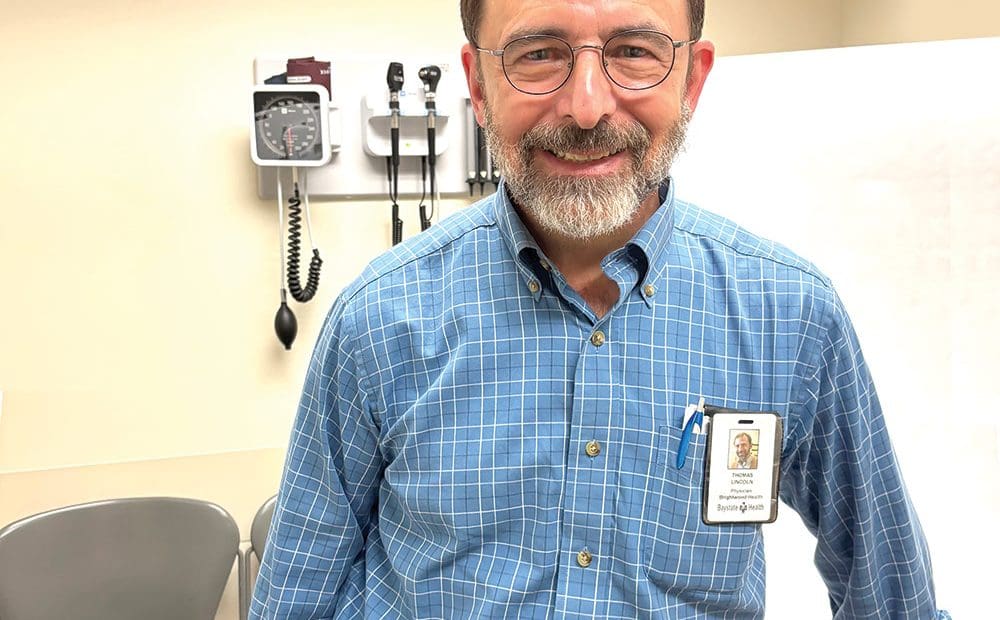
Dr. Thomas Lincoln
Lifetime Achievement
Physician and Associate Professor of Medicine, Baystate Health
He’s Pioneered an Innovative Model of Care for the Incarcerated
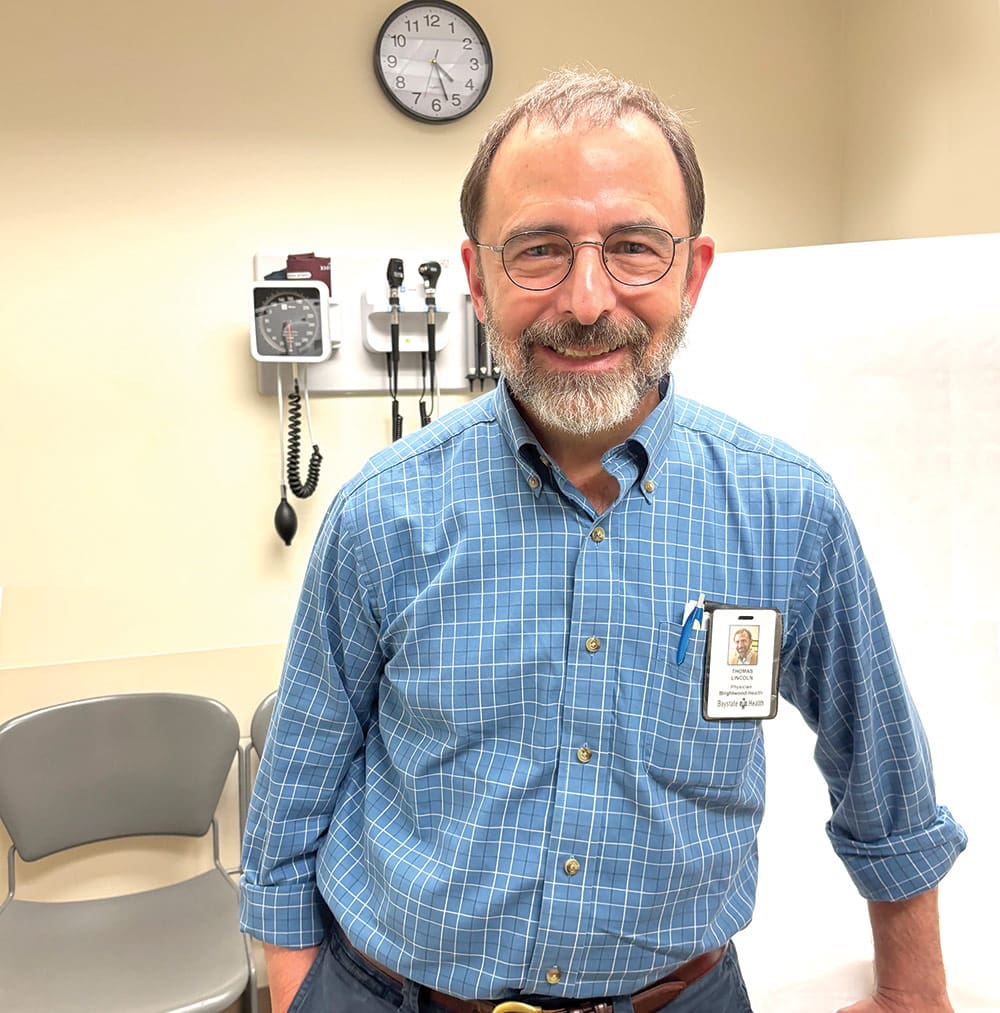
Dr. Thomas Lincoln
Passion. Empathy. Compassion. Leadership. Optimism.
Keisha Williams says these are just some of the qualities that Dr. Thomas Lincoln brings to his groundbreaking work every day.
“He’s very passionate about this population,” said Williams, responsible health authority and director of Nursing for the Hampden County Sheriff’s Office, who has worked with Lincoln for more than 25 years now as he has devoted much of his career to improving access to care for those impacted by incarceration. “He’s accessible, and he’s dedicated; there’s nothing he won’t do to assist someone or support someone and provide needed guidance.”
Lincoln, a physician at the Brightwood Community Health Center in Springfield and medical director of the Hampden County Correctional Centers, pioneered an innovative, nationally recognized public health model of healthcare for incarcerated individuals, one that not only ensures high-quality care during incarceration, but also supports a safe and successful transition back to the community — an initiative that has demonstrably improved outcomes and removed barriers to reintegration.
This model and the continuity of care it created has earned Lincoln national accolades, including the W. Lester Henry Award for Diversity and Access to Care from the American College of Physicians and the Armond Start Award for Excellence from the American College of Correctional Physicians. But for Lincoln, the far greater reward is seeing the results achieved by this work; the manner in which it is has become a model for other communities, including Washington, D.C., to emulate; and the gratitude of the inmate population.
“People are very appreciative just to be seen and taken care of in a manner that’s the same as what would be done on the outside,” he noted. “There’s plenty of need — you feel the need, and it feels worthwhile to do this.”
As medical director for Hampden County’s correctional centers, Lincoln cares for patients (inmates) at four facilities across the region, but especially what’s known as the ‘main institution’ in Ludlow, which has a population of approximately 800 men.
He helps treat what Williams describes as an older, sicker inmate population (more on this later) with a focus on all aspects of care, but the especially the HIV population.
“That’s his passion,” said Williams, adding that Lincoln is also medical director of the opioid treatment program.
With the Healthcare Hero award in the Lifetime Achievement category, Lincoln adds some additional recognition for this work not only with the incarcerated, but also with the underserved population that frequents the Baystate Brightwood Health Center in Springfield’s North End, and also for his work as an educator and mentor.
“As a primary care physician at Baystate Brightwood Health Center and associate professor of Medicine at UMass Medical School – Baystate, he has shaped the way care is delivered to underserved and marginalized communities across Western Mass.”
“As a primary care physician at Baystate Brightwood Health Center and associate professor of Medicine at UMass Medical School – Baystate, he has shaped the way care is delivered to underserved and marginalized communities across Western Mass.,” said Dr. Audrey Guhn, medical director of Brightwood Health Center. “His dedication to those who are too often overlooked by traditional healthcare systems makes him not only a role model, but a true Healthcare Hero.”
Impact Statement
When it comes to the Healthcare Heroes program and the many categories created to recognize the contributions of individual honorees, Lincoln checks essentially every box BusinessWest has created.
Indeed, he’s a provider and administrator, but also an educator, innovator, and collaborator with a strong focus on community. And because he’s been doing all this for decades now, he’s being honored in the Lifetime Achievement category.

Dr. Thomas Lincoln (center) with Hampden County Sheriff Nick Cocchi and Keisha Williams, responsible health authority and director of Nursing for the Hampden County Sheriff’s Office.
His story is somewhat similar to that of the 2024 honoree in this category, Dr. Andrew Balder, attending physician at Baystate Mason Square Neighborhood Health Center, who has also worked tirelessly on behalf of the underserved, with a specific focus focused on the homeless population and infant mortality, child maternal health, and birth outcomes. Yet, their careers have taken different, but equally impactful, paths.
Lincoln’s story begins in Concord, Mass., where he was drawn to science and eventually majored in physics in college before getting into research (geriatrics and cardiology) at Beth Israel in Boston.
“I decided I wanted to get into the people-based side of healthcare,” he said, adding that he enrolled at what is now UMass Chan Medical School in Worcester in 1983, with the goal of eventually getting into family medicine or emergency medicine, a path inspired in part by work as an EMT while in college.
He met his wife in medical school, and when she came to Baystate Medical Center to practice pediatrics, Lincoln, who was a year behind her in school, eventually followed her to Springfield, choosing internal medicine over pediatrics.
“I was interested in community health and work at a community health center,” he told BusinessWest, adding that he eventually landed at the Brightwood facility after his residency and has made it his career.
Sort of.
Starting in the early ’90s, his focus shifted to work at the county’s correctional facilities, where he now spends five days a week, a career path inspired in large part by the rise of HIV and the medication to treat it, AZT.
“Folks would disappear for a few months, come back not on medication, and we’d find out that they’d been in jail,” recalled Lincoln, who became interested in HIV care following a rotation at San Francisco’s Ward 86 HIV Clinic, the epicenter of the AIDS crisis, while in medical school. “And with all the stigma and everything, they wouldn’t tell health services — they wouldn’t tell anyone — about their HIV until they got back out of jail and came in for healthcare.”
This reality prompted officials at the Brightwood facility and the former York Street Jail in Springfield to create a type of outreach program to provide HIV care in the jail.
Lincoln, who was one of those providing such care, recalled that, early on, it was mostly emergency room physicians working after hours administering care to inmates, and over time, it was determined that, instead of this episodic, urgent care model, a primary care model would be more appropriate and provide more continuity with follow-up after patients were released from prison at area health centers.
This would become what’s known as the Hampden County public health model for correctional healthcare.
“Folks would disappear for a few months, come back not on medication, and we’d find out that they’d been in jail. And with all the stigma and everything, they wouldn’t tell health services — they wouldn’t tell anyone — about their HIV until they got back out of jail and came in for healthcare.”
Today, four area health centers — the Brightwood, Mason Square, and Southwest clinics in Springfield and Holyoke Health Center — are involved in providing this model of care to those who are incarcerated, with designated teams comprised of physicians from those facilities working with a primary nurse practitioner or physician assistant who works full-time at the jail, as well as a case manager and primary nurse.
“When people arrive at the jail, we divide them up by what neighborhood they’re from or where they’re going for their healthcare,” Lincoln explained. “They are assigned to a team; a primary nurse would follow up from the time they’re there, and a physician comes in once a week to see people. It’s primary care.”
And it continues after the individual is released from jail, he went on, adding that this continuity of care is critical for a population battling issues such as addiction, other mental health issues, hepatitis C, HIV, hypertension, diabetes, and often chronic injuries.

Dr. Thomas Lincoln says Hampden County’s primary are model for incarcerated individuals has been adopted by several other communities.
Williams agreed. “We would start the discharge planning with that team model so that, when that patient went back out into the community, their plan would be seamless, and there would be a continuity of care,” she explained. “Building that relationship with the community provider while they were on the inside would only help them return to the community and feel confident with the same provider outside.”
Innovative Model
Measuring the success of this program is somewhat difficult due to a lack of research on this population, but Lincoln believes it is certainly making a difference.
“Follow-up is a big marker — if someone’s following up, that’s generally a marker for better health,” he said, adding that, while hard evidence is difficult to come by, he believes the program is yielding results with everything from reduced ER visits after release to improved overall health.
Williams agreed, noting that the primary care model is certainly needed at a time when the inmate population is both older and sicker — and in need of such continuity of care.
“People are sicker coming to jail,” she said. “There’s a dynamic where there’s heighted mental health problems in the community, and with these problems comes substance abuse issues, as well as not taking care of existing conditions such as diabetes, hypertension, and liver disease associated with alcohol use, so people are coming to jail sicker than they have in the past.
“And there’s also an aging population,” she went on. “The patients we’re seeing now … we have fewer numbers, but we have more co-morbidity and more acuity; we have people in their 70s coming to jail.”
Meanwhile, one measure of success is the number of communities that have adapted the model, or aspects of it, for their correctional systems.
“The biggest adaptation and use of the model is Washington, D.C.,” Lincoln explained, adding that the Robert Wood Johnson Foundation provides funding for a nonprofit to promulgate the model and provide technical assistance. “There’s a large community health center system, and they adapted this there for the District of Columbia jail, and they actually dedicated a health center as a re-entry health site.
“Other community health centers, other spots in the country have looked at this and decided to do similar things; it very much lends itself to the smaller location, where the jail and the community health center serve the same population,” he added, noting that representatives of several communities and correctional facilities in states ranging from Florida to Michigan have come to Ludlow to watch, listen, and learn.
Beyond his work with those who are incarcerated, Lincoln is making a difference as an educator and mentor of young people looking to follow his lead and make their mark in healthcare.
“In addition to his clinical leadership, Dr. Lincoln is a passionate educator and mentor who has guided countless medical students, residents, and early-career physicians,” Guhn said. “His commitment to reaching the next generation of caregivers to serve with empathy, humility, and cultural competence has had a lasting impact not only on individual careers, but also on the broader field of internal medicine.”
Williams said one of the best testimonials to all that Lincoln brings to his work and the community is a scholarship that bears his name, one she pushed hard to create.
“It’s awarded to a medical staff member who is looking to further their education, and it talks about what he exemplifies, his moral principles, optimism, integrity, honesty, and respect for human dignity. It’s given to a person who epitomizes all that he stands for, and it’s my honor every year to talk about it.”
That’s a fitting tribute to someone who is called a pioneer, innovator, passionate care provider, and now … Healthcare Hero.