
Exhibit Tells the Nation’s Story Through Illustration
Norman Rockwell Museum
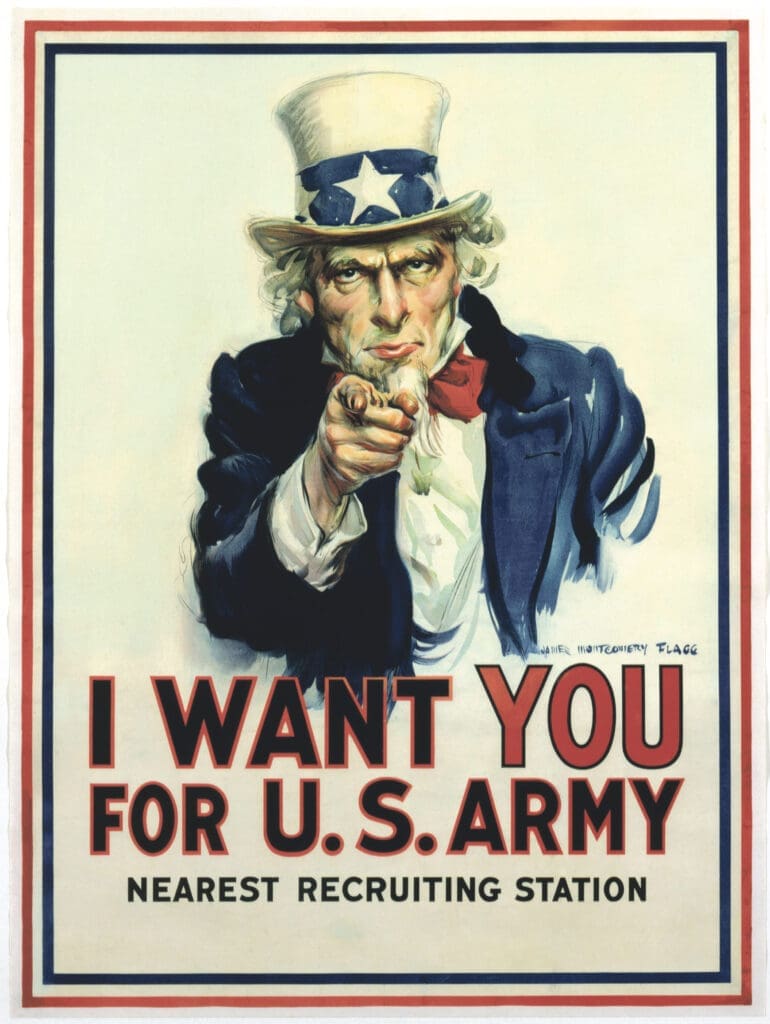
“American Stories, from Revolution to Rockwell” includes James Montgomery Flagg’s “I Want You for U.S. Army” (1917, chromolithograph on paper, private collection).
Russell Lord says planning for the nation’s 250th birthday at the Norman Rockwell Museum in Stockbridge began several years ago, and kicked into a higher gear when he arrived as chief of Curatorial Affairs in late 2024. Eventually, a mission emerged.
“As a museum devoted to not only Norman Rockwell, but also the history of illustration, we felt like we had something unique to offer at this moment in time,” Lord said. “Also, we understood that it might be somewhat expected of us to do something because Norman Rockwell is so closely associated with American identity and this vision of America.
“We wanted to both embrace what people expected of us and also add a little bit of the unexpected,” he went on, adding that both will come together in “American Stories, from Revolution to Rockwell,” which explores how artists from the Revolutionary era to the present “shared the ideals and evolving story of the United States in pictures and captured the American imagination in the process.”
Organized around a series of thematic chapters — including industry and innovation, immigration, the Civil Rights Movement, and civic life — that cut across time periods, the special exhibit, which runs from June 6 to Oct. 26, will bring together a wide range of works. These include illustrations, textiles, ceramics, paintings, prints, drawings, books, posters, advertisements, and digital media, from the nation’s founding to the present day, with each object telling a story.
“The United States is young enough to have its entire history extensively illustrated,” Lord said, noting that early works by engravers such as Paul Revere and Benjamin Franklin issue calls for unity against, and independence from, an oppressive monarchy.
“In the 19th century, artists served as visual journalists, entertainers, and advocates for reform,” he went on. “In the 20th century, illustrators captivated the public with idyllic scenes of American life, while also confronting the realities of racial injustice and political division. Today, in the 21st century, artists continue the legacy — engaging critically with the past and imagining possible futures — circulating images faster and more widely than ever through digital platforms.”
Among the items assembled from the museum’s extensive holdings (some 30,000 works representing 350 illustrators), as well as loans from institutions and private collections worldwide, are James Montgomery Flagg’s “Uncle Sam Wants You for the U.S. Army” and Howard Miller’s “We Can Do It!” posters, as well as Rockwell’s portrayals of American presidents and politicans such as Dwight Eisenhower, John F. Kennedy, Robert F. Kennedy, and Ronald Reagan, said Lord, adding that the goal is to blend some familiar works with others that visitors have likely not seen before.
“Two of the things I wanted to explore with this exhibit are history and myth, which is to say pictures that tell us about the actual history, and then pictures that are so famous — like ‘Uncle Sam Wants You’ — that they’ve taken on this kind of mythical status, and in some ways, that often means we don’t think about them as deeply as we might; we see them, and we say, ‘we’ve seen that, we recognize that.’”
Russell Lord
“As a museum devoted to not only Norman Rockwell, but also the history of illustration, we felt like we had something unique to offer at this moment in time.”

And while the exhibit, which will occupy nearly all of the museum’s exhibition space, was created to celebrate the nation’s 250th birthday, there is another purpose as well, said Lord, adding that the times call for a collection of works that show that this complicated era in the nation’s history is not without precedent.
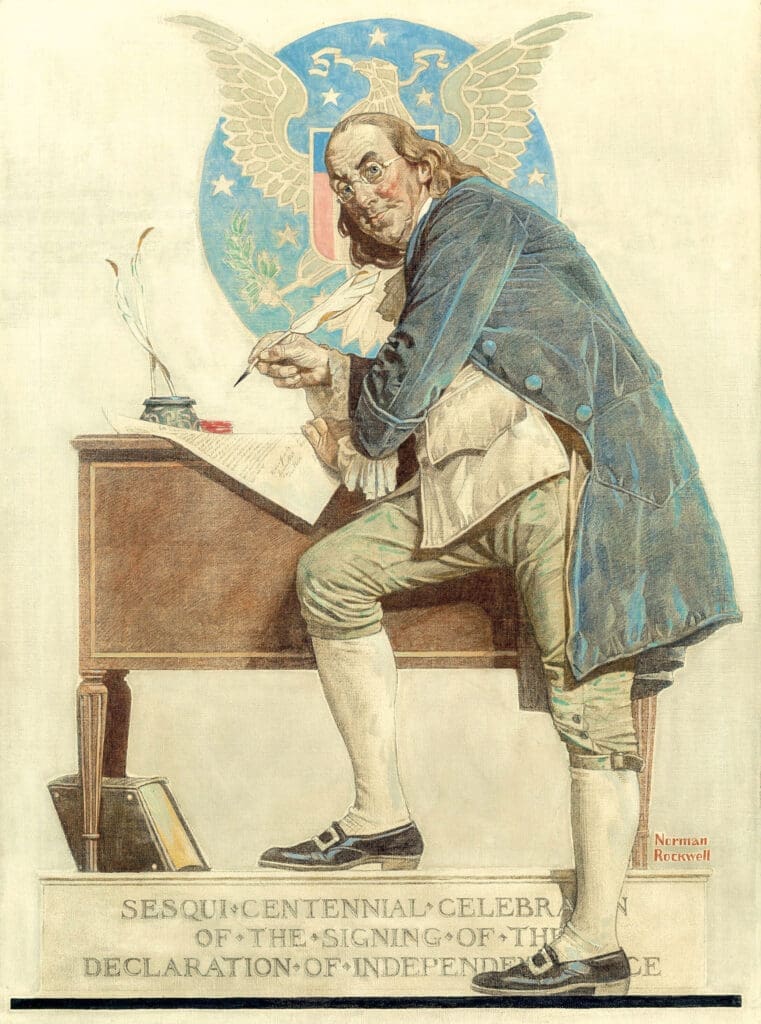
“American Stories, from Revolution to Rockwell” includes, above, Norman Rockwell’s “Ben Franklin’s Sesquicentennial” (cover illustration for the Saturday Evening Post, May 29, 1926),
“When I put together an exhibit, I like to ask the question, ‘why this exhibit now?’” he told BusinessWest. “Obviously, there’s an anniversary, but that’s not the only reason for this to have relevance right now.
“No matter where you sit on the political spectrum, I think everyone would agree that this is a very complicated moment for our own identity in the world,” he went on. “I always like to think that it can be somewhat unsettling to think that this is an unprecedented moment, and I also like to think about how there might be a precedent for this. A lot of the conversations we have today about our own identity in the world — about how other countries view us and how we view ourselves — are not new discussions.”
Image makers have wrestled with many of these identity crises from the very beginning, he continued, adding that this is one of many things he expects visitors will take away from an exhibit that offers both a visual journey through American history and a timely reflection on the enduring power of pictures to shape national identity.
—George O’Brien