
Speculation Abounds as Hampshire College Campus Hits Market
What Comes Next?
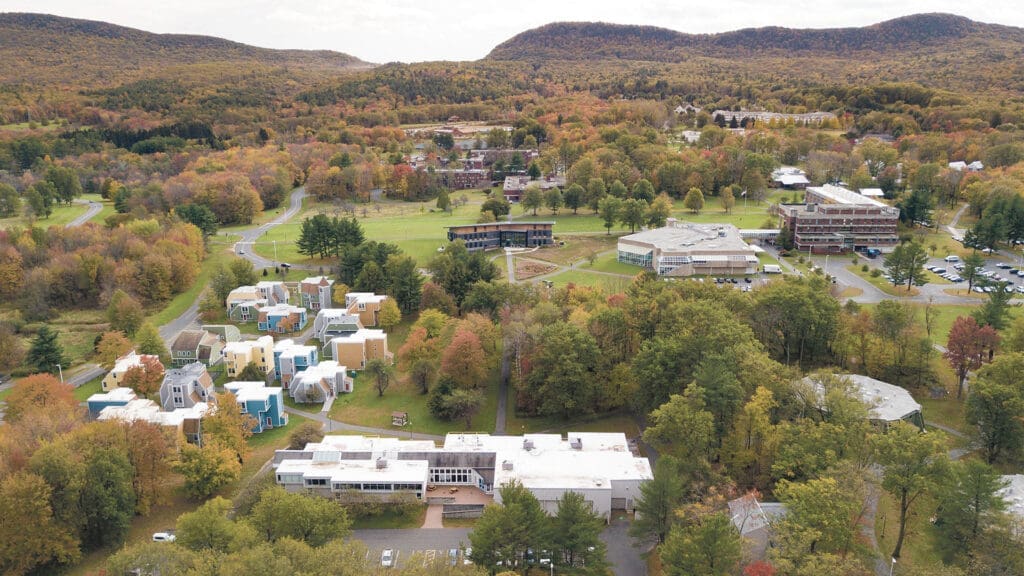
The Hampshire College campus covers roughly 800 acres, and there is already widespread speculation about the many potential future uses of the property.
“Stay tuned. This is going to be fun.”
With that, Barry Roberts, a developer who has reshaped downtown Amherst and handled projects across that college town, summed up what most are thinking about the announced sale of the Hampshire College property.
Elaborating, Roberts said he is expecting this to be an intriguing sale process, and one that could impact this community in many ways depending on who buys the property and what they do with it.
The college announced last month that it was selling the 800-acre campus property to pay off creditors; the school currently carries about $25 million in loans. In response to a series of questions sent to the school by email, a college spokesperson would say only this:
“As part of its transition to closure, Hampshire College is working to sell its land in order to satisfy debt obligations and steward an orderly teach-out process. The college has retained Region as a broker, and the college’s board of trustees is preparing to review any and all offers that enable meeting Hampshire’s fiduciary obligations.”
Region is a West Springfield-based commercial real estate firm led by the father-son team of Mitch and Ben Bolotin (see related story on page 28). Region is preparing a listing for the property, and while it was not available at press time, it was to be available ‘soon,’ according to that college spokesperson.
When asked to speculate about the sale and what might happen with the property, Roberts, who has been involved in retail, housing, and office projects in Amherst, said there has been plenty of talk, and there will be more in the weeks and months to come.
“They would like to get some tax money out of the property, I know that. It will be interesting to see who comes forward and what kind of deal they can work out with Hampshire.”
He told BusinessWest that town officials have expressed interest in “putting the property back on the tax rolls.” Colleges like Hampshire do not pay property taxes, but generally make in-lieu-of-tax payments. Most other uses, other than education and nonprofit initiatives, do pay taxes.
“They would like to get some tax money out of the property, I know that,” he said. “It will be interesting to see who comes forward and what kind of deal they can work out with Hampshire.”
He said there should be ample interest in the property, as there was for a 20-acre strip of Hampshire College-owned land near Atkins Farms that came on the market late last year. Roberts noted that his company submitted a proposal for that property that was under consideration by the school when “the clock ran out,” as he put it, and the college announced it would be closing.
Roberts didn’t want to speculate on whether the campus would be sold as one block or whether it could be subdivided and sold that way. Overall, the site comprises 600 acres in Amherst and 200 in Hadley, he said, but only a few hundred acres are developable, with the rest being wetlands.
And while the development community waits for the listing on the property, there have already been a few proposals forwarded for potential reuse.
One is called Hampshire Next, a coalition comprising alumni, students, families, staff, and community members. Its goal is to raise $21 million by September to retire the college’s bonds and ensure its financial stability.
The initiative’s website explains its mission — “to organize and secure a future where a new expression of Hampshire’s mission can be nurtured under the direct guidance of its community” — and motivation.
“It either stays with the community, or it could become the next data center,” organizers wrote on the site. “If we don’t act, Hampshire’s campus may be used for purposes that have little connection to what Hampshire made possible. Hampshire taught us to think critically, act boldly, and build alternatives. Now we are applying those values to ensure the campus continues to serve Hampshire’s mission through a future that is not yet fixed, but firmly rooted in its purpose.”
“It either stays with the community, or it could become the next data center. If we don’t act, Hampshire’s campus may be used for purposes that have little connection to what Hampshire made possible.“
Another proposal forwarded by Jerome Segal, a philosopher and former candidate for president, calls for a plan to refinance the school’s debt while merging it with his newly created Peace Institute into something that would be called the Advanced Hampshire Institute for Peace, Plain Living, and Conflict Resolution Training.
Whether either of these proposals gains any traction remains to be seen. In the meantime, input from the public will be paramount in the discussions about future uses and what will be permitted there, said Jeff Bagg, Amherst’s director of Planning and Economic Development.
“It’s important for the community to submit their ideas, questions, and concerns,” he said. “Given the size and complexity of the news about Hampshire College closing, the town manager has begun a series of meetings with various stakeholders to understand immediate impacts to students, faculty and staff. We are also taking into consideration the needs of the existing nonprofit organizations and businesses on or adjacent to the college campus,” he noted. “After some of the immediate issues are addressed, the town of Amherst expects to facilitate and be part of broader discussions about future uses of the land.”
As Roberts said, this should be fun. So stay tuned.