Community Spotlight
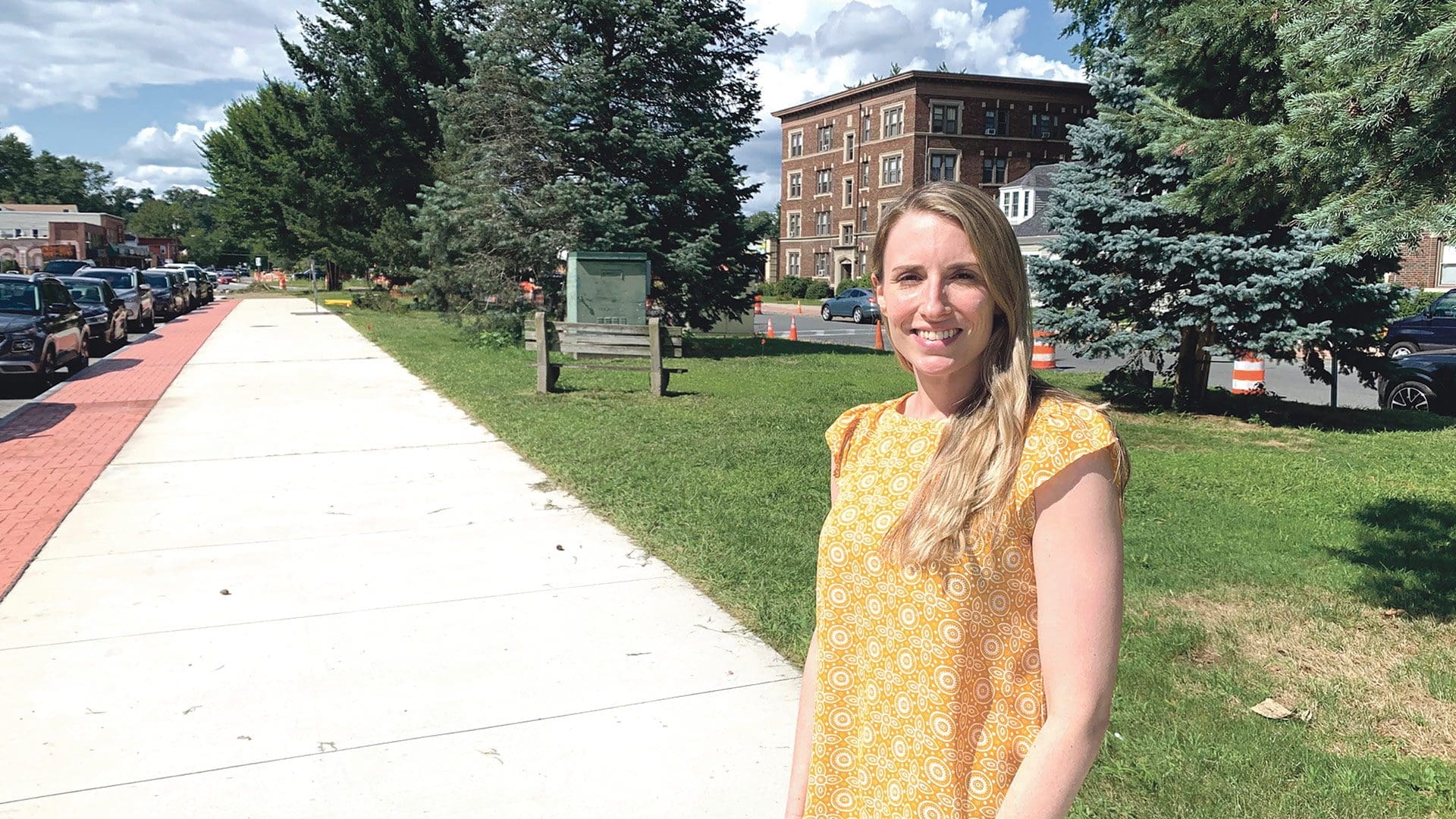
Allyson Manuel, seen here at one of the new sidewalks at the common on Elm Street, says there is renewed vibrancy in the downtown area.
Tyler Saremi calls it “cross-pollination.”
That’s how he chose to describe how the various businesses, government offices, and cultural institutions, especially the Majestic Theater, clustered in the downtown are supporting one another in a way that is bringing new vibrancy to the area and effectively turning back the clock in West Springfield’s central business district.
“It’s nice to see the downtown become a downtown again,” said Saremi, vice president of Saremi LLP, a multi-faceted company that redeveloped the former headquarters for United Bank at 95 Elm St. into Town Commons, a mixed-use facility that includes, on its ground floor, Tandem Bagel and West Side Bar & Grill, two eateries that are drawing more people into the downtown area and effectively extending their stays.
Indeed, more people are now arriving an hour or two before the shows at the Majestic for dinner at some of the eateries in that area, such as the Italian restaurant bNapoli — and, on some nights, especially when there is live entertainment at West Side Bar & Grill, sticking around after the shows.
“It’s fantastic cross-pollination in the downtown right now, and it’s beautiful to see; it’s all working,” he said. “You have people coming to West Side Bar & Grill before a show at the Majestic, and then there are people walking over when we have live music on weekends — they’re walking to their cars from bNapoli, and they’re saying, ‘I saw the music; I just wanted to come in and have a drink.’ Everything is complementing other businesses, and it’s exciting to watch the downtown grow.”
Julie Quink, managing principal with the accounting firm Burkhart Pizzanelli, which has been based in a former elementary school on Park Street for more than 25 years now, has also noticed more energy — and widespread general improvement — in the community’s downtown.
She referenced everything from new businesses like Tandem Bagel and West Side Bar & Grill, as well as comprehensive infrastructure improvements to the roads in the downtown and the signature town common as reasons why the downtown is staging what would be considered a comeback.
“There is a strong need, but there is just not much land that can be developed, and when we do propose something, it’s not welcomed.”
“There are a lot of new businesses, which is good for everyone,” she said. “And there is more vibrancy in the downtown area.”
Mayor Will Reichelt, now in his ninth year in the corner office, said this downtown transformation is just one development the community is celebrating as it also marks its 250th birthday — an ongoing party that has included fireworks, a revitalized Taste of West Springfield, and a 5K, and culminated with a parade on Aug. 24.
Indeed, the town that calls itself a city is also celebrating (if that’s the right word) some important infrastructure projects — on Elm Street, Memorial Avenue, and (soon) on Riverdale Street — that are bringing some inconvenience now but substantial benefits … well, down the road.
Also in the infrastructure category is a long-sought and highly anticipated solution to the rail crossing at Front Street near the border with Agawam — a flyover that will alleviate traffic backups in that area and make it more attractive for economic development (more on that later).
And while there is progress on many fronts, there is less of it in one identified area of need — housing, said Reichelt, noting that, while this community has many assets, an abundance of developable land is not one of them.
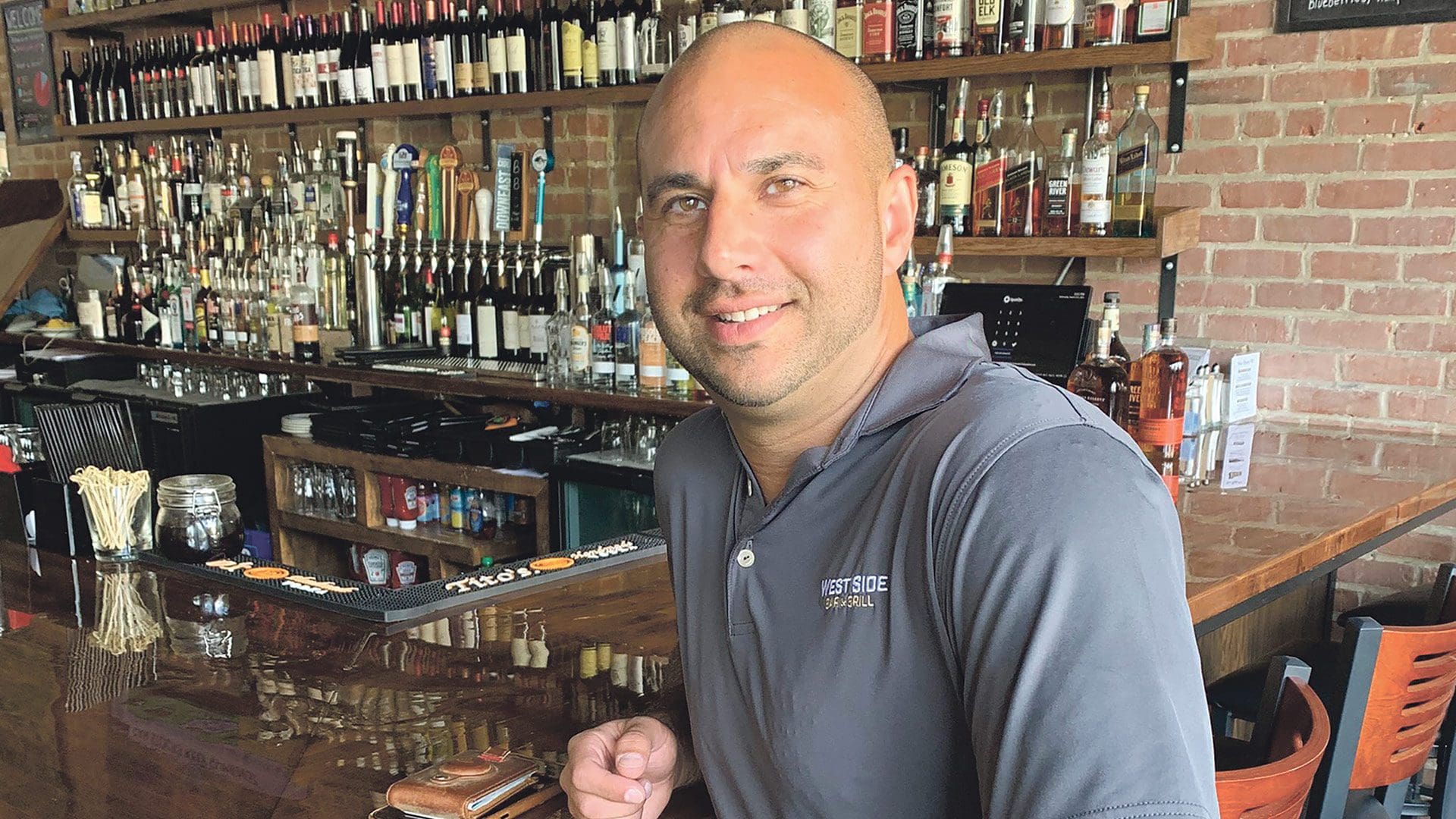
Tyler Saremi sits at the bar at West Side Bar & Grill, one of the many new businesses creating what he calls “cross-pollination” in the downtown.
“There is a strong need, but there is just not much land that can be developed, and when we do propose something, it’s not welcomed,” he said, adding that options are being considered, including very preliminary talks with the owners of the Cinemark theaters on Riverdale about the massive back parking lot, which might be ideal for a public-safety complex and some mixed-use housing.
Still, there are a few housing projects in various stages of development, including a condominium development at the site of a nursery on Piper Cross Road, as well as another project being undertaken by Saremi LLP — redevelopment of a former nursing home on Westfield Street into multi-family housing, most likely of the over-55 variety.
When a Plan Comes Together
As plans for redevelopment of 95 Elm St. were being drawn up, Saremi said, it was viewed as a three-year project.
Instead, it took maybe 18 months to secure tenants to fill the property’s three floors, he explained, adding that the property is now home to a variety of tenants, including the Saremi company, which has several components, including a real-estate arm and a student health-insurance venture; Tandem Bagel and West Side Bar & Grill; Kindred at Home; the Worcester-based Seven Hills Foundation and Affiliates, which has made Westside its Western Mass. hub; and an engineering company.
These businesses are bringing people back to that property to work years after United Bank left, he said, adding that these workers, coupled with those already downtown — there are dozens of businesses along Park and Elm streets, as well as West Springfield’s town offices — have created a critical mass of people that not only support other businesses, but generate more overall vibrancy.
“When the bank took off and left all those offices vacant, it was very quiet in the downtown,” he noted. “Now, I can look out my office window at any time, and there’s people walking around; there’s foot traffic. People are going into Celery Stalk, walking out and eating on the picnic tables he has outside, or they’re going back to the town offices — it’s great to see.”
Quink agreed, and, like Saremi, she said the infrastructure work taking place downtown, which includes a roundabout at the former intersection of Elm and Westfield streets, new sidewalks, new lighting, and considerable work to make the town common more accessible and walkable, have helped make the area more of a destination.
“The mill buildings are sandwiched between the Westfield River and the train tracks, and you have to get over the train tracks to access them right now. So having that alternative access opens them up to a lot of different uses they’re not suitable for now.”
“The city is doing a good job of making the town common more appealing,” she noted. “They have events there, like the Taste of West Springfield and events for veterans; it’s a great asset for the community.
“The construction has been really challenging for some small businesses on Elm Street,” she went on. “But the end result is going to be good; we just have to get through this period.”
As noted earlier, this renewed vibrancy downtown is one of the many emerging storylines in West Springfield. Others include the year-long 250th celebration, which has brought residents and businesses together to mark the past and contemplate the future; a new Chick-fil-A going into the site of the former Friendly’s on Riverdale Street; and, of course, the upcoming 17-day Big E, which will bring more than 1.5 million people to the community, clogging many of its roads, but also providing a huge boost to its many hotels and other hospitality-related businesses (see story on page 15).
There’s also ongoing infrastructure work along the two main commercial arteries — Riverdale Street and Memorial Avenue. With the latter, a project due to be finished in 2026, crews are undertaking underground utility work, said Reichelt, adding that, in the next construction season, concrete work from the Memorial Bridge to the border with Agawam will be completed, along with new curbing and lane reconfigurations.
On Riverdale Street, utility work is also being undertaken, with repaving coming over the next few years, he said, adding that, while it is inconvenient to have both major arteries torn up at the same time, the town will benefit when the projects are completed.
Train of Thought
Then there’s the planned flyover at the rail crossing at Front Street, which will alleviate traffic backups that have been a problem for decades, the mayor said. Announced late last month, the project, which is expected to cost at least $20 million, came about after extensive and sometimes contentious talks between representatives of Agawam and West Springfield, CSX, state transportation officials, and U.S. Rep. Richard Neal.
The fix will not only alleviate traffic tie-ups, but eliminate a public-safety concern, said Reichelt, noting that ambulances now take alternate routes, not knowing if they will be delayed by a parked train.
Allyson Manuel, West Springfield’s town planner, agreed, noting that the flyover will also facilitate economic development in the area, especially with an old mill complex that has sat mostly vacant in part because of accessibility issues created by moving or parked trains.
“The mill buildings are sandwiched between the Westfield River and the train tracks, and you have to get over the train tracks to access them right now,” she said. “So having that alternative access opens them up to a lot of different uses they’re not suitable for now.”
West Springfield at a glance
Year Incorporated: 1774
Population: 28,835
Area: 17.5 square miles
County: Hampden
Residential Tax Rate: $14.81
Commercial Tax Rate: $29.80
Median Household Income: $40,266
Median Family Income: $50,282
Type of Government: Mayor, City Council
Largest Employers: Eversource Energy, Harris Corp., Home Depot, Interim Health Care, Mercy Home Care
* Latest information available
Like almost all communities in the region, West Springfield is in need of more housing, said Manuel, adding that, unlike most of those cities and towns, it does not have much open land on which to build.
Which is why a provision within the $5.16 billion Affordable Homes Act recently signed into law by Gov. Maura Healey, which will allow in-law apartments in all communities, could have a substantial impact in Westside, where they are currently prohibited.
“We’ll be looking at how to regulate that, and we obviously have some work to do on that because they are currently not allowed; it’s a pretty big change,” Manuel said, adding that, in the few weeks since the housing bill was signed, there have been numerous inquiries.
Meanwhile, there are some projects in various stages of development. These include the condo project on Piper Crossing Road; Heartstone Village, a 55+ project off Birnie Avenue, a project that has been years in the making; and preliminary talks concerning repurposing the former Cowing School at the corner of Park and Elm streets for housing, especially senior housing.
There’s also the former nursing home on Westfield Street, which has been vacant for more than 20 years and in recent years had become an eyesore, Saremi said.
“There was an opportunity to acquire it, and we decided to take it on,” he told BusinessWest, using those words to help explain the size and scope of the challenge and the fact that few, if any, were willing to take on this property.
“It was a nightmare cleaning that place out; it was very labor-intensive — crews had to wear full-body suits with respirators,” he said while detailing the level of deterioration of the building. “There were trees growing on the roof. Now, the interior is completely clean, and we’ve had a zone change go through.”
The most common-sense reuse is housing, either affordable or 55+, Saremi said, adding quickly that, while architectural plans are being developed, funding help will be needed from the state or federal government to take what is likely to be a $7 million project off the drawing board and make it reality.
“The cost to build has just skyrocketed,” he said, adding that he is hoping that the housing bill will include funds for projects like this one.
“We’re ready to go,” he said of the project, which would include 51 mostly efficiency and one-bedroom apartments. “We just need some sort of government assistance on the cost to build.”