Home Posts tagged college-town
Community Spotlight Special Coverage

Community Spotlight

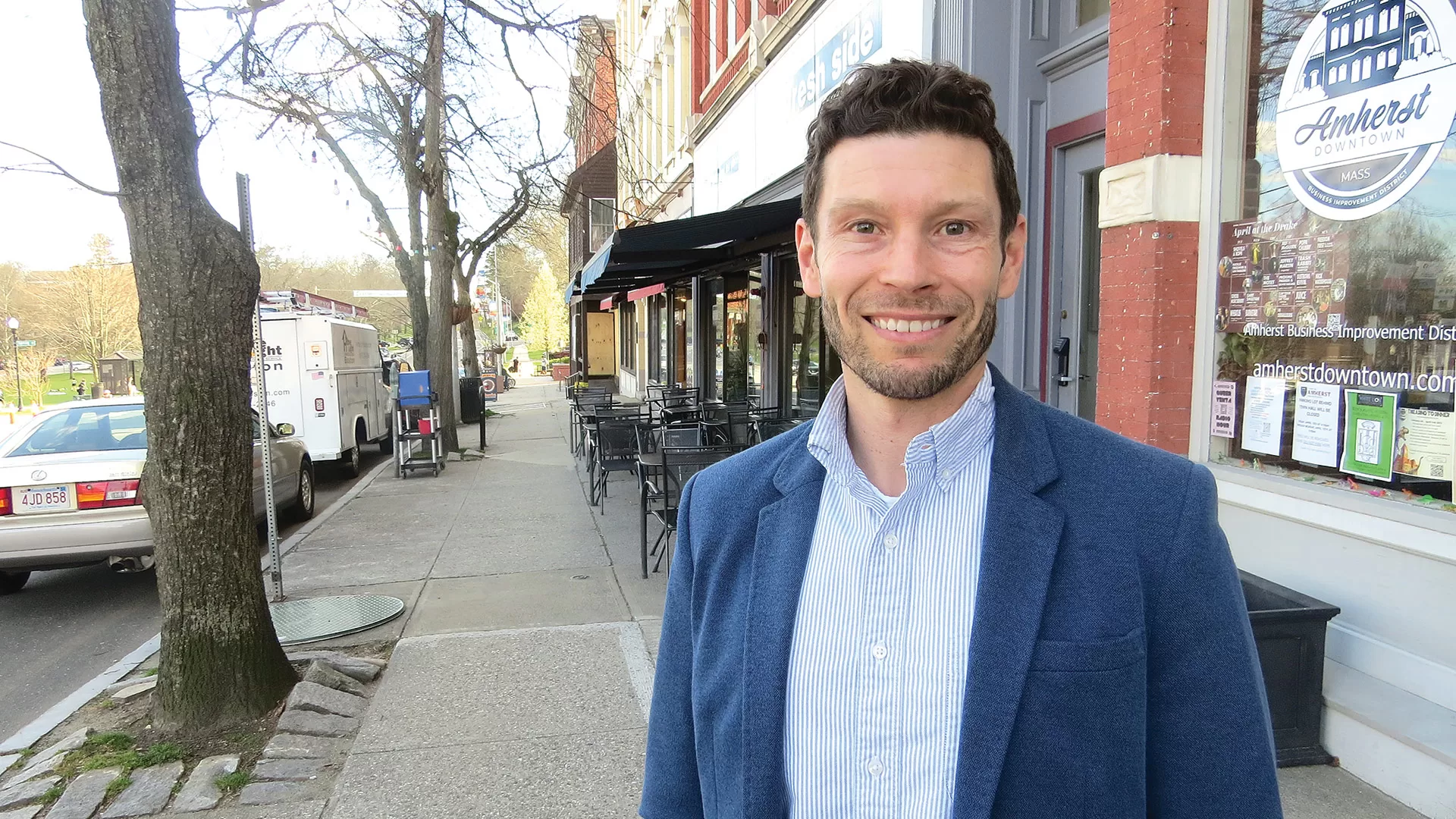
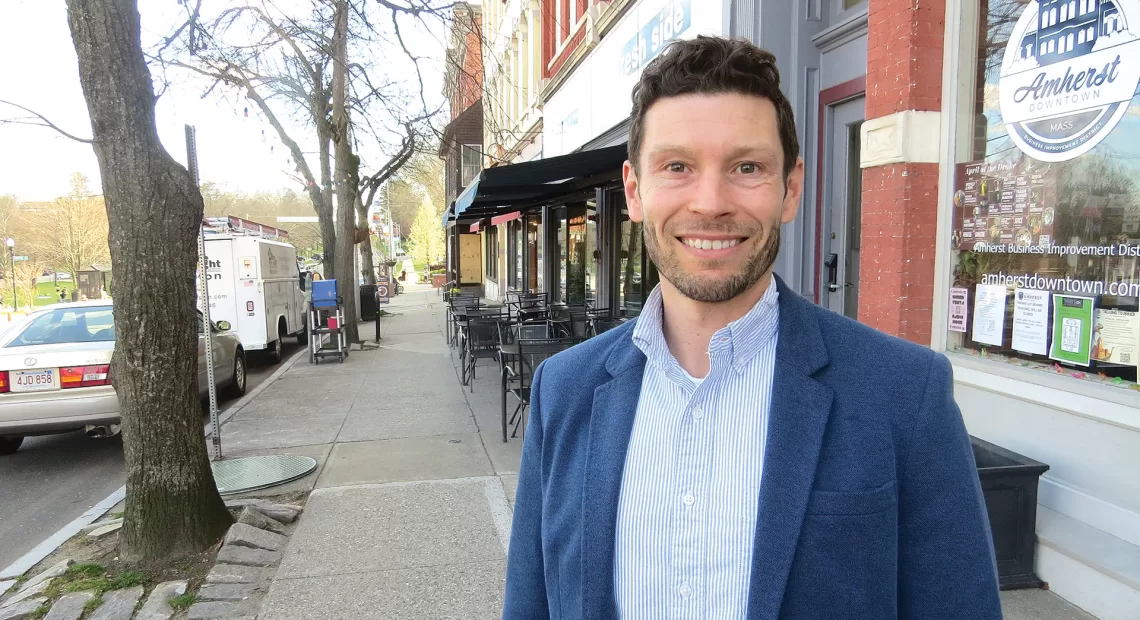
John Page describes Amherst as a “cultural college town.”

John Page describes Amherst as a “cultural college town.”

John Page calls it a ‘retail incubator.’

That’s the unofficial name given to a facility — still very much in the planning stages — designed to bolster retail in downtown Amherst and bring more balance (and more reasons to visit) to an area more known for its arts, culture, and restaurants.

“It’s a small location for retailers — people who are online, they’re artists, they do things at farmers markets — who are not quite ready to make the jump to a brick-and-mortar store, which is high-risk and quite complicated, said Page, executive director of the Amherst Business Improvement District (BID). “We’re hoping to make a half-step, where folks can start to test their concept out and learn more about being a brick-and-mortar retailer.”

The retail incubator (more details to come later this year, he said) is one of myriad initiatives in various stages of development in Amherst — a town where there is almost always a lot happening — that cross a wide spectrum, from housing to education; from new restaurants to new retail. That long list includes:

• A new elementary school that will be 100% carbon-neutral and ready for occupancy in the fall of 2026;

• Several new housing projects that include everything from market-rate apartments to home-ownership opportunities (much more on these later);

• An extensive, $46 million renovation and expansion of the Jones Library;

• A new restaurant, the Amherst Oyster Bar, which will bring much-needed new life to an historically vibrant spot, site of the former Judie’s restaurant on North Pleasant Street;

• An enhanced presence for both UMass Amherst and Amherst College downtown, with UMass Amherst recently opening UMass Downtown, a multi-purpose retail, event, and meeting space on North Pleasant Street, and Amherst College having opened a campus store on South Pleasant Street;

• Conversion of a former VFW post into a homeless shelter and supportive housing for veterans;

• The continued success story that is the Drake, a live-performance venue in the heart of downtown;

• The planned arrival of another cultural attraction downtown — Ancestral Bridges, an organization that celebrates the history of contributions of Black and Afro-Indigenous families in Amherst; and

• A reimagining of the space called North Common, a former a parking area that has become a popular gathering place downtown.

City officials and business leaders alike are enthusiastic not only about these individual developments, but how they will — and, in many respects, already are — working together to create more foot traffic and vibrancy in the downtown area.

“We’re between Boston and New York, and in such an academically driven area, you get a lot of people from those areas, and they’re looking for something they expect from a city vibe. That’s certainly new to Amherst, but that’s the direction we want to push things in.”

Indeed, the new housing units are bringing more residents to support the full spectrum of businesses downtown, said Page, adding that cultural attractions like the Drake and Amherst Cinema are bringing people to restaurants and bars before and after shows. Meanwhile, new retail, like Aster & Pine Market and the two college stores, are broadening the mix of things to do and reasons to come to the downtown.

“We have a lot of housing in our downtown, and that’s been very helpful to us because we have more people; those people go out to lunch and for coffee, and they spend money,” said Page, who referred to Amherst as a “cultural college town.”
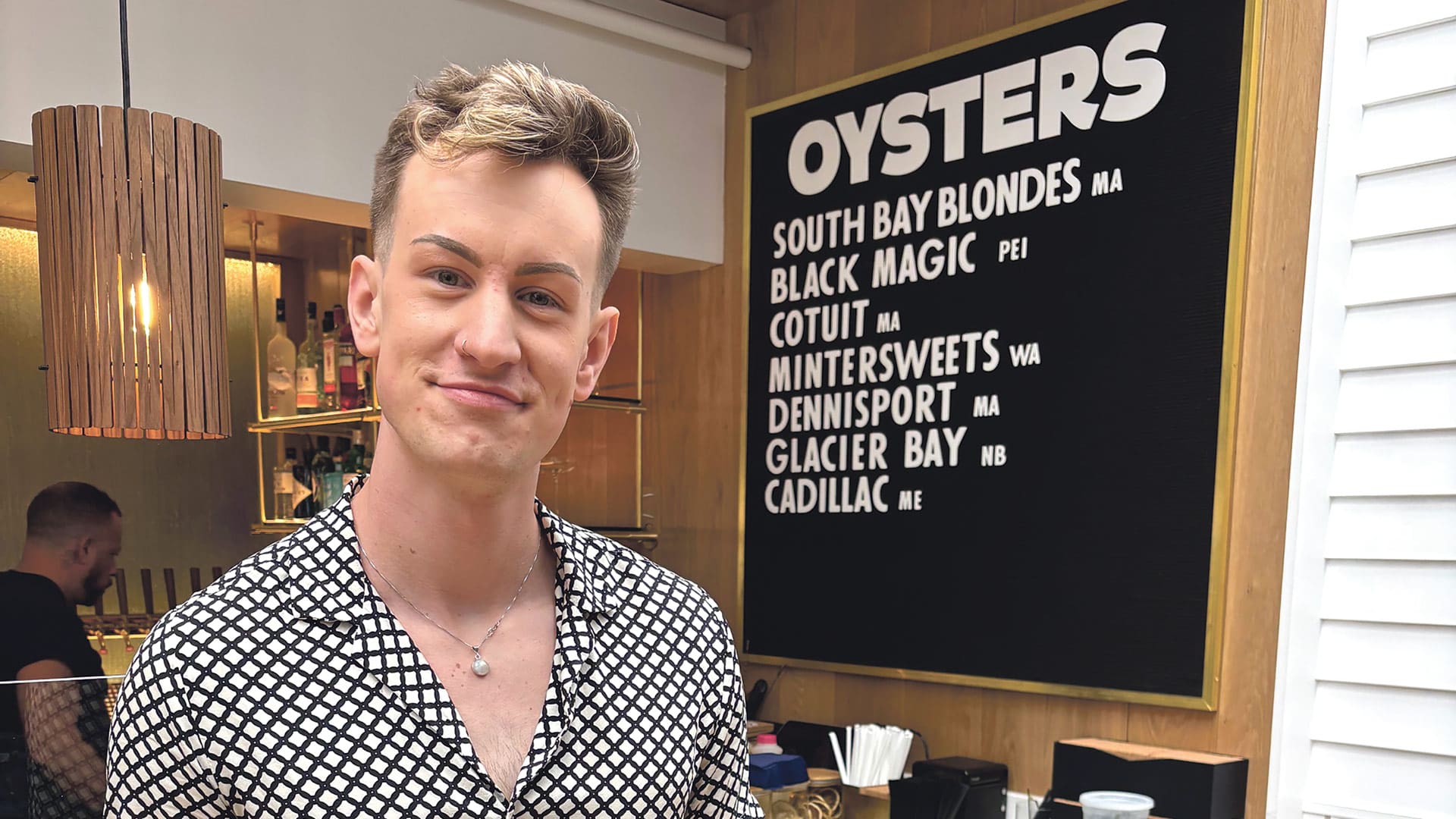
Alden Peotter shows off the recently opened Amherst Oyster Bar.

Alden Peotter shows off the recently opened Amherst Oyster Bar.

“Meanwhile, with Amherst Cinema and the Drake, we encourage people to enjoy a meal before or after, or maybe a cocktail, so that there is that stickiness — people linger and enjoy the downtown.”

Paul Bockelman, Amherst’s long-time town manager, agreed.

“The Drake, along with the Amherst Cinema, has made a huge impact in bringing people downtown to live events,” he said. “And once they’re there, they stay and they support other businesses.”

As for the Oyster Bar, it has been a long time coming. Its grand opening had been pushed back so many times that the eventual date, April 1, was taken by some as an April Fools joke, said Alden Peotter, operations manager for Amherst Innovative Hospitality, which also operates the nearby Protocol bar and restaurant.

He spoke with BusinessWest the day after a soft opening late last month, and said that both the Oyster Bar and Protocol, which opened as a bar but has evolved into a popular restaurant drawing people of all ages, provide what he called a “metropolitan vibe,” something he believes young people, and some not so young, are looking for.

“We’re between Boston and New York, and in such an academically driven area, you get a lot of people from those areas, and they’re looking for something they expect from a city vibe,” he said. “That’s certainly new to Amherst, but that’s the direction we want to push things in.”

For this, the latest installment of its Community Spotlight series, BusinessWest looks at the many forms of development and progress in Amherst, a college town that is so much more.


Building Momentum

For Page, who took the helm at the BID last October, his new job is a return to downtown Amherst.

Indeed, he worked at the Amherst Regional Chamber of Commerce, which shares space with the BID in an office on South Pleasant Street, handing marketing and membership, before taking a job at UMass Amherst working on large events like commencement.

“I wanted to get back involved with the town of Amherst and all that was happening downtown,” he said, adding that he was inspired to seek the BID job after doing consulting work for the agency on its summer concert series.

“It reignited my passion for that economic-development work,” he said, adding that, since arriving, he’s continued the BID’s work in tandem with the chamber to promote the downtown and generate more vibrancy in the central business district, which has made a nice recovery after being devastated by COVID — but with changes.

Indeed, while food and beverage taxes are exceeding 2019 levels, there are still fewer people going out, overall, with restaurants still doing strong takeout business. One goal — at the BID, the chamber, and with new destinations like the Oyster Bar and Protocol — is to get them back out.

Amherst at a Glance

Year Incorporated: 1759
Population: 39,263
Area: 27.7 square miles
County: Hampshire
Residential Tax Rate: $17.82
Commercial Tax Rate: $17.82
Median Household Income: $48,059
Median Family Income: $96,005
Type of Government: Town Council, Town Manager
Largest Employers: UMass Amherst; Amherst College; Hampshire College
* Latest information available

“Our real view on downtown Amherst is promoting not just nightlife, but getting people out of their house, getting people to form these communities that have really been missing due to COVID and what came after; we want to give them that location,” said Peotter, who described both establishments as “that third place.” By that, he meant it’s not home, and it’s not work — “it’s another place to be.”

Page said one of his focal points is what would be considered traditional, brick-and-mortar retail. The downtown has some, he said, and the goal is attract more, while also retaining what exists, through initiatives like the planned retail incubator, a site for which has yet to be determined.

“It’s a difficult industry,” he said, adding that Amherst is not known as a retail destination, but could become one. “You need critical mass — you need other retailers so that people view you as a shopping destination.”

Jacob Robinson, executive director of the Amherst Area Chamber of Commerce, agreed.

“Fortunately, downtown Amherst isn’t experiencing a significant vacancy issue, but there’s strong interest in attracting more retail to diversify the mix of businesses and further enhance the pedestrian experience,” he said.

“Of course, retail-space turnover is a normal and expected part of any dynamic downtown. As business owners retire, pivot, or evolve their offerings, it naturally creates opportunities for new entrepreneurs to bring fresh ideas and energy into the community. We’re seeing that play out in Amherst, with some beloved businesses closing for personal or planned reasons — often after years or decades of serving the community — and new ventures preparing to take their place. It’s a sign of a living, breathing local economy that continues to adapt and grow.”

Among the relatively new retail offerings are the Amherst College Store, which opened a year ago in the former A.J. Hastings space at 45 South Pleasant St., and UMass Downtown, which opened its doors in February at 108 North Pleasant St., in space most recently occupied by Greenfield Savings Bank.

The latter is a multi-purpose retail, event, and meeting space, said Nancy Buffone, associate vice chancellor of University Relations, who spoke with BusinessWest at the facility.

She said a downtown presence for the university has been talked about for many years, and it became a priority for Chancellor Javier Reyes when he arrived in 2023.

“This is truly about bringing UMass and the community together,” she said, adding that the facility will host both UMass events, such as lectures slated for this spring, and community events, such as registration for the Big Brothers Big Sisters Daffodil Run.

UMass Downtown has seen steady volumes of foot traffic, said Buffone, adding the numbers are expected to move higher as the weather improves and especially for commencement week and ‘destination days,’ when those students who have been accepted to the university, and their parents, are invited to take in the school and the town.


Developing Stories

Bockelman calls it the “mixing middle.”

He was referring to the broad segment of housing involving homeownership opportunities for segments of the population that might otherwise not break that barrier. This middle area is being addressed in a project on Ball Lane, undertaken by Valley Community Development Corp.

“We’re seeing a lot of apartments being built, but what has been largely missing has been homeownership opportunities, which is why the Ball Lane project is so exciting,” he told BusinessWest, adding that plans call for 30 units on an eight-acre tract.

The project is one of many housing initiatives, public and private, in various stages of development in town, and they address a critical need for new housing.

Other projects include two public projects totaling 78 apartments, 31 at the former East Street School and 47 at 70 Belchertown Road, said Bockelman, noting that these will be a mix, with varying levels of affordability. The developer, Way Finders, expects to have both sites developed and occupied by 2028.

On the private side, developer Barry Roberts is forwarding two projects, a large (but scaled-down) initiative at the corner of Amity Street and University Drive that will involve retail on the ground floor and apartments above, and the other at the former Hastings site. Meanwhile, Archipelago Investments LLC is set to break ground on a five-story, 68-unit project at Olympia Drive, a dorm-like building that will rise on the site of the former Iota Beta chapter of the Chi Omega sorority, which Archipelago acquired several years ago.

Archipelago has also been named designated developer for a project to create 140 residential units on a large tract of land owned by Hampshire College, adjacent to Atkins Farms.

These projects and others in different stages of development will make a large dent in the overall need for housing across the spectrum, said Bockelman, adding that such projects are needed to help seniors stay in town, young professionals to move there, and employees at many types of businesses, especially the hospitality sector, to afford to live in town.

Robinson agreed. “Housing remains a key issue,” he told BusinessWest. “While Amherst is actively exploring strategies to create more diverse and affordable housing options, it’s clear that housing supply directly affects workforce retention, talent attraction, and the overall economic vibrancy of the region. Our businesses need access to a stable workforce, and that depends in part on people being able to afford to live and thrive here.”

 

Opinion

Opinon

By James E. Samels, Arlene L. Lieberman, Michael Moriarty, and Jacob Brewer


Long before bowl games and Sweet Sixteens, college towns celebrated their venerable roots at places like Harvard in Cambridge; Yale in New Haven, Conn., and Princeton in Princeton, N.J. Consider the proliferation of neoclassical destination college towns across America over the last century — campuses like Amherst, Boulder, Champagne, Durham, Ithaca, Madison, etc.

Destination college towns typically attract students, faculty, families, and year-round visitors because they offer something for everyone. Destination college towns may be small, yet they thrive — with great public schools and prep schools, vibrant downtowns, family discovery centers and tourist attractions, upscale amenities, on-campus concerts, charming villages, and safe, walkable neighborhoods.

With a proud history as the largest paper manufacturer in the U.S., the 15 neighborhoods that now make up Holyoke are among the most diverse in the Commonwealth. With a strong Irish and Latinx population, it is no surprise that Holyoke is home to the second-largest St. Patrick’s Day parade in the U.S. and Fiestas Patronales, the region’s largest showcase of Puerto Rican music, cuisine, and culture. Volleyball lovers rejoice as they enter Holyoke, the birthplace of American volleyball and home to the Volleyball Hall of Fame at Holyoke Heritage State Park.

Founded in 1971, OneHolyoke CDC is a community-development organization dedicated to improving housing for Holyoke residents. Since its establishment, the organization has created more than 160 new homes in the Flats, Churchill, and South Holyoke neighborhoods; rehabilitated hundreds of apartments; and provided thousands of home-improvement grants to homeowners through the Neighborhood Improvement Program.

OneHolyoke builds new homes, improves and manages a portfolio of multi-family buildings, and, in partnership with the city, offers loan and grant opportunities to property owners who need to improve their properties. OneHolyoke has a particular focus on the value of home ownership, both for the families it serves and for the social and financial well-being of the city of Holyoke.

OneHolyoke CEO Michael Moriarty’s hope is that “young people will grow up and love being from Holyoke.” That can be difficult for those growing up in poverty, but we (as a community-development corporation) can certainly take the edge off.

There are a lot of good things happening in Holyoke. Housing, residential, and mixed-use win-win partnerships drive non-tuition revenue streams for both college campuses and towns; hence, destination college towns are less dependent on conventional tuition revenue. Both colleges and towns highly value non-tuition revenue from consumer market demand, tourism, retail, entertainment, and auxiliary enterprises.

“As an institution of opportunity, Holyoke Community College sees itself as an economic and workforce-development engine within its region and in the city it calls home,” HCC President George Timmons said. “I am proud to be the fifth president of HCC, and I am committed to the growth of our community through excellence in education, which meets the needs of our citizens and of area businesses. HCC looks forward to the development of creative partnerships and innovative projects to further the needs of the individual to get a job, to get a better job, and to learn how to do the job better, all right here in Holyoke.

“I am confident that Holyoke has numerous opportunities for growth,” Timmons added. “We recognize that a focus on workforce skill development and the encouragement of an entrepreneurial infrastructure can move the city forward. Holyoke is where we are located, college is what we do, and community is who we are.”

To this end, destination college towns deploy underutilized and underleveraged real-estate assets. These high-value assets collateralize off-campus residential growth opportunities and create a downtown renaissance. Beyond downtown, these partnerships build new, intergenerational residential living and learning communities located at underutilized historical homes and buildings.

Towns know that public-school rankings and reputation drive up property values. Thus, destination college towns value highest and best use. This means creative mixed uses like student, faculty, and staff housing; artist lofts; design and media studios; bookstores; cafes; organic bakeries; multi-ethnic bistros; boutiques; gift and memorabilia shops; microbreweries; live entertainment; and bowling, billiards, and axe throwing.

As a practical matter, colleges and universities are among the largest local employers and economic forces that drive downtown redevelopment. These destination college towns ignite active participation in town-gown relations, with school superintendents and municipal officials participating in on-campus events and college officials serving on municipal boards and community organizations.

In the end, destination college towns are built on mutual respect, economic interdependence, and collegial sympatico — the kind of partnerships that are sustainable and impactful in the near future and over the long run.


James E. Samels is president and CEO of the Education Alliance. Arlene L. Lieberman is senior associate of Samels Associates, Attorneys at Law. Michael Moriarty, executive director of One Holyoke, and Jacob Brewer, graduate of the University of Chicago and Alliance Research fellow, are contributors to this article.


Community Spotlight

Community Spotlight

Jacob Robinson

Jacob Robinson took the helm at the Amherst Area Chamber of Commerce earlier this month.

After relocating to Belchertown a few years ago, Jacob Robinson found himself a frequent visitor to nearby Amherst and admits to falling in love with its downtown — as many do.

He confided to BusinessWest that, on more than one occasion, while walking along South Pleasant Street and passing the building that houses the town’s chamber of commerce, business improvement district, and visitors’ center, he thought to himself, “how cool would it be to work in a place like that?”

And now … he gets to answer that question.

Indeed, late last month, Robinson was named executive director of the Amherst Area Chamber of Commerce, and he took the helm on April 1.

“No joke,” he said in reference to his start date, adding that what he likes about the job, and what prompted him to seek it, besides its mailing address, is that it involves high levels of collaboration and the fostering of partnerships, which he believes are personal and professional strengths gained from more than 15 years of work with various nonprofits, most recently the West Roxbury Main Streets program, which he served as director.

“There’s a special energy to this town,” he said when asked what attracted him to the position. “And I wanted to be part of it.”

Robinson’s arrival is one of the many converging storylines in this community, known for its liberal leanings; college-town character; rich mix of museums, restaurants, and other tourism and hospitality businesses; its reputation as a great community to retire to; and a bustling, ever-changing downtown.

“There’s a special energy to this town.”

Others include a nearly $50 million expansion and renovation of the Jones Library; a $2 million renovation of the North Common adjacent to Town Hall; new businesses, such as the Aster & Pine Market, a specialty store, which cut the ceremonial ribbon on April 20; and a number of ongoing residential and mixed-use projects that will address a perpetual need for more housing while also, in many cases, bringing more vibrancy to the downtown.

These include several being developed by the Roberts Group, including a much-anticipated re-imagining of the property (just a few doors down from the chamber) known as the Hastings Building, because it was home to the legandary office-supply store for more than a century, and new construction on adjacent property.

Hastings Building

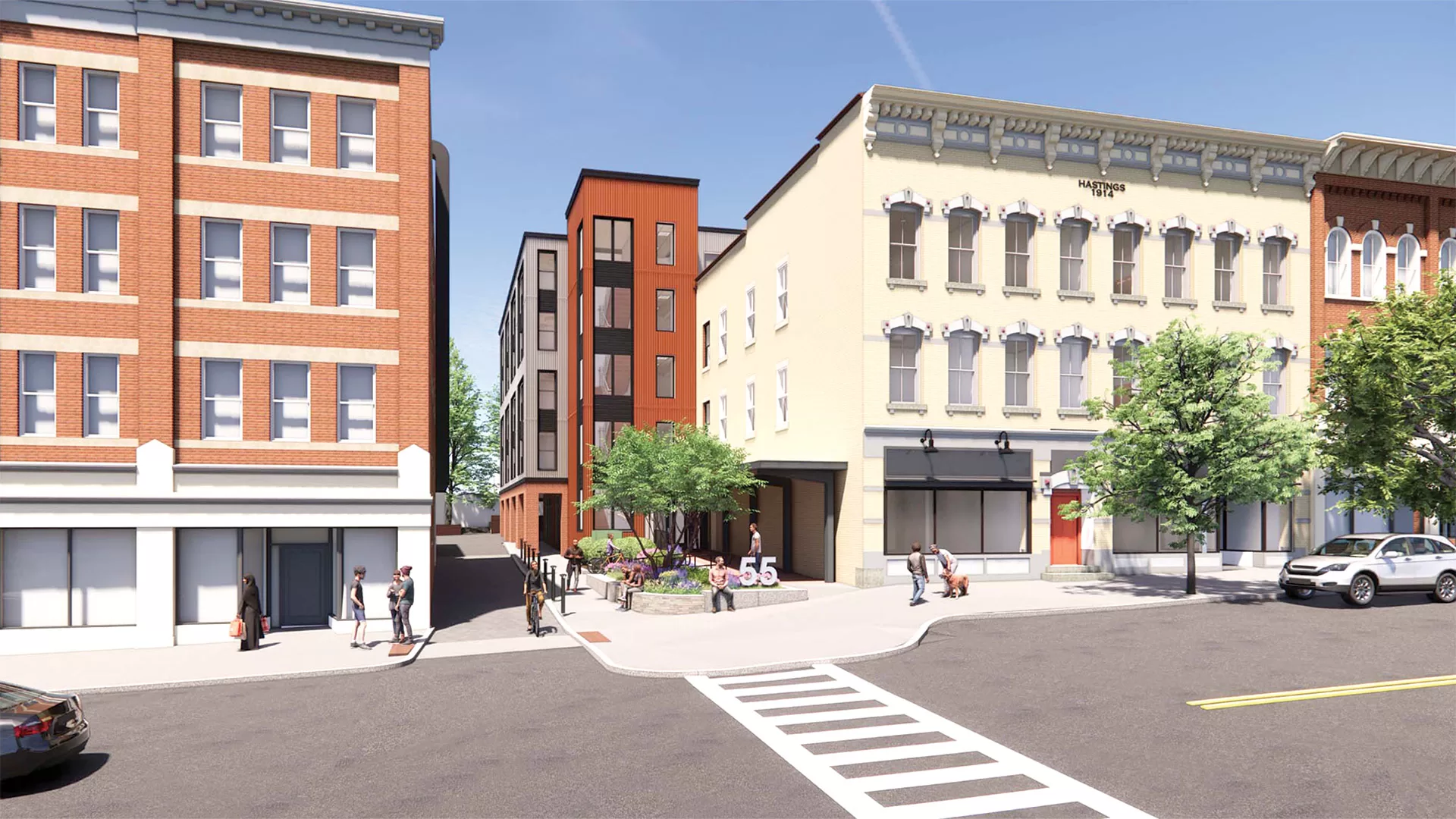
An architect’s rendering of the planned mixed-use development at the Hastings Building and adjoining property on South Pleasant Street.

Barry Roberts, president of the Roberts Group, said plans call for six units of market-rate housing on the upper floors of the Hastings Building and the Amherst College bookstore on the ground floor, with work on the latter already underway, with the goal of that facility being open for commencement. The adjacent 55 South Pleasant St. will be torn down, as well as property that served as cold storage for Hastings, with a five-story property to be built on that site that will feature 16 units of market-rate housing.

Meanwhile, another, much larger project is being planned for the former Rafters sports bar property at the corner of University Drive and Amity Street, most recently home to Pleasantrees, a cannabis dispensary that closed after operating for only a year. The site will be transformed into 85 units of housing in two five-story buildings, as well as retail and office space (more on this later).

There are also some ongoing stories, such as the Drake, the live-event space that brings hundreds of people to the downtown for shows each week; White Lion Brewing Co., located in the same building as the Drake, which is still acclimating to doing business in Amherst six months after opening (more on that later as well); and the largest of these ongoing stories — continued recovery from the pandemic, which devasted a business community that is largely dependent on the students, faculty, staff, alumni, and parents from the surrounding colleges.

For this latest installment of its Community Spotlight series, BusinessWest turns its lens on Amherst, a community that is in a seemingly constant state of motion — and change.


What’s on Tap?

Ray Berry has been in business with White Lion, launched in Springfield, for several years now, but he told BusinessWest that his location in Amherst amounts to a learning experience on several levels, with new lessons every day.

Indeed, he said the intriguing nature of this community — it’s not just a college town, but a three-college town with two more just a few miles away — presents challenges and opportunities that are unique and require some … well, getting used to.

“As a business, we continue to learn from the ebb and flow of the Greater Amherst community; every day is a learning process.”

“As a business, we continue to learn from the ebb and flow of the Greater Amherst community; every day is a learning process,” he said. “Whether it’s the population coming and going or special events in the town, we continue to learn and appreciate; it’s all new to us.

“In Springfield, we have pretty much 24/7, 365-days-a-year activity — there’s plenty of activity, and we don’t have to incorporate the university population that’s close by,” he went on. “But in Amherst, we have to be very mindful of how the university and private-college student activity, and faculty activity, impact the day-to-day business community.”

Elaborating, he said White Lion, now proudly serving Marcus Camby New England IPA, which is especially popular in Amherst, has operated through winter break, spring break, St. Patrick’s Day, March Madness, and other annual happenings, but the learning process will continue when the colleges shut down, or mostly shut down, for the summer and then reopen in September.

Learning these ebbs and flows is part and parcel to doing business in Amherst, noted Robinson, who is on a learning curve himself. Indeed, while already quite familiar with the town, he will now take his knowledge to a much deeper dive, while also getting further acquainted with the other six towns represented by this chamber, all with their own distinct personalities: Belchertown, Hadley, Leverett, Pelham, Shutesbury, and Sunderland.

Since arriving, Robinson has been busy with everything from staging one of the chamber’s signature networking and fundraising events, Margarita Madness, to planning the next events, including After-5s, workshops, and a new-member reception coming up in May, as well as early-stage work to hire a new marketing and events coordinator for the chamber.

“I’ve had to hit the ground running,” he said, adding that the chamber position presented a unique opportunity for him to continue what he calls “community work,” as both a volunteer and a nonprofit leader, most recently with Main Streets program in West Roxbury.

Amherst at a glance

Year Incorporated: 1759
Population: 39,263
Area: 27.7 square miles
County: Hampshire
Residential Tax Rate: $18.51
Commercial Tax Rate: $18.51
Median Household Income: $48,059
Median Family Income: $96,005
Type of Government: Select Board, Town Meeting
Largest Employers: UMass Amherst; Amherst College; Hampshire College
* Latest information available

He was commuting to that job from Belchertown — though also working remotely, to a large degree — when his brother-in-law brought the posting for the executive-director position at the Amherst Area Chamber to his attention. He applied with the intention of enthusiastically taking part in building on what he saw, heard, and experienced during all those visits to downtown Amherst — its restaurants, coffee shops, and theater.

“There is so much charm here; there’s the connection to the universities, the energy that comes from all those students, and the vibrancy of a town that’s connected to the college communities,” he said. “There’s a healthy mix of businesses and services, and that’s very telling of a dynamic and strong community here in downtown Amherst.”


Building Momentum

Long-term, the obvious goals are to continue building partnerships and creating collaborative efforts to promote the community, attract new businesses, and continue the ongoing recovery from the pandemic, which, as noted, hit this community perhaps harder than any other in the region because it shut down the Five Colleges and removed from the business equation tens of thousands of people and countless gatherings, from sporting events to commencements.

“It was very tough on everyone — it was shocking. Who would ever have imagined that the universities and the colleges would be closed for that length of time?” recalled Lisa Johnson, president of Encharter Insurance, the latest name on an Amherst institution that has been around since the late 1800s. “It was shocking to be on the streets and have them be so quiet.

“But the bounceback has been strong even though it took a while before people started coming out again, even the students,” she went on, adding that, perhaps because of the hard lessons learned during the pandemic and its aftermath, she believes the town and its business community are devoting more time and energy to attracting visitors while being slighly less dependent on the colleges.

Which is why she is encouraged by projects like the ones planned for Amity Street and the Hastings Building, initiatives that will bring more residents, but also opportunities for new businesses to settle in the community.

Roberts agreed, telling BusinessWest that, by and large, his ongoing projects are simply taking the names of their street addresses. Like ‘422 Amity.’

This is the the mixed-used project at the old Rafters property, and one that has the potential to change the landscape, in all kinds of ways.

The 85 units of housing will help meet an enormous need in that realm, he said, adding that the complex will bring new retail and new office tenants — and, therefore, more vibrancy — to that area just a few hundred yards from the UMass campus and a few blocks from downtown.

“It will even provide the town with the opportunity to apply for a Community Development Block Grant to put a roundabout at that crazy intersection there,” said Roberts, whose company has been, in a word, busy over the past few years.

Indeed, it has been involved in a number of initiatives, from the Drake project to bringing new tenants to several properties downtown, to another ambitious housing project, this one called 180 Fearing St., or simply One Eighty, which is in its final stages of construction and is fully rented through 2026.

The complex of duplexes features 22 versatile units ranging from studios to four bedrooms, said Roberts, adding that it has succeeded in attracting a wide range of tenants, from students and young families to professionals to retirees, which was the goal when it was put on the drawing board several years ago.

“This is an exciting project, and it has attracted an intriguing mix of tenants that really reflects the Amherst community — students, professionals, and retirees alike,” he said, adding that the same is expected from the project on the Hastings site, as well as another initiative in its early stages: the razing of a building across South Pleasant Street from the Drake — home to the former McMurphy’s bar and the Knights of Columbus — and construction of high-end condos (with accompanying parking) and commercial businesses on the street level.

“We’re still working on getting the permitting,” said Roberts, adding that this hurdle should soon be cleared, and another endeavor to bring more people, and vibrancy, to the downtown will be underway.