

Amherst Is College Town with ‘Metropolitan Vibe’
Community Spotlight

John Page describes Amherst as a “cultural college town.”
John Page calls it a ‘retail incubator.’
That’s the unofficial name given to a facility — still very much in the planning stages — designed to bolster retail in downtown Amherst and bring more balance (and more reasons to visit) to an area more known for its arts, culture, and restaurants.
“It’s a small location for retailers — people who are online, they’re artists, they do things at farmers markets — who are not quite ready to make the jump to a brick-and-mortar store, which is high-risk and quite complicated, said Page, executive director of the Amherst Business Improvement District (BID). “We’re hoping to make a half-step, where folks can start to test their concept out and learn more about being a brick-and-mortar retailer.”
The retail incubator (more details to come later this year, he said) is one of myriad initiatives in various stages of development in Amherst — a town where there is almost always a lot happening — that cross a wide spectrum, from housing to education; from new restaurants to new retail. That long list includes:
• A new elementary school that will be 100% carbon-neutral and ready for occupancy in the fall of 2026;
• Several new housing projects that include everything from market-rate apartments to home-ownership opportunities (much more on these later);
• An extensive, $46 million renovation and expansion of the Jones Library;
• A new restaurant, the Amherst Oyster Bar, which will bring much-needed new life to an historically vibrant spot, site of the former Judie’s restaurant on North Pleasant Street;
• An enhanced presence for both UMass Amherst and Amherst College downtown, with UMass Amherst recently opening UMass Downtown, a multi-purpose retail, event, and meeting space on North Pleasant Street, and Amherst College having opened a campus store on South Pleasant Street;
• Conversion of a former VFW post into a homeless shelter and supportive housing for veterans;
• The continued success story that is the Drake, a live-performance venue in the heart of downtown;
• The planned arrival of another cultural attraction downtown — Ancestral Bridges, an organization that celebrates the history of contributions of Black and Afro-Indigenous families in Amherst; and
• A reimagining of the space called North Common, a former a parking area that has become a popular gathering place downtown.
City officials and business leaders alike are enthusiastic not only about these individual developments, but how they will — and, in many respects, already are — working together to create more foot traffic and vibrancy in the downtown area.
“We’re between Boston and New York, and in such an academically driven area, you get a lot of people from those areas, and they’re looking for something they expect from a city vibe. That’s certainly new to Amherst, but that’s the direction we want to push things in.”
Indeed, the new housing units are bringing more residents to support the full spectrum of businesses downtown, said Page, adding that cultural attractions like the Drake and Amherst Cinema are bringing people to restaurants and bars before and after shows. Meanwhile, new retail, like Aster & Pine Market and the two college stores, are broadening the mix of things to do and reasons to come to the downtown.
“We have a lot of housing in our downtown, and that’s been very helpful to us because we have more people; those people go out to lunch and for coffee, and they spend money,” said Page, who referred to Amherst as a “cultural college town.”
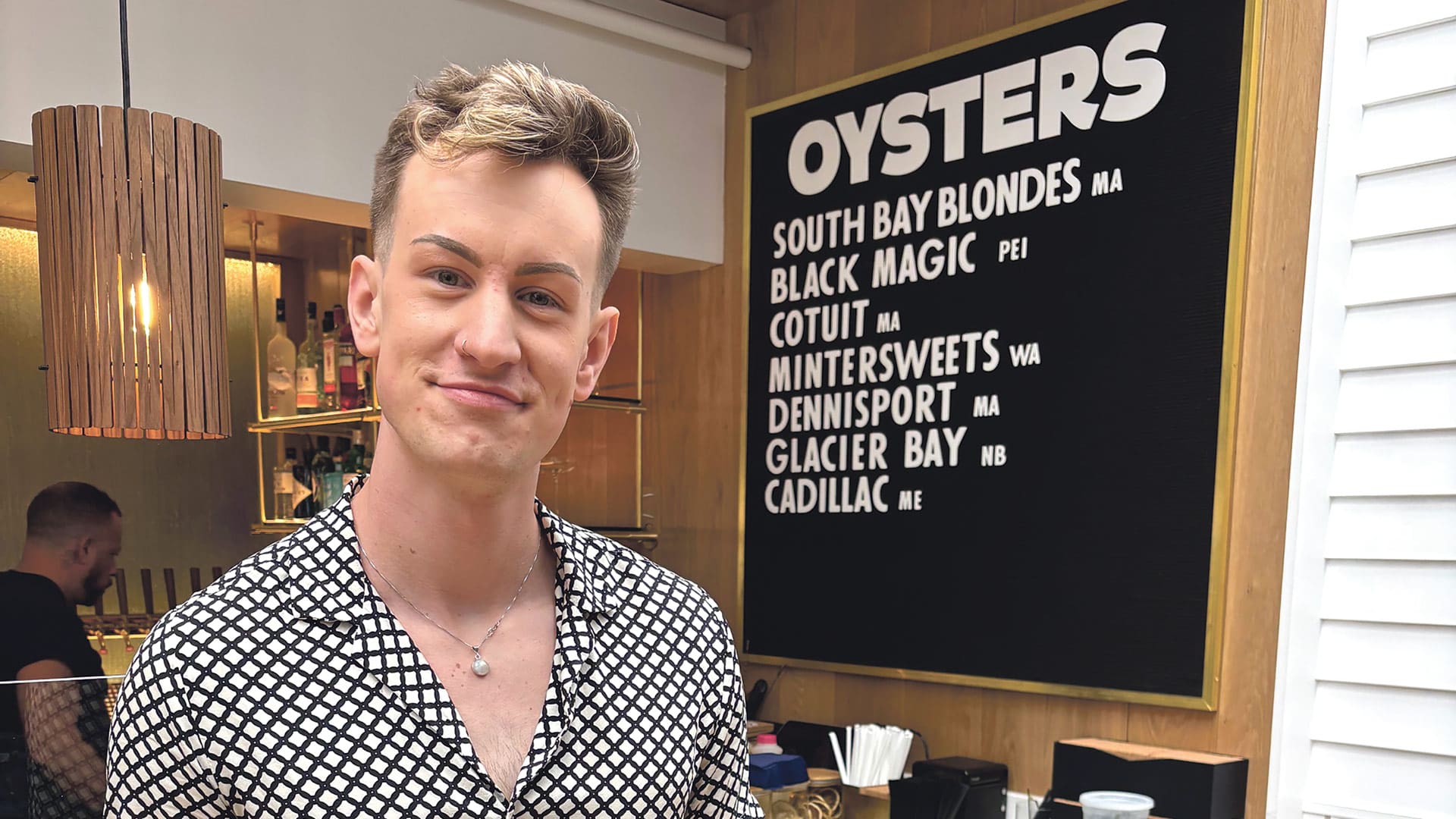
Alden Peotter shows off the recently opened Amherst Oyster Bar.
“Meanwhile, with Amherst Cinema and the Drake, we encourage people to enjoy a meal before or after, or maybe a cocktail, so that there is that stickiness — people linger and enjoy the downtown.”
Paul Bockelman, Amherst’s long-time town manager, agreed.
“The Drake, along with the Amherst Cinema, has made a huge impact in bringing people downtown to live events,” he said. “And once they’re there, they stay and they support other businesses.”
As for the Oyster Bar, it has been a long time coming. Its grand opening had been pushed back so many times that the eventual date, April 1, was taken by some as an April Fools joke, said Alden Peotter, operations manager for Amherst Innovative Hospitality, which also operates the nearby Protocol bar and restaurant.
He spoke with BusinessWest the day after a soft opening late last month, and said that both the Oyster Bar and Protocol, which opened as a bar but has evolved into a popular restaurant drawing people of all ages, provide what he called a “metropolitan vibe,” something he believes young people, and some not so young, are looking for.
“We’re between Boston and New York, and in such an academically driven area, you get a lot of people from those areas, and they’re looking for something they expect from a city vibe,” he said. “That’s certainly new to Amherst, but that’s the direction we want to push things in.”
For this, the latest installment of its Community Spotlight series, BusinessWest looks at the many forms of development and progress in Amherst, a college town that is so much more.
Building Momentum
For Page, who took the helm at the BID last October, his new job is a return to downtown Amherst.
Indeed, he worked at the Amherst Regional Chamber of Commerce, which shares space with the BID in an office on South Pleasant Street, handing marketing and membership, before taking a job at UMass Amherst working on large events like commencement.
“I wanted to get back involved with the town of Amherst and all that was happening downtown,” he said, adding that he was inspired to seek the BID job after doing consulting work for the agency on its summer concert series.
“It reignited my passion for that economic-development work,” he said, adding that, since arriving, he’s continued the BID’s work in tandem with the chamber to promote the downtown and generate more vibrancy in the central business district, which has made a nice recovery after being devastated by COVID — but with changes.
Indeed, while food and beverage taxes are exceeding 2019 levels, there are still fewer people going out, overall, with restaurants still doing strong takeout business. One goal — at the BID, the chamber, and with new destinations like the Oyster Bar and Protocol — is to get them back out.
Amherst at a Glance
Year Incorporated: 1759
Population: 39,263
Area: 27.7 square miles
County: Hampshire
Residential Tax Rate: $17.82
Commercial Tax Rate: $17.82
Median Household Income: $48,059
Median Family Income: $96,005
Type of Government: Town Council, Town Manager
Largest Employers: UMass Amherst; Amherst College; Hampshire College
* Latest information available
“Our real view on downtown Amherst is promoting not just nightlife, but getting people out of their house, getting people to form these communities that have really been missing due to COVID and what came after; we want to give them that location,” said Peotter, who described both establishments as “that third place.” By that, he meant it’s not home, and it’s not work — “it’s another place to be.”
Page said one of his focal points is what would be considered traditional, brick-and-mortar retail. The downtown has some, he said, and the goal is attract more, while also retaining what exists, through initiatives like the planned retail incubator, a site for which has yet to be determined.
“It’s a difficult industry,” he said, adding that Amherst is not known as a retail destination, but could become one. “You need critical mass — you need other retailers so that people view you as a shopping destination.”
Jacob Robinson, executive director of the Amherst Area Chamber of Commerce, agreed.
“Fortunately, downtown Amherst isn’t experiencing a significant vacancy issue, but there’s strong interest in attracting more retail to diversify the mix of businesses and further enhance the pedestrian experience,” he said.
“Of course, retail-space turnover is a normal and expected part of any dynamic downtown. As business owners retire, pivot, or evolve their offerings, it naturally creates opportunities for new entrepreneurs to bring fresh ideas and energy into the community. We’re seeing that play out in Amherst, with some beloved businesses closing for personal or planned reasons — often after years or decades of serving the community — and new ventures preparing to take their place. It’s a sign of a living, breathing local economy that continues to adapt and grow.”
Among the relatively new retail offerings are the Amherst College Store, which opened a year ago in the former A.J. Hastings space at 45 South Pleasant St., and UMass Downtown, which opened its doors in February at 108 North Pleasant St., in space most recently occupied by Greenfield Savings Bank.
The latter is a multi-purpose retail, event, and meeting space, said Nancy Buffone, associate vice chancellor of University Relations, who spoke with BusinessWest at the facility.
She said a downtown presence for the university has been talked about for many years, and it became a priority for Chancellor Javier Reyes when he arrived in 2023.
“This is truly about bringing UMass and the community together,” she said, adding that the facility will host both UMass events, such as lectures slated for this spring, and community events, such as registration for the Big Brothers Big Sisters Daffodil Run.
UMass Downtown has seen steady volumes of foot traffic, said Buffone, adding the numbers are expected to move higher as the weather improves and especially for commencement week and ‘destination days,’ when those students who have been accepted to the university, and their parents, are invited to take in the school and the town.
Developing Stories
Bockelman calls it the “mixing middle.”
He was referring to the broad segment of housing involving homeownership opportunities for segments of the population that might otherwise not break that barrier. This middle area is being addressed in a project on Ball Lane, undertaken by Valley Community Development Corp.
“We’re seeing a lot of apartments being built, but what has been largely missing has been homeownership opportunities, which is why the Ball Lane project is so exciting,” he told BusinessWest, adding that plans call for 30 units on an eight-acre tract.
The project is one of many housing initiatives, public and private, in various stages of development in town, and they address a critical need for new housing.
Other projects include two public projects totaling 78 apartments, 31 at the former East Street School and 47 at 70 Belchertown Road, said Bockelman, noting that these will be a mix, with varying levels of affordability. The developer, Way Finders, expects to have both sites developed and occupied by 2028.
On the private side, developer Barry Roberts is forwarding two projects, a large (but scaled-down) initiative at the corner of Amity Street and University Drive that will involve retail on the ground floor and apartments above, and the other at the former Hastings site. Meanwhile, Archipelago Investments LLC is set to break ground on a five-story, 68-unit project at Olympia Drive, a dorm-like building that will rise on the site of the former Iota Beta chapter of the Chi Omega sorority, which Archipelago acquired several years ago.
Archipelago has also been named designated developer for a project to create 140 residential units on a large tract of land owned by Hampshire College, adjacent to Atkins Farms.
These projects and others in different stages of development will make a large dent in the overall need for housing across the spectrum, said Bockelman, adding that such projects are needed to help seniors stay in town, young professionals to move there, and employees at many types of businesses, especially the hospitality sector, to afford to live in town.
Robinson agreed. “Housing remains a key issue,” he told BusinessWest. “While Amherst is actively exploring strategies to create more diverse and affordable housing options, it’s clear that housing supply directly affects workforce retention, talent attraction, and the overall economic vibrancy of the region. Our businesses need access to a stable workforce, and that depends in part on people being able to afford to live and thrive here.”