
Taking a Big Swing
Ashley Schaffer has a fond memory from summer camp, when she was growing up in Texas.
“They had a big capture the flag event where everyone joined in — the entire camp,” she recalled. “All the adults were playing capture the flag with us, all the administrators, everybody. In my little kid head, it kind of blew my mind.”
So when she turned 40, she decided to do the same thing at her birthday party, inviting everyone she knew to a friend’s farm to play capture the flag.
The venture she and Patrick Roche (her partner in business and life) recently opened — Hatfield Rally House, a tennis and pickleball facility just off I-91 in Hatfield — is kind of like that, Schaffer said. “This is me trying to live that out every single day.”
The idea, she explained, is connection. “I wanted to build something that’s not just tennis, not just pickleball. Everyone has lot of connections; sometimes they overlap, and sometimes they don’t. I love having a party where you can invite everyone you know and see how your different connections who don’t overlap can come together.”
And that coming together — among both friends and teammates who just met — is what she and Roche envisioned at Hatfield Rally House, which also features a café and lounge with big-screen TVs, and land outside to install volleyball and bocce courts when the weather gets warm, and invite food trucks as well. The vision was a place where people would want to hang out after playing — or not even have to play at all.
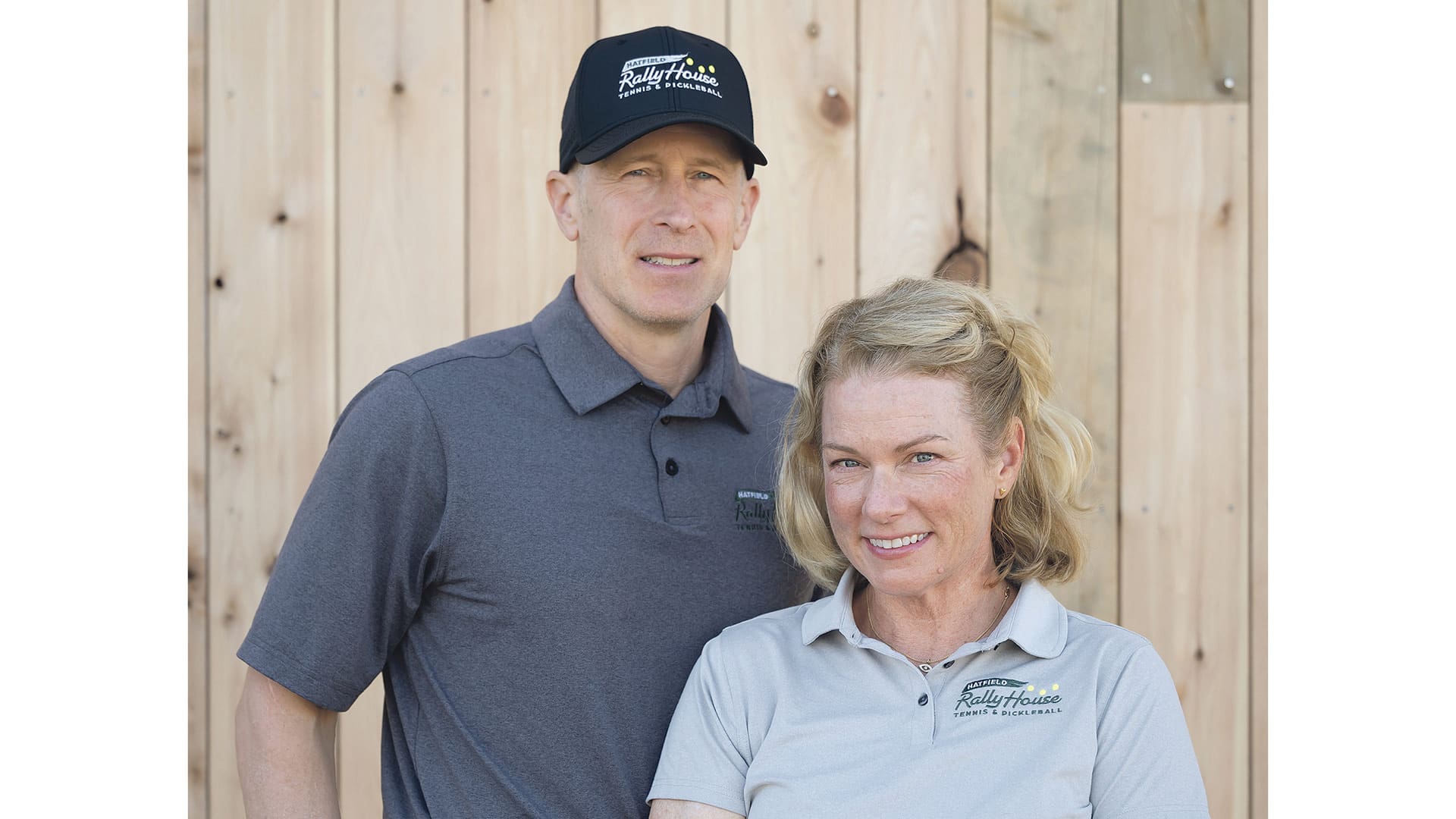
Patrick Roche and Ashley Schaffer aimed to create a sports facility where people would also want to come hang out and connect.
Photo by Derek Fowles Photography
“You can come into the lounge and watch a game and have a drink and chill,” she added. “I just want everyone to come, whether they’re into tennis and pickleball or not — just come and gather and meet some new people. They don’t even have to be into sports.”
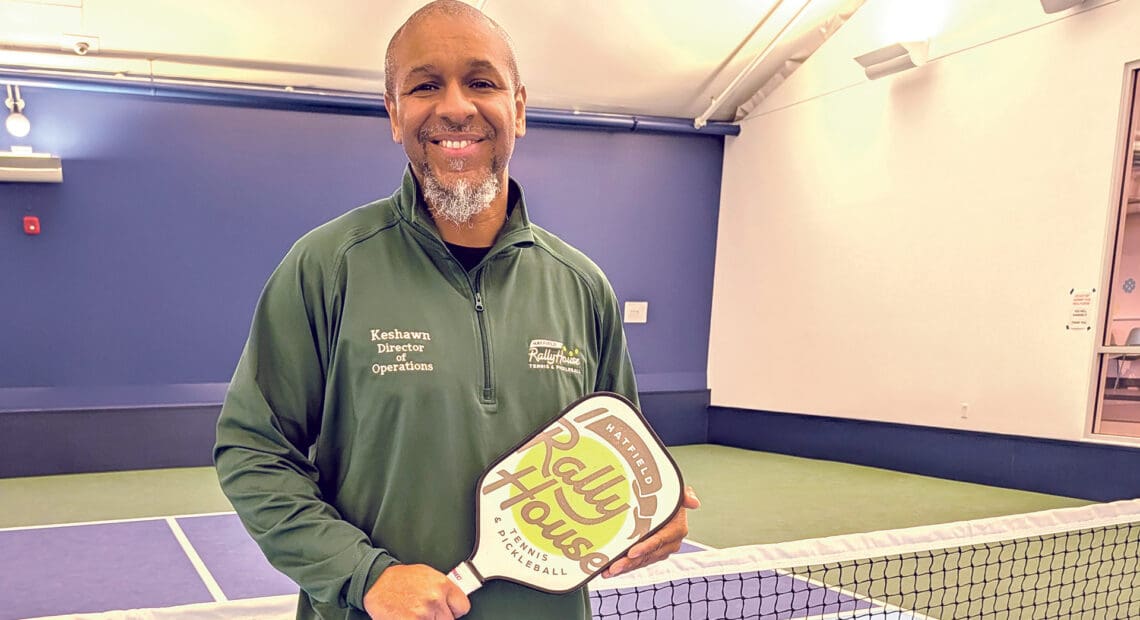
Director of Operations Keshawn Dodds told BusinessWest that the vision of Schaffer and Roche — he a tennis pro, but both avid tennis players who wanted to create something more than a tennis center — appealed to him.
“I just want everyone to come, whether they’re into tennis and pickleball or not — just come and gather and meet some new people. They don’t even have to be into sports.”
“They play at various places across Western Mass., and Ashley always said she wanted a place that she can call her home, that had the amenities to make sure that people felt welcome,” he explained.
“A lot of places that she went to didn’t have certain things. So she wanted to make sure we had a café, a place that kind of builds community and doesn’t focus on just the sport. So she and Patrick sat down and decided how to put tennis and pickleball together in a place where people can come and enjoy both sports, but also have more outside of that.”
The model centers around memberships, he explained, and although drop-in play for non-members is certainly encouraged, he said (day passes cost $20) a trial 30-day membership for $25 makes sense for most — and he said the facility has a strong turnover rate of people trying it out and remaining members after the first month.
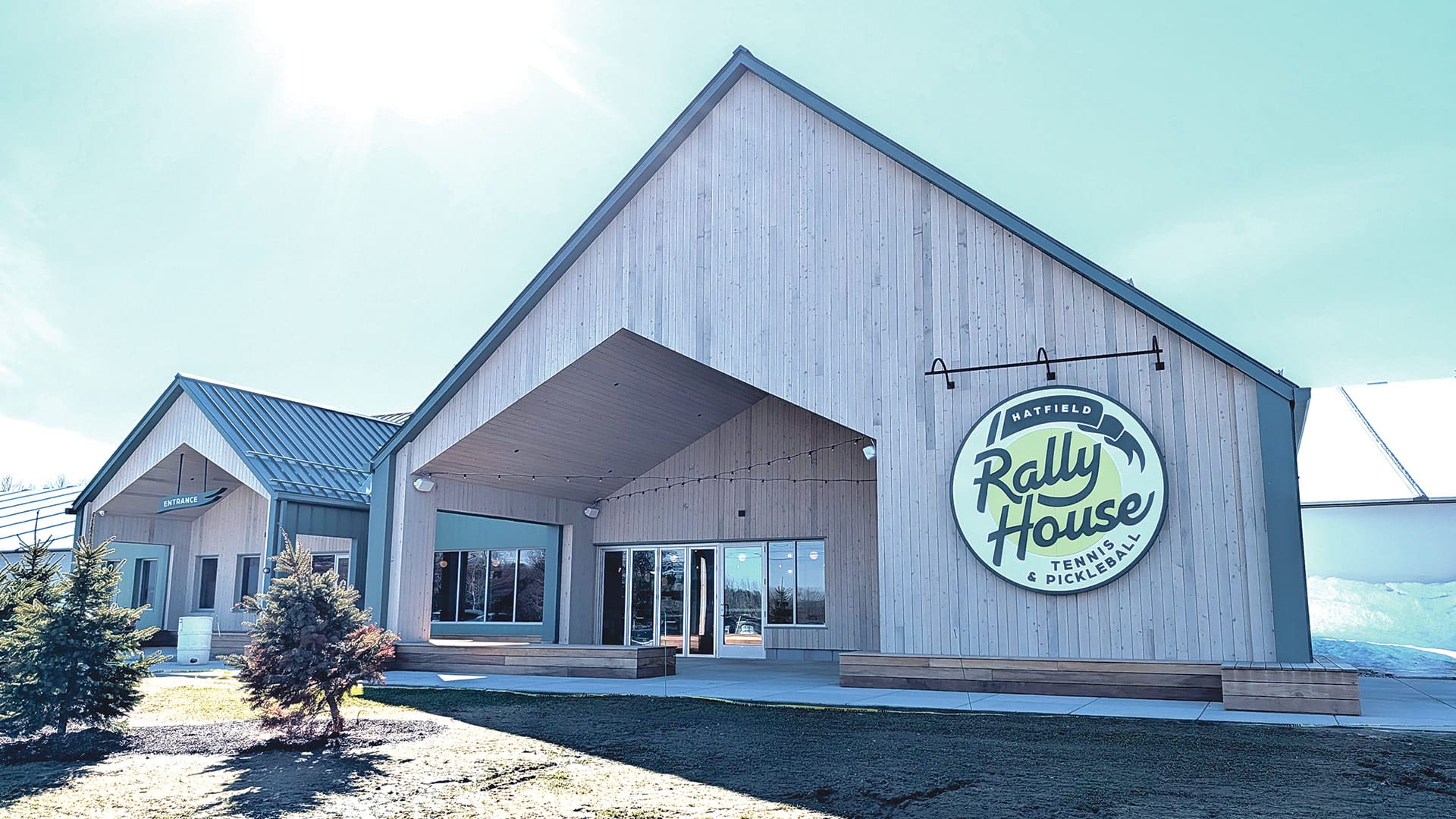
The owners of Hatfield Rally House say its location just off I-91 was one of the selling points of the site.
Indeed, Dodds noted, the goal was to sign up 500 members in the first year of operation — and that was exceeded in the first month.
“So right now, it’s about managing all that. It made us happy to see this was actually something beneficial to not only the sports community, but the community at large. People are looking for something where they can be active and share that sense of community.”
Stay a While
Schaffer has experienced playing tennis or pickleball indoors and then doing … well, not much else.
“You have to get off the court at a certain time, and you ended up talking in the parking lot,” she said, adding that, while indoor tennis and pickleball isn’t a new idea, she had a specific vision for it — somewhere between that place with nothing else to do and an overly broad venue.
“In Texas, everything’s over the top. I didn’t want an over-the-top, country club place, but a place where you can come play with your friends and kind of lounge around afterwards and talk. You don’t even have to play.”
“After COVID, pickleball really took off. So it was just more on my radar, watching the pickleball culture, seeing how they operate. I felt like pickleball could float our tennis courts in terms of a business model. Eventually, we said, ‘let’s try to do this. We’ve been talking about it — we need to stop talking about it. Let’s do it.’”
She said a tennis-only model didn’t work financially because of the limited number of players who could support the square footage needed at any given time, but pickleball, with its more compact courts, had been gaining in popularity for years, and she and Roche saw an opportunity to combine the two in a way that could work.
“After COVID, pickleball really took off. So it was just more on my radar, watching the pickleball culture, seeing how they operate. I felt like pickleball could float our tennis courts in terms of a business model. Eventually, we said, ‘let’s try to do this. We’ve been talking about it — we need to stop talking about it. Let’s do it.’”
As for the business model — both in memberships and day passes — Schaffer said she’d heard that people won’t pay when they can find outdoor courts for both sports for free, but the first three months of operation (Hatfield Rally House opened on Dec. 14) have proven them wrong.
“It’s something that the community wanted,” Dodds said. “And it’s been bigger than what we thought, bigger than the expectations. So we’re happy.”
When Schaffer and Roche started calling architects, only one — Bonham & Douglas Architects in Northampton — seemed to take an interest in the project, and enthusiastic interest at that. “Dan Bonham picked up the phone and talked to me for 45 minutes, and finally, I was like, ‘OK, this is my guy,’” Schaffer said.
As for the location, just a few hundred feet off I-91 exit 30 northbound (and not far from exit 32 southbound), “I know they were looking at several different places, including a couple places in Northampton,” Dodds said, “but this was a farm area that somebody introduced to them, and they looked at it and decided it was just the right location. As a business owner, you say, ‘location, location, location,’ and this is right off the highway, easy access from up north. So this is the perfect spot. We got lucky.”
The 60,000-square-foot facility, built by Five Star Building Corp. in Easthampton, contains four tennis courts, eight pickleball courts, and fitness equipment upstairs, as well as full locker rooms and showers. Meanwhile, in the café and lounge up front, the business partners with Prospect Meadow Farm in Hatfield for food and Berkshire Natural in Northampton for snacks. “We try to keep it local as much as possible,” Dodds said.
“It’s amazing to have all of this here,” he quickly added. “And trust me, the thing that I love the most is when people say, ‘I still get this wow factor when I walk in.’”
Rising Tide
While Hatfield Rally House fills a specific niche in the region, there are other places to play pickleball, including Pickleball Kingdom in the Holyoke Mall, the Picklr in Westfield, indoor courts at Holyoke Community College, and others, including any number of outdoor municipal courts across the region.
However, “we don’t see it as competition — we see it as a help. We want people to understand they can play in other places, but they also have the opportunity to play here,” Dodds said, effectively suggesting a rising tide lifting all boats situation, where the more people introduced to the sport, the better, and the best facilities will do well by drawing in these new fans.
As for that early success, “we’re not in this to make a lot of money,” Schaffer said. “The goal is really to be self-sustaining. I didn’t want some windfall — I just wanted a different kind of place that I feel we didn’t have in Western Mass.”
“We provide lessons and clinics and ladders and open play — an easy way of connecting into the community. Sometimes you go to other places, and it’s a little intimidating. I’m trying to make it easy for people to come. We want to be super welcoming. That’s the whole thing.”
And now that she has it — and early returns are strong — she’s just trying to get the word out to more people who would enjoy a few games of tennis or pickleball. And human connection, of course.
“I feel like I’ve been shouting from the hills that we’re open. I’m not the type of person that starts a business, and the struggle is getting more people to know about it. There’s a lot of places you can go outside and play pickleball, tennis, whatever, but we’re inside, and to me the biggest asset we provide is programming and ways for people to come and play.”
Elaborating, she said Hatfield Rally House, like other places, offers open play so that anyone can show up without a partner and get into a game (and maybe make a friend or three). But they can also take a lesson to improve their skills.
“We provide lessons and clinics and ladders and open play — an easy way of connecting into the community. Sometimes you go to other places, and it’s a little intimidating. I’m trying to make it easy for people to come. We want to be super welcoming. That’s the whole thing.”
Again, Dodds emphasized the local nature of the business.
“These aren’t people that just are just trying to make more money — they’re here investing and being a part of every little nook and cranny. And the best thing about this is, we’re here to stay. We want to make it the best for everyone. Even today, we’re talking with members about how to make the programming better. We take their suggestions, and we put them into action right in front of them. They’re like, ‘wow, you guys are really receptive.’
“And that’s because we’re not a franchise. This is family-owned,” Dodds went on. “And we make the members feel like they have ownership of it — because this is their place. That’s how you make it a better community.”
In short, “a lot of people really wanted this. And luckily, we came together and built it.”