Home Posts tagged Financial Fraud
Banking and Financial Services

Preparing for 2025

By Daniel Cardi


If there’s one thing we all learned in 2024, it’s this: scammers aren’t slowing down. From texts that pose as Amazon to fake job offers asking you to deposit checks, their deception is getting more creative — and more effective. In fact, the Federal Trade Commission (FTC) estimates Americans will lose more than $10 billion to fraud this year alone.

The good news? Protecting financial data doesn’t have to be complicated. With a few smart strategies and a healthy dose of skepticism, you can avoid becoming a statistic in 2025. Let’s break down what’s deceiving people, why it’s working, and what you can do about it.


Scammers Got Smarter in 2024

Last year, we saw some old tricks making a comeback. Counterfeit checks were still common — people receiving fake checks, depositing them, and being asked to forward the funds before the check bounces. These scams often target folks selling things online or applying for jobs.

Daniel Cardi

Daniel Cardi

“Scammers thrive on urgency. They’ll tell you your account’s been compromised or there’s a suspicious charge on your card, hoping you’ll panic and act without thinking.”

But one thing really stood out: fraudulent text messages. Criminals sent fake texts pretending to be from retailers like Walmart or Amazon, claiming there were “suspicious charges” on your account. The goal? Get you to click a link, enter your banking info, and give them instant access to your money.

These scams are working for a reason. As a society, we use our phones for everything, and we trust them with a lot of information — from shopping to banking to ordering pizza. Scammers know this and are doubling down on texts and emails because they know we’ll respond quickly, often without a second thought.


What Scams to Expect in 2025

These tactics aren’t going anywhere. In fact, they’ll likely get more advanced. Cybercriminals are already using artificial intelligence (AI) to create more convincing fake messages. It’s only going to get harder to tell the difference between a legitimate message and a computer-generated one.

Who’s most at risk? Unfortunately, older people are still a primary target because they’re less familiar with digital tools. But anyone who’s too quick to click or too trusting can fall victim, especially as scams get more sophisticated.

For our part, the financial industry is fighting back. Many institutions, like Community Bank, are embracing AI to catch fraudulent activity faster. These systems analyze millions of transactions in real time to flag suspicious activity. But even with all the technology in the world, the best defense is still a vigilant consumer.


How You Can Protect Yourself in 2025

So what can you do to stay ahead of scammers? Luckily, the best strategies are simple and don’t require a computer science degree.

Slow down. Scammers thrive on urgency. They’ll tell you your account’s been compromised or there’s a suspicious charge on your card, hoping you’ll panic and act without thinking. Pause and look closely at the message. Does it seem real? Check the link — is it actually from a legitimate source, or is it some random string of letters and numbers? When in doubt, call your financial institution’s customer-care center directly and have them research the activity.

Change your passwords. I know — it’s inconvenient. But using old, weak passwords is like leaving your front door wide open. Make a habit of updating your passwords regularly and using different ones for different accounts. If that sounds overwhelming, get a password manager to do the hard work for you.

Use multi-factor authentication. MFA is an added layer of protection for devices and accounts — a gateway guard that says “prove it’s really you.” When you log in, you’ll need to verify your identity with a code sent to your phone or email. It’s an extra step, but it’s worth it to keep scammers out of your accounts.

Be skeptical of offers that seem too good to be true. If someone offers you a job out of the blue or says you’ve won money but need to send funds to claim it — run. Scammers love to bait people with promises that sound amazing but aren’t real.

Report fraud ASAP. If you think you’ve been scammed, don’t stay silent. Call your bank immediately. Not only can we help you secure your account, we might also be able to recover your money. In 2024, our team at Community Bank helped recover more than $235,000 on behalf of our customers who would have otherwise lost that money to scams.


The Role of AI and What’s Next

Here’s the silver lining: 2025 is shaping up to be a turning point for fraud prevention. Like I mentioned earlier, financial institutions, like Community Bank, are rolling out advanced AI systems that can adapt in real time to catch new scams as they emerge. Because these tools use machine learning to analyze millions of transactions daily, they can spot patterns that humans might miss. Any new trend will be addressed instantly, with new or updated alerts to our team.

But with every advancement in fraud prevention comes new strategies from the scammers. They’re also experimenting with AI to create fake emails, texts, and even phone calls that are more convincing than ever. This is why vigilance and skepticism will always be your best tools.

We also expect more regulations in 2025 aimed at improving cybersecurity. Businesses will need to comply with stricter rules to protect sensitive data — which is great news for consumers. But at the end of the day, personal accountability remains key.


Don’t Rush and Stay Skeptical

The main takeaway for this year? Take your time. Whether it’s a text about a suspicious charge or an email requesting urgent action, don’t rush to respond. Scammers rely on speed and panic — take that away, and you take away their power.

Remember, if something feels off, don’t hesitate to call and ask questions. By staying informed, skeptical, and proactive, you can outsmart the scammers and protect what matters most.

In short, 2025 will bring new challenges, but with the right mindset and tools, you’ll be ready.


As vice president and Corporate Security officer for Community Bank, Daniel Cardi draws on more than three decades of experience in policework, gaming investigations and security analysis to stay ahead of emerging threats and prevent financial losses for customers. He specializes in risk management, fraud prevention, and physical security, overseeing security upgrades and modifications across the bank’s branch network. He also supervises a dedicated team of corporate security investigators committed to investigating allegations of fraudulent financial activity across the bank’s footprint to foster a safer banking environment for all customers.

 

Special Coverage Wealth Management

Too Good to Be True

By Carlo Centeno

Some of the largest financial fraud schemes have taken place within the last 100 years. The truism “if it’s too good to be true, then it probably isn’t” has been pushed aside by those convinced that if they hesitate, they lose the opportunity.

Pride has a way of pushing a desire or perceived benefit into acceptance. The short version of that notion is commonly known as FOMO [fear of missing out]. White-collar criminals understand that, as investment tactics, strategies, and offerings become more complex, the easier it is to pull the wool over some eyes. For the unfortunate victims, the fear of missing out is all too real, but a greater fear comes to bear regarding their sense of self: in not wanting to appear naïve or uninformed, the ego takes over.

In the mid-1980s, Warren Buffet noted in a letter to Berkshire Hathaway shareholders about “two super-contagious diseases,” namely fear and greed. His analogy to disease — more specifically epidemics — made clear that uncertainty, time of discovery, duration, strength, along with other possible factors could compromise global economies and markets. Ultimately, this led to his aphorism, “we should be more fearful when others are greedy, and to be greedy when others are more fearful.”

According to psychologists, humans are motivated more to avoid pain than to seek pleasure. Put another way, studies have shown that, when it comes to fraud, fear is a stronger motivator than greed.

“According to psychologists, humans are motivated more to avoid pain than to seek pleasure. Put another way, studies have shown that, when it comes to fraud, fear is a stronger motivator than greed.”

Corporations and their minions take advantage of investors’ interests by feeding ‘data points,’ the kind of information most would like to hear. In a marketing sense, the perception is the reality; it’s not what investors are hearing, but what they believe they’re getting.


Investment Fraud

Investment reasoning is contrarian for most of us. We think that, when some assets are experiencing losses, we need to sell to reduce such losses, and then, when the market goes up, we should buy more of said assets. It’s been long documented that making investment decisions guided by emotions does not fare well. However well-intentioned the feeling might be, it’s usually not good in the long run.

Jim Ratley, president and CEO of the Assoc. of Certified Fraud Examiners (ACFE), notes that “there’s no such thing as small fraud, but fraud that has yet to reach their full potential.” The ACFE has reported that approximately 87% of first-time offenders have never been charged or convicted. In such cases, the idea of getting caught is real, but a sense of invincibility reinforces continuation of the tactics that keep money in the wrong hands.

Carlo Centeno

Carlo Centeno

“Investment reasoning is contrarian for most of us. We think that, when some assets are experiencing losses, we need to sell to reduce such losses, and then, when the market goes up, we should buy more of said assets. It’s been long documented that making investment decisions guided by emotions does not fare well.”

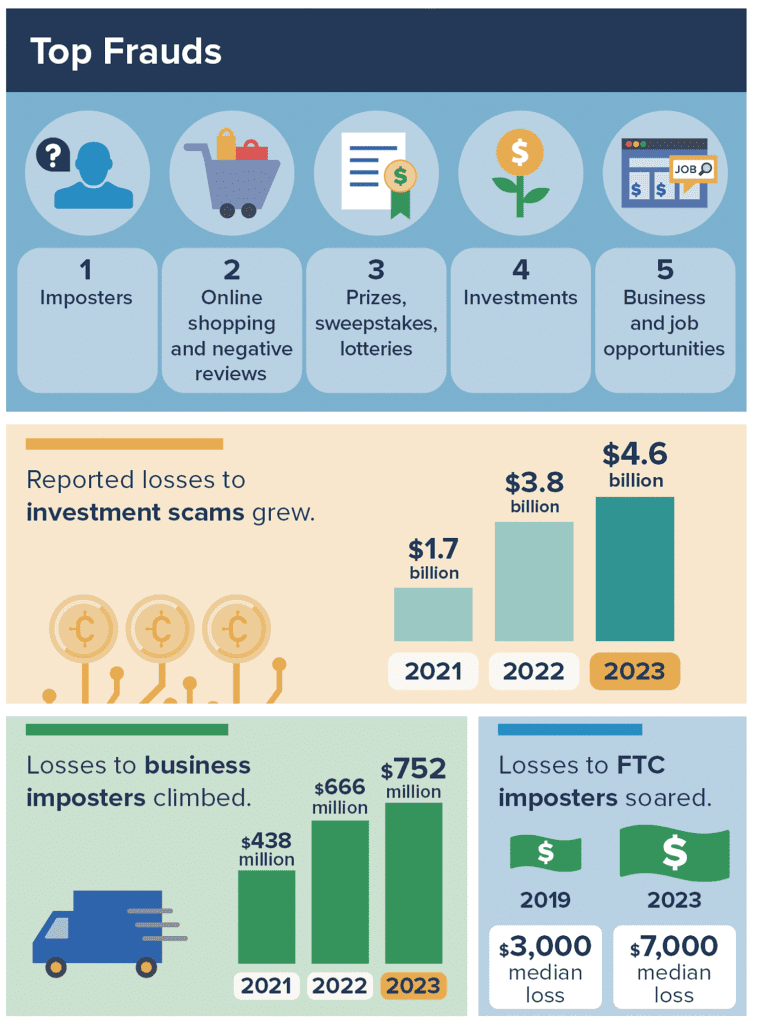
According to the Federal Trade Commission (FTC), consumers reported a record $10 billion in fraud losses in 2023. The amount represents an increase of 14% over losses in 2022. The top category: investment scams. The most used method of acquiring fraudulent cash was through bank transfers.

To be clear, this writer is not aware of any cohort consumer behavioral research which quantitatively ascertains why the losses are so high, though, based on the FTC findings, the means in acquiring fraud dollars can be attributed to a combination of factors: the increased use of online selling and buying, the growing sophistication of iterative websites that mimic actual sites, proficiency in acquiring personal information, in particular from social media, and trends in lifestyle resources appearing on tablet and mobile devices, in particular with health-related products and services, dating services, and financial management.

And the losses continue to grow. Here are some fraud examples that took place not that long ago.

• Lehman Brothers: When you hide $50 billion in loans and reassign them as assets, that’s bound to backfire. It did. The bank’s internal department discovered $3 billion in losses to investors; that money was bought by Cayman Island banks to be purchased later by Lehman Brothers. The majority of the first-timers involved with the scam had no prior criminal record. Due to lack of evidence, the SEC did not prosecute.

Enron: The Houston-based energy commodities corporation kept enormous amount of debt off the balance sheet. Clients and employees of the firm lost their retirement accounts, and shareholders lost a staggering $74 billion. Auditing firm Arthur Anderson was involved, CEO Jeff Skilling was sentenced to 24 years in jail, and CFO Andrew Fastow pleaded guilty and served jail time. Fastow forfeited $24 million and pleaded guilty to two counts of conspiracy. In a news interview, he said, “there are people who look at the rules and find ways to structure around them. The more complex the rules, the more opportunity. The question I should have asked is not what is the rule, but what the principle is.”

• Bernie Madoff: Running the largest Ponzi scheme ever, Madoff’s investment firm took $64.8 billion from investors. Any “returns” paid out came from money from other investors or even their own money. After he confessed to his sons about his fraud, the sons reported him to the SEC the following day. For all the technology available to the investment industry, the fraudulent information was stored in a 1980s-era IBM AS/400 server.

• Sam Bankman-Fried’s FTX Scam: One of the more recent scams involved cryptocurrency. The investment scam was Sam Bankman-Fried, with friends being his associates. Cryptocurrency, to this day, still poses a high level of risk (see related story on page XX). The securities platform called FTX was claimed to deliver higher rates of return in 2019. By 2022, it all came undone. Bankman-Fried was sentenced to 25 years in federal prison for the FTX fraud. At its zenith, FTX valuation reached $32 billion.


Bottom Line

Financial fraud is wrought with complexities in large part because of the size and scale of investments offered today. Adding to this depth and volume, the ongoing evolution of computers, satellite communications, storage, encryption, and verification (just to name a few factors) continues to develop ways to not only identify bad actors, but the means to identify transactions and activities that point to potential financial crimes.


Carlo Centeno is vice president and Marketing director at St. Germain Investment Management. Much of his career has been in corporate communications, primarily on the agency side, where he worked on a variety of projects with national clients. He has received both a Clio Award and a Golden Pyramid Award for strategic business-to-business communication programs. He received his bachelor’s degree in English literature from Boston University and an MBA from the Isenberg School of Management at UMass Amherst.