Innovation in Healthcare
Chief of Thoracic Surgery, Chief of Robotic Surgery, and Medical Director of the Lung Cancer Screening Program, Mercy Medical Center
With Screening and Technology, He’s Improving Outcomes and Saving Lives
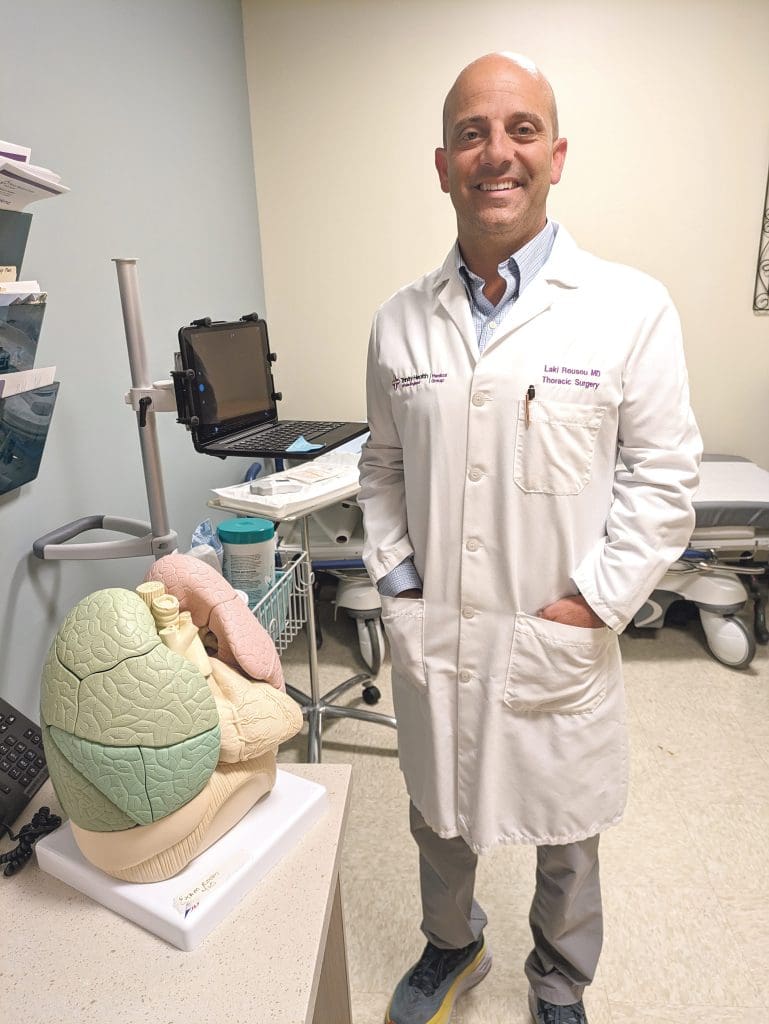
Dr. Laki Rousou
Robotic surgery has been one of the most significant medical developments of the past couple decades, one with impacts that are … well, deeply human.
“It allows you to do major operations through small incisions and, at the same time, protect some vital structures more easily than you could even if you’re doing non-robotic minimally invasive surgery,” said Dr. Laki Rousou, who has performed more than 1,000 surgeries on the da Vinci surgical platform — and earned him recognition as a Healthcare Hero in the Innovation category.
Raised in Longmeadow, Rousou grew up with a deep appreciation for the medical field. As a child, he saw the impact his father, Dr. John Rousou, retired chief of Cardiothoracic Surgery at Baystate Medical Center, had on the lives of his patients. Meanwhile, his brother, Dr. Tony Rousou, is a cardiothoracic surgeon who specializes in cardiac surgery at Baystate.
At Mercy, Dr. Laki Rousou has carved out an intriguing, multi-faceted role as chief of Thoracic Surgery, chief of Robotic Surgery, and medical director of the Lung Cancer Screening Program (more on that later).
“My father was a physician in this area for years, so it was always in the back of my mind as something I would want to do,” he told BusinessWest. “Right after college, I didn’t immediately decide that’s what I wanted to do, but I eventually came to that conclusion and went to medical school.”
Rousou was drawn to the physiology of the heart and lungs, and wanted to find a way to marry that interest to some technical skill, which would turn out to be thoracic surgery.
“The main operation I do is taking out a lobe of the lung for a lung cancer,” he said. “Then there’s the esophagus, which is also in the chest, and diaphragm hernias. But robotics helped me along in my career in that I was able to expand some of the things that we could do minimally invasively.”
Two examples are a thyectomy, the removal of the thymus gland in the middle of the chest, and esophagectomy, in which he removes a good portion of the esophagus. “All that can be done robotically.”
Robotic surgery — by which a surgeon controls a camera and mechanical instruments inside the body from … well, outside it — brings many advantages for both patient and doctor, Rousou told BusinessWest.
“For cancer operations, it allows you to do a more comprehensive lymph-node dissection and gives you better visualization so that you can make sure that you’re taking out everything that you can take out and you’re doing that safely,” he explained.
“Even for non-cancer operations — let’s say a hernia of the diaphragm — there’s a fair amount of sewing that goes into that. In some of these open operations, when we’re deep in a cavity and we’re sewing with our hands and not robotically, it’s hard to see. You’re stretching your arm out, and the angles aren’t quite right, but with the robot, you can make the angles perfect, and you can see perfectly.”
From the physician’s standpoint, robotic surgery brings a different set of advantages.
“If you’re doing open surgery — or even doing non-robotic, minimally invasive surgery — you’re standing, and a lot of times reaching, and you’re not in an ergonomic position. When we’re doing these robotic operations, we’re sitting in a chair in a perfect ergonomic position,” he explained.
“So, just from that standpoint, you can lengthen your career. I know plenty of surgeons who, as they get toward the end of their career, their knees hurt, their backs hurt, and they stop because of that. Maybe this allows you to continue. You may still stop at the same time, but you can do it on your terms, and not because your knee hurts or your back hurts or things like that.”
While he’s become proficient at robotic surgery, Rousou admits he was a skeptic of the technology at first. Then he started to learn about the potential good it could do for patients by decreasing pain, more accurately dissecting lymph nodes, and other reasons.
“I went into it saying, ‘all right, I’m going to find out for myself.’ So I tried it. I did the trainings, and I started doing it. And told myself, ‘I’m not going to commit totally for a year.’”
“I see future benefits coming down the pike, just by being able to use AI and various technologies that can be linked with the robot to help others get better, to help myself get better, and to better evaluate outcomes.”
But after that year, he was seeing clear benefits, especially as he became more adept at it. “Once I saw that benefit, I committed wholeheartedly to it, and now, six or seven years after fully committing to it, I see future benefits coming down the pike, just by being able to use AI and various technologies that can be linked with the robot to help others get better, to help myself get better, and to better evaluate outcomes.”
Breathing Easier
Rousou also heads up Mercy’s Lung Cancer Screening Program, but he wasn’t enamored with the idea at first, when he was asked by hospital leadership to launch the initiative.
“I thought, ‘I’m a surgeon. Why am I going to start a program like that?’ But I thought about it and said, ‘all right, I’ll do it’ — because I think, with any screening program, if it’s not done in a particular way, it can cause harm. And I didn’t want that.”
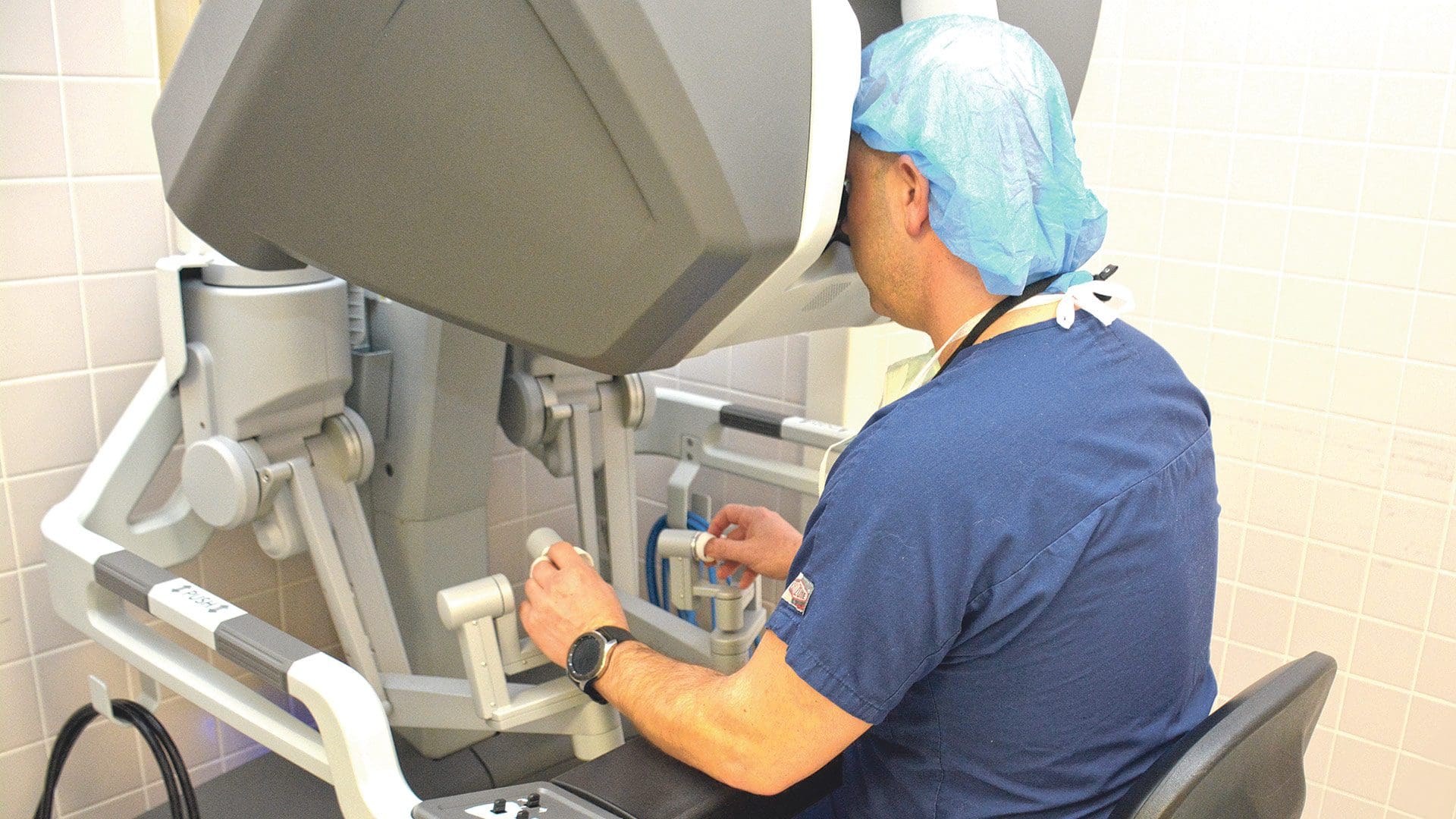
Robotic surgery is essentially performed away from the body, with better precision than open surgery in many cases.
He was joined in that endeavor shortly thereafter by Ashley LeBlanc, who was honored as a Healthcare Hero in the category of Emerging Leader just last year. “Together, we grew this program that we started,” he said before explaining how it works.
“It’s not just a CT scan; it’s a visit with a patient that might be eligible for screening. They’re eligible for screening if they have a certain smoking history, a certain age — and if they’ve quit, it’s got to be within 15 years. But it starts with a visit and a discussion, and then, typically that day, they get a CT scan.”
Those results are reviewed, especially if there’s a high-risk result, by a group comprised of oncologists, pulmonologists, surgeons, radiologists, and pathologists to recommend next steps. If the result is not high-risk, the patient is advised to return for a scan the following year.
“The idea was to have those eligible get screened, but also get information back quickly because, if there’s a risk or a potential for cancer, you don’t want to sit on it. So, they get information back quickly, positive or not, and the care ends up being multi-disciplinary, with much, much better outcomes.”
That’s a big difference from the past, when CT scans for lung cancer were typically reactive, not preventive.
“Before screening, the lung cancers that we caught were caught incidentally,” Rousou said. “They got a CT scan because they had pneumonia. Or they got a CT scan because someone thought they had a blood clot in their lung. And then you see this mass. The vast majority of those were stage 3 or 4 lung cancers. Stage 3 is very difficult to treat; stage 4 is not curable.
“The idea behind screening is you flip the script on that. So now, in the screening population, the majority of the cancers that we find are stage 1 or 2, and are not as difficult to treat. We’ve had a lot of success with it.”
Those early screens are especially critical considering that lung cancer is the leading cause of cancer death in the U.S. (and in most other countries as well), and second only to heart disease in total deaths. In fact, Rousou said, lung cancer causes more deaths than the next four cancers combined in both men and women.
“I grew up here. I’ve got skin in the game here. And one of my goals from the outset, coming back here, was — at least in thoracic surgery and thoracic oncology — to make Western Mass. the equivalent, or better than, some of the major medical centers.”
“So that’s the perfect scenario for screening because, if you do have symptoms, it’s late. And lung cancer is an aggressive cancer,” he added. “You can get diagnosed with late-stage lung cancer, and then you might be gone in six months. That’s not the case, necessarily, with stage 1 or 2.”
Rousou is encouraged that earlier screening, combined with diagnostic advances, new treatment technologies, and pharmaceutical breakthroughs, are resulting in many lives saved. “This is a pretty exciting time, in my opinion.”
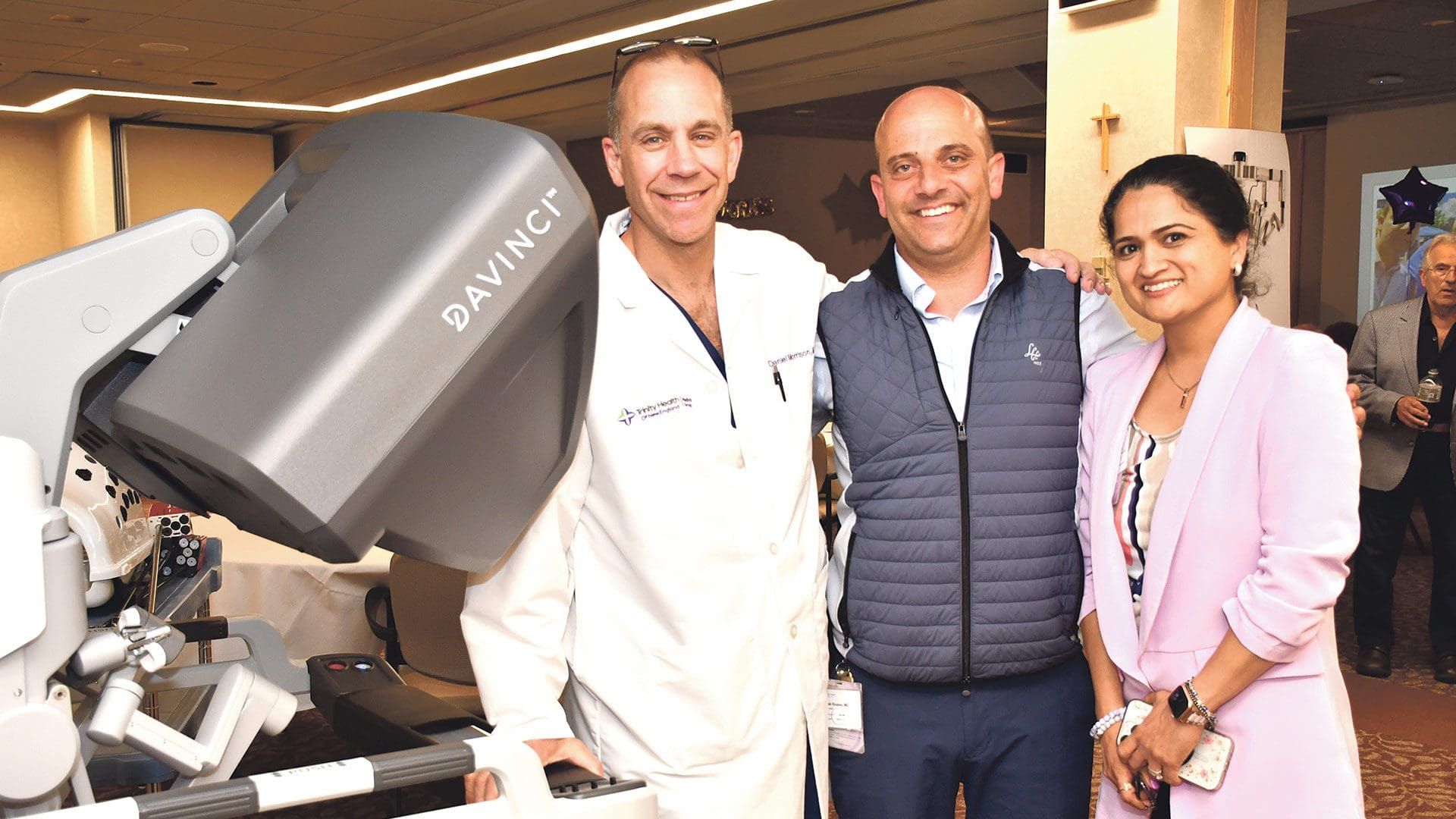
Dr. Laki Rousou (center) celebrates his 1,000th da Vinci procedure with Mercy’s Chief of Surgery Dr. Dan Morrison (left), and Chief Medical Officer Dr. Asha Dhamija.
While outlining the innovations, robotic and otherwise, that Rousou has been putting into play at Mercy, Mary Orr, the hospital’s Media and Communications specialist, also took time to praise his human side in nominating him to be a Healthcare Hero.
“In addition to being a highly qualified, proficient thoracic surgeon, Dr. Rousou is deeply committed to his patients, always putting them at the center of everything he does,” she wrote. “He not only keeps current on the latest developments regarding technological advances and best practices in patient care so that his patients have the best chance of a positive outcome, his bedside manner is second to none. It’s not unusual to find him taking extra time to make sure his patients and their families fully understand the care plan or calling a patient after offce hours to answer their questions or allay their fears.”
Surgical Milestone
Having recently completed his 1,000th robotic thoracic surgery using da Vinci Xi, Rousou is among the nation’s most frequent users of the da Vinci surgical system for thoracic surgery, and he has also completed the most da Vinci thoracic surgeries in all of Trinity Health, the parent organization of Mercy Medical Center, which boasts 36,500 physicians and clinicians across 27 states.
The technology is highly adaptable; da Vinci Xi can be used across a spectrum of minimally invasive surgical procedures, including gynecologic, urologic, thoracic, cardiac, and general surgeries. Rousou was instrumental in championing efforts for Mercy to acquire the da Vinci Xi surgical system earlier this year.
“They had the older version of the robot when I got here; at least for thoracic surgery, it wasn’t being used a lot,” he explained. “So, once I made that commitment, that bolstered the program for robotics, and when the next version of the DaVinci robot came into play, I was involved in making that happen. Now we have two, and I was one of many who pushed for that second version of the robot.”
To hear him tell it, these are not only his patients, but his community — one where he has deep roots and personal connections. It explains why he returned to Springfield in 2014 after a decade of surgical roles at New York University Medical Center, Yale-New Haven Hospital in Connecticut, and Concord Hospital in New Hampshire.
“I grew up here. I’ve got skin in the game here. And one of my goals from the outset, coming back here, was — at least in thoracic surgery and thoracic oncology — to make Western Mass. the equivalent, or better than, some of the major medical centers, like Boston, New York, Yale, those places.”
By doing so, he envisions people getting care at a smaller, more intimate health center and not having to travel to bigger cities — and having access here to the most recent innovations, including the most advanced robotic surgery possible.
“That’s been an overreaching goal, and still is, for us here — to make this top-of-the-line care in your backyard,” he said. “And we’re not done yet.”