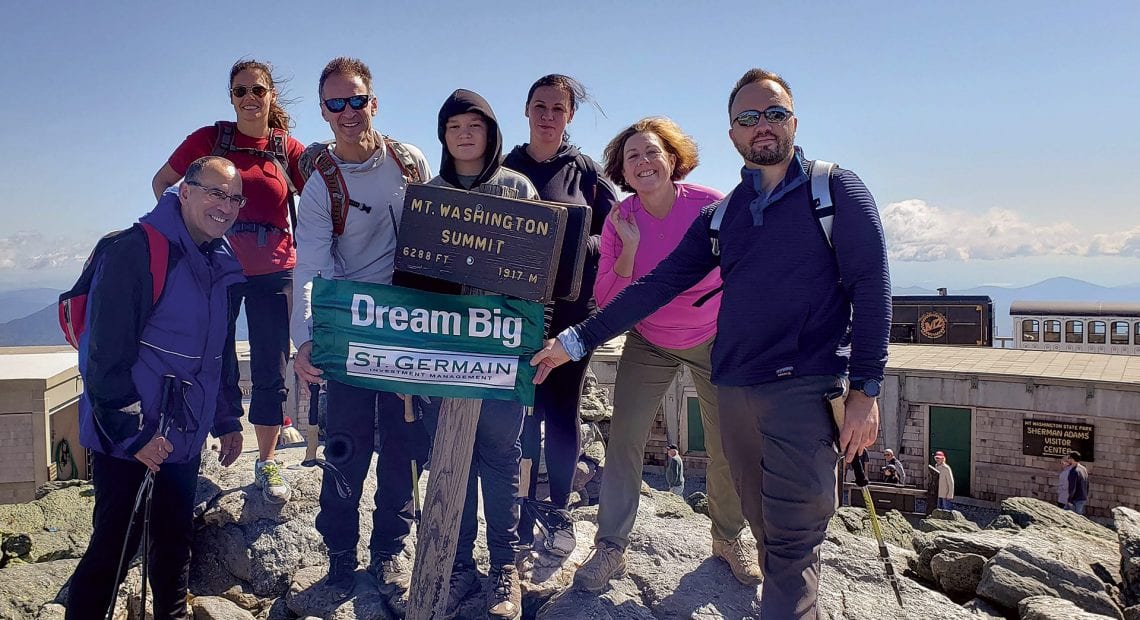
Reaching the Summit

Several of those who hiked Mount Washington as part of a team-building exercise at St. Germain Investments pose for a photo at the summit.
For a good part of its 95-year existence, St. Germain Investment Management has been focused on the last two words in its name. But over the years, it has evolved into a financial-planning company that will take a check and invest it, but also help clients with everything from devising a plan to pay for college to determining when someone can retire.
Mike Matty was dressed casually on this Friday, which was unusual, because, in general, he doesn’t do casual Friday — or casual any other day, for that matter.
But there was a reason.
In a few hours, he would be heading up to Mount Washington in the Presidential Range to do some advance work — such as collecting the keys for the rented condos and other logistical matters— for a rather unique team-building exercise, with the emphasis squarely on exercise.
“A lot of those rules of thumb came about decades ago, back when there were traditional pensions and people retired at 65. And if you did retire at 65, you didn’t have 15 years worth of traveling ability in front of you because you didn’t have artificial knees and hips and stents; all that has changed.”
Indeed, as he did last year, Matty, a seasoned climber who has accomplished the rare feat of summiting the highest mountain on every continent, would be leading a team of employees at St. Germain Investments, spouses, and even a few children on a hike up Mount Washington, the 6,288-foot peak — the highest in the Northeast — famous for everything from its cog railway to its notorious, quickly changing weather.
“You’re not starting at zero, you’re starting at 2,600 feet or so, but it’s still a good hike up, and it’s a great challenge for people,” said Matty, president of St. German, who could have used those same words (and does) to describe the task of financial planning. “There are a lot of people here who have never done anything like this.”
Matty told BusinessWest that, while it might seem natural that he would take the point, as they say, in this climb and lead his team up the mountain from the front, he would instead be “leading from behind,” as he put it in an e-mail to the roughly 30 people, representing all age groups, who would be joining him.
“I’m back there cheering on the people who are having a hard time and struggling a bit and feeling that maybe they should turn around or that they’re going too slow and holding everyone up,” he said, adding that the first mile or so “isn’t bad,” then the next mile is very steep, then there’s another generally flat portion, and then it gets quite steep again.
Listening to this, one could, and should, see myriad parallels between what Matty was doing for his employees on the Mount Washington climb and what his team at St. Germain does for clients on a daily basis — provide advice and encouragement, help others take advantage of accumulated knowledge and experience, and yes, assess risk.
“It is a lot like financial planning and investing,” he said. “You set a goal and a path for getting there. And if conditions aren’t right, you pull back and turn around; it’s all about risk assessment and doing everything you can to be ready. That’s what we help people do.”
These thoughts sum up what has been a significant change at St. Germain, one that has taken place over the past few decades or so. In the past, the company was strictly as asset manager, while today it is engaged in virtually every kind of financial planning, right down to the well-attended seminar on Medicare planning that it staged recently.
“Years ago, this was an asset-management business,” he explained. “It was really just ‘come in, give us a check, and we’re going to manage the assets for you.’ Today, we’re much more actively involved with the financial-planning side of it.”
Elaborating, he said the company is now involved with helping clients decide when they can retire, when they should start taking Social Security, whether they can afford a vacation home, whether they should invest in municipal bonds in the state they intend to move to, and myriad other aspects of financial planning for today and especially tomorrow.
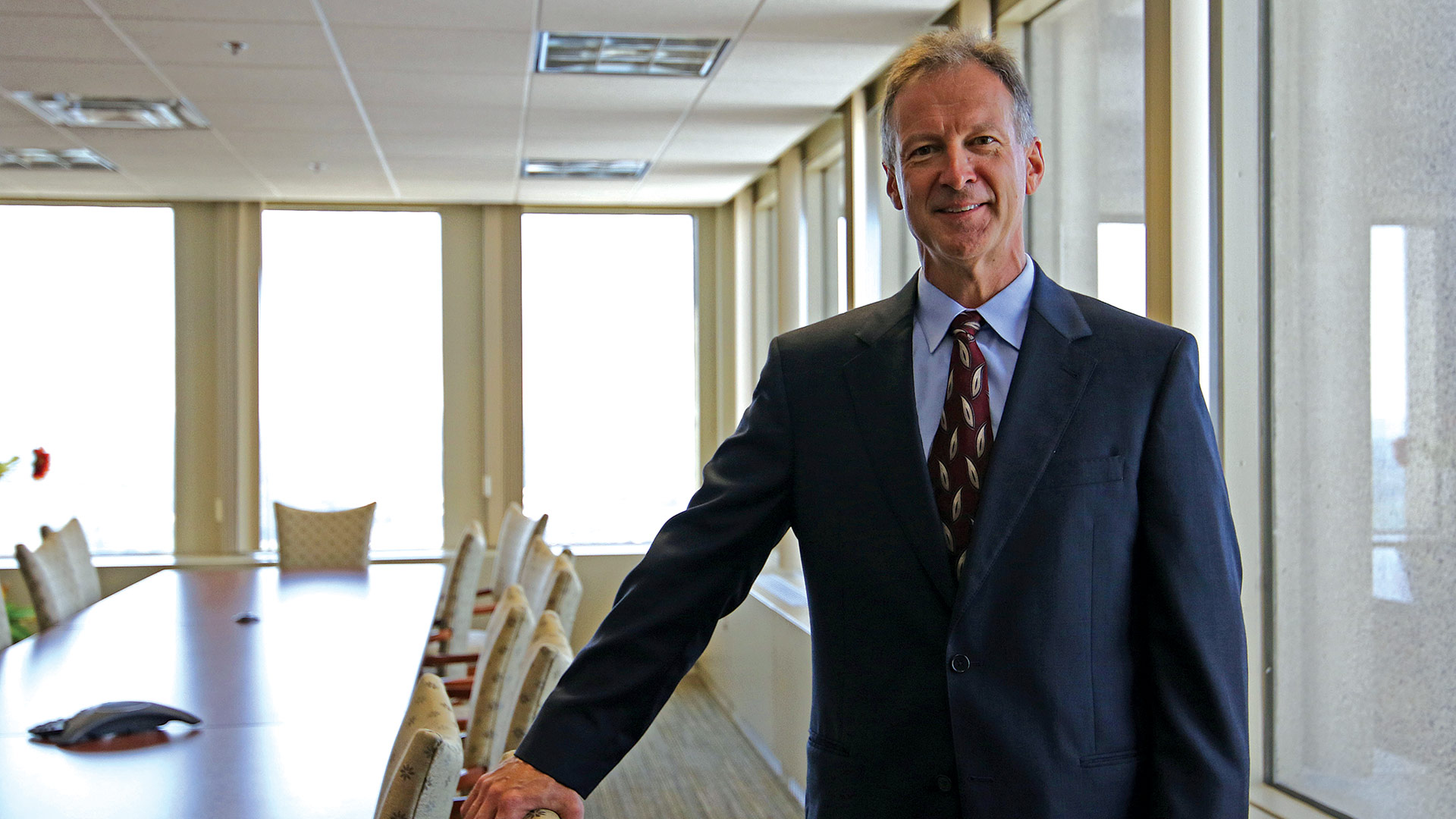
Mike Matty says climbing a mountain is a lot like financial planning — they both involve setting goals, devising strategies for meeting them, and assessing risk.
It’s a sea change of sorts, and the evolutionary process continues — the company recently hired someone to exclusively develop financial plans for clients through the use of acquired software, a hire that speaks volumes about how the company has grown and evolved in recent years, said Matty.
For this issue and its focus on financial planning, BusinessWest talked at length with Matty about how the company serves clients on perhaps the most important climb of their lives, and how it works with them to help ensure that achieving financial security isn’t necessarily an uphill climb.
Upward Mobility
Like anyone who has climbed Mount Washington a number of times, Matty has his own large supply of stories about the peak — and especially about its famous weather and measured wind speeds well north of 100 miles per hour.
“I have a video that I took two years ago,” he said. “I’m literally standing on top of Mount Washington; there’s a 50-mile-per-hour wind, a few inches of snow on the ground, there’s snow blowing by me — and it’s September 1st!”
That anecdote provides yet another parallel between climbing a mountain and achieving financial security for the long term, said Matty, adding that life, much like the weather on Mount Washington, can change quickly and, quite often, unexpectedly.
Thus, the very best strategy is to have a good plan and be prepared — for anything.

And that, in a nutshell, is what St. Germain Investments has been helping its clients do for nearly a century now — the company is marking its 95th anniversary this year.
Much has changed since 1924, as Matty noted, and even over the past few decades, as the company’s focus has shifted from simply managing money to assisting clients with the myriad aspects of financial planning — from determining how college can and should be paid for (often, several generations of a family share the load these days), to determining when to sell the family business, to deciphering how Medicare works, hence that aforementioned seminar.
Which was not your run-of-mill Medicare seminar, such as the one you might see at the local senior center, said Matty, but rather one led by experts who can speak to questions and concerns raised by the typical St. Germain client, a couple or individual who has managed to accumulate some assets and save successfully for retirement.
That seminar, as well as the recently hired financial planner — who was among those on the hike to the top of Mount Washington — are some of the many obvious indications of change and growth at the firm, said Matty, who said there are a number of ways to measure success at St. Germain.
He listed such things as profound growth in assets under management (the number is now just over $1.5 billion) to similarly profound growth in the workforce — there are now 23 employees. There’s also a new satellite office in Lenox with its own brand (October Mountain Financial Advisors) and consistent presence — four years in a row — on the FT (Financial Times) 300 list of the top financial advisors in the country.
“There’s a lot of stuff out there you can get named to because you paid 50 bucks — this list isn’t one of them,” he said, adding that there is a very rigorous set of criteria that must be met to be so honored and there are only a few firms in this region on that list.
But the best measure of success is clients’ ability to successfully navigate their climb to financial security, he said, adding that the firm helps them accomplish this by first getting to know them and their specific circumstances, and then leading from behind, if you will, by providing guidance and working in what amounts to a true partnership with the client.
As Matty noted, this is a long way from the days of taking a check and investing the amount written on it.
Peak Performance
As he talked about financial planning and how his company goes about serving clients, Matty noted there are, or were, several rules of thumb, if you will, in this business, regarding everything from life expectancy to retirement age, to the percentage of money in one’s portfolio that should be invested in stocks.
He believes most of them are obsolete and that, in general, as people live longer and are able to do more in retirement than they were a generation or two ago, there are no more rules.
“A lot of those rules of thumb came about decades ago, back when there were traditional pensions and people retired at 65,” he told BusinessWest. “And if you did retire at 65, you didn’t have 15 years worth of traveling ability in front of you because you didn’t have artificial knees and hips and stents; all that has changed.
“You have 70-year-olds getting new knees and going skiing,” he went on. “That was unheard of 30 or 40 years ago; people didn’t ski at 70, let alone take up skiing at 70.”
When the company runs financial plans for couples now, said Matty, it does do knowing that the odds are good that one of the spouses will live until age 95.
“So if you want to retire at 65, you need to be planning on 25 to 30 years of your money working for you,” he continued. “That’s a long time. I get it — you want to travel for the next 10 to 15 years, when you’re between the ages of 65 and 80. How do we structure a plan that’s going to support all that?”
Overall, Matty said, as his firm works with clients in this environment, there are certainly talks that are financial in nature. But an equal number of them — if not a greater number of them — are “psychological” in nature.
And they involve everything from often-complicated end-of-life matters to simply convincing people who have, indeed, done very well when it comes to saving for retirement that, when they get there, it’s OK to spend the money they’ve accumulated.
And there are many people who need convincing, he told BusinessWest.
“People get to that stage [retirement] by foregoing and saving for the future, foregoing and saving for the future,” he explained. “At a certain point, you have to flip that switch a little bit and say, ‘it’s OK; this is why I did all that — I don’t have to keep doing this for the rest of my life.’ Sometimes, your job really is to tell people, ‘it’s OK to spend it.’”
As for end-of-life issues, Matty said these emotional times are often made even more difficult by uncertainty about whether survivors will be adequately taken care of, and the pressing need to make sure they are.
“Often, you’re having a conversation with them, and one of them is lying in a bed they’re never going to come out of,” he said. “And often, it’s the one in worse health, the one who’s passing away, who wants to make sure that the other one is OK financially, and they really need that assurance.
“It’s a fairly easy financial conversation to have at times, because the money is there,” he went on. “But it’s really, really, really about trying to make that heartfelt assurance to someone to things are going to be OK, especially if the one who’s passing is the one who made all the financial decisions.”
Matty said he’s had a number of these discussions, and he remembers one instance where he was called to a home for a talk with a woman who was about to enter hospice and wanted assurances that her husband, suffering from Alzheimer’s disease, would be OK.
“She knew nothing about the financial situation, she knew nothing about how their will was structured, etc., etc.,” he told BusinessWest. “I called back to the office and asked the receptionist what I had on the schedule, and then I told her to call and cancel.”
He spent the next several hours going through the will, looking over insurance policies, and making sure all questions were answered and every matter was resolved.
There have been a number of cases like that, he said, adding that all the financial advisors at the company have what amounts to a license to clear their schedules in such instances because they’re paid a salary, not commissions.
Getting to the Top
These anecdotes show clearly just how much St. Germain has changed over the years.
Instead of taking a check and investing the money, the company is leading from behind and guiding clients on a certainly challenging trek, one in which a plan has to be made, risks have to be assessed, and unforeseen circumstances — life’s equivalent of 50- or even 100-mile-per-hour winds — are anticipated and accounted for.
Returning to the hike up Mount Washington, Matty said his goal for the day “was not to make good time, but to have a good time.”
That’s the goal for retirement as well, and this company has moved to the top within this industry when it comes to helping people do just that.
George O’Brien can be reached at [email protected]