
Community Health
Associate Professor of Nursing and Director of the Seedworks Health Equity Program, UMass Amherst
Her Focus on Health Equity Is Changing Outcomes for Women

Lucinda Canty
It takes more than a sentence or two to describe what Lucinda Canty does — and then a lot longer to fully describe the impact of her work.
She’s an associate professor at the Elaine Marieb College of Nursing at UMass Amherst, but also a nurse midwife.
“A lot of what I teach is around women’s health and reproductive health, but I also address social justice and health equity. So there’s quite a range of what I do,” she said. “I mentor undergraduate students and support them through my program, but I also have PhD students or DNP students that I mentor through their projects.”
She also founded Lucinda’s House, a maternal-health initiative that creates an environment where women of color feel safe, supported, and empowered. It provides comprehensive services, including individual consultations, health-education events, and access to community resources covering critical topics such as postpartum mood disorders, breastfeeding, perimenopause and menopause, pregnancy loss, reproductive health wellness, and HIV.
And as director of the Seedworks Health Equity in Nursing Program at the university, she is helping to mentor the next generation of healthcare providers.
According to Crystal Neuhauser, chief Development officer at the Elaine Marieb College of Nursing and one of Canty’s nominators as a Healthcare Hero, “her dedication to her students is evident in her commitment to fostering an environment where future nurses and midwives are trained to understand and address health disparities.”
In short, Canty has found avenues to direct her work as a nurse and educator to achieve some very specific goals. It’s a career that has unfolded in intriguing ways since she chose a healthcare path over a culinary one at a young age.
“When I was in high school, I wanted to either be a chef or a nurse,” she recalled. “I was trying to decide, and a friend was like, ‘you know, you can always cook. Even nurses cook.’ And I wanted to help people; I love being able to provide care. So that’s how I started into nursing.”
In nursing school, she discovered a specific passion for maternal health and midwifery, and she worked in that field for about 14 years before having yet another epiphany moment, when a friend told her about a teaching opening for a clinical maternity professional at the University of St. Joseph in West Hartford.
“I was like, ‘oh, I could do that with my eyes closed.’ So I was going to do one semester and then go back to clinical practice. But I loved it so much. I loved working with the students. I loved how they discovered their confidence — them being terrified to even hold the baby, and then at the end, you see them giving a shot like it’s nothing, and see their interactions. I wanted to be part of that. And now, that one semester has turned into 15 years. And I still love it to this day.”
Others appreciate her as well. “Dr. Canty’s work as a scholar is transformative, especially in addressing maternal health disparities,” said Allison Vorderstrasse, dean and professor at the Elaine Marieb College of Nursing, another nominator. “She is a formidable advocate for maternal and child health in the Pioneer Valley. Her leadership extends beyond UMass Amherst as she engages with local healthcare providers and community organizations to promote health equity. Her efforts have brought much-needed attention to the disparities in maternal-health outcomes and have driven collaborative efforts to address these issues.”
That’s the broad impact of a Healthcare Hero.
Legacy of Learning
As a professor, Canty loves seeing the impact her own students have in the community — and appreciates how the teaching environment has changed.
“Things are different from when I was a student to seeing students now. When I was given a clinical site, I didn’t have a say in it; whatever site you got, you went to,” she recalled. “But now, when I hear people asking, ‘what do students want?’ or hear them advocating for themselves, I’m like ‘that’s what we need in nursing.’ I feel like I was kind of made to feel silent. I did what I had to do, and I appreciate it, but I see these new ways, and I love being part of that.
“And then, to see them in their careers, working, that’s really the most gratifying part. That’s awesome.”
“I loved working with the students. I loved how they discovered their confidence — them being terrified to even hold the baby, and then at the end, you see them giving a shot like it’s nothing, and see their interactions. I wanted to be part of that. And now, that one semester has turned into 15 years.”
But she also desired to delve into research, which included earning a doctorate 20 years after graduating with her master’s degree.
“I wanted to look at health disparities and reproductive health. I wanted to understand what causes disparities, especially among black women,” she told BusinessWest, noting that, for many populations, as socioeconomic status improves, so do health outcomes — but for Black women, that’s not always the case.
Among the findings of her research was the importance of making sure women have accurate health information, but another was the impact of having a relationship with a healthcare provider that goes beyond the basics.
And that gets into the importance of diversity in healthcare, of having doctors, nurses, and other professionals who understand cultural differences and can connect more effectively with patients — and develop a relationship built on trust, communication, and mutual understanding.
“I feel like there’s so much that we can learn from each other,” Canty said. “And I also feel, in nursing school, medical school, we don’t talk enough about culture and how that shows up in healthcare. So we need to have environments where we can have discussions about that.”
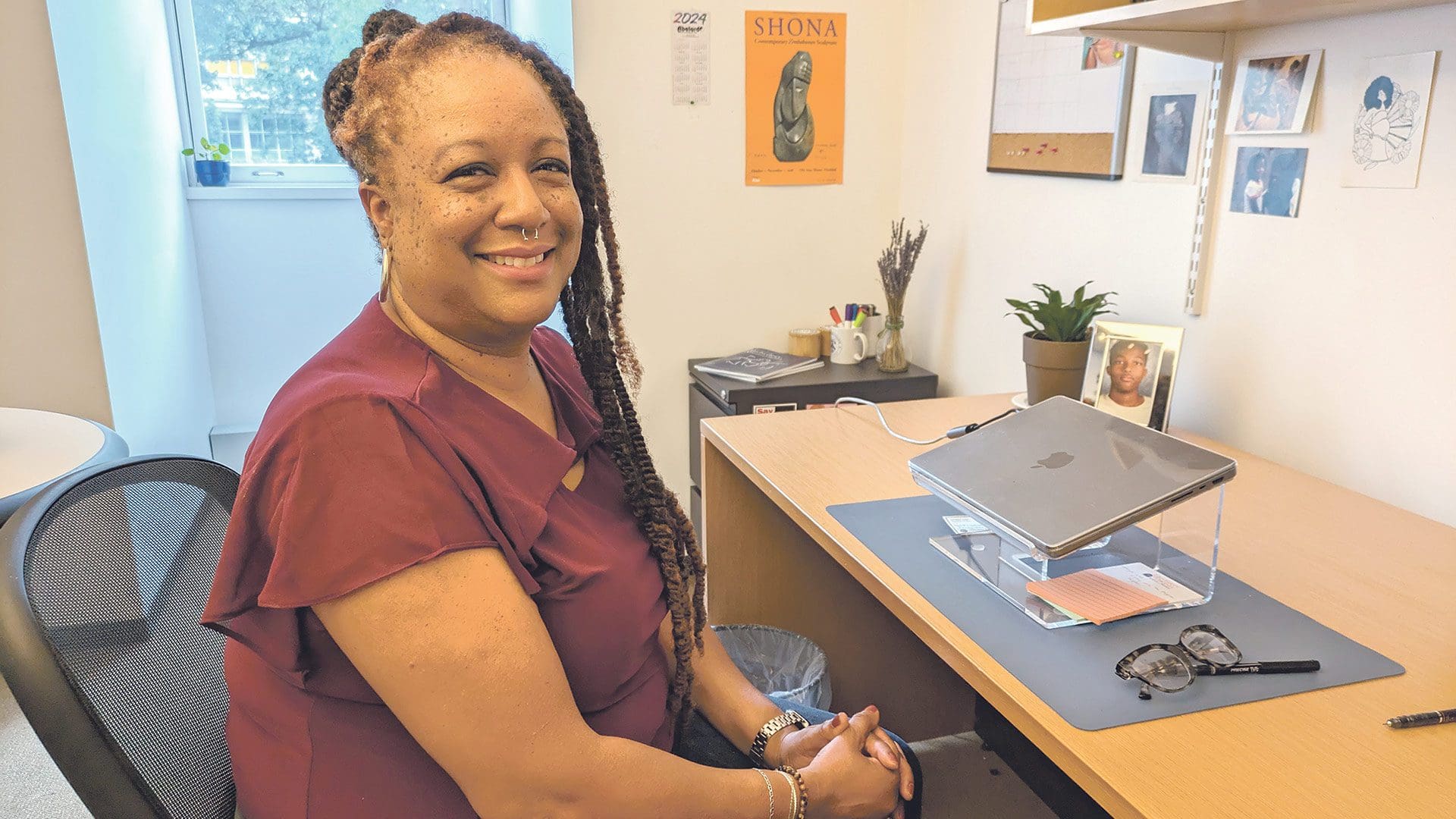
Lucinda Canty has created, in Lucinda’s House, a program that powerfully helps women of color while giving hands-on training to tomorrow’s nurses.
Vorderstrasse agrees, calling Canty’s scholarly contributions “vast and impactful,” adding that she has “published extensively in esteemed journals, providing evidence-based insights that are shaping the future of maternal healthcare. Her research is not just academic, but is deeply rooted in community engagement, ensuring that her findings translate into practical applications that directly benefit the communities she serves.”
This research, in fact, influences the Seedworks Health Equity in Nursing Program, which began in 2022 as an effort to increase diversity in the nursing world.
“It’s recruiting students, but it’s also supporting them from their freshman year all the way up until they graduate. So it’s involved mentoring,” Canty explained, adding that it’s not just professors doing that; upperclassmen also mentor incoming students.
“Sometimes you’ll have programs that want to increase diversity, and the students come in, and they feel very isolated through that, or they don’t feel supported. So it’s really about changing that environment so they can see that they belong here and they belong in nursing. Our goal is to increase diversity, not just to say, ‘oh, look, we have a few people of color,’ but to say, ‘look, we have people who have something to offer to nursing.’ And as they’re going through, I want them to see what they have to offer.”
Heart of the Matter
A focus on community is at the heart of that model, Canty said, but when it comes to direct community impact, Lucinda’s House — where her nursing students get hands-on experience in community-based healthcare — has been a game changer for many women since it opened in 2022.
“When I finished my research, I started to see how many things could have been prevented just in the experience of care,” she recalled. “And I felt like I needed to do something.”
Lucinda’s House, according to the description Canty wrote for its website, is a collective space where women of color can discuss sensitive issues related to their health and bodies, while developing their own solutions. “We understand the challenges Black mothers face in the healthcare system and know that changes can occur when the members of the community come together to address issues that prevent Black women and other women of color from maintaining a level of wellness.”
“When I finished my research, I started to see how many things could have been prevented just in the experience of care. And I felt like I needed to do something.”
One of the standout programs at Lucinda’s House is its community baby showers, which provide pregnant women of color with essential resources and support. The showers have been held in underserved communities, ensuring that women receive the care and support they need, both during pregnancy and postpartum.
Canty’s innovative approaches also include the Perinatal Loss Program, which offers health education and support in a safe space for women to discuss their needs and receive the necessary support for healing, including support groups that use creative forms of expression to promote healing.
Lucinda’s House also hosts Community Conversations exploring Black women’s views on factors impacting hypertensive disorders of pregnancy. These storytelling events capture the experiences and beliefs of Black women to develop community health-education programs tailored to their needs.
“What I found, being in the community through my research, is that people just want to tell their stories,” Canty said. “They want someone to listen to them. They want you to understand what they went through, to be able to share and say, ‘this is what happened to me,’ and not be judged in that. At Lucinda’s House, you’re going to be receiving non-judgmental support. Just tell me what it is that you need so that you can better take care of yourself.
“I’m not going to tell you, you’re going to tell me,” she went on. “And from that, I also don’t say, ‘this is what you need to do.’ I give them the opportunity to get the information and let them make the decision. And if they have questions from that, they can let me know.”
Connecting with women, both culturally and emotionally, but also giving them autonomy in the healthcare system has been incredibly powerful, she added. And she’s not only working with first-time moms, but many who are in their second or third pregnancy but are dealing with trauma from a previous pregnancy.
“I don’t turn anyone down,” she said. “I provide support that helps someone’s mental health and well-being, but if they have trauma, I know a social worker, a psychologist, I know people that I can refer them to.
“And that’s the other piece — I have a network of support,” Canty went on. “I’m grateful for that because it’s overwhelming to try to do something and address an issue like maternal health all by myself, or diversity in nursing all by myself. To have people support that strengthens me and strengthens the work that I’m doing. This is not something that I’m just doing on my own.”
Bottom Line
Vorderstrasse recognizes the value of this body of work, not just for the students at the Elaine Marieb College of Nursing, but across the entire community.
“Her work is directly impacting the health and well-being of women in our community, and her influence is shaping the future of healthcare providers,” she wrote. “Dr. Canty’s unwavering dedication to improving maternal health outcomes, her innovative educational programs, and her relentless advocacy for health equity make her a true Healthcare Hero.”
Yet, Canty never set out to earn that title; she’s just following her passion and proving every day that choosing nursing over cooking was a great decision.
“I feel like things just fell into place, and I’m doing something that I love,” she told BusinessWest. “I have friends who have good positions, but sometimes they feel like they’re not 100% happy with what they’re doing. I can really say that I feel good about what I’m doing. Sometimes I feel like it’s a dream — but it’s real.”