Community Spotlight

Marc Strange considers it “disappointing” that the majority of the town wasn’t ready for a charter change.
When Marc Strange came to Ludlow as town administrator in the spring of 2022, he saw an opportunity to take a leadership position in a bustling community and use his experience and skills — he was formerly director of Planning and Development for Agawam and selectman in Longmeadow — to effect change in this community.
One big proposed change is not happening, but there’s still plenty on his plate.
“When I applied for the job, the number-one priority was the change of government,” he said of a push to change the town’s charter and system of government — now a board of selectmen and representative town meeting — to one many felt was more befitting a community of roughly 21,000 residents, either a town manager and town council, a mayor and city council, or perhaps a hybrid model.
“That’s been a focus of mine, although I wasn’t involved in the creation of the charter,” he told BusinessWest of the effort by a charter-review committee that eventually settled on a town council/town manager model, which included the hiring of the Edward J. Collins Center for Public Management to guide the process and a series of public forums. “I took it upon myself to make sure we were pushing toward on that, putting in the request to fund a consultant and just keep that ball moving.”
But the ball stopped rolling at a town meeting earlier this month, when the charter and the government change was voted down, 41-29.
“That just means that we’re going to continue status quo, the way we’ve been operating,” Strange said. “It’s disappointing because the charter committee put together a good charter, but the town just wasn’t ready for the change. The town manager would have replaced the board of selectmen, and then a town council would have replaced town meeting as a legislative body. You’re just able to get things done quicker.
“All the surrounding towns have grown, and that has contributed to our growth. And the town of Ludlow has grown tremendously since we started.”
“We have about 21,000 people, and a $84 million budget. We’re really a small city. It certainly has a town feel to it, but in terms of the form of the government, the structure of the government, I personally think it would have been more efficient to make the change. But the town meeting didn’t see it that way.”
For many town-meeting participants, Strange said, it came down to a question of representation.
“There are a little more than 100 members, technically, but there there were 70 at this town meeting. You’re going from that many people and that many voices down to a seven-member town council. I think the overriding sentiment was, the more voices you have, the more democratic a process.”
Still, he added, “Easthampton is a city, Palmer is a city, Southbridge is a city. These are smaller towns, smaller than us, that have city forms of government.”
Strange had other goals when he was hired in 2022, including efforts to make the government more efficient, which has included balancing out staffing and combining the treasurer’s and collector’s offices, and development efforts downtown.
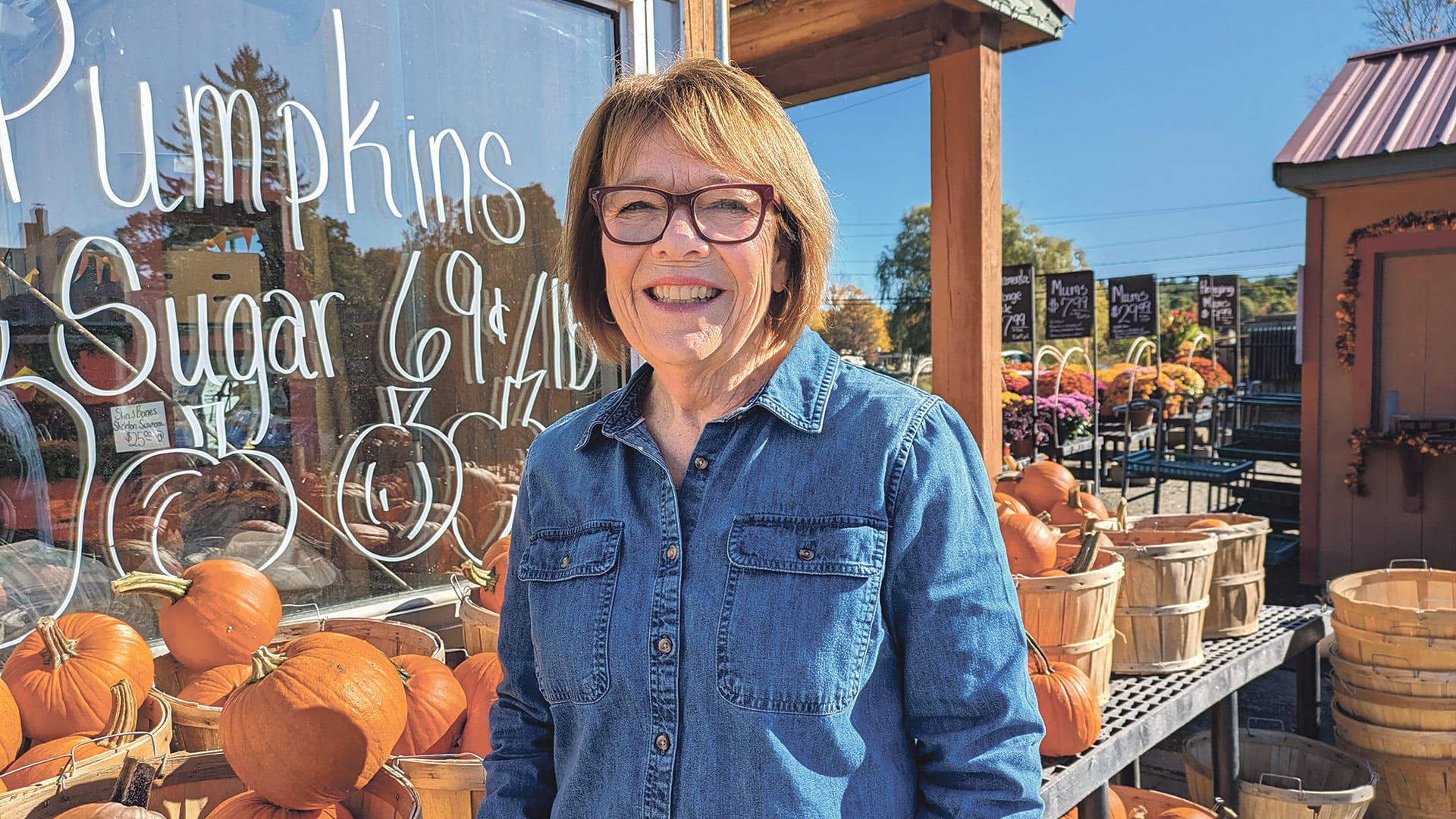
Karen Randall says location is her business’s number-one asset.
“I grew up in the economic-development world, in municipal government, and that’s one of the reasons why I was so excited to join Ludlow,” he said. “There’s so much potential here.”
Location, Location, Location
Karen Randall has certainly seen plenty of change in Ludlow, most of it positive. In 1962, her father built the first store at Randall’s Farm, and in 1997, the building underwent a significant expansion, including a greenhouse and big produce department.
The business also added “a postage stamp of a kitchen,” she added, which would turn out to be entirely inadequate as the bakery, deli, and prepared-food operations took off as people’s lifestyles changed.
“Center Street, where the pike exit is, is pretty built out and super busy. There are a lot of businesses there. But the downtown area, I feel like we need to really focus on that, because residents’ quality of life will rise if we can create a more exciting downtown area.”
“The kind of customers we have are mostly local customers. They’re on their way home or on their way to work, and it’s very convenient for them to have home-cooked food — not cooked in their home, but cooked in our home. We prepare everything from scratch, for the most part. And that department just went way beyond our expectations. It’s almost 40% of everything we do now, which we never saw coming. The garden center is still a big part, and produce is still a huge part, but prepared food was a surprise.”
Guests also come for the homemade hard ice cream, as well as family activities that peak in the fall with pumpkin decorating, scarecrow making, and seasonal games. Randall said the farm draws regulars from a roughly 20-mile range, from communities like Longmeadow, Westfield, and Enfield, Conn. “Sometimes people make a weekend trip just for their groceries. We have a lot of specialty grocery; we do a lot of gluten-free and allergy-friendly food. We have a big following for that.”
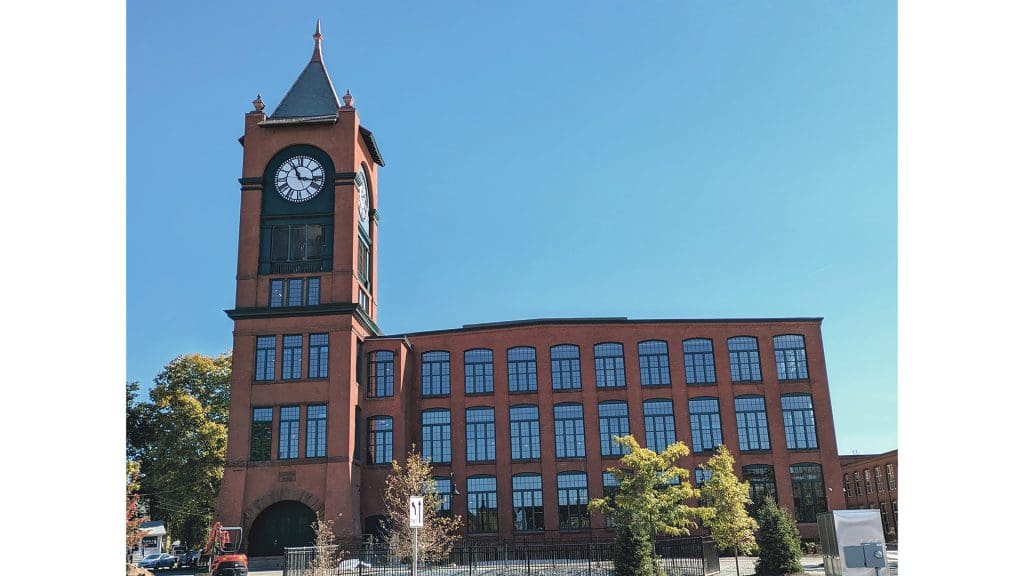
The Ludlow Mills project, with its mix of housing, businesses, and the restored, iconic clocktower, continues to progress each year.
But after talking about what Randall’s Farm offers, she was quick to explain what Ludlow itself offers — notably its location off Mass Pike exit 54 and near a number of growing residential communities. It also benefits from its own growth, with new residential developments in recent years (more on that later).
“We’re in a great location. Location, I would say, is our number-one asset,” Randall told BusinessWest. “Having the turnpike less than a mile away, people in the surrounding towns who are using the turnpike drive by us very often. Belchertown has grown, all the surrounding towns have grown, and that has contributed to our growth. And the town of Ludlow has grown tremendously since we started.
“It’s a great community to have a business in, with great people. The town gives us excellent young employees; we have a lot of people that start in high school, and hopefully they stay while they go to college and come back and work holidays or weekends or summers,” she went on. “Some of our young employees stay with us for six years or so until they graduate from college, and then we hate to lose them. They become nurses and engineers and go on to their careers, and they leave a big hole for us because they were excellent employees.”
Ludlow at a glance
Year Incorporated: 1774
Population: 21,002
Area: 28.2 square miles
County: Hampden
Residential Tax Rate: $18.09
Commercial Tax Rate: $18.09
Median Household Income: $53,244
Median Family Income: $67,797
Type of Government: Board of Selectmen, Representative Town Meeting
Largest Employers: Hampden County House of Correction; Encompass Rehabilitation Hospital; Massachusetts Air National Guard; Kleeberg Sheet Metal Inc.
*Latest information available
All that said, “the business is doing well,” Randall noted. “We continue to grow and change with the trends and what customers want and what other stores like us are doing. We try to stay in tune with what’s happening so we can deliver the best to our customers.”
Downtown Developments
The town has been focusing on its downtown area in recent years as well, not just at Ludlow Mills, but in the East Street corridor, where it has planned extensive infrastructure improvements to make the street more safe, pedestrian-friendly, and aesthetically pleasing, as well as expanding its District Improvement Financing (DIF) area, which had previously covered just the footprint of the mills, to East Street.
“Our East Street corridor is sort of our Main Street, and there are a lot of small businesses there that have a loyal following and are very popular,” Strange said. “So we created a DIF last year so, with any developments made in that district, instead of that additional tax revenue going into the general fund, we can keep it in the district for infrastructure improvements.
“I’m really looking forward to being able to improve the look and the feel, but also the infrastructure of East Street. We’re also going to be repaving the roads around down State Street, which is where the mills are, then around to East Street,” he added. “Center Street, where the pike exit is, is pretty built out and super busy. There are a lot of businesses there. But the downtown area, I feel like we need to really focus on that, because residents’ quality of life will rise if we can create a more exciting downtown area.”
One of the most recent business openings on East Street is BarBurrito, a new restaurant venture from Bill Collins, owner of Center Square Grill in East Longmeadow. “We were thrilled to see BarBurrito come in,” Strange said. “Bill Collins has established businesses that are popular, so to have him come invest his money into East Street, I was really excited to see that.
“There are a lot of small businesses on East Street that have a loyal following, but we do have some storefronts that tend to turn over,” Strange added. “So we’re really hoping to, again, raise the excitement level of the downtown area, beautify it, and have more businesses like BarBurrito come in and build out those storefronts.”
As for Ludlow Mills, that remains an ongoing process, one that began two decades ago and ramped up when Westmass Area Development Corp. acquired the property 13 years ago. The 95 residential units at Mill 8 should be complete next month, complimenting the 75 units in Mill 10 and a series of commercial developments across the complex’s footprint. Meanwhile, the clock tower in Mill 8 completed its renovation this year.
“Every single year there’s something. There’s always cranes and activity down there. It’s exciting, and I think it gets people excited about the future,” Strange said, noting that the new residential units are for age 55 and up, and there is a great need for that kind of housing locally.
“I can see a vibrant downtown in Ludlow,” he added. “We have a lot of beautiful residential areas, particularly in the mountains and certainly closer to downtown as well. The clocktower so iconic. I remember, before I started here, coming over the bridge to go to Randall’s and looking to the right and seeing the clock tower. It just made you feel like you had arrived someplace. Now we have corporate resources that are putting money into the area.
“I’m really excited about what the downtown could be,” Strange went on. “I feel like, if we can complete the downtown and update it, revitalize it, and make it exciting, it’s really going to make a difference for Ludlow. That’s my focus.”