
Home Posts tagged Peter Banko
Healthcare News Special Coverage

Turning the Battleship

Peter Banko says that, despite a mountain of challenges, the Baystate Health system has achieved needed momentum.

Peter Banko says that, despite a mountain of challenges, the Baystate Health system has achieved needed momentum.

Peter Banko was asked if he was frustrated.

He would certainly have good reason to be.

After all, Banko, president and CEO of Baystate Health, had spent the past 17 months or so trying to right the ship at the system — “turning around a battleship in a bathtub,” as he would later tell the audience at a forum on the state of the healthcare sector in the region — and had made a good amount of progress through difficult and unpopular decisions that included layoffs, cutbacks in many departments, and, most recently, buyouts for many employees, resulting in a profitable fiscal 2025.

But by his estimation, provisions within the One Big Beautiful Bill Act (or OB3, as he calls it), signed into law last July, will cost Baystate Health $146 million a year through its specific provisions and their aftereffects, and essentially wipe out all that’s been accomplished and bring the system back to where he started in terms of the size of the hole to dig out of.

“Those reductions wipe out our positive cash flow in one fell swoop,” said Banko, noting that the system exceeded budget expectations for fiscal 2025 and recorded a 3.6% EBIDA (earnings before interest, depreciation, and amortization). “We exceeded our budget expectations by about $50 million; it was the first time we exceeded our budget in six years. But whatever progress we made this year gets eliminated by the One Big Beautiful Bill; we’re down to zero again, and we start from scratch.”

“We’ve got a lot of great work going on behind the scenes that isn’t glamorous and won’t make headlines, but it’s the right work. I feel more optimistic than I’ve felt in a long time.”

So … while frustration would certainly be understandable, and the picture for 2026 is bleak by most accounts (more on that later), he prefers to be upbeat — to a degree.

“That’s because I believe we’ve created some momentum,” he said. “I’m happy with the momentum we’ve created. We’ve got a lot of great work going on behind the scenes that isn’t glamorous and won’t make headlines, but it’s the right work. I feel more optimistic than I’ve felt in a long time.

“I feel like we have the team and the committed board and committed team members that are willing to do the tough work and make the difficult decisions for it to be successful,” he went on, adding that there are certainly more difficult decisions to be made, and more consolidation likely in the healthcare industry — and 2026 is shaping up to be an ultra-challenging transition year for hospitals.

But, overall, he believes the ship has been turned and is positioned to navigate the turbulent seas that are forecasted.

For this issue and its focus on healthcare, we talked at length with Banko about the progress that’s been made, how much of that progress stands to be undone by the OB3, and what happens next as he continues the turn-around assignment he assumed in the fall of 2024.


Time of Transition

Banko said the One Big Beautiful Bill Act will result in $1 trillion in cuts nationally and represents “the largest rollback to federal support for healthcare in our lifetimes.”

Most of the impact to the Baystate system will not kick in until October, a month before the midterm elections, he went on, adding that online estimators project that the overall impact to Baystate will be more than $140 million. Broken down, these cuts involve everything from sharp increases to the number of uninsured individuals from Medicaid and the Affordable Care Act to a decrease in funding from Medicaid (MassHealth), to a loss of funds from the 340B Drug Pricing Program.

The impact to the system — and all providers — will be profound, he said.

Valley Springs Behavioral Health Hospital, one of Baystate Health’s most significant recent projects, opened in Holyoke in 2023.

Valley Springs Behavioral Health Hospital, one of Baystate Health’s most significant recent projects, opened in Holyoke in 2023.

“A lot of people won’t have insurance, so they won’t have access to coverage or financing,” he explained. “They’re going to delay care, and they’re increasingly have to use the ED when things are really serious, so we’re going to have more overcrowding. It would be shortsighted to say that this will most significantly impact the poor and vulnerable in our community; if you have commercial insurance, you can expect double-digit increases in your premiums the next five years because commercial insurance makes up the difference for Medicare and Medicaid.

“If you’re an employer in this state or anywhere in the United States, you’re going to be paying more for your insurance to cover the gaps here,” he went on, adding that, for systems like Baystate, the impact will be felt in the ER, certainly, but in other realms as well.

When asked to make projections on what will happen across the system and its four hospitals — Baystate Medical Center, Baystate Noble Hospital, Baystate Wing Hospital, and Baystate Franklin Medical Center — Banko said it’s too early to do so, with the specific impacts not likely to be known until the provisions of the bill take effect.

And that won’t be until almost a year from now, he went on, adding that, in most respects, 2026 will be what he called a “transition year.”

“It will be like preparing for a snowstorm,” he told BusinessWest before extending the metaphor further. “Everyone is going to be buying milk and bread and snow shovels; there’s going to be a lot of preparation and action in anticipation of next year.”

When asked how a system prepares for the storm that’s coming, he said the system will continue to make additions and adjustments in the ER in anticipation of more people using that front door instead of primary care.

“We’re aggressively recruiting nurses and physicians for the ER, and we’re working on improving our throughput in the hospital, which impacts the ER,” he explained. “We’re working on improving access and throughput, which will help.”

Overall, he said the system itself will manage, but he’s concerned about the human toll for the cutbacks and their impact on the overall health of the community.

“It will be like preparing for a snowstorm. Everyone is going to be buying milk and bread and snow shovels; there’s going to be a lot of preparation and action in anticipation of next year.”

“Let’s consider this from the humanistic end — someone who had coverage now doesn’t,” he said. “They may be in the middle of cancer treatment; they may be in the middle of a pregnancy. A few months from now, they get diagnosed with a condition, and they delay care, or they’re feeling symptoms, and they know they can’t afford care. From a community standpoint, we’re worried about the impact to the most vulnerable people in our community.

“How do we look our community in the face and say, ‘15% to 25% of you no longer have coverage,’” he went on. “This state has worked so hard, going back to Governor [Mitt] Romney, to provide care for as many people as possible — it’s hard to say all because some people fall through the cracks — and now, it’s all being dismantled.”


Bottom Line

And it’s unlikely there will be much, if any, help coming from Washington, Banko opined, noting that, for now, both sides consider what’s happening to be a “political win,” which makes action before the midterms unlikely in his view.

“Behind the scenes, I think everyone knows what the right things to do are,” he went on. “But OB3 has become a political football, so the folks left holding the bag are our governor and our Legislature — they’re going to have to fill a huge budget gap, $4 billion to $5 billion, and I don’t envy them having to try to figure that out. And our healthcare systems are left holding the bag because it impacts us most severely. Who gets lost in this are the people losing coverage — I’m not sure they have a voice at the moment.”

As for the Baystate system itself, Banko said that, when it comes to the progress made in 2025, budget-wise, roughly half is attributable to cost cutting, with the other half coming from revenue growth.

“We saw decent growth in our business last year, above what our expectations were,” he noted, adding that this growth came in ER volume, surgical volume, inpatient volume, and other realms. “More than half our financial improvement was solid revenue growth.”

Looking ahead to 2026, he’s projecting revenue growth of 2% to 3%, with expenses growing 6%.

“And in any business, that’s not a recipe for success,” he went on, adding that the system has identified core growth areas, including overall access to care.

“We lose a lot of our patients to Boston because they can’t get in here. So if we can grow revenue by 6% to 8% and trim some of our costs, that will allow us to stay in the game,” he explained, adding that there will be more cost cutting in the year ahead — at Baystate and most other providers.

There will also be some less profitable services cut back or eliminated by many providers, he said, as well as continued consolidation within the industry as systems look for all-important scale in the wake of the rising costs of doing business.

“We’re talking to a lot of organizations, and with each one, I have a confidentiality agreement that I can’t violate,” he said, withholding comment on rumored talks between Baystate and Mercy Medical Center. “So, I would just say this … everyone is talking to everyone right now. There isn’t a week that goes by that I’m not having a discussion with a competitor, someone in an adjacent market, someone in a non-adjacent market.

“Everyone is viewing the changes from OB3 as transformational, so everyone is trying to figure out the same thing,” he went on. “We’re all talking to one another about, ‘hey, how do we manage this?’ Or ‘can we manage this better together?’”

There is some evidence that scale has not worked out in healthcare, at least as much as it has in other industries, he continued, adding quickly that he believes scale does bring advantages; systems just need to seize those advantages.

“Our overhead costs are about 12.9%,” Banko explained. “Without more scale, we can bring that down to 10%, but best-practice health systems are below 8%, and there’s no way we can get below 8% without more scale.”

In the meantime, and as he mentioned earlier, he senses real momentum across the system, progress in many ways overshadowed by large headlines about layoffs and buyout programs.

“What gets published in the media is just the financial stuff,” he told BusinessWest. “So when we do a layoff or cut costs somewhere, that gets all the media attention, and it gets all the attention inside the organization. But I would say that 80% of the work is non-financial, and we’re making real progress.”

Daily News

SPRINGFIELD — Peter Banko, president and CEO of Baystate Health, today announced that, as part of an ongoing “transformation” at the healthcare system, another 43 jobs will be eliminated, on top of the 7% reduction in the overall workforce that has been implemented since last fall.

In a prepared statement, Banko said the positions eliminated were “selected to minimize impact to direct patient care.” There was no further information on where the cuts will be made.

“This week we will complete one of the most disruptive components of our transformation journey in FY25 — reducing our workforce,” said Banko. “Since November 2024, we have had to make some very difficult decisions to reduce our workforce in total by 7%, and while this directly impacted a significant number of our team members, 60% of the total reductions were realized through attrition, a gradual reduction through resignations or retirements with elimination of those positions by not filling the vacancies.

“Even with this ongoing focus and disciplined approach to attrition, we did have to make the difficult decision to eliminate positions within Baystate Health this week, and as a result, 43 individuals will be leaving Baystate Health,” he went on. “Individual discussions with those impacted will be completed no later than Friday, May 2.”

Eligible team members who are not transitioned to another position in the organization will receive severance pay and other job support, including access to career transition services, he said. “We deeply understand the profound effect these transitions have on our people, their families, and our community as the anchor employer in Western Mass. We continue to aggressively recruit, hire, and retain physicians, advanced practice providers, and bed-side caregivers.”

Banko stressed that Baystate’s transformation is ongoing.

“Since launching our core operations improvement journey in October 2024, we are seeing meaningful and measurable progress — both in the success of our transformation efforts and, most important, in our progress toward long-term consistent and predictable financial resilience,” he noted. “In late February, we met with the Fitch Rating Agency — one of the “Big Three” nationally recognized rating organizations designated by Wall Street — and they affirmed our A+ credit rating with a negative outlook. The rating came as a timely, objective affirmation that Baystate Health continues to be a very high-credit-quality health system with a strong capacity to meet all our financial commitments.

“The rating also attests to the decisions we have made and the new processes we have established regarding our organizational structure, streamlined decision-making, management spans and layers, the efficiency and effectiveness of corporate functions, contract and premium labor, and external spend,” he went on. “The transformation workstreams to date — coupled with a busy respiratory season and increased emergency department volume and surgical throughput — has resulted in four consecutive months of positive operating margin and cash flow for the health system. I am so proud of a true team effort — all our incredible caregivers — individually and collectively contributing quickly to turning the corner toward a renewed, healthy, growing, and independent future for Baystate.

“We have more work to do to achieve sustainable financial transformation and re-invest more than $1.2 billion in our people, services, and technology over the next six years,” he continued. “We are currently actively working on redesigns in supply chain, pharmacy, and revenue-cycle management. This summer, we will start planning for FY26 by focusing on the physician enterprise (Baystate Medical Practices) and care management (including acute length of stay management) across the enterprise. At the same time, we will initiate an intentional implementation of Baystate Health 2030 (our new strategic plan) to grow our hospitals and service lines, integrate Health New England, and more supportively engage, retain, and develop our employees.”

Features Special Coverage

Goal to Go

Peter Banko

Peter Banko

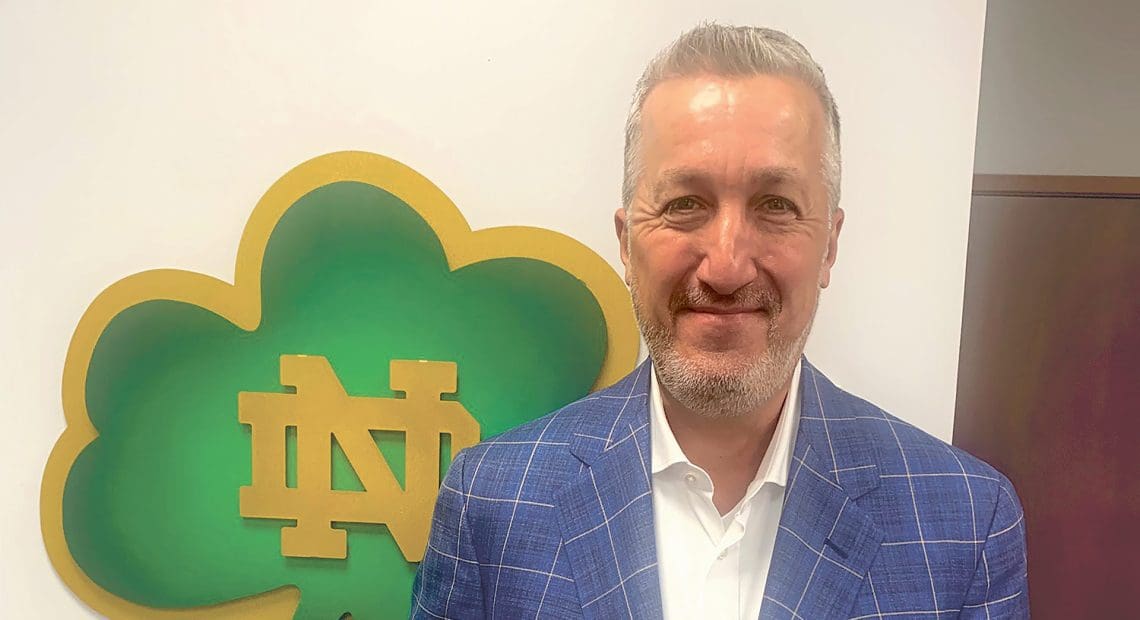
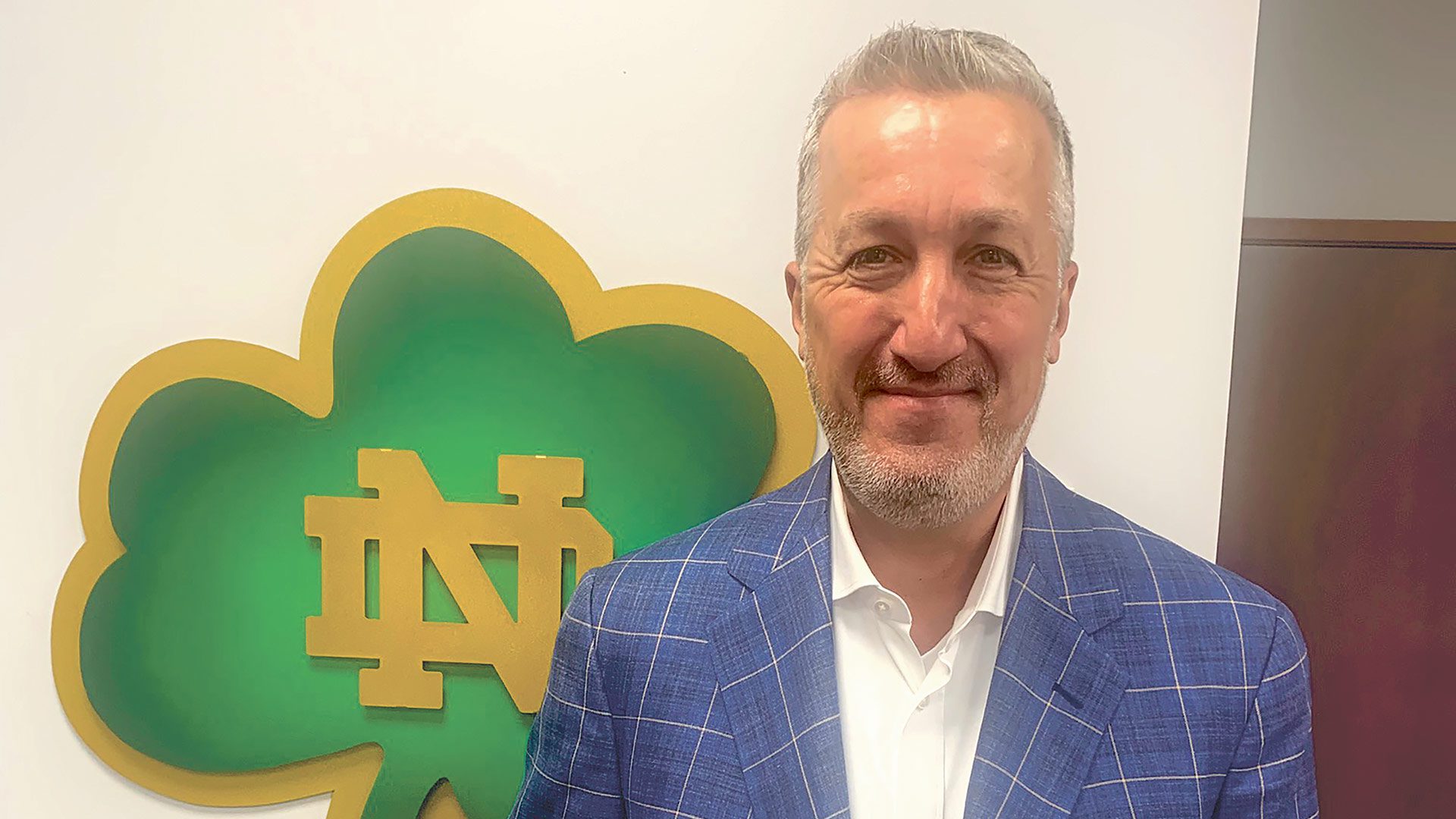
Peter Banko earned a bachelor’s degree at Notre Dame in the late ’80s.

And as with most people who attend that university, his connection to it — and its football team — remains quite strong, manifesting itself in many ways.

Indeed, his office on the sixth floor at 280 Chestnut St. boasts everything from signed photos of players from his era — including one of Pat Terrell, who famously broke up that two-point conversion in the so-called ‘Catholics vs. Convicts’ game against the University of Miami in 1988, Banko’s senior year — to a replica of the famous ‘Play Like a Champion Today’ sign that players smack as they exit the locker room. Meanwhile, he has season tickets and goes to most games in South Bend each fall.

But the connections to Notre Dame don’t end there, and they extend, coincidentally, to his eventual arrival at Baystate Health, where he took the helm as president and CEO on June 3.

As Banko tells the story, he was standing in line at the men’s room at Notre Dame Stadium during the game against USC last October when the person two ahead of him in that line, someone who places executives in healthcare systems, started talking about the top position being open at Baystate, and how he might want to think about pursuing it.

“In meeting with the board and others, what came across was a commitment to mission and community. The academic nature, but also the community nature of the system was very attractive.”

“He turned around and said, ‘hey … are you open to looking at something?’ I said ‘yes,’ and he said, ‘Baystate,’” Banko recalled. “I said, ‘in Springfield?’ and he said, ‘yeah.’” (More on this later.)

And then … well, there’s his commitment to taking the Notre Dame family’s philosophy, if you will, about taking care of one another — long after they’ve graduated or stopped playing football — to healthcare in general, and now to Baystate Health.

Baystate Medical Center

Peter Banko says these have been difficult times for Baystate Health and its flagship hospital, Baystate Medical Center, but the system’s goals are “within reach.”

“There’s a way that you’re indoctrinated, that you take care of each other,” he said, referring those who are called ‘Domers,’ a reference to the campus’s famous golden dome. “From a healthcare perspective, this is a people business, and we have to take care of the people who provide the care. That’s the business lesson learned — you take care of the people; the rest works itself out.”

Putting aside all the Notre Dame memories and connections for a moment, Banko said he came to Baystate because he was well aware of its strong reputation within the industry and wanted to be part of it.

“I’m also having fun again. Sometimes big is not great,” he said, adding that he wasn’t having much fun — or, at least, not as much as he used to — at Centura Health in Centennial, Colo. (which he served as president and CEO), which is part of the massive, $4 billion CommonSpirit Health system.

How much fun he has at Baystate will likely be a function of how well the system, which consists of four hospitals — Baystate Medical Center, Baystate Noble Hospital, Baystate Wing Hospital, and Baystate Franklin Medical Center — as well as several neighborhood clinics and other community-based services, fares with the many challenges facing all healthcare systems today.

“I heard someone say I’ve got the toughest job in town, and I said, ‘no, I’ve got the easiest job in town; I’ve got a great group of people.’”

These include workforce issues, which started before COVID and were amplified by the pandemic; inadequate reimbursements from public payers; and, in general, maintaining a healthy bottom line.

Perhaps the biggest of those challenges is building and maintaining a workforce, he said, adding that a number of factors, from retiring Baby Boomers to COVID-induced burnout that prompted many to leave the industry, are conspiring against healthcare providers on this front.

“We’re facing all the demographics — people are retiring, and there aren’t people replacing them,” he said, adding that Baystate’s status as a teaching hospital will likely be an advantage as it confronts these workforce issues moving forward.

As for financial challenges, he takes over a health system that experienced an operating loss of $178 million in FY 2022, lost $63 million on operations in FY 23, and saw operating losses carry over into FY 24. Nonetheless, Banko sees light at the end of this tunnel.

Peter Banko says workforce issues are the biggest challenge

Peter Banko says workforce issues are the biggest challenge facing Baystate Health, and all healthcare providers, today.

“We’re poised and in a good situation, even though we’ve had a couple of rough years,” he went on. “Folks have said, ‘yeah, it’s been really rough here. I said, ‘well, if it was too rough, I wouldn’t have come.’ We’re poised to do some really good stuff.”

Overall, he said his primary goal is to build on the solid foundation put down his predecessor, Dr. Mark Keroack, and take full advantage of the system’s many assets, especially its core of physicians and clinicians.

“As I told the board then and I keep telling people now, I can move mountains with the group of physicians we have here,” he told BusinessWest. “We can do anything.”

For this issue, we talked at length with Banko about healthcare, the challenges facing the industry, his plans for meeting them head on, and, yes, Notre Dame football and all those connections to his alma mater.


His Chosen Field

Banko calls it his “week of fame.”

It came in 2006, when he was serving as administrator of the CHRISTUS Spohn Health System in Corpus Christi, Texas, and it started when he got a phone call alerting him that Vice President Dick Cheney had been shot while quail hunting and had been taken to what was known then as Corpus Christi Memorial Hospital, part of the system. Upon arrival, Banko found out that wasn’t the case, and also that, while no one was saying it out loud, let alone officially, it seemed that Cheney had likely shot the person who was in his hospital.

“I did a few interviews with national news outlets that evening on the phone, and I came in the next day at 6:30, and every news outlet on the planet was parked outside the hospital,” he recalled. “I did all the press conferences every day; I had a direct line to the White House.”

And what he remembers as much as those press briefings and his hotline to 1600 Pennsylvania Ave. is how his doctors eventually solved the mystery surrounding the victim’s heart-attack-like reaction to the shooting.

“We couldn’t figure out what it was,” he recalled. “We had doctors in from three major teaching hospitals and the White House. I was in the cath lab with seven cardiologists and three heart surgeons on our side, and one of our docs found an obscure article about a Vietnam vet who had shrapnel in his heart, and years later he had the same symptoms. So they treated him based on that one article.”

The rest of Banko’s career has brought considerably less fame, if you will, but myriad rewards and rich learning experiences. And except for one very brief stint in the private sector, as he called it, he’s spent that career in healthcare administration.

He actually got his start in healthcare as a junior volunteer in his home state of New Jersey while attending Notre Dame. His specific assignment was patient transport, which enabled him to meet hundreds of people and compile a large portfolio of stories.

“I had a lot of great conversations, and I learned a lot,” he said, adding that the administrator of the hospital — a Notre Dame football fan — told him he a knack for health leadership.

“Being an academic center has put us in a better position. We can more easily work with the universities and colleges, we can partner more, and we have that academic setting where we can train and keep our own, which puts us in a unique position.”

“I said, ‘I don’t even know what you do,’” he recalled. “She spent a few hours with me and encouraged me down a path. So, other than one week working in a supermarket as a porter, I’ve never worked anywhere other than a hospital or physician group or health plan.”

After earning his bachelor of business administration degree at Notre Dame and his master of health administration degree from the Sloan Program in Health Services Administration at Cornell, where they take their football far less seriously, he worked in a succession of jobs in healthcare administration, starting at Saint Clare’s Health Services in Denville, N.J. Later, there were stints as president and CEO of CHI St. Vincent in Little Rock, Ark.; and at CHRISTUS Spohn in Texas.

With CommonSpirit Health, he spent nearly two decades in various capacities, including vice president of Southeast Operations and national chief integration officer, before becoming president and CEO of Centura Health, with facilities, including 20 hospitals, across Colorado, Kansas, and Utah.

“I was at CommonSpirit for 17 years, and I was ready for a refresh and a chance to do something different,” he said.

Which brings us to that encounter with the executive recruiter in the men’s room at Notre Dame Stadium.


New Team Leader

Banko said he was late, as in very late, to the game when it came to Baystate’s search for a successor for Keroack, but, with some additional encouragement from his executive coach, who once worked in the Baystate system and told him he needed to look into this opportunity, he hustled and became part of a large field of candidates. As noted earlier, he said he was familiar with the organization and its strong reputation within the industry.

“And in meeting with the board and others, what came across was a commitment to mission and community,” he told BusinessWest. “The academic nature, but also the community nature of the system was very attractive.”

He persevered through several rounds of interviews, including a lengthy discussion with the board about his vision for the system, and was chosen by the search committee in March.

Summarizing that vision, he said there are several components to it, everything from honoring a mission and legacy that dates back to 1883 to having a “more physician- and clinical-centered system”; from achieving growth and operating at scale to having a healthy balance sheet.

“We want to use our physicians and other clinicians to drive our strategy and what we do going forward,” he explained. “One of the things that impressed me being here and interviewing is that our cadre of physicians is one of the best I’ve seen in the country in terms of training, expertise, skills, and leadership.”

As for the bottom line, that balance sheet, he said COVID and its after-effects have obviously taken a toll on this and every other healthcare system across the country.

“But it’s all within reach,” Banko added. “Financially, our future is easily within our reach; it’s nothing that’s not attainable. I heard someone say I’ve got the toughest job in town, and I said, ‘no, I’ve got the easiest job in town; I’ve got a great group of people.’

“COVID wasn’t great, and the recovery afterwards has been worse, almost,” he went on. “We’re not facing any problems anybody else isn’t dealing with nationally — some more, some less — but I feel our future is attainable and within our grasp; we just have to go for it.”

Elaborating, he noted that, while all healthcare systems are facing the same issues and challenges, the solutions are local.

“The problems are generally the same … the solutions and how you work at them are very locally contextual,” he elaborated. “Workforce challenges in Boston are different than the ones we face here, but we both have them, and our solutions are not the same as what our colleagues in Boston are doing.”

As for those workforce issues he mentioned earlier, he said Baystate Health does have some advantages as it works to attract and retain talent, including its status as a teaching hospital, but also its location and comparatively lower cost of living.

“Being an academic center has put us in a better position,” he explained. “We can more easily work with the universities and colleges, we can partner more, and we have that academic setting where we can train and keep our own, which puts us in a unique position.

“Plus, this is a great area,” he went on. “It’s affordable, you can raise a family here, and that’s not true of a lot of places around the country.”

One of the keys to success with workforce moving forward is taking care of people, which includes the wages paid, but certainly doesn’t end there, he told BusinessWest.

“My view is that, if you take care of people and help them produce a good product, then growth and profitability will take care of themselves,” he said. “That’s where we have to start; we need to make sure that people want to work here and that we’re a workplace of choice and that we’re delivering a quality product for our community.”

Since arriving at Baystate, Banko says he’s been on a listening tour, one involving both internal and external constituencies, which will continue for the next several months.

What he hears, what he learns, and what he shares will all be part of a report to the board on his first 100 days at the helm, one that will update and likely add new layers of specificity to that vision he has for where this system can go in the years and decades to come — and how to get there.


Passing Thoughts

Getting back to those season tickets Banko has had since 2017 … there are four of them for each game, and he likes to share the wealth. And that includes work colleagues.

Which means some of his new team members will be journeying to South Bend in the autumns to come as the Irish pursue their first national championship since … well, Banko’s senior year.

They’ll also be contributing to another journey, one in which they’ll help write the next chapters in the history of this institution — a game with much higher stakes, and one for which he believes the winning formula is already in place.

As they say in football, it’s a matter of execution — and that will be a big part of Banko’s new job.