
The Road Ahead

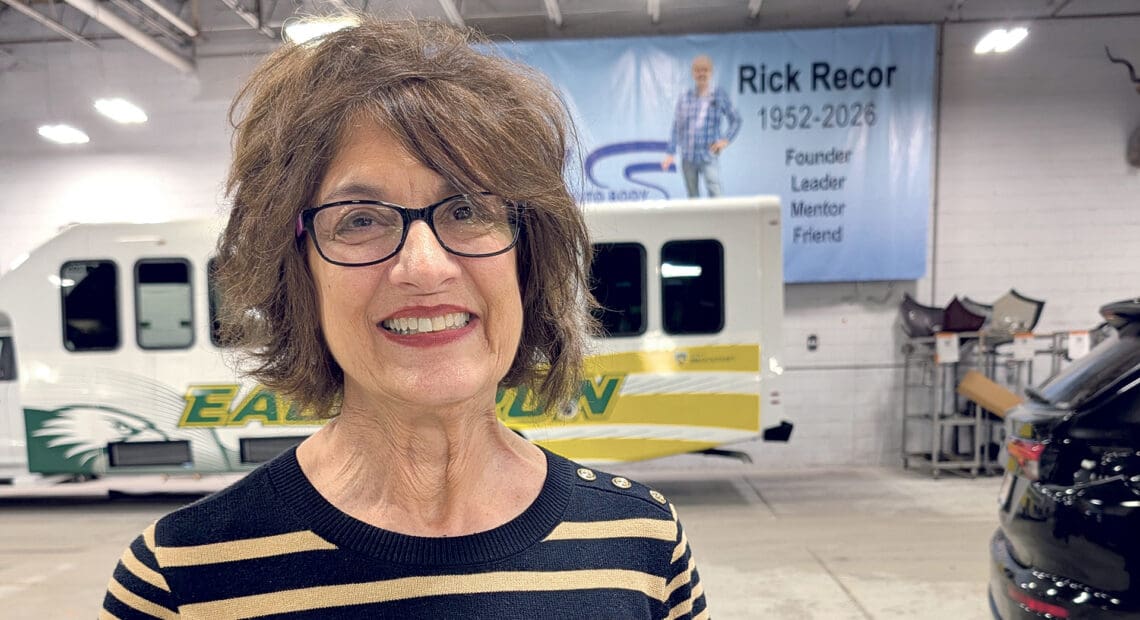
Owner Mari Tarpinian
When Rick Recor passed away on Jan. 21, it marked the end of a life well-lived.
But it did not mark the end of an era — if that’s what we can call a business that has grown and thrived for more than a half-century, and will continue to do so under the ownership of Recor’s widow, Mari Tarpinian.
“We’re very proud of this, and we still love what we do,” she told BusinessWest during a recent visit to Rick’s Auto Body, which has been headquartered on a sprawling Pasco Road property in Springfield for almost three decades. “Looking back after all these years, it’s definitely had its ups and downs, but we still love what we do, and we still want to live by what Rick would always say — ‘treat a customer the way you’d want to be treated.’ He’d say it all the time.”
Recor was a successful businessman, but he was also a cancer survivor, having fought off throat cancer that he developed in 2005. In the end, that medical history contributed to his death; radiation treatments two decades ago weakened his jaw, which fractured last year and needed replacement.
“He went to Boston to have the jaw replaced, and for most people — like, if you’re in an accident, and the jaw just severs — it’s a clean cut,” Tarpinian explained. But because Recor’s jaw had become necrotic, the situation was more dicey.
“Looking back after all these years, it’s definitely had its ups and downs, but we still love what we do, and we still want to live by what Rick would always say — ‘treat a customer the way you’d want to be treated.’ He’d say it all the time.”
“The pain was excruciating, but he still came to work every day. They had to replace the jaw with a metal plate, but while he was in there, he got a very, very bad strain of pneumonia that is very resistant to any kind of antibiotics.
“Then they thought he was beyond it, and then he would get another infection, and then they thought he was beyond that, and he got another infection,” she went on. “He was in the ICU for almost four months in Boston.”
Eventually, Recor succumbed to illness. In his final days, he only wanted to see a few people — family and the management team. And while he declined quickly in the end — and he and Tarpinian didn’t have as much time as they would have liked to discuss the business transition — they fully intended to keep the venture going.
“We’ve been approached so many times,” Tarpinian said of inquiries to acquire the operation over the years. “Not to be braggadocious or anything, but we’re known locally, we are known in the state, and we’re really well-known within the industry. There was an outfit from California, and they would have considered us one of their crown jewels because of our certifications and the financial commitments that we’ve made in our tools and machinery.”
But that’s not what Recor wanted — and it’s not what she wants.
“He still wanted to be an asset to our community, and he wanted to be locally owned and operated,” she said. “He always felt that was beneficial to the community, beneficial to the product that we put out, and beneficial to the customer service. Because we’re here. It’s not like a big conglomerate in another state buying up places, and they’re never there; it’s just for the portfolio.”
Indeed, Tarpinian and her dedicated team intend to be there on Pasco Road, continuing Recor’s legacy the best way they know how — treating customers how they’d want to be treated.
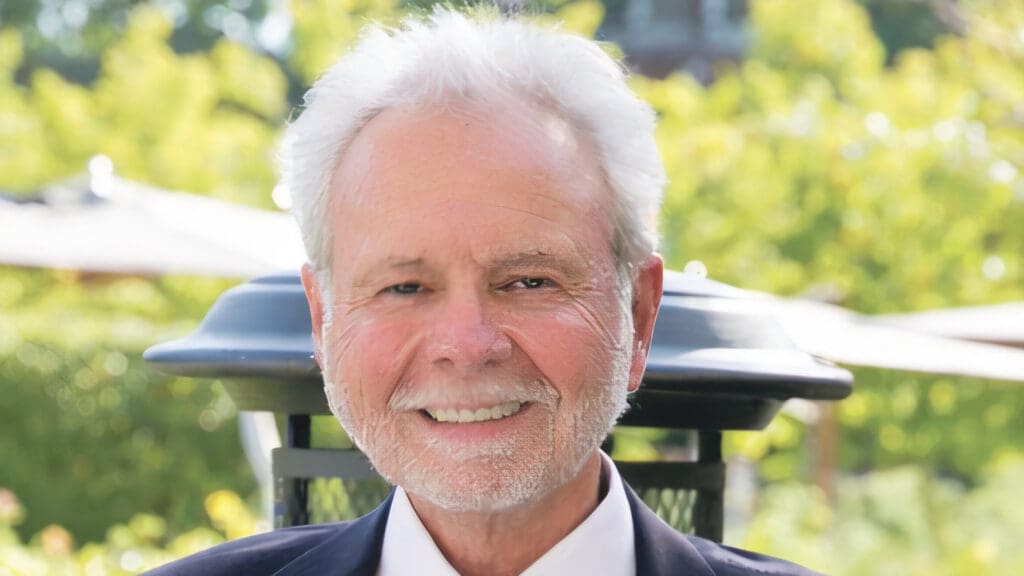
Rick Recor led the company that bears his name for 52 years.
Driven by a Passion
Born in Springfield in 1952, Recor was associated with the city his entire life — and developed a passion for cars at age 5, when he would follow his father to work.
In 1974, he went into business for himself, opening a small repair shop in a one-car garage behind Millie’s Pierogi on Broadway Street in Chicopee, which he called Rick’s Auto Body.
He steadily added customers and grew the business into progressively larger garages. In 1997, he moved into the current headquarters, a 40,000-square-foot facility that once housed Grossman’s Lumber.
“He still wanted to be an asset to our community, and he wanted to be locally owned and operated.”
There, he built a large family business; Tarpinian, who previously worked in the travel industry, came on board more than two decades ago, and her sister, Susan, has been the office manager for even longer. And that idea of family doesn’t refer only to blood relatives, Tarpinian said, but extends to a workplace culture where many of the roughly 45 employees have been there for decades — as she put it, “we have people from six months to 38 years and everything in between.”
Recently, the business added a 6,000-square-foot building that Recor never got to see completed, mainly to house parts carts. “When a vehicle’s being repaired, all the parts don’t come at the same time, and while we’re waiting for all the parts to come in on a particular job, those parts carts are in the way of us being able to book more vehicles to get repaired,” Tarpinian explained. “So he decided to build an annex.”
Recor ran the business differently than many in this industry, Tarpinian said, including a refusal to run what’s known as a ‘flat-rate shop,’ where employees are paid according to how much work they put out — a model that can prioritize speed over quality and an ‘everyone in it for themselves’ mentality.
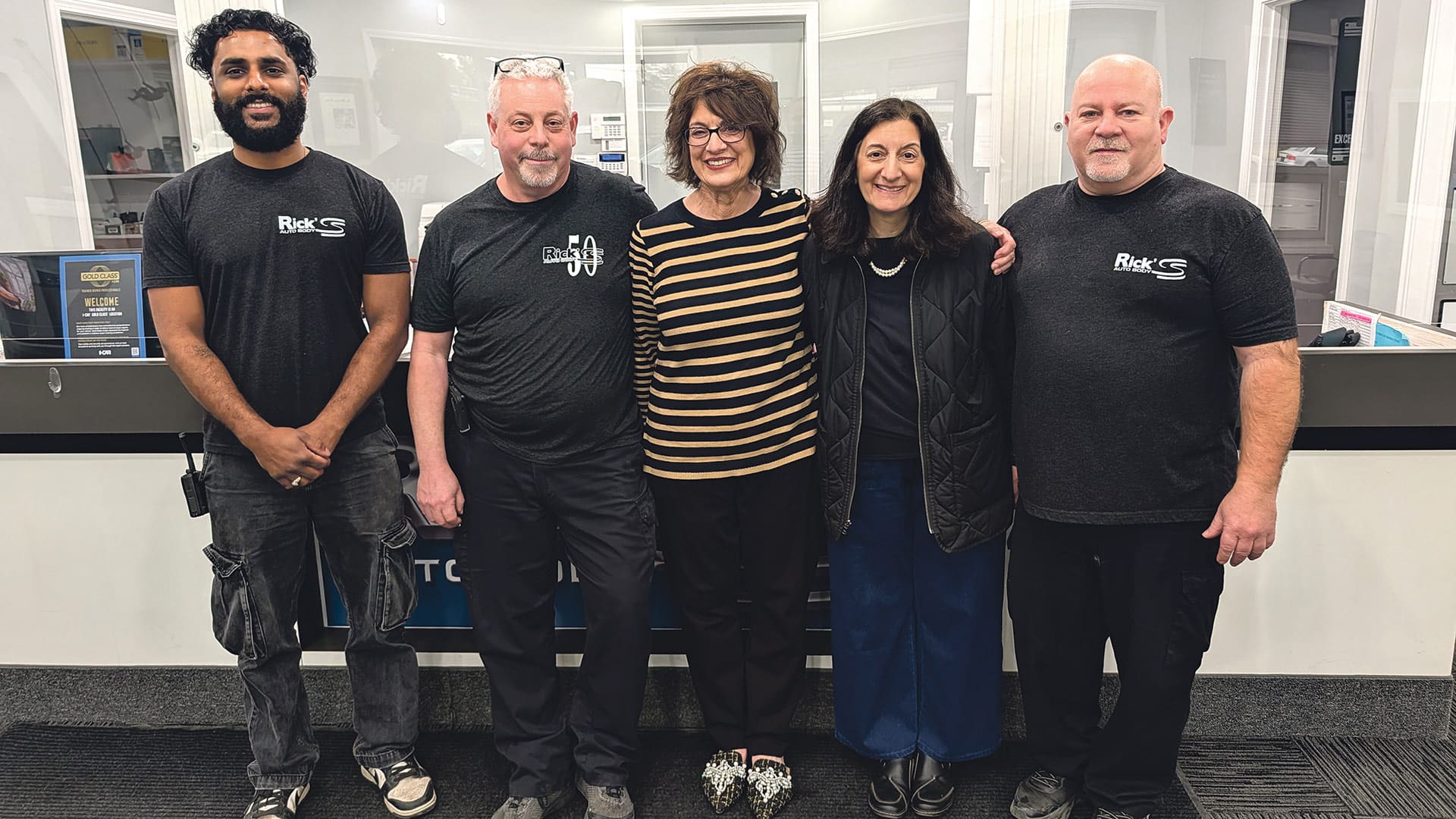
The leadership team at Rick’s Auto Body, from left: Parts Manager Nafees Nadeem, Production Manager Mike Haniffy, owner Mari Tarpinian, Office Manager Susan Tarpinian, and Operations Manager Chuck Laprade.
“Many times, when technicians are flat rate, they don’t want to help the technician next to them. Here, they’re helping each other make the product the best. That was his philosophy.”
Recor was old-school in many ways, she added. “When the phone rings, it’s not ‘press one, press two’ — we answer the phone live. People appreciate the same service that existed in the 1970s — and they’ve grown with us.”
That’s not to say plenty hasn’t changed, starting with the way cars are essentially rolling computers these days.
And repairing them requires plenty of continual learning and manufacturer certifications — the most recent was by Tesla — at a facility where all work is done in-house, Tarpinian said, from frame work to mechanical work to alignments. “The only time a customer’s car would leave the shop is if an airbag goes off or something like that; then it has to go to the dealer so the dealer can reset it.”
Today’s biggest challenges running the company include the expected — getting parts on a timely basis and maintaining staffing for such a large operation.
“We’ll do things for each other outside of work, and we’re just here for each other. When they found out that Rick passed away, everybody was crying.”
“Everyone’s looking for good help, and there are ups and downs. But we have a great reputation, so we’re really fortunate that we’re able to sustain the way we do business,” she said, again noting the culture of family and loyalty that Recor seeked to instill. “We’ll do things for each other outside of work, and we’re just here for each other. When they found out that Rick passed away, everybody was crying.
“The other thing I will say is that probably 97% of the times that an employee gets a raise, they haven’t asked for it. And I think that says something. It says that we, as an organization, recognize someone when they’re doing a good job, and we give them a raise without being asked. It’s indicative of how we how we are here, and we just want to continue the way Rick did it.”
Shifting into the Next Phase
Tarpinian said Recor’s story is an inspiring one.
“He came from nothing. You know, he didn’t graduate from 10th grade; he is a high school dropout,” she told BusinessWest. “But he was a numbers guy. He knew numbers inside and out. And that, combined with sweat equity, just working really hard, made him a success.”
Not only with auto repair, but with ancillary businesses like vehicle sales, towing, a car wash, and other properties. “He just felt really lucky.”
And grateful, too, for the company’s many repeat customers — many representing two or three generations of the same family, bringing their cars to Rick’s Auto Body over the decades. “We have kids that are 17 years old up to people that are 98, and they’re still driving. It’s all facets of life.”
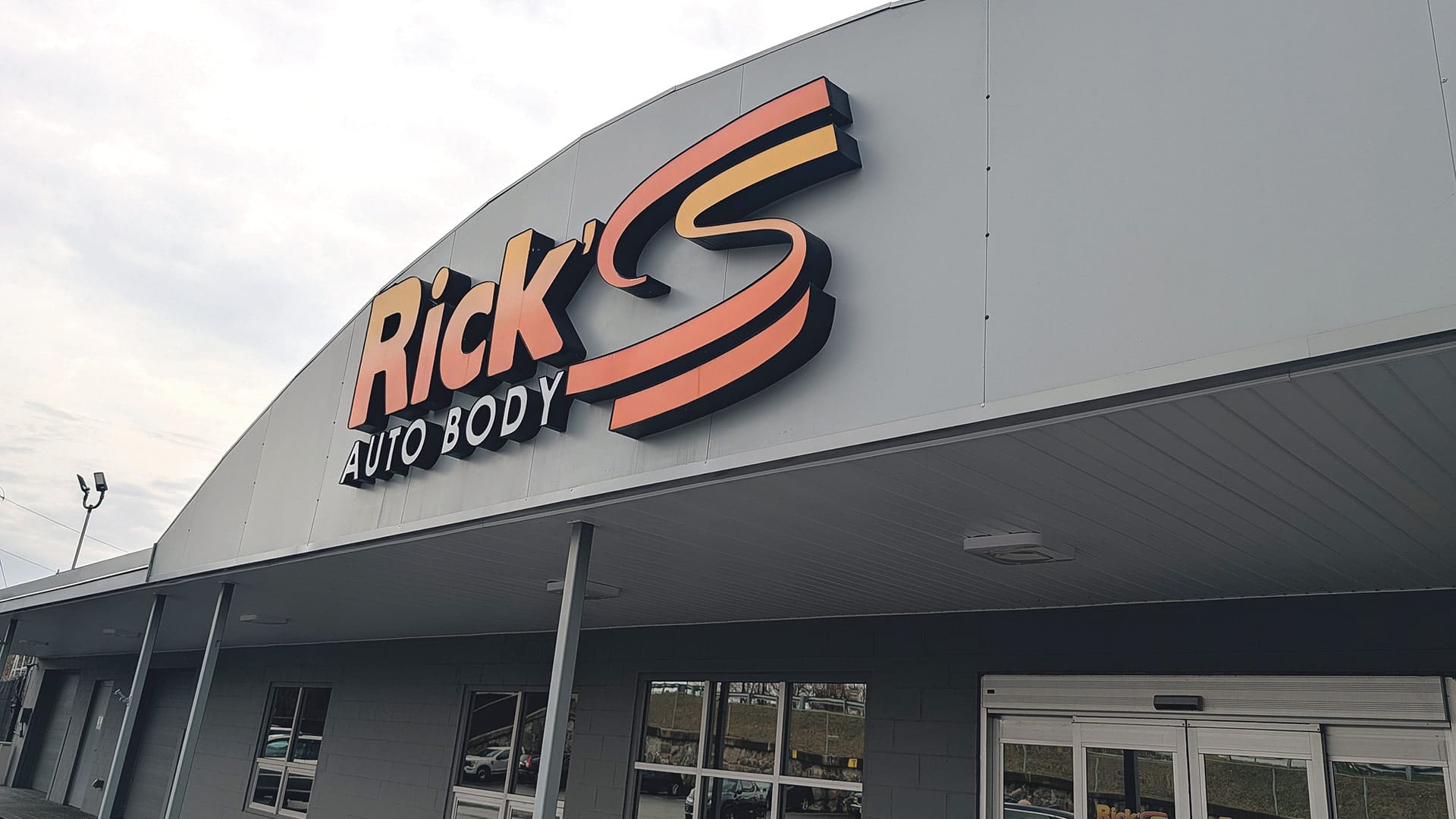
Rick’s Auto Body moved to its current headquarters on Pasco Road in Springfield in 1997.
Recor’s life will be celebrated with a memorial service on Saturday, April 18 at Wilbraham Funeral Home. Calling hours are from 9 a.m. to noon, followed by a funeral service at noon. In lieu of flowers, memorial contributions may be made to Dana-Farber Cancer Institute in Boston.
Tarpinian is certainly grateful for Recor’s life, and expects many people feel the same.
“There were so many times when people would come here and thought that they needed to spend money to have something done. And he would just say, ‘listen, let me just take your keys.’ He’d go around to the back and have our detail department buff something out, no charge, for someone. Or there was a single mother with her kids in the van, and she had a problem with her tires. He would do things for people.”
In short, she added, he was proud to serve the community that had been good to him.
“I feel like we’re an asset to this community, too, because there are so many times when people will call us and treat us like the library or Google or something, asking us questions because they just don’t know where to get the answers. It may not even be a job we’ll end up getting, or it’s not even part of a repair process that we do, like rust or something like that. But we will always give them as much information as we can on the phone. And we still do that. They’ll say, ‘we didn’t know who to call,’ and we’ll say, ‘ask us; we’ll help you.’ That’s how we do it. It’s kind of old fashioned, right?”
That’s the sort of client relationship Recor valued, Tarpinian said, and he wanted it to continue.
“He didn’t want it sold. He definitely did not want it sold to a conglomerate. He definitely voiced that to all of us, that he wanted us to carry it on. And that’s what we’re going to do.
“So I just really want the public to know that we are going to keep it here in the family, and we are going to keep on doing business exactly how he wanted to do business,” she added. “We’re going to respect that.”