Home Posts tagged Robotics
Special Coverage Technology

Armed with Automation

A robotic palletizer tackles a load of boxes.

A robotic palletizer tackles a load of boxes.


No one likes loading boxes onto a pallet. But machines don’t seem to mind.

Mike Holmberg noted as much as he pointed to a neatly palletized pile of boxes from a liquor distributor. In a non-automated facility, he said, someone would be loading those by hand.

“They’re making the different spirits, and then they put them in a bottle, put the bottle inside a case, then the case comes down a conveyor, and some person is picking up each one of these, and they’re stacking it in this stack, all day long. It’s not a fun job,” said Holmberg, senior vice president at Elm Electrical in Westfield.

“So we developed a solution for a robotic palletizer,” he said, pointing to the robotic arm and related equipment on Elm’s engineering floor. “It will now take the box as it’s coming off the conveyor, pick it up, and build this pallet. That’s called robotic palletizing.

“It’s a huge labor saver. And it’s about safety, too. It’s backbreaking. And it’s also work that people don’t want, so they don’t last. And in today’s day and age, it’s hard to find employees,” he went on. “Customers, manufacturers in particular, are having difficulty keeping those kinds of jobs filled. You’ve got to train them, they have to go through all the safety protocols, and then they come in and work for a few days and go, ‘hey, I don’t want to do this,’ and they’re out of here. Now you have to start over.”

On this recent afternoon, Holmberg led BusinessWest on a tour of the floor where it builds, programs, tests, and demonstrates robotic equipment in a growing automation division that serves clients in a number of fields.

“We essentially procure robotic arms from them, and then we integrate them. We do the programming, and we come up with the end-of-arm tool, which is like the robot’s hand. We develop that solution, and then we teach the robot to do whatever task it needs to do.”

Elm Electrical’s journey into automation was gradual, he explained, as the company originally specialized in electrical contracting and eventually moved into programmable logic controller (PLC) systems, which automate and control electromechanical processes, becoming a Rockwell Automation integrator.

“We integrated their product, and we use their product to develop solutions. And over the years, we’ve morphed into supporting different market segments, whether it’s water or wastewater, food and beverage, machining, material handling. And as automation started to grow, we started to get involved in robotics,” Holmberg explained.

To that end, Elm is an authorized FANUC robotics integrator, partnering with FANUC, a global leader in robotics and automation products.

“They make the robotic arms — that’s an arm that’s programmed to pick and place and move things. So we essentially procure robotic arms from them, and then we integrate them. We do the programming, and we come up with the end-of-arm tool, which is like the robot’s hand. We develop that solution, and then we teach the robot to do whatever task it needs to do.”

This FANUC robotic arm is set up to demonstrate its capabilities for an Elm Electrical client that makes wine racks.

This FANUC robotic arm is set up to demonstrate its capabilities for an Elm Electrical client that makes wine racks.

One arm on display was being used to nail together components of a wine rack. “The wood gets put down in this fixture, and now the robot holding the nail gun can go and build this for them,” Holmberg said. “And so you can rotate this on a table, rotate the next one in, build the next one. That frees the operator up from doing this tedious task all day to focus on quality control or doing some other portion of the business — more high-value tasks.”


Behind the Scenes

Holmberg noted that he brings that arm to trade shows to demonstrate opportunities for robotics.

“Behind the scenes, there’s a controller, which is essentially a computer that’s controlling that robot, telling it what to do,” he said, pointing out the physical capabilities of the arm and potential tools that can be attached to it. “There’s a motor in each one of those, and it can move in six different directions — it can spin, or it can move forward and backward. And those little motors have to be controlled.

“So we build control panels to hold all those controls, and we give the operator a touchscreen interface to make it easier to operate. Behind the scenes, here at Elm, we wire this; we put in all the technology to make that robot run. We design the control panel, we’ll connect it to the robot, then our engineers will program it to make it work.”

The robots can also be “set up for vision,” as he explained by using a set of multi-colored dice, which the arm can sort.

“Let’s say I want all the blue colors to be picked up. Well, it’ll roll them until it sees a blue color, and then it’ll pick it up and put the blue over here. That’s to show that, in the world of automation, there are times where random parts are coming down a conveyor, and I need to pick those random parts up. That illustrates to a customer that we can do vision-guided robotics. There are industries that would support.”

Whatever the capability, Holmberg continued, “we do all the programming, we do all the testing here, and then we take it to their site, install it, and then train their operators. We do the whole thing.”

While there has always been negative talk about robots replacing workers, Holmberg said this technology can be a positive for both employers and employees.

“Automation sometimes can be a taboo thing because people say, ‘well, it’s eliminating jobs.’ But in some cases, it’s creating opportunities for clients that can’t find laborers to do the work anymore. So in some instances, without automation, they’re not going to survive because they can’t do the work. This allows companies to be able to differentiate themselves and do things less expensively because they can do things faster. This doesn’t take a break, doesn’t go home sick, it doesn’t do any of that stuff because it’s running all the time.

“But I also look at it as an advancement for the employee,” he went on. “If I’m the employee that was doing that tedious task of picking something up and placing the round peg in the round hole all day long, now I get to operate the robot that’s doing that. And maybe I’m operating several robots. So I’m able to achieve a higher value at a job by learning the robotics, learning those skills, and now I have a much different career.

“I envision it as creating opportunities for people in the technology space. If they’re operating the robots, they get a little higher-tech job, and it’s much easier than the backbreaking work they were doing before.”

“So I envision it as creating opportunities for people in the technology space,” he added. “If they’re operating the robots, they get a little higher-tech job, and it’s much easier than the backbreaking work they were doing before.”


Complete Package

Holmberg explained that Elm Electrical has long operated as a four-legged stool, so to speak — its construction division (the main business, which launched the company), an automation group, a service group that provides 24/7 support service for companies, and its control panel business.

“So, ideally, we like to sell a solution that has all four of the legs in the stool. If we can sell an automation solution where we get the after-market support service, that’s great. If we can do our installation, our construction group can install it and put it in place. And if it has control panels in it, now we’ve sold all four legs of the stool. That’s what we try to do.”

Most electrical contractors don’t offer all four niches, he added. “Typically, they would have the service business unit and the contracting division, but they don’t have a panel shop where they build the control panels; they would typically farm that work out. And most integrators doing the automation work like we do, that’s all they do, and they would hire an electrical contractor to do the installation. So it’s rare to find somebody that has all four legs and be able to supply that complete turnkey solution.”

While automation is a growth industry, he added, it also requires significant investment up front, which can be a challenge for potential clients.

“There’s not a manufacturing facility that can’t leverage automation. They want to do something to make their job easier and to make their products faster. They want to open up capacity. They want to make it higher-quality. Now, whether or not they can afford to do that is the next question. Do they have the capital to do that? That’s an investment.”

He acknowledged that further growth is complicated by uncertainty in manufacturing around the economy, tariff impacts, and other factors, but the overall potential remains.

“I feel like automation is a place to be. Think about it — today, everybody wants something now, they want it tomorrow, they don’t want to wait. You can order something on Amazon, and it’s delivered that day,” Holmberg said. “That mindset means you’ve got to build it faster, you’ve got to have it ready faster — and all that is going to take automation.”

At the end of the day, he told BusinessWest, “we want to help customers solve their problems. That’s what we hope to do. We want to develop solutions. That’s the business we’re in — developing solutions and helping customers solve a problem.”

And those customers aren’t choosing from pre-designed models, he added. “Everything we do is custom. We develop it for you. It ends up being your solution for your project. So we like to be a partner with our clients. That’s how we get more work — by doing good things for good people.”
Technology

Blasting Off

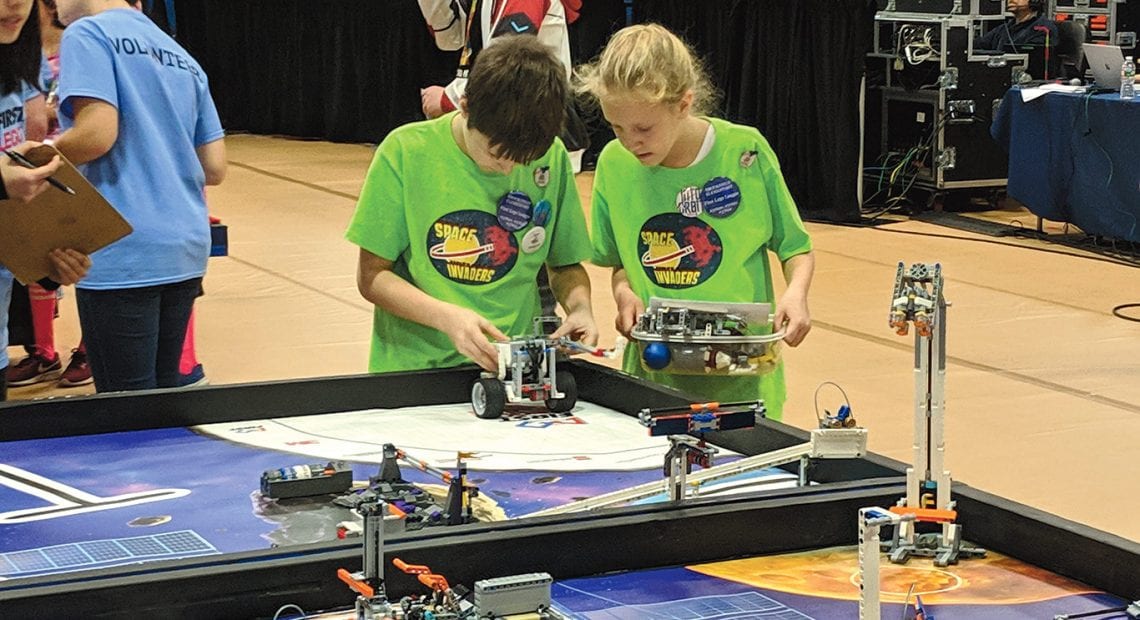
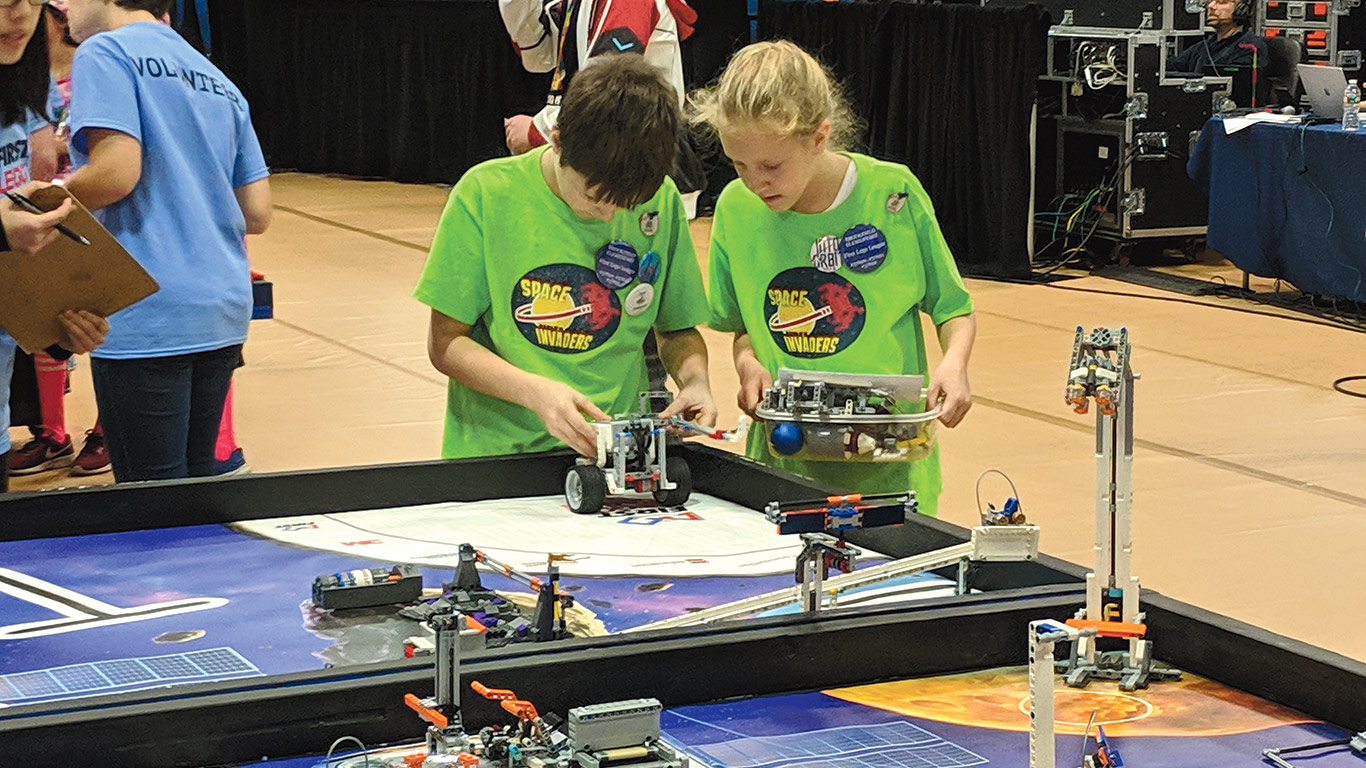
A team from Feeding Hills gets ready to put their robot to the test.

A team from Feeding Hills gets ready to put their robot to the test.

Seeing a group of middle-schoolers design, build, and program robots that perform specific, detailed tasks on cue is an impressive sight. But the impact of the FIRST LEGO League, which boasts teams in numerous schools throughout Western Mass., goes far beyond engineering training. It’s also teaching young people communication skills, teamwork, and confidence — all key traits to take into whatever career they choose, whether in the STEM fields or not.

As the robotic rover methodically navigated a landscape of obstacles, it relied on its programming to perform any number of tasks, from extracting core samples to angling a solar array to crossing a crater. If the programming — honed over months of diligent trial and error — failed, so did the robot.

That’s OK, though — this wasn’t a billion-dollar piece of outer-space equipment at stake, but a robot built from LEGO Mindstorm parts, and performing tasks on a colorful, space-themed table. And these weren’t astronauts or NASA engineers performing experiments, but area elementary and middle-school students showing off their prowess at the recent FIRST LEGO League Into Orbit Challenge at Western New England University.

Three dozen teams of students from Agawam, Brookfield, Chicopee, Greenfield, Holyoke, Longmeadow, Northampton, South Hadley, Springfield, West Springfield, Westhampton, and Wilbraham took part in the competition, reflecting a surge in growth for school-based robotics programs.

“It’s more than just the robots. Yes, the engineering is important — the math and the physics behind it — but more important than that is the teamwork, the critical-thinking skills, and the communication skills the kids develop.”

After competing head to head with each other, seven of those teams advanced to a statewide competition in Worcester a week later, and from there, the top teams moved on to championship events this spring.

“It’s all about taking your classroom lessons — the math, the science — and applying them in a real-world situation,” said Dana Henry, a senior mentor for the regional FIRST (For Inspiration and Recognition of Science and Technology) program, who first connected students with robotics in Agawam 18 years ago.

“It’s more than just the robots,” he told BusinessWest. “Yes, the engineering is important — the math and the physics behind it — but more important than that is the teamwork, the critical-thinking skills, and the communication skills the kids develop.”

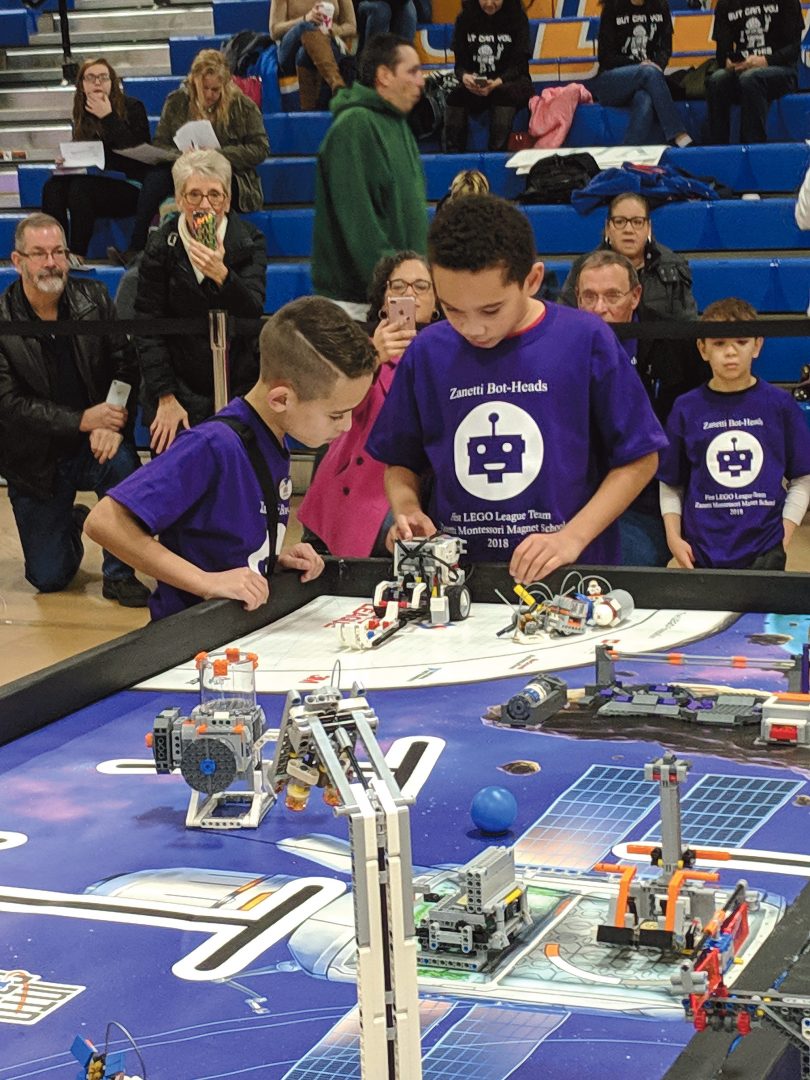
The FIRST LEGO League challenges kids to think like scientists and engineers. During this year’s space-themed season, teams choose real-world problems to solve and then build, test, and program an autonomous robot using LEGO Mindstorms technology to solve a set of missions.

Last months’s event, the Agawam Qualifier, is in its 11th year, moving to WNEU this season after outgrowing its previous space at Agawam Junior High School, Henry noted.

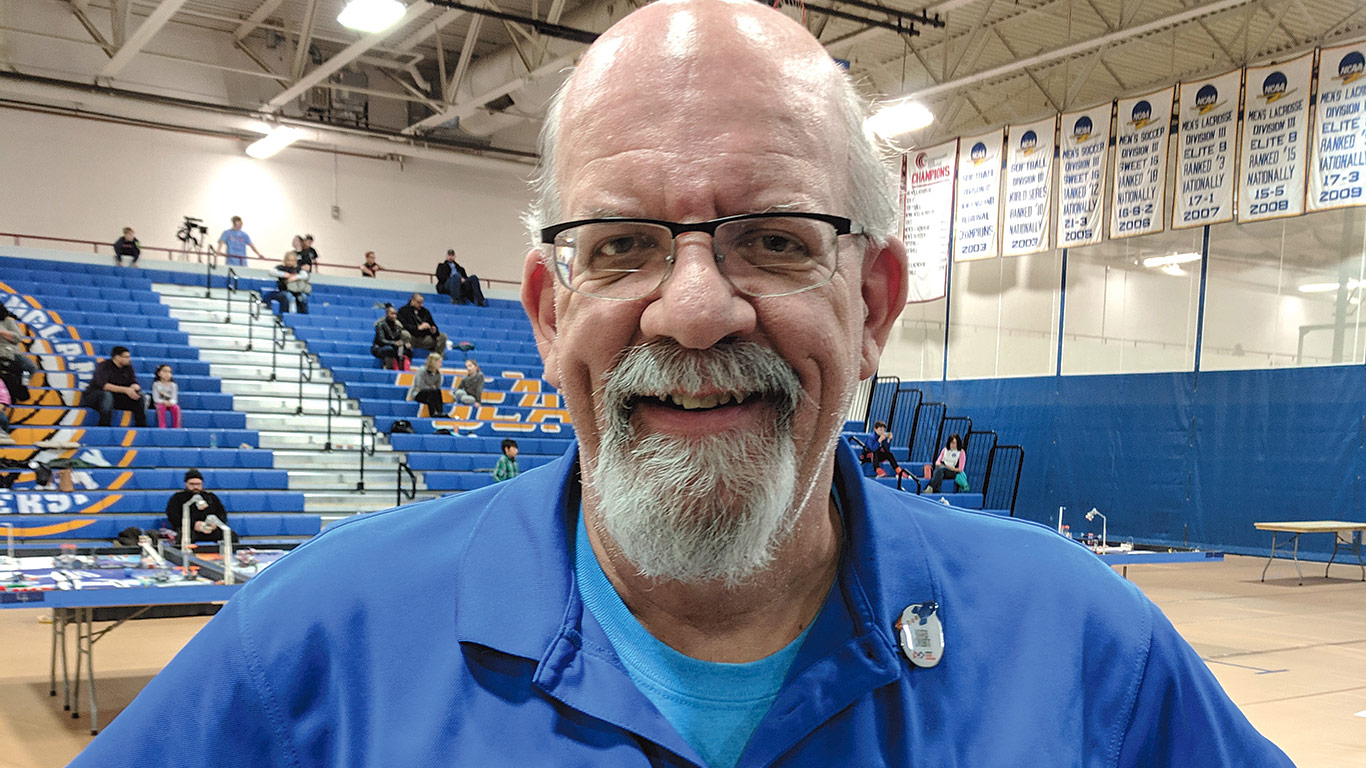
Dana Henry says FIRST LEGO League competitors are applying classroom lessons to real-world problems, and gaining a raft of skills while doing so.

Dana Henry says FIRST LEGO League competitors are applying classroom lessons to real-world problems, and gaining a raft of skills while doing so.

“We have four programs in Agawam, and we help other teams, at other school systems in the area, get up and running,” Henry said of his role with FIRST. “Western New England came in with the facility and some resources, and they are working with a couple of local teams themselves. It’s been a pretty great ride so far.”

Suleyman Demirhan, a science teacher at Hampden Charter School of Science in Chicopee who oversees that school’s robotics club, explained that the faculty coach’s role is to teach students the basics of building and programming the robot — and researching issues as they arise — but it’s important for students to learn how to accomplish their goals with minimal hand-holding.

“They learn a specific topic for their project, and how to design a robot and program it. The coach is there just to guide them, to provide the right materials and supplies for learning the robotics, and then we get to see their progress. We’re teaching them how to solve problems. It’s a learning process,” Demirhan said.

“Actually, they teach each other and learn from one another,” he went on. “I see it like working at a company, like being an engineer, but at the same time being a middle-schooler. They’re learning to solve all these engineering problems, and then they learn how to solve the programming problems.”

Values Added

The FIRST LEGO League, launched 20 years ago by inventor Dean Kamen and LEGO Group owner Kjeld Kirk Kristiansen, now boasts 320,000 participants and 40,000 teams in 98 countries.

At the cornerstone of the program are a set of core values, through which participants learn that friendly competition and mutual gain are not separate goals, and that helping one another is the foundation of teamwork.

According to the league website, those core values include discovery (exploring new skills and ideas), innovation (using creativity and persistence to solve problems), impact (applying what we learn to improve our world), inclusion (respecting each other and embracing our differences), teamwork (understanding that we are stronger when we work together), and fun (enjoying and celebrating what we do).

The student-designed robots are all different, taking myriad approaches to tackling similar challenges.

So the goal is more than learning robotics, engineering, and programming. But even the tasks themselves extend far beyond the robots. Each year, teams are mandated to research a real-world problem such as food safety, recycling, energy, etc., and then develop a solution.

As part of this year’s Into Orbit theme, teams considered the challenges humans must overcome to travel around the solar system — such as extreme temperatures; lack of air, water, and food; waste disposal and recycling; loneliness and isolation; and the need for exercise — and research and present a project, not unlike at a science fair, that aims to solve one of those problems.

“With this year’s theme, they designed a project that helps astronauts in space travel improve their physical conditions and mental health, or it could be anything that supports astronauts,” Demirhan said, noting that his school’s two teams took on the problems of growing food in space and designing an effective trash compactor.

The competition itself centers around the LEGO robots designed and built by the students, he went on. “Each challenge needs to be solved by a robot which is running autonomously. So the students program the robots and make specific attachments that work with different challenges. They don’t only design these attachments, but design and write the programs.”

If the programming is off by the slightest margin, the robot will miss its target on the table — and miss out on critical points needed to post a high score and advance.

“With each one of these challenges, they encounter difficult areas with the programming,” Demirhan went on. “Some programs might work in a specific environment and might not work in a different environment, and they’re trying to write the best program that can work in many different conditions. For example, light could be a factor — robots have light sensors, and the amount of light in the practice room could be different than in competition. So the student needs to solve this challenge and write a really good, efficient program that can run in both these environments.”

For students inclined to this type of work, Henry said, it’s a fun way to learn to apply STEM (science, technology, engineering, and math) concepts while developing critical-thinking and team-building skills, and even soft skills like how to talk to the judges about their robots in an engaging way — yes, they’re judged on that, too.

“Not only do they have to build a robot to compete on the table, but they’re also being judged on a project, and they have to adhere to all the core values throughout the FIRST program,” he added. “It’s about communication skills and critical-thinking skills. It’s much more than just robots.”

Time to Shine

Through the FIRST LEGO League, Kamen and Kristiansen always intended for young people to discover the fun in science and technology but also develop in a positive way as people. Henry said he has seen exactly that.

“We had one kid that came through the program who was very shy, ate his lunch in the corner all by himself at his junior high school, but he came into high school and absolutely bloomed. He got into college, and now he’s an engineer with NASA. I’m telling you, if he doesn’t go to Mars, he’s going to be one of the engineers that gets us there.”

Other students in the program have gone on to non-science fields, like teaching, music, and the culinary arts, he continued, but the lessons they learned about solving problems and working with others are applicable to any field.

For those who do aspire to a career in engineering or robotics, however, the FIRST program does offer a leg up, Demirhan said, both in the college-application process — schools consider this valuable experience — and gaining career skills at an earlier age than most future engineers do.

“They’re all doing real-world engineering. Once they go to an engineering school, they’re seeing problems like these and learning how to solve them. So this is really a tiny engineering program that has massive applications. We’re teaching real-world problems and coming up with good solutions to them.”

In short, students are creating ideas, solving problems, and overcoming obstacles, all while gaining confidence in their abilities to positively use technology. To Henry, that’s an appealing mix.

“The STEM part is important, absolutely, but it’s more than just that,” he said. “I can’t stress that enough. We’ve seen kids blossom in so many ways.”

Joseph Bednar can be reached at [email protected]