
The Andy Yee Palliative Care Unit
Collaboration in Healthcare
Inspired by a Lifetime of Giving, They Gave the Region Something in His Name

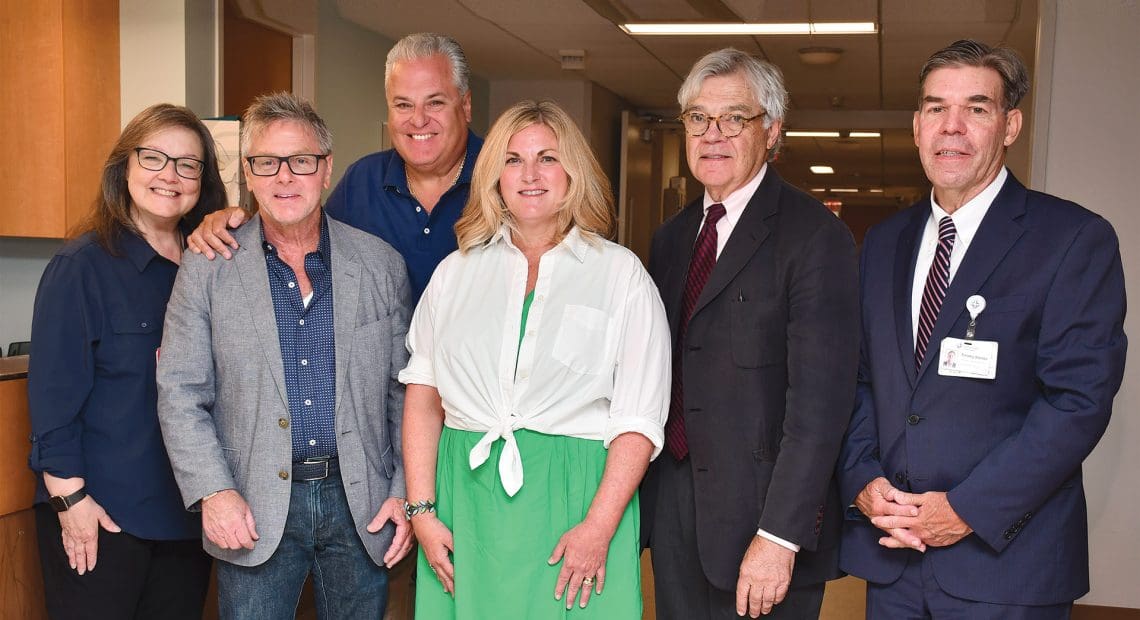
From left, Dr. Laurie Loicono, Peter Picknelly, Tony Ravosa, Sarah Yee, Dr. Philip Glynn, and Tim Stanton.
As BusinessWest spoke with several individuals about how the Andy Yee Palliative Care Unit at Mercy Medical Center was conceived and eventually became reality, they took turns gesturing toward one another and saying, “if wasn’t for … this never would have happened.”
It was said about Tony Ravosa, ‘Uncle Tony,’ a close friend of Yee’s, who doggedly raised money for the unit, conceived soon after Yee succumbed to pancreatic cancer in 2021.
It was said about Dr. Philip Glynn, the oncologist (and a Healthcare Hero himself in 2022) who cared for Yee during his illness and became inspired to do something to bring a new level of care to the region in his honor. He is now co-director of the unit with Dr. Laurie Loicona.
It was said of Tim Stanton, regional vice president of Philanthropy and chief Development officer for Trinity Health Of New England, Mercy’s parent company, who quarterbacked the fundraising efforts.
It was said of Yee’s wife, Sarah, who wanted to do something to recognize the unique brand of care provided to Andy in Mercy’s ICU in his final days and bring it to more patients and families facing difficult end-of-life issues.
But mostly, it was said about the person not in that room, but whose spirit certainly was: Andy Yee himself.
Indeed, all those gathered said creation of the eight-bed unit, the only one of its kind in the region, would not have been possible were it not for the way Yee touched all those who knew him — from customers in his restaurants to his nurses in the ICU; from long-time friends and business associates to former Massachusetts Gov. Charlie Baker, who rushed back to Springfield from a Republican governors’ meeting in Nashville, Tenn. to be at Mercy the day Yee died — and seemingly willed them to come together and make this ambitious undertaking reality.
“All of this is because of Andy and the people who loved him,” said Yee’s friend and business partner Peter Picknelly, chairman of Peter Pan Bus Lines. “Mayor [Domenic] Sarno stepped to the plate, the governor stepped to the plate, the lieutenant governor, the business community, all because of Andy and this institution, which helped him so much.”
In truth, the palliative care unit would not have happened without everyone in that room working together to create a vision and then make it reality. And all those individuals would be quick to note that getting the doors open was just the first chapter in this story. The next ones involve operating it in the compassionate, innovative manner that was imagined and, hopefully, expanding the facility to include more beds — because the existing beds are almost constantly full and the need, sadly, remains.
“This space was created in Andy’s spirit, and it’s designed to focus on enhancing interaction and time between family and their loved one at some of the most difficult times in people’s lives.”
“We had the ribbon cutting, and we were full the next day,” Glynn said. “We could fill 15 beds today.”
The unit was designed to help achieve what is known in healthcare as a ‘good death,’ one that, according to an Institute of Medicine Report, is “free from avoidable distress and suffering for patient, family, and caregivers, in general accord with the patient’s ands family’s wishes, and reasonably consistent with clinical, cultural, and ethical standards.”
By all accounts, Andy Yee’s passing met this criterion, and the unit created in his name is dedicated to helping others achieve a similar passing.
“This space was created in Andy’s spirit, and it’s designed to focus on enhancing interaction and time between family and their loved one at some of the most difficult times in people’s lives,” Loicona noted, adding that this is the very essence of palliative care.
Coming Together
‘Collaboration’ comes from the Latin word ‘collaborare,’ meaning ‘to labor together.’ It has come to describe individuals and groups working together to achieve a common goal.
Since the Healthcare Heroes program was created in 2017, the Collaboration category has been an important part of the initiative because almost all issues in healthcare, from opioid addiction to food insecurity, are complex and require the efforts of many different agencies pulling in the same direction.
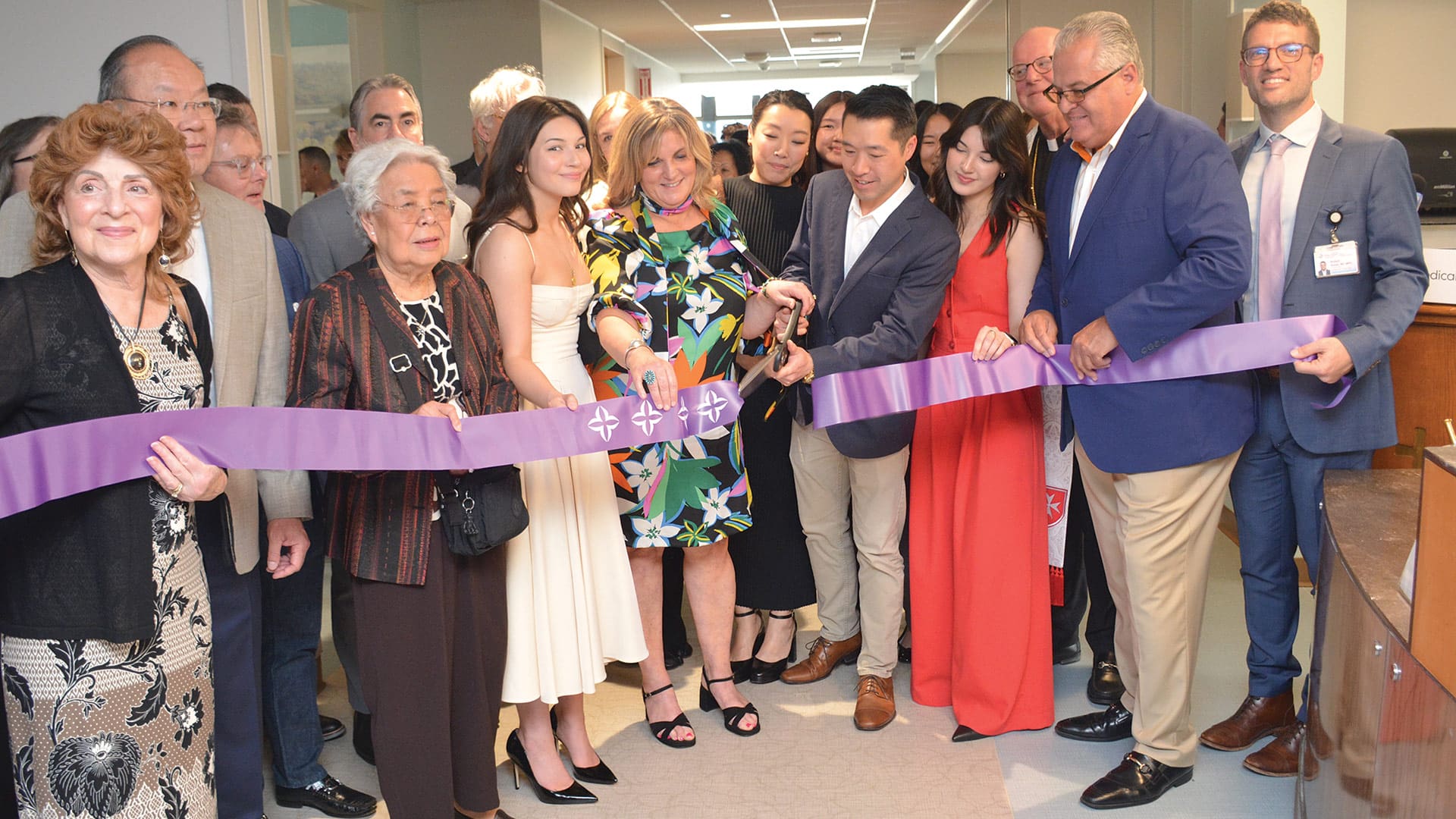
Yee family members and guests cut the ribbon on the Andy Yee Palliative Care Unit in May.
The creation of the Andy Yee Palliative Care Unit is a somewhat different story, but one that provides poignant lessons about the importance of collaboration and how it enables things to happen that wouldn’t happen otherwise.
Our story begins … well, it’s hard to say when it actually begins. It certainly began before Andy Yee’s cancer brought him to Mercy’s ICU. And it probably began before Yee, working with Picknelly, coordinated meal donations for employees at Mercy and other hospitals during the pandemic.
But that’s a good place to start because those efforts reflected Yee’s deep respect for Mercy, healthcare workers in general, and, eventually, the doctors and nurses who treated him.
“Andy really had an affection for this hospital; he could have gone anywhere for his care, but he chose this place because of that guy over there,” said Picknelly, gesturing toward Glynn. “People encouraged him to go elsewhere; he didn’t. He said, ‘I’m staying here; the people at Mercy are awesome, and Dr. Glynn is the best.”
This respect was repaid by those at the hospital bending the rules, if you will, for Yee and his family during his stay in the ICU, meaning the rules regarding how many people could visit him at one time, how long they could stay, and how they were able to make Andy feel more at home by bringing some of his home to his room in the ICU.
In other words, helping him achieve a ‘good death.’
These actions inspired Sarah Yee to want to do something to thank those at Mercy and help others facing oncology care. One thought early on was to gift an infusion suite for the cancer center in Andy’s name. But eventually, sights were set much higher, on creating a palliative care unit.
“We were given the opportunity to make that a comfortable space for our family that week he was here,” Sarah recalled, referring to his room in the ICU. “And I thought, ‘wouldn’t it be nice if other families could have that opportunity as well?’”
“We were given the opportunity to make that a comfortable space for our family that week he was here. And I thought, ‘wouldn’t it be nice if other families could have that opportunity as well?’”
So there was an initial conversation with Glynn, who has long understood the need for a unit devoted to palliative care and was more than amenable to the idea. He also understood that, unlike putting Yee’s name on an infusion suite, this would require a collaborative effort to address the many facets of this project — especially fundraising, design, and, eventually, operations.
And for the fundraising side, those duties fell to Ravosa, owner of a public relations and consulting firm, who accepted the assignment even as it kept changing and growing in scope, from initial estimates of $100,000 to the eventual total of $1.5 million as the cost of construction and materials kept climbing after COVID.
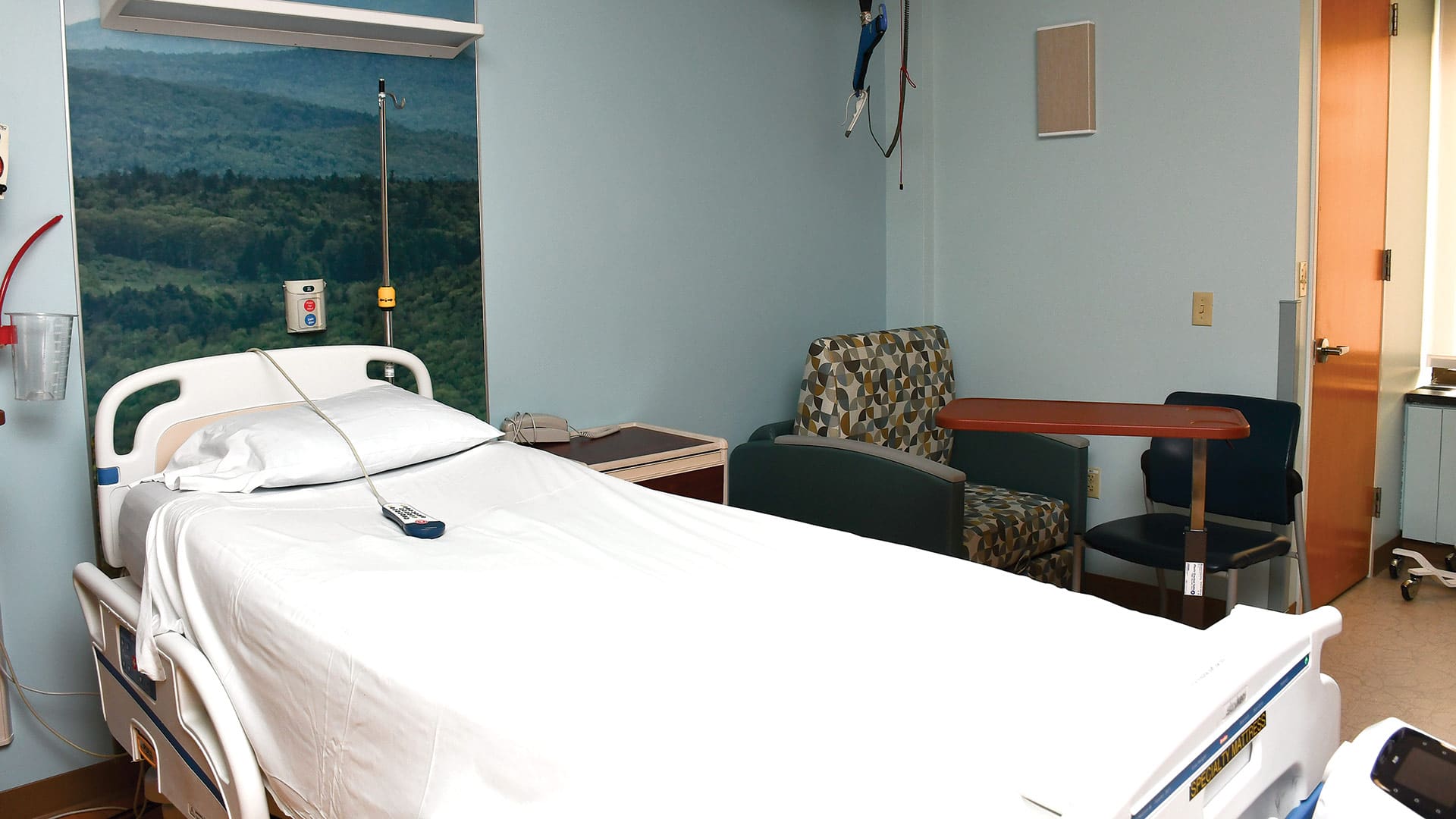
The rooms in the unit are designed to bring comfort to both patients and family members.
Overall, the three-year effort generated $650,000 in grants, including $250,000 in ARPA money, $450,000 in corporate gifts, $70,000 in political committee gifts, and donations from friends, family, and colleagues.
Food for Thought
The I-91 Supper Club covers several of those categories.
This is a group of friends, business colleagues, ‘political guys,’ and more who first gathered to mark the closing of the Hu Ke Lau in Chicopee (one of the Yee family’s many restaurants) and started meeting regularly after that, Ravosa said.
“We’d go to a restaurant once a month with a pre-set menu, and we’d bounce around … there were a lot of long-standing friendships and legacy businesses involving families that had been the community a long time,” he went on, noting that Sarah Yee was invited to come to a meeting of the group and give a presentation on the proposed unit.
And it was the group’s six-figure donation that essentially got the ball rolling, said Stanton, who worked in tandem with Ravosa on the project and recalls him being a “bull in a China closet.”
“Those checks started flying in,” he recalled. “Tony had a few events, and people brought money to them, and then he was on a roll. In more than 20 years of doing this, I can only think of one president of one university that I had to sprint to keep up with, and the other one who was like that was Tony; he kept pushing us and pushing us and pushing us.”
While funds were being raised, others were at work on design and operating plans for the unit, which, as noted, is the first of its kind in the region.
Located on the hospital’s fifth floor, the unit provides an inviting, soothing space for end-of-life care for patients and families, as well as patients with chronic illnesses requiring pain and symptom management. The layout required certain key elements, everything from a place where family members could sleep overnight to spaces for physician-patient consultation.
As for the care provided there, Loicona added that the overriding mission is to bring care at this level “back to family” and provide a support unit to the patient and family members.
Kathy Sullivan, nurse manager of the unit, agreed.
“Our nurses go above and beyond to provide the comfort and support that the patients and their families need, whether it’s little things like making sure the families have everything they need to eat or drink or making the beds for them to sleep in,” she said. “They order comfort trays for the patients from our kitchen, and they’re always advocating to make sure the medications are there that they need, and the providers.”
Glynn agreed, recalling a poignant example of going above and beyond. It involves a younger patient with a young child. Knowing he had a limited amount of time left, the patient wanted to talk with his son, but didn’t really know what to say and wanted to collect his thoughts in writing.
“He said that he was just too weak,” Glynn recalled. “So, one of the nurses took pen and paper and sat down next to him and wrote it all down, so he had what he wanted to say to his son.”
This is the kind of care that those who conceptualized this unit had in mind, and as they talked about what it was like to be part of this collaborative effort, those in the room kept coming back to the person who wasn’t, but who really made it all happen.
“I never had the pleasure of meeting Andy — I joined Mercy just after he died — but I feel like I know him very well from dealing with all of his friends and all the people involved in this effort,” Stanton said. “Tony did a great job of recruiting Fontaine Bros. for the contracting — they knew Andy — and JCJ Architecture; they knew Andy. Everyone involved in this project knew Andy, and it was a labor of love. It wasn’t work; it was ‘we have to make this happen.’”
Sarah Yee agreed.
“Andy had no idea of the people he touched,” she said, adding that now, through the unit named in his honor, he can touch countless more.
And while the unit wouldn’t have happened without him, it also wouldn’t have happened without a group of determined collaborators who are also Healthcare Heroes.