The Craft Beer Industry Is Definitely Flat
Tapped Out?

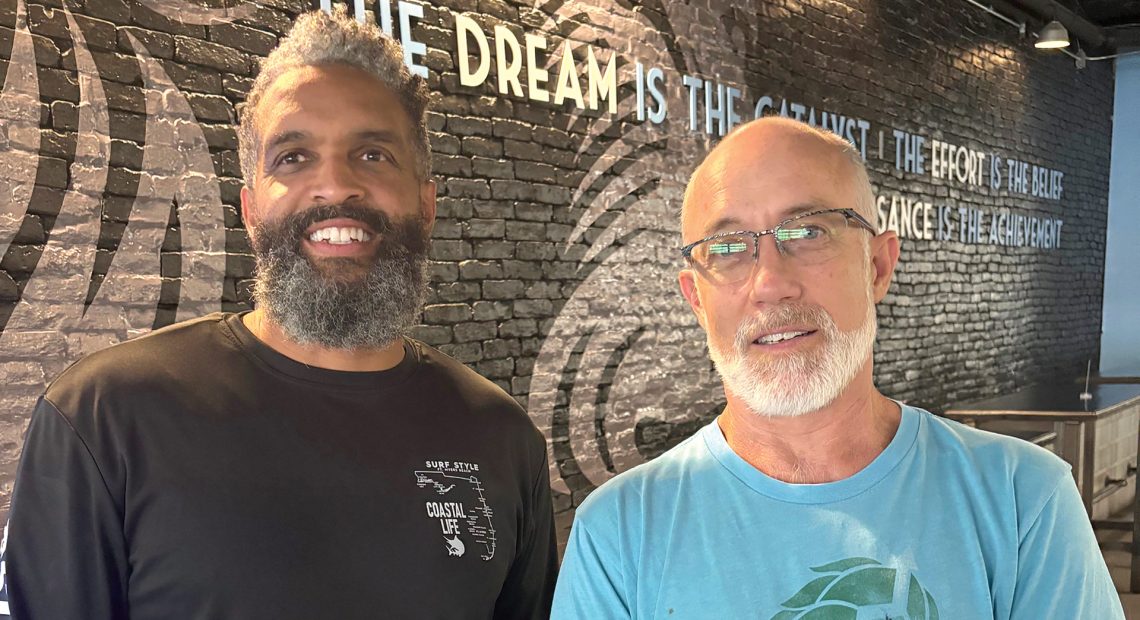
Ray Berry (left) and Mike Yates at White Lion Brewing in downtown Springfield.
Mike Yates says it’s a matter of simple math.
“People aren’t drinking as much, and when they do drink, they have a lot more options,” said Yates, brewmaster and business partner with Ray Berry in Springfield-based White Lion Brewing, adding that this math presents a challenge for area craft brewers, and it has for a while now.
Berry agreed, noting that, while they didn’t do it single-handedly, it was the Millennials that provided the foundation for the craft beer industry to build and boom. And now, those in that generation, the oldest of which are in their mid-40s, have more and different responsibilities and are thus spending less time at brew pubs and buying fewer cans and growlers.
“Ten, 15 years ago, it was the Millennials that propped up the craft beer trade and provided the enthusiasm,” Berry explained. “As those 10 to 15 years have gone by, the Millennials’ palates have changed, they have different work-life challenges, they may have children and the children are getting older … there are different priorities.
“So they’re not visiting the breweries as often as they used to,” he went on. “And the generation that stands behind them, the Gen Zs, are not as inclined to visit craft breweries as the Millennials were, nor are they as loyal.”
Meanwhile, as noted by Yates, there are more options for Millennials and everyone else — a still-dizzying number of craft beers, domestics, distilled spirits, hard seltzers, cannabis, and more. On top of all this, there are other pain points that range from inflation to workforce issues (including cost and availability) to post-COVID realities, such as fewer workers in their offices to support brew pubs in business districts — like White Lion.
“Ten, 15 years ago, it was the Millennials that propped up the craft beer trade and provided the enthusiasm. As those 10 to 15 years have gone by, the Millennials’ palates have changed, they have different work-life challenges, they may have children and the children are getting older … there are different priorities.”
All this prompted Brewers Assoc. President Bart Watson to sum up 2024 with the single word ‘painful,’ a nod to statistics showing a 2% decline in overall craft beer production and more breweries closing last year (399) than opening (335) — a sharp reversal from just a few years ago.
All this adds up to more challenging times and the need to adjust and pivot.
Which explains paint-and-sip nights at Skyline Brewery in Westfield, where participants can get a painting lesson and a cold brew, or a glass of wine, on the side, said Lisa Lafreniere, co-owner with Dana Bishop. It also explains Skyline’s popular trivia nights, live music, full food menu, wine, ciders, slushies, homemade sodas, and back patio area, which comes complete with stunning views of the farm below.
“People have to have a bigger dynamic than craft beer — the people who are struggling now are places just relying on their beer and not much else,” said Lafreniere, who, like Bishop and everyone else in this business, has noticed not-so-subtle changes in the landscape and what people are calling a ‘maturation’ of the industry.
It’s been marked, as noted, by consolidation and closures of some operations and declining sales overall and that need to pivot and offer more than pilsners, sours, IPAs, and stouts.

Dana Bishop and Lisa Lafreniere, co-owners of Skyline Brewery, say today’s craft brewers have to offer customers much more than beer.
At White Lion, for example, its Pridelands on Mane event destination in Tower Square Park, across the street from its brew pub, recently hosted a puppy pool party that attracted a few dozen four-legged participants and their owners. A few days later, it hosted a seafood festival and has plans for a wine-tasting event and also a town meeting of sorts featuring candidates for Springfield City Council.
Such programs are designed to fully activate the space (complete with custom-designed shipping containers), give area residents more opportunities to sample White Lion brews, and provide more of an experience than simply sampling the latest offering.
It’s not a recent phenomenon, to be sure, but it is becoming more critical with each passing year, if not each passing quarter.
“The days of going out of your way to visit a brewery for a pint or two and then maybe spinning off to another brewery for a pint or two … that still happens, but not to the extent that it did,” Berry said. “So now, you have to create an additional experience.”
Pint of View
Over the past 30 years or so, BusinessWest has chronicled the rise of the craft beer sector in this region, from its infancy to an impactful presence in communities across the 413.
The names of these businesses have become part of the landscape — Tree House, 7 Railroads, Hot Plate, Abandoned Building, Vanished Valley, Barrington Brewery, Skyline, White Lion, and many more.
These ventures are still thriving, but several breweries have closed in this region and across the state, including some big players, such as Cambridge Brewing.
Pioneer Valley Brewing in Turners Falls was a recent local casualty, closing its doors on May 31, for all the reasons listed above.
“Expenses have gone through the roof,” co-owner Steve Valeski told the Greenfield Recorder. “The last two years have been devastating. Prices went up, everything’s gone up. It’s the market, it’s the economy. People aren’t going out as much. Shipping’s more expensive. Cans are more expensive. Everything is more expensive. We just can’t keep charging more and more for a glass of beer. It gets to a certain point where you have to say no.”
Most area brewers are still saying yes, but success is not coming as easily as it did a few decades ago, or even five years ago.
“People have to have a bigger dynamic than craft beer — the people who are struggling now are places just relying on their beer and not much else.”
There are many reasons for this, said Bishop, noting those demographic changes mentioned earlier, but also rising costs of everything from barley and malt to labor. In response, Skyline has taken steps to bring many products in-house, such as soda, while also implanting strategies to manage the skyrocketing cost of yeast.
Tanzi Cannon-Eckerle, majority owner of Brew Practitioners in East Longmeadow, summed it up succinctly and effectively: “there’s fewer butts in seats.”
Elaborating, she said her brewery, which does not serve food and focuses exclusively on beer and other beverages, tracks business performance in several ways, from overall visitation to new customers to spending, and the numbers tell a story.
“From last year to this, we’ve seen a decrease in the number of people coming in the door,” said Cannon-Eckerle, an employment lawyer by day and brewer … well, the rest of the time. “Spending per person has been about the same, but the number of people has changed.”
She wasn’t about to put it all on Millennials, although she has seen that maturation of the market in Western Mass. and beyond, and less overall enthusiasm for breweries and craft brews.
“This academic or intellectual pursuit of all things craft beer and it becoming cool to visit all the breweries … has that gone by the wayside? Maybe it’s not as popular with the younger drinkers,” she acknowledged, adding quickly that there is still a healthy thirst for beer, and it’s up to individual brewers to maintain a buzz for their products.
Lafreniere agreed, noting that, overall, there is less enthusiasm for craft beer, an observation that extends to everything from sales to the buzz once generated when a local brewer would roll out a new brand.

Two of the guests at White Lion’s recent puppy pool party.
“People just don’t line up for a beer release — you don’t see that anymore,” she said. “They know it’s out, they know they’ll get down there; the hype, the excitement about the business is much lower.
“The bubble has burst — there’s far less buzz,” she went on. “We are friends with a lot of people who own local breweries, and we talk all the time about what is gone and the struggle to get people in the tap rooms. We’ve seen a lot of our friends that were wicked busy pre-COVID, and now, somewhat after COVID … it’s night and day.”
The challenges facing the industry were made clear at a Massachusetts Brewers Guild annual conference in Framingham 18 months ago, said Berry, where Watson, then the chief economist for the Brewers Assoc., painted a challenging picture for brewers.
“He was monitoring the trends nationwide, and the trends were either flat and going sideways or going down in particular areas of operation,” Berry told BusinessWest, returning to the notion of pivoting and providing more of an experience.
“It just cannot be a location where people come and get a beer,” he explained. “You can get a beer anywhere; you can get a beer in your backyard. What experience are you driving?”
Head Games
Berry said last month’s event was the second puppy pool party. The first was pre-COVID, and the second edition drew maybe 30 dogs (puppies and adults alike) and provided another opportunity to grow the brand.
“There’s 30 people that we had an opportunity to engage that we may not have been able to engage otherwise,” he noted, adding that the same is true of the seafood festival (the third annual) and the town meeting featuring City Council candidates.
“It’s about creating new experiences that people appreciate and that may keep them coming back or, at minimum, pay attention to what the city of Springfield has to offer,” he went on, adding this is what breweries must do now if they want to succeed.
Lafreniere and Bishop concurred.
“Getting people in now … it has to be a party,” said Bishop, adding that this explains Skyline’s many efforts to draw visitors, which also include a strong focus on food, initiated in 2024.
“For us, it’s a lot of food; we found that the beer drinkers are here, but we need to have the food be very exciting for them,” said Lafreniere, which is why they’ve gone from pretzels and flatbreads to a full menu that includes everything from chicken sandwiches, lobster rolls, and quesadillas to pulled pork from their own smoker.
Beyond food, there needs to be other ingredients that add up to an experience, they said, adding that trivia nights are part of the equation, as are paint-and-sip nights that draw maybe 12 to 15 people.
“The days of going out of your way to visit a brewery for a pint or two and then maybe spinning off to another brewery for a pint or two … that still happens, but not to the extent that it did. So now, you have to create an additional experience.”
“It’s not going to save us, but it helps,” said Lafreniere, adding that the collective efforts to bring more people to the brewery are paying dividends.
Cannon-Eckerle, meanwhile, stressed that, while breweries are fun — many started as hobbies and evolved into businesses — they are, in fact, businesses. And like all businesses, owners must pivot and adjust, but also focus on building their brands and differentiating themselves from the others.
“As in any business, you have to keep your ear to the ground and watch for market trends and where consumer spending is moving,” she explained.
Operations like Brew Practitioners, which are strictly breweries and focus almost exclusively on beer, have fewer opportunities to diversify and adjust, but they still must do so, and her business has, adding mocktails and other non-alcoholic beverages to meet the demands of younger customers.
“We sell quite a few of them,” she said. “The costs on them are pretty high, but it’s a pivot that we had to do to meet market demand.
“It’s about how we engage the individuals to come see us,” Cannon-Eckerle went on. “Before, when it was super cool and everyone went to see every new brewery, and whenever you went to a new town, the first thing you wanted to was check out the breweries, it was a lot easier. The question now is, how do we adjust to all that? It’s just not enough to hang out your shingle and say you’re a brewery.
“Spending is in flux right now — we don’t know what tomorrow is going to bring,” she continued. “People are being choosy about where they spend their money on a $7, $8, or $9 beer, and it better be good.”
Berry agreed. “If you don’t make adjustments, if you try to stay in a singular lane,” he said, “you will not survive, especially in this trade.”