

Ty Vinick Continues a Family Legacy at Moors & Cabot
Lessons Learned

Ty Vinick
Ty Vinick says his grandfather, the late Jim Vinick, had been “training me my whole life.”
That’s not surprising to anyone who knew Jim, the former managing director of investments at Moors & Cabot — and a 2013 BusinessWest Difference Maker — who passed away in June, and was known for his passion for financial literacy.
“When I was like 8 years old, he was teaching us stocks and bonds and everything else,” Ty recalled. “I came to work with him at the start of this year, and I was hoping to work with him longer — I mean, he’d been teaching me my whole life though.”
That wasn’t meant to be, however. “Three days before he passed, we were in the hospital, and he was asking to check on his portfolio. So he was working right up to the end. He went out with his boots on.”
Those are certainly massive boots to fill — Jim was one of the driving forces behind the establishment and evolution of the Basketball Hall of Fame in Springfield, as well as a longtime, respected wealth manager and financial expert — but Ty is up for the challenge, recently taking over his grandfather’s book of clients and running the Springfield office of Moors & Cabot, a Boston-based financial planning firm with numerous locations across the U.S.
“He loved his job,” Ty recalled. “Outside of his family, he loved his job, and he loved the Basketball Hall of Fame. Anyone who ever met him heard all about both things. He had incredible relationships with people, and I feel really fortunate that I get to do the same thing he did.
“I had a lot of teaching experience, which I actually find helpful now because I spend a lot of time explaining different concepts to people in terms of investing, or different investment vehicles they might not know about.”
“I see a side of him that maybe even other people in our family don’t get to see, where I’m talking with people, and they say, ‘you know, he was like a father figure to me. He was there for me when my husband passed or when my parents passed, and I didn’t know what to do, and there was money, and I needed help handling it,’” he went on. “And then they’re like, ‘but he was also just there to talk about life and what I might need.’ So it’s good to see, not just coming from him, but from other people, the impact he had on them, where they say, ‘you know, when I really needed somebody, he was someone I could turn to.’ That’s pretty cool.”
And the younger Vinick finds it gratifying to help people in the same way.
“Life keeps on going for everybody, and different things come up, and people call me because they had someone pass or they’re planning for their kids,” he told BusinessWest. “Sometimes you’re helping them because it’s a good situation that you’re trying to manage, making things a little more secure, like parents paying for college. And sometimes you’re helping them because it’s a sad situation; if a partner dies or spouse dies or a parent dies, they’re in a really tough moment, but at least you’re there to make that tough moment a little more manageable and a little bit smoother to get through.”
Let’s Talk
Vinick’s title is financial professional, though, as noted earlier, it involves a lot of education, too. That makes sense, considering his career journey.
At Tufts University, he majored in economics and also studied pre-med, thinking he might want to be a doctor. But after that, he went to Spain for a year and worked as a teacher in a rural village of about 700 people; he had also done some tutoring in college.
“I had a lot of teaching experience, which I actually find helpful now because I spend a lot of time explaining different concepts to people in terms of investing, or different investment vehicles they might not know about. So, in a weird way, it actually ended up being very, very helpful.”
After returning to the States and working in a few doctors’ offices, he realized he had lost enthusiasm for the medical profession. So he worked in biotech for a time, then returned to his native Western Mass. and entered the family business. In retrospect, it was the logical choice.
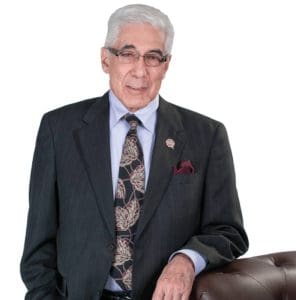
Jim Vinick, pictured here in 2013, when BusinessWest named him a Difference Maker, was well-respected in the region for wealth management, financial literacy, and civic commitment, particularly with the Basketball Hall of Fame.
“I think I took a lot of it for granted growing up. We would sit with my parents and with my grandfather at the table, learning about investing and things like that, and now that I’m working in this role, a lot of times, I’m explaining things to people that I’ve been taught my entire life, and he was so good at teaching all that.”
It’s an ethos he brings to each client interaction today.
“I’m constantly talking to my clients, pretty much every month. So I get to really know them as people,” Vinick said. “A lot of the planning and understanding their finances is ongoing, rather than just sitting down and having it be a one-time conversation. It’s ongoing conversations, understanding where people are in life and meeting their shifting needs.”
Those clients, he said, range from young families all the way up through retirees working on estate planning matters, and they come to Moors & Cabot with a wide range of income levels and assets. Obviously, the investing strategies — and those conversations — are far from cookie-cutter.
“It definitely changes with retirees who might be looking more for income and living off of the savings that they have, versus younger people who might be looking to build something for the future, planning for a house or college,” Vinick said. “There are a lot of key factors that most people want to consider, so we just talk through those. You can always start with the big picture and then hone down as you go.”
As for clients closer to retirement, at a time when people are living longer than ever, it’s important to help them understand they might be looking at 25 years or more of post-work years — and how much money it will take to live the lives they want.
“Part of it is factoring in the fact that there’s going to be inflation in that path, and expenses might vary even during retirement. Health concerns can come up. Do you plan on traveling, and do you have certain goals or a certain lifestyle you want to maintain during retirement? Those costs can change as you go,” he explained. “So you want to consider that variability. You don’t want to get to retirement and then run out of money because that would be a tough position. So that’s part of the plan as well.
No matter what one’s age, Vinick said, it’s important to start crafting that life plan as soon as possible.
“The best time to start was yesterday, and the second best time to start is today. So even if you didn’t start yet, you can always get started now, and it’s better than not getting started at all. Better late than never, they say.”
“Some people can see volatility and say, ‘it’ll be fine. I know I’m not investing for tomorrow; I’m investing for 10 years.’ And for some people, there could be a 1% change in their account over the span of a month, and it will worry them.”
Another element of helping clients is guiding them through periods of uncertainty in the market, like during the roller-coaster ride this past spring when the market kept diving and rising amid constant tariff rumours, announcements, and rollbacks.
“Part of investing for different clients is meeting the level of risk that they’re willing to accept,” Vinick said. “Some people can see volatility and say, ‘it’ll be fine. I know I’m not investing for tomorrow; I’m investing for 10 years.’ And for some people, there could be a 1% change in their account over the span of a month, and it will worry them. It’s something to keep in mind for each client, how much risk they can accept or how much tolerance they have for it.
“And then part of it is explaining to them, ‘hey, something may have happened last month, but overall we’re doing OK,’ or ‘this is the vision for the long term, and this is what we’re looking to do,’ and keeping them on track rather than giving in to either overjubilance when things go really, really well, or panicking when things get a little rocky for a month here or there, whatever it might be.”
That’s easier to do with somebody who’s at an earlier stage of life and can take a longer view, but it’s also a matter of personality, he added. “Younger people can still panic, too. I think it just depends on the personality, the person, and the risk they can accept.”
Back to School
Vinick’s father, Michael, didn’t choose the financial services path, but rather forged a successful career in the HVAC trade; he’s president of Duct & Vent Cleaning of America in Springfield. But Ty’s transition into leadership at Moors & Cabot ensures a multi-generational family legacy there — serving clients that are often also multi-generational.
“My grandfather had clients that were parents, grandparents, great-grandparents, and then, with his passing, I now have them as clients,” he said. “I’m the fifth generation of my family that’s in Springfield, and part of the business for me will also include being involved in the community that my family’s been involved in.”
And also education and communication. Vinick is already thinking about not only how he can become more involved with community organizations, as Jim was, but also how to continue his grandfather’s work on financial literacy, which included, many years ago, The Vinick Report, a local TV show on that topic.
“I love talking to people. I get to be on the phone all day with people, and you get to know them quite well,” he said. “You get to build these very meaningful relationships with people where you can kind of track them through their life. I think that’s the part that I enjoy doing.
“And I get to have a meaningful impact on their lives as well — I’m genuinely helping people reach milestones and achieve their financial goals,” he added. “You know, outside of their health, making sure they have a reasonable financial plan creates the foundation for everything else they want to do.”