

John Doleva
President and CEO, Naismith Memorial Basketball Hall of Fame
He’s Led the Shrine Through Crisis and onto Stable Footing

John Doleva
Photo by Bob Zemba, Simple Truth Imaging
John Doleva knows a little something about recognition programs.
Indeed, he’s president and CEO of the Naismith Memorial Basketball Hall of Fame, which, in addition to being a sports museum, annually inducts a handful of individuals and groups, across all levels of the game, into the shrine.
In fact, he’s the one who gets to call these people and let them know they’ve reached the pinnacle of this sport.
So when he was called to inform him that he was named a Difference Maker for 2025, the shoe was on the other foot, and he was both humbled and a little … well, reluctant.
“Why me? I’m just doing my job,” he asked.
Maybe. But this job, which he’s held since 2001, has been far more challenging — and even more rewarding — than he could possibly have imagined when he took it.
The rewards have come from overcoming those challenges, most of them financial in nature, and taking the Hall from a position where it didn’t know every two weeks if it could make payroll or if it would have to file for bankruptcy, or if it might be moved to another city, to where it is now: financially stable and with a secure future. In Springfield.
And most would say he isn’t just doing his job — he’s also been active in his community, especially regarding youth sports, childhood literacy, and other initiatives.
Jerry Colangelo, the former owner of the Phoenix Suns, long-time Hall of Fame board of governors member, and its current chair, has seen the transformative change at the shrine and credits Doleva with being the right leader at the right time.
“He’s always talked about how important the Hall of Fame is to the city of Springfield and the great interest he’s had, and the Hall has had, in promoting the city,” Colangelo told BusinessWest. “When you look at the progress the Hall of Fame has made, I give a great deal of credit to John Doleva. He’s been a great leader, and I think he’s a very valuable asset for the city of Springfield. The Hall of Fame is in the best financial condition it’s ever been in, by far, and the future looks great.”
Frank Colaccino, another long-time board member, agreed. “John doesn’t waver — he’s a hard-working guy; he doesn’t give up,” he said. “He’s one of the key reasons this organization is where it is today. John is the engine that makes it go.”
Looking back, Doleva told BusinessWest that it was never his intention to stay at the Hall long enough to have people describe him in such terms. Indeed, he said his plan was to stay a few years and then return to the sporting-goods world from which he came.
What kept him from going back, what kept him at the Hall, was the enormity of the challenge and opportunity to lead the shrine through it.
“When you look at the progress the Hall of Fame has made, I give a great deal of credit to John Doleva. He’s been a great leader, and I think he’s a very valuable asset for the city of Springfield.”
“I wouldn’t call it a thrill, but it was the thrill of managing something that that was seemingly impossible,” he said. “It was a like a firefight; you get into it, and you’re making progress — you can feel it, you can see it. It took a long time, and there were a couple of stumbles like the 2008 recession. But I enjoyed seeing the Hall reposition itself — that was exciting to me.”
Over the past 20 years or so, the Hall has gone from $14 million in debt to a $4 million endowment. Doleva acknowledges both that the latter is certainly not enough, and one of his goals is to greatly grow that number, and that the turnaround at the Hall was not the work of one man.
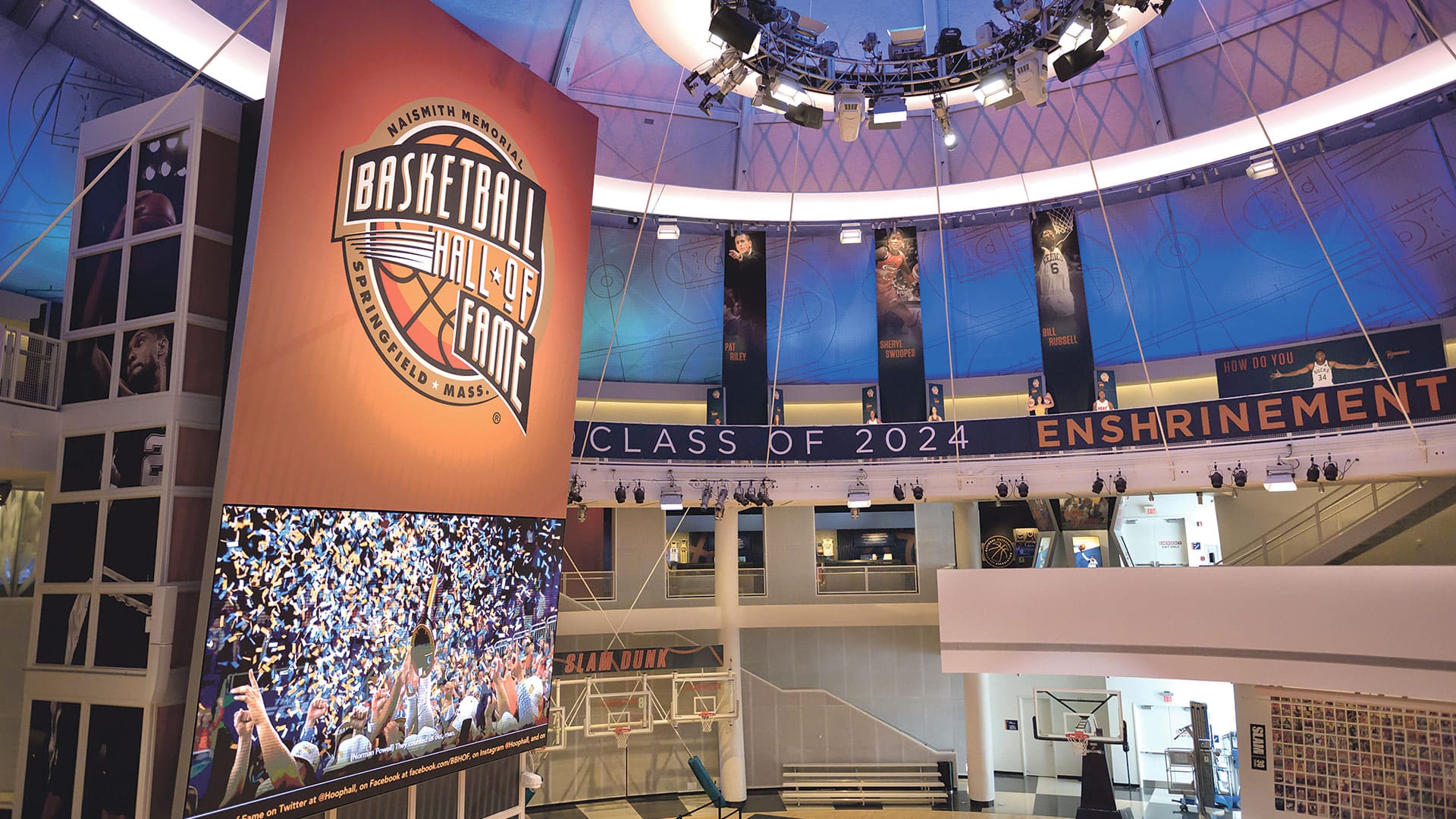
John Doleva says the successful capital campaign accompanying a recent renovation of the Hall exemplifies its stronger financial footing and status within the basketball community.
Photo by Bob Zemba, Simple Truth Imaging
But those who know him say it’s Doleva’s leadership and ability to build vital relationships that were weak or non-existent that made it possible.
And that’s one of many reasons why he’s a true Difference Maker.
Not a Slam Dunk
As noted earlier, Dovela came from the sporting-goods world, specifically Spalding, then based in Chicopee at the site of what is now a Callaway golf-ball manufacturing plant.
He was 25 when he joined the company as assistant product manager in the early ’80s, eventually rising to vice president and general manager of the company’s Sporting Goods Group. He said his years working for President George Dickerman, noted for being a tough, demanding manager, were difficult, but ultimately invaluable learning experiences.
“Those first few years, I went through the wringer with him … there were lots of times when I said, ‘this is crazy, I’m going to quit, I’m going to quit, I’m going to quit,’” he recalled. “But the lightbulb went off one day that what he was doing was preparing those who wanted to be prepared to be really good managers.
“You were always ready with your numbers, for instance, and you had two or three options for every question you anticipated him asking,” he went on. “And I think that really helped me with my business thinking.”
Doleva said those years at Spalding under Dickerman certainly helped steel him for what was to come at the Hall, which he joined in 1999 as vice president of Marketing, with the encouragement of Dickerman, one of the many leaders forced out when Spalding was acquired by KKR in 1996. (Doleva took a package from Spalding and worked briefly for a technology company in the Berkshires before coming to the Hall.)
Just a few years later, when then-president Don Gibson left, Doleva was placed in the role of chief operating officer, and a year later, he was named president and CEO and thrust into what could only be called a crisis.
“Those first few years, I went through the wringer with him … there were lots of times when I said, ‘this is crazy, I’m going to quit, I’m going to quit, I’m going to quit. But the lightbulb went off one day that what he was doing was preparing those who wanted to be prepared to be really good managers.”
Indeed, the new Hall of Fame on the city’s riverfront was opening after a failed capital campaign and amid $14 million in debt that suffocated the institution.
Colangelo remembers Doleva calling him at the height of this crisis in 2002, asking for advice, and soliciting his help. Colangelo responded by pledging financial support and telling other NBA owners — “I didn’t ask them, I told them” — to support the cause as well.
The money raised by the NBA provided vital breathing room, but the crisis was far from over, and huge amounts of debt remained. The firefight, as Doleva described it earlier, would continue for years.
Describing how he and his team were able to steer the Hall out of serious debt, onto stable financial footing, and raise more than $30 million during a recent capital campaign to renovate the shrine, he said it’s been about building relationships — with the NBA, the NCAA, high-school basketball, other bodies, and especially the hall of famers themselves.
“When I first came to the Hall, we’d have enshrinement, and we’d invite existing hall of famers back, but we wouldn’t pay for their flights, we wouldn’t pay for their hotel, we wouldn’t pay for their ticket to enshrinement,” he explained. “And the return was very low; I remember one year we had five hall of famers return and a class of three. It wasn’t a very crowded room.

John Doleva, left, with former UMass coach John Calipari at his induction ceremony, has led the Hall through times of both growth and extreme challenge.
“The first thing I said when I took over — and this is when we had all that debt and no money — is that ‘we have got to offer to pay for hall of famers to come back, with a guest; we’re going to pay for their airfare, we’re going to pay for their hotel and their ground transportation … we’re going to treat them like hall of famers. And we’re going to bet that this will pay off in the future because they will get more involved.’”
And they have, with 58 hall of famers coming to Springfield for enshrinement ceremonies last fall, joining the 13 being inducted. Meanwhile, these inductees have become foot soldiers, as Doleva called them, acting as ambassadors for the Hall and taking part in its many events around the country.
Nothing but Net
This brings Doleva back to something he said earlier about seeing the Hall reposition itself over the years “from a place that had a lack of knowledge and lack of respect from the basketball community to something that was meaningful and respected and, in fact, revered.
“We’ve changed the minds of a lot of people in basketball about what the Hall is, what it represents, and what kind of quality image it has in the game,” he went on, adding that this work never stops.
While repositioning the Hall, Doleva has also become quite involved in the Western Mass. community. He’s active with the Greater Springfield Convention and Visitors Bureau, and also with efforts to create the annual Hoophall Classic, one of the nation’s largest and most prestigious high-school basketball tournaments, and Hooplandia, the annual 3-on-3 basketball tourney staged at the Big E, with select division championship games at the Hall.
Meanwhile, he has also been involved with the nonprofit Link to Libraries (LTL) — as a reader, program sponsor, and youth mentor — as well as the Greater Springfield YMCA, Springfield College, the Red Cross of Pioneer Valley, the Springfield Rescue Mission homeless shelter, and other area agencies.
“John is a dynamic, hardworking, caring, and humble man. He excels in many things, including his work at the Hall of Fame, but more importantly, he excels at being a truly wonderful and generous human being,” wrote Susan Jaye Kaplan, co-founder of LTL, as she nominated Doleva for the Difference Makers award. “He goes the extra mile each day, and not just in his work-related duties. He cares greatly for his Western Mass. community, and it is evident on a daily basis.”
Getting back to his role as the one who calls inductees with the good news, Doleva said that’s a bittersweet day — because he’s also the one who calls those who came up short in the annual voting.
And there are sometimes tears from those in both camps, he said, adding that this makes the day somewhat difficult.
As for the phone call he received from BusinessWest … there were repeated attempts to minimize his contributions to the Hall, the game, the city of Springfield, and this region by simply saying, “I’m just doing my job.”
But Doleva has been doing much more than that. He’s been a real leader and a true Difference Maker.