
Holyoke Continues to Ride a Green Wave
Community Spotlight

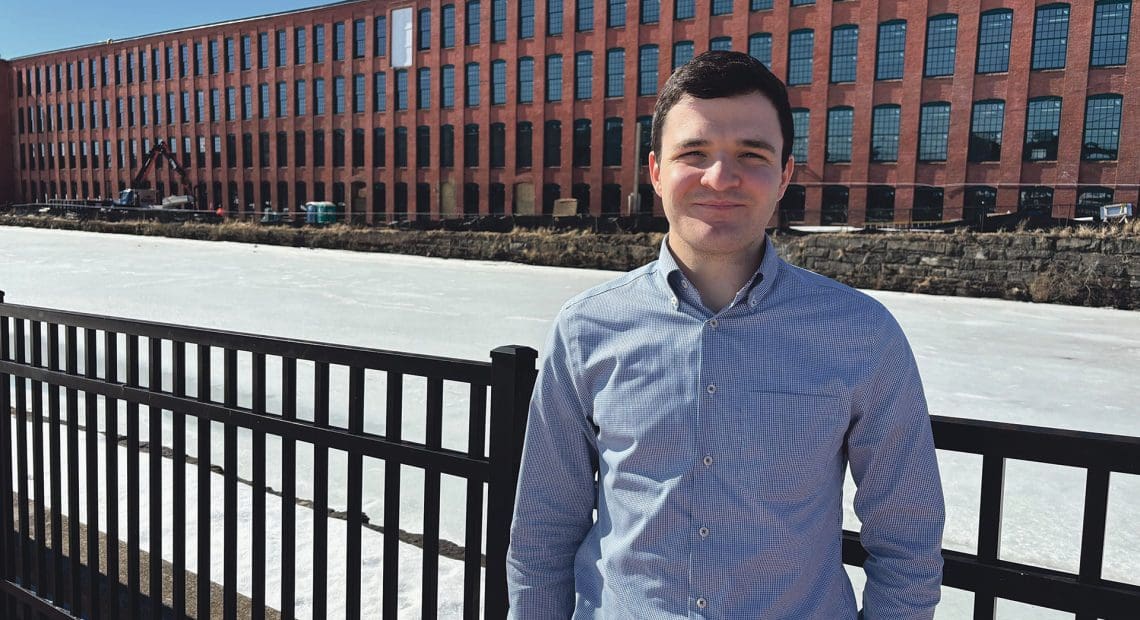
Hagop Toghramadjian stands outside phase one of the Residences on Appleton, which features 88 units of mixed-income housing.
Aaron Vega calls them ‘meet and greets.’
And they are, well … just what that name suggests. They’re meetings between city officials and small-business owners, many of them representing ventures in the emerging ‘climate tech’ sector who have heard about Holyoke and the companies that now call it home, and want to hear more with an eye toward following them.
“They’re hearing about Clean Crop, they’re hearing about Sublime Systems, they’re hearing about Simple Pack, and they want to know what’s going on,” said Vega, director of the city’s Office of Planning and Economic Development, referring to three cutting-edge businesses we’ll get to back to later that are either already in Holyoke or advancing plans to locate there.
As city leaders listen to these business owners, a common thread — and a real challenge for the community — emerges.
“The biggest challenge for these companies that want to come to Holyoke as they move from their startup space is that there’s no built, ready space for them,” Vega noted. “There’s no white-box office space to move into. These guys don’t want to get involved in a rehab project; they want to be able to move in and get to work.”
“The biggest challenge for these companies that want to come to Holyoke as they move from their startup space is that there’s no built, ready space for them. There’s no white-box office space to move into. These guys don’t want to get involved in a rehab project; they want to be able to move in and get to work.”
Holyoke’s meet and greets and other aspects of its efforts to bring more small businesses to this former manufacturing hub — and early-stage efforts to create more spaces for them to move into — are just a few of the many converging storylines in Holyoke.
Others include:
• New housing projects, including a WinnDevelopment initiative at the former Farr Alpaca Co. complex — a $60 million endeavor that will create 88 units of mixed-income housing for adults 55 and over in phase 1 and another 70 in phase 2, while preserving a huge piece of the city’s past — and another project at Open Square that will create 80 units of market-rate housing;
• A cannabis cluster in flux: Holyoke welcomed the cannabis industry with open arms, and for a time, it looked like a large cluster of different businesses, from growers to dispensaries, would settle there. Some have, but as the sector faces growing pains and overall contraction, the city faces challenges, including businesses that are fighting to survive and one large grow facility, Trulieve, that has closed, with its huge plant sitting idle;
• New businesses and greater energy downtown. The city continues to ride a wave of entrepreneurship that has generated several new restaurants and storefronts in and around High Street, Vega said, adding that the new housing units coming online should generate more new-business activity;
• Those aforementioned companies in the green-energy and climate-tech sectors, headlined by Sublime Systems, which will manufacture environmentally friendly concrete at a plant on Water Street;
• A sports complex that is still in its early stages, with a site identified on Whiting Farms Road and other properties being assembled, as well as new ownership of Wyckoff Country Club (see related story on page 31).
• A reinvigorated Holyoke Community College, which has received a huge boost from MassEducate, the state’s free community-college program, and is making adjustments in the wake of a 24% rise in enrollment over the past two years;
• A new strategic plan for the city now being prepared, which is expected to help create a road map for continued progress in a city that has seen momentum on several fronts in recent years; and
• Existing businesses and traditions, especially the upcoming Holyoke St. Patrick’s Day Parade and Road Race.
Slicing through all that, Mayor Joshua Garcia, the Holyoke native now in his fourth year in the corner office, said the city is achieving progress with many goals and on several fronts, but there is still considerable work to do and projects to bring to the goal line.
These include everything from the sports complex to renovation of the historic Victory Theatre, a project now 40 years in the making. Those behind the effort are still struggling to close a significant gap between the funding that’s been raised and what will be needed to revitalize the landmark.
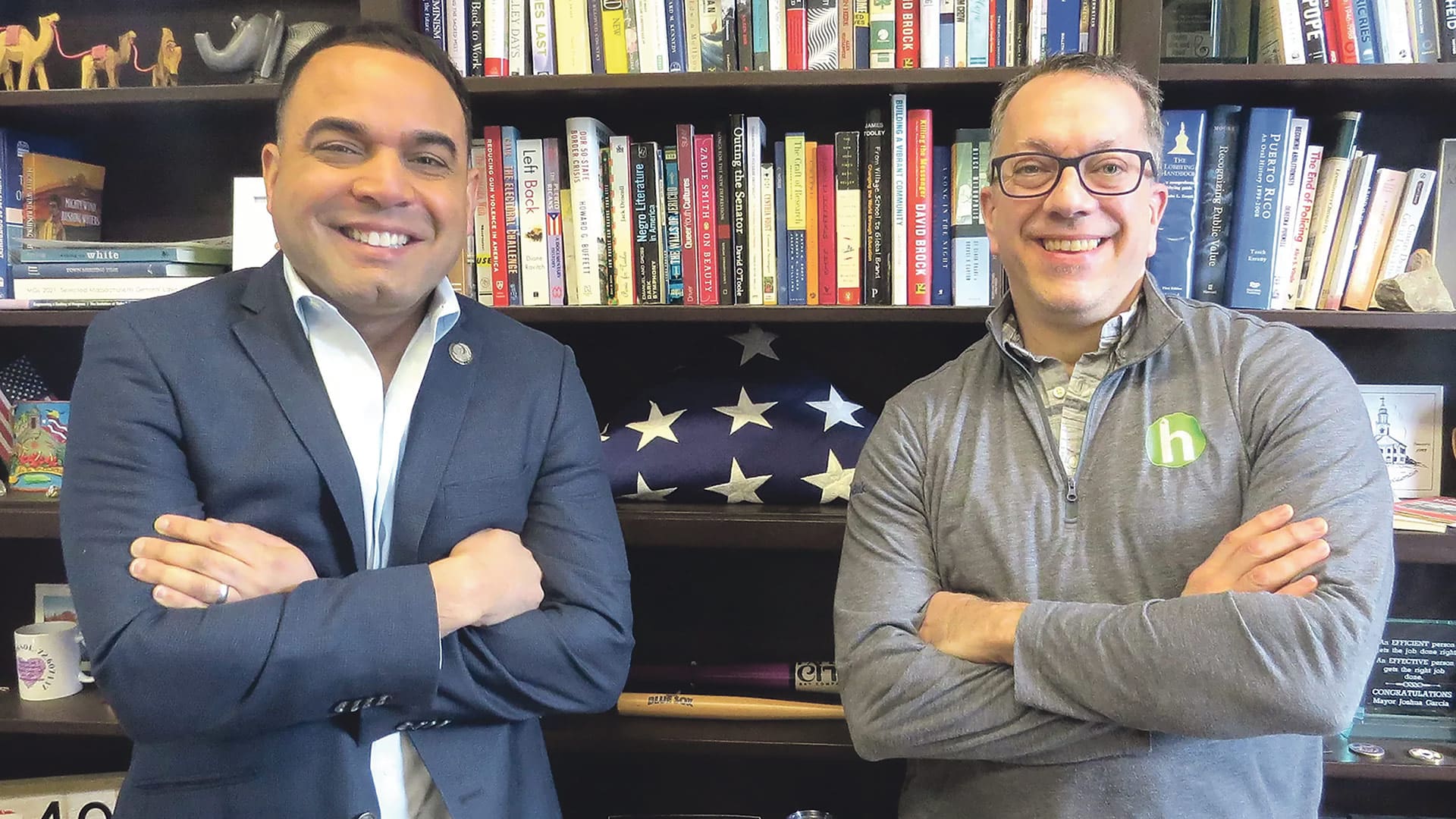
Mayor Joshua Garcia, left, and Aaron Vega say Holyoke continues to pursue — and add — new businesses in the broad realm of climate tech.
Garcia described economic development in the city as an ecosystem, one including manufacturing, small — and often very small — businesses, hospitality, the arts, food, and sports.
“The question is, how can we get all the boats to rise together so we’re establishing sustainability in our city?” he asked, adding that the answer to that question is the ongoing priority of his administration.
Not Your Run-of-the-mill Project
“Daunting.”
That’s the word Hagop Toghramadjian, a project director and development counsel with Boston-based WinnDevelopment, settled on as he was asked to describe the ongoing work at Appleton Street at the former Farr Alpaca complex.
Elaborating, he said he considers the project, called the Residences on Appleton, now far more than a decade in the making, to be the most challenging building-conversion initiative that WinnDevelopment has undertaken. And that’s saying something.
Indeed, the company has taken on many complex projects locally, including 31 Elm St. (Court Square) in Springfield and several buildings in the Ludlow Mills complex, and in numerous other communities as well.
But this conversion of the 125-year-old former mill complex into housing is on another level, said Toghramadjian as he talked with BusinessWest in the kitchen of one of the nearly finished units. He noted that there are several reasons why — from the extremely poor condition of the mill to the need to assemble property for parking and a three-story amenities building, to simply securing access to a building bordered on one side by a canal and the other by the Pioneer Valley Railroad.
As with all projects of this nature, there was also the challenge of pulling together the requisite pots of money, which, in this case, included everything from state and federal historic tax credits to state and federal low-income housing funds.
“We want to keep these small businesses local; we want to keep them here and give them an opportunity to grow their business.”
“Where we’re standing now … there was thin air, the floor had rotted through, the roof had rotted through — only the brick walls were still standing,” he said. “It was very dark, the air quality was bad … you would never dream that this could become comfortable, beautiful housing.”
But the various groups involved have persevered because this project is as important as it is difficult, he noted.
“Given its location and given how blighted it was, it cast a shadow on the whole downtown — it was a top priority for the city,” said Toghramadjian, noting that the site sits between Main and High streets, the city’s two main commercial districts, and directly across from Holyoke Heritage State Park and the Massachusetts Green High Performance Computing Center. “Because of that, they’ve been really good partners, and that’s why Winn came to Holyoke and made this investment here — it’s because the city knew what it took to make this kind of project happen.”
Jim Lavelle
“We’ve been trying to promote not only the lower utility rates here, but the clean energy that customers can promote with their products and hopefully help with sales.”

As phase 1 continues, with leasing to commence and tenants due to start moving in this fall, Toghramadjian and others we talked with said that, while these 88 units will make a welcome addition to the landscape and help spur economic development in the area, they represent a drop in the bucket when it comes to the city’s overall housing needs.
Indeed, Garcia said a recent report put that need at roughly 1,600 units of new housing over the next 20 years across the broad spectrum of income levels, which is another key element in the equation because different types of housing, including market-rate and homeownership, enables residents to stay in the city as their financial situation improves.
“The Appleton Street project doesn’t address the magnitude of the problem, but we’re chipping away at it,” said the mayor, noting that there may be as many as 600 units already in the pipeline.
That includes phase 2 of the Appleton Street initiative, he said, noting that WinnDevelopment is currently assembling the required pots of money for that initiative, as well as the market-rate units planned for Open Square and other ongoing housing initiatives.
There are several smaller housing initiatives taking place, said Vega, including many involving the upper floors of properties along High Street, projects that provide a few or a few dozen units, all of which help meet growing need.
The problem, he went on, is the immense competition for limited state and federal support for such initiatives, with seemingly every community in the Commonwealth in need of housing.
“All the developers are going for the same pots of money, whether they’re in Holyoke, Springfield, Chicopee, or West Springfield,” he said, adding that, in this environment, having a solid mix of projects, large and small, in the pipeline is a must.
Current Events
As noted earlier, there are several projects in various stages of development in Hoyoke, and many converging storylines.
One of the most intriguing involves new-business development, especially in green energy and related sectors, where a cluster is emerging as companies eye Holyoke for location, available and relatively inexpensive real estate, and, especially, its lower-cost, clean electricity, said Jim Lavelle, general manager of Holyoke Gas & Electric (HG&E), which provides that energy.
“We’ve been trying to promote not only the lower utility rates here, but the clean energy that customers can promote with their products and hopefully help with sales,” said Lavelle, adding that Sublime Systems is just one of many businesses, large and small, that have chosen Holyoke for that reason, among others.
As an example, he cited Simple Pack, a company now located in Open Square that manufactures green food packaging to restaurants, schools, hospital cafeterias, and food distributors. Being able to say such products are produced with clean energy, in this case hydropower, is important to the company’s mission and a strong selling point with its clients, he said.
There are several similar examples, said Lavelle, who will gain a different title in a few days — grand marshal of Holyoke’s annual St. Patrick’s Day Parade.
While his father served in that role decades ago, Lavelle never expected to wear that hat himself because, while he’s long been somewhat involved in the parade, he has never served on its committee.
He considers the honor a nod to HG&E’s important role in the city, and is enthusiastic about fulfilling the many duties of grand marshal, including attendance at myriad events and, in accordance with tradition, responsibility for parade-day weather.
“I have a much greater appreciation for the effort that goes into all these different events that the parade committee puts on,” he said. “And I have a much greater appreciation for how strong a regional collaboration exists between the different communities’ parade committees and other civic organizations and the sponsors; they really work hand-in-hand on all these different events that happen across Western Mass.”
Putting his HG&E hat back on, figuratively if not literally, Lavelle said Sublime Systems, which he believes should be ready to starting building its facility later this year or early next, will soon become the utility’s largest customer, with 10 to 12 megawatts of demand. That’s a huge draw, but one it can easily absorb thanks to transmission-system upgrades, he went on, adding that the HG&E has the capacity to attract several more large users and dozens of smaller ones.
Attracting these businesses is one of many priorities for the city, said Vega, noting that there have been a steady volume of meet-and-greets in recent years, and more are on the schedule.
Many of these sessions involve early-stage companies, many of them in green-energy or green-manufacturing ventures, he said, adding that, in addition to city officials, the leaders of companies like Clean Crop, which uses electricity to revolutionize food safety, are often in the room to discuss Holyoke and its many selling points.
“If they’re a little further along and they have specific questions, we’ll bring in Holyoke Gas & Electric to talk about the energy portfolio they can provide,” the mayor went on. “We’re on people’s radar — we just need to put the package together to bring them in.”
Holyoke at a Glance
Year Incorporated: 1786
Population: 38,247
Area: 22.8 square miles
County: Hampden
Residential Tax Rate: $17.46
Commercial Tax Rate: $38.54
Median Household Income: $37,954
Median Family Income: $46,940
Type of Government: Mayor, City Council
Largest Employers: Holyoke Medical Center, Holyoke Community College, ISO New England Inc., PeoplesBank, Universal Plastics, Marox Corp.
* Latest information available
Which brings him back to that ongoing challenge of offering them spaces that are ready to move into. There aren’t many of them in the city, but he’s in discussions with some building owners about possibly partnering with the city to develop co-work, start-up, or innovation space.
“That’s a direction we want to go in,” he told BusinessWest. “We want to keep these small businesses local; we want to keep them here and give them an opportunity to grow their business.”
Bottom Line
As for businesses already growing in Holyoke, there are many in the cannabis sector, which, while it is experiencing strong growing pains, remains a force in Holyoke, Garcia said.
He noted that social consumption, or so-called cannabis cafés, constitutes the next frontier for this industry — the Cannabis Control Commission is taking up regulatory reforms on such facilities — and for some establishments in Holyoke, it could be a real lifeline in this time of growing challenge.
“In Holyoke, we want to be among the first communities to adapt and implement that opportunity for on-site consumption,” he said, likening these establishments to bars and restaurants in the sense of attracting people to the community. “If we can bring people into our city to spend money, that’s a plus.”
With cannabis, as with many of the other storylines unfolding in Holyoke, Garcia said he remains a “glass-full leader.”
That means he’s optimistic, but also realistic. It means he understands that, while much has been accomplished, there’s still much to do, and on many fronts.
It means he’s more bullish on his hometown than ever.