
Area Architects Face Challenges, but Remain Busy
Weathering Some Uncertainty
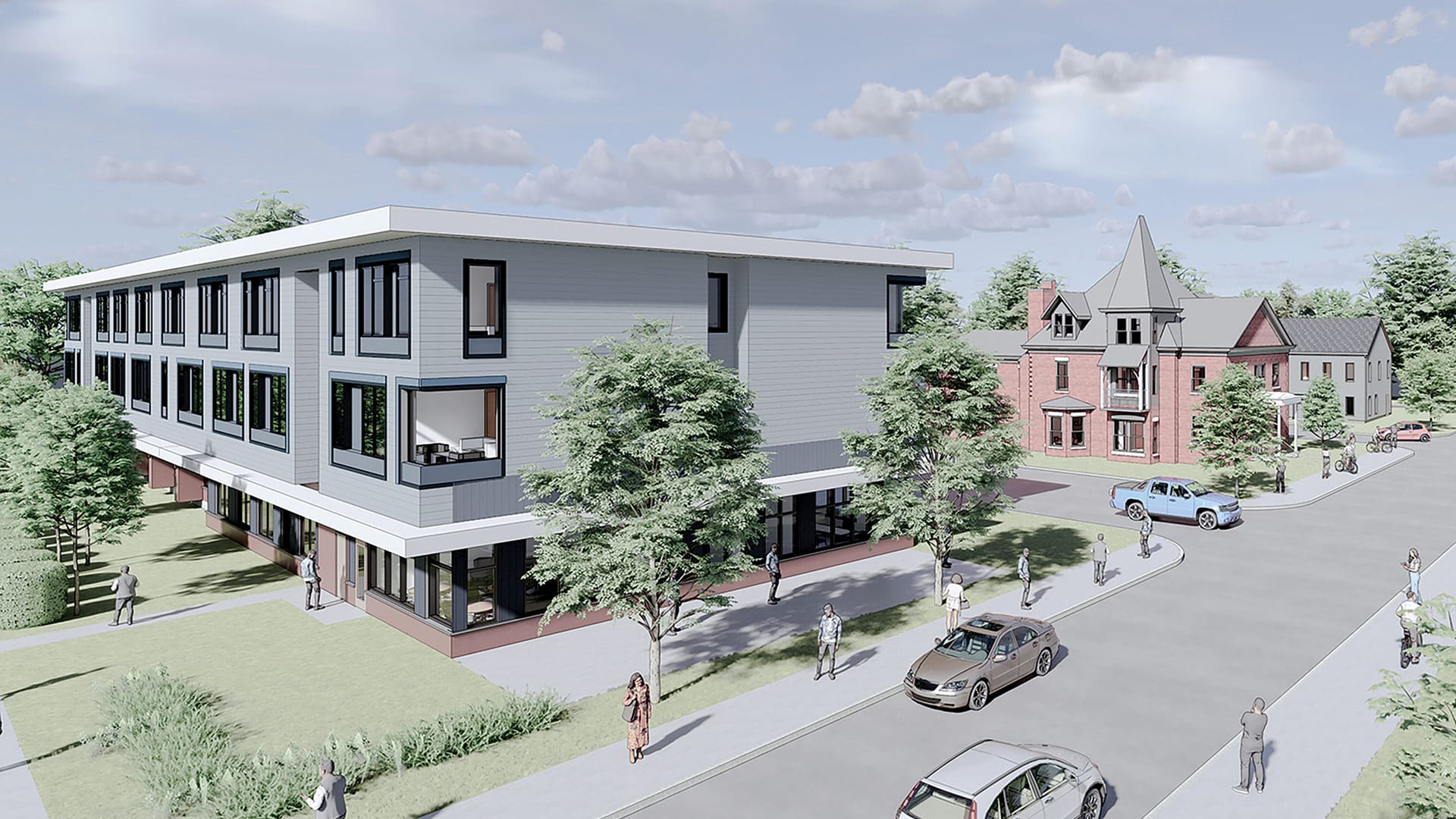
A rendering of a project in downtown Pittsfield, one of many housing initiatives in the Dietz & Company portfolio.
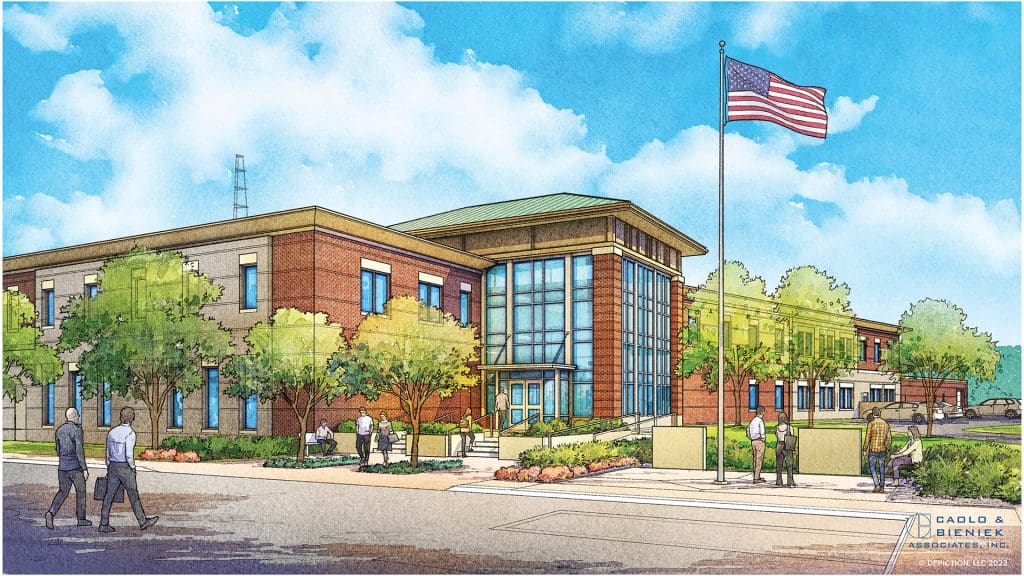
A rendering of a public safety facility in Taunton designed by Caolo & Bieniek.
Lee Morrissette was probably looking for some wood to knock on.
In the architecture industry, he explained, there is chatter about things slowing down and work becoming more difficult to attain, and for several reasons. But at the same time, Morrisette, a principal with Springfield-based Dietz & Company Architects, has a different take.
“The architecture industry has been saying that things have been softening for quite a while — billings are down, and new job starts are down, but we’re just not seeing that,” he said, noting that the firm — which recently opened an office in Cambridge, where Morrissette leads a team of four — has a considerable amount of work on the books.
Especially strong is work within the broad housing sector, he added, noting that the critical need for housing of all kinds, but especially the affordable variety, is a statewide problem that is keeping the firm busy.
“We’ve maintained a consistent stream of work,” he said, noting that housing and housing-related projects — from a new community center and administrative office for the Fitchburg Housing Authority to an intriguing 48-unit housing project in downtown Pittsfield, to redevelopment of a demolished shopping plaza in Manchester, Conn. into 232 units of market-rate housing — are dominating the portfolio.
Others we spoke with agreed, at least to some extent, but noted that there are some signs of slowdown and a variety of forces — from rising prices of materials and labor to tariffs to a slower-than-expected pace of decline in interest rates — contributing to a good amount of uncertainty, which is never a good thing within the broad building trades sector.
Still, area firms seem to be maneuvering through this uncertainty, mostly through the diversity of their portfolios, the housing crisis, and the fact that many projects are moving forward in some form, though maybe a little later than planned in some cases.
“While some people have hit pause on projects, there’s more of what I’ll call re-evaluation,” said Curtis Edgin, a principal with Chicopee-based Caolo & Bieniek Architects. “People are saying, ‘is this what we really want to do, or do we want to explore a plan B opportunity?’ We’ve seen a little bit of that, and we’ve been fortunate that there’s always been a plan B.
“The architecture industry has been saying that things have been softening for quite a while — billings are down, and new job starts are down, but we’re just not seeing that.”
“We’ve had another good year, and we have good work in the boards for next year,” he continued, adding, again, that diversity of projects — public, private, large, small, long term and shorter term — has been a real asset for the firm.
Kevin Rothschild, principal with East Longmeadow-based Architecture Environment Life (AEL), agreed, but noted there are some forces that will make 2026 somewhat more challenging. These include the end of several pandemic-related programs to fuel the economy, cutbacks to some public sector programs, and other factors.
“Things are a little harder, a little slower,” he told BusinessWest. “We’re seeing the tail end of funding programs like ARPA and ESSER [Elementary and Secondary School Emergency Relief] as well as municipal or federal grants that were out there for schools and cities and Green Communities,” he said. “We’re seeing a lot of those programs reach their conclusion. The work that we’re exposed to on those projects has had a good run, and we’re seeing a lot of that closing out.”

For this issue and its focus on architecture, we talked to several area firms about what this bellwether sector is seeing, hearing, and experiencing, and what they’re expecting in the months to come.
Drawing Conclusions
Morrissette said it was the housing crunch and ongoing efforts to address it that prompted the Dietz firm to expand with its Cambridge office, a small space in the Cambridge Innovation Center, a co-working facility — a step taken after lessons learned from the pandemic about remote work, virtual meetings, and the ability for teams to work effectively even if they’re not all in the same office at the same time.
“We were finding that the housing authorities, particularly the Cambridge Housing Authority and others that we working with … we had enough work with them, and they kept saying, ‘if you had an office here in the Boston area, it would be a lot easier to work on a continuing basis,’” he recalled. “You don’t have to hear that too many times before taking some action.”
And it is housing that continues to broaden the book of business, he said, adding that the firm is involved with several intriguing projects, including the redevelopment of the corner of Linden and Center streets in Pittsfield’s Downtown Arts District. The initiative calls for 48 units of affordable apartment housing through Low-Income Housing Tax Credits — a 30-unit apartment building and two six-unit townhouses designed for passive house certification, the firm’s first such project.
“While some people have hit pause on projects, there’s more of what I’ll call re-evaluation. People are saying, ‘is this what we really want to do, or do we want to explore a plan B opportunity?’ We’ve seen a little bit of that, and we’ve been fortunate that there’s always been a plan B.”
Dietz is also working on an ambitious project in Manchester, Conn. on the site of a razed shopping center. In addition to the 232 units of market-rate apartment housing, plans call for a clubhouse with a fitness center, outdoor pool, and space for community events, as well as a multi-use recreation trail extension, said Morrissette, adding that the project appeared stalled last fall amid uncertainty and higher interest rates, but quickly got back on track.
“We had done some schematics and design-development drawings, and they said, ‘you know what … hold on, we’ll finish out the space, and we’ll see what happens, and if interest rates start to come down, we’ll contact you,’” he recalled. “It didn’t take much of an interest rate drop before they said, ‘OK, it’s looking good enough; we’re moving in the right direction,’ and they re-engaged and got it going again.”
Meanwhile, the firm, with the help of that Cambridge office, has been able to secure work with several housing authorities, including the one in Fitchburg, in the center of the state, where it is designing a new community center and administrative offices.

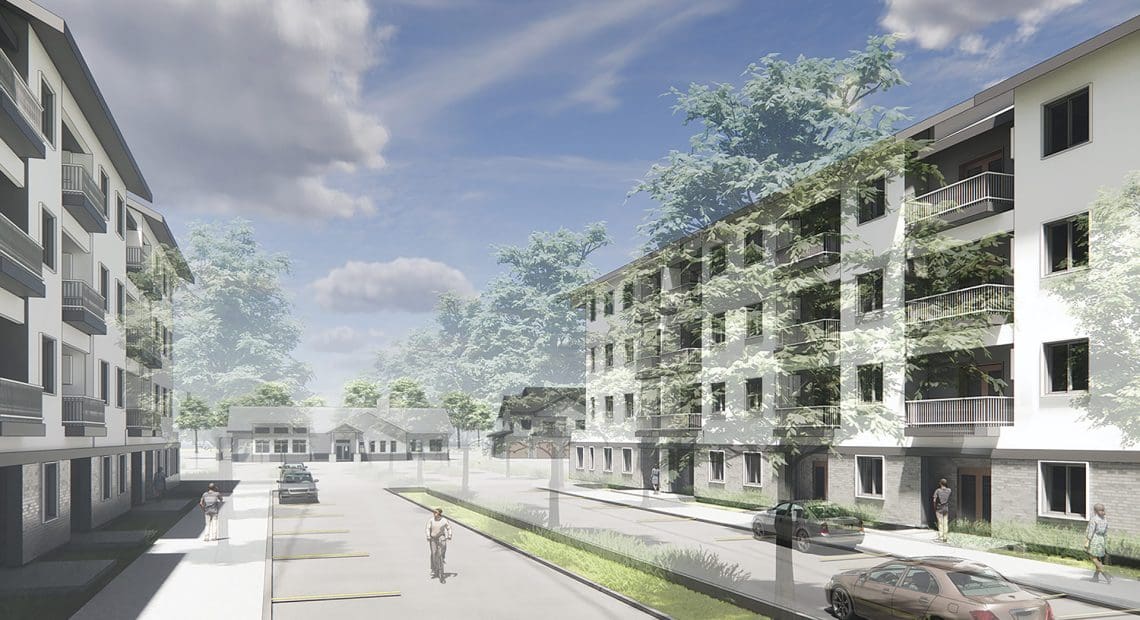
A rendering of an ambitious housing project in a demolished strip mall in Manchester, Conn. being designed by Dietz & Company.
“We’ve been successful with quite a fair amount of housing authority work, which has been rooting us nicely in this Cambridge office; it’s been good,” Morrissette said, adding that the firm has work in other realms as well, including municipal — the renovated former Chicopee Library, for example — as well as hospitality, education, and office projects.
Growth — by Design
Diverse portfolios are also the key to success for the other firms we spoke with.
Indeed, Caolo & Bieniek has been involved with everything from renovations to the clubhouses at Springfield’s two municipal golf courses, Franconia and Veterans, to the new Barry Elementary School in Chicopee; from work at public colleges, including UMass Amherst and Westfield State University, and the municipal library in Richmond to several public-safety projects. That list also includes early-stage work on what will be one of several proposals for a replacement for the troubled Roderick L. Ireland Courthouse in downtown Springfield.
“Our work varies from very long-term projects, like the Barry Elementary School, to the short-term, ‘the roof is leaking; we need to do something’ projects,” Edgin explained. “And that’s what has kept our lights on through the years; we don’t only depend on public sector money. We do some private work, and we have some good private clients as well. And through the years, they appreciate what we we’ve done for them, and they keep coming back, and that’s how we’ve been fortunate.”
The firm has developed a strong niche in the design of public safety facilities, he went on, adding that it has several in various stages of progress in Lenox, Taunton, and Princeton. And, like most firms, it is garnering work in the broad housing sector.
Edgin said his take on the short term, meaning the next several quarters, is one of cautious optimism as the public and private sectors cope with all those challenges listed above and face decisions about whether to proceed with projects, and how.
Curtis Edgin
“We don’t only depend on public sector money. We do some private work, and we have some good private clients as well.”

As he noted, there is usually a plan B.
Rothschild agreed and said his firm still has considerable work on its plate and in the pipeline, but noted that the winding down of several COVID-related programs will certainly be felt within the industry.
He said his firm secured several ESSER-funded, HVAC-related projects to improve ventilation in schools, especially in Holyoke — work that is coming to an end.
Meanwhile, AEL has also garnered some work — lighting, ceiling, insulation, and other initiatives — via the state’s Green Communities program, which provides grants and technical assistance to municipalities to reduce their energy consumption and costs through energy efficiency and renewable energy projects.
“That seems to be ongoing,” he said. “But with national trends in support of different policies, obviously there are question marks moving forward.
“Meanwhile, the national trends and the pulse of federal cuts, the changes the federal policy, tariffs, labor, immigration … we’re seeing direct impacts from all that,” he went on. “We’re seeing the availability of labor slowing, we’re seeing the cost of work going up, we’re seeing the availability of materials challenged — even if it’s uncertainty concerning what might be coming, it has an impact.”
Rothschild mentioned a HUD-funded project involving a local housing authority the firm was involved with to get his points across.
“I think we were 90% through the drawings, and that was stopped because the funding was not secure. I think ultimately it was cut, and that project was put on the shelf,” he said. “We’re seeing the impact of what’s happening on the federal level on the private market and the public side as well.”
On the positive side, there is the strong potential for new work through state law now permitting property owners to build one accessory dwelling unit in an area zoned for single-family homes, he said, adding that area communities are adapting the bylaw, and some are seeing requests for permits to build.
Meanwhile, AEL is still seeing a good amount of work on both sides of the ledger, and some pockets of the economy, including the commercial market, show the confidence needed to move forward with projects.
“Everything from people trying to open a dance studio to a carpet business looking to expand to trucking and warehouse facilities — there’s a diversity of work out there,” he said. “It’s still there, it’s just hard. Financing is a challenge, contracting is a challenge — everything seems to take a little longer, and it’s a little harder to get through the pipeline.”