
Banks, Credit Unions Leverage Evolving Technology
Tools of the Trade

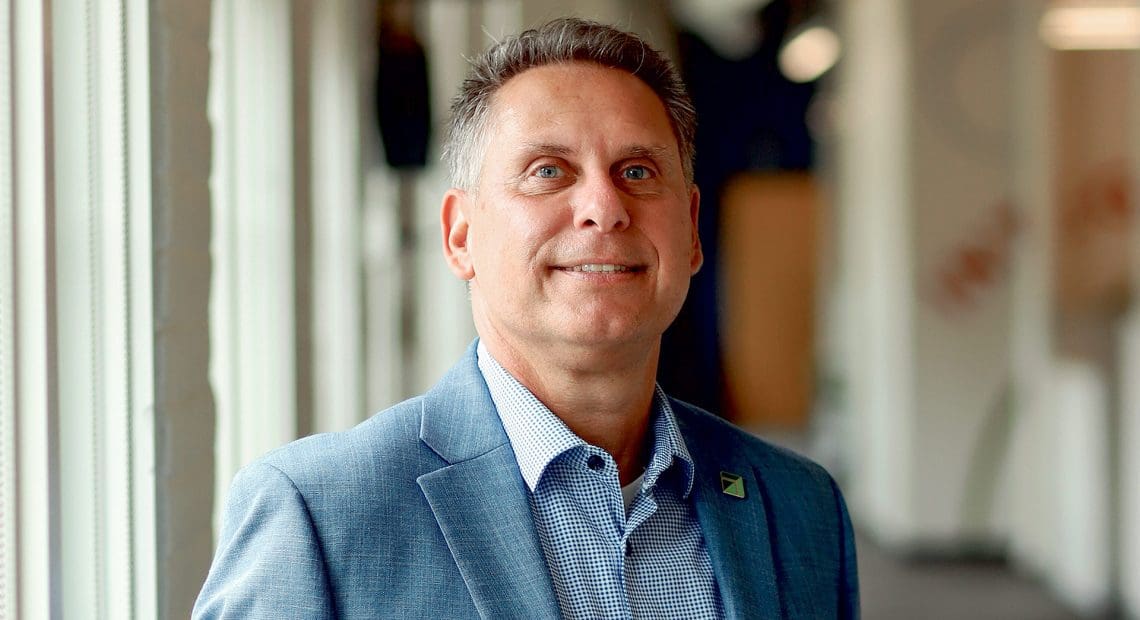
Marco Bernasconi says Country Bank’s adoption of new technology must be done smartly, with the needs of customers in mind.
It’s no secret, Marco Bernasconi said, that all banks use similar technology. The difference lies in how they deploy it, and which services they emphasize.
“It’s not just about getting bigger, or being involved in more technology; it’s about operating with intelligence and leveraging efficiency and automation to drive sustainable growth,” said Bernasconi, chief Operating and Innovation officer at Country Bank. “For us, it’s about being smart and determining how to serve the needs of customers.”
Glenn Welch, president of Freedom Credit Union, agreed.
“A lot of us use services provided through a third-party provider. So if you go to our websites, they’re fairly similar — different colors, but the same tools,” he said. “So a lot of it comes down to service. You have to have the tools on the websites, but customers have to like you, too. You have to provide good service to the members.”
Both were speaking to a reality shared by all banks and credit unions these days — at a time when fewer customers actually visit a branch to do business, instead conducting most of it online, institutions need to ensure that those digital tools are robust, easy to use, and, especially, secure.
At the same time, though, there will always be a need for a physical branch presence for the business that people like to conduct there — opening accounts, loan applications, and, for some, normal deposits and withdrawals — so banks can’t afford to neglect that side of their business while they focus on developing and evolving their digital platform.
“We’re modernizing digital channels and continuing to leverage digital investing and marketing tools, and constantly reassessing different technologies to keep customers secure. But we also need to be equipped to train the team when people come in for traditional transactions,” said Bernasconi, noting that Country’s branch strategy includes its first branch in Springfield, opening this year.
“We’re modernizing digital channels and continuing to leverage digital investing and marketing tools, and constantly reassessing different technologies to keep customers secure. But we also need to be equipped to train the team when people come in for traditional transactions.”
The volume of branch visitors has changed from the time he was a teller, he added, “but they’re coming in with more difficult problems, and we’re spending more time with them on education, explaining different products, helping move their financial lives forward. So we certainly need traditional transactions at branches.”
A balance between high-tech and high-touch resources is important to commercial customers as well, said Aleda De Maria, executive vice president and chief operating officer at PeoplesBank.
“A lot of our small business owners are all things to their users — CEO, CFO, HR person, day-to-day manager. So we want to make sure we’re offering services through technology to make their lives easier,” she explained.

Aleda De Maria says PeoplesBank has bolstered its internal fraud detection tools to protect customers.
For example, “last year, we implemented some smaller balance lending that our customers can apply for 100% digitally and get answers from us within days, in some cases. We’d like to push that in 2026, optimize that to bring it to a wider audience. That’s something I’m super excited about.”
Last year, PeoplesBank underwent a core conversion of its technology and systems, building on the early growth of its digital brand, ZYNLO Bank, which it launched in 2020 in partnership with Nymbus.
“We didn’t just do the conversion to say we did it. We did it to continually evolve what we offer customers,” De Maria said, adding that the focus was on both back-end technology and front-end interface.
“We are constantly focused on the front end. That’s the window into PeoplesBank. If the customer opens an account and we’re not seeing them after that, what are they doing? They’re online and mobile,” she went on. “Because of the conversion, we have more control over the customer experience and can be more aggressive in updating user experiences — and to ask ourselves what services are available, how can we improve, and what we can add to that.”
Bernasconi said banks must decide whether to crawl, walk, or run toward new technology, but all are asking similar questions — how to deal with the rise of AI, from both a technical and governance perspective; how to help customers access new business products; and, through all of it, how to ensure a crisp customer experience.
“We’re competing with the Apples and Amazons, the fintechs now; it’s not competing only with banks and credit unions anymore,” he added. “The world has changed.”
Battling Back
All the area financial leaders who spoke with BusinessWest said fraud prevention — and the increasingly powerful tools that enable it — are critical to any institution’s technology strategy.
“One of the biggest things we’re talking about is fraud detection,” De Maria said. “I recently read an article saying financial scams are an industry now, and one of the things the scammers have going for them is the use of AI. So we’re having internal conversations about how to leverage new technology to detect and prevent these scammers from getting a foot in the door or gaining access to customer accounts — the concept of how to fight AI with AI, using different fraud detection tools.”
Last year, PeoplesBank launched a new fraud detection module developed through ZYNLO.
“We saw some success immediately in detecting fraud specific to account-to-account activity,” she noted. “We’re looking to expand that and get into other areas like mobile deposits, and also things like devices; the technology that we’re dealing with can look at a device somebody’s on and better detect whether that’s your device or not because of how they interact with the screen, where normally they’d spend three seconds on a screen, and they’re now spending 10 because it’s not as familiar to them.
“From a customer perspective, those things may not sound exciting — unless you’ve been the victim of fraud — but it’s certainly something we are extremely excited about as a bank, to be able to step up our game in this industry that has been created around fraud and scams.”
“From a customer perspective, those things may not sound exciting — unless you’ve been the victim of fraud — but it’s certainly something we are extremely excited about as a bank, to be able to step up our game in this industry that has been created around fraud and scams. So we’ll be looking this quarter at deploying more of those fraud technologies at PeoplesBank.”
Such efforts are critical, De Maria added, at a time when many people do the majority of their banking online.
“We still see a significant amount of accounts open in person — those are still greater than the accounts we open online — but after that, we may not see those customers often; they’re relying on the bank’s investment in technology. There is an expectation that, if they use that technology, they’re going to be safe; they’re going to be protected. I think customers should have the expectation that banks are investing in technology to make things safer and more secure.”
Welch said Freedom has also developed a robust set of fraud prevention tools on the back end, which can detect transactions that are unusual to an account at any given time. The same goes for wire fraud or other types of social engineering attacks designed to separate customers from their money.
“At times, I think we have annoyed members by asking them too many questions, but we want to keep them safe. And we’ve stopped a lot of fraud up front by just knowing our members, knowing what their normal transactions are, reaching out to them, and making sure that is something they want to do.”
Along with its wide array of digital banking tools, Country Bank also hosts numerous online financial literacy and fraud prevention resources, in addition to community outreaches like its Credit for Life fairs at area high schools.

Glenn Welch says people became more comfortable during the pandemic conducting basic transactions online, but many were relieved to return to face-to-face interactions.
“It’s extremely important that we spend a lot of time in our community and with the high schools, educating them in financial literacy and credit reports and how to manage budgets,” Bernasconi said, noting that it’s in the bank’s interest to engage young adults. “We spend a lot of time understanding the needs of younger generations. We’ve got to cater to the customers that we have, but also onboard the next generation and be astute to their needs as well.”
Face to Face
One way banks and credit unions have melded high tech with high touch is with interactive teller machines, or ITMs, which offer the functions of a traditional ATM with some enhanced services, such as making loan payments, cashing large checks, opening accounts, and, most notably, speaking live with a teller over a video feed.
“We launched our first ITMs in 2019. I like to say we had a crystal ball before COVID hit,” De Maria said. “Our ITM fleet is pretty significant — we have ITMs at every banking center, and also standalone remote locations throughout Western Mass. And we’re seeing, on average, about 25% of our in-person transactions occurring through the ITMs. At some banking centers, it’s as much as 35% to 40%.”
And it’s not just personal lines — about one-quarter of PeoplesBank’s commercial clients have used an ITM at least once. “We’re really seeing a good adoption of the ITM technology,” she said, noting that they operate seven days a week. “They’re what I would consider the next generation of drive-up teller, essentially.”
Country Bank has a fleet of ITMs as well, and while Freedom Credit Union offers one at its Springfield main office — and has the technology ready to deploy at other branches — Welch said questions remain about whether customers are clamoring for more.
“People are using it a lot like an ATM. We might need it more at remote sites because, if the branch is open, customers like to see people,” he explained. “These were perfect during COVID; we couldn’t let people in, or they had to wait in a long line. But now, I think if people travel to the branch, if they want the convenience of a drive-up ATM, they do that, but if they want to talk over transactions, we find they’re coming inside.
“We’ve stopped a lot of fraud up front by just knowing our members, knowing what their normal transactions are, reaching out to them, and making sure that is something they want to do.”
“So we’re going to turn on the remote one that we have in Ludlow to see if that makes a difference,” he went on. “If it’s not attached to a building or a branch in a remote area, and they have transactions they want to discuss with someone, they might get more out of it. So that’s part of our strategy this year — we’re going to test it in Ludlow and see how that goes.”
Part of any institution’s strategy, Welch added, has to be how to engage multiple generations, which is why all this technology is important.
“The younger generation doesn’t necessarily want to come in to do transactions. If they want to do an auto loan, they may not want to do it online, and definitely for mortgages, they want to be walked through the process and talk to people,” he said, adding that Freedom also has a secure video call platform where people can engage in these conversations from home and even download documents.
But since the pandemic, he added, “I think a lot of people got more comfortable doing basic transactions online.”
Across the industry, that’s especially true of younger customers, so Freedom — whose average customer age is around 50, a number Welch would like to see creep into the 30s — will, like all financial institutions, continue to evolve its digital platforms and other high-tech offerings in order to strike that generational balance and meet customer needs.
“When people age out of here, we need to have new members filling in the pipeline,” he said. “And we need to keep them here.”