
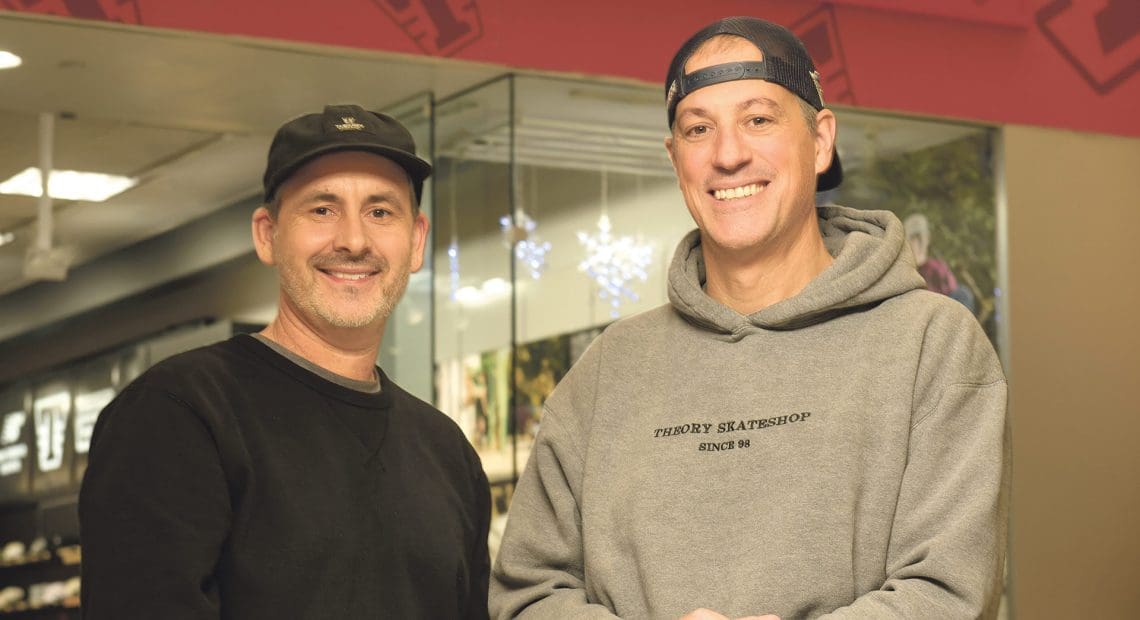
Theory Skate Shop Owners Grab Some Air
Top Entrepreneurs 2025

Frank Langone (left) and Dan Dziuban at Theory’s Holyoke Mall location.
Photo by Bob Zemba, Simple Truth Imaging
A Thrill Ride
For Dan Dziuban, running a business is a lot like skateboarding and snowboarding.
“When you fall down, you’ve got to get right back up,” he said, offering one of many analogies between these activities, all of which feature twists and turns, trial and error, aches and pains (of either the figurative or literal variety), a fast pace, and an always-changing landscape.
Watch more from this year’s Top Entrepreneurs:
Success in all these realms also requires persistence and some luck, said Frank Langone, Dziuban’s partner in the venture known as Theory Skate Shop, which is coming up on 30 years of growth, evolution, thrills, spills, no less than 18 moves within the Holyoke Mall, and rewards on many different levels.
“It’s been a real roller-coaster ride,” Langone said. “There have been a lot of ups and downs, but mostly, it’s been a lot of fun.”
More ups than downs, to be sure, for Theory, which also sells apparel, including its own brand of clothing, and a wide range of accessories, and now operates two locations, with the other in Northampton, and has a strong online presence as well.
But it’s not just the retail aspect of this venture that has earned Dziuban and Langone BusinessWest’s coveted Top Entrepreneur honor, first awarded 30 years ago. There is also the manner in which they have promoted these sports, and especially skateboarding, bringing the sport more into the mainstream and greatly upgrading facilities locally.
Indeed, they have worked with several area communities to design and build skateboard parks — the latest such initiative is in Westfield — and there have also been summer camps, an indoor skateboard park they operated in Springfield for 14 years called Junction, videos, skating events, and more to bring people into the sport — and sometimes, through their influence, into the professional ranks.
“We’ve had three local guys come up and become professional skateboarders, and one become a professional snowboarder who’s left a huge mark on the sport; he grew up riding at Blandford, shopping here, and working for us,” said Dziuban, adding that helping people get into these sports and then watching some excel at the highest level is among the greatest rewards from all their hard work.
Another is seeing and hearing from young people who attended their skateboard camps and frequented the indoor skateboard park and have not forgotten those experiences.
“You’ll be in a restaurant, and someone will tap you on the shoulder … you don’t recognize him because it’s 20 years later and he was just a kid then, but he’ll tell you how much the skate park impacted his life, kept him out of trouble, kept him busy,” Dziuban said. “You could be in Rhode Island and that would happen, and it would happen all the time. And that’s very rewarding.”
“You’ll be in a restaurant, and someone will tap you on the shoulder … you don’t recognize him because it’s 20 years later and he was just a kid then, but he’ll tell you how much the skate park impacted his life, kept him out of trouble, kept him busy.”
Our story begins in the mid-’80s, with both Dziuban and Langone becoming part of what could be called the rise of skateboarding, fueled by highly visible professionals, especially Tony Hawk, who pioneered vertical skateboarding and would go on to become a successful entrepreneur — with his own skateboard company, Birdhouse — and philanthropic, helping to build skateboard parks around the world.
Dziuban and Langone have essentially followed this pattern within the 413 and a little beyond. They started with a small store on Main Street in West Springfield in 1998, and would go to set up headquarters, if you will, in the mall. They would diversify — into snowboarding, as that sport became more popular, and also into footwear and a wide array of clothing, including Theory branded items, while also getting involved in the community, especially with building skateboard parks and operating skate camps. They would add several other locations over the years, most of which did work out long-term.
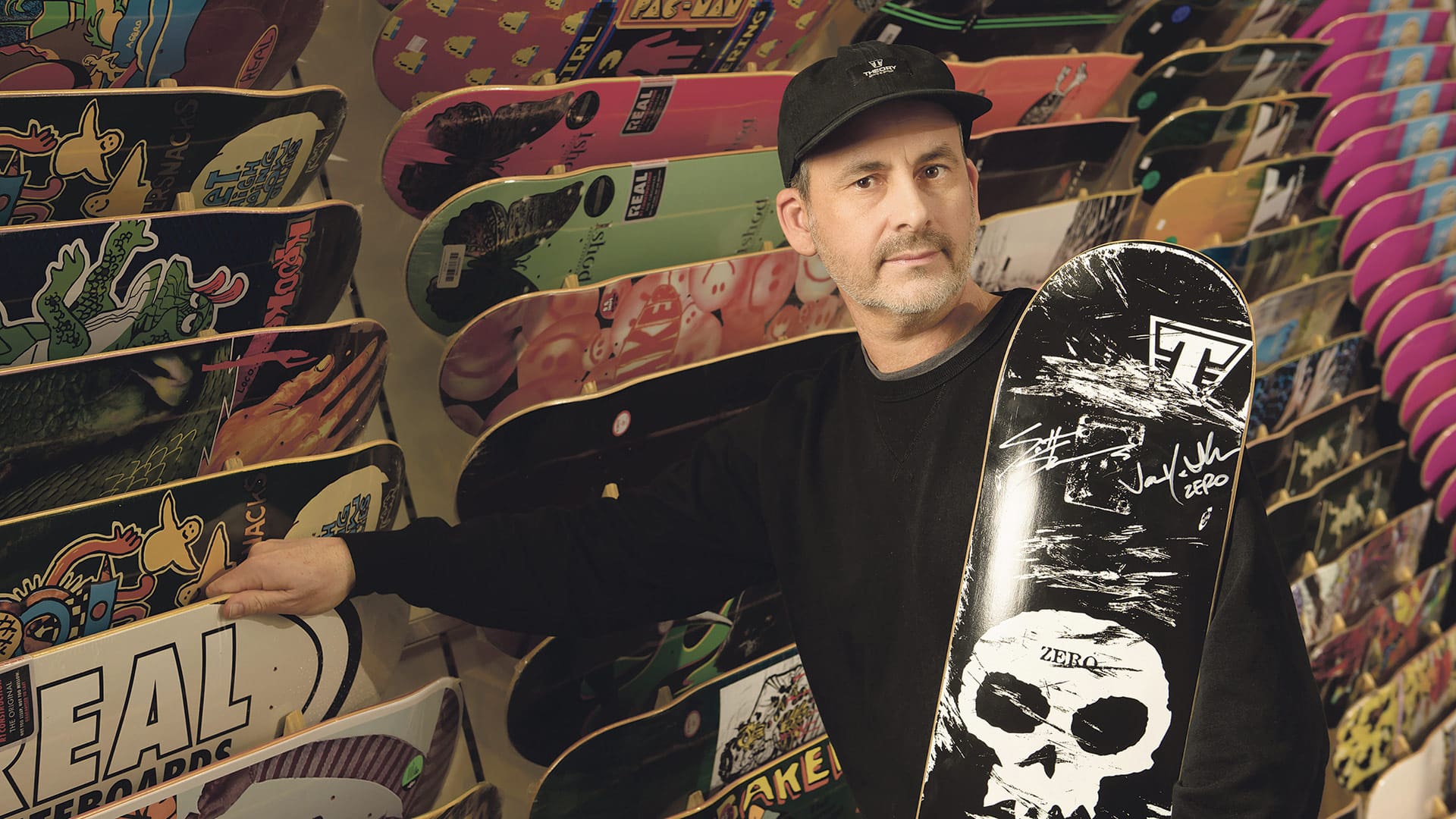
Dan Dziuban describes the company’s journey as a roller-coaster ride.
Photo by Bob Zemba, Simple Truth Imaging
Which brings us back to Langone’s reference to a roller-coaster ride, which this has been — a fun, rewarding thrill ride that has become a story not only of entrepreneurship, but of giving back; not just doing business in a community, but becoming a positive force within that community.
For this issue, we talked with Dziuban and Langone about the ride, about grabbing some air, as they say in the skateboarding world, and about the possible next chapters in an intriguing story.
Ramping Up
As he talked with BusinessWest in the Holyoke Mall just before it opened for the day earlier this month, Dziuban referenced the new Dick’s House of Sport soon to open in the old Sears footprint, just a few doors down from Theory’s current location.
The new Dick’s will be massive — and interactive — with batting cages, rock-climbing walls, a turf field, and much more, in addition to its vast inventories of sporting goods. Dziuban was asked if he worried about what would seem to be intimidating new competition.

Frank Langone says being an entrepreneur is much like mastering a skateboard or snowboard — there’s lots of trial and error.
Photo by Bob Zemba, Simple Truth Imaging
“The younger me would definitely be worried about what this might mean for us,” he said. “This older me? I can see how this will be good for the mall and bring more people here — and possibly to our store. I’d prefer to focus on the positive aspects of this.”
Those comments show a maturity that comes with nearly three decades of experience in retail; time in the trenches that has included countless learning experiences on many levels; coping with new challenges like COVID and, more recently, tariffs; and, as noted earlier, some falling and getting back up again.
Before doing it in business, both Dziuban and Langone were doing it on skateboards on the streets of Springfield.
“Someone in the neighborhood got a board … you tried it, and then you wanted one,” Dziuban recalled, adding that this pattern was being repeated countless times across the region and the country.
“A friend of mine and I … we bought our boards together and started from there,” Langone said. “We met new people, and then Dan and I met eventually down the line.”
In addition to some passion for the emerging sport of skateboarding, Langone, who left for California for a year in the mid-’90s before returning to Western Mass., and Dziuban also shared some entrepreneurial blood, if you will. Langone’s father owned a flower shop in Springfield’s South End, and Frank worked there growing up. Meanwhile, Dziuban’s father operated a cleaning service.
So they knew what they were getting into — sort of — when they opened their first store on Main Street in West Springfield, looking to tap into the growing popularity of the sport.
“I just had an idea — I thought starting a shop would be a cool thing to do, and Dan agreed. We pooled our money together and got started,” said Langone, who also worked for a time at the Board Room, one of the region’s first skateboard shops, in Northampton.
“When you’re 23 or 24 years old … at that age, you pretty much think you can do anything.”
Neither one quit what would be considered their day job as they set up shop — Langone was still working at the flower shop, and Dziuban was still stocking shelves in the frozen food aisle at the Food Mart on Allen and Cooley streets in Springfield — and they couldn’t afford to pay themselves for a while, either.
But they were laying a foundation for a business — and a brand.
Indeed, the name originated with a class in criminal theory that Dziuban was taking at Westfield State University, and the logo, an ornate ‘T,’ which has stood the test of time, was created by his roommate, a graphic design major.
Soon after they opened and established a firm footing, they started laying another foundation, this one for work in the community, specifically with West Springfield to create its first skate park within the city’s Cooks Park.
“We had built a lot of ramps for ourselves over the years, so we knew what to do, and we played a pivotal role in getting that park built,” said Dziuban, adding that they did so thinking the facility would be for the community, but also inspire more people to take up the sport.
The partners would soon get involved in more parks in communities such as Belchertown, Amherst, Monson, and Sturbridge, he went on, joking that, before long, the business had what could be called a construction division, often converting little-used tennis courts into skate parks.
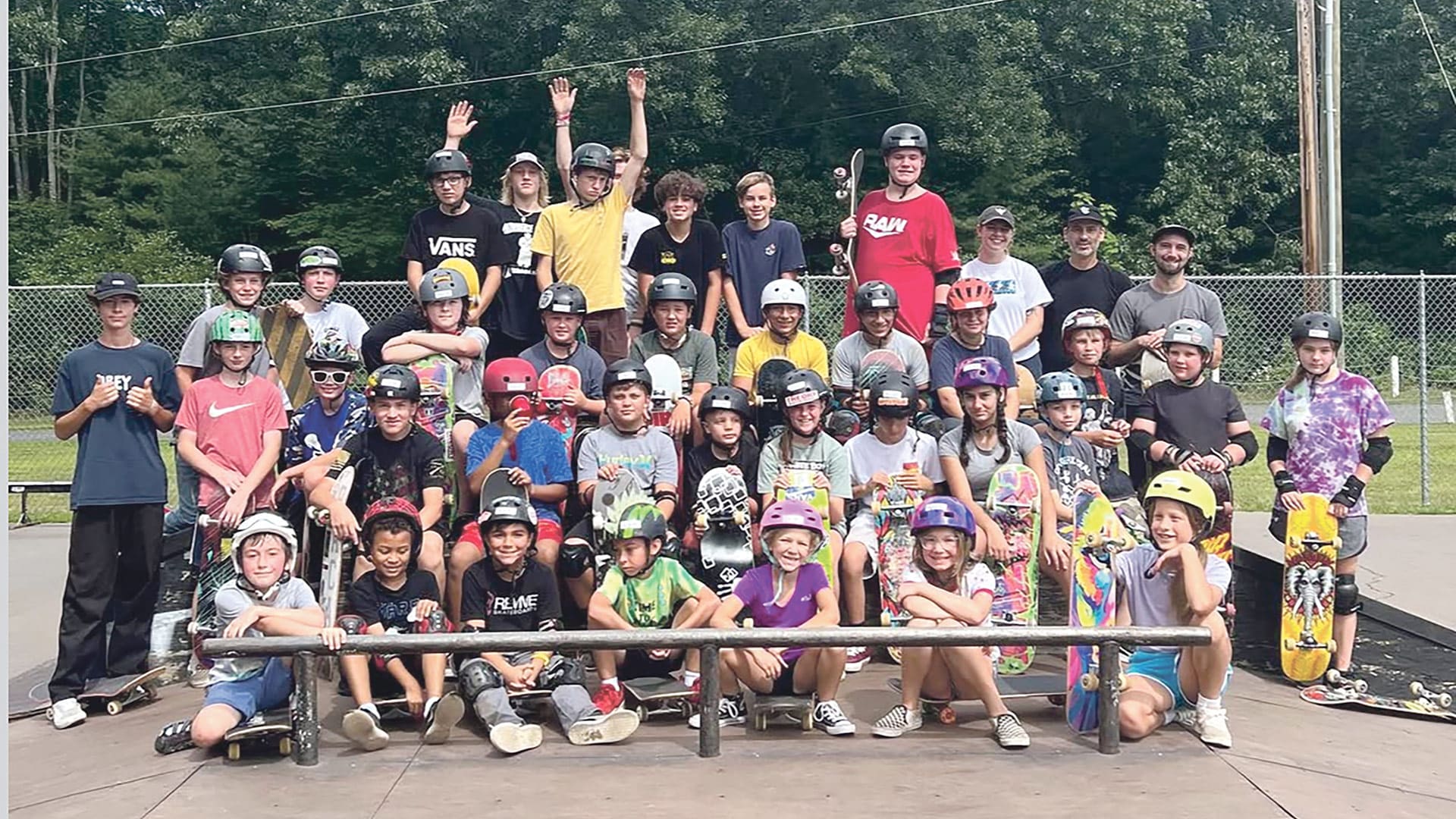
Summer skate camps, like the one seen here, are among the many ways Theory and its founders get involved in the community and give back.
Meanwhile, the two partners started conducting summer skate camps — they still participate in city-run camps in Agawam and Westfield — that bring more people into the sport and forge some relationships that have lasted for decades.
And in 2000, they started created their first skateboard video, called “Thesis,” featuring local skateboarders on the Theory team. It was designed to promote both the sport and the company, and it would be the first of many.
“It was the first of its kind for this area,” Dziuban said. “We premiered it at CityStage — there more than 400 people there; it sold out. That video was on VHS, we sold 1,600 copies — it was very well-received, and that was the tipping point for us doing eight more of those videos, and business boomed after that.”
On a Roll
Looking back on the early years, the partners acknowledged that, while there was some of that fear that comes with opening any kind of business, there was also a certain confidence that comes from youth — and perhaps from being able to master difficult skateboarding maneuvers.
“When you’re 23 or 24 years old … at that age, you pretty much think you can do anything,” Langone said.
Dziuban agreed, adding, “in all honesty, we didn’t have much time to think. We opened the store, then we built that skateboard park in West Springfield, and every year we were doing a new skateboard park or a new store or trying something new. There was no time to relax and little time to think.”
Soon after getting started, the partners would add snowboard equipment to the mix, as many skate shops have, bringing needed diversity to a business focused on a sport that more or less shuts down for the winter months. The sports are similar in many respects, and many who skateboard also snowboard.
They eventually set up a holiday pop-up store at the Holyoke Mall in 2006, an experience that would lead them to become year-long tenants there, although not with enough confidence to sign anything approaching a long-term lease.
Which explains the 18 moves within that facility, said Dziuban, humorously noting that he knows every inch of the mall because he’s operated in every corner of it.
“Sometimes, there were two moves in the same year,” he recalled. “It was every six months for a few years.”
The moves within the mall — in addition to four moves in West Springfield earlier in the life of the company — reflect the newness and trial-and-error aspect of this specific niche within retail, the partners noted.
And with the successes have come some setbacks. Indeed, Dziuban and Langone have opened shops or acquired existing facilities in various locations, including Amherst and Northern Connecticut, that have not worked out. There was also Junction, the indoor skate park that, though it eventually closed, was a huge part of the business and its efforts to introduce people to skateboarding.
“We were out there all the time, skating with everyone, teaching skate camp, working there — we were becoming friends with our customers. It was amazing,” Dziuban said.
“We were throwing a lot of darts, and we were younger and more eager to try things,” said Langone, adding that, collectively, these were learning experiences that have made Theory a stronger company and the partners wiser entrepreneurs.
Today, there are the two locations — in addition to two large booths at the Big E they’ve had for 20 years now — as well as the summer camps and events at the skate parks.
“We do ‘come skate with us’ events on Wednesday nights; we have a DJ, sometimes we have food, we have prizes for best trick,” Dziuban noted. “We have go-skate events, which are all-day events; we do a Halloween event … we do a bunch. We’re out there interacting with the skateboard community and doing everything we can to keep it fun.”
Such efforts are more difficult on the snowboarding side of the equation — the company used to run bus trips to area ski resorts — but the partners do what they can to build enthusiasm for that sport as well.
Meanwhile, Theory has diversified into brands, and products, that are not skate- or snowboard-related, especially at the mall location, which boasts everything from outdoor clothing (Patagonia and the North Face) to Yeti coolers and accessories, to a wide range of shoes and even sunglasses and backpacks. As for the Theory brand itself, it can be found on everything from T-shirts and hoodies to jeans and baggy shorts.
“The good thing is the skateboard culture itself is popular,” Dziuban said. “The clothing brands, the shoes … you don’t necessarily have to skate to want to buy those products.”
Overall, business has been good, but there is a fickleness to sporting goods in general and some specific sports, like skateboarding and snowboarding. Indeed, Langone and Dziuban referenced how the snows of last December, a stark departure from the past several years, to be sure, helped fuel sales of snowboards during the holiday season — and also how the recent years with little snow before January didn’t drive such sales.
“If you can’t see snow in your backyard, you’re not even thinking about snowboarding,” Langone said. “And with skateboarding, one day it’s really cool, and everyone wants a skateboard for Christmas, and then, five years later, every kid wants a soccer ball, and skateboarding is not cool.”
Dziuban agreed. “The thing about skateboarding and snowboarding is they’re both so volatile,” he explained. “The weather affects snowboarding, and skateboarding comes in and goes out of popularity. So we don’t have much time to think about what the business plan should be. The business plan is pretty much sent to us by the customer.”
Making the Jump
Right now, the plan calls for continuous efforts to listen to those customers and respond accordingly, growing the internet sales side of the business, and continuing to get involved with efforts that simultaneously promote the sport and bring new facilities to area communities.
The latest initiative is in Westfield, where the partners, along with Jeff Burke, a Theory team rider who came up through its skate camp, have helped design, coordinate, and raise money for a $1.6 million skate park facility in Amelia Park.
It’s the latest example of how these entrepreneurs have always been more then retailers. They’ve also been promoters — of skateboarding and snowboarding, to be sure, but also safe, healthy communities.
Previous Top Entrepreneurs
• 2024: John and Chris DeVoie, owners of Hot Table
• 2023: The Food Bank of Western Massachusetts
• 2022: Benson Hyde and Bruce McAmis, co-owners of Provisions
• 2021: Dinesh Patel and Vid Mitta, owners of Tower Square in Springfield
• 2020: Golden Years Homecare Services
• 2019: Cinda Jones, president of
W.D. Cowls Inc.
• 2018: Antonacci Family, owners of USA Hauling, GreatHorse, and Sonny’s Place
• 2017: Owners and managers of the Springfield Thunderbirds
• 2016: Paul Kozub, founder and president of V-One Vodka
• 2015: The D’Amour Family, founders of Big Y
• 2014: Delcie Bean, president of
Paragus Strategic IT
• 2013: Tim Van Epps, president and
CEO of Sandri LLC
• 2012: Rick Crews and Jim Brennan, franchisees of Doctors Express
• 2011: Heriberto Flores, director of the New England Farm Workers’ Council and Partners for Community
• 2010: Bob Bolduc, founder and CEO of Pride
• 2009: Holyoke Gas & Electric
• 2008: Arlene Kelly and Kim Sanborn, founders of Human Resource Solutions and Convergent Solutions Inc.
• 2007: John Maybury, president of Maybury Material Handling
• 2006: Rocco, Jim, and Jayson Falcone, principals of Rocky’s Hardware Stores and Falcone Retail Properties
• 2005: James (Jeb) Balise, president of Balise Motor Sales
• 2004: Craig Melin, president and CEO of Cooley Dickinson Hospital
• 2003: Tony Dolphin, president of Springboard Technologies
• 2002: Timm Tobin, president of
Tobin Systems Inc.
• 2001: Dan Kelley, president of
Equal Access Partners
• 2000: Jim Ross, Doug Brown, and Richard DiGeronimo, principals of Concourse Communications
• 1999: Andrew Scibelli, president
of Springfield Technical
Community College
• 1998: Eric Suher, president of E.S. Sports
• 1997: Peter Rosskothen and Larry Perreault, co-owners of the Log Cabin Banquet and Meeting House
• 1996: David Epstein, president and co-founder of JavaNet and the JavaNet Café