
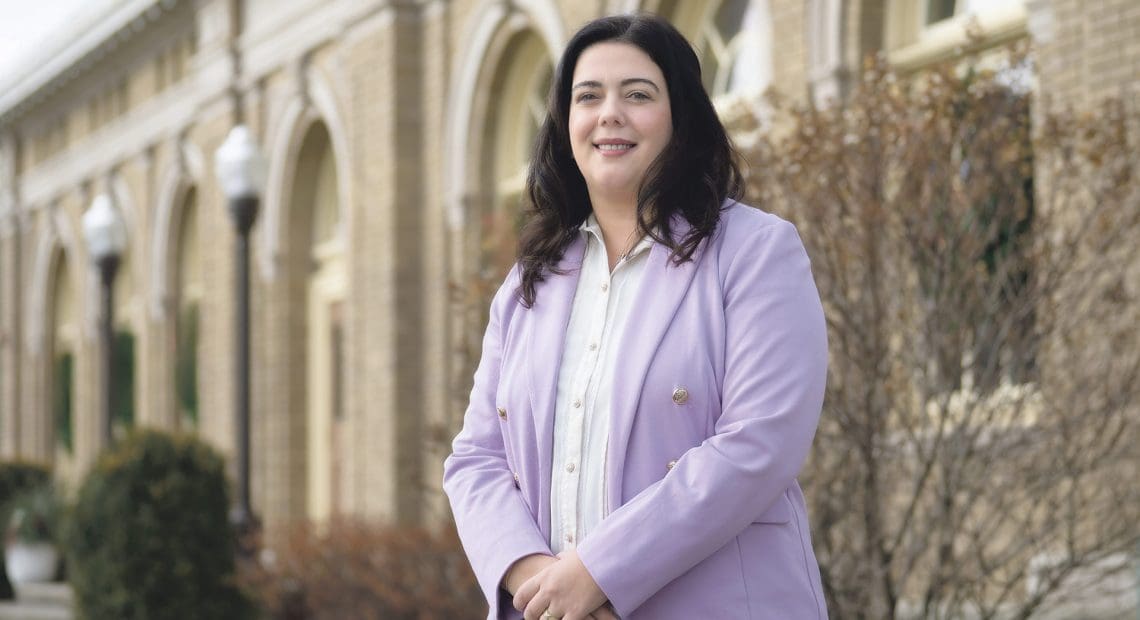
Rachelle Hannoush
Director of Youth, Violence Prevention, and Court Support Programs, YWCA of Western Massachusetts
She Has a Passion for Improving the Lives of Women, Children, and Families

Rachelle Hannoush often talks to teenagers about red flags and green flags in relationships — because, at that young age, it’s easy to mix up the two.
“Say a guy is isolating you from your family, isolating you from going to your volleyball practice. And when I ask about it, you say this is actually a green flag because it shows that they love you and want to spend time with you,” said Hannoush, whose title — director of Youth, Violence Prevention, and Court Support Programs at the YWCA of Western Massachusetts — hints at the many hats she wears there.
In this particular part of her conversation with BusinessWest, she was explaining the ‘prevention’ part of her job, especially an initiative called the HERE (Healthy and Empowering Relationship Education) Project, which helps students between ages 12 and 18 how to navigate everything from dating violence to gang activity to sex trafficking risks.
“We go into schools and teach youth different curriculum that enhances their skills on healthy relationships, violence prevention, bystander intervention. Like, if you see something, what do you do? Who do you talk to? How do you stay safe? And also, how can we have healthy relationships? What are the green flags? What are the red flags? During high school and middle school, a lot of things happen. So it’s really equipping them with skills to be able to make good decisions as they get through those teenage years.”
“What empowers our work and makes the biggest impact is when different organizations work together. And I see that here at the Y — all the departments truly live its mission, which is to empower women.”
Hannoush said prevention is effective — and is more important than ever in the age of social media and the extra pressure it places on kids.
“They can see, ‘oh, she got to go to the Caribbean for April vacation,’ or ‘she got this purse,’ or ‘she’s hanging out with this friend, and they didn’t invite me.’ There’s much more transparency and knowledge, and sometimes it can be very toxic.”
Another of Hannoush’s roles involves supervised visitation centers in Hampden and Hampshire counties, which provide secure, neutral visitation services for families experiencing domestic violence, divorce, custody, and probate issues. The program provides a structured environment for children to connect and visit with their non-residential or custodial parents.
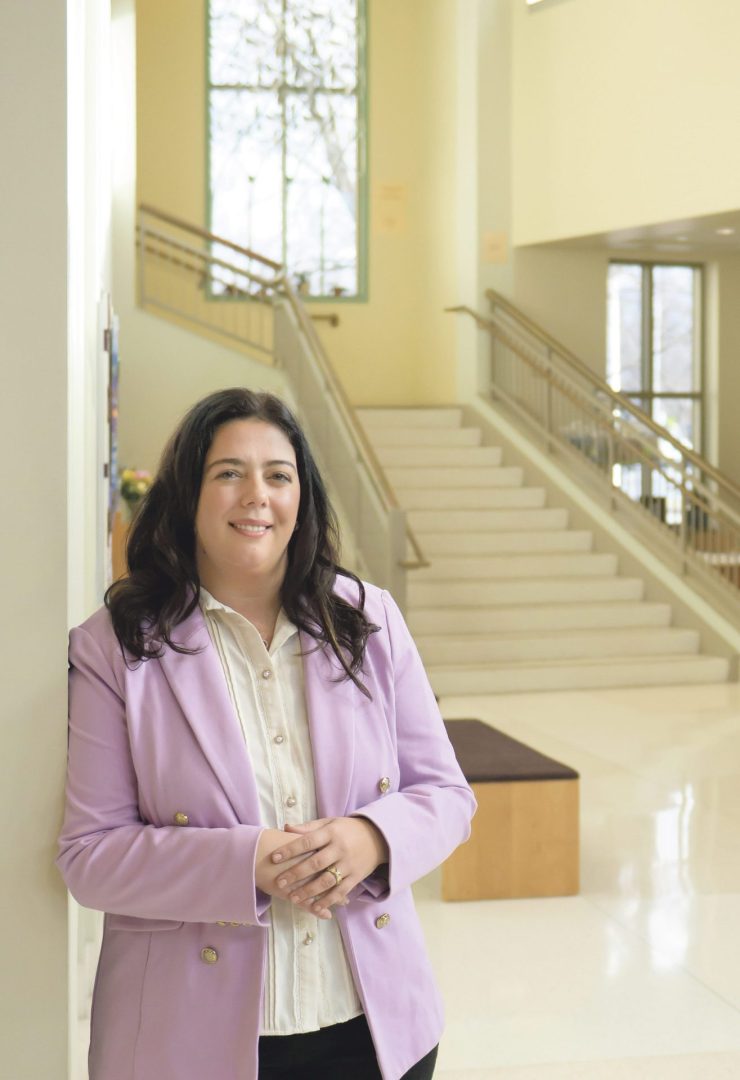
Rachelle Hannoush says her own early struggles as a high school student in Lebanon have influenced the significant empathy she has for teenagers today.
Photo by Bob Zemba, Simple Truth Imaging
“We ensure an environment that’s safe; the most important thing is the child in that scenario,” she explained. “We want the child to have this special bond with their parents, and supervised visitation creates an environment where the parent can connect or the caregiver can connect with the child in a safe environment.”
The third leg on the stool of her job description is working with SAFEPLAN, which provides vital court advocacy services for victims of domestic violence, sexual assault, and stalking in five area district and probate courts. These advocacy services include assistance in obtaining restraining orders, harassment orders, safety planning, and resource and referral information.
“In each of the courts, there’s a SAFEPLAN office and a SAFEPLAN advocate. And anyone that is looking to do a restraining order or harassment order, the advocates help them,” she said. “Sometimes we’re making referrals to other community organizations, or for other programs within the YWCA.”
So … it’s definitely more than a long job title for Hannoush — it’s a lot of work. And that’s not even touching on some of her other community-centered projects outside the YWCA (but we will touch on those a bit later).
But she’s gratified by her copious responsibilities at the YWCA, where she started working last September after years of being connected to the nonprofit as a volunteer and advocate.
“It’s amazing work, and I’ve always been a fan of the YWCA, even before I started working here,” she said. “What empowers our work and makes the biggest impact is when different organizations work together. And I see that here at the Y — all the departments truly live its mission, which is to empower women.”
Humble Beginnings
Hannoush grew up in Lebanon, and to say she encountered struggles in school would be an understatement.
“The reason my family moved was because I was, you might say, the troubled child. I remember to this day, my principal telling my mom, ‘don’t bother with her; she will be nothing in life.’ And I had to redo my freshman year because I failed it. I was going through a lot back then — just teenage stuff — but nobody stopped to ask, why is she doing this?’” she explained. “I think that’s why I care so much — that experience really informed my work. But I didn’t come to that conclusion until much later.”
First came a dramatic turnaround when her family settled in Holyoke.
“It was my sophomore year of high school, and the change in school environment shifted me to become almost a straight-A student,” she recalled, adding that she still derives motivation from her high school experience in Lebanon. “That principal’s words will never leave me — I will be something, and I will do my best, and I will always be looking for more.”
Those years also gave her a deep empathy for the challenges of young people, which is why she found herself working in early education.
Her path there wasn’t exactly linear; she originally went to school for nuclear medicine. But she loved spending time with the children during internships at Boston Children’s Hospital, and when she had her first child, she began to understand the critical role of early education for a working parent — and its cost and access challenges — and she began to explore that as a career.
“I love science, so I was able to blend science with motherhood and education,” she said. “I started as an assistant teacher and then went back to school and got my teacher certification, then lead teacher certification, then director certification. And that started my educational leadership journey.”
A few years later, in 2019, Hannoush found herself developing a passion for professional development and also came across across the Children’s Trust, a Boston-based organization that addresses child abuse and neglect, which was looking for trainers.
“As early educators, as caregivers, we’re mandated reporters, which means, if you see something, you have to report it. My staff had always taken the mandated reporter training, but the training only shows you how to report; it doesn’t teach you how to respond. Like, if a child comes and discloses something to me, what’s the appropriate thing to say? That caught my attention and started my journey deep diving into prevention.”
The Children’s Trust eventually appointed her outreach coordinator for Western Mass. “I would reach out to different schools, different programs, anyone serving children, to say, ‘hey, we will give you training on how to create policies and procedures that ensure safe environments for children.’ Then I started doing parent workshops. With everything I do, the child is always center.”
“Rachelle has spent years working on the front lines and behind the scenes, creating systems of support and bridging gaps between agencies, schools, nonprofits, and families. Her ability to mobilize networks, build trusting partnerships, and bring diverse sectors together demonstrates the very essence of making a difference.”
That mindset led Hannoush to create an organization called Rooted Leaders, which partners with area schools, early education programs, and youth-serving organizations through parenting workshops, educator workshops, leadership services, and coaching and consulting programs.
“You cannot act in silos when you are serving children and families,” she told BusinessWest. “And if you want to have a really big impact, the impact comes from working together.”
The COVID years, especially, posed challenges for educators.
“Social and emotional development got really bad. So a lot of support was needed within the classrooms when we came back. I remember, when we came back into the classroom after COVID, the kids had to be in what I called islands. I’m like, how do we keep 3-year-olds separated? So we created islands. I got different colored rugs and it was like Pirate Island, or Lego Island, and each child got to have an island per day.
“That takes creativity and planning; we knew that it wasn’t right, but it’s what we had to do,” she added. “So how do you make it fun and exciting so children don’t feel it?’”
Willing to Serve
Hannoush has taken on other civic responsibilities as well. As president of the Massachusetts Assoc. for the Education of Young Children, she represents thousands of early educators across the state, advocating for policies and professional supports that strengthen the early education workforce.
And her commitment to young women is further amplified through her role with the Hampden County Commission on the Status of Women, where she champions opportunities, safety, and leadership development for girls and young women across the county.
“Her voice and advocacy contribute to meaningful conversations and initiatives that uplift the next generation of leaders,” said Lauren Kidrick, a registered behavior technician with Beacon Mental Health Services, who nominated Hannoush as a Difference Maker.
Hannoush is also an adjunct professor at the Urban College of Boston, a role she took on after earning her master-of-education degree last spring from Bay Path University. “One of my goals was to teach in higher education. I’ve been doing professional development, and I’m training everywhere, but I really wanted to experience the higher ed field.”
This depth of commitment impresses Kidrick. “Across all her roles — nonprofit leadership, statewide advocacy, higher education, and community service — Rachelle has spent years working on the front lines and behind the scenes, creating systems of support and bridging gaps between agencies, schools, nonprofits, and families. Her ability to mobilize networks, build trusting partnerships, and bring diverse sectors together demonstrates the very essence of making a difference.”
Hannoush said she’s not afraid to say no, but she also makes sure time with family comes first, noting that she and her husband, Ziad Hannoush — “my support and cheerleader from day one” — make sure their children, ages 13, 10, and 6, come first.
She’s also quick to credit others in her life, from her mother, Carol Tatarian, to her grandfather, George Tararian, for their influence on helping her overcome obstacles to success.
“My grandpa was a big supporter of mine,” she recalled. “He always really believed in me, regardless of what was happening at the school in Lebanon. He would say, ‘you are smart; you just have to put your mind to it — never give up.’ And he would spend hours teaching me, doing homework and preparing me for tests. So, whenever I succeed in something, he’s always there with me.”
That said, “I’m still figuring it out as I go,” Hannoush went on. “I do the best that I can today. I don’t think 10 years from now; I think one day at a time, one month at a time. Wherever I see an opportunity to make a difference, to help someone, I take the opportunity — because that’s what stays. That’s our legacy — our legacy is our impact.”
And that’s why she’s able to take on so much, to be a true Difference Maker — because helping others succeed, as others helped her, is deeply meaningful.
“Entrepreneurship has given me the ability to dream beyond survival and focus on legacy,” she said. “I come from a place where nothing was handed to me, and that reality fuels my passion to build something meaningful for my family, my children, and the community I serve. I want to show that it’s OK to want more, to pursue different goals, and to redefine what success looks like. Breaking generational cycles means not only changing our circumstances, but also creating access, hope, and opportunity for the next generation.”