Daily News

BOSTON — The Healey-Driscoll administration announced $2.2 million in Re-entry Workforce Development Demonstration Grants awarded to 11 organizations, including two in Western Mass., to train 389 formerly incarcerated individuals returning to the workforce for job opportunities in culinary, construction, manufacturing, hospitality, and healthcare.

“We all benefit when individuals re-entering our communities have the relevant skills and experiences they need to succeed in today’s workforce,” Gov. Maura Healey said. “These grants will make a positive difference for our employers, economy, and public safety.”

Locally, Community Action of Pioneer Valley in Greenfield will receive $200,000 to partner with the Franklin County and Hampshire County sheriff’s offices to offer a training program with a focus on the manufacturing, culinary, social services, and healthcare industries. Successful program graduates will be placed in roles as line cooks, recovery coaches, custodial workers, and production occupations at Franklin County Community Development Corp., Fitzwilly’s, Whitman Properties Inc., Nortek Inc., and the Center for Human Development.

Meanwhile, Second Street Second Chances Inc. in Pittsfield will receive a $89,000 grant to partner with the Berkshire County Sheriff’s Office to offer a training program with a focus on the advanced manufacturing and engineering industry. Successful program graduates will be placed in machinist roles at Onyx Specialty Papers and Unistress Corp.

“These investments will help support formerly incarcerated individuals through job training and employment opportunities,” Secretary of Labor and Workforce Development Lauren Jones said. “By supporting formerly incarcerated individuals through targeted training and employment opportunities, we are helping to break down barriers to employment, support critical skill building, and offer pathways to successful careers.”

Daily News

SPRINGFIELD — Robert Sproull has been elected to the board of directors of New England Public Media (NEPM).

“We are honored to welcome Robert Sproull to the New England Public Media board,” said Crist Myers, board chair. “Bob’s extraordinary career in applied research, computer science, and organizational leadership brings a level of expertise and depth that will be invaluable to NEPM. His perspective, particularly as public media navigates rapid technological change, will greatly strengthen our ability to serve our community with integrity, innovation, and purpose.”

Sproull recently retired as vice president and director of Oracle Labs, an internationally respected applied research group that originated at Sun Microsystems. Since his undergraduate days, he has been building hardware and software for computer graphics: clipping hardware, an early device-independent graphics package, page description languages, laser printing software, and window systems. He has also been involved in VLSI design, especially of asynchronous circuits and systems.

Before joining Sun Microsystems in 1990 (acquired by Oracle in 2010), Sproull was a principal at Sutherland, Sproull and Associates, an associate professor at Carnegie Mellon University, and a member of the Xerox Palo Alto Research Center. He is co-author, with William Newman, of the influential early text Principles of Interactive Computer Graphics, and author of Logical Effort, a foundational work on designing fast CMOS circuits.

Sproull is a member of the National Academy of Engineering, a fellow of the American Academy of Arts and Sciences, and has served on the U.S. Air Force Scientific Advisory Board. He has also worked as a technology partner at Advanced Technology Ventures and as co-chair of the National Research Council’s report review committee. He currently serves as an adjunct professor of computer science at UMass Amherst and serves on the boards of the Connecticut River Conservancy and River Network.

“I am a lifelong fan and beneficiary of NPR and PBS, already smitten when my daughter met Mister Rogers on the screen 40 years ago,” Sproull said. “I am honored to be elected to the board and hope to help NEPM sustain and grow its vital services to the area.”

Daily News

SPRINGFIELD — Bacon Wilson, P.C. announced that the firm has been recognized in the 2026 edition of Best Lawyers in America and ranked among the Best Law Firms in America by U.S. News & World Report and Best Lawyers for the fourth consecutive year.

For 2026, Bacon Wilson earned the following firm rankings:

• Regional Tier 1 – Springfield, Mass: Banking and Finance Law, Business Organizations (including LLCs and Partnerships), and Elder Law.

• Regional Tier 2 – Springfield, Mass: Bankruptcy and Creditor-Debtor Rights / Insolvency and Reorganization Law.

In addition to firmwide honors, several Bacon Wilson attorneys were individually recognized by Best Lawyers for their professional excellence.

2026 Best Lawyers in America – Springfield, Mass:

• Kenneth Albano (recognized since 2020): Business Organizations (including LLCs and Partnerships);

• Gina Barry (recognized since 2018): Elder Law;

• Gary Breton (recognized since 2018): Banking and Finance Law; Business Organizations (including LLCs and Partnerships);

• Hyman Darling (recognized since 2020): Elder Law; and

• Michael Katz (recognized since 2016): Bankruptcy and Creditor Debtor Rights / Insolvency and Reorganization Law.

2026 Best Lawyers in America:

• Gina Barry: Elder Law (Springfield, Mass.).

Best Lawyers: Ones to Watch in America – Springfield, Mass.:

• Tyler Humphrey (recognized since 2021): Banking and Finance Law; and

• Daniel McKellick (recognized since 2023): Corporate Law; Real Estate Law.

The Best Lawyers and Best Law Firms recognitions are based on extensive peer review and client feedback, highlighting firms and attorneys who demonstrate excellence, integrity, and consistent professional achievement.

Daily News

PITTSFIELD — Pittsfield Cooperative Bank successfully concluded its year-end community giving initiative, combining direct donations with interactive Where’s the Action Cash Cube events to benefit local nonprofits across Berkshire County this holiday season.

Each participating not-for-profit organization received a $500 contribution from the bank, along with an on-site Cash Cube visit that gave them the opportunity to catch up to an additional $500. All events were held at the nonprofits’ locations and shared on the bank’s social media channels to spotlight the essential services they provide throughout the region.

Through the Cash Cube events, the nonprofits grabbed the following additional amounts:

• Berkshire Choral International: $211

• Berkshire County Arc: $151

• BFAIR: $394

• Christian Center of Pittsfield: $187

• Elder Services: $137

• Girls Inc. of the Berkshires: $219

• Hinsdale Food Pantry: $231

• Pittsfield Community Food Pantry: $75

• UCP of Western Massachusetts: $87

“These events were more than just moments of enjoyment — they created meaningful opportunities for our members to feel seen, valued, and connected to the broader community, while also shining a light on the important work happening every day,” said Randy Kinnas, CEO of UCP of Western Massachusetts. “The support from Co-op Bank, both financial and through visibility, helps strengthen our ability to serve individuals and families throughout the Berkshires.”

Since 1889, Pittsfield Cooperative Bank has been committed to enhancing the economic vitality and social welfare of the communities it serves through charitable donations. A major focus of the bank’s charitable giving is directed toward education, youth programs, community development, and health and human services. The bank contributed $4,500 in direct donations, with an additional $1,692 raised through the Cash Cube events, bringing the total combined contribution to $6,192 in support of Berkshire County nonprofits in December.

“Our nonprofit partners are addressing some of the most critical needs in Berkshire County, from food security and housing stability to arts, early childhood development, education, and human services,” said Gregg Levante, president of Pittsfield Cooperative Bank. “The Cash Cube events brought a little holiday cheer while highlighting organizations that truly make a difference. Supporting them is core to who we are as a community bank.”

Daily News

Vicki Baldyga

WESTFIELD — James Hagan, president and CEO of Westfield Bank, announced the appointment of Vicki Baldyga as retail banking officer and branch manager at its Ware office, located at 350 Palmer Road.

Baldyga joins the bank with more than 25 years of banking experience. In her new role, she will be responsible for leading and managing the branch, including customer service, retail and business product sales, employee development, and overseeing general branch operations, as well as business and community development within the Ware market.

Since joining the banking industry in 1999, she has held various management positions at other community banks across the local area. She holds several diplomas and certificates from the Center for Financial Training and is a 2024 graduate of the New England School for Financial Studies, completing an intensive two-year program for banking professionals.

“I am very excited to welcome Vicki to Westfield Bank,” said Kelly Pignatare, first vice president and manager of Retail Banking and Business & Government Deposit Services. “She is an experienced and knowledgeable banker with a strong commitment to customers and community. As a Ware native, she knows and understands the market, and we’re thrilled to have her leading the team in Ware.”

Active in the community, Baldyga is the treasurer and board member of the Three Rivers Chamber of Commerce and has served in past roles for Big Brothers Big Sisters, United Way of Hampshire County, and Crossway Clothing Outreach.

Daily News

Meghann Arnold

PITTSFIELD — Greylock Federal Credit Union announced the hiring of Vice President, Controller Meghann Arnold, who joins the Finance team.

“We are excited for Meghann to join our organization, as she brings over a decade of experience in public accounting,” said Michael King, senior vice president, chief financial officer. “With expertise in accounting operations and policy, Meghann will help drive efficient operations and timely reporting. In addition, she’ll lead our budgeting and forecasting processes, while performing important financial analysis.”

As part of the Finance team, Arnold will ensure compliance with generally accepted accounting principles and regulatory requirements, and as a strategic leader in the credit union, she will play a critical role in budgeting, financial planning, asset-liability committee participation, internal controls, audit coordination, and process improvement.

“We’re thrilled that Meghann has joined our leadership team,” said JamieEllen Moncecchi, senior vice president, chief administrative officer. “Her experience, knowledge, and interests align purposively with Greylock’s mission and current initiatives. We’re happy to welcome her to Greylock and look forward to her many contributions.”

Arnold, a certified public accountant (CPA), brings more than 15 years of progressive leadership in finance, accounting, and audit across both public and private sectors. She most recently served as a senior audit associate in PwC’s Asset and Wealth Management division, where she led complex, multi-entity audit engagements and advised executive teams on complex technical accounting matters, internal controls, and regulatory compliance. Arnold’s background spans investments, insurance, and banking, giving her a deep understanding of the financial services landscape.

“Throughout my career, I’ve been drawn to organizations that make a real impact,” Arnold said. “Joining a community-focused, member-owned credit union allows me to apply my technical expertise in a space where financial stewardship directly benefits local families and businesses. I’m excited to support a mission that aligns with both my professional values and my personal commitment to this community.”

Daily News

HOLYOKE — Holyoke Community College (HCC) is running a free, 16-week training program for people interested in getting a jump start in the clean energy field as solar technicians.

The in-person, hands-on program runs Monday through Thursday and on select Fridays beginning Wednesday, Jan. 7 from 5:30 to 8 p.m. on the main HCC campus and at Holyoke High School’s Dean Tech campus. It concludes on May 1.

Program participants will earn OSHA 30 safety credentials while learning fundamental electrical and construction skills and how those skills are applied in solar photovoltaic systems design, installation, operation, and maintenance. The program also includes job readiness and career development components.

Upon completion, participants will be coached on how to apply for apprenticeships as solar installers and electricians or for jobs in building trades or clean energy fields.

Eligible students must be 18 years of age or older, authorized to work in the U.S., and have a high school diploma, GED, or HiSET. For a complete list of program requirements, or to apply, visit hcc.edu/cleanenergy.

The program is funded through a grant from the Massachusetts Executive Office of Education, in partnership with the Coalition for an Equitable Economy, Springfield Works, Holyoke Public Schools, and the MassHire Hampden County Workforce Board.

For more information, contact Mary Wagner, HCC Clean Energy Training manager, at (413) 552-2802 or [email protected].

Where Are They Now?

Where Are They Now?


Mike Vedovelli seen today at Eversource
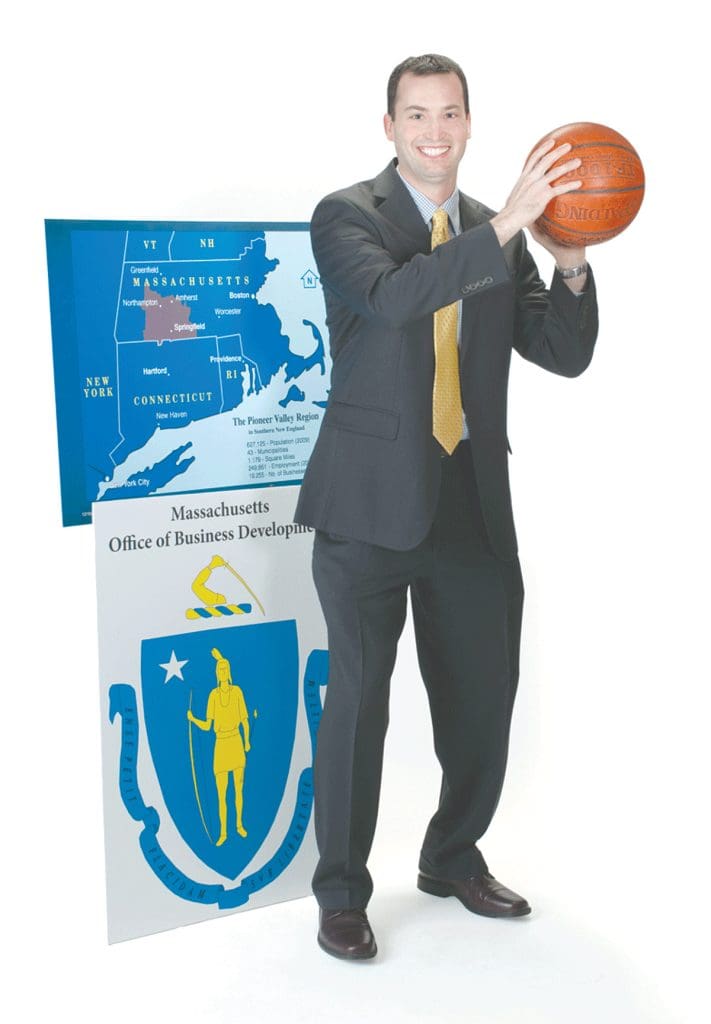
Mike Vedovelli seen today at Eversource

Mike Vedovelli as a member of the 40 Under Forty class of 2011

Mike Vedovelli as a member of the 40 Under Forty class of 2011

Mike Vedovelli says it’s as if he had written the job description for himself.

Indeed, Eversource had posted for a Community Relations specialist, and the job description it sent out indicated it was looking for someone who knew the region — as in the four counties of Western Mass. — and also “knew the economic development side of things,” said Vedovelli, who had all this covered through previous career stops.

These included nearly a decade in Westfield’s Community Development office, several more running the Western Mass. office of the Massachusetts Office of Business Development (MOBD), and then a few years as director of Community Development in Chicopee.

He thought that experience qualified him to join the giant utility in the community relations role, and those doing the hiring agreed, thus beginning an intriguing chapter in the career of this 2011 40 Under Forty honoree. And he’s written a few more since joining Eversource, rising in the ranks, first as manager of Community Relations for Massachusetts (overseeing the team of specialists, each serving their own region), and currently as director of Community Relations and Economic Development in Massachusetts.

Based at the utility’s facility on Cadwell Drive in Springfield, but frequently on the road to communities in every corner of the state, Vedovelli now oversees a team of 14, “which rises to 140 during storm events,” he said, adding that one of his many responsibilities is to work with those on his teams to coordinate response to severe weather in the more than 70 communities served by the utility.

“Each city and town has a designated liaison,” he explained, adding that, from an incident-command structure in Boston, he oversees these liaisons as they work with their respective communities on preparation for, and response to, severe weather.


Community Focus

We’ll get back to the weather and how Vedovelli and Eversource prepares for it. But first, a look back.

Vedovelli, who grew up in Indian Orchard and stayed in the region, first started working in government and economic development when he became an accountant and Grants Compliance coordinator in the Westfield Community Development office, overseeing HUD initiatives and especially the Community Development Block Grant program.

He worked in Westfield for more than 10 years before becoming a regional director for the Massachusetts Office of Business Development, with the region essentially being everything west of Worcester — 101 cities and towns, a number that has stuck with him.

While getting to know those cities and towns in the 413 and their business communities, he helped several companies, including Titeflex and Smith & Wesson (which would eventually relocate its headquarters and significant operations to Tennessee starting in 2021), stay in the region, expand, and create more jobs.

“I made a point of getting to know all four counties as well as I could — knowing not just the businesses, but the fabric of the communities — and making connections.”

“I was representing the governor and the administration, and you had to be aware of what was occurring on many different levels, not just in business development opportunities,” he said of his work at MOBD and now it would provide him with invaluable experience for career stops to come. “I made a point of getting to know all four counties as well as I could — knowing not just the businesses, but the fabric of the communities — and making connections.”

It was rewarding work that came to an abrupt end with the change of gubernatorial administrations in January 2015. A few months later, one of those connections he’d made paid off when he got a call from then-Chicopee Mayor Michael Kos to see if he would be interested in becoming the city’s next director of Community Development.

Vedovelli was, and spent the next few years on projects ranging from redevelopment of the former Uniroyal plant to the opening of a Mercedes-Benz dealership on Burnett Road.

But then, he read the job description that seemed written for him.

Over the past nine years, he has added several new responsibilities, but maintains that the work still comes down to making connections and building relationships, something he’s been doing his whole career, while “handling all things Eversource, on the gas, electric, and transmission sides.

“Every day is different — that’s the 24/7 nature of the business,” he said of his work and what he likes most about it, adding that his job description is varied and includes everything from educating public officials, communities, and other key partners on Eversource’s projects to conducting outreach for the siting of major projects and strategic initiatives.


Power Play

In recent years, a growing focus has been on meeting the state’s decarbonization goals and the many investments needed to make that happen.

“We’re working very closely with our load forecasting team to analyze areas as we move toward decarbonization, and the loads that will put forth on the system,” he explained. “New infrastructure will be needed, and placing infrastructure is always a challenge, while also upgrading the existing system to make it as safe and reliable as we can.

“People are relying on power more and more — not just for their home and business, but for electric vehicles and everything else that requires power,” he went on. “It’s a needed resource.”

Then there’s the weather, which has always been a very big part of this job, he said, adding that the utility contracts with several weather services and partners with the University of Connecticut, which creates the UConn Outage Prediction Model, which is fed with high-resolution weather data to forecast a storm’s impact on the electric grid.

The model takes into account everything from snowfall amounts to wind speeds to the amount of foliage in trees (a huge factor in the devastating impact from the pre-Halloween storm in 2011) to project the level of power outages, he went on.

“With the information that we get from the weather service and the information we get from the prediction models, the incident commander can make decisions on enacting an emergency response plan,” Vedovelli explained. “Everyone in the company has a storm role.”

And while the community liaisons have many responsibilities, he said, the biggest is communicating with officials in that city or town so that they can make informed decisions.

“If they know when a road is going to be open, if they know when power is going to be restored, they can make decisions for their community,” he told BusinessWest, adding that this is especially true during weather events that stretch over several days.

Preparation is always the key, he said, adding that Eversource is prepping for hurricane season from June to early November, and there are regular training programs to help ensure that those at the utility are prepared for whatever might happen and have the necessary resources in place. Such was the case with three tornadoes that touched down on Cape Cod in July 2019, an unexpected weather event, he noted.

“If you think about the Cape and how many people are there in July … now mix in a tornado,” he said. “That tornado came through on a Tuesday, and everything was buttoned up and cleaned up by Thursday. That shows you the power of being prepared.”

Helping the utility and communities across the state be prepared for such calamities is now a big part of Vedovelli’s job description. No, he didn’t write it himself, but his past experiences have enabled him to carry it out and make a surge — yes, that’s an industry term — in his career.

 

Law

Work in Progress

By Meaghan Murphy, Esq.


A Massachusetts Superior Court recently dismissed claims brought by an employee under the Massachusetts Equal Pay Act (MEPA) and the Massachusetts anti-discrimination law after an employer successfully used the MEPA’s absolute defense to liability. Unhappy with the outcome, the employee who filed the lawsuit appealed the Superior Court’s decision, and that appeal is pending.

The Appeals Court heard argument in this case on Sept. 3, and a decision is expected in the coming months. That decision will be the first appellate guidance on the affirmative defense available to employers under MEPA and will set the standard for pay equity disputes across the state.

Before diving into the case on appeal, it is important to understand what MEPA prohibits and requires, and what the employer defense that acts as a total shield to liability is all about.


What MEPA Does

MEPA applies only to claims of discriminatory pay based on gender. The law prohibits employers from paying employees less due to their gender, and further requires employers to pay employees equal pay for comparable work.

Meaghan Murphy

Meaghan Murphy

“The Appeals Court affirms the Superior Court’s dismissal of Woodward’s claims, it might mean that employers can rely on self-evaluations and proposed changes as a shield to liability, without actually making the changes — a lower standard for this affirmative defense than expected.”

Comparable work is work that requires substantially similar skill, effort, and responsibility, and is performed under similar working conditions. A job title or job description alone does not determine if two employees are performing comparable jobs. A more fact-specific analysis of the day-to-day duties and responsibilities is typically required.


The ‘Evaluate and Progress’ Defense

MEPA contains a rare ‘safe harbor’ provision that courts can rely on to dismiss MEPA claims when an employer successfully shows they have met the legal requirements. Under §105A(d) of MEPA, employers are protected from liability for gender-based pay disparity claims if they complete “a self-evaluation” of their own pay practices “in good faith” and demonstrate “reasonable progress” toward eliminating any identified wage differentials based on gender for comparable work. An important caveat: that self-evaluation must be completed within three years of an employee (or group of employees) filing a claim under MEPA.

If an employer can satisfy these requirements, then MEPA claims are barred. In other words, there is no liability for employers who can show they took these steps within three years of getting sued under MEPA. Of course, not all employers conduct these self-evaluations. But for those that do, this ‘evaluate and progress’ defense is a total game changer.


The Case on Appeal

In Woodward v. Board of Registration in Nursing et al., the plaintiff, Lauren Woodward, was hired by the Board of Registration in Nursing as a compliance officer. Woodward is a woman, and the two other compliance officers at the time were men.

Part of a compliance officer’s pay was based on the number of years of relevant or similar work experience they had prior to being hired. The board gave credit — and increased the pay — for that prior experience. All three compliance officers were credited with different numbers of years of experience, but the two men were credited with more years based on their respective experience. That resulted in the men being paid more than Woodward for the same job.

In June 2020, Woodward filed a lawsuit alleging that she was paid less than the two male compliance officers. She asserted a claim under MEPA and a sex discrimination claim under the Massachusetts anti-discrimination law based on these same allegations of sex-based pay disparity.

In a motion filed with the court, the board asked that the claims be dismissed and asserted the ‘evaluate and progress’ defense under MEPA. The board argued that it had conducted a good-faith self-evaluation of its pay practices within three years of Woodward’s claim being filed, that it had identified wage differentials based on gender for comparable work, and that it had made reasonable progress towards eliminating those wage differentials.

During its self-evaluation, which the board said was conducted in November 2019, the board identified seven individuals — both women and men — who were subject to potentially impermissible pay disparities. The board proposed that the pay for all seven employees be adjusted upward to match the pay of their peers doing comparable work. Notably, Woodward was not one of the seven employees identified during the evaluation, so her pay was not proposed to be adjusted upward to match that of her two male co-workers.

Based on these facts, the board argued, it had satisfied the requirements of the ‘evaluate and progress’ defense and, therefore, is shielded from Woodward’s MEPA claim.

Woodward did not dispute that the board had conducted a self-evaluation of its pay practices. However, she disputed other important facts, including whether the self-evaluation was conducted in good faith and whether the board made reasonable progress toward eliminating wage differentials based on the findings of that self-evaluation.

Interestingly, Woodward pointed out that, while the board had proposed adjustments to the pay for the seven employees identified, it had not actually made those adjustments. Therefore, according to Woodward, the board failed to show reasonable progress toward correcting the gender-based pay disparities.

The court was not persuaded by this argument from Woodward, finding that the proposal for pay adjustments for the employees identified was enough. According to the court, though evidence of actual pay increases would have demonstrated greater progress towards eliminating gender-based wage differentials, evidence of the board’s first step toward such pay increases — identifying potentially impermissible wage differentials and proposing corresponding pay increases, subject to funding approval — appears to satisfy the requirements of MEPA.

The board also argued that, even if it could not use the ‘evaluate and progress’ defense, the pay disparity between Woodward and her male peers was lawful because it was based on their varying experience and not their differing genders. But the court did not get to that argument because the board successfully demonstrated it was entitled to the affirmative defense MEPA provides. So the court stopped there.

The court also did not address the merits of Woodward’s sex discrimination claim under the state’s anti-discrimination law. Under MEPA, an employer who can establish the ‘evaluate and progress’ defense avoids liability under MEPA and the state’s anti-discrimination law.

Woodward’s claims were dismissed at the summary judgment stage (i.e., before ever getting to a jury). As mentioned above, Woodward has appealed. In her appeal, Woodward contends that the court improperly analyzed her claims and how MEPA’s ‘evaluate and progress’ defense should be applied.


What’s Next?

Employers and employees alike should be interested in the Appeals Court’s decision in this case. If the Appeals Court affirms the Superior Court’s dismissal of Woodward’s claims, it might mean that employers can rely on self-evaluations and proposed changes as a shield to liability, without actually making the changes — a lower standard for this affirmative defense than expected.

Alternatively, the Appeals Court could disagree with the Superior Court’s dismissal of Woodward’s claims and send the case back down for further analysis, which might result in a jury deciding the case. A decision is expected in the coming months.


Meaghan Murphy is an attorney with Skoler, Abbott & Presser, P.C. Licensed in both Connecticut and Massachusetts, she regularly advises clients on various workplace issues, including discipline and performance matters, policy development and implementation, and compliance with local, state, and federal laws and regulations.

Law

Choosing a Cause That Matters

By Gina M. Barry, Esq.


As we come to the holiday season, charitable giving comes to the fore. Do you donate money to charity each year? Perhaps you donate to an organization dedicated to finding a cure for an awful disease. Perhaps you choose to benefit organizations that support and encourage positive growth in our youth. Perhaps you decide to support the local animal shelter or abuse prevention.

To reap the most benefit from charitable giving, you must first choose an appropriate charity to benefit from your generosity. There are thousands of charities working within a huge variety of causes from which to choose. Thus, you can be certain there is a charity working to bring positive change in a way that you would love to support. Of course, the causes touched upon above are just a few examples of where your donation can make a difference.

Once you have decided that you would like to support a charitable cause, it is important to determine how you will contribute. Most will choose to donate cash; however, you might also consider donating highly appreciated securities, which would allow you to avoid paying the capital gains tax on those assets. Likewise, the charity also would avoid paying this tax due to its charitable status.

Aside from a monetary donation, you may also donate goods. When purging your household to make way for new holiday items, you can donate those that are gently used, but no longer desired. For example, you may have a pantry full of uneaten, non-perishable food that your family is not eating. Consider filling a couple of grocery bags with this food and donating to your local food pantry.

Gina M. Barry“Donations claimed as tax-deductible contributions for 2025 must be actually paid to the charity on or before Dec. 31, 2025, and it is best always to obtain a receipt for your donation regardless of the amount.”


Likewise, children often grow out of clothes and get bored with their toys while they are still in good repair. Many charities that benefit children would be delighted to receive these clothes and toys to help the children that they serve. Similarly, when you and your old vehicle finally part ways, you do not have to send the vehicle to a junkyard. Many charities accept any vehicle, working or not, as a donation.

If making a monetary contribution or a donation of goods is not possible at this time, consider volunteering your time to your favorite cause. Elder services, animal shelters, hospitals, and soup kitchens are all wonderful places to volunteer. While the time you volunteer is not tax-deductible, any out-of-pocket expenses associated with volunteering are usually deductible. For example, travel expenses to and from the volunteer site, as well as parking fees and tolls, may be deducted.


Next Steps

When you have decided which cause you would like to help and in what manner, you are almost ready to make a donation. Be certain the charity has received approval from the Internal Revenue Service (IRS) as being eligible to receive tax-deductible contributions. You can determine the tax-exempt status of an organization either by contacting your local IRS office or by asking the organization for a copy of its ‘letter of determination,’ which is the formal notification the organization receives from the IRS once its tax-exempt status has been approved. Also, IRS Publication 78, Cumulative List of Organizations, is an annual listing of thousands of organizations that can accept tax-deductible donations.

Donations claimed as tax-deductible contributions for 2025 must be actually paid to the charity on or before Dec. 31, 2025, and it is best always to obtain a receipt for your donation regardless of the amount. When considering donating to charity, it is also important to check in with your tax advisor, as there have been some important changes.

For example, starting in 2026, even taxpayers who take the standard deduction (i.e., don’t itemize) can claim a modest ‘above-the-line’ deduction — up to $1,000 for singles and $2,000 for married couples filing jointly. For those who do itemize, deductions for charitable contributions will apply only to the portion that exceeds 0.5% of adjusted gross income. That means the first 0.5% of adjusted gross income in charitable gifts each year will not reduce taxable income. Further, in 2026, the tax benefits of itemized charitable deductions will be capped at 35%, even for those in the 37% marginal tax bracket. Thus, to make the most of your charitable giving, be sure to consult your advisor before making your donations.

Charitable giving is extremely rewarding. You will not only reap the benefit of knowing that you are helping to make a difference in this world, but when tax season comes, you may enjoy a beneficial tax deduction as well.


Gina M. Barry is an attorney in the Springfield office of Bacon Wilson, P.C. She is a member of the National Academy of Elder Law Attorneys, the Estate Planning Council, and the Western Massachusetts Elder Care Professionals Assoc. She concentrates her practice in the areas of estate and asset protection planning, probate administration, guardianships, conservatorships, and residential real estate.

Environment and Engineering

Innovative Approach


From left: Eversource Senior Vice President of Engineering Digaunto Chatterjee, Eversource Manager of Substation and Transmission Data Innovation Junhui Zhao, Assoc. of Edison Illuminating Companies Vice President of Technical Strategy Elizabeth Cook, and Assoc. of Edison Illuminating Companies CEO Steve Hauser.

From left: Eversource Senior Vice President of Engineering Digaunto Chatterjee, Eversource Manager of Substation and Transmission Data Innovation Junhui Zhao, Assoc. of Edison Illuminating Companies Vice President of Technical Strategy Elizabeth Cook, and Assoc. of Edison Illuminating Companies CEO Steve Hauser.

In recognition of its ongoing commitment to sustainability in providing safe, reliable electric service to customers, Eversource has been honored with a 2025 Achievement Award from the Assoc. of Edison Illuminating Companies (AEIC), the electric utility industry’s longest-serving and preeminent association of leading operations experts.

The AEIC Achievement Awards are presented annually to member utilities and individuals who demonstrate significant contributions to advancing operational excellence in the electric industry. This year, Eversource received one of the prestigious awards for developing a cutting-edge leak detection method for high-pressure-fluid-filled (HPFF) cables — a type of high-voltage, underground electric transmission line that runs through densely populated areas like Boston — which is already helping to enhance the operational efficiency of the grid and mitigate environmental risk.

“This remarkable technology has reduced the time required to detect leaks within these underground transmission networks from several days to a few hours, and we are already seeing in practice how valuable this application is for our system operators, as it allows us to respond to any issues and address them even more quickly and efficiently,” said Digaunto Chatterjee, Eversource’s senior vice president of Engineering.

“Not only does this transformative monitoring tool provide substantial operational benefits, it can also be implemented cost-effectively, creating vast potential for this method to become a scalable solution as utilities across the country face challenges of addressing aging infrastructure and maintaining environmental responsibility.”

“Not only does this transformative monitoring tool provide substantial operational benefits, it can also be implemented cost-effectively, creating vast potential for this method to become a scalable solution as utilities across the country face challenges of addressing aging infrastructure and maintaining environmental responsibility,” he added. “I’m incredibly proud of our team for being recognized by AEIC for their achievements on this innovative project, which we hope will serve as a model for similar advancements throughout the industry.”

Operated in Boston and other cities throughout Eversource’s three-state service territory, HPFF systems are designed to provide safe, reliable and efficient delivery of electricity in densely populated urban areas. Because of the extensive lengths and critical nature of these underground, high-voltage power lines, HPFF systems require smart, highly sensitive methods of leak detection monitoring.

Eversource’s team of engineers was honored with the 2025 AEIC Achievement Award for the solution they developed to address these challenges in the Boston area — a dynamic monitoring dashboard powered by artificial intelligence, which offers comprehensive insights into the operational status of HPFF networks that allow for a dramatic reduction in leakage detection time, in turn lowering environmental risk.

Since its implementation in late 2023, the early detection system has been rigorously tested and has already proven to be effective in detecting early-stage leaks within the HPFF network in Boston, highlighting the benefits of integrating sophisticated analytics with operational expertise. Because this innovative tool is entirely data-driven and does not require new sensors, it is also cost-efficient and provides greater potential for the system to be more widely adopted.

Insurance

Advancing Equity


The Blue Cross Blue Shield of Massachusetts Foundation announced $771,000 in new grant funding to support 15 organizations working to improve perinatal health across Massachusetts through its Perinatal Health Initiative, a multi-year program aimed at reducing racial inequities in perinatal health outcomes.

Now in its second cycle, the multi-year Perinatal Health Initiative grant program is part of the foundation’s broader strategy of grantmaking and policy analysis aimed at better understanding and disrupting structural racism and broadening health equity.

Building on the foundation’s 2024 effort, the two-year program was shaped by insights from community partners, fellow funders, and an ongoing assessment of the perinatal health landscape. Seven of the organizations funded in 2025 are continuing grantees from the foundation’s initial cohort to deepen their impact through this next phase. The grants support organizations providing community-based perinatal education and support, expanding the perinatal workforce, and policy advocacy.

“These organizations are creating lasting improvements in perinatal health by expanding access to culturally responsive care and centering community voices.”

“These organizations are creating lasting improvements in perinatal health by expanding access to culturally responsive care and centering community voices,” said Audrey Shelto, president and CEO of the Blue Cross Blue Shield of Massachusetts Foundation. “Their work exemplifies the power of community-based leadership in achieving health equity.”

The foundation’s board of directors approved two-year grants ranging from $25,000 to $60,000 for each of the following nonprofit organizations and their projects:

• Accompany Doula Care, Boston, which will partner with Health Leads and collaborate with healthcare systems, advocates, and providers to launch a cross-sector workgroup to increase equitable maternal health outcomes by integrating doulas into clinical care teams and creating supportive hospital policies;

• Berkshire Nursing Families, to expand the organization’s support of families who are Black, Indigenous, and people of color in Berkshire County by launching perinatal education programs, training new staff to become certified lactation counselors, and building a diverse workforce;

• Family Health Center of Worcester, to expand the capacity of its OB Advocates program, which connects community members with trained and culturally aligned doulas during pregnancy through two years postpartum;

• First Teacher Boston, which will integrate its pilot perinatal health program into its community-based parent education for Black and Brown families in Dorchester, Roxbury, and Mattapan, offering year-round workshops, infant-focused resources, and professional development for staff in perinatal care;

• Greater Lowell Health Alliance of CHNA 10, which will build upon its Doula Academy to expand, diversify, and increase skills of the local perinatal workforce in the Lowell area;

• Greenfield Community College Foundation, to create Massachusetts’ first public certified professional midwives accredited training program to increase access to a pipeline of trained, licensed midwives and expand community birth options;

• It Takes a Village, Huntington, which will partner with the Green River Doula Network to provide community-led perinatal education, perinatal mood and anxiety disorder prevention, labor preparation, postpartum care, breastfeeding support, peer-led support circles, and extended home visits for historically marginalized families in Western Mass.;

• Massachusetts Society for the Prevention of Cruelty to Children, which will support the Mind the Gap Coalition’s statewide advocacy to strengthen perinatal mental health policies and align efforts across the continuum from prenatal to infancy;

• Nantucket Community School, to increase access to childbirth education and lactation supports by providing classes and training three instructors from Black, Indigenous, and people of color communities and those fluent in Spanish and Brazilian Portuguese;

• Neighborhood Birth Center, Roxbury, to educate public health experts, policy makers, and payers regarding issues to advance midwifery education, workforce development, and access to birth centers, and lead a campaign to promote equitable reimbursement for licensed midwives and birth center facilities;

• North Quabbin Health Collaborative, Orange, which will expand one-to-one nurse visits for families up to one-year postpartum in rural and structurally marginalized communities in the towns of Orange, New Salem, Petersham, Warwick, and Wendell, providing health education programs, screening, and referrals;

• Propa City Community Outreach, Roxbury, which will implement a community-centered initiative focused on perinatal loss, expanding access to healing-centered education, connecting families and care providers across Massachusetts, and reducing isolation for families experiencing loss;

• Sacred Birthing Village, New Bedford, to train 12 multi-ethnic and linguistically diverse women in Southeastern Mass. to provide doula care and prepare them to meet state certification requirements for MassHealth-covered services;

• Worcester Addresses Childhood Trauma, which will partner with Worcester Public Health to deliver culturally responsive perinatal education, public awareness campaigns, and events guided by the Citywide Black and Brown Maternal Health Work Plan; and

• Worcester RISE for Health, to strengthen its Maternal Care Access program for refugee and immigrant communities by providing practice-based mentorship for doulas and developing a centralized referral system and wraparound supports.

The Blue Cross Blue Shield of Massachusetts Foundation will continue to collaborate with other foundations working in perinatal health to collectively learn, align philanthropic efforts, and elevate local leadership and community-led solutions to advance birth equity in Massachusetts.