Golden Opportunity

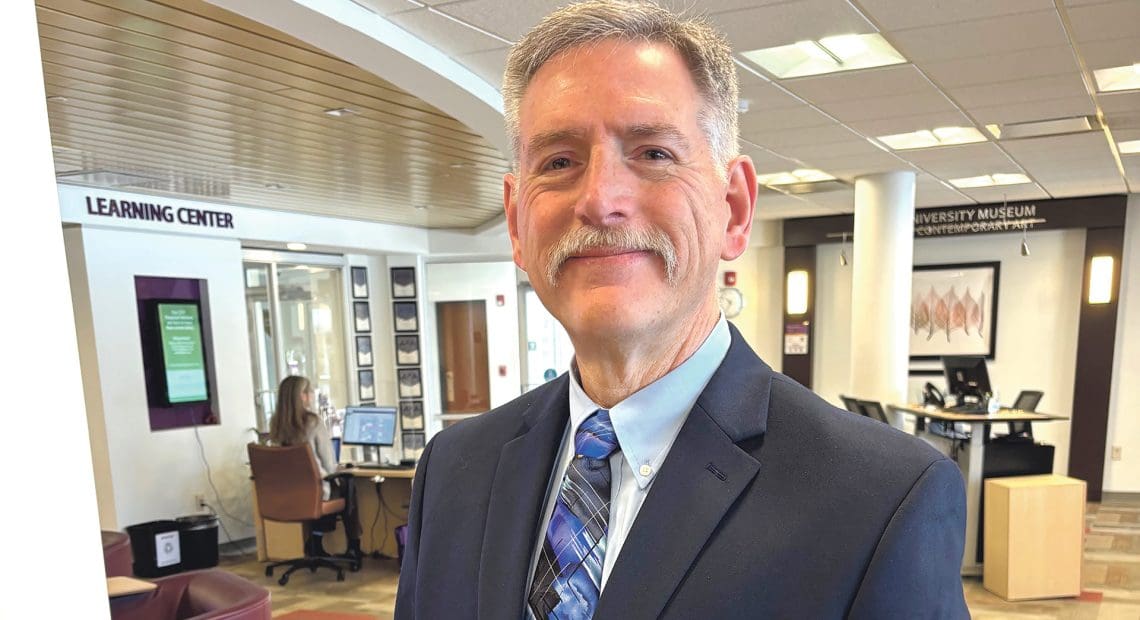
From left, Heather Roy, marketing and communications specialist; D’Lynn Healey, project executive; Bryan Hughes, president; and Ed Ackley, general superintendent.
Bryan Hughes says Western Builders has marked its 50th anniversary in several different ways — from a gathering of employees and their families at a local restaurant,to postings on social media celebrating both employee and company milestones, to a new, temporary logo marking the occasion.
And there’s more to come, with a larger gathering slated for September at the company’s Granby headquarters for employees, clients, subcontractors, and more.
But in many ways, it’s been business as usual for this construction firm, which is not the same thing as business as it was done in 1975, or even 2005.
“In decades past, business was generally done with a handshake,” said Hughes, who took over as company president in 2022. “And the new way of delivering a project is more managerial in a sense; when people come to Western, they’re paying for a partnership in solving problems, forecasting challenges, and addressing them.”
Creating more value for clients is just one of the focal points for Hughes and the leadership team at Western, a subsidiary of the O’Connell Companies.
“In decades past, business was generally done with a handshake. And the new way of delivering a project is more managerial in a sense; when people come to Western, they’re paying for a partnership in solving problems, forecasting challenges, and addressing them.”
Overall, the company is in a growth mode — let’s call it a controlled growth mode — fueled by several factors, but especially the region’s (and the state’s) housing crisis. Indeed, many of the firm’s current projects involve initiatives to address an extreme shortage of housing, especially within the affordable category. These include:
• Phase 2 of South Holyoke Homes, a modular construction project led by the Holyoke Housing Authority that features single-family homes and duplexes;
• Baskin West Main Residences, a 105-unit, mixed-income apartment complex being undertaken by Brisa Builders Development;
• Amethyst Brook Apartments, an affordable housing community in Pelham being undertaken by Home City Development; and
• An expansion of Clinical & Support Options’ Friends of the Homeless campus on Worthington Street in Springfield, a 23,974-square-foot facility that will provide critical shelter and supportive housing to individuals experiencing chronic homelessness.
Meanwhile, several projects completed recently involve housing — everything from East Gables, an affordable housing project on Northampton Road in Amherst undertaken in collaboration with Valley CDC, to Aspen Heights, a student housing apartment facility, also in Amherst.
The housing crunch is not a problem that will be solved quickly or easily, said Hughes, adding that this reality should provide ongoing growth opportunities for a firm that has made its mark in that arena.
“The way the crisis is described to us by local, state, and federal officials is that it will be a never-ending challenge to overcome,” he noted, adding that, as the Commonwealth and local agencies ranging from Way Finders to Home City Development address the crisis, Western will have opportunities to not only do more work in the 413, but expand its service radius as well.

Among the many projects in the Western Builders portfolio is renovation work at the Naismith Memorial Basketball Hall of Fame. (Photo by Red Skies Photography)
“We definitely have a local edge, with local subcontracting partners and local relationships and clientele — that’s why we’re Western Builders, because we typically stay in Western Mass.,” Hughes explained. “But part of the future vision of the company is to push the limits there a little bit, because the housing crisis isn’t limited to Western Mass.
“Moving forward, we want to grow the company at a comfortable clip — we want to be able to sustain our methods and our confidence in ourselves,” he went on. “But I think we’re ready to take on more.”
Any firm marking 50 years has survived many kinds of challenges, and that’s true of Western as well, which has weathered downturns and a Great Recession, but also a pandemic and ongoing workforce issues, including the need to replace the many talented workers approaching, or already at, retirement age.
Like other firms, it is taking a proactive approach to the problem, as we’ll see, promoting the trades and getting young people involved early, giving them a taste of the work as well as the financial rewards and relative stability of the sector.
For this issue and its focus on the building trades, we’ll look at the first 50 years for Western Builders and what will likely come next at a time when some golden opportunities are emerging.
Firm Commitment
Tracing the history of the firm, D’Lynn Healy, project executive, said it was created by O’Connell to work with the company’s development group and also with local private colleges and development companies.
And from the beginning, diversity, in all its forms, has been perhaps the company’s strongest suit.
Indeed, while it’s perhaps best known for wood-frame construction — as seen in projects ranging from phase 1 of Glenmeadow in Longmeadow to transformation of the former Yankee Pedlar in Holyoke into a PeoplesBank branch; from River Mills Assisted Living in Chicopee to restoration of the historic Gaylord mansion on the Elms College campus — it has worked with stone and steel as well.
Indeed, the portfolio includes projects like Way Finders’ new home in downtown Springfield, the Educare early learning facility, also in Springfield, and renovation work on the Naismith Memorial Basketball Hall of Fame, including refurbishment of the sphere, which involved removing thousands of fiberglass panels and resurfacing them, but also extensive interior renovations.
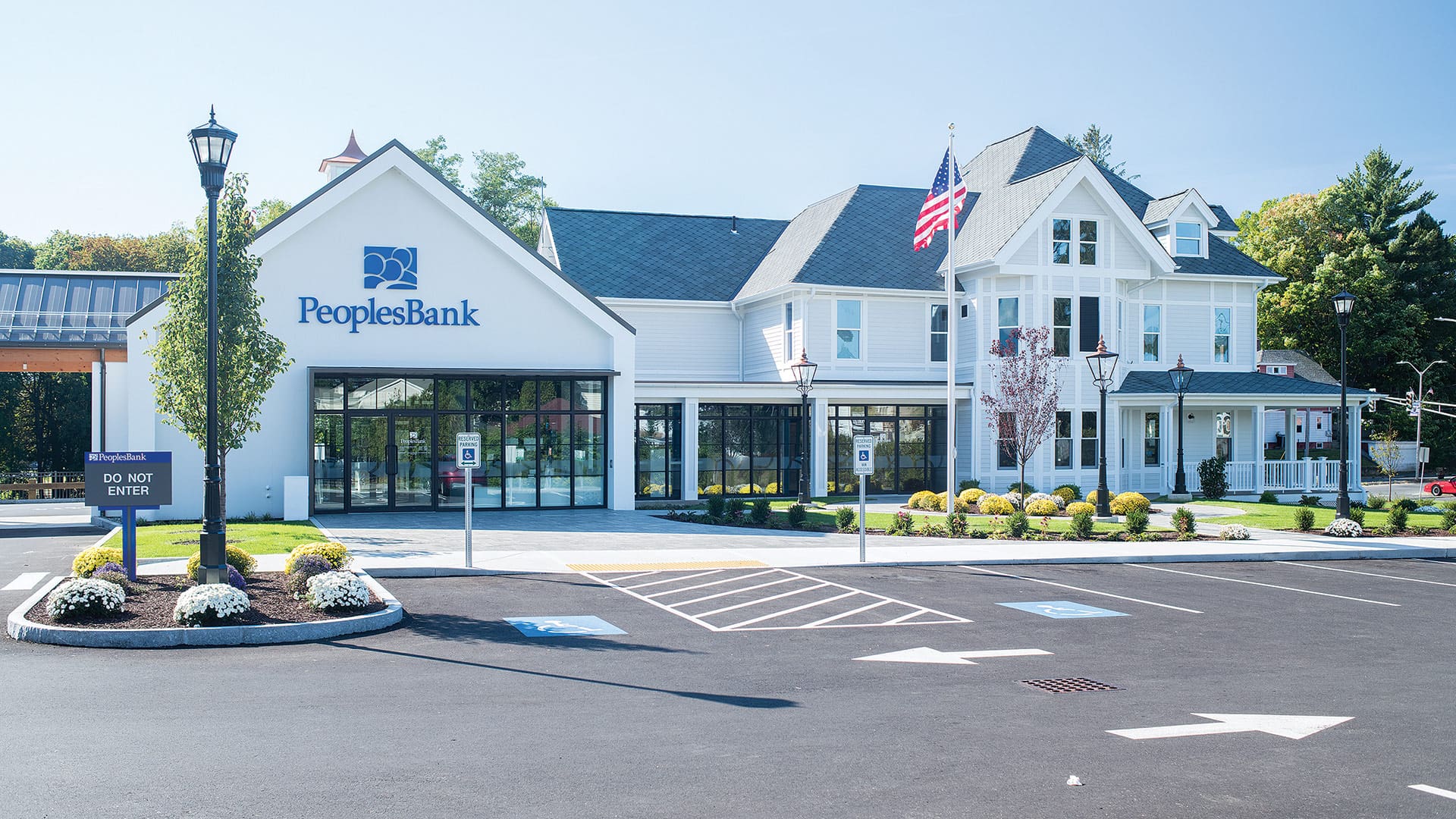
The PeoplesBank branch in the former Yankee Pedlar in Holyoke. (Photos by Red Skies Photography)

Work in the Health Sciences building at American International College (right) showcase the diversity of projects in the Western Builders portfolio. (Photos by Red Skies Photography)
Beyond diversity with materials, the company has worked in several sectors, including public and private clients, new construction as well as renovations, such as at Elms College, and different realms, everything from housing to the new Phoenix Academy Public Charter School at the Springfield Technology Park, to emergency renovations to the Courniotes Building at American International College (AIC) after a fire there.
“Our focus can remain in housing, but we want to emphasize diversity,” Hughes said. “We’ve won some hard-bid projects for public work, which has helped us diversify in our project types. We’re back at some institutions, like AIC and Smith College, building on existing relationships.”
Signature projects over the past five decades, and there are many, include work with O’Connell Development to build a new 152,000-square-foot, LEED-certified manufacturing facility and corporate headquarters for L3Harris Integrated Mission Systems/KEO, formerly Kollmorgen, at the site of the former Northampton State Hospital; the Educare facility, considered state-of-the-art in that sector; the work at the Hall of Fame; the new Girls Inc. headquarters in Holyoke, located, ironically, in the former home of the O’Connell Companies; and the Holyoke Crossing retail facility in Holyoke, another project where O’Connell Development was the client.
Today, Western is doing far less for O’Connell and much more with a growing list of clients, many of them involved with housing, including Way Finders, Valley CDC, Home City Development, and others.
A common denominator is repeat business, said Healey, adding that clients such as Way Finders, American International College, PeoplesBank, and others have turned to Western for several different undertakings.
“A lot of clients are repeat clients that we’ve worked with,” she explained, adding that one of the firm’s strengths is relationship building. “When these clients have another project, they reach out to us.”
And much of this repeat business stems from the firm’s ability to create value and effectively manage projects, as Hughes mentioned earlier.
“It used to be … construction was definitely a ‘work-harder industry,’” Healey explained. “Now, we’ve finally acquiesced and realized that we have to work smarter and not just harder. You have to be strategic, and you have to plan — you have to make sure that you have everything lined up before you start working.”
Building Relationships
As noted earlier, housing has become a major focal point for Western over the past few decades as need grows and agencies take imaginative steps to address it. And the company has several projects in this realm in various stages of development.
Amethyst Brook should be fully occupied by the end of this month; the projects in Chicopee (Baskin West Main Residences) and Springfield (expansion of the Friends of the Homeless complex) are in early-stage work, while the Holyoke initiative is moving toward completion, with the Holyoke Housing Authority now running commercials urging people to enter the lottery to purchase those homes.
That Holyoke project represents a first — working with modular construction, said Hughes, adding that it has been a learning experience.
“Boxes are prefabricated in Pennsylvania and shipped to Holyoke and put together as side-by-side townhomes,” he explained, adding that the process significantly streamlines the timeline for construction.
“It’s nice to see an emphasis on the trades. You see commercials about it, you hear the unions talk about it, the non-unions talk about it … anyone in the trades can be, if they want to apply themselves, as successful as someone who wound up with a giant college loan that they have to pay back and may or may not be able to work in the field they trained for.”
Meanwhile, many initiatives, including one of the buildings at Amethyst Brook as well as East Gables in Amherst, involve what’s known as passive housing, a voluntary standard for energy efficiency in a building that has surpassed LEED as the cutting edge in that realm.
“There are more passive houses in development and pre-construction because that’s the popular trend moving forward with energy efficiency and sustainability, which is what clients want,” Hughes said. “But there’s also a code aspect — client developers need to meet the Massachusetts Stretch Energy Code, which is one of the most stringent in the country.”
Beyond housing and the growth opportunities it presents, the company has been focused on relationship building — continuing long-standing partnerships and forging new ones — and also on perhaps the biggest issue facing this sector — maintaining a workforce.
Indeed, since arriving at Western, Hughes said one of his priorities has been to generate interest in the field among the younger generations.
He cited several initiatives, including work with Dean Tech High School in Holyoke, hiring co-op students to work for the company part-time at job sites while also attending school.
“It’s been cool to see that youthful excitement about construction,” he said, adding that, by exposing young people early to the lifestyle and opportunities the trades create, the firm is helping to put more future workers into the pipeline.
Ed Ackley, the company’s long-time general superintendent, agreed.
“The workforce is aging, and it’s retiring out,” he said. “So one of things we’ve been doing is trying to attract young people as project managers and assistant superintendents in hopes that they can gain experience, so by the time they become a super, they’re as effective as the seasoned personnel we have now.
“It’s nice to see an emphasis on the trades,” Ackley went on. “You see commercials about it, you hear the unions talk about it, the non-unions talk about it … anyone in the trades can be, if they want to apply themselves, as successful as someone who wound up with a giant college loan that they have to pay back and may or may not be able to work in the field they trained for.”
And, unlike jobs in many other fields that face uncertain futures with advancing technology, including AI, those in the trades are relatively secure, Hughes told BusinessWest. “You can’t ask ChatGPT to build a masonry wall.”